Tag Archives: idea management

The Innovation Management Process: A Practical Guide

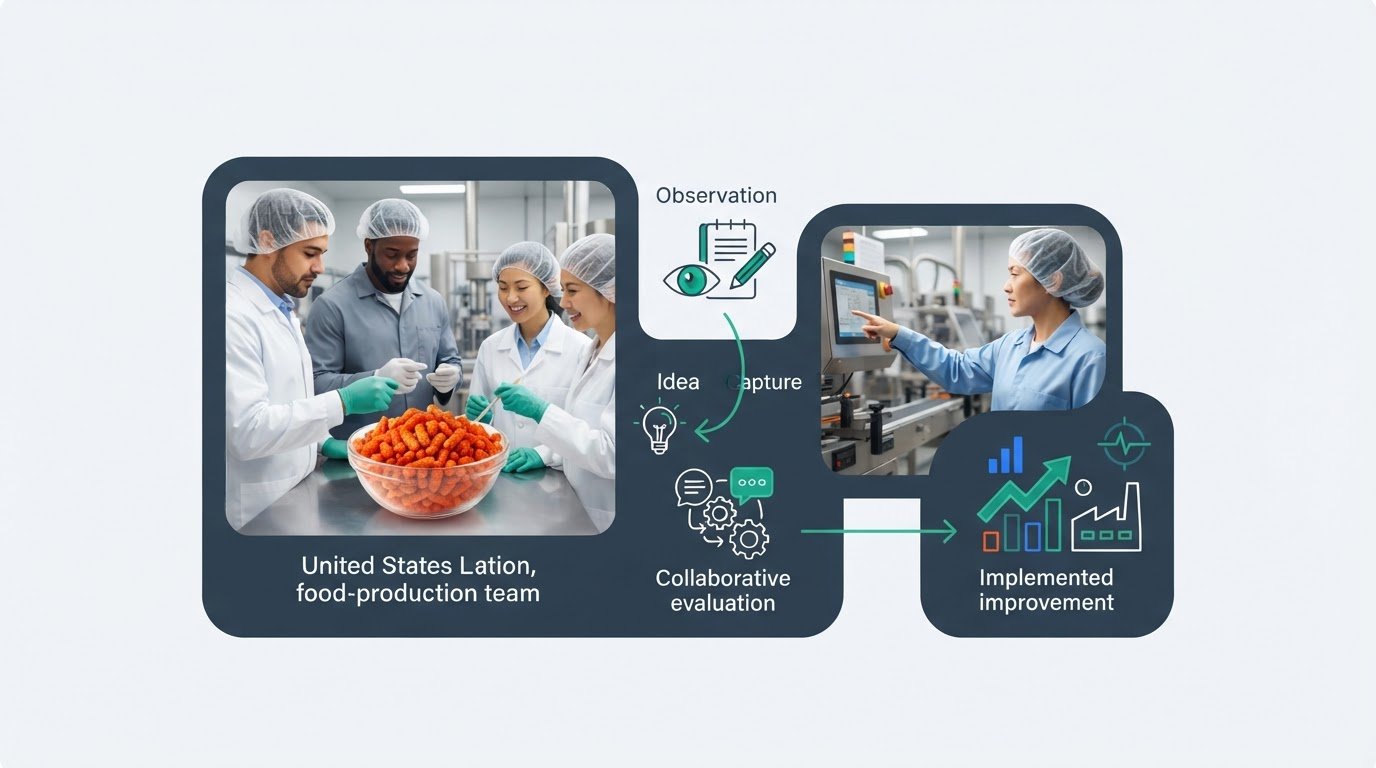
Transit employees evaluate and advance improvement ideas on an innovation management dashboard at a bus depot
Coby Skonord|
November 20, 2026

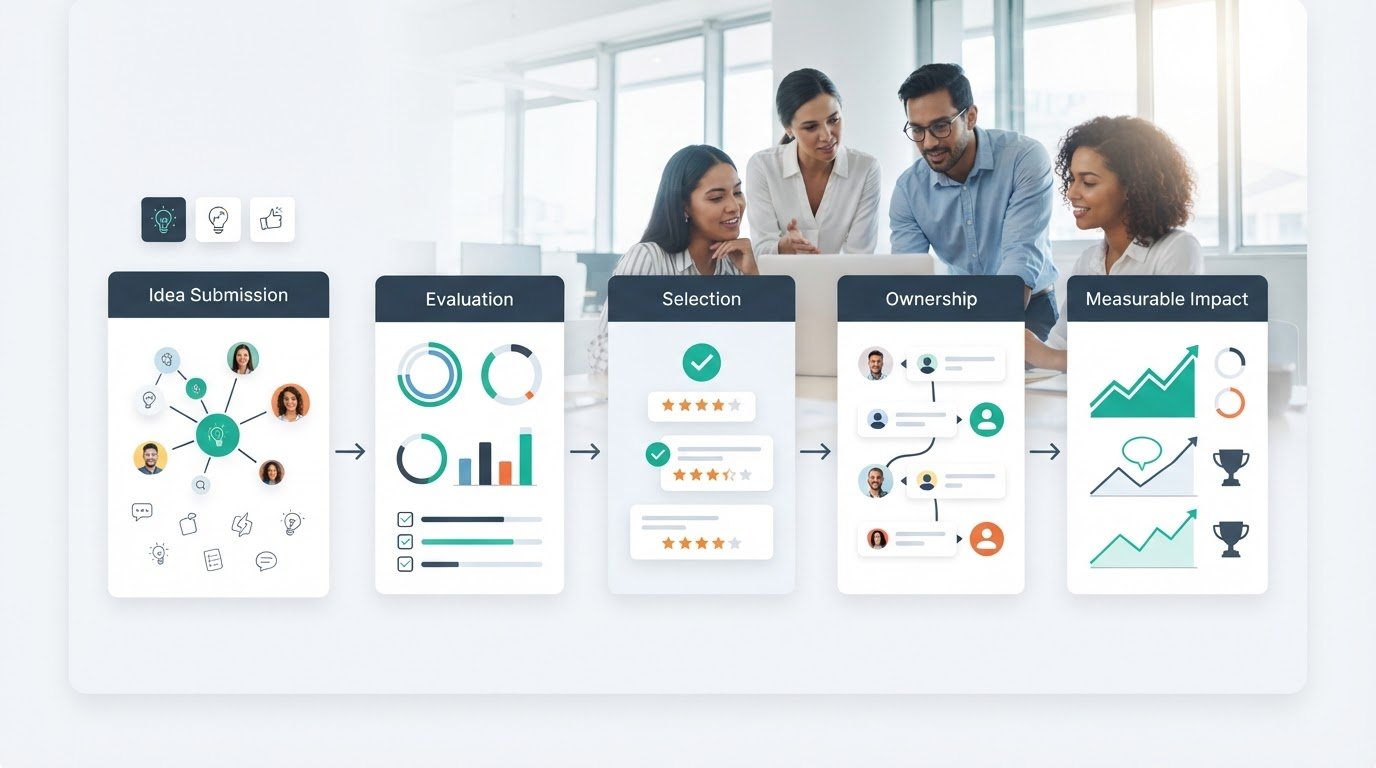
At a large organization, innovation rarely stalls because people lack ideas. It stalls when there’s no clear path from idea to launch. An innovation management process provides that path, moving ideas from generation through evaluation and development to implementation and market introduction.

That structure matters because enterprise innovation must connect promising ideas to business priorities without shutting down experimentation. You’ll learn what innovation management involves, how organizations collect and assess ideas, and how selected concepts move toward launch. This guide also explains how large organizations coordinate teams, decisions, and portfolios so innovation becomes repeatable rather than a collection of disconnected projects.

Key Takeaways

  • Use clear evaluation criteria to compare ideas, surface risks early, and decide what should advance, pause, or be saved for later.
  • Combine focused innovation challenges with ongoing idea submissions to capture both strategic opportunities and frontline insights.
  • Move selected concepts toward launch through staged development, testing, coordinated implementation, and feedback.
  • Track both early activity and business outcomes so innovation measures progress, not just the number of ideas collected.
  • As innovation scales across a large organization, align governance and portfolio decisions with enough flexibility for teams to experiment.

Evaluating, validating, and launching ideas

Selection turns a broad set of ideas into projects with a clear path forward. Leaders need consistent criteria, evidence from validation, and launch plans that connect decisions to execution.

Idea Evaluation and Selection Criteria

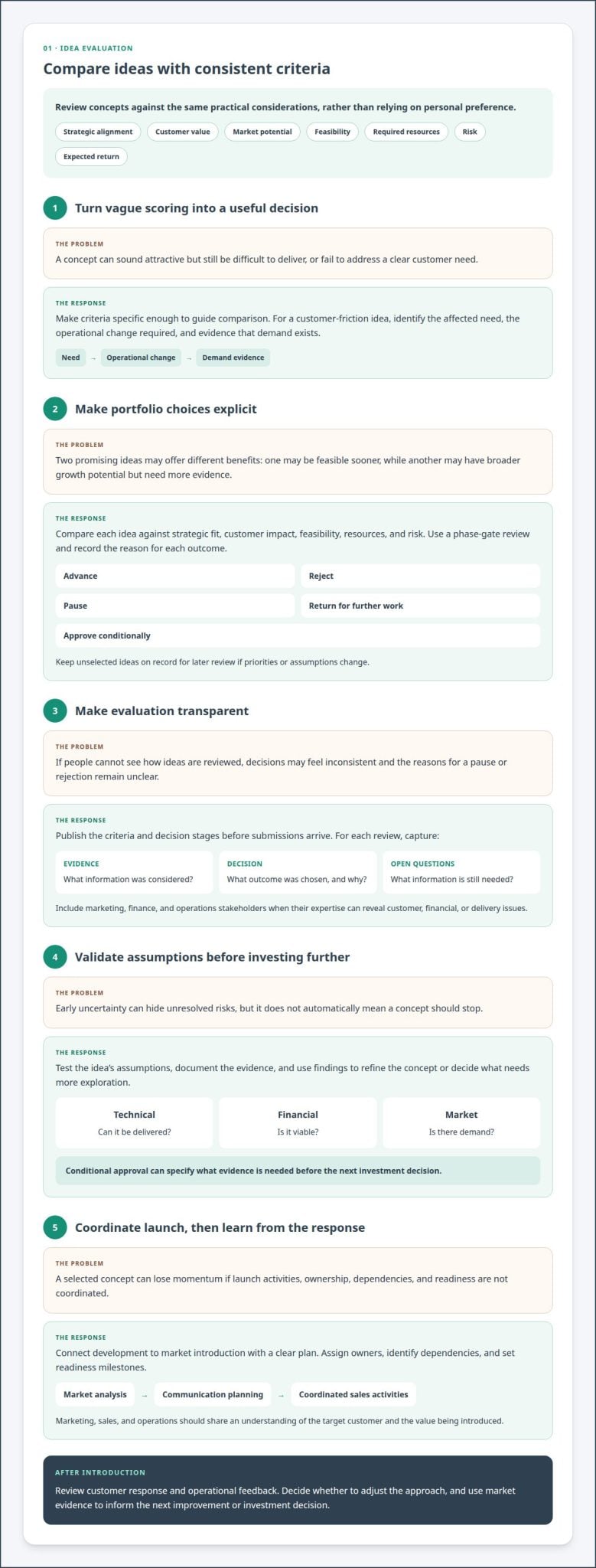
Idea evaluation and selection criteria are the standards used to compare concepts before committing resources. A practical review considers strategic alignment, customer value, market potential, feasibility, required resources, risk, and expected return. Together, these criteria help leaders distinguish promising ideas from attractive concepts that may be difficult to deliver.

Make the criteria specific enough to guide a decision. For example, a concept intended to reduce customer friction should identify the affected customer need, the operational change required, and the evidence that demand exists. A structured idea evaluation process helps reviewers apply the same questions across projects instead of relying on personal preference.

Prioritizing Innovations

Prioritizing innovations means comparing validated ideas with business goals and available capacity, then deciding which should advance. A phase-gate review gives each concept a decision point: advance, reject, pause, return for further work, or approve conditionally. Record the reason for each outcome and define the next step.

Consider two proposals: one improves an existing customer process, while another explores a new market. The first may be feasible sooner; the second may offer broader growth potential but need more evidence. Compare both against strategic fit, customer impact, feasibility, resources, and risk. Keep unselected ideas on record for later review, especially if priorities or assumptions change.

Transparent Evaluation Protocols

Transparent evaluation protocols explain who reviews ideas, which criteria apply, and how decisions are recorded. Publish the criteria and decision stages before submissions arrive. For each review, record the evidence considered, the decision and its rationale, and any information still needed.

Involve marketing, finance, and operations stakeholders when their expertise can reveal customer, financial, or delivery issues. For example, an operations reviewer can identify a workflow constraint before a concept enters development. Consistent records also help employees understand why an idea advanced or paused, supporting experimentation while preserving accountability.

Validate Before Investing Further

Validation tests an idea’s assumptions before a team commits to broader development. Examine technical feasibility, financial viability, and market demand, then record the evidence behind each conclusion. A customer-facing concept, for example, may need evidence of demand alongside an assessment of how it can be delivered.

Use the findings to refine the concept, identify unresolved risks, or return it for further exploration. Conditional approval can specify what evidence is needed before the next investment decision. This keeps the innovation management process evidence-led without treating early uncertainty as an automatic reason to stop.

Coordinate the Launch

A launch plan connects development to market introduction through market analysis, communication planning, and coordinated sales activities. Assign an owner to each activity, identify dependencies, and set readiness milestones. Marketing, sales, and operations should share an understanding of the target customer and the value being introduced.

Before launch, confirm that customer-facing messages reflect the tested value proposition and that delivery teams can support the offer. After introduction, review customer response and operational feedback, then decide whether to adjust the approach. Evaluation does not end at launch: market evidence informs the next improvement or investment decision.

Collecting employee ideas through challenges and open submissions

Employee ideas can come through focused challenges or an always-open channel, providing both targeted and unsolicited input. Common risks include vague prompts, low participation, duplicate submissions, biased screening, and ideas that receive no feedback or ownership.

Ideas-First and Needs-First Approaches

An ideas-first approach starts with a proposed solution, while a needs-first approach starts with a problem employees or customers experience. The distinction matters: a clever suggestion can miss the underlying need, while a clearly defined problem gives contributors room to explore different solutions.

Use open submissions to capture ideas employees notice in everyday work, then ask what problem each addresses. For example, a warehouse employee might suggest a new scheduling tool; follow-up could reveal that shift handoffs, not scheduling, cause delays. Focused challenges work well when leaders can define a need, such as reducing handoff errors or simplifying a service step.

A strong culture makes room for both approaches. Challenges create a shared focus, while open submissions can surface improvements beyond current priorities. Explain the challenge’s purpose, who can contribute, and how ideas will be reviewed. This helps employees connect their experience to organizational needs without forcing every suggestion into a predetermined solution.

Crowdsourced Feedback on Ideas

Crowdsourced feedback gathers reactions, refinements, and expertise from a group of employees rather than leaving screening to one reviewer. It matters because colleagues in different roles may identify implementation barriers or customer effects that the original contributor cannot see.

For useful feedback, present the problem, proposed idea, and specific prompts together. Ask colleagues to identify likely benefits, risks, missing information, or alternatives. A frontline employee may spot a workflow issue, while a customer-facing colleague may flag an unmet need. Make commenting and voting part of a clear evaluation process, not a popularity contest.

Advocacy can strengthen an idea’s case when supporters explain their reasoning and relevant experience. Still, leaders should distinguish enthusiasm from evidence. A screening step can group duplicates, clarify incomplete submissions, and route ideas to people with relevant knowledge. A structured employee ideation program can make participation and feedback part of ongoing improvement.

Recording and Sharing Ideas

Recording ideas means keeping each submission in a shared, searchable record with enough context for follow-up. Without one, ideas can disappear in email threads, meeting notes, or isolated forms, leaving teams unable to revisit useful suggestions.

Capture the problem, proposed change, affected team or customer, expected benefit, and supporting details. Add a status and owner so employees can see whether an idea needs clarification, is under review, or has moved forward. Share submissions with relevant colleagues, keeping discussion focused on useful feedback and next steps.

For example, a facilities team could record a recurring equipment issue and invite staff to suggest ways to reduce disruption. Related submissions can be grouped, discussed, and retained even if no immediate project proceeds. Close the loop by communicating decisions and reasons; otherwise, silence can weaken participation. To see how a digital approach can support this work, explore a guided platform walkthrough.

What is the Innovation Process?

The innovation process moves a concept from a defined opportunity toward development, implementation, and adoption. It gives teams a practical route from strategic intent to action.

Organizations fund and resource innovation projects by aligning them with strategic priorities, assigning people and budget, and releasing additional resources as evidence supports progress. Internal teams, external partners, and staged investment can each contribute, depending on a project’s needs.

Innovation Strategy Development

An innovation strategy defines the opportunities an organization will pursue, the outcomes it wants, and the capabilities it can commit. It matters because leaders must balance near-term improvements with longer-term concepts that could open new markets.

Start by connecting innovation goals to business priorities, such as improving customer experience or operational efficiency. Then clarify which teams, expertise, and funding can support each goal. A portfolio can combine incremental improvements with more exploratory projects, helping leaders avoid spending all available capacity on one kind of opportunity. The distinction between incremental and radical innovation can help frame that balance.

Concept Development and Prototyping

Concept development turns an opportunity into a defined proposal, while prototyping creates a simple representation that supports learning. These steps help teams expose unclear assumptions before committing to full development.

A product concept should identify its intended user, the problem it addresses, and the value it offers. A team exploring a faster service handoff, for example, might sketch the revised workflow before building new systems. Depending on the concept, a prototype could be a sketch, digital simulation, or physical model. Keep it focused on the question the team needs to answer, such as whether users understand the new process.

Concept Testing

Concept testing evaluates assumptions with relevant users, stakeholders, or operational evidence before broader implementation. It helps reveal whether a proposed benefit matters and whether delivery conditions support it.

Choose a test that matches the uncertainty. A customer-facing concept might be assessed through user reactions to its value proposition; an internal process change might be tried with the employees who do the work. Record the response, assumptions tested, and resulting changes. If findings expose a gap, refine the concept and test again rather than treating early feedback as a final verdict.

Innovation Development and Implementation

Development and implementation turn a tested concept into an operating product, service, or process. Even a strong concept needs clear ownership and coordinated delivery to create practical value.

Build an implementation plan that connects development tasks to people, resources, milestones, production needs, and launch activities. For a new service, operations may prepare delivery workflows while marketing develops customer communications. External partners can contribute needed capabilities, with responsibilities agreed before work begins. Track dependencies and unresolved risks, then coordinate the launch across relevant teams. After implementation, use customer and operational feedback to guide improvements and further development.
The Innovation Management Process: A Practical Guide

What is innovation management?

Innovation management connects initiatives to evidence, learning, and measurable outcomes. Common frameworks include Lean Startup’s build-measure-learn loop, design thinking, stage-gate reviews, roadmapping, and idea management.

Innovation Performance Measurement

Innovation performance measurement tracks whether innovation work produces learning and business outcomes. Idea counts alone cannot show whether initiatives solve customer problems or improve operations.

Choose measures that fit each initiative’s goal. A service improvement might track customer satisfaction and process quality, while a new offer might track adoption, revenue growth, or time-to-market. Compare results with the initiative’s original objective, not an unrelated portfolio target.

Review measures at decision points, including after launch. If adoption is weak, examine customer feedback, implementation barriers, and original assumptions before deciding whether to adjust or stop. A consistent approach to measuring innovation programs helps leaders connect project evidence with portfolio outcomes.

Input and Output Metrics

Input metrics measure the resources and activity committed to innovation; output metrics measure what those efforts produce. Track both, because high activity does not automatically mean successful results.

Inputs can include employee participation, ideas submitted, experiments completed, and resources assigned. Outputs can include concepts advanced, projects launched, customer response, revenue growth, or operational improvements. For example, strong participation but few tested concepts may signal a bottleneck between collection and evaluation.

Pair each input with a relevant output, then review the relationship over time. If experiments increase but customer learning does not, teams may need better test questions. If launches occur but adoption remains limited, examine whether the offering addresses an important need. Metrics should prompt investigation, not reward activity without impact.

Innovation Management Tools and Frameworks

Innovation tools and frameworks organize idea capture, experimentation, decisions, and learning. Choose them to fit the uncertainty and delivery needs of each initiative.

Lean Startup uses a build-measure-learn loop: build a testable version, measure how people respond, and use feedback to decide what to change. A team testing a new service feature could release a limited version, observe customer use, and refine the concept. The loop is iterative, allowing teams to revisit assumptions instead of treating a launch as proof of success.

Design thinking helps teams investigate user needs and develop potential solutions. Stage-gate reviews structure decisions between project phases, while roadmaps connect initiatives to strategic priorities. Idea management supports collecting and tracking proposals. Choose a framework based on the challenge: uncertain customer demand calls for testing and learning; a defined operational improvement may need milestones, owners, and delivery measures.

Innovation management in large organizations

Large organizations need shared priorities without centralizing every experiment. Governance, portfolio oversight, and clear ownership connect ideas generated across departments to organization-wide goals.

Accenture reported that 96 percent of executives said long-term success depends on developing new ideas. Accenture also found that 82 percent of respondents did not distinguish meaningfully between significant innovation and incremental performance gains. Its research further reported that 72 percent of companies let innovations languish without a formal process or organizational home. These findings point to a coordination challenge: ideas need sponsors, resources, and decisions. Accenture’s innovation research highlights the need to connect ambition with execution.

Give each initiative an accountable owner and a route to decision-makers. A central innovation lead can coordinate portfolio priorities, while business units assess operational fit and contribute expertise. For example, a customer-service suggestion may need input from operations, IT, finance, and customer-facing teams before it becomes a funded project.

Set governance around decision rights, not layers of approval. Define who can sponsor an idea, assess its fit, allocate resources, and pause work when evidence changes. Use stage reviews for investment decisions, but keep early exploration lightweight. Standardize records and reporting while allowing teams to test solutions suited to their work.

Portfolio oversight helps leaders balance near-term improvements with longer-term opportunities. Review initiatives together, considering strategic fit, expected outcomes, resources, and dependencies. If technology changes customer expectations, revisit priorities instead of protecting projects simply because they already have support. Stopping work that no longer fits frees capacity for stronger opportunities.

Culture matters too. A study by Strategyn involving 393 innovation leaders found recurring innovation problems across nearly every organization studied. Leaders can address ambiguity by defining each initiative’s intended scope and outcome. An operational efficiency project and a new-market exploration effort may both matter, but they need different evidence and review criteria.

Make participation practical across locations and roles. Invite employees to contribute through challenges and ongoing channels, then communicate decisions and next steps. Innovation Leader reported that over 82% of executives in large organizations surveyed had used the Lean Startup Methodology in some way. Experimentation can support learning, but enterprise teams still need clear ownership to turn learning into coordinated action.

For large organizations, the key is to centralize priorities and accountability while distributing exploration and learning. A consistent framework should make it easy to see who owns each initiative, what evidence supports it, and where the next decision lies.

Ideawake

Ideawake offers a cloud-based platform for collecting, evaluating, and implementing ideas. It may be relevant when employee, customer, or partner ideas are spread across teams and need a defined path into innovation initiatives. Its Innovation Management Platform and Idea Management Platform cover stages of the innovation lifecycle, alongside Continuous Improvement and Ideawake AI.

For large organizations, a shared platform can provide a place to capture proposals, involve contributors in evaluation, and track ideas as they progress. Voting, leaderboards, and prizes are possible ways to encourage participation, while structured workflows can help teams handle ideas consistently. These capabilities can support focused innovation efforts as well as ongoing improvement.

Contact Ideawake to discuss whether its platform fits your organization’s innovation processes.

Make the next decision count

Put your innovation management process to work by choosing one business priority that needs fresh thinking. Name an accountable sponsor, define the decision the initiative should inform, and agree on what evidence would justify moving forward. This creates a focused starting point without requiring the entire organization to change at once.

Then make learning visible. Give teams a clear way to share progress, surface barriers, and explain what they need from decision-makers. A useful review helps leaders decide whether to continue, adjust, or redirect effort. That discipline makes innovation a leadership practice, not a side project competing with everyday work.

Ideawake supports organizations with an Innovation Management Platform, an Idea Management Platform, and Continuous Improvement capabilities. If you’re ready to discuss how these offerings could support your organization’s priorities, take the next step.

Start with a meaningful opportunity, learn from the work, and build from there. Progress begins with a decision your teams can act on.

Frequently Asked Questions

Where is the Phase-Gate process used?

Phase-Gate is used to manage projects that need staged reviews and investment decisions. Organizations can apply it to product development or operational improvements when work can be divided into stages with evidence reviewed at each decision point. A team may advance a concept, pause it for more evidence, recycle its assumptions, or stop it. The approach is most useful when leaders need explicit control over commitments and clear accountability at each gate.

What is the innovation management process?

The innovation management process is the coordinated way an organization develops promising ideas into implemented changes. It connects opportunities to business priorities, assigns ownership, and gives teams a way to learn from evidence. For example, an operations leader could use it to move a recurring service issue from employee observation to a tested process change. Its value lies in making innovation work visible and actionable, not merely collecting suggestions.

What are the key stages of an innovation management process?

Key stages typically include generating ideas, selecting and evaluating them, developing concepts, implementing solutions, and introducing them to users or markets. Teams may revisit stages when new evidence changes an assumption. For example, customer feedback during a limited release could send a concept back for refinement. The sequence gives leaders a shared map while allowing initiatives to move at different speeds based on uncertainty and delivery needs.

How do organizations generate and prioritize innovation ideas?

Organizations generate ideas through employee submissions, focused challenges, customer input, and collaboration with external partners. To prioritize them, leaders can compare each proposal with strategic goals, customer or operational needs, feasibility, resource demands, and potential risk. For example, a service team may rank suggestions by how directly they address a recurring customer problem. Keep lower-priority proposals on record so teams can reconsider them when conditions or priorities change.

How do companies evaluate the feasibility and business value of innovations?

Companies assess feasibility by examining whether a concept can be delivered with available technical capabilities, operational capacity, and resources. They assess business value by considering strategic fit, customer benefit, market demand, and expected returns. A proposal to simplify a service process, for instance, should address both user value and the team’s ability to implement it. Record assumptions separately from supporting evidence so decision-makers can identify what still needs testing.

How are innovation projects tested, developed, and launched?

Teams test a project’s riskiest assumptions using a method suited to the concept, such as a sketch, simulation, pilot, or limited release. They use feedback to refine requirements before broader development. During implementation, assign owners for delivery, operations, and communications. Before launch, confirm that the product or process is ready for its intended users. Afterward, review actual use and feedback to identify adjustments, support needs, or further opportunities.

What metrics measure innovation management performance?

Useful measures connect innovation activity to learning and outcomes. Input indicators can include participation, submissions, experiments, and resources committed; output indicators can include concepts tested, projects implemented, customer response, time-to-market, revenue growth, or operational improvement. Select measures based on each initiative’s objective. For example, a process-improvement effort should track its targeted operational result, not rely only on how many ideas employees submitted.

How does innovation management differ across industries and company sizes?

Innovation management varies with customer needs, operating conditions, project risks, and organizational structure. A manufacturer may emphasize production feasibility, while a service organization may focus on customer experience and workflow changes. Smaller organizations may coordinate decisions through fewer roles; larger enterprises often need clearer governance across departments. In either setting, adapt review steps and evidence requirements to the initiative while keeping ownership, decision criteria, and outcomes clear.

Article by

Coby Skonord

Coby Skonord is the co-founder and CEO of Ideawake. Since 2013 he has worked with enterprise innovation, continuous improvement, and HR leaders to turn employee ideas into measurable business impact.

How to Build a Kaizen Board for Continuous Growth

Warehouse employees use a digital kaizen board to assign and track continuous-improvement actions across shifts
Coby Skonord|
November 18, 2026

Improvement ideas lose momentum when nobody knows who owns the next step. A kaizen board makes improvement work visible, giving teams a shared way to capture opportunities, track actions, and record results.

Small, practical changes are easier to act on when employees can share what they notice in their daily work. The challenge is turning those observations into focused improvements instead of letting them disappear into a suggestion box or meeting notes.

This guide explains how to build a board that supports employee participation, surfaces waste, and moves ideas through a repeatable improvement cycle. You’ll learn what to include, how to prioritize and track actions, and how to choose between a physical and digital format.

The goal isn’t to add another display or dashboard. It’s to create a useful routine for making problems visible, assigning clear next steps, and learning from results.

Key Takeaways

  • Use a shared visual system to capture improvement opportunities, assign actions, and make progress visible.
  • Design ownership and updates to work across shifts and sites, so ideas don’t stall when teams can’t meet in person.
  • Give employees a clear route to raise problems and help reduce waste by testing practical changes in daily work.
  • Choose a physical or digital format based on where teams work and how they need to share updates and retain results.
  • Move improvement work through a repeatable cycle, and coordinate responsibilities, updates, and outcomes across teams.

What is a Kaizen Board?

A Kaizen board is a visual system for organizing continuous improvement, from identifying a problem to recording what the team learned. It gives employees a shared way to highlight opportunities, coordinate actions, and connect proposed changes with outcomes.

Its usefulness depends on how the team uses it. A display that only collects ideas doesn’t show whether anyone assessed, tested, or adopted them.

Kaizen Board Purpose

Kaizen means “change for better.” A board puts that principle into daily practice by helping a team capture a problem, agree on an action, and record the result. Each improvement item should clarify what is happening, where it occurs, and why the team considers it worth addressing.

For example, employees who repeatedly search for shared tools could record where delays occur and suggest changing how the tools are stored. The board supports investigation and follow-through, but it can’t replace a culture that encourages people to identify problems and learn from tests.

Board Setup and Operation

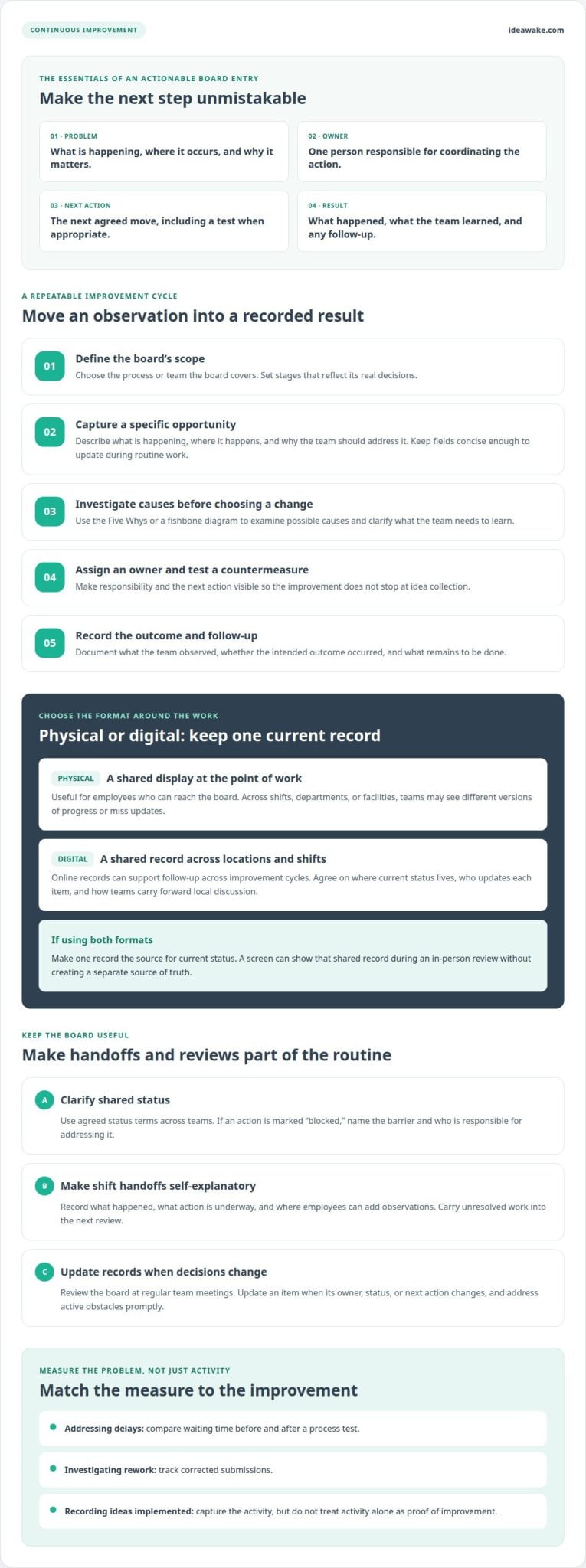
Start by defining the process or team the board will cover. Choose stages that reflect its actual decisions, then agree on what each entry needs: a problem statement, an owner, the next action, and a place to record results. Keep fields concise so employees can update them during routine work, not just formal reviews.

Next, select an initial opportunity and clarify what the team needs to learn. Members can use the Five Whys or a fishbone diagram to examine causes before choosing a countermeasure. Assign an owner to coordinate the test, then record the outcome and any follow-up. This provides a practical structure without forcing every issue into the same investigation.

Board Types and Differences

A Kaizen board tracks improvement efforts, while a Kanban board generally represents workflow. Teams may use Kanban-style stages to show how an improvement action progresses, but the goals differ: improvement work examines how to change a process, while workflow tracking shows how work moves forward.

A suggestion board primarily collects ideas. An improvement process adds evaluation, ownership, action, and a record of what happened. For instance, “reduce duplicate form entry” becomes actionable when a team identifies where duplication occurs, tests a revised handoff, and documents what it learned.

Reviews and Improvement Metrics

Review the board at regular team meetings, and update an item whenever its owner, status, or next action changes. Set the review rhythm to suit the work: address active obstacles promptly, while longer investigations can have planned check-ins. The key is keeping records current enough to support the next decision.

Choose measures linked to the problem. A team addressing delays might compare waiting time before and after a process test; a team investigating rework could track corrected submissions. Also record ideas implemented, but don’t treat activity alone as proof of improvement. For a structured view of Kaizen software use cases, consider how digital records can support follow-up across improvement cycles.

Limits of boards across shifts and sites

A physical board is visible only to employees who can reach it. Across shifts, departments, or facilities, teams may see different versions of progress, miss an action, or repeat work because updates arrive late. Teams working across locations should decide where the current status will be recorded before launching shared improvement work.

Common risks include unclear ownership, outdated cards, too many open actions, and layouts that teams interpret differently. Reduce these risks by assigning one owner per action, defining shared status terms, and carrying unresolved work into the next review. For example, a card marked “blocked” should name the barrier and who is responsible for addressing it.

Different shifts also need a workable handoff. A production employee may report a recurring equipment setup issue near the end of a shift, while the incoming crew needs enough context to continue the investigation. Record what happened, what action is underway, and where employees can add observations. Without those details, a visual display can become a noticeboard rather than a useful reference.

Across facilities, use a common structure without requiring every team to investigate the same problem. Agree on shared fields and status labels, then let each team describe its own process. A warehouse might document a material-flow obstacle, while an office team examines duplicate approvals. Shared terms make progress easier to understand, while local details keep each action relevant.

A mixed physical and digital system can create coordination problems of its own. If one team updates a wall display and another updates an online record, employees may not know which version reflects the latest decision. Agree on one record for current status, and define how local discussion updates will be transferred to it. A screen showing the shared record can support in-person reviews without creating a separate source of truth.

Standardization should preserve local context. A shared template can define an item’s owner, next action, and status while leaving room for site-specific observations. This helps prevent a central team from overlooking meaningful differences or treating identical labels as identical problems. During a cross-site review, ask what changed at each location and whether the intended outcome occurred.

When a team marks an action complete, it should also record the result and any remaining follow-up. Completion alone doesn’t show whether the change helped. A shift handover could note what the team tested, what it observed, and whether another crew needs to adapt the change. That record lets employees learn from previous work without relying on memory or having attended the same meeting.

For cross-site work, agree on who updates each item, how teams escalate blocked actions, and where completed work remains available for reference. A shared digital workflow can help teams coordinate these practices across locations. Explore a coordinated approach to distributed improvement work.

Employee engagement and waste reduction

Employees often see friction before leaders see its operational cost. A useful improvement routine gives team members a practical way to describe that friction, discuss its cause, and help test a change. The board supports participation when submitted ideas receive visible ownership and follow-up, not just acknowledgment.

Engagement depends on what happens after someone raises an issue. For example, a distribution team member may point out that frequently used supplies are stored far from the work area. The supervisor can record the observation, involve employees who do the task, and agree on a small test. Sharing the outcome, including a decision not to adopt the change, shows contributors that their input was considered.

For an enterprise team, improvement work should connect everyday observations to a clear next step. Ask the person closest to the task to describe when the problem occurs, who else is affected, and what makes the current process difficult. A short meeting can then distinguish symptoms from causes and identify an employee to help test a countermeasure. This keeps the discussion grounded in the work rather than assumptions.

Waste reduction starts with a specific example, not a broad demand to “work smarter.” A team can identify waiting, unnecessary movement, rework, or duplicated steps, then record one observable problem. During a meeting, members examine the current process, use the Five Whys to explore causes, and agree on a focused countermeasure. After testing it, they compare the relevant measure with the earlier condition.

Consider a service team that repeatedly enters the same customer details on separate forms. Team members can map where duplication occurs, identify which information is genuinely needed, and test a revised handoff. The test should capture intended effects and possible tradeoffs, such as whether the new step creates extra work elsewhere. An improvement idea earns broader adoption through evidence, not enthusiasm alone.

Use a simple response cycle to turn contributions into action:

  • Capture: Record the problem in the employee’s own words, with a concrete work example.
  • Discuss: Ask affected team members where the issue occurs and what observations support it.
  • Prioritize: Select an improvement idea based on its relevance, feasibility, and connection to team goals.
  • Test: Assign an owner and define what observation would show whether the change helped.
  • Share: Report the outcome and recognize contributors, including when a test changes or rejects the original proposal.

That routine makes employee input part of operational learning, rather than a separate suggestion channel. Clear participation practices can also strengthen employee ideation programs by connecting ideas to decisions, implementation, and reported outcomes.

How to Build a Kaizen Board for Continuous Growth

Physical and digital Kaizen boards

Choose a format based on where teams work and how they need to share updates. Both formats can support continuous improvement, but they differ in visibility, access, and recordkeeping.

Physical Kaizen Boards

A physical board puts improvement work where employees can discuss it during normal operations. Cards can move through stages such as opportunity, action, and complete, while dry-erase status circles or red, amber, and green indicators show progress. A team can update the display during a meeting, then use it to focus discussion on blocked actions.

Keep the layout readable from the team’s usual meeting point. Use one card for each improvement, with a concise problem statement, owner, next action, and result. Color-coded magnetic labels or status sliders can make changes visible without rewriting each card. For example, a production team could mark a countermeasure as blocked and discuss the barrier at its next huddle.

Physical displays work best when relevant employees can access them and someone keeps the information current. A board in one facility may not serve colleagues working remotely or on another shift. Teams should agree who updates cards after meetings and how completed changes will be shared beyond the room.

Digital Kaizen Boards

A digital format gives teams a shared record they can access across locations. Entries can keep meeting notes alongside improvement details, making decisions and outcomes available for later reference. Managers can view multiple boards remotely and respond to visible roadblocks without waiting for an in-person visit.

Digital layouts can be adjusted, saved, and duplicated when a team finds an arrangement that works. Notifications can keep participants informed as actions progress, while searchable records help teams revisit completed work. For example, a team could review an earlier test before making an incremental change to a similar process.

Digital access doesn’t guarantee useful participation. Teams still need clear owners, current records, and a review routine, or the board can become a stale database. A screen can also display a digital board in a shared workspace, combining face-to-face discussion with records that colleagues across locations can access.

Compare formats against the work itself: physical boards offer immediate local visibility, while digital boards support remote access and retained records. A hybrid approach can use a shared screen for team discussion and digital updates for cross-site coordination. In either format, track the operational measure tied to the improvement, such as rework or waiting, rather than treating card movement as proof of productivity gains.

Plan-Do-Study-Act and prioritization

Plan-Do-Study-Act (PDSA) gives teams a repeatable method for testing a change before adopting it more broadly. A board can make each cycle visible, from defining the problem to documenting what the team learned. This helps prevent a promising idea from going straight to rollout before its effects are understood.

Use the cycle to connect a problem with a documented decision:

  1. Plan: Describe the issue, the process it affects, the change to test, and the evidence the team will review. A charter can define the scope, participants, and intended outcome.
  2. Do: Test the proposed change in the relevant workflow. Record who performs each action and any practical obstacles.
  3. Study: Compare the observed result with the expected outcome. Include employee feedback and unexpected effects, not just the intended measure.
  4. Act: Adopt the change, revise it for another test, or stop it. Document the decision and assign any follow-up.

For example, a service team investigating incomplete handoffs could plan a revised checklist, test it with one workflow, and study whether required details are consistently transferred. If employees find the checklist unclear, revise it before expanding its use. Record the decision and rationale so the next team understands what was learned, rather than seeing only a completed card.

Prioritization matters when proposed changes compete for attention. Compare each idea against consistent criteria: its connection to team goals, the effect of the problem, the feasibility of a test, and the available evidence. A short decision record can explain why one item moves forward while another waits. Leaders can use idea management software to organize submissions and decisions beyond a local board.

Keep the active queue aligned with available capacity. If several actions depend on the same specialist or approval, record that dependency before assigning more work. The team can then address the constraint, clarify ownership, and bring blocked items to its next review. This makes prioritization an ongoing management practice rather than a one-time ranking exercise.

For a focused improvement event, a charter can frame the issue before the team records observations, root-cause analysis, countermeasures, and actions. Linking these tests to a wider continuous improvement process helps teams carry learning into future work. If you’re considering how to coordinate these cycles, contact Ideawake to discuss your improvement goals.

Ideawake

Ideawake helps organizations connect employee ideas with evaluation, ownership, and implementation. When a local board no longer provides enough visibility across teams or locations, Ideawake’s Idea Management Platform and Continuous Improvement offering can support a broader process for collecting and managing improvement work.

This is useful when leaders need to coordinate submissions, decisions, and follow-up beyond a single team’s physical display. Teams can retain the practical Kaizen cycle while giving employees a consistent way to contribute and track ideas across the organization.

Make Improvement Part of How Work Gets Done

A kaizen board creates more value when it connects local learning with wider organizational priorities. Decide how teams will share useful lessons, who can approve changes that affect other areas, and how leaders will make room for promising tests. These decisions keep employee-led improvement connected to operational goals without turning every small change into a lengthy approval process.

For organizations coordinating ideas across teams, Ideawake’s Innovation Management Platform supports the broader process of capturing, evaluating, and implementing employee ideas. Start with your current improvement priorities and the coordination challenges you need to solve. Keep the focus on making good ideas easier to act on, and let each completed cycle inform the next.

Contact Ideawake to discuss your improvement goals

Every practical change can reveal another opportunity to make work clearer, more effective, and easier for employees to improve. For entrepreneurs and real estate investors looking to refine their business systems and scale alongside experienced peers, The Boardroom Mastermind provides an elite community and educational platform for strategic growth.

Frequently Asked Questions

What Should the Record Hold for Each Improvement?

Record enough detail for someone outside the discussion to understand the improvement later. Include the problem’s location or process, the person who raised it, the current condition, the proposed change, an owner, the status, and supporting evidence. After testing, add the observed result, the decision to adopt or revise the change, and any follow-up. For example, attach a process note describing where a recurring delay occurs.

What does Kaizen stand for?

Kaizen is a Japanese word commonly translated as “change for better.” In work settings, it describes an approach focused on ongoing process improvements, rather than waiting for one large transformation. For example, a team might adjust how it organizes frequently used materials, then observe whether the new arrangement makes the task easier. The practice depends on learning from work and refining changes.

What is a good Kaizen example?

A good example targets a specific, observable source of friction and tests a practical change. Suppose a team repeatedly searches several folders for the latest procedure. It could agree on one shared file location, clarify how updates are labeled, and ask users whether the new method reduces confusion. Before making the new approach standard, the team should record what changed and what it learned, including any unintended problems.

What is a kaizen board and what is it used for?

A kaizen board is a visual aid for organizing improvement opportunities and follow-through. It helps a group see which issues have been raised, what work is active, and which changes are complete or need attention. For instance, a customer-service team could use one to coordinate a test of a revised response process. The board supports discussion and accountability, but team routines and follow-up drive improvement.

What columns and information should an improvement board include?

Use columns that match the team’s actual decision flow, such as “new opportunity,” “under review,” “testing,” and “adopted or closed.” Each item can include a short problem statement, affected process, submitter, owner, next action, status, and evidence of results. Add a reason when an idea is deferred or declined. This context helps employees understand decisions and prevents old items from returning without new information.

What are examples of improvement ideas for manufacturing and office teams?

Manufacturing teams might examine recurring label corrections, unclear tool storage, or avoidable movement between work areas. Office teams could investigate duplicate data entry, repeated approval requests, or confusion over document versions. Each idea should describe a specific occurrence, not a broad goal such as “improve efficiency.” Teams can then identify the affected step, gather observations, and decide whether a small test could address the underlying cause.

What are the best physical and digital tools for creating an improvement board?

The best format is one employees can update and use during their normal work. A physical display can use cards, magnets, and erasable markers for visible team discussions. Digital board software can help colleagues across locations access shared records and review changes remotely. A team working together in one location may prefer a wall display; a group working across multiple sites may benefit from a shared digital record or a combination.

How can teams prioritize improvement ideas and assign owners?

Compare ideas using consistent criteria: the problem’s effect on work, alignment with team priorities, feasibility of testing, and available evidence. Select an owner who can coordinate the next action, involve affected colleagues, and report findings. If another team controls a required approval or resource, record that dependency before work begins. Explain why an idea is selected, deferred, or declined so contributors understand the decision.

Article by

Coby Skonord

Coby Skonord is the co-founder and CEO of Ideawake. Since 2013 he has worked with enterprise innovation, continuous improvement, and HR leaders to turn employee ideas into measurable business impact.

Feature Request Software: How to Collect and Prioritize Customer Ideas

Customer advisory team sorting voted feature requests by impact and feasibility
Coby Skonord|
November 9, 2026

Votes can reveal demand, but they cannot set your roadmap. Feature request software gives teams a shared place to collect customer ideas, invite voting, and assess requests by user impact, feasibility, and other criteria. The goal is not to ship the most popular suggestion automatically. It is to understand what people need and make thoughtful, transparent decisions.

When feedback arrives through support conversations, sales calls, and scattered messages, patterns are easy to miss and expectations are harder to manage. A clear process brings requests together, lets customers support ideas that matter to them, and keeps discussion focused on real problems rather than vote counts alone.

This article explains how to collect useful requests, invite participation through voting, and prioritize ideas using practical criteria. You’ll also learn how to decline or defer a request respectfully, so customers understand the reasoning and know their feedback was considered.

Key Takeaways

  • Bring requests from different channels into one place, then capture the problem, context, and intended benefit behind each idea.
  • Use voting to surface shared interest, but weigh customer impact, strategic fit, and feasibility before setting roadmap priorities.
  • Make idea boards easier to use by guiding contributors toward clear, specific submissions and inviting them to support relevant requests.
  • When declining or deferring an idea, explain the decision and keep stakeholders informed as its status changes.
  • Choose a consistent process that helps teams turn customer input into informed decisions, not just a longer list of suggestions.

What is feature request software?

Feature request software gives teams a shared system to collect, review, and prioritize ideas for product changes. Requests might describe a usability problem, an integration need, or new functionality. For example, a customer may request bulk export because downloading records one at a time slows their workflow. The request explains the problem; the proposed feature is one possible solution.

There is no universal “best” request management tool. Compare options by submission methods, voting, status updates, reporting, and connections to existing systems. A support queue can organize incoming issues, while a public board lets customers find and vote on related ideas. A centralized system can bring feedback from these sources together for product review.

For context, Ideawake reports average participation rates of 50%-80%, compared with typical rates of 5%-15% with other tools, according to Ideawake. Its reported average increase in engagement scores is 10%, according to Ideawake. Ideawake reports that the top 5% of ideas drive 95% of new business results, according to Ideawake. These are company-reported figures, not a guarantee of results for every organization.

Use this comparison to narrow your approach before evaluating products:

Option Submission sources Voting and visibility Roadmap support
Shared spreadsheet Manual entry Limited without a review process Manual status tracking
Support-ticket queue Support conversations Organized around individual cases Useful for issue triage
Public idea board Customer submissions Visible ideas and community votes Can communicate request status
Central request system Multiple feedback sources Can group ideas and show demand Supports planning and prioritization

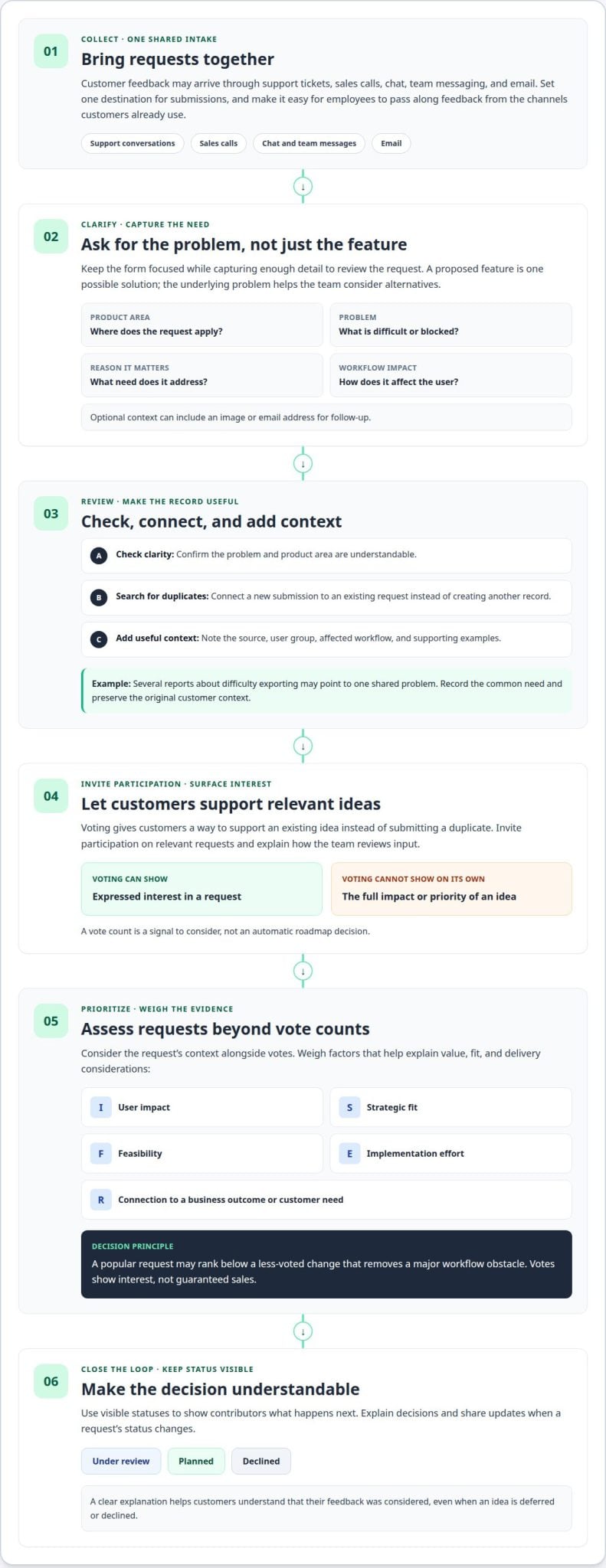
Small businesses can start with a clear submission form, searchable requests, simple status labels, and a reliable way to export data. To prioritize, weigh votes alongside user impact, strategic fit, effort, and feasibility. A popular request may rank below a less-voted change that removes a major workflow obstacle.

Assess revenue impact by connecting a request to a business outcome, such as supporting a customer segment or preserving an important workflow. Votes show interest, not guaranteed sales. Consider implementation effort and the needs of other users before assigning priority.

In the United States, costs depend on factors such as user access, integrations, reporting, and administration needs. Free plans and trials vary, so compare included capabilities and limits. In a security review, examine permissions, customer-data visibility, integrations, and how sensitive information is handled.

To link requests with product planning, track decisions and status changes in a shared workflow. Teams comparing platforms can use this guide to idea management software to assess their needs. For the next step from evaluation to execution, see this guide to implementing innovative ideas.

Feature request collection and voting

Customer requests arrive through support tickets, sales calls, chat, team messaging, and email. Without a clear intake route, the same idea can sit in several inboxes, separated from useful context. Set one destination for submissions, then make it easy for employees to pass along feedback from the channels customers already use.

For example, a support agent hears several customers describe difficulty exporting reports. Rather than treating each conversation as a separate request, the agent records the shared problem and attaches the original context. A consistent intake process helps enterprise teams spot recurring needs across departments, customer segments, and communication channels.

Keep the submission form focused, while collecting enough detail to make review useful. Ask for the product area, the problem, why it matters, and how it affects the user’s workflow. Let people attach an image when a screen or process is difficult to explain. An email address can support follow-up, while optional fields reduce friction for simple submissions.

After collecting requests, organize them so reviewers can understand and act on them:

  • Review the incoming idea: Confirm the problem and product area are clear.
  • Search for duplicates: Connect a new submission to an existing request instead of creating another record.
  • Add useful context: Note the source, user group, workflow affected, and supporting examples.
  • Set a visible status: Tell contributors whether the request is under review, planned, or declined.

This process turns scattered feedback into a searchable record and helps teams distinguish a proposed feature from the underlying need. A request for a dashboard filter, for example, may point to a broader difficulty finding records quickly. That distinction lets product teams evaluate different solutions without losing the customer’s original perspective.

Voting provides a participation signal: customers can support an existing idea instead of submitting a duplicate. But votes represent expressed interest, not a complete measure of impact. Review the request’s context alongside votes, then share updates when its status changes. A brief explanation of what happens next keeps contributors involved and makes the feedback loop visible.

To strengthen participation, tell customers where to submit ideas, invite them to vote on relevant requests, and explain how the team reviews input. Keep the prompt specific: “What task is difficult, and what would make it easier?” is more useful than asking for a feature wish list. Teams refining their wider idea intake can explore idea crowdsourcing methods and consider how a guided platform walkthrough could support their collection process.

Declining feature requests without disappointing customers

Declining a request is part of prioritization, not a judgment of the customer’s needs. Explain the decision clearly, for example, by citing limited capacity, weak strategic fit, or another solution that already addresses the problem. If a requested export duplicates an existing report, point customers to that workflow and record what remains difficult.

Capture the original context before making a decision. A customer conversation may reveal a need that a short request misses: an account manager might learn that teams manually combine reports before sharing them. Record the workflow, impact, and customer segment alongside the proposed feature. This preserves useful feedback even if the requested solution is not selected.

Use categories to distinguish themes such as usability, integrations, reporting, and new functionality. A dashboard filtered by category, status, and customer segment helps reviewers compare similar requests without treating every submission as unique. Define each category briefly so support, sales, and product teams classify requests consistently.

Custom statuses make decisions visible across teams. A practical workflow might include “Under review,” “Planned,” “In progress,” “Declined,” and “Revisit later.” Moderators should merge duplicates, remove spam, and redirect submissions that expose sensitive details. Keep a record of merged requests so contributors’ original context is not lost.

Match customer notifications to the status change. When declining an idea, acknowledge the problem, explain the reason, and describe any next step. For example: “We understand that reconciling these records takes extra work. We’re not planning a separate export because the current report supports this workflow. We’ll revisit the underlying issue as reporting priorities change.” Avoid promising a delivery date unless the roadmap includes one.

Apply a repeatable review sequence to help teams make consistent decisions:

  • Confirm the need: Summarize the customer’s problem in plain language.
  • Check the evidence: Review conversation notes, affected workflows, and related requests.
  • Choose a status: Prioritize, defer, decline, or merge the request.
  • Explain the outcome: Send a specific update and document the rationale.

Review declined and deferred requests during roadmap planning. If several customers describe the same obstacle, reassess the problem even if the original feature proposal remains unsuitable. A team might decline a custom dashboard while investigating whether clearer filters address the broader need. This keeps options open without implying that every request will be built.

When practical, close the loop in the same channel where the conversation began. If a sales call surfaced the idea, give the account team a concise status and response to share. Consistent updates help employees explain decisions accurately and prevent conflicting messages across customer interactions.

Feature Request Software: How to Collect and Prioritize Customer Ideas

Public idea boards and feature voting

A public idea board lets customers submit suggestions, find related requests, and discuss needs in one visible space. This visibility can help product teams identify shared problems and show customers how ideas move through review. A board works best when each entry clearly describes a need and comments add context rather than becoming disconnected conversations.

Public access suits requests that can be discussed openly, such as an improved search filter or a new reporting option. It also lets users vote on existing ideas instead of creating duplicates. Before opening a board, define moderation rules, remove personal or confidential information, and explain what voting means. A vote signals interest, not a promise to build.

Some requests need a private route. Enterprise customers may share account details, internal workflows, or sensitive business context that should not appear publicly. A private board can restrict visibility to selected groups, while product teams review those requests alongside broader feedback. Separate access rules protect context without losing sight of needs that may affect other users too.

Proxy voting can capture feedback from customers who raise ideas during calls or support conversations but do not use the board themselves. An employee can submit the request on their behalf, label it as a proxy, and record its source. Keep proxy votes distinct from direct votes. This makes demand easier to interpret and prevents teams from overstating community participation.

Use a board structure that supports both discovery and review:

  • Choose visibility: Publish general ideas, and route account-specific details to private discussions.
  • Group related requests: Use categories such as reporting, integrations, and usability.
  • Set discussion norms: Ask participants to explain the problem and avoid sharing confidential details.
  • Show request status: Mark ideas as under review, planned, in progress, or declined.

Boards should make participation useful, not merely visible. A customer who finds an existing request can vote and explain their use case. A moderator can merge overlapping entries while preserving why each person supported the idea. This gives reviewers more evidence than a vote count alone and helps product teams distinguish a common need from popular wording.

Choose board access based on the audience and sensitivity of the feedback. A public board supports broad discussion and transparent updates; a private board supports focused review with selected customers or internal teams. A hybrid approach can work well: publish a clear, general problem, then move confidential details into a restricted conversation. Teams comparing board structures can review idea board software approaches as part of their product strategy.

Before launch, test the board with a sample request from each intended audience. Confirm that people can submit, find, discuss, and vote on ideas, and that moderators can update statuses. Then explain how the team uses votes, comments, and customer context in roadmap decisions. Clear expectations make the board a practical input channel, not a public promise of delivery.

Feature request voting and maximizing participation

Voting works best when customers understand how their votes are used. Explain whether votes help teams assess demand, shape research, or inform roadmap discussions. For example, a note beside the voting control can clarify that the product team considers votes alongside customer context, strategic fit, and implementation effort. Clear expectations invite participation without turning popularity into an automatic delivery promise.

Make participation easy to find and complete. After a customer submits an idea, invite them to support related requests. In a customer community, highlight open ideas in relevant discussions rather than sending broad, untargeted reminders. Dedicated platforms like Nomadipity.com, which connects frequent flyers and travel enthusiasts, illustrate how shared interests naturally drive member conversations and organic insights. A focused invitation tied to a workflow gives people a reason to contribute and keeps feedback connected to actual needs.

Use segments to interpret votes. Support from users in one role or customer group may reveal a specific need, while broader support may point to a common friction point. Compare voter segments with the request’s context, including the task affected and the workaround people use. This turns a vote total into evidence product teams can assess.

Set participation rules before opening voting. Decide whether users can support multiple ideas, change their votes, or comment without voting. Then apply the same rules across the board. Moderators can review unusual activity and distinguish direct customer input from ideas submitted by employees on customers’ behalf.

A practical review can combine participation signals with product judgment:

  • Demand: Review votes and comments, then identify which audience contributed.
  • Impact: Assess the problem’s effect on customer workflows or product use.
  • Fit: Compare the request with product strategy and current priorities.
  • Feasibility: Consider available resources and a realistic delivery timeframe.

Use the evidence to inform decisions, not to let a leaderboard dictate them. A highly voted request may serve a narrow use case or require substantial work. A less visible request may address a serious obstacle for an important customer segment. Product teams should document why they prioritize, defer, or decline each idea.

Close the loop with visible updates. If a request moves into review, explain what the team is assessing. If priorities change, update its status and give contributors a concise reason. Do not equate a vote threshold with implementation. A consistent idea evaluation process helps teams weigh participation alongside impact and feasibility.

Ideawake: Innovation Management Platform

Ideawake’s Innovation Management Platform helps organizations capture, evaluate, and implement ideas from customers, employees, and partners. When feedback comes from multiple groups and requires a consistent review process, its Idea Management Platform provides a central place to organize submissions and assess their potential.

Voting and gamification features, including leaderboards and prizes, can encourage participation. Ideawake AI provides AI-assisted evaluation, semantic duplicate detection, and configurable AI agents. Together, these capabilities help teams move from collecting input to evaluating ideas and deciding what to advance, while keeping customer suggestions part of a broader innovation process.

If your team is ready to bring idea collection and evaluation into a shared process, contact Ideawake to discuss your needs.

Turn customer input into a stronger product direction

Make request review a dependable part of product planning. Assign an owner to incoming ideas, agree on how the team weighs evidence, and revisit decisions when customer needs or business priorities shift. Feature request software can support the process, but its value depends on clear criteria and consistent follow-through.

For organizations connecting product feedback with wider innovation work, Ideawake offers an Innovation Management Platform, an Idea Management Platform, and Continuous Improvement. These offerings help teams manage ideas in a shared process and connect evaluation with action.

Start with the workflow your team needs to improve, then build a process that makes customer input easier to assess and act on. Thoughtful decisions help shape a more responsive product direction.

Your next useful product idea may already be in a customer conversation. Give it a clear path forward.

Frequently Asked Questions

How do feedback, the roadmap, and the changelog fit together?

Feedback records user evidence, the roadmap communicates intended direction, and the changelog documents released changes. Keep these connected without treating them as interchangeable. A release note, for example, can reference the request theme it addresses, while the roadmap item describes the planned outcome. This helps customer-facing teams explain what changed and product leaders trace shipped work back to user needs.

How does feature voting work?

Feature voting can follow different rules, so define them before inviting participation. Decide whether people may change a vote, support multiple ideas, or vote only within a particular customer group. If users can revise their choices, use the latest vote for prioritization and preserve the history for analysis. Clear rules make results easier to interpret and reduce confusion when participants compare their input.

What happens to duplicate requests?

Before combining similar submissions, check whether they describe the same underlying need or simply use similar words. A request for faster reporting and one for scheduled reports may sound related but represent different workflows. Keep links to the original submissions and note why they were grouped. This preserves each contributor’s context and helps reviewers distinguish a shared problem from distinct requirements.

What is feature request software and how does it work?

Feature request software manages product suggestions from initial review through a recorded decision. Teams can assign ownership, document evaluation criteria, and maintain a decision history. For example, a reviewer can record why a request was deferred, what evidence might change the decision, and which team owns the next review. These records support consistent decisions when staff or priorities change.

How do you collect and organize customer feature requests?

Choose a small, shared set of categories and define them in plain language for every intake team. A “reporting” category might cover access to, presentation of, or export from reports, with a secondary tag identifying the affected workflow. Preserve the original channel and customer segment as separate fields. Review category use regularly so teams do not label the same request inconsistently.

How do you connect feature request software to product roadmaps and issue trackers?

Start by agreeing on the handoff: which team advances an approved request, what information travels with it, and who keeps its status accurate. Map shared fields such as request identifier, owner, priority, and delivery status. If an integration or API connects systems, define which system is authoritative for each field. This prevents conflicting edits and helps customer-facing teams share accurate progress.

What are the best feature request management tools in 2026?

There is no universal best tool. Compare submission methods, voting, status updates, reporting, and connections to existing systems, then choose a consistent process that fits your needs.

How do popular feature request platforms compare on integrations and features?

Compare tools by submission sources, voting and visibility, status updates, reporting, and connections to existing systems. A support-ticket queue organizes individual cases, a public idea board displays ideas and votes, and a central request system can combine feedback sources and support prioritization.

Article by

Coby Skonord

Coby Skonord is the co-founder and CEO of Ideawake. Since 2013 he has worked with enterprise innovation, continuous improvement, and HR leaders to turn employee ideas into measurable business impact.

How to Drive Innovation Using Microsoft Tools

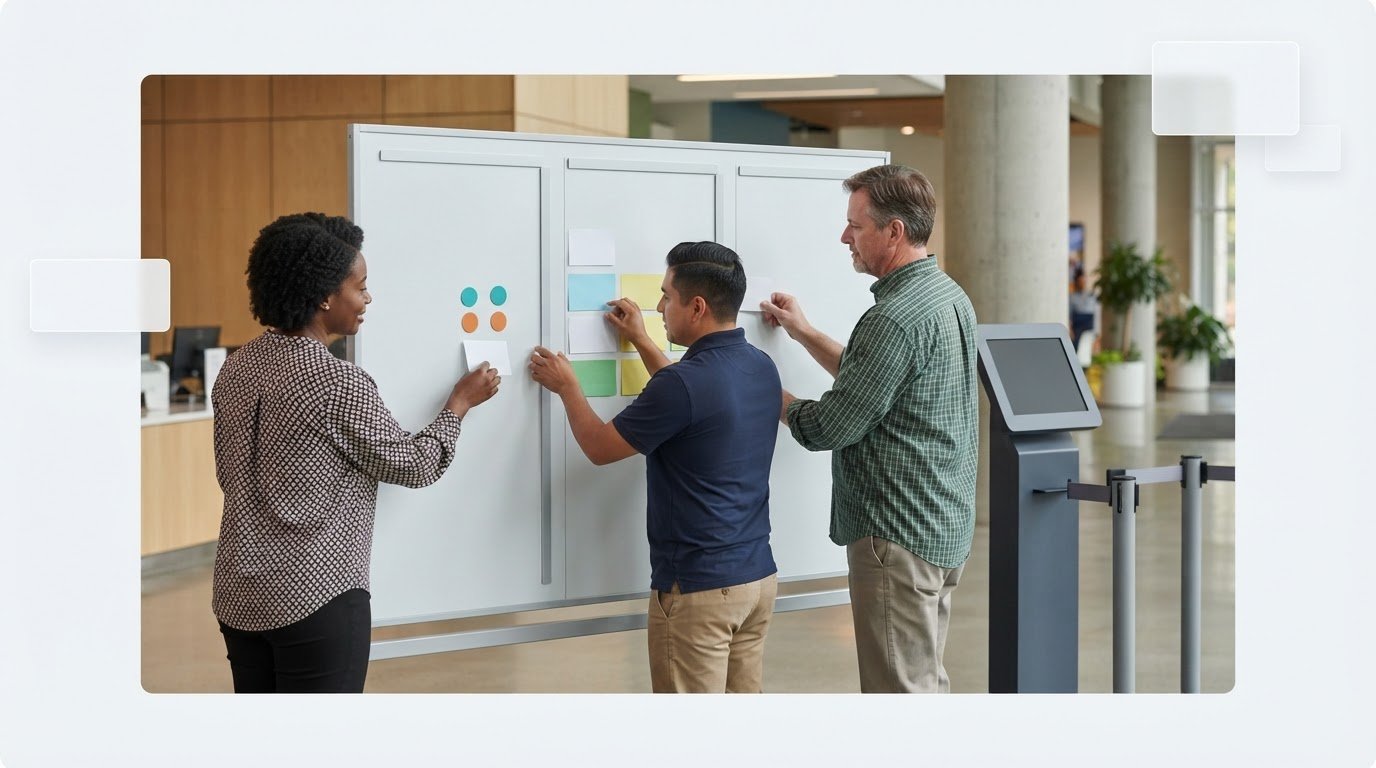
College staff prioritize employee ideas on a physical innovation workflow beside a student check-in queue
Coby Skonord|
November 2, 2026

Innovation doesn’t come from adding more software to an already crowded stack. Enterprise innovation software helps employees capture ideas, use AI to explore and refine them, and collaborate across departments, while Microsoft tools can support the day-to-day work of sharing and developing those ideas. The key is connecting the tools to a clear process, so promising suggestions move beyond conversation and into evaluation and action.

It’s reasonable to expect familiar workplace tools to make collaboration easier, but access alone won’t create a repeatable innovation process. This article explains how to connect Microsoft tools with idea-sharing practices, where AI and generative AI can assist, and how cross-functional teams can evaluate ideas against business priorities. You’ll also learn what to consider when choosing enterprise innovation software and how to build a practical approach that employees can use across the organization.

Key Takeaways

  • Set clear business goals and a transparent evaluation process so employees can see how ideas move from submission toward action.
  • Use AI and generative AI to help organize and develop ideas, with human review and safeguards for sensitive information.
  • Choose tools that support collaboration across departments and make ownership, progress, and outcomes visible.
  • Assess software against your workflows, governance needs, and ability to manage ideas through implementation.
  • Connect familiar Microsoft tools with a dedicated idea management process when everyday collaboration alone isn’t enough.

How can companies encourage employees to contribute more innovative ideas?

Employees are more likely to contribute when leaders make participation useful, visible, and worth their time. Gallup’s 2024 State of the Global Workplace report found 23% of employees globally were engaged, 62% were not engaged, and 15% were actively disengaged. These figures underline why idea programs need more than an open submission form: leaders must make contribution part of meaningful work.

Middle managers shape that experience through everyday choices. Gallup reports that managers account for 70% of the variance in team engagement. Give managers a practical role: make space for suggestions during existing team routines, explain what happens after submission, and recognize useful contributions. For example, a manager can invite staff to describe a frustrating task and share the team’s response to the suggestions at a later meeting.

Make participation easier to sustain by linking ideas to outcomes employees can see. Gallup’s Q12 meta-analysis found that teams in the top engagement quartile had 23% higher profitability and 18% higher productivity than teams in the bottom quartile. These comparisons do not prove that an idea program alone creates those outcomes. They do show why leaders should connect employee participation with real organizational priorities.

Organizational change management should clarify what is changing, who will review ideas, and how decisions will be communicated. If employees submit suggestions but hear nothing back, they have little reason to contribute again. Enterprise innovation software can support a consistent process, but managers still need to explain its purpose and reinforce it in daily work. A clear response, including why an idea is deferred, helps maintain trust.

Managing Large Idea Volumes

Managing large volumes of ideas means organizing submissions so reviewers can spot patterns and assess proposals efficiently. Use topic labels such as safety, customer experience, or process improvement, then assign review responsibility by subject. This makes recurring concerns easier to identify and helps teams find related suggestions. Enterprise innovation software supports this work when its categories reflect how the business operates.

Selecting Enterprise Innovation Software

Choosing enterprise innovation software means matching a platform to your organization’s goals, workflows, and governance needs. Compare requirements for submission, review, access, reporting, and integrations. Test a realistic suggestion from intake through decision, and note where users need clarification. This practical evaluation reveals fit beyond a feature checklist.

Idea Management Software

Idea management software provides a dedicated place to submit, assess, and follow suggestions. It helps when email threads or spreadsheets make ownership difficult to track. For example, a team could collect proposals to reduce rework, group similar submissions, and route them to the relevant reviewers. Explore corporate innovation tools by considering how each supports that process.

AI and generative AI applications

AI can help teams examine employee ideas, surface themes, and develop early concepts. Generative AI can also draft summaries or suggest questions for reviewers. These capabilities support innovation work, but they don’t replace business judgment. Start with one defined challenge, such as reducing repetitive service requests, and decide which task AI should assist with.

For example, an AI system could group submissions about confusing customer handoffs, then summarize common causes for a human review team. Generative AI could help turn a rough suggestion into a clearer problem statement or propose follow-up questions that reveal assumptions. Reviewers can then compare the refined idea with operational priorities. This assistance makes submissions easier to scan, without treating generated content as proof.

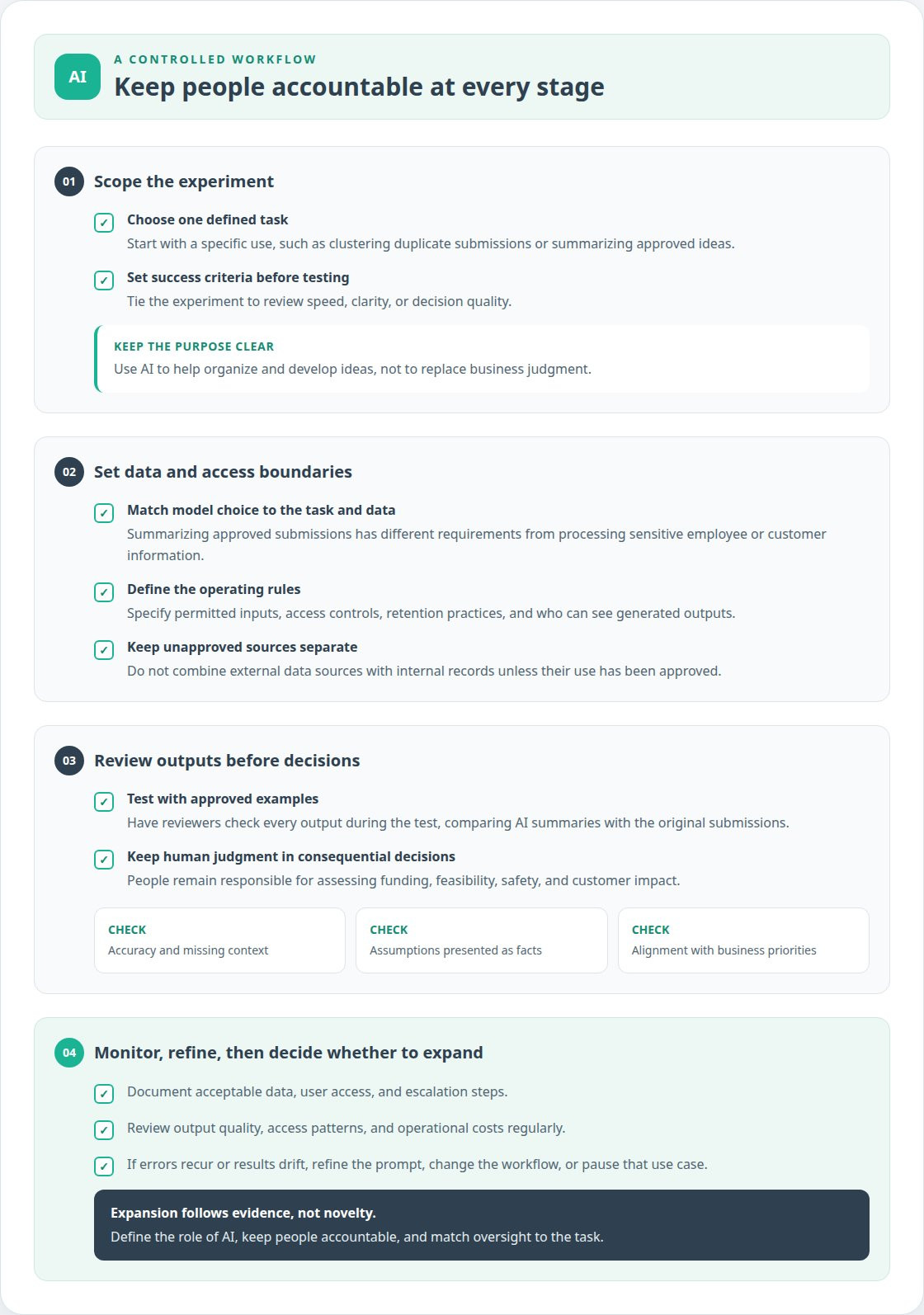
Choose an AI model based on the task and the data involved. A model that summarizes approved submissions has different requirements from one processing sensitive employee or customer information. Before deployment, define permitted inputs, access controls, retention practices, and who can see generated outputs. Keep external data sources separate from internal records unless their use has been approved. Clear boundaries reduce the risk of useful automation creating new information risks.

Generative systems can produce inaccurate statements, omit context, or present assumptions as facts. Human supervision is essential for decisions about funding, feasibility, safety, and customer impact. Ask reviewers to compare AI summaries with original submissions before advancing an idea. Monitor output quality, access patterns, and operational costs after deployment. If errors recur or results drift, refine the prompt, change the workflow, or pause that use case.

Move from experiment to practice through a controlled workflow:

  • Choose one specific task, such as clustering duplicate submissions.
  • Set success criteria tied to review speed, clarity, or decision quality.
  • Test with approved examples and have reviewers check every output.
  • Document acceptable data, user access, and escalation steps.
  • Review performance regularly before expanding automation.

This approach helps teams learn where AI adds value without letting novelty drive adoption. The same discipline applies to AI agents that assist with analysis, design, testing, or delivery: define their role, keep people accountable, and create oversight that matches the task. For practical examples of AI use in innovation workflows, explore AI tools for innovation managers. Well-scoped experiments can strengthen idea development while preserving human control and clear ownership.

AI adoption in enterprise software

AI adoption works best as a focused business transformation, not a technology add-on without a clear goal. An operations team might use AI to identify recurring production delays, while a service team could analyze common customer handoff problems. In either case, leaders should name the decision or workflow they want to improve before selecting a system. This keeps the project grounded in business needs.

Enterprise software has evolved through waves such as cloud computing and software as a service. AI represents another shift because it can assist with analysis, content creation, and workflow execution. For example, an innovation team might use AI to summarize employee submissions, then ask reviewers to validate the themes against original ideas. Technology supports the work, but accountable people still make decisions.

Build governance into the design rather than treating it as a late approval step. Define which information AI may process, who can access its outputs, and which decisions require human review. For example, separate general process suggestions from submissions that contain customer or employee details. Assign an owner to monitor output quality, access, and operational performance. Clear responsibility helps keep promising experiments from becoming unmanaged systems.

Data infrastructure and security determine whether an AI use case can move beyond a prototype. A team analyzing service feedback needs reliable input data, controlled access, and a way to review model performance over time. Organizational change matters too. Explain how AI affects existing roles, train employees on the revised workflow, and give them a way to flag errors. Without adoption planning, a tool can add steps instead of reducing friction.

Use a practical adoption sequence:

  • Choose a specific workflow and state the business outcome it should support.
  • Identify the data, users, and systems involved before configuring AI.
  • Set review rules for generated summaries, recommendations, or actions.
  • Test the workflow with real users and collect examples of errors.
  • Track performance and adjust governance before expanding its scope.

These steps connect technical delivery with daily work. For example, a department can start with AI-assisted idea categorization, review whether the categories help staff find relevant proposals, and refine the process before applying automation elsewhere. Keep the target narrow enough to measure but meaningful enough to matter. That balance gives leaders evidence for their next decision.

AI-enabled innovation workflows also need a clear operating model: named owners, review criteria, and a process for handling exceptions. Organizations planning that foundation can explore AI-powered innovation management as one approach to connecting AI with idea development. The priority is deliberate adoption, where governance, people, and technology advance together.

How to Drive Innovation Using Microsoft Tools

Cross-departmental collaboration

Cross-departmental collaboration brings people with different expertise together to solve a shared business problem. A customer handoff challenge, for example, may involve operations, sales, service, and technology. Each team sees a different part of the workflow, so working together can reveal causes one department might miss. Shared ownership matters: without it, ideas can stall between teams as each waits for another to act.

Microsoft Teams can support discussion, while SharePoint can provide a shared space for project materials. These tools help teams communicate, but collaboration still depends on clear decisions, owners, and handoffs. Define who frames the challenge, contributes expertise, assesses feasibility, and approves implementation. For a recurring service issue, operations might map the process, customer service could identify pain points, and technology staff could assess system dependencies.

Build engagement by giving each department a specific contribution instead of inviting everyone into a broad, undefined discussion. A useful working agreement identifies the problem, decision-maker, information needed, and how progress will be shared. During a process-improvement effort, frontline employees can describe workarounds, managers can explain performance targets, and analysts can examine available data. This division uses existing capabilities without letting one department dominate.

Manual handoffs can weaken otherwise strong ideas. Reduce that friction by recording decisions, assigning next steps, and setting a shared review point. For instance, when a proposal affects employee training and a customer-facing process, the training lead and service owner should review the same recommendation. Governance clarifies who resolves competing priorities. Continuous improvement then becomes part of the workflow, rather than a separate investment that fades after kickoff.

Use this collaboration checklist before launching a cross-functional effort:

  • Name the business problem and the outcome teams are working toward.
  • Include people with relevant frontline, operational, and technical expertise.
  • Assign one accountable owner for decisions and action tracking.
  • Agree how Microsoft Teams discussions and shared documents will support the work.
  • Review progress together and communicate decisions to contributors.

These practices connect engagement with action. A focused innovation challenge can give departments a common target, such as improving onboarding or reducing repeated service questions. Its value depends on participation, clear criteria, and follow-through, not just the number of submissions. Teams can use innovation challenge examples to shape a cross-functional effort around a specific need.

Leaders should recognize that collaboration takes time away from employees’ existing responsibilities. Make the work visible in planning, clarify which decisions need group input, and let specialists complete independent tasks between reviews. When departments understand their roles and see how decisions progress, they can combine their capabilities without creating another disconnected workflow.

What is enterprise innovation software and what features does it include?

Enterprise innovation software gives organizations a structured way to collect, assess, develop, and track ideas. Unlike a Microsoft Teams conversation or shared document, it can connect submissions to review stages and decisions. For example, an employee suggestion about reducing repeat customer questions can be recorded, assigned for review, and tracked through implementation. The system supports the process; leaders still set priorities and make decisions.

Think of the platform as a workflow from idea intake through follow-through. Employees submit proposals, reviewers assess them against shared criteria, and owners record what happens next. A proposal might move from “submitted” to “under review,” then to a decision and an implementation owner. These stages create visibility across departments and help teams see whether an idea needs clarification, further analysis, or action.

For a large organization, useful capabilities typically include:

  • Idea capture: forms or portals collect a problem, proposed change, and supporting context.
  • Review workflows: criteria and assigned reviewers make assessment more consistent.
  • Collaboration: comments and discussion help contributors build on proposals.
  • Portfolio visibility: dashboards show status, themes, and ownership across initiatives.
  • Reporting: records connect activity with decisions and documented outcomes.
  • Integrations: connections to workplace systems can reduce manual handoffs when configured for organizational workflows.

Microsoft tools can remain part of the working environment. Teams can host discussions, while a dedicated innovation system organizes submissions, evaluation, and progress. Enterprise innovation software distinguishes informal conversation from a managed process by recording an idea’s owner, status, decision, and next action. Before selecting tools, map an example from initial suggestion to final decision, then identify where information currently gets lost.

Feature lists alone don’t determine fit. Compare each platform with your organization’s governance model, access needs, review criteria, reporting requirements, and existing workflows. Ask how employees submit proposals, managers handle duplicates, reviewers document decisions, and implementation owners report progress. Enterprise innovation software should meet these requirements in daily use, not just during a product demonstration. A guided evaluation of innovation management software selection can help teams compare real workflows with platform capabilities.

Keep the first rollout focused on a defined use case, such as frontline suggestions for reducing rework. Set clear ownership, test the review path with real submissions, and see whether employees understand each stage. Then refine fields, criteria, and reporting based on where reviewers encounter friction. The right platform makes work visible from idea to decision, while a sound operating process turns that visibility into accountable action.

Ideawake: Innovation Management Platform

Ideawake provides an Innovation Management Platform for capturing, evaluating, and advancing employee, customer, and partner ideas. It’s a natural next step when Microsoft tools support everyday conversations but your teams need a dedicated process to manage ideas through their lifecycle.

The Idea Management Platform supports structured idea review, while Continuous Improvement helps teams organize improvement efforts. Ideawake AI can assist innovation work, and engagement features such as voting, leaderboards, and prizes can encourage participation. Together, these capabilities bring submissions into a shared process, reduce administrative complexity, and make progress easier to follow.

If your organization is ready to give ideas a clearer path from submission to action, visit ideawake.com to explore how Ideawake can support your innovation program.

Make innovation part of how work gets done

Connect your innovation priorities with the routines, owners, and measures your organization already uses. Choose a business challenge, define who will guide the work, and decide how progress will be reviewed. This gives employees a clear path to contribute and helps leaders assess whether enterprise innovation software fits their operating model.

Ideawake offers an Innovation Management Platform, an Idea Management Platform, and Continuous Improvement to help organizations build this process. Each can structure the management of ideas and improvement initiatives around your program’s needs.

Start with a focused next step, then give your teams the space and direction to turn useful insight into progress.

Frequently Asked Questions

How Does Software Help?

Software helps teams organize information and apply analytical tools to work that would otherwise remain scattered. McKinsey’s 2024 State of AI report found that 72% of respondents said their organizations used AI in at least one business function, up from 55% in 2023. The same report found regular generative AI use rose from 33% to 65%. These figures offer context for assessing software that supports analysis, not proof that a particular platform will deliver results.

How can enterprises identify which innovation opportunities are worth pursuing?

Enterprises can distinguish opportunities by asking whether they address an emerging need, improve an existing operation, or open a different path to growth. Keep these categories visible during review, since each may require different evidence and decision-makers. For example, a service improvement could be tested within an existing process, while a new market concept may need research before operational planning. This helps leaders avoid judging unlike opportunities by identical expectations.

How do large companies maintain innovation momentum over time?

Large companies sustain momentum by developing employee skills alongside their innovation programs. The World Economic Forum’s Future of Jobs Report 2023 projects that 44% of workers’ skills will be disrupted within five years, and 60% of workers will require training before 2027. Leaders can use these findings to plan learning around new workflows, emerging technology, and changing roles. Regularly updating those learning plans helps teams keep pace as priorities shift.

Why do innovation initiatives sometimes lose executive support?

Executive support can fade when an initiative competes with urgent operational demands and its sponsors can’t explain the trade-off. Connect each initiative to a current priority, then make a clear decision about whether it deserves continued attention. For example, if a strategic shift makes a project less relevant, leaders can pause or redirect it instead of continuing by default. Explicit decisions protect focus and trust.

What are the best platforms for enterprise innovation in 2026?

There is no universal best platform for every organization in 2026. The right fit depends on whether the program centers on employee suggestions, continuous improvement, challenges, or portfolio oversight. Start by defining the primary use case and the people who will administer it. Then evaluate how well each option supports that program’s governance, adoption, and reporting needs. A strong fit should support the organization’s operating model, not force teams into an unsuitable one.

How do innovation platforms compare by features and use cases?

Compare platforms by examining how each handles the specific needs of a use case. A challenge program may need participant communications and review criteria, while continuous improvement may depend more on recurring operational input and status tracking. For programs using AI, assess how people review generated outputs and maintain oversight. A comparison matrix can record these requirements alongside administration, access, and reporting, making meaningful differences easier to discuss.

What are the leading platform vendors and their customer reviews?

Customer reviews can help buyers understand common user experiences, but they shouldn’t determine the decision alone. Look for detailed comments about the program type, implementation context, administrator workload, and employee experience. Check whether reviews describe recent, firsthand use or broad impressions, and compare recurring themes with your requirements. Use this evidence to shape internal evaluation questions, then assess the product against your workflows and governance needs.

How do companies choose an innovation platform?

Companies can choose an innovation platform by involving the people who will use and administer it before procurement. Include an employee contributor, a reviewer, a program owner, and an IT or security representative in the evaluation. Ask each person to complete tasks relevant to their role, then record friction points, missing information, and access concerns. This cross-functional assessment can reveal practical adoption issues that a feature checklist or executive review might miss.

Article by

Coby Skonord

Coby Skonord is the co-founder and CEO of Ideawake. Since 2013 he has worked with enterprise innovation, continuous improvement, and HR leaders to turn employee ideas into measurable business impact.

Innovation Challenge Software: A Practical Guide for 2026

Innovation Challenge Software: A Practical Guide for 2026
Coby Skonord|
October 18, 2026

What good is a challenge full of ideas if no one can tell which ones deserve attention or what happens next? Innovation challenge software should do more than collect submissions. It should give participants a clear way to contribute and help teams move promising ideas through review, decisions, and follow-through.

If submissions are scattered across forms, spreadsheets, and chat threads, it’s harder to keep people engaged, compare ideas consistently, and make ownership visible. A campaign can attract plenty of activity yet still fall short if submissions aren’t focused or selected ideas stall after evaluation. The platform matters, but so does the process behind it.

This guide explains how innovation challenge software fits into an innovation program and what to assess, from submission forms and participant engagement to review workflows and outcome tracking. You’ll learn how to set a useful challenge brief, compare platforms against your process, and connect participation with measurable results. The goal is a challenge that doesn’t end when submissions close, but creates a clear path from contribution to action.

Key Takeaways

  • Distinguish a time-bound innovation challenge from ongoing idea collection so the process matches the goal.
  • Use innovation challenge software to make review stages, decision ownership, and next steps easier to follow.
  • Compare platforms by program fit, participant experience, evaluation, reporting, and integrations, not by feature count alone.
  • Set the challenge problem, evaluation criteria, and success measures before launch to focus participation and assess results.
  • Connect engagement tools and analytics with workflows and ROI tracking to understand what happens after ideas are submitted.

What innovation challenge software does, and where it fits

Innovation challenge software is a digital system for collecting ideas in response to a defined need and managing the challenge from launch through review. It gives organizers a structured way to explain the problem, invite relevant participants, gather submissions, and coordinate what happens next.

A challenge is one format within the broader practice of innovation management. It turns a specific question into a focused program rather than treating every contribution as an isolated suggestion. The software can organize participation and make the process visible, but the organization still sets priorities, weighs trade-offs, and decides which ideas to pursue.

What makes an innovation challenge different from an idea box?

An idea box invites suggestions, often on any topic and at any time. A challenge is more focused: organizers define a question, identify who should contribute, and explain what the program is trying to learn or address. A clear brief gives participants useful boundaries without prescribing the answer. For example, it might describe a process problem and ask employees for practical ways to improve it. This structure also supports organized employee ideation programs.

Challenges are often time-bound, with a launch, submission period, and review phase. That creates a shared moment for participation and gives reviewers a defined set of ideas to consider. Ongoing idea collection, by contrast, keeps a channel open for contributions across different topics. An unstructured brainstorm may generate discussion, but without a specific prompt or process, ideas can be difficult to compare or carry forward.

Who uses innovation challenge software?

Innovation teams use challenge tools to coordinate contributions from employees, customers, or partners, depending on the question and intended audience. A team might invite employees to suggest ways to simplify an internal process, ask customers to identify unmet needs, or gather partner perspectives on a shared business challenge. Choose participants for their relevant experience or insight, not simply to maximize the size of the group.

The software helps organizers present the brief, collect responses in one place, and manage participation and review. It supports a program; it doesn’t choose the strategic problem or decide which proposal deserves investment. Those responsibilities remain with the organization’s leaders and reviewers.

That distinction matters. A well-framed challenge connects a real organizational need with people who can offer useful perspectives. The platform provides structure for gathering and assessing those perspectives, while clear goals and human judgment guide decisions. Without that combination, a challenge can become just another submission form. With it, focused participation has a defined purpose.

How challenge software moves ideas from submission to evaluation

A challenge needs a clear operating path, not just a place to submit ideas. Innovation challenge software can organize that path so participants know what to provide and reviewers can see what has been considered, what needs a decision, and who owns the next step. A practical sequence is:

  1. Define the challenge. Set the problem, intended audience, submission window, and review approach.
  2. Collect ideas. Use a structured form to gather submissions in a consistent format.
  3. Review submissions. Screen for relevance, clarify details, and organize similar proposals.
  4. Select candidates. Compare eligible ideas against agreed criteria and record decisions.
  5. Track next steps. Assign owners and move selected ideas into further assessment or action.

Set evaluation criteria before reviewing submissions so every idea is assessed against the same expectations. Criteria might cover alignment with the challenge, potential benefit, feasibility, or evidence needed for further review. Without a shared basis, reviewers may rely on different assumptions, making comparisons less consistent and decisions harder to explain.

From challenge brief to structured submissions

A useful brief states the problem, who the challenge is for, relevant context, and what participants should submit. Forms can then prompt for information that helps reviewers understand each proposal, such as the need addressed, the suggested change, and any assumptions or resources involved. Keep prompts relevant: unnecessary questions add effort without improving the review. Optional anonymous posting can be useful when organizers want contributions assessed without displaying the submitter’s identity, but it need not be enabled for every challenge.

Similar submissions also need a sensible handling process. Semantic duplicate detection can flag ideas with related meaning even when participants use different wording. Depending on the review rules, similar ideas can be grouped for evaluation or merged, while preserving useful distinctions. Reviewers should still check whether proposals that sound alike contain different details or approaches.

From evaluation to accountable next steps

Scorecards help reviewers apply shared criteria, while configurable workflows and approval stages show where an idea sits and who is responsible for moving it forward. Assigned owners can record a decision, request clarification, or coordinate the next review. This makes progression visible instead of leaving submissions in an inbox with no clear status. A structured idea evaluation process and criteria can help teams make review more consistent and transparent.

Comments and collaboration let participants or reviewers add context, and voting can help surface ideas for consideration. These inputs can inform deliberation, but they shouldn’t replace evaluation against the challenge’s criteria. Once a decision is made, record the rationale and next action, whether an idea advances, needs more information, or isn’t selected. That feedback closes the loop for participants and gives the team a usable record of the challenge. If you’re assessing how a platform could support this flow, you can explore a challenge workflow in a demo.

How to assess innovation challenge software beyond its feature list

A long feature list doesn’t tell you whether a platform fits your challenge. Start with the program you need to run, then assess whether the software helps participants contribute, administrators manage the process, reviewers make informed decisions, and responsible teams take selected ideas forward. Requirements vary with the audience and workflow, so compare platforms against your own needs rather than looking for a universal best.

Use a comparison framework that connects each capability to a practical need:

Area What to assess
Program fit Can you set up the challenge around its purpose, audience, and submission needs?
Participant experience Can participants access the challenge, understand expectations, and receive updates?
Evaluation Can reviewers use shared criteria and record decisions?
Workflow Can administrators see submission status, ownership, approvals, and next steps?
Reporting Can teams track relevant KPIs and understand what happens to selected ideas?
Integrations Can the platform fit alongside the tools teams already use?

Match platform capabilities to your challenge goals

For targeted feedback, focus on challenge setup, participant access, and submission forms that gather relevant details. A cross-functional program may need collaboration, routing, and configurable review stages so different teams can contribute without losing sight of ownership. If outcome tracking is central, assess whether administrators can create KPIs, view dashboards, and use financial ROI charts to monitor progress. An innovation software selection framework can help organize broader platform requirements around these goals.

Separate essentials from enhancements. A challenge with a narrow audience may prioritize clear forms and simple review, while a program involving several teams may depend on configurable workflows and collaboration. Notifications, gamification, and analytics can support engagement and visibility, but they’re valuable only when they serve the challenge’s purpose. Assess each capability in context: does it solve a real problem in the work your team needs to do?

Check adoption, security, and system fit

Evaluate the experience from both sides. Participants need a straightforward way to access the challenge on desktop or mobile, see announcements, receive notifications, and understand what happens after they submit. Administrators need to track submissions, communicate updates, and hand selected ideas to the teams responsible for assessment or implementation. Consider how participant feedback will be collected and used, too.

Security and integration choices also matter. Ideawake describes its security approach as zero data retention, and states that customer data is not used to train external models. Its integrations include Microsoft Teams, Jira, Asana, and Slack. An integration can connect systems, but that doesn’t mean every workflow or handoff happens automatically. Identify the information each connection needs to support and how it fits the team’s process. For a practical look at challenge workflows, you can explore Ideawake in a demo.

How to plan a challenge that earns participation and useful ideas

Strong participation starts before launch. Give people a clear reason to contribute, make the task easy to understand, and decide in advance how you’ll judge whether the challenge was useful. A practical sequence keeps planning focused:

  1. Define the problem. Frame a specific need that participants can meaningfully address.
  2. Choose the audience. Invite people with relevant experience, knowledge, or perspective.
  3. Set evaluation criteria. Agree on what reviewers will consider and who will make decisions.
  4. Launch and support participation. Share the brief, explain how to submit, and send useful reminders.
  5. Review and communicate. Update participants on progress, decisions, and next steps.

Before launch, select success measures that fit the challenge. These might include the relevance of submissions, participation across the intended audience, completion of review stages, or progress of selected ideas into further assessment. Set a baseline or define how each measure will be recorded, so the team can learn from the campaign without assuming a particular participation or ROI result. A platform can help organize idea crowdsourcing, but a clear purpose and timely communication give people a reason to take part.

Set the challenge up for focused participation

Use a concise problem statement, then explain why it matters and what participants are being asked to contribute. Choose an audience suited to the question, and describe submission expectations in plain language. People should understand what information to provide, how their input will be reviewed, and when they can expect updates. Points, leaderboards, or prizes may suit some programs, but treat them as optional engagement approaches, not guaranteed drivers of useful ideas or results.

Keep the brief focused enough to guide contributions without dictating a solution. For example, if the goal is to identify friction in an internal process, invite participants who encounter or support that process and ask them to describe the issue and a possible improvement. Make the invitation accessible through the channels the audience uses, and use announcements or notifications to clarify deadlines and answer common questions.

Close the feedback loop after submissions arrive

Tell participants what happens after submission and provide progress updates at meaningful points, such as when review begins or decisions are communicated. Challenge owners should share outcomes clearly, including when an idea needs more work or isn’t selected. For ideas that advance, assign an owner and connect the next steps to a workflow or project tracking process. That handoff gives promising contributions a route toward action; a defined approach to implementing innovative ideas can help teams carry the work forward.

Use the close of the challenge to capture lessons as well. Compare results with the measures set before launch, note where participants needed more guidance, and identify review bottlenecks. Those observations can sharpen the next brief and improve the participant experience. The goal isn’t simply to collect submissions. It’s to run a process people can understand, learn from, and trust.

How Ideawake supports innovation challenges from ideas to impact

Ideawake is an enterprise-grade idea and innovation management platform that supports challenges beyond the submission stage. It connects idea collection with evaluation, configurable workflows, participant engagement, and ROI tracking. For teams that need to keep submissions organized and make follow-through visible, the value is in linking these steps in one managed program rather than treating each idea as a separate record.

Ideawake reports average participation rates of 50 % - 80 % versus typical 5 % - 15 % with other tools. These are company-reported averages, not a promise of results for any individual challenge. Ideawake also reports an average six-month financial impact of $1,000,000. Outcomes depend on the program and how ideas are evaluated and acted on, so use measures that fit your own challenge when assessing performance.

Bring challenge participation into a managed workflow

Challenge submissions can move through evaluation stages, assigned ownership, and progress tracking in configurable workflows. That structure helps organizers see what is awaiting review, what decision has been made, and where selected ideas go next. Duplicate detection can help teams identify similar submissions, while notifications and collaboration tools support communication among participants and reviewers.

Engagement options include points, leaderboards, and prizes, which organizers can use to support participation. Analytics and reporting extend visibility beyond activity: Ideawake includes customizable dashboards, KPI creation, and financial ROI charts. Together, these capabilities help teams monitor defined measures and connect challenge activity with the progress and value they track, without assuming that submissions automatically become business results.

Explore whether Ideawake fits your challenge program

Ideawake also offers configurable AI agents for evaluation, tagging, short-listing, and market research. These capabilities support specific parts of the challenge process; they don’t remove the need for human review and decisions. AI-generated ideas and insights are listed as Coming Soon, so they aren’t currently available capabilities.

Assess the platform against your challenge requirements: the participant experience, review approach, workflow ownership, and measures you need to follow. Ideawake’s reported averages can provide context, but your success criteria should reflect your program’s purpose and baseline. A walkthrough can show how the platform’s challenge capabilities relate to your process.

Turn your next challenge into a clear next step

Choose one business question worth exploring and decide how you’ll recognize useful progress. Set a clear starting measure, identify who will review submissions, and name the team responsible for moving selected ideas forward. That preparation gives your innovation challenge software a purpose beyond collecting responses: it helps your organization learn what participants can contribute and what the program should improve next.

Ideawake reports average participation rates of 50 % - 80 % versus typical 5 % - 15 % with other tools, and an average six-month financial impact of $1,000,000. These are company-reported averages, not a guarantee of results. Use them as context, then define measures that reflect your own challenge goals and follow-through.

A well-run challenge can create a practical starting point for better questions, stronger collaboration, and ideas with a clear path forward. Book a free Ideawake demo to see how the platform can support your next challenge.

Frequently Asked Questions

What is innovation challenge software?

Innovation challenge software runs focused idea campaigns around a specific problem, from launch and promotion to idea submission, voting, expert evaluation and selecting winners. It replaces email and spreadsheets with one place where participants submit and collaborate and reviewers score ideas consistently. The best platforms also track what happens after the challenge, so winning ideas actually get implemented.

What are examples of innovation challenges?

Effective challenges ask one specific question. Examples from Ideawake customers include: What are your 2 or 3 most time-consuming tasks? How can we reduce customer complaints about a specific product? How can we lower distribution and shipping costs? How can we improve satisfaction for our patients and their families? Challenges tied to a measurable goal and a deadline produce more usable ideas than open-ended prompts.

How long does it take to launch an innovation challenge?

Most of the time goes into choosing the challenge question, the reviewers and the prizes, not into the software. A typical launch checklist covers KPIs, SSO, user upload, the submission form, the review workflow, promotion and 5 to 10 seed ideas from champions before inviting everyone. With Ideawake, Sargento ran its first challenge with no training and still exceeded its usage goals.

How much does innovation challenge software cost?

Pricing usually depends on users, administrators and how many challenges you run. For Ideawake, most mid-size programs land in the middle of the Business plan range, around $1,000 to $1,500 per month, and enterprise plans are quoted. See the Ideawake pricing page and our innovation management software pricing guide for the full budget picture.

How do you get employees to participate in an innovation challenge?

Ask a clear question people care about, make submitting take a minute, and show that ideas will get a response. Promote the challenge through leadership emails, team meetings and Teams or Slack, and offer recognition such as points, leaderboards or prizes. The strongest incentive is letting winners help implement their own idea.

Can you run an innovation challenge in spreadsheets?

You can for a very small challenge, but it breaks quickly. Spreadsheets cannot notify submitters, route ideas to reviewers, catch duplicates or keep a consistent scorecard, so organizers end up chasing people by email. Dedicated software handles those steps automatically and keeps the full decision record.

Can innovation challenge software be used for hackathons?

Yes. A hackathon is a time-boxed challenge with team submissions and judging, which maps to the same building blocks: a challenge brief, team members on each submission, judging scorecards and a winner announcement. In Ideawake, ideas can have co-submitters and team members, and judges score entries in a configurable evaluation stage.

How do you measure the success of an innovation challenge?

Measure participation, idea quality and outcomes. Track participation rate, ideas submitted and ideas advanced during the challenge, then projected value of shortlisted ideas and, later, implemented ideas and their actual value. Keep projected and actual value separate so reports stay credible.

Article by

Coby Skonord

Coby Skonord is the co-founder and CEO of Ideawake. Since 2013 he has worked with enterprise innovation, continuous improvement, and HR leaders to turn employee ideas into measurable business impact.

Frontline Innovation in Action: The Flamin’ Hot Cheetos Story

Frontline Innovation in Action: The Flamin’ Hot Cheetos Story
Coby Skonord|
October 11, 2026

A frontline idea can become a meaningful improvement, but only if it moves from observation to action. That’s the challenge at the heart of frontline innovation: employees closest to the work often spot unmet needs first, yet their insights can stall before decision-makers assess them or explain what happens next.

The Flamin’ Hot Cheetos story is memorable, but it is not settled proof that one person invented a blockbuster product. Richard Montañez has described pitching a spicy Cheetos idea; Frito-Lay has disputed his role in creating the product line, saying it was developed by a team in Texas. The Los Angeles Times reported on the conflicting accounts. The distinction matters: an inspiring story can spark interest, but organizations need a repeatable way to capture, assess, and implement employee ideas.

This article considers what the story can teach without treating a contested origin as settled fact. You’ll learn what helps frontline observations progress, why clear feedback matters, and how to connect idea submissions with evaluation, implementation, and measurable results.

Key Takeaways

  • Learn how frontline innovation moves from an employee’s observation to a change put into practice.
  • Explore what the Flamin’ Hot Cheetos story can and can’t show about employee ideas and organizational innovation.
  • Use problem relevance, feasibility, expected value, and evidence to assess promising suggestions.
  • Build a repeatable process for inviting ideas, capturing context, evaluating proposals, responding to employees, and learning from outcomes.
  • See how an innovation platform can connect idea intake with evaluation, implementation, and ROI measurement.

What frontline innovation means, and why everyday work insights matter

Frontline innovation is a new or improved product, service, or work process shaped by insight from employees close to day-to-day operations and put into use. This working definition adapts the OECD’s Oslo Manual definition of innovation, which distinguishes an implemented change from an idea that has not yet been used. The distinction is important: an observation can reveal an opportunity, but it becomes an innovation only when a change is adopted.

Consider a warehouse employee who notices that a frequently used item is stored far from the packing area. The observation is the extra movement that happens repeatedly. A possible improvement is to relocate the item. If the organization assesses the proposal, tests the change, and adopts it, that implemented change is innovation. Collecting the initial comment alone doesn’t complete the journey.

Who counts as a frontline innovator?

Frontline innovators include customer-facing employees, operational staff, and others who work close to everyday processes. Their job titles may differ, but they share a useful perspective: they see how work actually unfolds. A customer support agent may hear the same point of confusion repeatedly; a technician may spot a maintenance step that causes delays; an administrative employee may notice duplicate data entry.

Repeated tasks give employees a practical vantage point. They can see where instructions don’t match reality, where workarounds become routine, or where customers’ needs aren’t being met. Job title alone doesn’t determine who can contribute. What matters is proximity to the process, interaction, or recurring problem, along with a way to explain what they see.

Frontline innovation versus employee suggestion collection

Collecting ideas is a starting point, not evidence that an organization has innovated. A suggestion still needs evaluation against the problem it addresses, its feasibility, and the value it may create. Someone must own the next steps, communicate a decision, and, where appropriate, support implementation. Reviewing the result helps teams refine the change or apply the insight elsewhere.

A structured process makes participation more meaningful by showing employees how an observation can move forward instead of disappearing into an inbox. The practical test is straightforward: can employees share useful context, understand what happens next, and see whether a proposal leads to action?

That follow-through turns frontline innovation from an occasional insight into a repeatable approach. A clear path from observation to implementation gives decision-makers better information and gives employees a reason to keep contributing. Practical guidance on implementing innovative ideas can help teams put that path into practice.

The Flamin’ Hot Cheetos story: an example to examine, not oversimplify

The Flamin’ Hot Cheetos origin story is often told as an example of an employee close to the work spotting a product opportunity. In Richard Montañez’s account, he was a Frito-Lay employee who recognized an opportunity to appeal to Hispanic consumers and pitched a spicy Cheetos idea. The story has become a popular illustration of how insight from within an organization might reach product decision-makers. However, the central claim about who created the product line is disputed.

In 2021, Frito-Lay said its records showed the product was developed by a team in Texas in 1989 and that Montañez wasn’t involved in creating the Flamin’ Hot line. The company also recognized his contributions and insights into Hispanic consumers. The Los Angeles Times reported on the conflicting accounts. Ideawake’s earlier account of the story offers another retelling, which should be considered alongside the company’s response and independent reporting.

What the story can illustrate about employee insight

Set aside the unresolved question of individual authorship, and a useful organizational lesson remains: an employee may notice a customer need or market opportunity that isn’t obvious from a central office. A frontline observation can become a product possibility when it reaches people with the authority and resources to assess it. That doesn’t mean every suggestion will succeed. It does mean relevant ideas need a route to be heard and considered.

How to handle disputed innovation origin stories

Innovation stories are compelling, but polished retellings can compress a complex process into a single-hero narrative. For an accurate account, distinguish what a person has said from what a company states and what independent reporting has established. Avoid presenting disputed authorship, chronology, or business impact as settled fact. This care strengthens the lesson: recognize employee insight while examining the evidence.

That balance matters for organizations, too. Crediting ideas clearly and recording how proposals develop can make contributions visible without simplifying teamwork or overstating results. The broader lesson of frontline innovation isn’t that one person always creates a breakthrough alone. It’s that organizations need a credible route for observations to reach decision-makers, be assessed on their merits, and inform what happens next.

A structured idea process can connect employee input with review and follow-through. Explore Ideawake’s idea management platform to see how teams can organize that process.

What separates a promising frontline idea from an implemented improvement?

A frontline suggestion isn’t an implemented improvement just because someone submits it. The organization must investigate the problem, evaluate a response, assign responsibility, and put a change into practice. Each stage calls for different information, so teams can make better decisions by distinguishing an early observation from a proposal that’s ready for action.

  1. Raw observation: An employee notices a recurring issue, such as customers repeatedly needing to correct the same detail in an order.
  2. Actionable idea: The employee describes the issue and proposes a possible response, such as changing how that detail is collected.
  3. Evaluated proposal: Relevant stakeholders assess the problem, evidence, feasibility, risks, and expected value of the change.
  4. Implemented change: An owner puts the approved response into practice, then reviews whether it addressed the original issue.

These stages don’t mean every proposal should be approved. They help teams review ideas consistently and explain what happens next. Submission counts show participation, not implementation or impact.

Evaluate the problem before judging the proposed solution

Start with the need, not the employee’s first proposed fix. Who encounters the issue? How often does it arise? What happens when it does? Evidence might include examples from daily work, recurring customer feedback, process records, or a small test. The right evidence depends on the problem: a repeated inconvenience and a safety concern call for different levels of scrutiny.

Then assess the proposal against criteria that fit the organization’s goals and the issue itself. Consider problem relevance, feasibility, expected value, available evidence, and potential risks. An idea intended to reduce customer effort may need a different evaluation from one intended to shorten internal processing. A clear set of criteria helps teams make consistent judgments without treating every suggestion as if it had the same purpose.

Make progress and outcomes visible

Once a proposal is under review, assign an owner who can coordinate evaluation and communicate its status. Contributors should hear whether an idea is being explored, approved, declined, or deferred, with a clear reason and next step where possible. Even when an idea can’t move forward, a considered response is more useful than silence. It shows that participation leads to a decision.

Measure the journey, not just the intake. Submission volume and participation indicate activity. Proposals evaluated, changes implemented, and results tied to the original problem show progress beyond activity. For example, a team testing a revised order form might track whether customers need fewer corrections, using a suitable baseline for comparison. Teams planning next steps can use a practical framework for implementing innovative ideas to connect decisions with ownership and action.

How organizations can make frontline innovation repeatable

Good intentions don’t create a reliable idea process. Employees need clear ways to contribute, while managers need a consistent method for understanding suggestions, deciding what happens next, and sharing the outcome. A practical sequence makes the work visible without implying that every submission will be adopted.

The OECD’s Oslo Manual defines innovation around a product or process that has been made available or brought into use. That distinction supports a useful operating principle: inviting and reviewing ideas are important steps, but they aren’t the same as implementing a change or learning from its results.

  1. Invite input: Focus on a real operational or customer challenge, and explain what kinds of observations would be useful.
  2. Capture context: Ask contributors to describe where the issue occurs, who experiences it, and what they’ve observed. Keep the questions brief enough to answer during a normal workday.
  3. Assess: Route submissions to people with relevant knowledge and decision-making authority. Review them consistently against the challenge’s purpose.
  4. Respond: Tell contributors whether an idea is under review, moving forward, or not being pursued, and explain the next step.
  5. Learn: Record what happened after a test or implementation, then use employee and operational feedback to improve the process.

Design participation around real work

A submission route only helps if employees can use it within the realities of their roles and work patterns. A desk-based form may suit some teams; others may benefit from a short facilitated discussion or a shared digital channel. Use clear prompts tied to a defined challenge, such as “Where do customers encounter avoidable delays?” Inviting input across teams can also bring different perspectives to a problem.

Close the loop from submission to action

Make responsibility explicit. An idea owner can keep a proposal moving, coordinate the right reviewers, and update the contributor when its status changes. If an idea is selected, clarify who will lead a test or implementation and what the team hopes to learn. If it isn’t selected, a concise explanation helps employees understand the decision and offer more relevant input next time.

Review both the process and its outcomes. Look for points where employees abandon submissions, decisions stall, or contributors don’t receive updates. Then adjust prompts, review routes, or communication practices. A repeatable process doesn’t promise that every idea will succeed; it provides a dependable way to hear input, make informed decisions, and learn from what follows.

Turn frontline insight into organized innovation with Ideawake

Once employees have a clear way to share observations and understand what happens next, the next challenge is keeping ideas organized as they move through review and action. An innovation management platform can give submissions, evaluation, implementation, and results a shared structure, helping teams follow progress rather than rely on scattered forms, emails, and spreadsheets.

Ideawake supports the innovation lifecycle, from idea submission through ROI measurement. Teams can use AI-driven insights to support their work, along with engagement features such as voting, leaderboards, and prizes to encourage participation. These capabilities can help organize a process, but they don’t replace leadership decisions. People still need to review proposals, assign owners, communicate outcomes, and assess results.

Where an innovation management platform can help

When employee ideas arrive through different channels, it can be difficult to see which ones need review, who is responsible, or what has already happened. A shared workflow can make submissions and their progress easier to manage while reducing administrative complexity. The process should fit the organization’s goals and help decision-makers act on relevant input.

Keep the workflow practical. For example, a team might define stages for new submissions, initial review, further evaluation, implementation, and results tracking. These stages clarify what information is needed and who takes responsibility as an idea progresses. Employees can then see that submitting an idea starts a process, rather than sending a suggestion into an untracked queue.

Start with a focused frontline innovation challenge

Choose a specific problem employees recognize from their work, such as a recurring service delay or a confusing handoff between teams. Invite perspectives from employees who encounter it, and explain how proposals will be assessed. Clear criteria help reviewers compare ideas fairly; regular feedback gives contributors context on decisions and next steps.

Start with a focused challenge that gives the team room to learn. After reviewing submissions, identify a suitable proposal to explore or test, assign an owner, and decide what evidence would help judge its usefulness. Record what happens, including where the process creates friction for contributors or reviewers. Then refine the challenge, evaluation questions, or workflow before inviting input on another problem. This keeps the technology in service of a human-led process.

Organizations can use Ideawake to support a structured path from frontline insight to evaluation, implementation, and ROI measurement. See how that workflow could support your approach.

Put the next frontline idea in motion

Frontline innovation can start with one recurring point of friction. Choose a problem employees recognize, identify whose experience can shed light on it, and decide what evidence would help determine whether a proposed change is useful. A focused starting point makes it easier to learn from real work instead of relying on assumptions.

Before inviting ideas, clarify who will review them and how contributors will hear about decisions. That commitment makes participation a meaningful exchange, even when a suggestion isn’t selected. Use what employees share, and what happens after a change is tried, to shape the next challenge. Progress comes from making the process more responsive over time.

Your employees already see opportunities in the work they do every day. Give those insights a clear path forward, and a useful improvement could begin with a conversation you make room to hear.

Frequently Asked Questions

When did Flamin’ Hot Cheetos come out?

Frito-Lay says Flamin’ Hot Cheetos were developed by a team in Plano, Texas, in 1989 and test-marketed starting in 1990, before expanding nationally. The exact origin story is disputed, which is why the product is now as famous for the debate as for the snack.

Who invented Flamin’ Hot Cheetos?

It is disputed. Richard Montañez, a former Frito-Lay janitor who became an executive, has said he created and pitched the idea. In 2021, Frito-Lay said its records show a team in Texas developed the line and that Montañez was not involved in creating it, while recognizing his other contributions. The Los Angeles Times reported on both accounts.

Was Richard Montañez really a janitor at Frito-Lay?

Yes. Montañez started as a janitor at Frito-Lay’s Rancho Cucamonga, California plant and later rose to executive roles at PepsiCo, Frito-Lay’s parent company. His career path is not in dispute; his role in creating Flamin’ Hot is.

Why is the Flamin’ Hot story used as an example of intrapreneurship?

Because it captures an idea every company wants to believe: that the next big product could come from anyone. Whatever the true origin, the story shows the value of employees who understand customers and act like owners. The practical lesson is to build a process that captures frontline ideas so they do not depend on one person’s persistence.

What is frontline innovation?

Frontline innovation is a product, service or process improvement that comes from employees’ direct experience of daily work. A suggestion is the idea; it becomes an innovation when the organization puts the change into use. Frontline workers often see problems in processes and customer experience long before they show up in reports.

How can companies encourage frontline employees to share ideas?

Ask specific questions, make submitting easy and always respond. Instead of asking for big ideas, ask “Which step in our returns process causes the most confusion?” Offer submission routes that fit shift work, such as a phone browser or email, allow anonymous posting for sensitive topics, and show what changed because of employee ideas.

What happens after a frontline employee submits an idea?

In a well-run program, the idea goes to a named reviewer, gets evaluated against clear criteria, and the submitter is told the decision and why. Approved ideas get an owner, a test or implementation plan and a measured result. Ideawake automates that loop with routing, status emails and value tracking, so no idea disappears.

Article by

Coby Skonord

Coby Skonord is the co-founder and CEO of Ideawake. Since 2013 he has worked with enterprise innovation, continuous improvement, and HR leaders to turn employee ideas into measurable business impact.

Scalable Innovation Platform: How to Scale Ideas Into Measurable Impact

Scalable Innovation Platform: How to Scale Ideas Into Measurable Impact
Coby Skonord|
October 4, 2026

A bigger idea inbox won’t scale innovation. It will scale the backlog. A scalable innovation platform connects ideas to decisions, implementation, and measurable outcomes, so promising initiatives don’t get lost across teams and tools.

As innovation programs expand, coordination gets harder. Participation can dip beyond early adopters, ownership can become unclear, and leaders may struggle to see which ideas are progressing or delivering value. Adding campaigns or software alone won’t solve these problems. Scale depends on connected workflows, clear governance, and a process people can use consistently.

This article explains what makes an innovation platform scalable across an organization and how to build a repeatable approach from idea intake through evaluation and implementation. You’ll learn how to clarify ownership, sustain participation across teams, and track progress against meaningful business outcomes. The goal isn’t simply to collect more ideas. It’s to create an operating system that helps good ideas move forward and makes their impact visible.

Key Takeaways

  • A scalable innovation platform manages more than idea submissions. It connects participants, initiatives, workflows, governance, and measurement.
  • Map the path from idea capture to implementation and impact, with clear evaluation criteria and ownership at each stage.
  • Compare platforms by lifecycle coverage, flexibility, participation, governance, reporting, and usability. Look for ways to reduce disconnected work.
  • Start with a focused initiative, learn from how it works in practice, then refine the process before expanding to more teams.
  • AI-driven insights and gamification can support evaluation and participation, while clear governance keeps decisions and outcomes accountable.

What Makes a Scalable Innovation Platform Different From an Idea Repository?

A scalable innovation platform is a system for moving ideas from submission through evaluation, ownership, implementation, and impact measurement. A digital suggestion box collects input. A platform helps an organization decide what to do with it and track what happens next.

That distinction matters as an innovation program grows. Scale isn’t simply a larger number of users. It means teams can repeat a clear process across different initiatives and stakeholder groups, with governance and measurement that make decisions understandable. Employees, customers, or partners may contribute ideas, while teams run distinct initiatives, from continuous improvement to innovation challenges. The process should support that variety without leaving every group to invent its own rules.

What does scalable mean in an innovation program?

Organizational scalability is the ability to apply a repeatable approach across teams, initiative types, and participants. It’s different from technical capacity, which concerns whether a system can handle more activity. A program can accommodate more users and still fail to scale if review criteria, decision rights, and follow-through vary from one team to another.

Consider an employee suggestion to reduce a recurring step in a work process. A consistent workflow routes it to the right reviewer, assesses it against shared criteria, and assigns an owner if it’s selected. That owner coordinates implementation, and the team records whether the change produced the intended result. Each stage has a next step and someone responsible. That’s a repeatable process, not just a submission stored for later.

Innovation management connects the work of developing ideas with putting them into practice. A useful platform gives that discipline an operational structure, helping an initiative move beyond collecting suggestions. Organizations exploring different innovation approaches can also compare incremental and radical innovation as they define which kinds of ideas their processes should support.

How is a platform different from an idea repository?

Clear status visibility and accountable ownership make progress easier to follow across teams. Reviewers can see where decisions are needed, contributors can understand what’s happening to their ideas, and leaders can connect activity with outcomes instead of relying on submission counts alone. For a broader overview of the discipline, Innovation management provides useful context. The practical test is simple: does the system only preserve ideas, or does it help the organization act on them and learn from the results?

How a Scalable Innovation Platform Connects Ideas to Outcomes

A connected lifecycle gives every idea a clear route: capture, clarify, evaluate, prioritize, assign, implement, and measure. Each transition should preserve context and decision history. Teams can then see what was proposed, why it advanced, who is responsible, and what resulted.

From idea submission to evaluation and prioritization

Start with a guided submission that asks for information reviewers can use, such as the problem, who it affects, and the proposed improvement. Keep prompts focused. Overly complex forms can make participation harder, while sparse submissions leave reviewers guessing. Next, apply consistent criteria tied to the initiative’s goals. Teams might assess strategic fit, feasibility, and potential benefit, then record why an idea was advanced, deferred, or declined.

Voting and gamification can draw attention to ideas and encourage participation, but popularity isn’t the same as business value. Use engagement signals as one input, not a substitute for evaluation. AI-driven insights can help organize submissions or surface patterns for review, but people still need to interpret the findings, apply program criteria, and make accountable decisions. In broader enterprise work management, platforms such as Tolvane address this by combining execution workflows with a dedicated AI governance fabric to keep automated analysis transparent and accountable.

From implementation tracking to ROI measurement

Once an idea is selected, assign an owner and define the next steps, milestones, and status updates. For example, a customer suggestion to simplify an onboarding step might move from review to a team-owned test, then into implementation if the results support the change. A visible record helps contributors and decision-makers follow progress instead of relying on scattered updates.

Measurement should distinguish activity from outcomes. Submission totals, votes, and review completion show participation and process movement. They don’t establish whether an implemented idea created value. Define a relevant outcome measure before work begins, such as time saved, fewer process errors, or another operational improvement aligned with the initiative. A scalable innovation platform makes lifecycle data useful by connecting decisions, ownership, implementation, and results in one traceable view.

That connection turns reporting into organizational learning: teams can see where ideas stall and which approaches deliver. Bain & Company’s discussion of the best practices of great scalers also emphasizes embedding repeatable practices as organizations grow. To see how connected workflows can support idea evaluation and follow-through, explore an innovation platform walkthrough.

How to Evaluate Scalable Innovation Platforms Without Adding Complexity

A platform should make innovation work easier to coordinate, not add another layer of administration. Evaluate it against your program goals, participants, decision rights, and existing processes. The right fit supports a consistent approach to managing ideas while allowing teams to adapt workflows when initiatives genuinely differ.

Which platform capabilities matter as programs grow?

Use the criteria below to compare how a platform supports work across an initiative’s lifecycle. Look beyond feature lists. Ask how each capability would help your teams make decisions, keep work visible, and learn from results.

Evaluation area What to assess
Lifecycle coverage Can teams carry ideas from submission through evaluation, implementation, and outcome measurement?
Workflow flexibility Can distinct challenges use relevant steps and criteria without forcing every initiative into one template?
Participation Can the process support employees, customers, or partners where their input is relevant?
Governance Are decision rights, review criteria, and ownership clear at each stage?
Reporting Can teams follow status and connect program activity to outcomes?
Usability Are submission and review journeys straightforward for participants and administrators?

These criteria work together. A customer-focused challenge may need different prompts from an employee process-improvement initiative, while both can use clear ownership and progress reporting. A scalable innovation platform should make that variation manageable without fragmenting data or obscuring decisions.

How can teams avoid complexity and low adoption?

Start with the user journey. Participants should understand what information to provide and what happens after submission. Reviewers should be able to apply the program’s criteria without unnecessary steps. Governance needs enough consistency to make decisions explainable, but not so much rigidity that every initiative follows an ill-fitting process.

For organizations modernizing older processes, this guide to innovation software alternatives can help frame the transition. Compare platforms using a real initiative and the people who would run it. That practical test reveals whether the system can support meaningful flexibility while keeping work clear, traceable, and manageable.

How to Scale an Innovation Program in Practical Stages

Expanding an innovation program works best as a sequence of deliberate steps, not a company-wide launch that assumes every team is ready at once. Begin with a meaningful, bounded use case. Clarify accountability, configure the workflow, launch with a defined group, learn from actual participation, and expand what proves useful. This gives teams room to improve the process before more initiatives depend on it.

Start with a focused use case and clear ownership

Choose a business challenge specific enough to guide action, such as reducing friction in a process or improving a customer experience. Identify who can contribute, who makes decisions, and what outcome would indicate progress. Assign responsibility for screening submissions, evaluating ideas, implementing selected proposals, and communicating decisions. Without those owners, ideas can stall between approval and action.

Configure only the workflow needed for that initiative. Set clear submission prompts, review criteria, and decision points, then select measures that reflect activity and outcomes. Participation and review completion help show whether the program is functioning; an outcome measure should reflect the challenge itself. An idea management ROI calculator can help teams think through how to connect implemented ideas with value.

Expand through feedback, learning, and repeatable workflows

After launch, review where participants drop off, which steps create avoidable friction, and whether decisions are communicated clearly. Ask contributors and reviewers what was confusing, then refine prompts, criteria, and updates before adding another initiative. Share decisions, including why ideas move forward or don’t, so participation feels connected to real action.

As the program grows, standardize the elements that support consistency, such as decision roles and status definitions, while allowing workflows to reflect different initiative goals. A scalable innovation platform can help keep those processes connected, but the operating practice matters just as much: clear communication, useful feedback, and visible follow-through. Expand when the initial workflow is understood and owners can carry it into the next context without rebuilding the process from scratch.

How Ideawake Supports a Scalable Innovation Platform Strategy

A platform’s value depends on how well its capabilities fit the work an organization needs to coordinate. Ideawake supports a scalable innovation platform strategy with a cloud-based innovation management platform that connects idea capture, evaluation, implementation, and ROI measurement. This lifecycle coverage helps teams follow ideas beyond submission and examine progress through to outcomes.

The platform supports ideas from employees, customers, and partners, along with initiatives such as innovation challenges and hackathons. These sources and formats can serve different program goals. Consider who will participate, who will evaluate submissions, and how selected ideas will move into action. The aim is a connected process, not a one-size-fits-all initiative.

Where Ideawake fits in the innovation lifecycle

Ideawake supports the path from an initial idea to evaluation, implementation, and ROI measurement. AI-driven insights can assist with analyzing ideas, while gamification can support participation. Neither removes the need for clear criteria, accountable decision-makers, or thoughtful follow-through. Those practices help teams use platform capabilities in line with their program’s purpose.

For example, an organization could use a challenge to gather ideas from a defined participant group, evaluate submissions against its objectives, and track selected ideas through implementation. The workflow and outcome measures should reflect the initiative rather than assume results in advance.

What to explore in a platform demonstration

Bring a real use case to a demonstration and trace it through the lifecycle. Consider how participants submit ideas, how reviewers assess them, who owns implementation, and how the organization records outcomes. This makes it easier to judge whether the workflow supports your governance needs and addresses friction in the current process.

Also identify where administrative work can be simplified and where flexibility is needed for different initiatives. A demonstration should connect platform capabilities to the way your teams operate, so you can assess fit based on the work rather than a feature list.

Turn a repeatable innovation process into lasting impact. Innovation scales when ideas move through connected workflows, with clear ownership, consistent evaluation, and outcomes leaders can track. A scalable innovation platform is more than a place to collect submissions. It helps teams build a repeatable path from idea to implementation while adapting the process to different initiatives.

Start with a focused use case, make decisions visible, and learn from participant feedback before expanding. Ideawake’s cloud-based innovation management platform supports the lifecycle from idea submission through ROI measurement, including ideas from employees, customers, and partners. AI-driven insights and gamification can support analysis and participation, while clear governance keeps accountability with the people making and carrying out decisions.

See how those workflows could apply to your organization’s innovation goals.

Book a free Ideawake demo

Frequently Asked Questions

What is a scalable innovation platform?

A scalable innovation platform is software that runs the full idea lifecycle, from submission and evaluation to ownership, implementation and measured results, across many teams without adding administrators at the same rate. It gives every program consistent workflows and governance while letting each team adapt prompts and criteria. Unlike a digital suggestion box, it turns ideas into tracked outcomes.

How should you structure innovation teams for enterprise scale?

Most enterprises use a hub-and-spoke model: a small central team owns the platform, governance and reporting, while champions in each business unit run their own challenges and reviews. The central team sets shared criteria and ROI definitions; the spokes adapt them to local goals. This keeps standards consistent without creating a bottleneck at the center.

How do you evaluate innovation tools for long-term scalability?

Test whether the tool can add users, business units and use cases without a services project each time. Check SAML single sign-on and SCIM provisioning, multiple communities, group-based permissions, configurable workflows, automation limits, an API and reporting that rolls up across programs. Then run a realistic pilot workflow, not a feature demo.

How can an organization scale innovation without creating more bureaucracy?

Collect only the information each decision needs, automate the routine steps and keep workflows short at launch. Define who reviews, who approves and who communicates outcomes, then let automation handle routing, reminders and status updates. Add stages only when a real decision requires them.

Can AI help scale innovation management?

Yes. AI absorbs the work that grows with volume: flagging duplicate ideas, helping submitters complete missing details, summarizing ideas for reviewers and drafting business case content. In Ideawake, AI features are opt-in per feature and people keep every decision, so programs can grow participation without growing the admin team at the same pace.

How do you measure the ROI of an innovation platform?

Connect implemented ideas to measured outcomes, such as cost savings, revenue or time saved, and compare that value with total program cost. Track participation and implementation rate as leading indicators, but do not treat submission counts as proof of impact. Our idea management analytics guide covers the KPIs by program stage.

Which idea management platforms scale best for enterprises?

The platforms that scale best combine enterprise identity and permissions with low administrative overhead. Ideawake supports multiple communities, SAML SSO, SCIM provisioning and integrations with Teams, Slack, Jira and Asana, and holds a 4.8 out of 5 rating on Gartner Peer Insights. For side-by-side detail against IdeaScale, Brightidea, Qmarkets and others, see our comparison pages.

How should a company start scaling its innovation program?

Start with one bounded business challenge, a clear owner and a simple workflow. Launch with the intended group, review participation and process friction, then expand to the next team using what worked. Scaling a proven process is far easier than launching an organization-wide program at once.

Article by

Coby Skonord

Coby Skonord is the co-founder and CEO of Ideawake. Since 2013 he has worked with enterprise innovation, continuous improvement, and HR leaders to turn employee ideas into measurable business impact.

Gamification Innovation Software: Turn Participation Into Measurable Progress

Gamification Innovation Software: Turn Participation Into Measurable Progress
Coby Skonord|
September 27, 2026

What if the best measure of gamification isn’t how many people earn points, but how many ideas make it into practice? Gamification innovation software can make it easier to contribute, but points and prizes alone won’t show whether an idea is useful or what happens after submission.

Organizations often face the same challenges: participation fades, contributors don’t hear how their ideas progress, and activity metrics look healthy without showing business impact. The answer isn’t to remove game mechanics. It’s to connect them to a clear innovation process, so recognition encourages meaningful contributions and helps ideas move forward.

This article explains how to evaluate gamification innovation software, choose mechanics that fit your goals, and assess engagement alongside idea quality and realized value. You’ll also learn what to look for in a platform that connects idea submission, evaluation, implementation, and outcome tracking. The goal is to reward participation in ways that support progress, not just leaderboard activity.

Key Takeaways

  • Evaluate gamification innovation software by how well it supports idea progression, not just participation and rewards.
  • Use voting to surface interest, then apply clear evaluation criteria to guide decisions.
  • Compare platforms on workflow coverage, reporting, evaluation tools, and administrative effort.
  • Set transparent rules for eligibility, ownership, and follow-up before launching a challenge.
  • Track engagement alongside idea quality, implementation progress, and outcomes to understand what the program achieves.

What Gamification Innovation Software Does Beyond Points and Prizes

Gamification innovation software applies game mechanics, such as voting, recognition, or rewards, to a structured process for submitting, evaluating, and advancing ideas. Gamification can make participation more engaging, but it isn’t the innovation workflow itself. A contest may attract entries; a complete program also clarifies how ideas are reviewed, selected, implemented, and followed up. The broader concept of gamification covers game-design techniques used outside games. In an innovation program, those techniques should support progress toward a business question, not become the goal.

Activity and outcomes are different measures. Submission counts, comments, and votes show whether people are participating, but they don’t establish whether ideas are feasible, selected, or implemented. To understand a program’s value, assess contributions and track what happens to them after the initial activity.

Which innovation challenges does gamified software address?

Employees may hesitate to contribute when a challenge prompt is unclear, feedback is limited, or their idea disappears after submission. Software can make the process more visible by showing an idea’s status and communicating what comes next, such as discussion, evaluation, or a decision. This helps contributors understand what to expect and gives them a reason to stay involved. Gamification may encourage participation, but it can’t guarantee more ideas or stronger outcomes. Those depend on the challenge, review process, and follow-through.

Which capabilities belong in an innovation software platform?

A useful platform supports distinct stages rather than treating every action as a score. Idea submission captures contributions in response to a defined prompt. Comments let people clarify or build on ideas. Voting can surface interest, while structured evaluation applies consistent criteria. Decision-making identifies which proposals move forward, and implementation tracking records progress after selection.

Leaderboards and prizes are optional participation mechanics. They can recognize contributions, but they shouldn’t replace fair evaluation or give popularity the final say. A highly voted idea, for example, may still need review for feasibility, strategic fit, or expected value. The right innovation management platform connects engagement features to the broader workflow and helps administrators see where ideas stand, who owns the next step, and whether selected ideas are progressing. That’s the difference between rewarding activity and managing innovation.

How Gamification Mechanics Work Across an Innovation Workflow

Consider a challenge asking employees how to reduce delays in a routine process. A gamified program can make each step visible, but the mechanics should serve the work. The prompt gives people a clear focus, submissions capture suggestions, and discussion helps clarify how an idea might work. Reviewers then assess proposals against agreed criteria, make a decision, and communicate what happens next.

Engagement signals show how people interact with a program; validated innovation outcomes show which ideas were selected, implemented, and produced measurable value. This distinction keeps gamification innovation software from mistaking clicks or votes for proof of impact. It also anchors the program in a practical definition of innovation: ideas must progress toward useful change, not simply attract attention.

How do voting, leaderboards, and prizes affect participation?

Voting can reveal which suggestions resonate with peers and help reviewers spot ideas worth examining. It can’t establish feasibility, strategic fit, or business value. Leaderboards offer visible recognition, but set clear rules for what earns recognition and don’t let rankings dictate which ideas advance. Prizes are optional incentives. Use them only when they support the challenge’s purpose and don’t overshadow thoughtful contributions.

How does feedback keep contributors engaged after submission?

A status update can tell a contributor whether an idea is under review, needs clarification, has been selected, or won’t proceed. A brief explanation of the decision adds context and helps make the process credible. Assign someone to review submissions and communicate next steps, so follow-up doesn’t depend on informal reminders. Teams considering a gamified innovation platform can also consider how competition may shape participation while keeping evaluation grounded in consistent criteria.

Keep the mechanics tied to the challenge. If the goal is to improve a process, recognize useful collaboration and thoughtful proposals, not just high submission volume. Then track selected ideas through implementation and review outcomes against the original business question. To see how a platform can support this kind of idea workflow, explore an Ideawake platform walkthrough.

How to Evaluate Gamification Innovation Software Without Rewarding Activity Alone

A platform can generate submissions, votes, and leaderboard activity without helping an organization understand which ideas advance or why. Evaluate gamification innovation software by whether it supports participation and the work that follows: review, decisions, implementation, and measurement. The right fit makes progress visible without treating activity as a proxy for value.

Which engagement and workflow criteria should buyers compare?

Start with the program you plan to run. Check whether the software can present focused challenge prompts, collect submissions, support discussion and voting, and communicate updates. Then consider who needs to participate, whether the process is accessible to those contributors, and how much effort administrators will spend managing activity and follow-up. Choose a platform that fits the stakeholders and formats your organization actually expects to use.

Use a comparison table to assess vendors against the same requirements:

Criterion What to assess Useful question
Mechanics Voting, recognition, leaderboards, or prizes Can mechanics be aligned with program goals?
Workflow coverage Submission through decision and implementation Can teams see an idea’s status after it’s submitted?
Evaluation Criteria and review steps Can reviewers assess ideas consistently beyond popularity?
Reporting Participation, progress, and outcomes Can reports distinguish activity from implementation?
Administration Ownership, updates, and program setup Can the team manage the process and communicate next steps?

For a broader selection framework, see this guide on how to choose innovation management software.

How can buyers assess reporting and measurable outcomes?

Ask for a walkthrough of the reporting process, not just a dashboard preview. Can the team distinguish submissions and participation from evaluation progress, decisions, and ideas implemented? Can it record the measures your organization uses to assess results, such as adoption or realized value? Confirm who can access that information and how administrators can follow an idea through its lifecycle.

Keep the measures separate. Participation indicates engagement; evaluation records how ideas fare against criteria; adoption and realized value reflect what happens after a decision. Software can help organize this evidence, but a reported outcome alone doesn’t prove that a leaderboard, prize, or other mechanic caused it. Compare results with your program’s goals and context before drawing conclusions. This helps keep evaluation focused on progress, not just activity.

How to Design a Gamified Innovation Program That Stays Fair and Useful

A fair program starts before anyone earns points. Define the business question, decide how ideas will be handled, and make the rules visible before inviting people to participate. This gives contributors a clear reason to engage and reviewers a consistent basis for decisions. Gamification innovation software can support the process, but program governance determines whether participation leads to useful progress.

How should an organization set challenge goals and participation rules?

Use a focused rollout that connects the challenge to a real organizational need:

  1. Define the business question. State the problem to solve and what kinds of ideas are in scope. For example, ask for ways to reduce handoffs in a particular process rather than inviting ideas on an undefined topic.
  2. Set rules before launch. Explain who can participate, what submissions should include, whether and how voting works, and how recognition will be awarded. Publish the review criteria, timeline, and decision owner so contributors know what to expect.
  3. Launch a focused challenge. Use a prompt that makes the desired contribution clear. Choose recognition mechanics that fit the purpose, and avoid implying that participation or submission guarantees selection or a prize.
  4. Review consistently. Assign reviewers in advance and apply the stated criteria to submissions. Peer interest may inform review, but it shouldn’t replace evaluation.
  5. Communicate and learn. Share decisions and next steps, then review both participation and workflow progress. Look at who contributed and how ideas advanced, separately from implementation and realized value.

How can teams review ideas and close the feedback loop?

Before submissions arrive, identify who screens ideas, who evaluates them, and who communicates decisions. Consistent idea evaluation criteria help reviewers explain why a proposal advances, needs clarification, or isn’t selected. Give contributors a status update and a concise explanation, including when the answer is no. Clear follow-up respects the effort people invested and helps them understand how to participate in future challenges.

After the review, check whether the program followed its published rules, whether contributors received updates, and where ideas stand in the workflow. Treat submissions, votes, and comments as participation measures. Track evaluation decisions and implementation separately, then compare results with the business question the challenge was designed to address. This keeps a lively program accountable without claiming that activity alone proves impact.

Where Ideawake Fits in a Gamified Innovation Software Strategy

Once you’ve defined what your program needs from its mechanics, workflow, administration, and measurement, assess platforms against those criteria. Ideawake is one option to consider: its cloud-based innovation management software supports idea capture, evaluation, and implementation, with gamification features to support participation in challenges and other idea programs.

Voting, leaderboards, and prizes can encourage participation, but their value depends on how they fit the broader process. Ideawake supports the innovation lifecycle from initial submission through ROI measurement, helping teams consider not just engagement but also how ideas progress and what results they deliver. For a broader overview of platform capabilities and selection considerations, explore this guide to an innovation management platform.

How does Ideawake connect engagement with idea progression?

Teams can use voting to surface peer interest, leaderboards to recognize participation, and prizes as an optional incentive within an innovation challenge. These mechanics sit alongside idea evaluation and implementation support rather than replacing them. Ideawake also includes AI-driven insights. Organizations can assess how those capabilities fit their review and measurement needs as part of their platform evaluation.

For buyers, the practical question is whether a platform can support the stages their program requires and make progress visible to the people involved. Consider how ideas are captured, how evaluation is managed, and how teams can follow selected proposals toward implementation and ROI measurement. This end-to-end view keeps gamification innovation software focused on advancing ideas, not simply recording activity.

What should teams clarify before evaluating a platform demo?

Bring a real challenge to the conversation. Identify the intended participants, the problem the challenge should address, and the obstacles in your current process. Then ask how the platform could support review ownership, contributor updates, and the outcomes your organization wants to measure. Specific questions make it easier to judge practical fit rather than relying on a feature list.

If the workflow and capabilities align with your requirements, examine how they could support your program in practice.

Turn Engagement Into Ideas That Move Forward

Effective gamification innovation software connects participation to a well-managed idea process. Voting, leaderboards, and prizes can encourage involvement, but they shouldn’t replace clear evaluation, accountable follow-up, or outcome measurement. Track engagement alongside idea quality, implementation progress, and realized value to see whether your program is creating meaningful progress.

Ideawake supports the innovation lifecycle from idea submission through ROI measurement, with gamification features including voting, leaderboards, and prizes. Assess how those capabilities fit your goals, workflows, and contributors, then build a program that makes the next step clear.

Start with one focused challenge, set transparent expectations, and give promising ideas a clear path forward. Your next useful idea could begin with a better invitation to participate.

Frequently Asked Questions

What is gamification innovation software?

Gamification innovation software applies game mechanics, such as voting, recognition, or prizes, to a structured idea process. It can encourage people to participate in challenges and contribute suggestions, while the broader workflow supports reviewing, selecting, and implementing ideas. A leaderboard or reward campaign alone isn’t a complete innovation process. Look for tools that connect participation features to the stages ideas must pass through to produce useful change.

Does gamification improve employee innovation?

Gamification can encourage participation, but it doesn’t guarantee more ideas or better innovation outcomes. Its usefulness depends on a clear challenge, mechanics that fit the goal, and feedback about what happens to submitted ideas. Voting may show which suggestions attract interest, for example, while reviewers still need to assess feasibility and value. Judge the program by engagement and idea progress, not activity counts alone.

Which gamification features should innovation software include?

Choose features that suit your workflow rather than selecting mechanics for their novelty. Useful capabilities may include challenge prompts, idea submission, discussion, voting, and status updates, supported by evaluation and implementation tracking. Leaderboards and prizes can provide optional recognition, but they shouldn’t replace consistent review criteria. Reporting should distinguish participation from decisions and implemented ideas, while administration tools should make it practical to manage reviews and communicate next steps.

Can leaderboards make an idea program less fair?

Yes. Leaderboards can make a program feel less fair if rankings determine which ideas advance or reward only visible activity. Popularity may reflect peer interest, but it doesn’t establish feasibility, strategic fit, or business value. Set clear rules for what the leaderboard recognizes, explain how votes will be used, and keep idea evaluation separate. Reviewers should apply consistent criteria so quieter contributors and less widely supported ideas still receive appropriate consideration.

How do you measure ROI from gamified innovation software?

Measure ROI by tracking selected ideas through implementation and assessing their results against the organization’s chosen business measures. Keep that evidence separate from engagement indicators such as submissions, comments, or votes. A high vote count shows interest, not realized value. Define how outcomes will be recorded before launching the program, and avoid assuming that a software report proves a game mechanic caused a business result.

Is gamification software the same as idea management software?

No. Gamification describes the use of mechanics such as voting, leaderboards, and prizes to encourage participation. Idea management software supports capturing and evaluating ideas, and may also help teams follow them toward implementation. A platform can include both, but the terms describe different things: one refers to engagement techniques, the other to managing ideas. Assess whether the software connects those mechanics to the workflow your program needs.

How do you choose gamification innovation software?

Start by defining the challenge, intended participants, and steps ideas must follow from submission through decision and implementation. Then compare gamification innovation software on workflow coverage, evaluation, contributor updates, reporting, and administrative effort. Ask how it separates engagement metrics from implemented ideas and realized value. A practical demonstration using a real challenge can help your team assess whether the mechanics and workflow fit its goals.

Article by

Coby Skonord

Coby Skonord is the co-founder and CEO of Ideawake. Since 2013 he has worked with enterprise innovation, continuous improvement, and HR leaders to turn employee ideas into measurable business impact.

Enterprise Continuous Improvement Tools: The 2026 Strategy for Scalable ROI

Enterprise Continuous Improvement Tools: The 2026 Strategy for Scalable ROI
Coby Skonord|
September 20, 2026

Only 7% of organizations have successfully scaled operational excellence mechanisms enterprise-wide, according to research from McKinsey. Most leaders realize that relying on manual spreadsheets and fragmented email chains to manage growth is a losing strategy. You’re likely tired of seeing high-potential ideas die in administrative bottlenecks or struggling to quantify the financial impact of frontline suggestions. It’s time to demand more from your enterprise continuous improvement tools than just a digital suggestion box.

You’ll discover how to transition from broken feedback loops to a high-impact, AI-driven system that delivers measurable enterprise growth. We’ll examine the shift toward centralized “systems of intelligence” that align with the new ISO 9001:2026 standards, providing a clear roadmap for automated workflows and executive-ready ROI dashboards. This guide breaks down how to use modern idea management software and task-specific AI agents to eliminate administrative overhead, ensuring every improvement contributes directly to your bottom line.

Key Takeaways

  • Learn why legacy methods like spreadsheets create a “Chaos Gap” and how to bridge it with a centralized digital system of record.
  • Discover how AI-driven evaluation and automated deduplication slash administrative burden by prioritizing the highest-impact improvements.
  • Evaluate the total cost of ownership between custom builds and modern enterprise continuous improvement tools to ensure long-term scalability and compliance.
  • Follow a proven 5-step implementation roadmap that uses targeted Innovation Challenges to solve specific business problems with frontline insights.
  • Master the transition from tracking vanity metrics to hard financial outcomes by using ROI calculators to quantify cost savings for executive buy-in.

The Evolution of Enterprise Continuous Improvement: Why Legacy Methods Fail

The transition from physical suggestion boxes to digital innovation hubs isn’t just a tech upgrade; it’s a survival requirement. For decades, organizations relied on manual continual improvement processes that lived on plant floor whiteboards or in locked wooden boxes. These methods are fundamentally unscalable for the modern enterprise. Today, the “Chaos Gap” occurs when leadership attempts to manage complex operational excellence through spreadsheets and fragmented email threads. These manual systems lack auditability and real-time visibility, causing high-impact ideas to vanish into departmental silos before they ever reach a decision-maker.

Research from McKinsey indicates that roughly 70% of digital transformations fail, often due to poor employee engagement and a lack of structured support. Without dedicated enterprise continuous improvement tools, the momentum of any initiative quickly stalls. This is why forward-thinking organizations are increasingly appointing a Chief Innovation Officer to centralize the CI toolset and ensure that feedback loops remain closed and productive. A centralized platform transforms innovation from a vague cultural goal into a repeatable, data-driven business process.

The Hidden Costs of Fragmented CI Systems

Relying on legacy tools creates a significant administrative burden. Innovation managers often spend up to 40% of their week manually updating status reports or chasing stakeholders for feedback. This overhead isn’t just a waste of talent; it creates a “feedback black hole” where employees stop submitting ideas because they never hear back. When frontline insights are trapped in silos, the organization loses the ability to replicate small wins across different business units, directly impacting the bottom line. This fragmentation prevents the collection of clean data, making it nearly impossible to defend the program’s ROI during budget reviews.

Modern CI in a Hybrid World

The rise of distributed workforces means that innovation management for remote teams must be centralized and accessible from any device. Passive suggestion programs are being replaced by active “Innovation Challenges” that target specific operational bottlenecks. By establishing a single source of truth, enterprise continuous improvement tools allow teams to collaborate on solutions in real-time. This shift ensures that every employee, whether in a corporate office or on a manufacturing floor, has the power to contribute to the organization’s growth. Moving away from passive collection to active problem-solving is what separates high-performing enterprises from those stuck in perpetual pilot mode.

Essential Features of Modern Continuous Improvement Software

Modern software replaces passive suggestion boxes with structured, digital intake systems. These enterprise continuous improvement tools utilize standardized forms to ensure every idea arrives with the necessary context for evaluation. This structure aligns with the continuous improvement model promoted by the American Society for Quality, which focuses on reducing process variation through disciplined data collection. By centralizing this intake, organizations eliminate the “Chaos Gap” where valuable insights are lost to informal conversations or unmonitored email threads.

Leveraging AI for Idea Evaluation

Gartner predicts that 40% of enterprise applications will feature embedded, task-specific AI agents by the end of 2026. Within Ideawake AI, this technology moves beyond simple storage. The platform automatically identifies duplicate submissions and clusters related trends, preventing innovation managers from being buried under repetitive data. By applying automated scoring based on strategic feasibility, the system filters high-impact opportunities to the top. This significantly reduces “review fatigue,” allowing leadership to focus their energy on implementation rather than administrative sorting. Organizations can also leverage solutions like aigentia.io to access practical AI tools that help evaluate their current operations and uncover hidden growth opportunities. It’s a shift from being a data clerk to becoming a strategic architect of change.

Gamification and Engagement Dynamics

Sustaining engagement is often the most difficult hurdle in any CI initiative. Data from McKinsey shows that transformations are 1.4 times more likely to succeed when frontline employees generate the improvement ideas. Modern enterprise continuous improvement tools leverage gamification elements like leaderboards and peer voting to drive this participation. Voting acts as social proof, helping the best ideas gain momentum naturally while providing leadership with immediate feedback on what the frontline values most. Transparency is equally vital. When workers see their ideas moving through a visible pipeline, it builds a culture of “Frontline Power” and eliminates the morale-killing “feedback black hole.”

Implementation shouldn’t be a manual hand-off. Automated workflow management ensures that once an idea is approved, it moves through pre-defined stages without getting stuck in an inbox. Organizations adopting integrated process intelligence report an average 30% boost in operational efficiency according to Forrester Research. This end-to-end visibility is essential for scaling operational excellence across global business units. If you’re ready to see how these features function in a live environment, you can schedule a platform walkthrough to explore the interface.

The Build vs. Buy Dilemma: Choosing Your CI Infrastructure

Deciding whether to build an internal tool or purchase a specialized platform is a critical turning point for your operational excellence strategy. In 2026, developing a custom continuous improvement system carries an initial cost between $100,000 and $750,000 in development alone. Beyond the initial build, enterprises must account for annual maintenance and integration overhead, which typically requires an additional 15% to 25% of the original cost every year. These figures lead many organizations to realize that buying a scalable SaaS solution offers a much faster speed-to-value. By selecting specialized enterprise continuous improvement tools, leaders can focus on building a continuous improvement culture rather than managing software bugs and technical debt.

Why Custom-Built Tools Often Stagnate

Evaluating Vendor Flexibility and Scalability

Implementing CI Tools at Scale: A 5-Step Roadmap

Defining Your Strategic Objectives

Step 1 begins with defining specific business problems through targeted “Innovation Challenges.” Instead of asking for generic suggestions, you should focus your workforce on high-priority bottlenecks, such as reducing cycle time in a specific production line. This aligns CI initiatives with high-level Operational Excellence goals. You must select KPIs that go beyond vanity metrics. While participation rates are leading indicators of culture, implementation rates and validated ROI are the lagging indicators that prove the program’s worth. A compelling “Why” serves as the catalyst for employee buy-in, making it clear how their contributions impact the company’s future.

The Pilot Phase: Building Internal Momentum

Establishing clear phases of continuous improvement represents the second critical milestone. Without defined ownership for each stage, ideas stall in the approval process. Step 3 involves launching a high-visibility pilot in a department known for its agility. This “high-win” environment allows you to document the benefits of employee ideation programs quickly, creating internal case studies that convince skeptical stakeholders. Iterating on the submission process during this phase ensures the system is friction-free before a global rollout.

In Step 4, leverage AI to analyze the pilot’s initial results. This technology helps refine evaluation criteria by identifying which types of ideas yielded the highest ROI. Finally, Step 5 involves scaling the program by integrating CI participation into standard performance reviews. When continuous improvement is tied to professional growth, it ceases to be an “extra” task and becomes a core responsibility. This structured approach ensures that your enterprise continuous improvement tools deliver a sustained competitive advantage.

Measuring Success: Turning Continuous Improvement Into ROI

Scaling operational excellence requires more than just a high volume of suggestions; it demands a rigorous focus on financial outcomes. Many leaders make the mistake of tracking vanity metrics, such as the total number of ideas submitted, without correlating them to the bottom line. Modern enterprise continuous improvement tools solve this by providing a direct link between frontline feedback and measurable growth. It’s about the bottom line. By moving beyond participation rates, you can transform your CI program from a cost center into a primary driver of organizational value.

Hard ROI vs. Soft ROI in Continuous Improvement

To secure long-term executive support, you must quantify both the hard and soft returns of your initiatives. Hard ROI focuses on tangible gains like labor-hour reductions and waste elimination. According to Forrester Research, organizations adopting integrated workflow automation see an average 25% reduction in process waste. Utilizing a dedicated ROI calculator allows your team to present these findings with financial precision. Simultaneously, you shouldn’t overlook “Soft ROI,” which includes improvements in employee retention and cultural engagement. Automated dashboards consolidate these data points into real-time reports, ensuring leadership always has a single source of truth for the program’s impact.

The Future of CI: Predictive Analytics

The next evolution of continuous improvement lies in predictive capabilities. Rather than just reacting to past performance, Ideawake AI helps predict the potential impact of an idea before you commit resources to implementation. By analyzing historical data from previous Innovation Challenges, the system can forecast which improvements are most likely to succeed in your specific operational context. This data-driven approach also identifies “Innovation Champions,” the individuals who consistently contribute high-impact solutions, allowing you to foster a core group of internal experts. This shift from historical reporting to predictive intelligence ensures your enterprise continuous improvement tools remain a high-impact asset as you scale.

Book a demo to see how Ideawake tracks ROI in real-time.

Securing a Scalable Future for Enterprise Innovation

The shift from legacy spreadsheets to modern enterprise continuous improvement tools isn’t optional for organizations targeting sustainable growth. By centralizing frontline insights, you’ll eliminate the “Chaos Gap” and ensure every high-potential idea is captured. An AI-powered evaluation engine significantly reduces administrative complexity, allowing your managers to focus on strategic execution rather than manual data entry.

Implementing a structured roadmap ensures your program scales without performance degradation. With end-to-end ROI tracking, you’ll finally provide the financial transparency that executives demand. Transitioning to a specialized platform offers a clear speed-to-value advantage, positioning your organization as a leader in operational efficiency while avoiding the high maintenance costs of custom builds.

Success belongs to those who treat innovation as a data-driven business process. You’ve got the roadmap; now it’s time to execute and unlock your organization’s full potential.

Frequently Asked Questions

What are the best enterprise continuous improvement tools for 2026?

The top tools for 2026 are those that move beyond simple intake to become centralized “systems of intelligence.” Ideawake’s Innovation Management Platform is a primary choice because its modern architecture reduces administrative complexity while supporting the full innovation lifecycle. You should prioritize platforms that offer AI-driven insights and comply with the latest ISO 9001:2026 standards. These tools must provide end-to-end ROI tracking to justify the investment to your organization’s stakeholders.

How does AI improve the continuous improvement process in large organizations?

AI streamlines the evaluation phase by automatically identifying duplicate ideas and clustering related trends. This significantly reduces “review fatigue” for innovation managers. Task-specific AI agents can also predict the potential impact of an improvement before you commit resources to implementation. By automating high-volume administrative tasks, AI allows leadership to focus on strategic execution. Gartner predicts that 40% of enterprise applications will feature embedded AI agents by the end of 2026, and partnering with specialists like Jengara can help organizations establish the overarching AI strategy and governance needed to turn these technologies into measurable business performance.

Is it better to build an internal idea management tool or buy a SaaS platform?

Buying a specialized SaaS platform is typically superior due to the immediate speed-to-value advantage. Building an internal tool often costs between $100,000 and $750,000 initially, with annual maintenance requiring up to 25% of the original build cost. SaaS platforms like Ideawake eliminate this technical debt while providing specialized features like gamification and advanced ROI dashboards. Buying ensures you stay updated with the latest AI protocols without diverting internal IT resources.

How do you measure the ROI of a continuous improvement program?

Measuring ROI requires tracking both hard savings and soft organizational benefits. Hard ROI includes labor-hour reductions, waste elimination, and direct cost savings. Soft ROI focuses on employee retention and cultural engagement. Use an ROI calculator to quantify these impacts for executive reporting. Modern enterprise continuous improvement tools provide automated dashboards that correlate implemented ideas with measurable financial uplift, ensuring the program’s value is always visible to your board of directors.

What features should I look for in continuous improvement software?

Prioritize features that drive engagement and slash administrative overhead. Essential capabilities include:

  • AI-driven idea evaluation and automated deduplication.
  • Gamification elements like leaderboards and peer voting.
  • Mobile-first access for deskless frontline workers.
  • Structured submission forms to ensure high-quality data.
  • Automated stage-gate workflows for seamless implementation.

These features ensure the system scales across global business units without becoming a manual burden for your managers.

How can we encourage employees to participate in CI initiatives?

Encouragement stems from transparency and meaningful recognition. Use gamification features like prizes and leaderboards to make participation rewarding. It’s vital to show employees the progress of their ideas to avoid the “feedback black hole” that kills morale. Launching targeted Innovation Challenges that focus on specific operational bottlenecks also makes the process feel relevant. When workers see their contributions leading to actual changes, their engagement levels naturally increase across the organization.

Can continuous improvement tools integrate with existing software like Teams or Slack?

Idea management is the structured process of capturing and evaluating suggestions from various stakeholders. Continuous improvement is the ongoing effort to enhance products, services, or processes by implementing those ideas. While idea management provides the “what,” continuous improvement focuses on the “how” and the long-term results. A modern platform like Ideawake supports both functions by managing the full lifecycle from the first submission through to the final ROI measurement.

Article by

Coby Skonord

Coby Skonord is the co-founder and CEO of Ideawake. Since 2013 he has worked with enterprise innovation, continuous improvement, and HR leaders to turn employee ideas into measurable business impact.

Innovation Leaderboard Software: Driving Engagement and ROI in 2026

Innovation Leaderboard Software: Driving Engagement and ROI in 2026
Coby Skonord|
September 13, 2026

A staggering 90% of employees report that gamification makes them more productive at work, yet many organizations still rely on static suggestion boxes that collect dust rather than breakthroughs. If your innovation program feels like a chore for your team, it’s because it lacks the psychological triggers that drive consistent participation. Implementing high-performance innovation leaderboard software isn’t just about adding a scoreboard; it’s about building a transparent ecosystem where contribution is visible, measurable, and rewarded in real time.

You likely recognize that manual administration of rewards and the inability to identify your top-tier innovators are holding your culture back from its full potential. This article will show you how to leverage game mechanics to transform stagnant idea portals into high-participation engines that deliver clear, data-backed results. We’ll examine the specific strategies for 2026 that automate recognition, provide clear data on top contributors, and secure a proven ROI from employee-generated ideas.

Key Takeaways

  • Transition from static suggestion boxes to dynamic digital hubs that offer real-time transparency and peer-driven ranking.
  • Discover how modern innovation leaderboard software uses automated point-based incentives to drive participation while eliminating manual administrative tasks.
  • Leverage core psychological drivers like the Endowment Effect to foster a deep sense of idea ownership and sustained intrinsic motivation.
  • Apply a rigorous 5-step framework to align your gamification mechanics with measurable business outcomes and innovation KPIs.
  • Identify the critical differences between modern, AI-enhanced platforms and legacy tools to maximize your program’s long-term ROI.

What is Innovation Leaderboard Software?

Innovation leaderboard software is a specialized digital ecosystem designed to track, rank, and incentivize employee contributions to the organizational innovation process. It functions as a centralized engine that quantifies engagement by assigning values to specific behaviors, such as submitting an idea, collaborating on a colleague’s proposal, or participating in the evaluation phase. By providing a real-time view of top contributors, this software transforms abstract participation into a tangible, performance-driven metric.

The primary goal of these platforms is to foster a culture of continuous improvement through visibility. When employees see their contributions acknowledged publicly, it validates their effort and encourages sustained engagement. Core components typically include automated point systems, activity tracking modules, and dynamic ranking displays that update instantly as new data enters the system.

The Evolution from Suggestion Boxes to Gamified Platforms

Traditional suggestion boxes often represented a passive feedback loop where ideas were submitted and then effectively disappeared. This lack of transparency created a black hole effect that discouraged future participation. Modern platforms solve this by clarifying the distinction between creativity vs innovation. While creativity involves the generation of raw concepts, innovation requires the structured refinement and implementation of those concepts. Innovation leaderboard software makes this entire journey visible, replacing the silence of email-based suggestions with a transparent, social, and interactive hub.

Why Modern Enterprises are Moving Toward Gamification

Enterprises are increasingly adopting Gamification techniques because they align workplace tasks with fundamental human psychology. Research indicates that 83% of employees who receive gamified training feel more motivated in their work, a sentiment that carries over into ideation programs. Leaderboards directly address the visibility gap often found in remote and hybrid teams by ensuring that high-performing innovators are recognized regardless of their physical location.

Beyond individual motivation, these systems provide critical data for leadership. By tracking who the top contributors are, companies can identify emerging talent and subject matter experts who might otherwise remain hidden. This structured approach to recognition is one of the key benefits of employee ideation programs, as it links individual performance to broader organizational health and long-term retention strategies. The result is a self-sustaining cycle of participation that drives actual business value.

Core Features of High-Impact Innovation Leaderboards

High-impact innovation leaderboard software functions as more than a simple ranking tool. It’s a sophisticated engine that drives specific cultural behaviors. By utilizing points-based incentives for actions like submissions, detailed comments, and peer voting, organizations can reward the quality of collaboration as much as the initial spark of an idea. This granular tracking ensures that every meaningful contribution is captured and valued.

Tiered ranking systems are essential for maintaining engagement across large enterprises. While a global leaderboard highlights top-tier talent, departmental or regional tiers prevent lower-ranked employees from feeling discouraged by distant leaders. Research on the Impact of Tier-Based Leaderboards suggests that localized competition often yields higher sustained participation rates. This software also automates the administrative burden of prize fulfillment and awards digital badges to verify expertise, ensuring that recognition is both immediate and public.

AI-Driven Scoring and Evaluation

Human bias is a common pitfall in traditional innovation programs. Integrating AI tools for innovation managers ensures that idea evaluation remains objective and data-driven. Ideawake AI, for example, acts as an automated filter that scores proposals based on strategic alignment and feasibility. This prevents the leaderboard from becoming a popularity contest. AI also clusters similar concepts, which keeps the platform organized and prevents repetitive submissions from diluting the impact of unique breakthroughs.

Transparency and Social Proof Mechanics

Peer voting serves as a critical validation layer. It allows the collective intelligence of the workforce to filter high-potential ideas before they ever reach a manager’s desk. Public leaderboards leverage social proof to create a healthy sense of accountability. When employees see their peers making progress on the activity feed, it reinforces the belief that their contributions will lead to actual change. If you’re ready to see how these mechanics can scale your program, you can book a free demo to explore the platform’s full capabilities.

The Psychology of Competition: Why Leaderboards Drive Participation

Understanding why humans are drawn to digital rankings requires a deep dive into behavioral science. High-performance innovation leaderboard software does not just display names; it leverages core psychological triggers that convert passive observation into active contribution. By making progress visible, organizations tap into the “Endowment Effect,” a phenomenon where individuals attribute higher value to things they feel they own. When an employee sees their idea gaining traction on a leaderboard, they develop a psychological sense of possession, leading to a 60% increase in engagement as they work to defend and refine their concept.

A primary concern for many leaders is the risk of “toxic” competition. However, modern platforms mitigate this by utilizing collaborative scoring logic. Instead of rewarding only the quantity of submissions, points are distributed for peer-voting, constructive commenting, and refining the ideas of others. This ensures that the leaderboard reflects a culture of mutual support rather than a zero-sum game. This visibility also serves as powerful social proof, signaling to “lurkers” that innovation is the cultural norm, which eventually pulls them into the participation cycle.

Intrinsic vs. Extrinsic Rewards

While cash prizes can trigger initial interest, data shows that 83% of employees feel more motivated by gamified systems that prioritize recognition. Innovation leaderboard software excels at providing “status,” a powerful intrinsic motivator. High-performers are often more driven by visible expertise and professional standing than by small monetary bonuses. Effective programs frequently use non-monetary rewards, such as professional development opportunities or a lunch with the CEO, to validate the contributor’s value to the organization’s future. For milestone or annual innovation challenges, companies sometimes pair peer recognition with memorable experiential rewards, such as adventure travel arranged through Astro Safaris and Tours Ltd, to celebrate transformative contributions.

Avoiding Participation Fatigue

Sustaining momentum requires a strategic approach to reinforcement. If a leaderboard is static and permanent, new employees may feel they’ll never catch up to early leaders, which leads to burnout. To prevent this, organizations use sprint-based challenges that reset periodically. This creates a sense of urgency and provides multiple “fresh starts” for the workforce. This structured approach is a critical lesson learned from Google’s 20% time program, which demonstrated that while autonomy is essential, a lack of clear milestones and structured competition can lead to inconsistent participation over time. By using intermittent reinforcement, you keep the excitement of the “game” alive without exhausting your team’s creative energy.

Implementing Innovation Leaderboard Software: A 5-Step Framework

Transitioning from a passive suggestion box to a high-participation ecosystem requires more than just new tools. It requires a structured strategy. While legacy consultants often claim that enterprise implementation takes six to twelve months, modern cloud-based innovation leaderboard software allows organizations to deploy and scale in a fraction of that time. To ensure your program delivers immediate value, follow this 5-step framework.

  • Step 1: Define clear KPIs. Establish baseline metrics for success, such as a target participation rate or a specific idea-to-implementation ratio, to track progress from day one.
  • Step 2: Configure point values. Align your gamification mechanics with your business goals by assigning higher point values to the behaviors you want to encourage most.
  • Step 3: Establish a multi-tiered prize structure. Use a mix of departmental and global rewards to ensure that employees at every level feel they have a realistic chance to win, from everyday micro-incentives to aspirational grand prizes like Kenyan wildlife tours with Ketsafaris.
  • Step 4: Execute a high-energy internal launch. Build momentum through a dedicated internal campaign that explains the “why” behind the new system and showcases potential rewards.
  • Step 5: Monitor the evaluation cycle. Consistently review the idea evaluation process to ensure that high-ranking ideas on the leaderboard are moving toward implementation.

Setting the Right Point Values

Success isn’t just about the volume of submissions. It’s about the quality of collaboration. You should reward constructive feedback and peer evaluations more heavily than simple “likes” to drive meaningful refinement. Weighting points for the four main types of business collaboration ensures that the individuals who help bridge the gap between a raw concept and a viable solution are just as visible as the original submitters. To keep the competition fresh, consider resetting leaderboards quarterly. This prevents early leaders from becoming untouchable and gives new participants a recurring opportunity to top the charts.

Measuring ROI and Long-Term Success

To secure continued executive buy-in, you must translate leaderboard activity into financial impact. Leveraging an idea management ROI calculator allows you to tie specific employee engagement metrics to tangible bottom-line gains. Tracking the “Innovation Pipeline” from the moment an idea hits the leaderboard to its final market-ready state provides a clear narrative of success. When reporting to stakeholders, lead with data-backed metrics that show how gamification has reduced administrative overhead and accelerated the delivery of high-potential projects.

Choosing the Best Innovation Leaderboard Software for Your Organization

Selecting the right innovation leaderboard software requires looking past superficial features to evaluate the underlying architecture. Legacy systems often rely on rigid, complex frameworks that require extensive training and heavy manual oversight. In contrast, modern platforms prioritize automation to eliminate the administrative burden of tracking points and fulfilling rewards. You should seek an “AI-first” solution that supports the entire innovation lifecycle, from initial ideation to final ROI measurement, rather than a simple front-end submission tool. This ensures that your program remains scalable and results-driven as it grows.

Build vs. Buy: The Case for Dedicated Platforms

Many organizations initially attempt to build leaderboards using internal tools like SharePoint or standard spreadsheets. However, the hidden costs of maintenance, security vulnerabilities, and limited scalability often outweigh any perceived savings. For a detailed breakdown of these trade-offs, decision-makers should consult our build vs buy idea management software guide. Dedicated SaaS platforms offer a superior path forward by providing out-of-the-box gamification mechanics that are purpose-built for enterprise security and rapid global scaling, ensuring that your data remains protected while your program expands.

Why Ideawake is the Leader in Gamified Innovation

Ideawake stands out as a premier strategic innovation management platform because it combines modern architecture with a focus on user experience. Unlike legacy tools that can take months to deploy, Ideawake is designed for rapid implementation, allowing teams to launch high-participation challenges in weeks. The platform leverages Ideawake AI to automate scoring and evaluation, ensuring the leaderboard remains a fair and objective reflection of real business value rather than just a popularity contest.

The intuitive interface and seamless social features drive sustained participation without the need for constant management intervention. This shift from manual administration to automated engagement is what allows organizations to scale their innovation engines effectively across multiple departments. If you’re ready to transform your culture and see these mechanics in action, sign up for a demo today to explore how our leaderboard technology drives measurable ROI and identifies your organization’s top-tier talent.

Building a Sustainable Culture of High-Performance Innovation

Transforming your organization’s creative potential into a measurable financial asset requires moving beyond the passive feedback loops of the past. By integrating high-performance innovation leaderboard software, you tap into the psychological drivers that turn average employees into top-tier contributors. Success in 2026 hinges on objective, AI-driven scoring and a tiered ranking system that maintains momentum across every department. These mechanics ensure that participation remains high while administrative chaos disappears.

Ideawake provides the modern architecture needed to launch these programs in weeks rather than months. Leading enterprises already use our platform to capture thousands of actionable ideas; meanwhile, our AI-driven evaluation tools reduce manual administrative work by up to 80%. It’s time to stop settling for stagnant suggestion boxes and start building a self-sustaining innovation engine that rewards excellence and drives growth.

Your team’s next breakthrough is waiting for the right platform to bring it to light. Empower your workforce and secure your competitive advantage today.

Frequently Asked Questions

How do I prevent people from ‘gaming’ the leaderboard points system?

You prevent gaming by weighting point values toward high-impact behaviors rather than simple activity volume. Instead of awarding points for every comment, innovation leaderboard software should prioritize points for peer-validated refinements and successful evaluations. Ideawake AI further mitigates this by objectively scoring the quality of ideas, ensuring that only strategically aligned contributions rise to the top. This shift from quantity to quality discourages participants from spamming the system for artificial rank.

Will an innovation leaderboard discourage introverted employees from sharing ideas?

Leaderboards actually empower introverted employees by providing a structured, digital environment that bypasses the need for vocal dominance in meetings. These platforms offer a transparent hub where ideas are judged on merit rather than presentation style. Because the software facilitates asynchronous collaboration through voting and commenting, it allows thoughtful contributors to engage at their own pace. This ensures that valuable insights from all personality types are captured and recognized within the organizational hierarchy.

What are the most effective prizes for a corporate innovation leaderboard?

The most effective prizes blend extrinsic rewards with high-status intrinsic recognition. While gift cards provide immediate gratification, long-term engagement is driven by professional development opportunities, such as “lunch with the CEO” or sponsorship for a certification course. Digital badges and public expertise rankings also serve as powerful motivators. According to research, 83% of employees feel more motivated when their training and contributions are gamified through these non-monetary status symbols.

Can I integrate innovation leaderboard software with tools like Slack or Microsoft Teams?

Seamless integration with Slack and Microsoft Teams is a standard feature of modern innovation platforms. These integrations allow employees to submit ideas, vote, and track leaderboard standings directly within their existing workflows. By removing the need to log into a separate system, organizations significantly reduce adoption barriers and maintain a steady pulse of engagement. This ensures that the innovation leaderboard software remains a central part of the daily digital workplace rather than an isolated tool.

How often should an innovation leaderboard be reset to maintain engagement?

Resetting your leaderboard quarterly or at the end of specific “sprint” challenges is the most effective way to maintain long-term engagement. Periodic resets prevent a few early leaders from becoming untouchable, which can discourage new participants from joining the program. By providing “fresh starts,” you create recurring opportunities for different departments and individuals to reach the top. This cadence keeps the competitive element exciting and ensures that the culture of innovation remains dynamic and inclusive.

Is gamification suitable for highly regulated industries like healthcare or finance?

Companies using gamification in their programs report up to a 60% increase in engagement compared to traditional, non-gamified methods. While a passive suggestion box might see participation from only a small fraction of the workforce, a leaderboard-driven system taps into core human psychological drivers for progress and recognition. This shift in performance transforms innovation from a niche activity into a company-wide engine that consistently generates high-quality, actionable ideas for the business.

How does AI help in managing a large-scale innovation leaderboard?

AI manages the administrative complexity of large-scale leaderboards by automating the scoring and evaluation of thousands of ideas. Ideawake AI uses machine learning to cluster similar concepts and rank submissions based on their strategic alignment, which reduces manual administrative work by up to 80%. This allows innovation managers to focus on high-potential projects rather than getting bogged down in data entry. AI ensures that the leaderboard remains an objective, data-backed reflection of the most valuable contributions.

Article by

Coby Skonord

Coby Skonord is the co-founder and CEO of Ideawake. Since 2013 he has worked with enterprise innovation, continuous improvement, and HR leaders to turn employee ideas into measurable business impact.