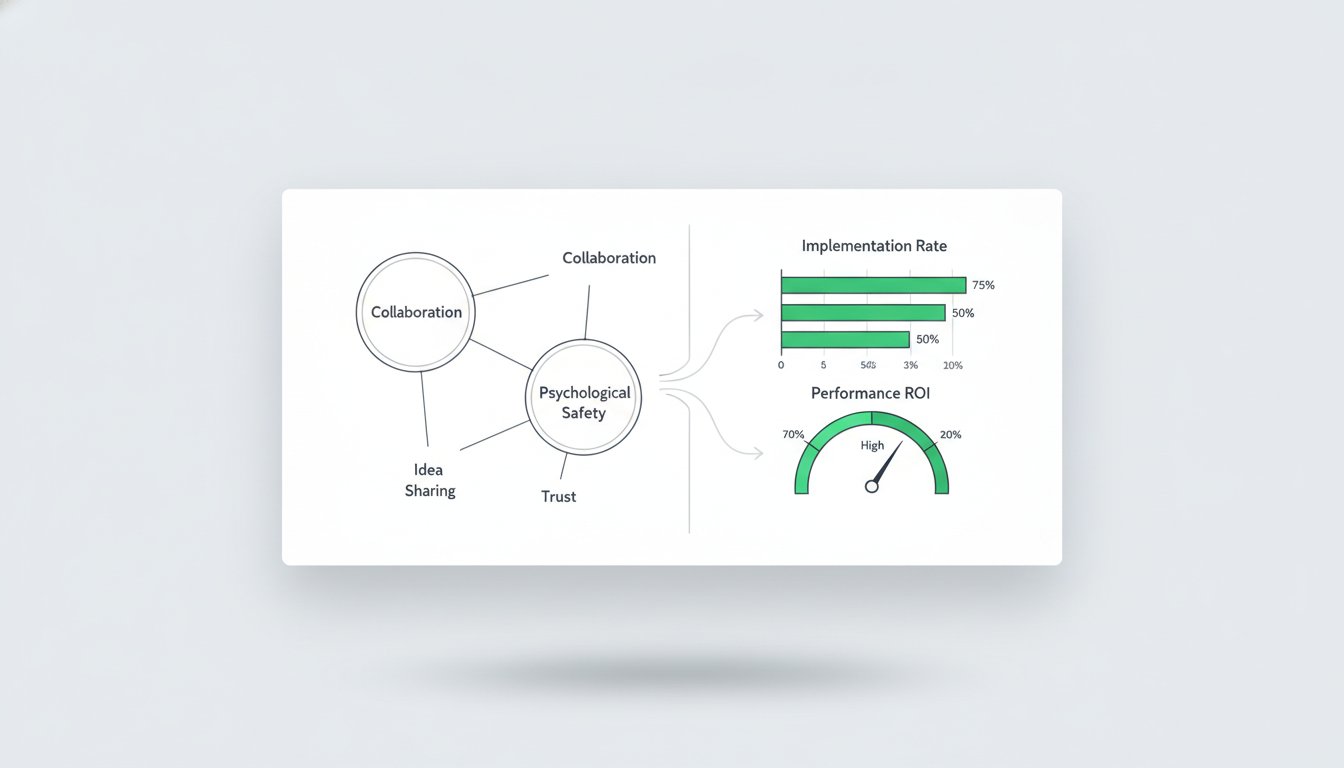
Employees need a clear way to share feedback and see how leaders use it. A structured employee listening program gathers workforce perspectives, identifies recurring themes, and connects them to decisions.
Most enterprise leaders know employee feedback matters. The harder task is building a process employees trust and leaders can act on, without overwhelming workers with surveys or letting comments disappear into a report. Effective employee listening links purposeful questions to business decisions and makes follow-up visible.
This guide explains how to design that process for a large organization. Learn how to define what you need to understand, choose between surveys and direct conversations, and analyze patterns across roles and teams. It also explains how to close the feedback loop so listening informs everyday decisions rather than becoming a one-time exercise.
Key Takeaways
- Match each listening channel to the decision you need to make, rather than collecting feedback without a clear purpose.
- Use regular, lightweight check-ins alongside deeper listening methods to spot changes and understand what is driving them.
- Pair survey patterns with focus groups and direct conversations to add context and surface issues broad questions can miss.
- Analyze responses across relevant roles and employee groups, then connect the findings to specific decisions and actions.
- Close the loop by sharing what you heard, what will change, and how progress will be communicated.
What Is Employee Listening?
Employee listening is a structured process for gathering workforce feedback and connecting it to decisions. In the United States, employers should explain what information they collect and why. Privacy and consent requirements vary by state and situation, so design each channel with clear notice and appropriate safeguards.
-
Collect Feedback Across Multiple Channels
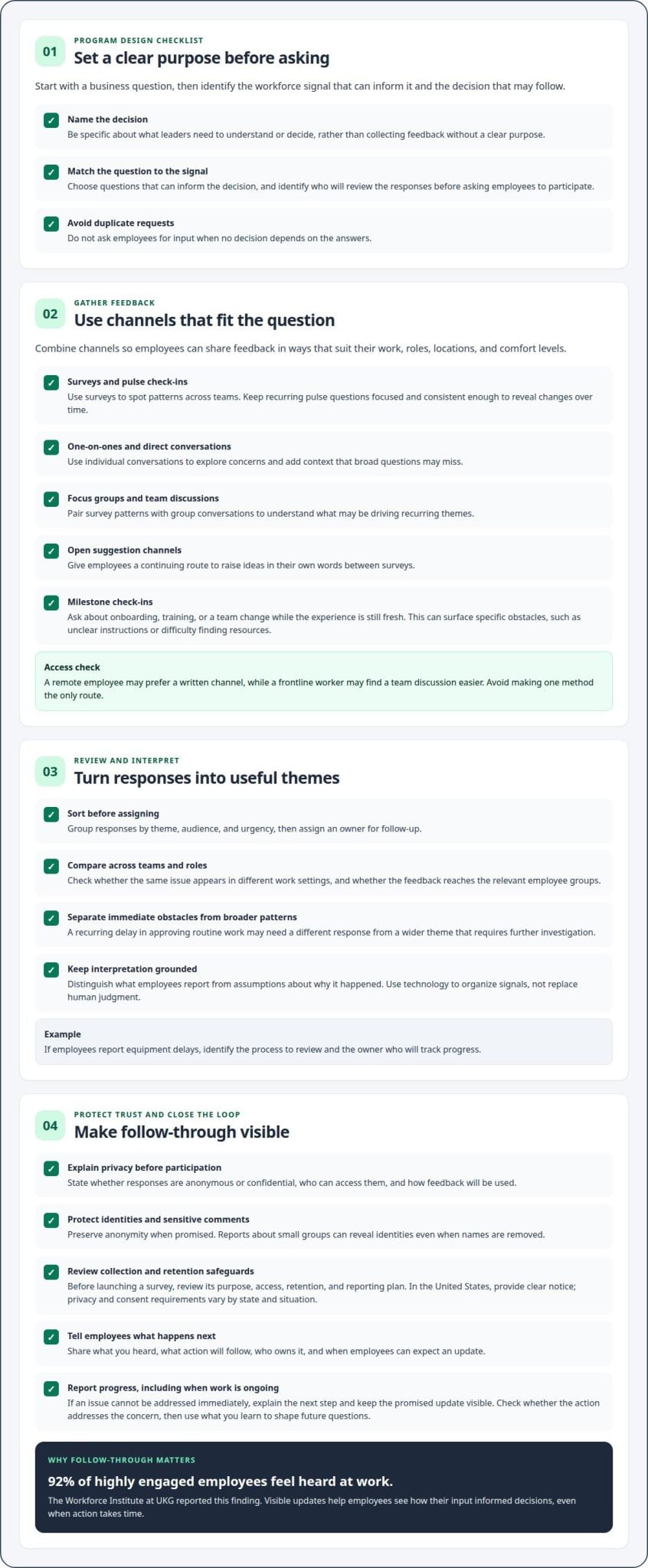
Choose channels that fit the question: surveys can reveal patterns across teams, one-on-ones can explore individual concerns, and open suggestion channels let workers raise ideas in their own words. An employee suggestion program can give employees a continuing route to share proposals between surveys. Check that each channel reaches the relevant roles and locations. Avoid sending duplicate requests when no decision depends on the answers.
-
Respond to Employee Feedback
Sort responses by theme, audience, and urgency before assigning an owner. Separate an immediate obstacle, such as recurring delays in approving routine work, from a broader pattern that needs investigation. Compare themes across teams to see whether the same issue arises in different work settings. Protect identities when handling sensitive comments, and distinguish employees’ reports from assumptions about why an issue occurred.
-
Close the Feedback Loop
Tell employees what they raised, what action will follow, and when to expect an update. If workers report equipment delays, explain which process will be reviewed and who will track progress. Share the action plan with affected employees, then provide updates as work continues. If a concern cannot be addressed immediately, explain the next step and keep the promised update visible.
-
Address Survey Privacy and Anonymity
Explain whether responses are anonymous or confidential before employees participate, and identify who can access them. Preserve anonymity when it is promised; reports about small groups can reveal identities even without names. Employers in the United States should give clear notice about workplace feedback collection, and some situations or jurisdictions may require consent. Review the purpose, access, retention, and reporting plan before launching a survey.
Make feedback actionable by connecting each theme to a specific decision, such as revising a handoff that delays work. Track whether the change addresses the concern, then use what you learn to shape future questions and actions.
Think of employee listening as a cycle: systematically gather and act on workforce feedback through surveys, pulse listening, and other signals to guide decisions. Start with a business question, identify the workforce signal that can inform it, and decide what action might follow. This keeps listening purposeful instead of treating feedback collection as an end in itself. Once a decision is made, explain how feedback informed it and what happens next.
Visible follow-through can help build trust: 90% of workers report being more likely to stay at a company that takes and acts on feedback. The Workforce Institute at UKG reported that 92% of highly engaged employees feel heard at work. Share employee listening action plans with employees and report back on progress, including when work is still underway. Consistent updates make it easier for employees to see that their input was considered, even when the response takes time or the final action differs from what they proposed.
Continuous listening strategies
Common methods include pulse surveys, manager one-on-ones, focus groups, onboarding check-ins, and open suggestion channels. A continuous listening strategy combines these options so employees can share feedback between major surveys, not only when leaders ask.
- Set a dependable listening rhythm. Use recurring pulse surveys to track a focused priority, such as workload or confidence in a change. Keep questions concise and consistent enough to reveal meaningful shifts over time. Before sending each pulse, identify who will review the responses and which decision the results could inform. A rhythm without review creates extra requests for employees, not useful insight for leaders.
- Make feedback available between surveys. Offer options that fit different work patterns: a manager conversation, an open suggestion channel, or a brief digital check-in. A remote employee may prefer a written channel, while a frontline worker may find a team discussion easier. Avoid making one method the only route. Access, schedules, and comfort with speaking publicly vary across roles.
- Connect listening moments to employee milestones. Ask new hires about onboarding while the experience is fresh, and invite feedback after relevant events such as training or a team change. These touchpoints can uncover specific obstacles, such as unclear instructions or difficulty finding resources. Asking near the experience helps employees provide useful detail rather than relying on distant recollection.
- Use technology to organize signals, not replace judgment. A listening platform can bring survey responses and suggestions into a shared view, making it easier to group themes and assign follow-up. Define access, ownership, and review practices before using the data. Distinguish recurring patterns from isolated comments, and consider the context behind each response. Technology should help people investigate and act, not reduce concerns to scores.
- Measure whether the cadence works. Track participation, recurring themes, response times, and whether actions reach the teams that raised concerns. Review these indicators together: a high response rate alone does not show that employees find the process useful. If participation falls or the same issue resurfaces, revisit the channel, question, or follow-up. Refine the listening strategy using what you learn instead of simply sending more requests.
For a steady improvement cycle, connect feedback themes to the practical stages in continuous improvement. Then share what changed and what remains under review. A walkthrough of employee feedback workflows can help teams explore how to organize ongoing suggestions.
Focus groups and direct employee interactions
Use direct conversations to understand what lies behind survey patterns. Focus groups, one-on-ones, suggestion channels, and employee resource groups each reveal different aspects of the employee experience.
- Build focus groups around a specific question. Invite employees who share an experience, such as a recent workflow change or onboarding process. Ask open-ended questions, then follow up for concrete examples: “Where did the handoff slow down?” A facilitator should make room for quieter participants and avoid treating one person’s perspective as representative of everyone.
- Pair group discussions with one-on-one meetings. Use focus groups to identify common themes, then offer individual conversations for concerns employees may not raise publicly. For example, a team may discuss meeting load together, while one-on-ones reveal how schedules affect particular roles. Combining these channels gives leaders a broader view without assuming everyone feels equally comfortable speaking in a group.
- Keep suggestion channels open between discussions. A physical suggestion box can suit a shared worksite, while a digital channel can reach distributed employees. Explain who reviews submissions and how ideas move forward. An employee suggestion system can connect proposals to evaluation and follow-up, rather than leaving them as isolated comments.
- Partner with employee resource groups. ERGs can help leaders hear experiences tied to inclusion, workplace access, or belonging. McKinsey reported that 83% of employee resource group participants felt included in the workplace. Treat that finding as a reason to invite ERG perspectives, not as proof that every group or employee has the same experience. Agree on the discussion topic and how feedback will inform decisions.
- Link conversation themes to other evidence. Compare focus group observations with relevant survey results, turnover themes, or operational measures. If employees describe repeated approval delays, examine where they occur in the process before choosing a solution. Linking evidence helps distinguish a widely shared barrier from an isolated event while preserving the context behind each comment.
- Offer digital participation with clear facilitation. Remote focus groups can include employees across locations, but a video call alone does not ensure balanced input. Share prompts in advance, invite written responses, and use a moderator to manage turn-taking. For a monthly employee resource group listening session, record themes rather than attributing sensitive comments to individuals, then explain how leaders will use the findings.
Listening program maturity and analytics
Use short pulse surveys for timely signals and an annual engagement survey for deeper analysis. The right cadence depends on whether leaders can review results and act between listening cycles.
- Establish a useful baseline. Start with a small set of questions tied to priorities such as workload, communication, or confidence in change. Then compare responses across relevant teams and time periods. 74% of surveyed organizations use annual formal, large-scale employee engagement surveys, 15 percentage points lower than five years earlier. Treat annual results as one input, not the whole picture.
- Combine survey data with other workforce signals. 59% of organizations gather engagement data from sources beyond surveys. Add relevant indicators, such as onboarding feedback, recurring suggestions, or operational trends, to understand what survey scores may mean. Keep the purpose clear: a rise in reported workload concerns, for example, can prompt a review of staffing patterns or process bottlenecks.
- Analyze patterns before predicting outcomes. Compare engagement results with changes in teams, roles, or employee experience, then check whether the same themes recur over time. Predictive modeling can help identify relationships between signals and outcomes, but a relationship alone does not prove cause. Treat a model’s output as a prompt for investigation, not a verdict about an individual worker.
- Use AI sentiment analysis as a review aid. Text analysis can group open comments around themes such as recognition or workload, helping analysts focus their review. Check examples behind each theme: sarcasm, local terminology, and context can change a comment’s meaning. Do not treat an automated sentiment score as a direct measure of culture or engagement, and restrict access to sensitive responses.
- Reduce survey fatigue and act on findings. Avoid repeating questions without a decision in view, and use short pulses when leaders need a focused update. Common risks include over-surveying workers, overlooking underrepresented groups, mistaking correlation for causation, and gathering feedback without follow-up. Assign an owner to each priority theme and share the action that follows. Connecting outcomes to measurable business goals can help teams assess the value of improvements with an idea management ROI calculator.
Program maturity is less about collecting more responses than giving each listening channel a clear purpose. Use continuous pulse surveys for ongoing visibility, while reserving the annual engagement survey for deeper analysis. Keep pulse questions short and frequent enough to surface emerging shifts, but avoid turning every concern into another questionnaire. Choose a focused set of topics leaders can review promptly, and explain how responses will inform next steps.
Analytics should help decision-makers distinguish a temporary fluctuation from a theme that deserves attention. Review results alongside relevant operational context, and check whether a pattern persists across listening cycles before drawing conclusions. When comments point to an issue, revisit the underlying feedback and seek context instead of relying on a summary alone. Close the loop by communicating what was heard, what will be examined, and what action is feasible. If no change is planned, explain why and when the issue may be revisited. This keeps listening connected to decisions and helps sustain confidence in the process.
Employee listening program design
Build the program around decisions leaders need to make, not a calendar of surveys. A clear design links each question to a workforce group, a method, an accountable owner, and a planned response.
- Define the decision before writing questions. Identify what leaders need to understand and how answers might shape action. For example, if onboarding feedback will guide process changes, decide which teams own those changes before collecting responses. This keeps the program focused and makes it easier to explain why employees are being asked for feedback.
- Map listening moments to the employee journey. Plan opportunities around experiences that can reveal specific friction, such as onboarding, learning, or a team transition. A new-hire plan can use check-ins at days 7, 30, 60, and 90. Choose the moments that align with your decisions, rather than asking the same questions at every stage. Understanding these key milestones also informs external talent attraction, where specialists like GBS Worldwide help organizations translate internal employee insights into an authentic employer brand strategy.
- Tailor questions to the audience. Use role-specific or region-specific prompts when a company-wide question might hide local barriers. For example, ask warehouse employees about shift handoffs and office teams about approval workflows. Keep a shared core of questions for organization-wide comparisons, then add targeted prompts to understand distinct workplace experiences.
- Set clear ownership before results arrive. Form action-planning teams in advance, with leaders responsible for reviewing findings and deciding next steps. Assign each priority theme to an owner who can coordinate relevant teams. This prevents results from landing in an inbox without a decision-maker and gives employees a clear route from feedback to action.
- Tell participants when they will hear back. Explain which audiences will receive results and when they can expect an update. Share survey results with specific groups ideally within 30 days. If one team reports unclear handoffs, communicate the finding to that audience and name the next review step. A defined update date makes follow-through part of the design.
- Choose a manageable core question set. Limit the core engagement survey to 10-15 items, then use focused follow-ups when results reveal a specific issue. This supports comparison over time without making every listening moment a full assessment. Review each question for clarity and purpose: remove items that won’t inform a decision or help explain a result.
- Build a repeatable action cycle. After each listening round, document the theme, affected audience, owner, next action, and update date. For example, a concern about career growth or leadership readiness could prompt targeted support from Rainmakers Coaching International, followed by a progress update for affected employees. Use this record to distinguish completed actions from issues still being investigated.
Ideawake: Employee Suggestion Platform
Ideawake’s Employee Suggestion Platform gives organizations a structured way to capture, evaluate, and implement employee ideas. It fits when listening reveals opportunities employees can help solve, such as recurring workflow obstacles or ways to improve day-to-day operations.
Use the platform to connect employee input with a defined review process, rather than leaving ideas scattered across meetings, messages, and documents. Leaders can bring suggestions together, assess them, and move suitable ideas toward implementation. This complements surveys and conversations: those methods help identify concerns, while an employee suggestion platform provides a path for actionable ideas.
For organizations building a broader program, Ideawake’s Idea Management Platform and Continuous Improvement offering can help turn employee contributions into practical improvements.
Contact Ideawake to discuss how its Employee Suggestion Platform can fit your listening program.
Make Listening Part of How Work Improves
Make employee listening part of how your organization adapts, not a separate HR exercise. Treat each new priority as a chance to learn: define the decision, invite input from the people closest to the work, and use what you hear to shape the next improvement. Over time, this approach can help leaders spot processes that need attention and ideas employees think could work better.
Ideawake supports this work through its Innovation Management Platform, Idea Management Platform, and Continuous Improvement offering. These options help organizations gather ideas, evaluate them, and move selected improvements forward in a structured way. Connect your listening goals to the decisions and workflows your teams want to improve.
Build a program that makes employee input useful, visible, and connected to better work. Each thoughtful action creates an opportunity for a stronger next conversation.
Frequently Asked Questions
What does a mature listening ecosystem look like at 12-18 months?
At 12-18 months, maturity is better judged by dependable practice than elapsed time alone. A mature program has consistent definitions for key measures, clear data access rules, and a record linking feedback to decisions. For example, leaders can compare how business units describe role clarity while preserving enough context to understand why employees’ experiences differ.
What are the benefits of employee listening programs?
These programs help leaders identify workplace friction, compare experiences across functions, and prioritize changes grounded in employees’ firsthand knowledge. For example, if new hires in several departments describe unclear ownership during role transitions, HR and operations can examine that handoff instead of launching a broad engagement initiative. This gives decision-makers a clearer view of shared concerns and issues that need targeted attention.
How do you build an effective workforce feedback strategy?
Start with a written program charter naming the business question, employee population, method, decision owner, privacy approach, and review date. Pilot the plan with one business unit before expanding it. For example, test whether a question about role clarity means the same thing to frontline and corporate teams, then refine it before comparing results across the organization.
How should employers analyze and act on employee feedback?
Separate employees’ direct observations from interpretations before deciding what feedback means. If workers report missed deadlines, distinguish their stated explanations from assumptions about workload or management. Compare comments with relevant operational context, document the decision and its rationale, and assign an owner to track the result. This gives leaders a practical way to assess whether their employee listening efforts addressed the underlying issue.