Tag Archives: Operational Excellence

Operational Excellence Management System Guide

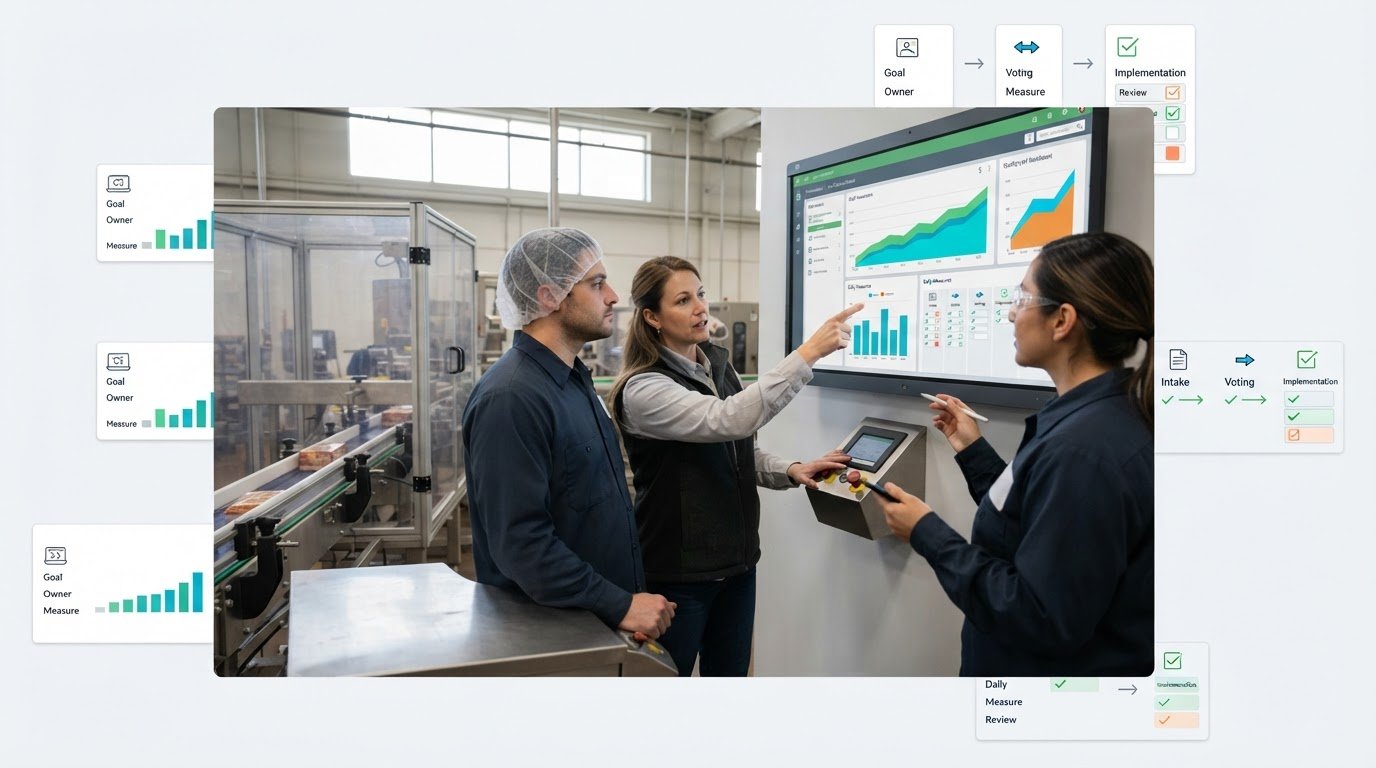
A packaging-line team reviews operational measures and employee improvement ideas in a dashboard.
Coby Skonord|
November 11, 2026

A strategy that never reaches the front line is just paperwork. An operational excellence management system connects organizational goals to everyday work, giving leaders and employees a shared way to improve processes, quality, safety, and customer experience. It brings responsibilities, performance measures, and regular reviews into one system, making improvement part of how work gets done.

That takes more than choosing a method or setting a target. The system must align daily management with broader priorities, make performance visible, and give employees a practical way to raise and address problems. This guide explains how it works, what it is designed to achieve, and how Lean, Six Sigma, and Kaizen can support improvement. You’ll also learn how daily management connects plans to consistent action.

Key Takeaways

  • Connect strategic priorities to daily work with clear ownership, performance measures, and regular review.
  • Use recognized standards, such as ISO 9001, as reference points when shaping a system around your organization’s needs.
  • Choose improvement methods based on the problem: Lean targets waste, Six Sigma focuses on variation and defects, and Kaizen supports ongoing incremental change.
  • Use a Plan-Do-Check-Act cycle to set actions, carry them out, review results, and refine procedures.
  • Align daily management across teams so employees can surface problems, follow standards, and contribute improvement ideas.

What Is an Operational Excellence Management System (OEMS)?

An operational excellence management system connects strategic priorities with the routines, standards, and decisions that shape daily work. It gives leaders and employees a shared structure for improving quality, productivity, and customer experience.

Leadership and Improvement Culture

Leadership and improvement culture shape how continuous improvement becomes part of everyday work. Leaders’ choices signal whether employees are encouraged to raise problems, test better approaches, and learn from results.

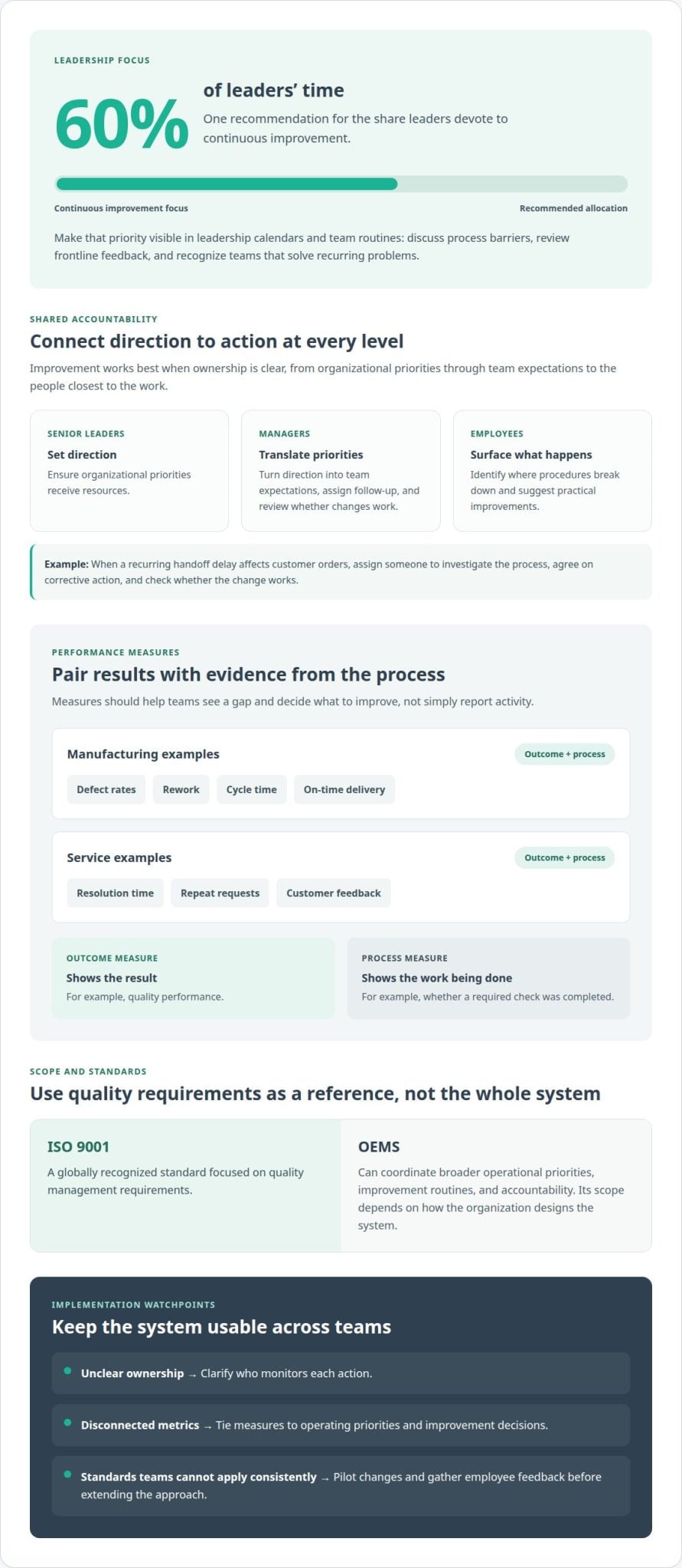
A useful starting point is to make improvement visible in leadership calendars and team routines. One recommendation is for leaders to spend 60% of their time on continuous improvement. Leaders can reinforce that priority by discussing process barriers, reviewing frontline feedback, and recognizing teams that solve recurring problems. The continuous improvement approach works best when those actions connect to clear operating priorities, rather than becoming a separate initiative.

Accountability for Operational Excellence

Accountability means assigning ownership for performance standards, improvement actions, and follow-up decisions. Without an owner, an issue can persist across shifts, teams, or locations.

Senior leaders set direction and ensure priorities receive resources; managers translate those priorities into team expectations. Employees closest to the work can spot where procedures break down and suggest practical changes. For example, if a recurring handoff delay affects customer orders, a manager can assign someone to investigate the process, agree on corrective action, and review whether the change works. This creates shared responsibility without making improvement solely a leadership task.

Metrics and Performance Indicators

Metrics and key performance indicators show whether operational priorities are producing stronger results. They are most useful when they help teams identify a gap and decide what to improve, rather than simply report activity.

Useful measures depend on the operation and its goals. A manufacturing team might monitor defect rates, rework, cycle time, and on-time delivery; a service team might track resolution time, repeat requests, and customer feedback. Pair outcome measures, such as quality, with process measures, such as whether a required check was completed. Leaders can then see what changed and which part of the work needs attention.

ISO 9001 is an example of a globally recognized standard relevant to an operational excellence management system, according to the International Organization for Standardization. ISO 9001 focuses on quality management requirements, while an operational excellence management system can coordinate broader operational priorities, improvement routines, and accountability. Business management systems may cover additional organizational functions, so the scope depends on how the organization designs its system.

Common implementation risks include unclear ownership, disconnected metrics, and standards that teams cannot apply consistently. Leaders can reduce these risks by piloting changes, gathering employee feedback, and clarifying who monitors each action before extending the approach across the organization.

What Is an Operational Excellence Management System (OEMS)?

An operational excellence management system connects strategic priorities with the routines, standards, and decisions that shape daily work. It gives leaders and employees a shared structure for improving quality, productivity, and customer experience. In practice, it clarifies how teams identify process problems, assign actions, and assess whether changes support organizational goals.

Leadership and Improvement Culture

Leadership and improvement culture shape how continuous improvement becomes part of everyday work. Leaders’ choices signal whether employees are encouraged to raise problems, test better approaches, and learn from results. A written standard alone cannot show teams how to respond when actual work differs from the documented process.

A useful starting point is to make improvement visible in leadership calendars and team routines. One recommendation is for leaders to spend 60% of their time on continuous improvement. Leaders can reinforce that priority by discussing process barriers, reviewing frontline feedback, and recognizing teams that solve recurring problems. The continuous improvement approach works best when those actions connect to clear operating priorities. For example, a manager can make an unresolved process barrier a standing agenda item and assign follow-up to the relevant team.

Accountability for Operational Excellence

Accountability means assigning ownership for performance standards, improvement actions, and follow-up decisions. Without an owner, an issue can persist across shifts, teams, or locations.

Senior leaders set direction and ensure priorities receive resources; managers translate those priorities into team expectations. Employees closest to the work can spot where procedures break down and suggest practical changes. For example, if a recurring handoff delay affects customer orders, a manager can assign someone to investigate the process, agree on corrective action, and review whether the change works. This creates shared responsibility without making improvement solely a leadership task.

Metrics and Performance Indicators

Metrics and key performance indicators show whether operational priorities are producing stronger results. They are most useful when they help teams identify a gap and decide what to improve, rather than simply report activity.

Useful measures depend on the operation and its goals. A manufacturing team might monitor defect rates, rework, cycle time, and on-time delivery; a service team might track resolution time, repeat requests, and customer feedback. Pair outcome measures, such as quality, with process measures, such as whether a required check was completed. Leaders can then see what changed and which part of the work needs attention.

ISO 9001 is an example of a globally recognized standard relevant to an OEMS, according to the International Organization for Standardization. ISO 9001 focuses on quality management requirements, while an OEMS can coordinate broader priorities, improvement routines, and accountability. Business management systems may cover additional organizational functions, so their scope depends on how an organization designs and connects its processes.

Common implementation risks include unclear ownership, disconnected metrics, and standards that teams cannot apply consistently. Leaders can reduce these risks by piloting changes, gathering employee feedback, and clarifying who monitors each action before extending the approach across the organization. This makes gaps visible while there is still time to adjust processes and responsibilities.

Lean, Six Sigma, and Kaizen help teams translate strategic priorities into practical improvement actions. An operational excellence system can combine them, matching each method to the problem instead of treating one tool as a universal fix.

Match the Method to the Problem

Six Sigma provides a structured way to investigate variation and defects. General Electric implemented Six Sigma to enhance process quality and reduce defects across its manufacturing units. A team could define a defect precisely, examine where it occurs, and use process data to identify contributing factors before testing a countermeasure. This approach is useful when inconsistent results persist despite clear work instructions.

Kaizen emphasizes ongoing, incremental improvement involving the people who do the work. A team might use a shift handoff to surface a recurring equipment setup problem, test a small adjustment, and record its effect. The value lies in learning through manageable changes, not launching a major redesign for every issue.

Use Root-Cause Tools Before Choosing Actions

The 5 Whys and fishbone diagrams help teams investigate underlying causes instead of treating visible symptoms. If a shipment leaves late, a fishbone diagram can organize possible causes across staffing, materials, equipment, and procedures. The 5 Whys then helps trace a specific delay to a process cause, such as an unclear release step. Teams can select actions that address the cause and monitor whether the problem recurs.

The Shingo Model adds principles that connect methods to organizational behavior: quality at the source, customer value, a zero-inventory supply chain, and understanding the workplace at all levels. These principles help leaders assess whether a proposed improvement supports the broader system. Dr. Shigeo Shingo published 18 books on his business philosophy, reflecting a body of work focused on improvement and operational practice.

There is no need to force every tool into every initiative. A team confronting excess process steps may start with Lean; a team investigating recurring defects may use Six Sigma; employees identifying small daily frustrations may apply Kaizen. For sustainability, 3M’s Pollution Prevention Pays program has prevented more than 2.66 million tons of pollutants, while its long-running process improvement and sustainability work has saved nearly $2.3 billion USD. These examples show how improvement methods can address both operational and environmental priorities.

Let the strategic objective guide method selection: define the issue, choose a suitable tool, test targeted actions, and review the result. This keeps improvement practical and focused on outcomes that matter to the operation.
Operational Excellence Management System Guide

Management system cycle

A management system needs a repeatable cycle for turning priorities into action and learning from results. Plan-Do-Check-Act (PDCA) provides a practical structure for setting goals, carrying out measures, auditing work, and reviewing procedures.

Implementation follows a clear sequence: define the operating priority, pilot a response, review the evidence, then refine and expand the practice.

  1. Plan: Define the performance issue and the outcome the team needs. For example, a distribution center might address recurring order-picking errors. Set an action plan, identify who owns each action, and choose a measure that shows whether errors are changing. Record the current procedure and conditions that could affect the result, such as staffing patterns or material availability.
  2. Do: Carry out the planned measures in a pilot area before launching them across the organization. A warehouse team could test a revised picking sequence in one workflow, brief affected employees, and record where the new practice differs from the plan. A pilot makes operational friction visible while the scope remains manageable. It also gives employees a specific opportunity to report unintended effects.
  3. Check: Compare the observed result with the objective, and audit whether the agreed procedure is being followed. If errors continue, examine whether the cause lies in the sequence, training, materials, or another process condition. An audit should identify gaps and evidence, not simply confirm that a form was completed. The review should distinguish between a weak countermeasure and inconsistent execution.
  4. Act: Use the review to adjust the procedure, clarify responsibilities, or select another countermeasure. If the pilot shows the revised sequence is practical and supports the objective, leaders can standardize it and plan how to extend it. If it fails to address the issue, return to planning with what the test revealed. Documenting the decision helps other teams understand what changed and why.

The cycle also needs a defined review rhythm. Leaders should review the system and its achievements annually, then assess whether objectives, measures, and procedures still fit operational priorities. A review can examine unresolved actions, audit findings, recurring problems, and lessons from pilots. It should identify practices that need clearer ownership or follow-up, keeping the system useful instead of letting it become static documentation.

Feedback matters during both the pilot and wider rollout. Employees can explain where a proposed change creates delays, conflicts with another procedure, or complicates a handoff. Gathering their input before organization-wide implementation gives leaders time to refine actions and establish workable standards. Without this feedback loop, a change may be formally launched but fail to become consistent practice across teams.

PDCA supports efficiency by making review part of execution, not a separate cleanup exercise. Success depends on clear objectives, assigned action owners, evidence from the work, and decisions that change practice when results call for it. This discipline makes each cycle a useful test of how well the operation performs and adapts.

Daily management systems and organizational alignment

Daily management connects organizational priorities with the decisions employees make in routine work. It works best when strategic objectives, team measures, and frontline actions are clearly linked.

Consider a manufacturer focused on improving delivery reliability. Executives set the priority, site leaders translate it into operating goals, and production teams track issues affecting completed orders. A daily review connects missed targets to specific causes, such as a delayed material handoff or an unclear work instruction. Each level can act within its authority while keeping the shared objective in view.

Alignment takes more than cascading targets. Teams should understand how their measures affect other groups’ work. If production increases output while inspection capacity stays fixed, completed units may wait for review. A shared view of production flow, inspection queues, and delivery status helps leaders see the trade-off and coordinate a response across departments.

Daily huddles and visual management make this coordination practical. A team might review its current performance measure, flag a deviation, assign an owner, and record the next action. A meeting is useful when it resolves a work issue or escalates a barrier, not when it repeats status reports without decisions. Consistent routines engage employees by giving them a clear way to raise obstacles and follow up.

Layered process audits help verify that agreed standards are followed and issues are corrected before they recur. For example, supervisors can check whether teams follow a critical equipment procedure, record a gap, and track its correction. Audit findings can also show where a standard is impractical, prompting leaders to revise the process instead of blaming employees for workarounds.

To implement the system across a large organization, define the alignment chain in plain terms: enterprise objective, site or function contribution, team measure, and frontline action. Then decide who reviews each measure, how teams escalate blocked work, and where decisions are recorded. This structure helps prevent local improvements from undermining broader priorities.

Software can support the system by bringing measures, action owners, audit findings, and employee input into a shared view. It should make work easier to understand, not add another reporting burden. For example, when a team identifies a recurring handoff problem, a common record can capture the issue, assigned action, and outcome for other teams facing the same challenge. The key is to align the measures, routines, and escalation paths people use to deliver results.

Ideawake: Innovation Management Platform

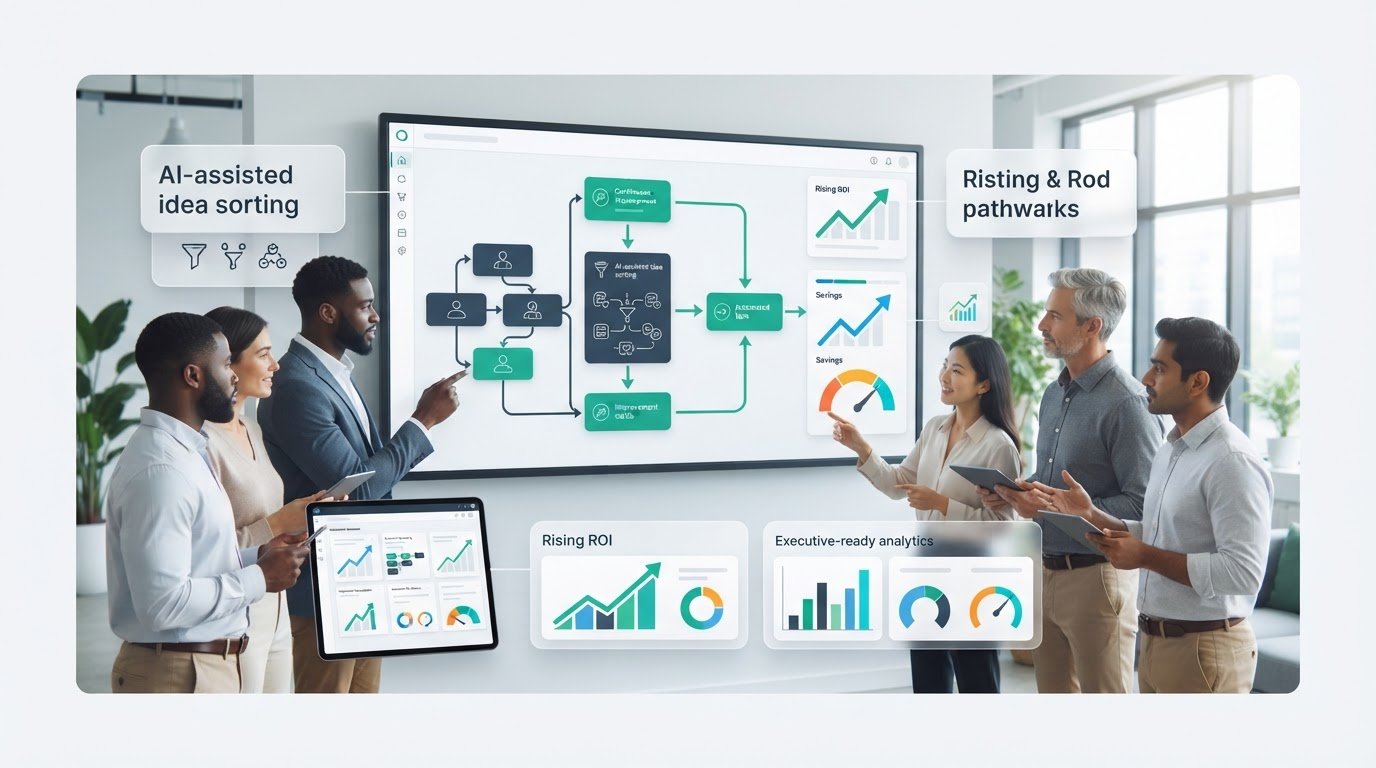
Ideawake’s Innovation Management Platform helps organizations capture, evaluate, and implement ideas from employees, customers, and partners. It fits when improvement depends on engaging people across teams and giving promising suggestions a path from submission to action. Voting, leaderboards, prizes, and AI features support participation and idea review, while a shared process helps teams manage ideas through the innovation lifecycle.

For an operational excellence program, this can help collect frontline proposals, organize evaluation, and track which ideas move toward implementation. It complements daily management by creating a structured channel for suggestions that might otherwise remain within one team or location. Contact Ideawake to discuss how its platform could support your organization’s improvement goals.

Turn Improvement Into a Shared Practice

The next step is to make improvement accessible beyond the teams already involved. An operational excellence management system can provide direction, but employees also need a clear way to contribute ideas, identify opportunities, and help move promising changes forward.

Ideawake offers an Innovation Management Platform, an Idea Management Platform, and Continuous Improvement tools. These offerings help organizations create a more structured path for employee input, evaluation, and implementation. The right starting point depends on where your improvement process needs stronger participation or follow-through.

Consider which gap matters most now: collecting ideas across teams, evaluating them consistently, or connecting selected ideas to action. A focused conversation can help clarify how an idea management approach fits alongside your existing improvement practices.

Your next operational improvement can start with a clearer path for people to contribute. Build that path with purpose and keep progress moving.

Frequently Asked Questions

What is an operational excellence management system?

An operational excellence management system is the coordinated structure an organization uses to manage performance and improve how work is done. It links priorities, responsibilities, processes, and review practices. For example, a company with recurring order errors can use the system to find where they occur, assign an investigation, and decide how to assess a proposed change. The system supports consistent management rather than relying on isolated improvement projects.

What are the core elements of an operational excellence management system?

Core elements include clear governance, defined processes, performance measures, assigned responsibilities, and mechanisms for reviewing risks and improvement actions. Organizations also need document control, so employees can identify the current procedure and understand how updates are approved. For example, a site may keep an approved maintenance procedure, record revisions, and assign a role to review audit findings. These elements help connect local decisions with organization-wide expectations.

What operational excellence frameworks are commonly used, such as Lean, Six Sigma, and Shingo?

Lean, Six Sigma, and the Shingo Model are commonly used frameworks, each offering a different perspective on improvement. Lean examines process flow and waste, Six Sigma focuses on defects and variation, and the Shingo Model connects operational principles with organizational behavior. A team might use Lean to locate a bottleneck, Six Sigma to investigate inconsistent outcomes, and Shingo principles to assess whether a proposed change reinforces customer value.

What software supports operational excellence management, and what does it cost?

Software can support operational excellence by organizing performance information, documenting improvement work, assigning action owners, and making progress visible across teams. Costs depend on the software’s scope, user access, workflows, integrations, and support requirements. For an enterprise, the deciding factor is whether the system fits existing processes and governance needs, not simply how many features it includes. Compare the work it enables with the effort required to administer it.

How can organizations build a culture of continuous improvement and employee engagement?

Organizations build a continuous improvement culture by making it safe and worthwhile for employees to raise problems, then responding visibly to their input. For example, after a frontline employee flags a confusing approval step, a manager can explain whether the process will change, who owns the review, and what happens next. Closing the feedback loop shows that participation leads to decisions, even when an idea is not adopted.

What U.S. regulations or industry standards affect operational excellence management systems?

ISO 9001 is a globally recognized standard relevant to an OEMS, and IATF 16949 is an example of a third-party certification audit standard. The material does not identify specific U.S. regulations.
Article by

Coby Skonord

Coby Skonord is the co-founder and CEO of Ideawake. Since 2013 he has worked with enterprise innovation, continuous improvement, and HR leaders to turn employee ideas into measurable business impact.

Enterprise Continuous Improvement Tools: The 2026 Strategy for Scalable ROI

Enterprise Continuous Improvement Tools: The 2026 Strategy for Scalable ROI
Coby Skonord|
September 20, 2026

Only 7% of organizations have successfully scaled operational excellence mechanisms enterprise-wide, according to research from McKinsey. Most leaders realize that relying on manual spreadsheets and fragmented email chains to manage growth is a losing strategy. You’re likely tired of seeing high-potential ideas die in administrative bottlenecks or struggling to quantify the financial impact of frontline suggestions. It’s time to demand more from your enterprise continuous improvement tools than just a digital suggestion box.

You’ll discover how to transition from broken feedback loops to a high-impact, AI-driven system that delivers measurable enterprise growth. We’ll examine the shift toward centralized “systems of intelligence” that align with the new ISO 9001:2026 standards, providing a clear roadmap for automated workflows and executive-ready ROI dashboards. This guide breaks down how to use modern idea management software and task-specific AI agents to eliminate administrative overhead, ensuring every improvement contributes directly to your bottom line.

Key Takeaways

  • Learn why legacy methods like spreadsheets create a “Chaos Gap” and how to bridge it with a centralized digital system of record.
  • Discover how AI-driven evaluation and automated deduplication slash administrative burden by prioritizing the highest-impact improvements.
  • Evaluate the total cost of ownership between custom builds and modern enterprise continuous improvement tools to ensure long-term scalability and compliance.
  • Follow a proven 5-step implementation roadmap that uses targeted Innovation Challenges to solve specific business problems with frontline insights.
  • Master the transition from tracking vanity metrics to hard financial outcomes by using ROI calculators to quantify cost savings for executive buy-in.

The Evolution of Enterprise Continuous Improvement: Why Legacy Methods Fail

The transition from physical suggestion boxes to digital innovation hubs isn’t just a tech upgrade; it’s a survival requirement. For decades, organizations relied on manual continual improvement processes that lived on plant floor whiteboards or in locked wooden boxes. These methods are fundamentally unscalable for the modern enterprise. Today, the “Chaos Gap” occurs when leadership attempts to manage complex operational excellence through spreadsheets and fragmented email threads. These manual systems lack auditability and real-time visibility, causing high-impact ideas to vanish into departmental silos before they ever reach a decision-maker.

Research from McKinsey indicates that roughly 70% of digital transformations fail, often due to poor employee engagement and a lack of structured support. Without dedicated enterprise continuous improvement tools, the momentum of any initiative quickly stalls. This is why forward-thinking organizations are increasingly appointing a Chief Innovation Officer to centralize the CI toolset and ensure that feedback loops remain closed and productive. A centralized platform transforms innovation from a vague cultural goal into a repeatable, data-driven business process.

The Hidden Costs of Fragmented CI Systems

Relying on legacy tools creates a significant administrative burden. Innovation managers often spend up to 40% of their week manually updating status reports or chasing stakeholders for feedback. This overhead isn’t just a waste of talent; it creates a “feedback black hole” where employees stop submitting ideas because they never hear back. When frontline insights are trapped in silos, the organization loses the ability to replicate small wins across different business units, directly impacting the bottom line. This fragmentation prevents the collection of clean data, making it nearly impossible to defend the program’s ROI during budget reviews.

Modern CI in a Hybrid World

The rise of distributed workforces means that innovation management for remote teams must be centralized and accessible from any device. Passive suggestion programs are being replaced by active “Innovation Challenges” that target specific operational bottlenecks. By establishing a single source of truth, enterprise continuous improvement tools allow teams to collaborate on solutions in real-time. This shift ensures that every employee, whether in a corporate office or on a manufacturing floor, has the power to contribute to the organization’s growth. Moving away from passive collection to active problem-solving is what separates high-performing enterprises from those stuck in perpetual pilot mode.

Essential Features of Modern Continuous Improvement Software

Modern software replaces passive suggestion boxes with structured, digital intake systems. These enterprise continuous improvement tools utilize standardized forms to ensure every idea arrives with the necessary context for evaluation. This structure aligns with the continuous improvement model promoted by the American Society for Quality, which focuses on reducing process variation through disciplined data collection. By centralizing this intake, organizations eliminate the “Chaos Gap” where valuable insights are lost to informal conversations or unmonitored email threads.

Leveraging AI for Idea Evaluation

Gartner predicts that 40% of enterprise applications will feature embedded, task-specific AI agents by the end of 2026. Within Ideawake AI, this technology moves beyond simple storage. The platform automatically identifies duplicate submissions and clusters related trends, preventing innovation managers from being buried under repetitive data. By applying automated scoring based on strategic feasibility, the system filters high-impact opportunities to the top. This significantly reduces “review fatigue,” allowing leadership to focus their energy on implementation rather than administrative sorting. Organizations can also leverage solutions like aigentia.io to access practical AI tools that help evaluate their current operations and uncover hidden growth opportunities. It’s a shift from being a data clerk to becoming a strategic architect of change.

Gamification and Engagement Dynamics

Sustaining engagement is often the most difficult hurdle in any CI initiative. Data from McKinsey shows that transformations are 1.4 times more likely to succeed when frontline employees generate the improvement ideas. Modern enterprise continuous improvement tools leverage gamification elements like leaderboards and peer voting to drive this participation. Voting acts as social proof, helping the best ideas gain momentum naturally while providing leadership with immediate feedback on what the frontline values most. Transparency is equally vital. When workers see their ideas moving through a visible pipeline, it builds a culture of “Frontline Power” and eliminates the morale-killing “feedback black hole.”

Implementation shouldn’t be a manual hand-off. Automated workflow management ensures that once an idea is approved, it moves through pre-defined stages without getting stuck in an inbox. Organizations adopting integrated process intelligence report an average 30% boost in operational efficiency according to Forrester Research. This end-to-end visibility is essential for scaling operational excellence across global business units. If you’re ready to see how these features function in a live environment, you can schedule a platform walkthrough to explore the interface.

The Build vs. Buy Dilemma: Choosing Your CI Infrastructure

Deciding whether to build an internal tool or purchase a specialized platform is a critical turning point for your operational excellence strategy. In 2026, developing a custom continuous improvement system carries an initial cost between $100,000 and $750,000 in development alone. Beyond the initial build, enterprises must account for annual maintenance and integration overhead, which typically requires an additional 15% to 25% of the original cost every year. These figures lead many organizations to realize that buying a scalable SaaS solution offers a much faster speed-to-value. By selecting specialized enterprise continuous improvement tools, leaders can focus on building a continuous improvement culture rather than managing software bugs and technical debt.

Why Custom-Built Tools Often Stagnate

Evaluating Vendor Flexibility and Scalability

Implementing CI Tools at Scale: A 5-Step Roadmap

Defining Your Strategic Objectives

Step 1 begins with defining specific business problems through targeted “Innovation Challenges.” Instead of asking for generic suggestions, you should focus your workforce on high-priority bottlenecks, such as reducing cycle time in a specific production line. This aligns CI initiatives with high-level Operational Excellence goals. You must select KPIs that go beyond vanity metrics. While participation rates are leading indicators of culture, implementation rates and validated ROI are the lagging indicators that prove the program’s worth. A compelling “Why” serves as the catalyst for employee buy-in, making it clear how their contributions impact the company’s future.

The Pilot Phase: Building Internal Momentum

Establishing clear phases of continuous improvement represents the second critical milestone. Without defined ownership for each stage, ideas stall in the approval process. Step 3 involves launching a high-visibility pilot in a department known for its agility. This “high-win” environment allows you to document the benefits of employee ideation programs quickly, creating internal case studies that convince skeptical stakeholders. Iterating on the submission process during this phase ensures the system is friction-free before a global rollout.

In Step 4, leverage AI to analyze the pilot’s initial results. This technology helps refine evaluation criteria by identifying which types of ideas yielded the highest ROI. Finally, Step 5 involves scaling the program by integrating CI participation into standard performance reviews. When continuous improvement is tied to professional growth, it ceases to be an “extra” task and becomes a core responsibility. This structured approach ensures that your enterprise continuous improvement tools deliver a sustained competitive advantage.

Measuring Success: Turning Continuous Improvement Into ROI

Scaling operational excellence requires more than just a high volume of suggestions; it demands a rigorous focus on financial outcomes. Many leaders make the mistake of tracking vanity metrics, such as the total number of ideas submitted, without correlating them to the bottom line. Modern enterprise continuous improvement tools solve this by providing a direct link between frontline feedback and measurable growth. It’s about the bottom line. By moving beyond participation rates, you can transform your CI program from a cost center into a primary driver of organizational value.

Hard ROI vs. Soft ROI in Continuous Improvement

To secure long-term executive support, you must quantify both the hard and soft returns of your initiatives. Hard ROI focuses on tangible gains like labor-hour reductions and waste elimination. According to Forrester Research, organizations adopting integrated workflow automation see an average 25% reduction in process waste. Utilizing a dedicated ROI calculator allows your team to present these findings with financial precision. Simultaneously, you shouldn’t overlook “Soft ROI,” which includes improvements in employee retention and cultural engagement. Automated dashboards consolidate these data points into real-time reports, ensuring leadership always has a single source of truth for the program’s impact.

The Future of CI: Predictive Analytics

The next evolution of continuous improvement lies in predictive capabilities. Rather than just reacting to past performance, Ideawake AI helps predict the potential impact of an idea before you commit resources to implementation. By analyzing historical data from previous Innovation Challenges, the system can forecast which improvements are most likely to succeed in your specific operational context. This data-driven approach also identifies “Innovation Champions,” the individuals who consistently contribute high-impact solutions, allowing you to foster a core group of internal experts. This shift from historical reporting to predictive intelligence ensures your enterprise continuous improvement tools remain a high-impact asset as you scale.

Book a demo to see how Ideawake tracks ROI in real-time.

Securing a Scalable Future for Enterprise Innovation

The shift from legacy spreadsheets to modern enterprise continuous improvement tools isn’t optional for organizations targeting sustainable growth. By centralizing frontline insights, you’ll eliminate the “Chaos Gap” and ensure every high-potential idea is captured. An AI-powered evaluation engine significantly reduces administrative complexity, allowing your managers to focus on strategic execution rather than manual data entry.

Implementing a structured roadmap ensures your program scales without performance degradation. With end-to-end ROI tracking, you’ll finally provide the financial transparency that executives demand. Transitioning to a specialized platform offers a clear speed-to-value advantage, positioning your organization as a leader in operational efficiency while avoiding the high maintenance costs of custom builds.

Success belongs to those who treat innovation as a data-driven business process. You’ve got the roadmap; now it’s time to execute and unlock your organization’s full potential.

Frequently Asked Questions

What are the best enterprise continuous improvement tools for 2026?

The top tools for 2026 are those that move beyond simple intake to become centralized “systems of intelligence.” Ideawake’s Innovation Management Platform is a primary choice because its modern architecture reduces administrative complexity while supporting the full innovation lifecycle. You should prioritize platforms that offer AI-driven insights and comply with the latest ISO 9001:2026 standards. These tools must provide end-to-end ROI tracking to justify the investment to your organization’s stakeholders.

How does AI improve the continuous improvement process in large organizations?

AI streamlines the evaluation phase by automatically identifying duplicate ideas and clustering related trends. This significantly reduces “review fatigue” for innovation managers. Task-specific AI agents can also predict the potential impact of an improvement before you commit resources to implementation. By automating high-volume administrative tasks, AI allows leadership to focus on strategic execution. Gartner predicts that 40% of enterprise applications will feature embedded AI agents by the end of 2026, and partnering with specialists like Jengara can help organizations establish the overarching AI strategy and governance needed to turn these technologies into measurable business performance.

Is it better to build an internal idea management tool or buy a SaaS platform?

Buying a specialized SaaS platform is typically superior due to the immediate speed-to-value advantage. Building an internal tool often costs between $100,000 and $750,000 initially, with annual maintenance requiring up to 25% of the original build cost. SaaS platforms like Ideawake eliminate this technical debt while providing specialized features like gamification and advanced ROI dashboards. Buying ensures you stay updated with the latest AI protocols without diverting internal IT resources.

How do you measure the ROI of a continuous improvement program?

Measuring ROI requires tracking both hard savings and soft organizational benefits. Hard ROI includes labor-hour reductions, waste elimination, and direct cost savings. Soft ROI focuses on employee retention and cultural engagement. Use an ROI calculator to quantify these impacts for executive reporting. Modern enterprise continuous improvement tools provide automated dashboards that correlate implemented ideas with measurable financial uplift, ensuring the program’s value is always visible to your board of directors.

What features should I look for in continuous improvement software?

Prioritize features that drive engagement and slash administrative overhead. Essential capabilities include:

  • AI-driven idea evaluation and automated deduplication.
  • Gamification elements like leaderboards and peer voting.
  • Mobile-first access for deskless frontline workers.
  • Structured submission forms to ensure high-quality data.
  • Automated stage-gate workflows for seamless implementation.

These features ensure the system scales across global business units without becoming a manual burden for your managers.

How can we encourage employees to participate in CI initiatives?

Encouragement stems from transparency and meaningful recognition. Use gamification features like prizes and leaderboards to make participation rewarding. It’s vital to show employees the progress of their ideas to avoid the “feedback black hole” that kills morale. Launching targeted Innovation Challenges that focus on specific operational bottlenecks also makes the process feel relevant. When workers see their contributions leading to actual changes, their engagement levels naturally increase across the organization.

Can continuous improvement tools integrate with existing software like Teams or Slack?

Idea management is the structured process of capturing and evaluating suggestions from various stakeholders. Continuous improvement is the ongoing effort to enhance products, services, or processes by implementing those ideas. While idea management provides the “what,” continuous improvement focuses on the “how” and the long-term results. A modern platform like Ideawake supports both functions by managing the full lifecycle from the first submission through to the final ROI measurement.

Article by

Coby Skonord

Coby Skonord is the co-founder and CEO of Ideawake. Since 2013 he has worked with enterprise innovation, continuous improvement, and HR leaders to turn employee ideas into measurable business impact.

Continuous Improvement Process Examples: Scaling Operational Excellence in 2026

Continuous Improvement Process Examples: Scaling Operational Excellence in 2026
Coby Skonord|
July 26, 2026

In 2026, the gap between organizations that “do” continuous improvement and those that digitize it has become a chasm that separates market leaders from those falling behind. Most suggestion boxes are effectively graveyards for innovation, where manual tracking and fragmented spreadsheets ensure that high-potential ideas never see the light of day. You likely recognize that your frontline staff holds the keys to significant efficiency gains, yet the struggle to track ROI and maintain employee engagement remains a constant barrier. These continuous improvement process examples demonstrate that operational excellence is no longer a periodic event but a digital-first ecosystem. Manual systems fail because they can’t scale.

With the release of ISO 9001:2026, the industry has shifted its focus toward building a proactive quality culture that prioritizes ethical behavior and risk management. Research indicates that every $1 spent on preventive measures can save an estimated $3 to $5 in emergency fixes later, according to IEEE research. This article provides a clear list of actionable examples and a framework for scaling CI across a global workforce. You’ll discover how top-performing organizations turn frontline ideas into measurable ROI while moving away from the chaos of manual data entry.

Key Takeaways

  • Learn how to modernize traditional frameworks like the PDCA cycle and identify the eight forms of lean waste within your current business operations.
  • Explore ten high-impact continuous improvement process examples ranging from frontline safety protocols to real-time supply chain optimization.
  • Understand why transitioning from fragmented spreadsheets to a centralized platform is essential for scaling operational excellence across global teams.
  • Discover how gamification elements like voting and leaderboards drive employee adoption and prevent suggestion programs from becoming inactive.
  • Master the specific KPIs needed to track the compound financial impact of marginal gains and turn small ideas into measurable ROI.

What is the Continuous Improvement Process? A 2026 Perspective

Continuous improvement isn’t a one-time project; it’s a permanent operational posture. The Continual Improvement Process is a systematic, recurring effort to refine products, services, or internal workflows. In 2026, this concept has evolved beyond simple efficiency. It’s now the primary defense against rapid technological disruption. Organizations that rely on static models find themselves obsolete within months. Modern CI demands agility. It requires a digital infrastructure that captures frontline insights and converts them into data-driven actions. The upcoming ISO 9001:2026 standard reinforces this by placing a fresh emphasis on quality culture and ethical behavior, signaling that improvement is as much about people as it is about processes.

Transitioning from “analog” suggestion boxes to sophisticated idea management platforms is no longer optional. Traditional methods lack the visibility required to sustain momentum. When looking at continuous improvement process examples in high-performing firms, you’ll notice a common thread: they’ve replaced the physical box with a transparent, digital ecosystem. Supporting that transition often requires dependable infrastructure management from specialists like CX IT Services to keep workplace networks and cloud tools operating seamlessly. This shift allows for real-time feedback loops and immediate ROI tracking. It turns a passive “wait and see” approach into an active search for value.

The Core Philosophy: Kaizen vs. Innovation

Operational excellence requires a dual-track approach. Kaizen, or “change for the better,” focuses on small, incremental improvements that compound over time. Radical innovation, on the other hand, seeks disruptive breakthroughs that redefine market positions. Understanding the difference between creativity vs. innovation is vital. While creativity generates the spark, innovation is the disciplined execution of that idea. Balancing incremental vs. radical innovation ensures you aren’t just making the “wrong things” faster. You need both to survive. Kaizen keeps the lights on and margins healthy; radical innovation secures the future. Organizations that ignore one for the sake of the other eventually hit a performance ceiling.

Why Manual CI Processes Fail at Scale

Physical suggestion boxes are the “black holes” of corporate strategy. Ideas enter but rarely return as implemented solutions. This lack of transparency kills employee engagement. If workers don’t see their contributions valued, they stop contributing. Managing these workflows via spreadsheets creates an unsustainable administrative burden. Data becomes fragmented. Tracking the lifecycle of an idea from submission to implementation becomes nearly impossible without a centralized system. Comparing Ideawake vs. spreadsheets reveals that automation is the only way to prove ROI at scale. Without a single source of truth, CI remains a series of isolated events rather than a cohesive strategy. Successful continuous improvement process examples show that a “Value Vault” approach, where every small gain is documented, is the only way to build lasting momentum.

Proven Frameworks: The Foundation of Improvement

Frameworks turn abstract goals into repeatable results. They provide the roadmap for the continuous improvement process examples we see in top-tier organizations today. While Total Quality Management (TQM) serves as the cultural foundation for long-term success, specific methodologies like Six Sigma provide the surgical precision needed for complex problem-solving. Six Sigma’s DMAIC (Define, Measure, Analyze, Improve, Control) framework is particularly dominant in manufacturing, which accounts for 38% of Six Sigma implementations as of 2026. This data-driven approach ensures that decisions are based on statistical evidence rather than gut feeling. TQM, meanwhile, ensures that every employee, from the CEO to the frontline, is personally invested in the quality of the final output.

The PDCA Cycle in a Digital Environment

The Continuous Improvement Model often centers on the Plan-Do-Check-Act (PDCA) cycle. PDCA is a four-stage iterative process used by businesses to achieve continuous improvement through rapid testing and verification. In a modern setting, PDCA is a high-speed loop designed for rapid iteration rather than a slow, quarterly review. Digital platforms now automate the ‘Check’ and ‘Act’ phases by providing real-time data visualization and automated feedback loops. During the ‘Do’ phase, teams can use rapid prototyping to test frontline ideas without committing significant resources. This creates a fail-fast environment where only the most viable improvements move to the control phase, maximizing efficiency while minimizing risk.

Lean Thinking: Eliminating the Friction

Lean is about the relentless pursuit of value by removing anything that doesn’t add it. You must look for the 8 forms of waste, including overproduction, waiting, and untapped employee talent. Bottlenecks often hide in administrative workflows just as much as on the factory floor. Identifying these bottlenecks is only half the battle; you need a system to act on them. Using continuous improvement process examples like real-time waste reporting allows teams to fix issues before they impact the bottom line. By using the top continuous improvement tools available, companies empower frontline workers to spot waste using mobile devices. This ensures that a worker on the shop floor can document a process friction point in seconds. If you’re ready to see how these frameworks look when fully automated, you can explore a digital-first approach to operational excellence.

Moving from theory to execution requires a library of proven continuous improvement process examples that deliver measurable ROI. It’s one thing to understand Lean; it’s another to see it slash operational costs in real time. Organizations that empower their frontline workers to act as sensors for inefficiency often find the highest returns on their investment. These individuals see the friction points that executives miss. By capturing these insights through a centralized idea management software, companies ensure that no valuable suggestion is lost in a fragmented spreadsheet.

Consider frontline safety as a primary example. By using employee-led reporting instead of top-down audits, companies identify hazards before they lead to costly injuries. This proactive stance aligns with industry data showing that every $1 spent on preventive measures saves an estimated $3 to $5 in emergency fixes, according to savi.com. Supply chain optimization provides another high-value case. Instead of relying solely on automated GPS, top performers integrate real-time route adjustments based on driver feedback. Drivers spot local bottlenecks and changing conditions that static algorithms miss, ensuring faster delivery times and lower fuel consumption.

Operational & Manufacturing Examples

  • SMED (Single Minute Exchange of Die): Reducing changeover time on production lines to increase flexibility.
  • Digital ‘Andon’ Cords: Implementing virtual error reporting that allows workers to flag defects instantly.
  • Packaging and Material Optimization: Partnering with packaging specialists such as OEM Materials & Supplies to standardize box dimensions, prevent transit damage, and eliminate packing line waste.

Service & Administrative Examples

  • Email Fatigue Reduction: Implementing structured collaboration tools to replace chaotic internal threads.
  • Onboarding Optimization: Refining the employee onboarding process based on direct feedback from new hires.
  • Process Flaw Identification: Using reverse brainstorming to flip problems on their head and find hidden vulnerabilities.

Scaling Improvement: Moving from Spreadsheets to Platforms

Spreadsheets are perfectly fine for managing a grocery list, but they’re where operational excellence goes to die. While manual tracking might work for a small team, it becomes a logistical nightmare when you attempt to scale across a global workforce. The administrative tax of manually updating rows and chasing status updates is the primary reason CI programs stall. It’s also a financial trap. IEEE research indicates that 60% of the total cost of software occurs during the maintenance phase, meaning organizations that try to build their own tracking systems often face mounting costs that outweigh the benefits. When analyzing continuous improvement process examples from high-growth organizations, the differentiator is always the shift from static documents to a centralized “Value Vault.”

A direct comparison of Ideawake vs. spreadsheets highlights a massive gap in visibility and engagement. Generic tools lack the specialized features needed to sustain a culture of improvement, such as gamification. Elements like voting, leaderboards, and public recognition are the engines that keep employee participation high over the long term. Without them, participation rates inevitably plummet as the initial novelty wears off. Furthermore, a structured idea submission process ensures that suggestions are high-quality and aligned with strategic goals, rather than a flood of irrelevant complaints.

The Role of AI in Modern CI

Managing a high volume of suggestions manually is an impossible task for lean management teams. This is where Ideawake AI features transform the workflow. AI reduces administrative overhead by automatically grouping similar ideas, which prevents the duplication that often plagues large-scale programs. It can also use sentiment analysis to gauge employee engagement in real time, allowing leadership to identify departments where morale might be lagging. By automating the initial evaluation, AI ensures that the most impactful continuous improvement process examples are prioritized based on data rather than subjective manager preference.

Building a Culture of ‘No Excuses’ Improvement

Leadership must incentivize participation by closing the loop on every submission. When an employee takes the time to suggest a fix and never receives feedback, they won’t contribute a second time. Transparent feedback loops prove to the workforce that their insights are valued and acted upon. This psychological benefit is often more powerful than a one-time cash bonus. It builds a culture where improvement is everyone’s job, not just a task for a specific quality department. When employees see their ideas turning into implemented reality, engagement becomes self-sustaining.

Measuring Success: Turning Small Ideas into Pure ROI

Vague claims about “better performance” are the hallmark of an amateur operational excellence strategy. Professional results require precise financial attribution. You can’t manage what you don’t measure. The most critical KPIs for any program focus on the delta between your participation rate and your implementation rate. High participation without execution is just noise; it creates a backlog that frustrates employees and stalls momentum. By analyzing successful continuous improvement process examples, we see that the real power lies in the “marginal gains.” A 1% improvement in a single workflow might seem negligible. When that 1% is compounded across a global workforce of 1,000 employees, the financial impact is transformative. It’s the difference between stagnant margins and aggressive growth.

Quantifying these wins is the only way to move CI from a “nice-to-have” initiative to a core business strategy. Organizations often struggle to put a price tag on frontline insights because they lack a standardized framework for valuation. You need a system that tracks every idea from the initial spark to the final implemented dollar. Using a dedicated ROI of idea management tool allows leadership to see exactly how small suggestions contribute to the bottom line. This level of transparency turns your CI program into a “Value Vault” that justifies its own existence through hard data.

Hard ROI vs. Soft ROI in CI

Executive buy-in depends on Hard ROI. This includes direct cost savings, recovered labor hours, and new revenue generated by employee-led innovations. However, focusing solely on the balance sheet ignores the “soft” metrics that drive long-term sustainability. Soft ROI includes improved employee retention, higher safety standards, and better cultural alignment. Tracking both is essential. Hard ROI pays for the platform; soft ROI builds the resilient, high-performance culture required to survive market shifts. Organizations that only track the dollars often lose the engagement that makes those dollars possible in the first place.

Next Steps: Launching Your 2026 CI Strategy

The path to operational excellence starts with a clear-eyed assessment of your current state. Don’t wait for a quarterly review to begin. Start with these three steps:

  • Audit Manual Bottlenecks: Identify where your current “suggestion box” or spreadsheet system is failing to close the loop.
  • Select a Pilot Department: Launch a targeted digital CI challenge in one department to prove the workflow before scaling.
  • Standardize Your Evaluation: Use a structured idea evaluation process to ensure only the highest-impact continuous improvement process examples move toward implementation.

If you’re tired of seeing great ideas die in spreadsheets, it’s time to digitize your excellence. A centralized top innovation management solution provides the visibility, gamification, and ROI tracking needed to turn frontline insights into a permanent competitive advantage.

Book a demo to see Ideawake in action and start scaling your ROI today.

Mastering Operational Excellence in a Digital-First World

Ideawake offers a modern architecture built for 10,000+ user scalability, ensuring your CI program remains effective as you grow. With AI-driven administrative reduction, you can finally prove the financial impact of every small improvement without the manual overhead. You have the framework and the evidence; now you need the infrastructure to scale. It’s time to stop settling for average results and start driving massive shifts in performance.

Your workforce is your greatest source of untapped potential. Take the first step toward a proactive quality culture and turn your organization into a permanent engine for growth.

Frequently Asked Questions

What is a real-world example of the continuous improvement process?

A hospital reducing patient discharge times by 20% through iterative frontline feedback is a classic example. By analyzing the “waiting” waste in the discharge cycle, staff can identify administrative bottlenecks that delay bed availability. This results in higher patient throughput and improved care quality. Many continuous improvement process examples in healthcare focus on these micro-adjustments to optimize resource allocation without increasing headcount.

How do you start a continuous improvement process in a large organization?

Begin by identifying a single department or high-friction process to serve as a pilot. Large organizations often fail by attempting to roll out CI across the entire enterprise simultaneously, which leads to cultural resistance. Instead, establish clear KPIs for the pilot, secure executive sponsorship, and use a digital platform to capture and track early wins. These initial successes provide the social proof needed to scale the program globally.

What are the 4 stages of the continuous improvement process?

The four stages are Plan, Do, Check, and Act, commonly known as the PDCA cycle. In the Plan phase, you identify an opportunity and create a hypothesis for improvement. The Do phase involves testing the change on a small scale. In the Check phase, you analyze the results against your goals. Finally, the Act phase involves standardizing the solution or refining the plan for another iteration.

What is the difference between Kaizen and continuous improvement?

Kaizen is a Japanese philosophy focusing on “change for the better” through daily, incremental improvements by every employee. Continuous improvement is the broader umbrella term that encompasses Kaizen along with other methodologies like Six Sigma and Lean. While Kaizen emphasizes a mindset and cultural habit, continuous improvement refers to the systematic processes and frameworks used to achieve measurable operational gains over time.

How can software help with continuous improvement process examples?

Software digitizes the entire lifecycle of an improvement, providing a transparent “Value Vault” for every idea. It eliminates the administrative burden of manual spreadsheets and ensures that frontline suggestions don’t get lost in a “black hole.” Modern platforms use gamification to sustain engagement and provide automated ROI tracking. This allows leaders to see which continuous improvement process examples are delivering the highest financial impact in real time.

How do you measure the ROI of continuous improvement ideas?

ROI is measured by calculating the net financial gain of an improvement against the cost of its implementation. Hard ROI includes direct cost savings, such as reduced material waste or energy consumption. Soft ROI focuses on labor hours recovered and improvements in employee retention or safety. To get an accurate picture, you must track these metrics from the initial submission through the final implementation phase using a standardized valuation framework.

What are common challenges when implementing continuous improvement?

Low employee engagement and fragmented data are the most frequent barriers to success. If workers don’t believe their ideas will be acted upon, they stop contributing, leading to a “zombie” program. Additionally, relying on manual suggestion boxes or disconnected spreadsheets makes it impossible to track progress or prove value to stakeholders. Overcoming these challenges requires a combination of transparent leadership and a centralized digital infrastructure.

Can AI be used for continuous improvement?

AI is a powerful tool for reducing the administrative overhead associated with high-volume CI programs. It can automatically group similar submissions to prevent duplication and use sentiment analysis to monitor organizational health. It helps prioritize ideas by predicting their potential impact based on historical data. This allows management to focus their resources on the improvements that are most likely to drive significant bottom-line results.

Article by

Coby Skonord

Coby Skonord is the co-founder and CEO of Ideawake. Since 2013 he has worked with enterprise innovation, continuous improvement, and HR leaders to turn employee ideas into measurable business impact.

Continuous Improvement Software: The 2026 Buyer’s Guide to Operational Excellence

Continuous Improvement Software: The 2026 Buyer’s Guide to Operational Excellence
Coby Skonord|
June 26, 2026

Why are 77% of organizations still flying blind while their competitors use real-time process intelligence to outpace them? Research indicates that only 23% of firms currently use process intelligence to support business transformation, which often results in a total disconnect between frontline activity and executive strategy. You likely recognize the frustration of watching high-potential ideas vanish into a black hole of spreadsheets and disconnected emails. Without the right continuous improvement software, it’s nearly impossible to track the financial impact of small changes or maintain the momentum needed for true operational excellence.

We agree that your organizational growth shouldn’t be a guessing game based on fragmented data. This guide will show you exactly how to evaluate and select a platform that bridges the gap between raw insights and measurable ROI. We’ll explore how to move toward a centralized source of truth for all projects, automate your reporting workflows, and implement the AI-augmented strategies that Gartner predicts will define 80% of organizations by 2030. It’s time to stop settling for average results and start scaling the intelligence already sitting on your factory floors and in your office cubicles.

Key Takeaways

  • Learn why modern continuous improvement software must function as a centralized digital ecosystem rather than a passive suggestion box to ensure ideas move from capture to execution.
  • Identify the 2026 must-have enterprise features that balance administrative oversight with the high adoption rates needed to sustain a culture of innovation.
  • Apply an objective framework to the “build vs. buy” debate and see why generic project management tools often lack the specialized workflows required for operational excellence.
  • Follow a clear roadmap for scaling your program from initial procurement to full organizational adoption while navigating the complexities of cultural change management.
  • Discover how AI-augmented platforms and gamification strategies can finally bridge the gap between frontline insights and measurable financial impact.

What is Continuous Improvement Software? The 2026 Enterprise Definition

Continuous improvement software is a centralized digital ecosystem designed to capture, evaluate, and execute incremental improvements across an entire organization. It’s the infrastructure that transforms the abstract continual improvement process into a repeatable, data-driven workflow. In the current landscape, simply having a “suggestion box” isn’t enough. Modern platforms provide the execution framework required to turn a frontline insight into a measurable result, ensuring that no high-value idea is left to wither in an inbox.

Leading enterprises in 2026 have moved beyond reactive problem-solving. They now utilize these platforms to foster a culture of proactive, employee-led innovation. This shift is essential for maintaining a competitive edge. When every team member is empowered to identify inefficiencies, the organization gains a massive advantage in agility. The software acts as a force multiplier, aggregating thousands of small changes that collectively drive significant shifts in performance and profitability.

The Evolution from Kaizen Boards to AI-Driven Platforms

The journey of operational excellence began with physical Kaizen boards on factory floors. While effective for localized teams, these boards couldn’t scale across global operations. The first digital shift brought basic task managers, but these lacked the strategic oversight needed for true transformation. Today’s intelligent platforms have changed the game by integrating predictive analytics and automation. Modern systems use Ideawake AI to automatically identify duplicate ideas and predict potential impact based on historical data. Continuous improvement software is the engine of modern operational excellence.

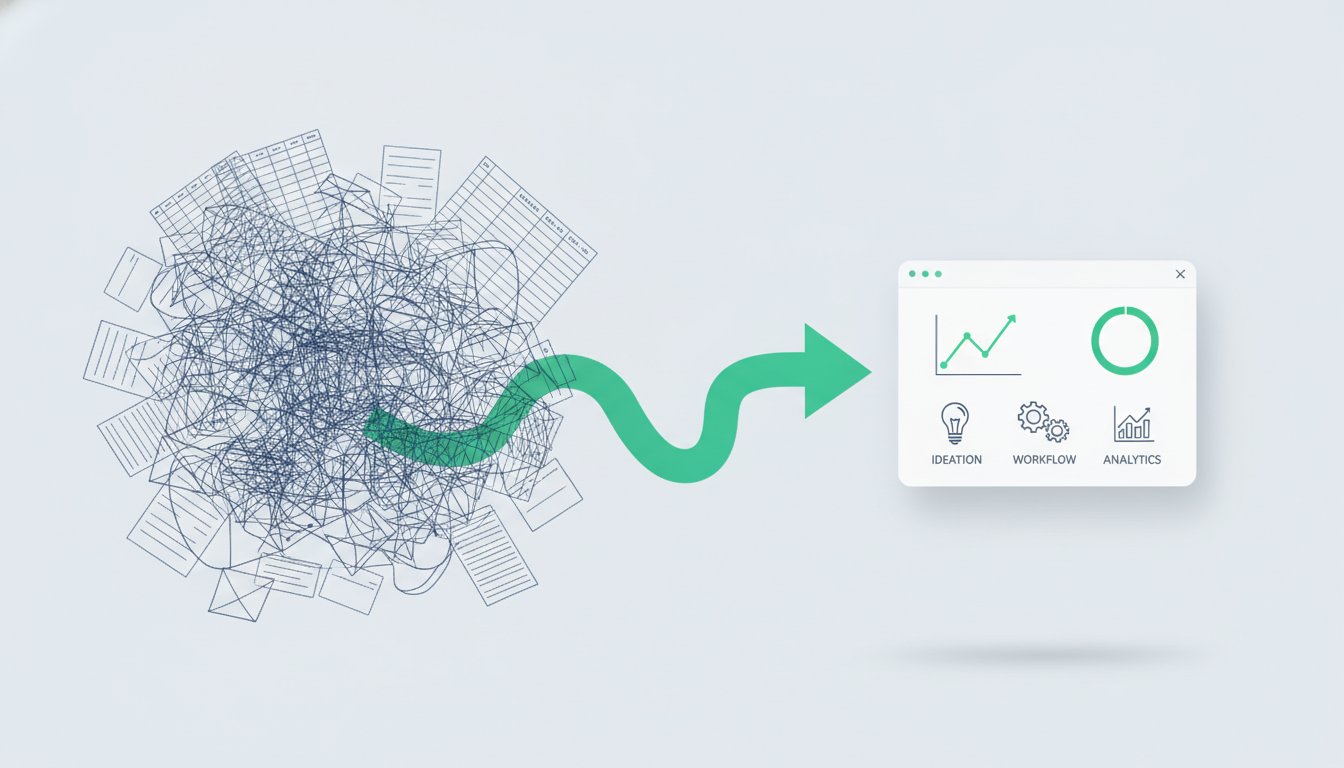
Why Spreadsheets Stifle Operational Excellence

Essential Features of a Modern Continuous Improvement Platform

The right continuous improvement software integrates seamlessly into your existing tech stack, ensuring that insights don’t stay trapped in a single department. These platforms function as a central nervous system for change, connecting disparate teams and aligning their efforts with high-level corporate strategy. When features like automated notifications and visual Kanban boards work together, they eliminate the “black hole” effect where employees never hear back about their suggestions. Transparency is the fuel that keeps the improvement engine running.

AI-Powered Evaluation and Prioritization

Administrative overhead is the silent killer of improvement programs. Ideawake AI addresses this by automating the initial heavy lifting, which can reduce manual administrative tasks by as much as 50%. The system uses machine learning to score submissions based on strategic alignment and technical feasibility. Automated workflows then move these ideas through the pipeline without requiring manual intervention from a manager at every step. This ensures that the most impactful projects receive immediate attention while lower-priority suggestions are handled systematically.

Gamification and Employee Engagement Dynamics

Top-down mandates rarely produce lasting change. Crowdsourcing is far more effective because it leverages the collective intelligence of your entire workforce. By incorporating leaderboards, digital points, and social recognition, you create a competitive yet collaborative environment. These benefits of employee ideation programs extend beyond simple suggestions; they build a culture of ownership. When workers see their peers being recognized for improvements, participation rates naturally climb. Modern continuous improvement software integrates these tools into widely used methods of continuous improvement like PDCA or Lean, making excellence a daily habit rather than a quarterly chore.

Automated ROI Tracking and Reporting

Executives don’t care about “good ideas”; they care about impact. Real-time dashboards must provide a granular view of both hard financial savings and “soft” benefits like safety improvements or reduced turnover. You shouldn’t have to spend weeks compiling a report for leadership. The software should do it for you. Utilizing an idea management ROI calculator helps justify the initial investment by projecting long-term gains based on current participation rates. If you want to see how these features can transform your specific operation, you can schedule a personalized walkthrough of the platform.

Evaluating Your Options: Build vs. Buy and Platform Comparison

Choosing the right continuous improvement software is a high-stakes decision that determines whether your program scales or stalls. Many organizations make the mistake of using generic project management tools like Trello or Jira to manage their improvement pipeline. These tools excel at managing structured tasks, but they weren’t built to handle the high-volume, unstructured nature of frontline ideation. Without purpose-built features for crowdsourcing and automated evaluation, your team will spend more time managing the tool than implementing the actual improvements.

A true comparison framework for continuous improvement software must account for organizational maturity. Smaller teams might start with basic task managers, but enterprise-grade operations require a platform that provides a single source of truth across global sites. The goal is to minimize friction at every touchpoint. If your software requires extensive training just to submit a suggestion, your participation rates will plummet. You need a system that balances simplicity for the user with robust analytical power for the administrator.

The Hidden Costs of Building In-House Solutions

It’s tempting to think that your IT department can build a custom solution that perfectly fits your unique needs. However, the initial development cost is only the tip of the iceberg. Custom builds often suffer from “feature creep” and lack the dedicated support needed for long-term success. Maintaining a proprietary system requires constant updates to keep pace with security standards and browser compatibility, drawing resources away from your core business. You can find a detailed breakdown of these risks in our build vs buy idea management software guide. 2026 enterprises prioritize speed-to-value over custom development chaos.

Legacy Innovation Software vs. Modern Agile Platforms

Legacy platforms are often characterized by high complexity and low adoption rates. These systems were built for a “top-down” era where only a few experts were responsible for innovation. In contrast, modern agile platforms are designed for the “bottom-up” shift, prioritizing user experience to drive maximum engagement. Modern architecture is leaner, integrates more easily with your existing tech stack, and places a much lower burden on your IT department. For a deeper look at how to navigate these choices, you can explore our resources on best innovation management software. Shifting from legacy bloat to agile efficiency is the fastest way to see tangible returns on your operational excellence initiatives.

How to Implement Continuous Improvement Software at Scale

Procuring continuous improvement software is only the first step toward operational excellence. The real challenge lies in driving adoption across a diverse, often skeptical workforce. Successful implementation requires a shift from viewing software as a simple tool to seeing it as the foundation of your organizational culture. We recommend a “start small, scale fast” philosophy. By launching a pilot program in a single department, you can iron out workflow kinks and generate the social proof needed to convince the rest of the enterprise that their ideas actually matter.

Cultural change management is the engine of software success. You must clearly communicate the specific value proposition to your frontline staff. If employees believe their suggestions vanish into a digital void, they’ll stop contributing. Transparency in the evaluation process and visible recognition for implemented ideas are non-negotiable requirements. When workers see that the platform leads to tangible changes in their daily tasks, adoption rates climb. This bottom-up momentum is what separates high-performing organizations from those stuck in legacy mindsets.

Defining Success Metrics and ROI Benchmarks

You can’t manage what you don’t measure. Before launching your continuous improvement software, you must establish baseline metrics to track progress accurately. We recommend focusing on five key performance indicators:

  • Participation Rate: The percentage of your workforce actively submitting or voting on ideas.
  • Implementation Rate: The ratio of submitted ideas that actually move to completion.
  • Cycle Time: The average duration from idea submission to final implementation.
  • Hard Cost Savings: Direct financial impact generated by improved processes.
  • Soft Savings: Quantifiable improvements in safety, employee retention, or customer satisfaction.

Setting these benchmarks early allows you to demonstrate the platform’s value to leadership within the first quarter of operation. For a deeper dive into these stages, see our guide on the phases of continuous improvement.

The 90-Day Implementation Roadmap

A structured timeline prevents implementation fatigue and ensures consistent momentum. Phase 1: Alignment and Configuration (Days 1-30) focuses on defining your strategic challenges, setting up user permissions, and integrating the software with your existing communication tools. Phase 2: Pilot Launch and Feedback Loop (Days 31-60) involves deploying the platform to a high-engagement team to gather feedback on the submission process and refine your evaluation criteria. Finally, Phase 3: Enterprise-Wide Rollout and Optimization (Days 61-90) scales the platform across all departments using success stories from the pilot to drive excitement. To ensure your rollout doesn’t stall at the execution stage, review our detailed framework on how to streamline idea implementation process workflows from submission to measurable result. If you’re looking for professional guidance during this transition, explore our ideawake implementation services to ensure a seamless rollout. To see how this roadmap fits your specific organizational needs, book a free demo today.

Ideawake: The Modern Choice for Continuous Improvement

After evaluating the market landscape and understanding the roadmap to implementation, the choice for enterprise leaders becomes clear. Ideawake is the only continuous improvement software designed to eliminate the friction that typically kills innovation programs before they can scale. We don’t just provide a digital place to store suggestions; we provide a high-performance engine that drives those suggestions through to completion. By combining advanced AI with intuitive gamification, Ideawake ensures your operational excellence initiatives move at the speed of your business rather than the speed of a static spreadsheet.

Bridging the Gap Between Idea Submission and Execution

Ideawake’s workflow engine acts as the backbone of your program, ensuring that no high-value insight is ever left behind in a digital void. From the initial submission to the final ROI report, our product features support every critical stage of the innovation lifecycle. To reduce friction even further, we offer seamless integrations with enterprise staples like Microsoft Teams and Slack. This allows your frontline workers to contribute to the continuous improvement process without ever leaving their primary workspace, which is the fastest way to achieve the high adoption rates we discussed in previous sections.

Transforming Culture Through Transparent Progress

Trust is the primary currency of any successful improvement program. Our platform for continuous improvement ideas builds this trust through radical transparency across all levels of the organization. When employees can see exactly where their suggestion sits in the pipeline and who is responsible for the next step, they feel a genuine sense of ownership over the outcome. Ideawake turns the suggestion box into a high-performance engine for growth. This cultural shift is what transforms a company from a reactive organization into a proactive, data-driven leader. Ready to see these results in your own operation? Sign up for a demo today and discover how we can bridge the gap between your frontline ideas and measurable ROI.

The Future of Operational Excellence Starts Today

Operational excellence is no longer a static goal but a dynamic capability powered by the right digital infrastructure. By transitioning from fragmented spreadsheets to a centralized continuous improvement software, you eliminate the data silos that currently trap high-potential ideas in disconnected email chains. You’ve learned that success in 2026 requires a shift toward AI-augmented evaluation and high-engagement gamification to ensure your program remains self-sustaining and transparent across the entire enterprise.

The path forward is clear. Organizations that leverage modern architecture and proven ROI tracking see a 50% reduction in administrative overhead while maintaining a direct line from frontline submission to measurable financial impact. You don’t have to settle for the inefficiency of legacy systems or the development chaos of custom builds. It’s time to empower your workforce and turn every employee into a catalyst for growth. Ready to see how Ideawake can scale your improvement efforts? Book a personalized demo today.

Your organization’s untapped potential is waiting. We look forward to helping you bridge the gap between frontline intelligence and your most ambitious performance targets.

Frequently Asked Questions

What is the difference between project management and continuous improvement software?

Project management tools are designed for top-down, structured tasks with specific start and end dates. In contrast, continuous improvement software is built for the ongoing, bottom-up collection and execution of incremental changes across an entire workforce. It prioritizes the ideation and evaluation phases that generic tools ignore, focusing on long-term culture and ROI tracking rather than just task completion.

How does AI help in the continuous improvement process?

AI eliminates the administrative “noise” that often stalls manual programs. It identifies duplicate submissions instantly and uses predictive modeling to estimate the potential impact of a new idea based on historical data. This allows managers to skip the manual filtering and move straight to high-value implementation tasks.

Can continuous improvement software integrate with our existing ERP or HR systems?

Modern platforms use robust APIs to connect with your existing tech stack. You can link improvement data to ERP systems for resource planning or HRIS platforms to align employee contributions with performance reviews. These integrations ensure that operational excellence is a core business function rather than a siloed activity.

How long does it typically take to see ROI from a continuous improvement platform?

Most organizations report a noticeable shift in employee engagement within the first thirty days. Hard financial ROI typically materializes between three and six months as the first wave of pilot projects reaches full implementation. This timeline depends on the speed of your internal approval workflows and the complexity of the initial projects.

Is continuous improvement software suitable for small teams or just large enterprises?

What are the most important KPIs to track in a continuous improvement program?

Focus on participation rates, the percentage of ideas implemented, and the net financial impact. You should also monitor the average cycle time from submission to completion. Tracking these metrics helps you identify bottlenecks in your pipeline and proves the program’s value to executive leadership.

How do we encourage frontline employees to actually use the software?

Mobile access is the most critical factor for frontline adoption. Workers need to submit ideas in seconds without leaving their stations or finding a desktop computer. Combining this accessibility with transparent feedback loops ensures they feel their contributions are valued and acted upon, which naturally drives long-term engagement.

What is the cost of implementing a continuous improvement solution?

Pricing is typically structured as an annual subscription based on your total user count or specific feature requirements. Beyond the license fee, you should account for the internal time dedicated to training and cultural alignment. Investing in a dedicated continuous improvement software prevents the massive opportunity costs associated with manual tracking and lost ideas.

Article by

Coby Skonord

Coby Skonord is the co-founder and CEO of Ideawake. Since 2013 he has worked with enterprise innovation, continuous improvement, and HR leaders to turn employee ideas into measurable business impact.