Tag Archives: kaizen

How to Build a Kaizen Board for Continuous Growth

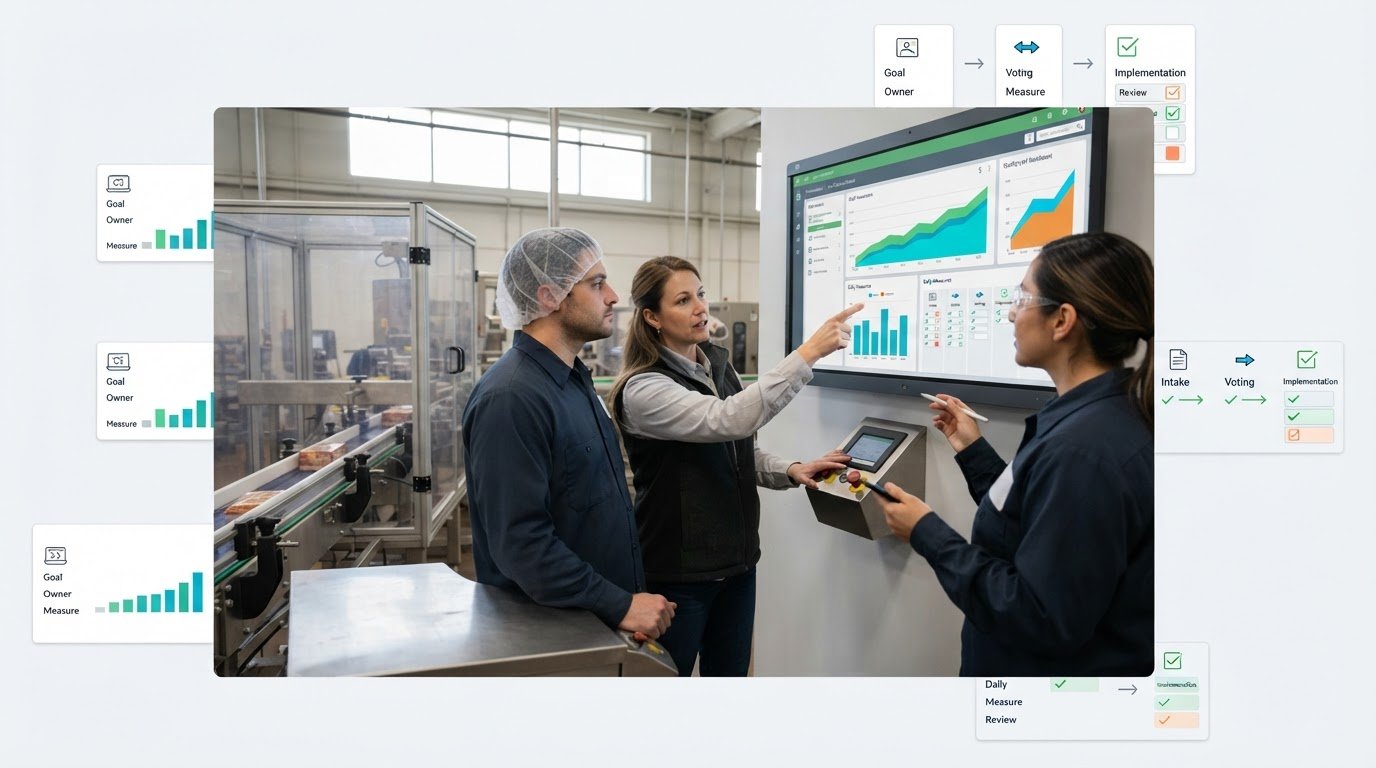
Warehouse employees use a digital kaizen board to assign and track continuous-improvement actions across shifts
Coby Skonord|
November 18, 2026

Improvement ideas lose momentum when nobody knows who owns the next step. A kaizen board makes improvement work visible, giving teams a shared way to capture opportunities, track actions, and record results.

Small, practical changes are easier to act on when employees can share what they notice in their daily work. The challenge is turning those observations into focused improvements instead of letting them disappear into a suggestion box or meeting notes.

This guide explains how to build a board that supports employee participation, surfaces waste, and moves ideas through a repeatable improvement cycle. You’ll learn what to include, how to prioritize and track actions, and how to choose between a physical and digital format.

The goal isn’t to add another display or dashboard. It’s to create a useful routine for making problems visible, assigning clear next steps, and learning from results.

Key Takeaways

  • Use a shared visual system to capture improvement opportunities, assign actions, and make progress visible.
  • Design ownership and updates to work across shifts and sites, so ideas don’t stall when teams can’t meet in person.
  • Give employees a clear route to raise problems and help reduce waste by testing practical changes in daily work.
  • Choose a physical or digital format based on where teams work and how they need to share updates and retain results.
  • Move improvement work through a repeatable cycle, and coordinate responsibilities, updates, and outcomes across teams.

What is a Kaizen Board?

A Kaizen board is a visual system for organizing continuous improvement, from identifying a problem to recording what the team learned. It gives employees a shared way to highlight opportunities, coordinate actions, and connect proposed changes with outcomes.

Its usefulness depends on how the team uses it. A display that only collects ideas doesn’t show whether anyone assessed, tested, or adopted them.

Kaizen Board Purpose

Kaizen means “change for better.” A board puts that principle into daily practice by helping a team capture a problem, agree on an action, and record the result. Each improvement item should clarify what is happening, where it occurs, and why the team considers it worth addressing.

For example, employees who repeatedly search for shared tools could record where delays occur and suggest changing how the tools are stored. The board supports investigation and follow-through, but it can’t replace a culture that encourages people to identify problems and learn from tests.

Board Setup and Operation

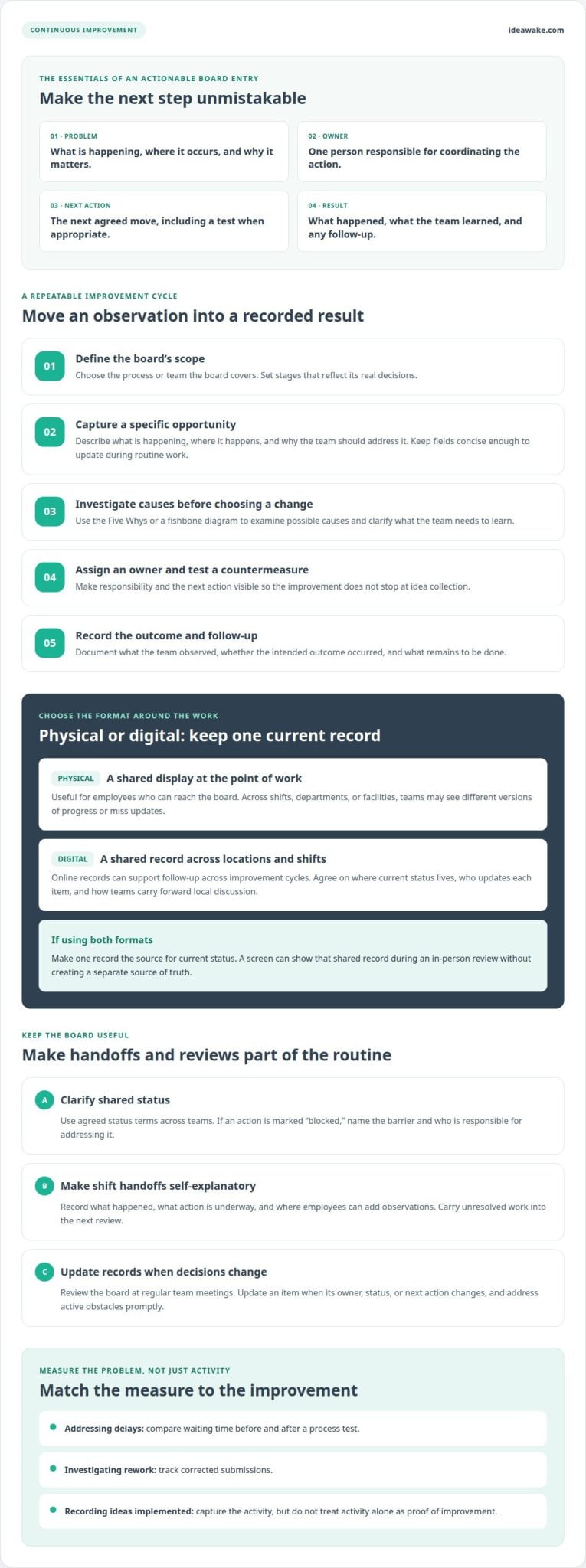
Start by defining the process or team the board will cover. Choose stages that reflect its actual decisions, then agree on what each entry needs: a problem statement, an owner, the next action, and a place to record results. Keep fields concise so employees can update them during routine work, not just formal reviews.

Next, select an initial opportunity and clarify what the team needs to learn. Members can use the Five Whys or a fishbone diagram to examine causes before choosing a countermeasure. Assign an owner to coordinate the test, then record the outcome and any follow-up. This provides a practical structure without forcing every issue into the same investigation.

Board Types and Differences

A Kaizen board tracks improvement efforts, while a Kanban board generally represents workflow. Teams may use Kanban-style stages to show how an improvement action progresses, but the goals differ: improvement work examines how to change a process, while workflow tracking shows how work moves forward.

A suggestion board primarily collects ideas. An improvement process adds evaluation, ownership, action, and a record of what happened. For instance, “reduce duplicate form entry” becomes actionable when a team identifies where duplication occurs, tests a revised handoff, and documents what it learned.

Reviews and Improvement Metrics

Review the board at regular team meetings, and update an item whenever its owner, status, or next action changes. Set the review rhythm to suit the work: address active obstacles promptly, while longer investigations can have planned check-ins. The key is keeping records current enough to support the next decision.

Choose measures linked to the problem. A team addressing delays might compare waiting time before and after a process test; a team investigating rework could track corrected submissions. Also record ideas implemented, but don’t treat activity alone as proof of improvement. For a structured view of Kaizen software use cases, consider how digital records can support follow-up across improvement cycles.

Limits of boards across shifts and sites

A physical board is visible only to employees who can reach it. Across shifts, departments, or facilities, teams may see different versions of progress, miss an action, or repeat work because updates arrive late. Teams working across locations should decide where the current status will be recorded before launching shared improvement work.

Common risks include unclear ownership, outdated cards, too many open actions, and layouts that teams interpret differently. Reduce these risks by assigning one owner per action, defining shared status terms, and carrying unresolved work into the next review. For example, a card marked “blocked” should name the barrier and who is responsible for addressing it.

Different shifts also need a workable handoff. A production employee may report a recurring equipment setup issue near the end of a shift, while the incoming crew needs enough context to continue the investigation. Record what happened, what action is underway, and where employees can add observations. Without those details, a visual display can become a noticeboard rather than a useful reference.

Across facilities, use a common structure without requiring every team to investigate the same problem. Agree on shared fields and status labels, then let each team describe its own process. A warehouse might document a material-flow obstacle, while an office team examines duplicate approvals. Shared terms make progress easier to understand, while local details keep each action relevant.

A mixed physical and digital system can create coordination problems of its own. If one team updates a wall display and another updates an online record, employees may not know which version reflects the latest decision. Agree on one record for current status, and define how local discussion updates will be transferred to it. A screen showing the shared record can support in-person reviews without creating a separate source of truth.

Standardization should preserve local context. A shared template can define an item’s owner, next action, and status while leaving room for site-specific observations. This helps prevent a central team from overlooking meaningful differences or treating identical labels as identical problems. During a cross-site review, ask what changed at each location and whether the intended outcome occurred.

When a team marks an action complete, it should also record the result and any remaining follow-up. Completion alone doesn’t show whether the change helped. A shift handover could note what the team tested, what it observed, and whether another crew needs to adapt the change. That record lets employees learn from previous work without relying on memory or having attended the same meeting.

For cross-site work, agree on who updates each item, how teams escalate blocked actions, and where completed work remains available for reference. A shared digital workflow can help teams coordinate these practices across locations. Explore a coordinated approach to distributed improvement work.

Employee engagement and waste reduction

Employees often see friction before leaders see its operational cost. A useful improvement routine gives team members a practical way to describe that friction, discuss its cause, and help test a change. The board supports participation when submitted ideas receive visible ownership and follow-up, not just acknowledgment.

Engagement depends on what happens after someone raises an issue. For example, a distribution team member may point out that frequently used supplies are stored far from the work area. The supervisor can record the observation, involve employees who do the task, and agree on a small test. Sharing the outcome, including a decision not to adopt the change, shows contributors that their input was considered.

For an enterprise team, improvement work should connect everyday observations to a clear next step. Ask the person closest to the task to describe when the problem occurs, who else is affected, and what makes the current process difficult. A short meeting can then distinguish symptoms from causes and identify an employee to help test a countermeasure. This keeps the discussion grounded in the work rather than assumptions.

Waste reduction starts with a specific example, not a broad demand to “work smarter.” A team can identify waiting, unnecessary movement, rework, or duplicated steps, then record one observable problem. During a meeting, members examine the current process, use the Five Whys to explore causes, and agree on a focused countermeasure. After testing it, they compare the relevant measure with the earlier condition.

Consider a service team that repeatedly enters the same customer details on separate forms. Team members can map where duplication occurs, identify which information is genuinely needed, and test a revised handoff. The test should capture intended effects and possible tradeoffs, such as whether the new step creates extra work elsewhere. An improvement idea earns broader adoption through evidence, not enthusiasm alone.

Use a simple response cycle to turn contributions into action:

  • Capture: Record the problem in the employee’s own words, with a concrete work example.
  • Discuss: Ask affected team members where the issue occurs and what observations support it.
  • Prioritize: Select an improvement idea based on its relevance, feasibility, and connection to team goals.
  • Test: Assign an owner and define what observation would show whether the change helped.
  • Share: Report the outcome and recognize contributors, including when a test changes or rejects the original proposal.

That routine makes employee input part of operational learning, rather than a separate suggestion channel. Clear participation practices can also strengthen employee ideation programs by connecting ideas to decisions, implementation, and reported outcomes.
How to Build a Kaizen Board for Continuous Growth

Physical and digital Kaizen boards

Choose a format based on where teams work and how they need to share updates. Both formats can support continuous improvement, but they differ in visibility, access, and recordkeeping.

Physical Kaizen Boards

A physical board puts improvement work where employees can discuss it during normal operations. Cards can move through stages such as opportunity, action, and complete, while dry-erase status circles or red, amber, and green indicators show progress. A team can update the display during a meeting, then use it to focus discussion on blocked actions.

Keep the layout readable from the team’s usual meeting point. Use one card for each improvement, with a concise problem statement, owner, next action, and result. Color-coded magnetic labels or status sliders can make changes visible without rewriting each card. For example, a production team could mark a countermeasure as blocked and discuss the barrier at its next huddle.

Physical displays work best when relevant employees can access them and someone keeps the information current. A board in one facility may not serve colleagues working remotely or on another shift. Teams should agree who updates cards after meetings and how completed changes will be shared beyond the room.

Digital Kaizen Boards

A digital format gives teams a shared record they can access across locations. Entries can keep meeting notes alongside improvement details, making decisions and outcomes available for later reference. Managers can view multiple boards remotely and respond to visible roadblocks without waiting for an in-person visit.

Digital layouts can be adjusted, saved, and duplicated when a team finds an arrangement that works. Notifications can keep participants informed as actions progress, while searchable records help teams revisit completed work. For example, a team could review an earlier test before making an incremental change to a similar process.

Digital access doesn’t guarantee useful participation. Teams still need clear owners, current records, and a review routine, or the board can become a stale database. A screen can also display a digital board in a shared workspace, combining face-to-face discussion with records that colleagues across locations can access.

Compare formats against the work itself: physical boards offer immediate local visibility, while digital boards support remote access and retained records. A hybrid approach can use a shared screen for team discussion and digital updates for cross-site coordination. In either format, track the operational measure tied to the improvement, such as rework or waiting, rather than treating card movement as proof of productivity gains.

Plan-Do-Study-Act and prioritization

Plan-Do-Study-Act (PDSA) gives teams a repeatable method for testing a change before adopting it more broadly. A board can make each cycle visible, from defining the problem to documenting what the team learned. This helps prevent a promising idea from going straight to rollout before its effects are understood.

Use the cycle to connect a problem with a documented decision:

  1. Plan: Describe the issue, the process it affects, the change to test, and the evidence the team will review. A charter can define the scope, participants, and intended outcome.
  2. Do: Test the proposed change in the relevant workflow. Record who performs each action and any practical obstacles.
  3. Study: Compare the observed result with the expected outcome. Include employee feedback and unexpected effects, not just the intended measure.
  4. Act: Adopt the change, revise it for another test, or stop it. Document the decision and assign any follow-up.

For example, a service team investigating incomplete handoffs could plan a revised checklist, test it with one workflow, and study whether required details are consistently transferred. If employees find the checklist unclear, revise it before expanding its use. Record the decision and rationale so the next team understands what was learned, rather than seeing only a completed card.

Prioritization matters when proposed changes compete for attention. Compare each idea against consistent criteria: its connection to team goals, the effect of the problem, the feasibility of a test, and the available evidence. A short decision record can explain why one item moves forward while another waits. Leaders can use idea management software to organize submissions and decisions beyond a local board.

Keep the active queue aligned with available capacity. If several actions depend on the same specialist or approval, record that dependency before assigning more work. The team can then address the constraint, clarify ownership, and bring blocked items to its next review. This makes prioritization an ongoing management practice rather than a one-time ranking exercise.

For a focused improvement event, a charter can frame the issue before the team records observations, root-cause analysis, countermeasures, and actions. Linking these tests to a wider continuous improvement process helps teams carry learning into future work. If you’re considering how to coordinate these cycles, contact Ideawake to discuss your improvement goals.

Ideawake

Ideawake helps organizations connect employee ideas with evaluation, ownership, and implementation. When a local board no longer provides enough visibility across teams or locations, Ideawake’s Idea Management Platform and Continuous Improvement offering can support a broader process for collecting and managing improvement work.

This is useful when leaders need to coordinate submissions, decisions, and follow-up beyond a single team’s physical display. Teams can retain the practical Kaizen cycle while giving employees a consistent way to contribute and track ideas across the organization.

Make Improvement Part of How Work Gets Done

A kaizen board creates more value when it connects local learning with wider organizational priorities. Decide how teams will share useful lessons, who can approve changes that affect other areas, and how leaders will make room for promising tests. These decisions keep employee-led improvement connected to operational goals without turning every small change into a lengthy approval process.

For organizations coordinating ideas across teams, Ideawake’s Innovation Management Platform supports the broader process of capturing, evaluating, and implementing employee ideas. Start with your current improvement priorities and the coordination challenges you need to solve. Keep the focus on making good ideas easier to act on, and let each completed cycle inform the next.

Contact Ideawake to discuss your improvement goals

Every practical change can reveal another opportunity to make work clearer, more effective, and easier for employees to improve. For entrepreneurs and real estate investors looking to refine their business systems and scale alongside experienced peers, The Boardroom Mastermind provides an elite community and educational platform for strategic growth.

Frequently Asked Questions

What Should the Record Hold for Each Improvement?

Record enough detail for someone outside the discussion to understand the improvement later. Include the problem’s location or process, the person who raised it, the current condition, the proposed change, an owner, the status, and supporting evidence. After testing, add the observed result, the decision to adopt or revise the change, and any follow-up. For example, attach a process note describing where a recurring delay occurs.

What does Kaizen stand for?

Kaizen is a Japanese word commonly translated as “change for better.” In work settings, it describes an approach focused on ongoing process improvements, rather than waiting for one large transformation. For example, a team might adjust how it organizes frequently used materials, then observe whether the new arrangement makes the task easier. The practice depends on learning from work and refining changes.

What is a good Kaizen example?

A good example targets a specific, observable source of friction and tests a practical change. Suppose a team repeatedly searches several folders for the latest procedure. It could agree on one shared file location, clarify how updates are labeled, and ask users whether the new method reduces confusion. Before making the new approach standard, the team should record what changed and what it learned, including any unintended problems.

What is a kaizen board and what is it used for?

A kaizen board is a visual aid for organizing improvement opportunities and follow-through. It helps a group see which issues have been raised, what work is active, and which changes are complete or need attention. For instance, a customer-service team could use one to coordinate a test of a revised response process. The board supports discussion and accountability, but team routines and follow-up drive improvement.

What columns and information should an improvement board include?

Use columns that match the team’s actual decision flow, such as “new opportunity,” “under review,” “testing,” and “adopted or closed.” Each item can include a short problem statement, affected process, submitter, owner, next action, status, and evidence of results. Add a reason when an idea is deferred or declined. This context helps employees understand decisions and prevents old items from returning without new information.

What are examples of improvement ideas for manufacturing and office teams?

Manufacturing teams might examine recurring label corrections, unclear tool storage, or avoidable movement between work areas. Office teams could investigate duplicate data entry, repeated approval requests, or confusion over document versions. Each idea should describe a specific occurrence, not a broad goal such as “improve efficiency.” Teams can then identify the affected step, gather observations, and decide whether a small test could address the underlying cause.

What are the best physical and digital tools for creating an improvement board?

The best format is one employees can update and use during their normal work. A physical display can use cards, magnets, and erasable markers for visible team discussions. Digital board software can help colleagues across locations access shared records and review changes remotely. A team working together in one location may prefer a wall display; a group working across multiple sites may benefit from a shared digital record or a combination.

How can teams prioritize improvement ideas and assign owners?

Compare ideas using consistent criteria: the problem’s effect on work, alignment with team priorities, feasibility of testing, and available evidence. Select an owner who can coordinate the next action, involve affected colleagues, and report findings. If another team controls a required approval or resource, record that dependency before work begins. Explain why an idea is selected, deferred, or declined so contributors understand the decision.
Article by

Coby Skonord

Coby Skonord is the co-founder and CEO of Ideawake. Since 2013 he has worked with enterprise innovation, continuous improvement, and HR leaders to turn employee ideas into measurable business impact.

Operational Excellence Management System Guide

A packaging-line team reviews operational measures and employee improvement ideas in a dashboard.
Coby Skonord|
November 11, 2026

A strategy that never reaches the front line is just paperwork. An operational excellence management system connects organizational goals to everyday work, giving leaders and employees a shared way to improve processes, quality, safety, and customer experience. It brings responsibilities, performance measures, and regular reviews into one system, making improvement part of how work gets done.

That takes more than choosing a method or setting a target. The system must align daily management with broader priorities, make performance visible, and give employees a practical way to raise and address problems. This guide explains how it works, what it is designed to achieve, and how Lean, Six Sigma, and Kaizen can support improvement. You’ll also learn how daily management connects plans to consistent action.

Key Takeaways

  • Connect strategic priorities to daily work with clear ownership, performance measures, and regular review.
  • Use recognized standards, such as ISO 9001, as reference points when shaping a system around your organization’s needs.
  • Choose improvement methods based on the problem: Lean targets waste, Six Sigma focuses on variation and defects, and Kaizen supports ongoing incremental change.
  • Use a Plan-Do-Check-Act cycle to set actions, carry them out, review results, and refine procedures.
  • Align daily management across teams so employees can surface problems, follow standards, and contribute improvement ideas.

What Is an Operational Excellence Management System (OEMS)?

An operational excellence management system connects strategic priorities with the routines, standards, and decisions that shape daily work. It gives leaders and employees a shared structure for improving quality, productivity, and customer experience.

Leadership and Improvement Culture

Leadership and improvement culture shape how continuous improvement becomes part of everyday work. Leaders’ choices signal whether employees are encouraged to raise problems, test better approaches, and learn from results.

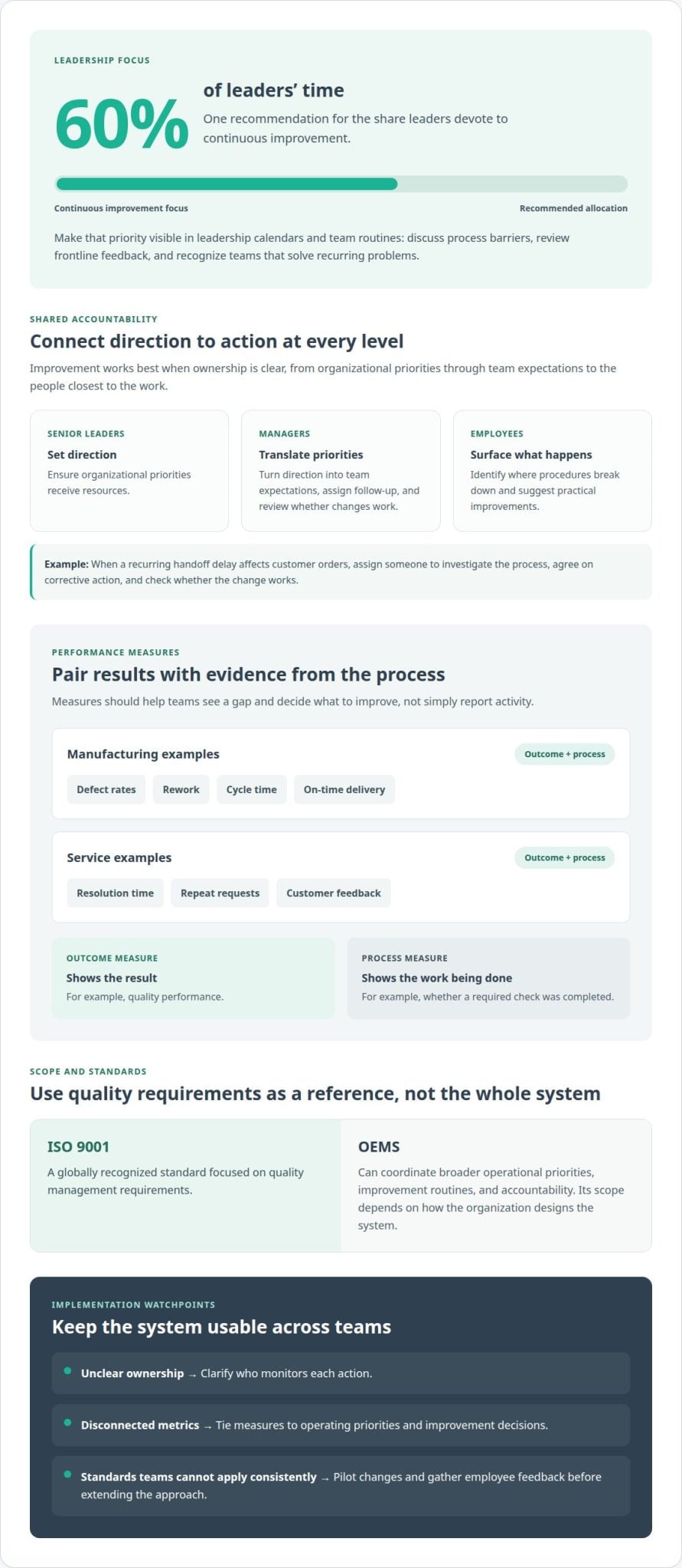
A useful starting point is to make improvement visible in leadership calendars and team routines. One recommendation is for leaders to spend 60% of their time on continuous improvement. Leaders can reinforce that priority by discussing process barriers, reviewing frontline feedback, and recognizing teams that solve recurring problems. The continuous improvement approach works best when those actions connect to clear operating priorities, rather than becoming a separate initiative.

Accountability for Operational Excellence

Accountability means assigning ownership for performance standards, improvement actions, and follow-up decisions. Without an owner, an issue can persist across shifts, teams, or locations.

Senior leaders set direction and ensure priorities receive resources; managers translate those priorities into team expectations. Employees closest to the work can spot where procedures break down and suggest practical changes. For example, if a recurring handoff delay affects customer orders, a manager can assign someone to investigate the process, agree on corrective action, and review whether the change works. This creates shared responsibility without making improvement solely a leadership task.

Metrics and Performance Indicators

Metrics and key performance indicators show whether operational priorities are producing stronger results. They are most useful when they help teams identify a gap and decide what to improve, rather than simply report activity.

Useful measures depend on the operation and its goals. A manufacturing team might monitor defect rates, rework, cycle time, and on-time delivery; a service team might track resolution time, repeat requests, and customer feedback. Pair outcome measures, such as quality, with process measures, such as whether a required check was completed. Leaders can then see what changed and which part of the work needs attention.

ISO 9001 is an example of a globally recognized standard relevant to an operational excellence management system, according to the International Organization for Standardization. ISO 9001 focuses on quality management requirements, while an operational excellence management system can coordinate broader operational priorities, improvement routines, and accountability. Business management systems may cover additional organizational functions, so the scope depends on how the organization designs its system.

Common implementation risks include unclear ownership, disconnected metrics, and standards that teams cannot apply consistently. Leaders can reduce these risks by piloting changes, gathering employee feedback, and clarifying who monitors each action before extending the approach across the organization.

What Is an Operational Excellence Management System (OEMS)?

An operational excellence management system connects strategic priorities with the routines, standards, and decisions that shape daily work. It gives leaders and employees a shared structure for improving quality, productivity, and customer experience. In practice, it clarifies how teams identify process problems, assign actions, and assess whether changes support organizational goals.

Leadership and Improvement Culture

Leadership and improvement culture shape how continuous improvement becomes part of everyday work. Leaders’ choices signal whether employees are encouraged to raise problems, test better approaches, and learn from results. A written standard alone cannot show teams how to respond when actual work differs from the documented process.

A useful starting point is to make improvement visible in leadership calendars and team routines. One recommendation is for leaders to spend 60% of their time on continuous improvement. Leaders can reinforce that priority by discussing process barriers, reviewing frontline feedback, and recognizing teams that solve recurring problems. The continuous improvement approach works best when those actions connect to clear operating priorities. For example, a manager can make an unresolved process barrier a standing agenda item and assign follow-up to the relevant team.

Accountability for Operational Excellence

Accountability means assigning ownership for performance standards, improvement actions, and follow-up decisions. Without an owner, an issue can persist across shifts, teams, or locations.

Senior leaders set direction and ensure priorities receive resources; managers translate those priorities into team expectations. Employees closest to the work can spot where procedures break down and suggest practical changes. For example, if a recurring handoff delay affects customer orders, a manager can assign someone to investigate the process, agree on corrective action, and review whether the change works. This creates shared responsibility without making improvement solely a leadership task.

Metrics and Performance Indicators

Metrics and key performance indicators show whether operational priorities are producing stronger results. They are most useful when they help teams identify a gap and decide what to improve, rather than simply report activity.

Useful measures depend on the operation and its goals. A manufacturing team might monitor defect rates, rework, cycle time, and on-time delivery; a service team might track resolution time, repeat requests, and customer feedback. Pair outcome measures, such as quality, with process measures, such as whether a required check was completed. Leaders can then see what changed and which part of the work needs attention.

ISO 9001 is an example of a globally recognized standard relevant to an OEMS, according to the International Organization for Standardization. ISO 9001 focuses on quality management requirements, while an OEMS can coordinate broader priorities, improvement routines, and accountability. Business management systems may cover additional organizational functions, so their scope depends on how an organization designs and connects its processes.

Common implementation risks include unclear ownership, disconnected metrics, and standards that teams cannot apply consistently. Leaders can reduce these risks by piloting changes, gathering employee feedback, and clarifying who monitors each action before extending the approach across the organization. This makes gaps visible while there is still time to adjust processes and responsibilities.

Lean, Six Sigma, and Kaizen help teams translate strategic priorities into practical improvement actions. An operational excellence system can combine them, matching each method to the problem instead of treating one tool as a universal fix.

Match the Method to the Problem

Six Sigma provides a structured way to investigate variation and defects. General Electric implemented Six Sigma to enhance process quality and reduce defects across its manufacturing units. A team could define a defect precisely, examine where it occurs, and use process data to identify contributing factors before testing a countermeasure. This approach is useful when inconsistent results persist despite clear work instructions.

Kaizen emphasizes ongoing, incremental improvement involving the people who do the work. A team might use a shift handoff to surface a recurring equipment setup problem, test a small adjustment, and record its effect. The value lies in learning through manageable changes, not launching a major redesign for every issue.

Use Root-Cause Tools Before Choosing Actions

The 5 Whys and fishbone diagrams help teams investigate underlying causes instead of treating visible symptoms. If a shipment leaves late, a fishbone diagram can organize possible causes across staffing, materials, equipment, and procedures. The 5 Whys then helps trace a specific delay to a process cause, such as an unclear release step. Teams can select actions that address the cause and monitor whether the problem recurs.

The Shingo Model adds principles that connect methods to organizational behavior: quality at the source, customer value, a zero-inventory supply chain, and understanding the workplace at all levels. These principles help leaders assess whether a proposed improvement supports the broader system. Dr. Shigeo Shingo published 18 books on his business philosophy, reflecting a body of work focused on improvement and operational practice.

There is no need to force every tool into every initiative. A team confronting excess process steps may start with Lean; a team investigating recurring defects may use Six Sigma; employees identifying small daily frustrations may apply Kaizen. For sustainability, 3M’s Pollution Prevention Pays program has prevented more than 2.66 million tons of pollutants, while its long-running process improvement and sustainability work has saved nearly $2.3 billion USD. These examples show how improvement methods can address both operational and environmental priorities.

Let the strategic objective guide method selection: define the issue, choose a suitable tool, test targeted actions, and review the result. This keeps improvement practical and focused on outcomes that matter to the operation.

Operational Excellence Management System Guide

Management system cycle

A management system needs a repeatable cycle for turning priorities into action and learning from results. Plan-Do-Check-Act (PDCA) provides a practical structure for setting goals, carrying out measures, auditing work, and reviewing procedures.

Implementation follows a clear sequence: define the operating priority, pilot a response, review the evidence, then refine and expand the practice.

  1. Plan: Define the performance issue and the outcome the team needs. For example, a distribution center might address recurring order-picking errors. Set an action plan, identify who owns each action, and choose a measure that shows whether errors are changing. Record the current procedure and conditions that could affect the result, such as staffing patterns or material availability.
  2. Do: Carry out the planned measures in a pilot area before launching them across the organization. A warehouse team could test a revised picking sequence in one workflow, brief affected employees, and record where the new practice differs from the plan. A pilot makes operational friction visible while the scope remains manageable. It also gives employees a specific opportunity to report unintended effects.
  3. Check: Compare the observed result with the objective, and audit whether the agreed procedure is being followed. If errors continue, examine whether the cause lies in the sequence, training, materials, or another process condition. An audit should identify gaps and evidence, not simply confirm that a form was completed. The review should distinguish between a weak countermeasure and inconsistent execution.
  4. Act: Use the review to adjust the procedure, clarify responsibilities, or select another countermeasure. If the pilot shows the revised sequence is practical and supports the objective, leaders can standardize it and plan how to extend it. If it fails to address the issue, return to planning with what the test revealed. Documenting the decision helps other teams understand what changed and why.

The cycle also needs a defined review rhythm. Leaders should review the system and its achievements annually, then assess whether objectives, measures, and procedures still fit operational priorities. A review can examine unresolved actions, audit findings, recurring problems, and lessons from pilots. It should identify practices that need clearer ownership or follow-up, keeping the system useful instead of letting it become static documentation.

Feedback matters during both the pilot and wider rollout. Employees can explain where a proposed change creates delays, conflicts with another procedure, or complicates a handoff. Gathering their input before organization-wide implementation gives leaders time to refine actions and establish workable standards. Without this feedback loop, a change may be formally launched but fail to become consistent practice across teams.

PDCA supports efficiency by making review part of execution, not a separate cleanup exercise. Success depends on clear objectives, assigned action owners, evidence from the work, and decisions that change practice when results call for it. This discipline makes each cycle a useful test of how well the operation performs and adapts.

Daily management systems and organizational alignment

Daily management connects organizational priorities with the decisions employees make in routine work. It works best when strategic objectives, team measures, and frontline actions are clearly linked.

Consider a manufacturer focused on improving delivery reliability. Executives set the priority, site leaders translate it into operating goals, and production teams track issues affecting completed orders. A daily review connects missed targets to specific causes, such as a delayed material handoff or an unclear work instruction. Each level can act within its authority while keeping the shared objective in view.

Alignment takes more than cascading targets. Teams should understand how their measures affect other groups’ work. If production increases output while inspection capacity stays fixed, completed units may wait for review. A shared view of production flow, inspection queues, and delivery status helps leaders see the trade-off and coordinate a response across departments.

Daily huddles and visual management make this coordination practical. A team might review its current performance measure, flag a deviation, assign an owner, and record the next action. A meeting is useful when it resolves a work issue or escalates a barrier, not when it repeats status reports without decisions. Consistent routines engage employees by giving them a clear way to raise obstacles and follow up.

Layered process audits help verify that agreed standards are followed and issues are corrected before they recur. For example, supervisors can check whether teams follow a critical equipment procedure, record a gap, and track its correction. Audit findings can also show where a standard is impractical, prompting leaders to revise the process instead of blaming employees for workarounds.

To implement the system across a large organization, define the alignment chain in plain terms: enterprise objective, site or function contribution, team measure, and frontline action. Then decide who reviews each measure, how teams escalate blocked work, and where decisions are recorded. This structure helps prevent local improvements from undermining broader priorities.

Software can support the system by bringing measures, action owners, audit findings, and employee input into a shared view. It should make work easier to understand, not add another reporting burden. For example, when a team identifies a recurring handoff problem, a common record can capture the issue, assigned action, and outcome for other teams facing the same challenge. The key is to align the measures, routines, and escalation paths people use to deliver results.

Ideawake: Innovation Management Platform

Ideawake’s Innovation Management Platform helps organizations capture, evaluate, and implement ideas from employees, customers, and partners. It fits when improvement depends on engaging people across teams and giving promising suggestions a path from submission to action. Voting, leaderboards, prizes, and AI features support participation and idea review, while a shared process helps teams manage ideas through the innovation lifecycle.

For an operational excellence program, this can help collect frontline proposals, organize evaluation, and track which ideas move toward implementation. It complements daily management by creating a structured channel for suggestions that might otherwise remain within one team or location. Contact Ideawake to discuss how its platform could support your organization’s improvement goals.

Turn Improvement Into a Shared Practice

The next step is to make improvement accessible beyond the teams already involved. An operational excellence management system can provide direction, but employees also need a clear way to contribute ideas, identify opportunities, and help move promising changes forward.

Ideawake offers an Innovation Management Platform, an Idea Management Platform, and Continuous Improvement tools. These offerings help organizations create a more structured path for employee input, evaluation, and implementation. The right starting point depends on where your improvement process needs stronger participation or follow-through.

Consider which gap matters most now: collecting ideas across teams, evaluating them consistently, or connecting selected ideas to action. A focused conversation can help clarify how an idea management approach fits alongside your existing improvement practices.

Your next operational improvement can start with a clearer path for people to contribute. Build that path with purpose and keep progress moving.

Frequently Asked Questions

What is an operational excellence management system?

An operational excellence management system is the coordinated structure an organization uses to manage performance and improve how work is done. It links priorities, responsibilities, processes, and review practices. For example, a company with recurring order errors can use the system to find where they occur, assign an investigation, and decide how to assess a proposed change. The system supports consistent management rather than relying on isolated improvement projects.

What are the core elements of an operational excellence management system?

Core elements include clear governance, defined processes, performance measures, assigned responsibilities, and mechanisms for reviewing risks and improvement actions. Organizations also need document control, so employees can identify the current procedure and understand how updates are approved. For example, a site may keep an approved maintenance procedure, record revisions, and assign a role to review audit findings. These elements help connect local decisions with organization-wide expectations.

What operational excellence frameworks are commonly used, such as Lean, Six Sigma, and Shingo?

Lean, Six Sigma, and the Shingo Model are commonly used frameworks, each offering a different perspective on improvement. Lean examines process flow and waste, Six Sigma focuses on defects and variation, and the Shingo Model connects operational principles with organizational behavior. A team might use Lean to locate a bottleneck, Six Sigma to investigate inconsistent outcomes, and Shingo principles to assess whether a proposed change reinforces customer value.

What software supports operational excellence management, and what does it cost?

Software can support operational excellence by organizing performance information, documenting improvement work, assigning action owners, and making progress visible across teams. Costs depend on the software’s scope, user access, workflows, integrations, and support requirements. For an enterprise, the deciding factor is whether the system fits existing processes and governance needs, not simply how many features it includes. Compare the work it enables with the effort required to administer it.

How can organizations build a culture of continuous improvement and employee engagement?

Organizations build a continuous improvement culture by making it safe and worthwhile for employees to raise problems, then responding visibly to their input. For example, after a frontline employee flags a confusing approval step, a manager can explain whether the process will change, who owns the review, and what happens next. Closing the feedback loop shows that participation leads to decisions, even when an idea is not adopted.

What U.S. regulations or industry standards affect operational excellence management systems?

ISO 9001 is a globally recognized standard relevant to an OEMS, and IATF 16949 is an example of a third-party certification audit standard. The material does not identify specific U.S. regulations.

Article by

Coby Skonord

Coby Skonord is the co-founder and CEO of Ideawake. Since 2013 he has worked with enterprise innovation, continuous improvement, and HR leaders to turn employee ideas into measurable business impact.

Continuous Improvement Process Examples: Scaling Operational Excellence in 2026

Continuous Improvement Process Examples: Scaling Operational Excellence in 2026
Coby Skonord|
July 26, 2026

In 2026, the gap between organizations that “do” continuous improvement and those that digitize it has become a chasm that separates market leaders from those falling behind. Most suggestion boxes are effectively graveyards for innovation, where manual tracking and fragmented spreadsheets ensure that high-potential ideas never see the light of day. You likely recognize that your frontline staff holds the keys to significant efficiency gains, yet the struggle to track ROI and maintain employee engagement remains a constant barrier. These continuous improvement process examples demonstrate that operational excellence is no longer a periodic event but a digital-first ecosystem. Manual systems fail because they can’t scale.

With the release of ISO 9001:2026, the industry has shifted its focus toward building a proactive quality culture that prioritizes ethical behavior and risk management. Research indicates that every $1 spent on preventive measures can save an estimated $3 to $5 in emergency fixes later, according to IEEE research. This article provides a clear list of actionable examples and a framework for scaling CI across a global workforce. You’ll discover how top-performing organizations turn frontline ideas into measurable ROI while moving away from the chaos of manual data entry.

Key Takeaways

  • Learn how to modernize traditional frameworks like the PDCA cycle and identify the eight forms of lean waste within your current business operations.
  • Explore ten high-impact continuous improvement process examples ranging from frontline safety protocols to real-time supply chain optimization.
  • Understand why transitioning from fragmented spreadsheets to a centralized platform is essential for scaling operational excellence across global teams.
  • Discover how gamification elements like voting and leaderboards drive employee adoption and prevent suggestion programs from becoming inactive.
  • Master the specific KPIs needed to track the compound financial impact of marginal gains and turn small ideas into measurable ROI.

What is the Continuous Improvement Process? A 2026 Perspective

Continuous improvement isn’t a one-time project; it’s a permanent operational posture. The Continual Improvement Process is a systematic, recurring effort to refine products, services, or internal workflows. In 2026, this concept has evolved beyond simple efficiency. It’s now the primary defense against rapid technological disruption. Organizations that rely on static models find themselves obsolete within months. Modern CI demands agility. It requires a digital infrastructure that captures frontline insights and converts them into data-driven actions. The upcoming ISO 9001:2026 standard reinforces this by placing a fresh emphasis on quality culture and ethical behavior, signaling that improvement is as much about people as it is about processes.

Transitioning from “analog” suggestion boxes to sophisticated idea management platforms is no longer optional. Traditional methods lack the visibility required to sustain momentum. When looking at continuous improvement process examples in high-performing firms, you’ll notice a common thread: they’ve replaced the physical box with a transparent, digital ecosystem. Supporting that transition often requires dependable infrastructure management from specialists like CX IT Services to keep workplace networks and cloud tools operating seamlessly. This shift allows for real-time feedback loops and immediate ROI tracking. It turns a passive “wait and see” approach into an active search for value.

The Core Philosophy: Kaizen vs. Innovation

Operational excellence requires a dual-track approach. Kaizen, or “change for the better,” focuses on small, incremental improvements that compound over time. Radical innovation, on the other hand, seeks disruptive breakthroughs that redefine market positions. Understanding the difference between creativity vs. innovation is vital. While creativity generates the spark, innovation is the disciplined execution of that idea. Balancing incremental vs. radical innovation ensures you aren’t just making the “wrong things” faster. You need both to survive. Kaizen keeps the lights on and margins healthy; radical innovation secures the future. Organizations that ignore one for the sake of the other eventually hit a performance ceiling.

Why Manual CI Processes Fail at Scale

Physical suggestion boxes are the “black holes” of corporate strategy. Ideas enter but rarely return as implemented solutions. This lack of transparency kills employee engagement. If workers don’t see their contributions valued, they stop contributing. Managing these workflows via spreadsheets creates an unsustainable administrative burden. Data becomes fragmented. Tracking the lifecycle of an idea from submission to implementation becomes nearly impossible without a centralized system. Comparing Ideawake vs. spreadsheets reveals that automation is the only way to prove ROI at scale. Without a single source of truth, CI remains a series of isolated events rather than a cohesive strategy. Successful continuous improvement process examples show that a “Value Vault” approach, where every small gain is documented, is the only way to build lasting momentum.

Proven Frameworks: The Foundation of Improvement

Frameworks turn abstract goals into repeatable results. They provide the roadmap for the continuous improvement process examples we see in top-tier organizations today. While Total Quality Management (TQM) serves as the cultural foundation for long-term success, specific methodologies like Six Sigma provide the surgical precision needed for complex problem-solving. Six Sigma’s DMAIC (Define, Measure, Analyze, Improve, Control) framework is particularly dominant in manufacturing, which accounts for 38% of Six Sigma implementations as of 2026. This data-driven approach ensures that decisions are based on statistical evidence rather than gut feeling. TQM, meanwhile, ensures that every employee, from the CEO to the frontline, is personally invested in the quality of the final output.

The PDCA Cycle in a Digital Environment

The Continuous Improvement Model often centers on the Plan-Do-Check-Act (PDCA) cycle. PDCA is a four-stage iterative process used by businesses to achieve continuous improvement through rapid testing and verification. In a modern setting, PDCA is a high-speed loop designed for rapid iteration rather than a slow, quarterly review. Digital platforms now automate the ‘Check’ and ‘Act’ phases by providing real-time data visualization and automated feedback loops. During the ‘Do’ phase, teams can use rapid prototyping to test frontline ideas without committing significant resources. This creates a fail-fast environment where only the most viable improvements move to the control phase, maximizing efficiency while minimizing risk.

Lean Thinking: Eliminating the Friction

Lean is about the relentless pursuit of value by removing anything that doesn’t add it. You must look for the 8 forms of waste, including overproduction, waiting, and untapped employee talent. Bottlenecks often hide in administrative workflows just as much as on the factory floor. Identifying these bottlenecks is only half the battle; you need a system to act on them. Using continuous improvement process examples like real-time waste reporting allows teams to fix issues before they impact the bottom line. By using the top continuous improvement tools available, companies empower frontline workers to spot waste using mobile devices. This ensures that a worker on the shop floor can document a process friction point in seconds. If you’re ready to see how these frameworks look when fully automated, you can explore a digital-first approach to operational excellence.

Moving from theory to execution requires a library of proven continuous improvement process examples that deliver measurable ROI. It’s one thing to understand Lean; it’s another to see it slash operational costs in real time. Organizations that empower their frontline workers to act as sensors for inefficiency often find the highest returns on their investment. These individuals see the friction points that executives miss. By capturing these insights through a centralized idea management software, companies ensure that no valuable suggestion is lost in a fragmented spreadsheet.

Consider frontline safety as a primary example. By using employee-led reporting instead of top-down audits, companies identify hazards before they lead to costly injuries. This proactive stance aligns with industry data showing that every $1 spent on preventive measures saves an estimated $3 to $5 in emergency fixes, according to savi.com. Supply chain optimization provides another high-value case. Instead of relying solely on automated GPS, top performers integrate real-time route adjustments based on driver feedback. Drivers spot local bottlenecks and changing conditions that static algorithms miss, ensuring faster delivery times and lower fuel consumption.

Operational & Manufacturing Examples

  • SMED (Single Minute Exchange of Die): Reducing changeover time on production lines to increase flexibility.
  • Digital ‘Andon’ Cords: Implementing virtual error reporting that allows workers to flag defects instantly.
  • Packaging and Material Optimization: Partnering with packaging specialists such as OEM Materials & Supplies to standardize box dimensions, prevent transit damage, and eliminate packing line waste.

Service & Administrative Examples

  • Email Fatigue Reduction: Implementing structured collaboration tools to replace chaotic internal threads.
  • Onboarding Optimization: Refining the employee onboarding process based on direct feedback from new hires.
  • Process Flaw Identification: Using reverse brainstorming to flip problems on their head and find hidden vulnerabilities.

Scaling Improvement: Moving from Spreadsheets to Platforms

Spreadsheets are perfectly fine for managing a grocery list, but they’re where operational excellence goes to die. While manual tracking might work for a small team, it becomes a logistical nightmare when you attempt to scale across a global workforce. The administrative tax of manually updating rows and chasing status updates is the primary reason CI programs stall. It’s also a financial trap. IEEE research indicates that 60% of the total cost of software occurs during the maintenance phase, meaning organizations that try to build their own tracking systems often face mounting costs that outweigh the benefits. When analyzing continuous improvement process examples from high-growth organizations, the differentiator is always the shift from static documents to a centralized “Value Vault.”

A direct comparison of Ideawake vs. spreadsheets highlights a massive gap in visibility and engagement. Generic tools lack the specialized features needed to sustain a culture of improvement, such as gamification. Elements like voting, leaderboards, and public recognition are the engines that keep employee participation high over the long term. Without them, participation rates inevitably plummet as the initial novelty wears off. Furthermore, a structured idea submission process ensures that suggestions are high-quality and aligned with strategic goals, rather than a flood of irrelevant complaints.

The Role of AI in Modern CI

Managing a high volume of suggestions manually is an impossible task for lean management teams. This is where Ideawake AI features transform the workflow. AI reduces administrative overhead by automatically grouping similar ideas, which prevents the duplication that often plagues large-scale programs. It can also use sentiment analysis to gauge employee engagement in real time, allowing leadership to identify departments where morale might be lagging. By automating the initial evaluation, AI ensures that the most impactful continuous improvement process examples are prioritized based on data rather than subjective manager preference.

Building a Culture of ‘No Excuses’ Improvement

Leadership must incentivize participation by closing the loop on every submission. When an employee takes the time to suggest a fix and never receives feedback, they won’t contribute a second time. Transparent feedback loops prove to the workforce that their insights are valued and acted upon. This psychological benefit is often more powerful than a one-time cash bonus. It builds a culture where improvement is everyone’s job, not just a task for a specific quality department. When employees see their ideas turning into implemented reality, engagement becomes self-sustaining.

Measuring Success: Turning Small Ideas into Pure ROI

Vague claims about “better performance” are the hallmark of an amateur operational excellence strategy. Professional results require precise financial attribution. You can’t manage what you don’t measure. The most critical KPIs for any program focus on the delta between your participation rate and your implementation rate. High participation without execution is just noise; it creates a backlog that frustrates employees and stalls momentum. By analyzing successful continuous improvement process examples, we see that the real power lies in the “marginal gains.” A 1% improvement in a single workflow might seem negligible. When that 1% is compounded across a global workforce of 1,000 employees, the financial impact is transformative. It’s the difference between stagnant margins and aggressive growth.

Quantifying these wins is the only way to move CI from a “nice-to-have” initiative to a core business strategy. Organizations often struggle to put a price tag on frontline insights because they lack a standardized framework for valuation. You need a system that tracks every idea from the initial spark to the final implemented dollar. Using a dedicated ROI of idea management tool allows leadership to see exactly how small suggestions contribute to the bottom line. This level of transparency turns your CI program into a “Value Vault” that justifies its own existence through hard data.

Hard ROI vs. Soft ROI in CI

Executive buy-in depends on Hard ROI. This includes direct cost savings, recovered labor hours, and new revenue generated by employee-led innovations. However, focusing solely on the balance sheet ignores the “soft” metrics that drive long-term sustainability. Soft ROI includes improved employee retention, higher safety standards, and better cultural alignment. Tracking both is essential. Hard ROI pays for the platform; soft ROI builds the resilient, high-performance culture required to survive market shifts. Organizations that only track the dollars often lose the engagement that makes those dollars possible in the first place.

Next Steps: Launching Your 2026 CI Strategy

The path to operational excellence starts with a clear-eyed assessment of your current state. Don’t wait for a quarterly review to begin. Start with these three steps:

  • Audit Manual Bottlenecks: Identify where your current “suggestion box” or spreadsheet system is failing to close the loop.
  • Select a Pilot Department: Launch a targeted digital CI challenge in one department to prove the workflow before scaling.
  • Standardize Your Evaluation: Use a structured idea evaluation process to ensure only the highest-impact continuous improvement process examples move toward implementation.

If you’re tired of seeing great ideas die in spreadsheets, it’s time to digitize your excellence. A centralized top innovation management solution provides the visibility, gamification, and ROI tracking needed to turn frontline insights into a permanent competitive advantage.

Book a demo to see Ideawake in action and start scaling your ROI today.

Mastering Operational Excellence in a Digital-First World

Ideawake offers a modern architecture built for 10,000+ user scalability, ensuring your CI program remains effective as you grow. With AI-driven administrative reduction, you can finally prove the financial impact of every small improvement without the manual overhead. You have the framework and the evidence; now you need the infrastructure to scale. It’s time to stop settling for average results and start driving massive shifts in performance.

Your workforce is your greatest source of untapped potential. Take the first step toward a proactive quality culture and turn your organization into a permanent engine for growth.

Frequently Asked Questions

What is a real-world example of the continuous improvement process?

A hospital reducing patient discharge times by 20% through iterative frontline feedback is a classic example. By analyzing the “waiting” waste in the discharge cycle, staff can identify administrative bottlenecks that delay bed availability. This results in higher patient throughput and improved care quality. Many continuous improvement process examples in healthcare focus on these micro-adjustments to optimize resource allocation without increasing headcount.

How do you start a continuous improvement process in a large organization?

Begin by identifying a single department or high-friction process to serve as a pilot. Large organizations often fail by attempting to roll out CI across the entire enterprise simultaneously, which leads to cultural resistance. Instead, establish clear KPIs for the pilot, secure executive sponsorship, and use a digital platform to capture and track early wins. These initial successes provide the social proof needed to scale the program globally.

What are the 4 stages of the continuous improvement process?

The four stages are Plan, Do, Check, and Act, commonly known as the PDCA cycle. In the Plan phase, you identify an opportunity and create a hypothesis for improvement. The Do phase involves testing the change on a small scale. In the Check phase, you analyze the results against your goals. Finally, the Act phase involves standardizing the solution or refining the plan for another iteration.

What is the difference between Kaizen and continuous improvement?

Kaizen is a Japanese philosophy focusing on “change for the better” through daily, incremental improvements by every employee. Continuous improvement is the broader umbrella term that encompasses Kaizen along with other methodologies like Six Sigma and Lean. While Kaizen emphasizes a mindset and cultural habit, continuous improvement refers to the systematic processes and frameworks used to achieve measurable operational gains over time.

How can software help with continuous improvement process examples?

Software digitizes the entire lifecycle of an improvement, providing a transparent “Value Vault” for every idea. It eliminates the administrative burden of manual spreadsheets and ensures that frontline suggestions don’t get lost in a “black hole.” Modern platforms use gamification to sustain engagement and provide automated ROI tracking. This allows leaders to see which continuous improvement process examples are delivering the highest financial impact in real time.

How do you measure the ROI of continuous improvement ideas?

ROI is measured by calculating the net financial gain of an improvement against the cost of its implementation. Hard ROI includes direct cost savings, such as reduced material waste or energy consumption. Soft ROI focuses on labor hours recovered and improvements in employee retention or safety. To get an accurate picture, you must track these metrics from the initial submission through the final implementation phase using a standardized valuation framework.

What are common challenges when implementing continuous improvement?

Low employee engagement and fragmented data are the most frequent barriers to success. If workers don’t believe their ideas will be acted upon, they stop contributing, leading to a “zombie” program. Additionally, relying on manual suggestion boxes or disconnected spreadsheets makes it impossible to track progress or prove value to stakeholders. Overcoming these challenges requires a combination of transparent leadership and a centralized digital infrastructure.

Can AI be used for continuous improvement?

AI is a powerful tool for reducing the administrative overhead associated with high-volume CI programs. It can automatically group similar submissions to prevent duplication and use sentiment analysis to monitor organizational health. It helps prioritize ideas by predicting their potential impact based on historical data. This allows management to focus their resources on the improvements that are most likely to drive significant bottom-line results.

Article by

Coby Skonord

Coby Skonord is the co-founder and CEO of Ideawake. Since 2013 he has worked with enterprise innovation, continuous improvement, and HR leaders to turn employee ideas into measurable business impact.

How to Measure Continuous Improvement: The Data-Driven Enterprise Guide for 2026

How to Measure Continuous Improvement: The Data-Driven Enterprise Guide for 2026
Coby Skonord|
June 17, 2026

Why is it that enterprise leaders can track every cent of a marketing budget but struggle to quantify the value of a thousand employee ideas? You likely recognize that incremental changes drive long-term growth, yet research shows 71% of manufacturers expect to increase quality spending this year while many still lack a unified way to track the results. When data is siloed in fragmented spreadsheets and “culture” feels impossible to measure, learning how to measure continuous improvement becomes more than a reporting task; it is a competitive necessity for the data-driven enterprise.

The administrative overhead of manual tracking is a relic of the past that your organization can no longer afford. This guide provides the exact frameworks and metrics required to transform abstract improvement goals into quantifiable ROI and organizational growth. We will examine the shift toward AI-augmented methodologies, including the implications of the upcoming ISO 9001:2026 update, and show you how to build board-ready reports that prove the financial impact of every implemented idea.

Key Takeaways

  • Identify why 70% of initiatives fail and how to establish the systematic feedback loops required to sustain long-term organizational growth.
  • Quantify both hard and soft gains by calculating net financial ROI and tracking cycle time reduction across your entire process portfolio.
  • Modernize the PDCA framework using data-driven crowdsourcing and AI to rapidly prototype changes with clear ownership and accountability.
  • Learn how to measure continuous improvement without the risks of “spreadsheet rot” by transitioning to automated platforms that reduce administrative overhead.
  • Develop a high-impact execution strategy that uses measurement data to fuel executive ROI reviews and meaningful employee recognition.

The Foundation of Continuous Improvement Measurement

Measurement is the heartbeat of any sustainable continual improvement process. Without it, you’re merely guessing. True measurement involves the systematic tracking of process efficiency, output quality, and cultural adoption. It transforms the vague feeling that things are getting “better” into the concrete knowledge of exactly how much your margins have expanded. By quantifying these shifts, you move from reactive management to proactive leadership.

Why do 70% of continuous improvement initiatives fail? The reason is rarely a lack of effort. It’s almost always a lack of quantifiable feedback loops. When employees don’t see the tangible impact of their contributions, engagement withers. When leadership can’t see a clear line to profitability, funding disappears. To prevent this, data-driven enterprises build a “Value Vault.” This is a centralized source of truth where every data point, from the initial idea to the final savings report, is archived and accessible. It stops “spreadsheet rot” and ensures that every win is documented.

Understanding how to measure continuous improvement requires a balanced view of indicators. Lagging indicators, like quarterly revenue or reduced defect rates, tell you what happened in the past. They are the scoreboard. Leading indicators, such as the number of active experiments or employee participation rates, predict your future performance. You need both to tell a complete story of organizational health.

Why Traditional Suggestion Boxes Fail the Measurement Test

The classic wooden suggestion box is where data goes to die. This “Black Hole” effect happens because manual systems make data extraction nearly impossible. Managers face administrative bottlenecks when they try to verify the impact of small-scale improvements across multiple departments. Without a digital audit trail, you can’t aggregate thousands of small wins into a single, board-ready report. Transitioning to a modern employee suggestion program eliminates these silos, replacing manual data entry with automated tracking that scales as you grow.

Aligning CI Metrics with Strategic Business Goals

Improvement for improvement’s sake is a luxury most enterprises can’t afford. You must create a “Golden Thread” that connects every frontline idea directly to a strategic objective. If a technician suggests a way to reduce machine downtime, that data should map directly to enterprise-level KPIs like Total Effective Equipment Performance (TEEP). This alignment ensures that your continuous improvement efforts are actually moving the needle on what matters most to the C-suite.

Establishing a baseline is your first priority. You can’t measure progress without a documented starting point. Before launching any new initiative, record the current state of your metrics. This baseline serves as the anchor for all future ROI claims, ensuring that your growth is both visible and indisputable. By starting with the data, you build a foundation that can support substantial shifts in performance.

Core Metrics: Quantifying Hard and Soft Gains

Transitioning from a general culture of “getting better” to a data-driven enterprise requires a rigorous approach to metrics. You cannot manage what you do not measure. To master how to measure continuous improvement, you must track a balanced scorecard that includes financial impact, process speed, and workforce engagement. Relying on a single data point creates a distorted view of performance. Instead, high-performing organizations use a mix of hard and soft metrics to validate their progress and justify further investment.

Four primary pillars define the success of a modern program:

  • Financial ROI: The net value generated by subtracting implementation costs from total gains.
  • Cycle Time Reduction: A direct measure of process velocity from the start of an activity to its completion.
  • Participation Rate: The percentage of your workforce actively contributing, voting, or commenting on improvements.
  • Implementation Rate: The critical ratio of submitted ideas to those that reach successful execution.

Hard Metrics: The Language of the C-Suite

Financial teams demand clarity. You must distinguish between direct cost savings, which reduce current spending, and cost avoidance, which prevents future expenses. Both are vital, but they impact the balance sheet differently. Revenue growth also plays a role as incremental enhancements to products or service open new market opportunities. In this context, ROI is the ultimate validator for balancing incremental vs radical innovation to ensure short-term stability and long-term growth. To see how these metrics look in real-time for your specific organization, you can book a free demo of our platform.

Soft Metrics: Measuring the ‘Immeasurable’ Culture

Frontline engagement is the engine of continuous improvement. While often labeled “soft,” these metrics are highly predictive of future financial success. High employee engagement scores typically correlate with high participation rates in improvement initiatives. Tracking cross-departmental collaboration reveals how effectively knowledge flows through your organization. Understanding the four main types of business collaboration provides the necessary context to measure these internal synergies accurately. When ideas move across silos, you unlock collective intelligence that a single department could never achieve alone.

Operational Excellence and Waste Reduction

Operational metrics ground your improvement efforts in daily reality. Organizations often use a formal Continuous Improvement Model to target the 8 forms of lean waste, such as overproduction and unnecessary motion. Quality metrics, including first-pass yield and rework costs, provide immediate feedback on process health. Additionally, quantifying safety and compliance improvements by tracking the reduction in workplace incidents proves that your CI program protects your most valuable asset: your people. This comprehensive data set ensures your program remains both profitable and sustainable.

The PDCA Framework in the AI Era

During the Plan phase, data-driven crowdsourcing identifies high-impact opportunities by aggregating frontline insights. The Do phase follows with rapid prototyping, where small-scale changes are implemented by specific owners to test viability without disrupting the entire value chain. While financial metrics are crucial, a holistic approach often incorporates The Balanced Scorecard to ensure that process improvements align with broader strategic goals like customer satisfaction and internal operational health.

Automating the ‘Check’ Phase with Artificial Intelligence

The ‘Check’ phase is where most programs stall due to manual data entry and observational bias. Modern AI driven innovation software eliminate these bottlenecks by automating data collection from disparate systems. This technology allows you to understand how to measure continuous improvement through predictive analytics, which use historical performance data to forecast the potential ROI of an idea before you commit resources. AI also facilitates sentiment analysis, providing a window into how employees perceive changes by analyzing platform engagement patterns. This real-time visibility ensures that you catch process deviations before they impact the bottom line.

Standardizing Success: The ‘Act’ Phase at Scale

Scaling a single success across a global organization is the ultimate test of a CI program. The Act phase must be standardized to prevent teams from “reinventing the wheel” in different regions. By creating a digital library of successful improvements, you ensure that a win in one factory becomes a blueprint for every other location. Automated notifications and leaderboards drive this phase through gamification, keeping teams focused on execution targets and maintaining momentum.

Efficiency in this phase is enhanced by Ideawake AI, which automatically identifies duplicate ideas across global teams. This prevents wasted effort on redundant pilots and ensures that resources are allocated to unique, high-value initiatives. When the ‘Act’ phase is automated, your organization moves from isolated pockets of excellence to a unified, high-performance culture that treats every improvement as a scalable asset.

Overcoming the Measurement Gap: Spreadsheets vs. Platforms

Many enterprises attempt to track their evolution using tools designed for accounting, not innovation. This reliance on fragmented files creates a massive measurement gap that stalls progress. While a spreadsheet might work for a single department, it quickly becomes a liability at scale. The global market for process improvement services was valued at over $4.3 billion in 2026, yet many organizations still bleed resources through manual data cleaning and reporting. If you’re struggling with how to measure continuous improvement, the bottleneck is likely your choice of tool, not your methodology.

Manual systems are plagued by “spreadsheet rot,” where broken formulas and outdated versions undermine executive trust. When data is siloed, you lose real-time visibility. Instead of live dashboards that drive action, you’re left with static monthly reports that are obsolete the moment they’re printed. This lack of integrity makes it impossible to provide the board with the defensible ROI they require. Transitioning to a centralized platform ensures that your data remains a reliable asset rather than an administrative burden.

The ROI of CI Software

The hidden costs of manual tracking are staggering. When you compare Ideawake vs spreadsheets, the difference in administrative overhead becomes clear. Centralized platforms increase idea velocity by automating the vetting and routing process, which directly boosts implementation rates. Buying a specialized continuous improvement software platform often yields a higher 3-year ROI than attempting to build and maintain an internal tool that lacks native innovation features. By offloading the tracking to a dedicated system, your team can focus on executing changes that drive the 12% growth rates projected for the business process management market through 2028.

Simplifying the Implementation Journey

Modernizing your measurement stack doesn’t have to be a disruptive event. Look for platforms that offer essential features like native integrations with your existing tech stack and automated workflows. A phased implementation approach is the most effective way to ensure user adoption across global teams. You can start by using an access idea management ROI calculator to quantify the potential gains of your program and justify the investment to stakeholders. This data-driven proof point is the first step toward a more transparent and accountable culture. Organizations that want to extend this discipline beyond internal processes should also evaluate how a customer idea management platform can convert external feedback into measurable financial outcomes using the same data-driven prioritization principles.

Stop fighting with fragmented data and start driving results. To see how a unified platform can transform your measurement capabilities, book a free demo of our idea management software.

Execution Strategy: Moving from Data to Action

Data without action is merely overhead. Collecting metrics is a vital first step, but the true value of a data-driven enterprise lies in how that information is used to steer the organization. You’ve already established the foundation and selected your metrics. Now, you must integrate these insights into the daily rhythm of your business. When you master how to measure continuous improvement, you aren’t just filing reports; you’re creating a roadmap for sustained performance gains that your competitors can’t replicate.

Start by establishing a monthly “Innovation ROI” review with senior leadership. This isn’t a passive update. It’s a strategic session where you map departmental wins back to the enterprise-level KPIs identified in the first section of this guide. By presenting hard data on cost savings and cycle time reduction, you secure the executive buy-in necessary for long-term scaling. This transparency builds trust and ensures that continuous improvement remains a top-tier priority rather than a side project.

Measurement data should also fuel your employee recognition strategy. Use your tracking platform to identify and celebrate “Small Wins” across the frontline. Highlighting the specific impact of an individual’s idea does more for engagement than any generic “employee of the month” program. These data points provide a continuous feedback loop that allows you to refine your idea evaluation process and criteria. If certain types of ideas consistently yield high ROI, you can adjust your evaluation weights to prioritize them in future challenges.

Gamification and the Psychology of Measurement

Transparency is a powerful psychological trigger. Sharing ROI data with your entire workforce boosts future participation by proving that their contributions actually matter. You can turn measurement into a competitive advantage by using leaderboards and prizes. This gamified approach encourages healthy competition between departments and keeps the momentum high. Organizations that leverage the best AI driven innovation software often see a significant spike in implementation rates when they make progress visible to everyone. It transforms measurement from a top-down chore into a bottom-up movement.

Next Steps for Your CI Program

Actionable change starts with an honest assessment of your current state. Your first step is to audit your existing metrics. Are they primarily lagging indicators that only show you what happened last month, or do you have enough leading indicators to predict where you’re going? Identify the biggest “data leaks” in your current pipeline, such as ideas that get stuck in the evaluation phase or results that never get recorded. Once you’ve identified these gaps, you can deploy targeted solutions to close them. Measurement isn’t the final goal; it’s the fuel for a high-performance culture that never settles for average results.

Ready to see these frameworks in action? Sign up for a demo to see how Ideawake automates your CI measurement and turns raw data into board-ready ROI reports.

Transforming Process Intelligence into Enterprise Growth

The journey from abstract improvement goals to a data-driven enterprise requires a fundamental shift in how you capture and analyze value. By replacing fragmented spreadsheets with automated platforms and integrating leading indicators into your monthly reviews, you create a transparent culture of accountability. You’ve seen how AI-augmented frameworks can compress analysis timelines and how a unified source of truth protects executive trust. Mastering how to measure continuous improvement is the final step in turning frontline potential into a sustainable competitive advantage. To build the system that powers this advantage, explore how to drive organizational growth through ideas using a repeatable framework that transforms raw workforce insights into measurable revenue and operational efficiency.

Our modern architecture is designed for 2026 standards, providing the AI-driven ROI tracking that global enterprise leaders rely on to scale their impact. You don’t have to settle for “spreadsheet rot” or administrative bottlenecks any longer. By adopting these data-driven strategies, you’re positioning your organization to lead rather than follow. The potential for massive shifts in performance is already within your teams; you simply need the right tools to unlock it.

Ready to turn ideas into quantifiable ROI? Sign up for Ideawake today.

The roadmap is clear and the tools are ready. Stop settling for average results and start building a high-performance future where every improvement drives your bottom line.

Frequently Asked Questions

What are the most important KPIs for continuous improvement?

The most critical KPIs focus on balancing hard financial gains with process health and workforce engagement. Net ROI and implementation rates provide direct evidence of value, while cycle time reduction measures your operational velocity. Participation rates serve as a vital leading indicator, showing the percentage of your workforce actively contributing to the organization’s evolution.

How do you measure the ROI of a continuous improvement program?

You calculate ROI by subtracting the total cost of implementation from the total financial gains generated by implemented ideas. Gains should include both direct cost savings and revenue increases from product or service enhancements. Implementation costs must account for software fees, labor hours, and materials to ensure the final figure is defensible during executive reviews.

Can you measure culture change in a quantifiable way?

Culture change is quantifiable through engagement metrics such as participation frequency, cross-departmental collaboration rates, and sentiment analysis. When you understand how to measure continuous improvement at the cultural level, you track the shift from passive observation to active problem solving. Monitoring how many employees move from submitting their first idea to leading an implementation provides a clear metric for cultural maturity.

How often should we report on continuous improvement metrics?

Reporting should follow a tiered schedule that balances real-time visibility with strategic reviews. Project teams need live dashboards to manage daily implementation, while senior leadership should receive a formal “Innovation ROI” report every month. Quarterly summaries are best for aligning long-term CI results with enterprise-level strategic objectives and annual growth targets.

What is the difference between leading and lagging indicators in CI?

Lagging indicators report on past results, such as total cost savings or reduced defect rates from the previous quarter. Leading indicators are predictors of future success, tracking current activities like the number of active experiments or average idea implementation speed. A high-performance program uses both to understand where the organization has been and where it’s likely to go.

How does AI help in measuring continuous improvement?

AI eliminates the administrative bottlenecks of manual data entry by automating the collection and cleaning of process data. It provides predictive analytics to forecast the potential financial impact of an idea before you commit resources to a pilot. Furthermore, AI identifies duplicate ideas across global teams, ensuring that your measurement data isn’t skewed by redundant efforts.

How do we track improvements that don’t have a direct financial value?

Improvements without a direct dollar value are tracked using proxy metrics like safety incident reduction, compliance scores, or employee retention rates. These “soft” gains often provide the foundation for long-term stability and indirect financial health. Assigning a weighted score to these categories ensures they’re prioritized alongside high-ROI projects in your centralized value vault.

What is the best way to present CI metrics to executive leadership?

The most effective presentations link specific process improvements directly to the “Golden Thread” of enterprise-level KPIs. Executives need a high-level summary that highlights net financial impact and implementation velocity rather than granular task lists. Use visual dashboards that clearly contrast your current performance against the documented baseline to prove the scale of your organizational transformation.

Article by

Coby Skonord

Coby Skonord is the co-founder and CEO of Ideawake. Since 2013 he has worked with enterprise innovation, continuous improvement, and HR leaders to turn employee ideas into measurable business impact.

The Modern Platform for Continuous Improvement Ideas: From Suggestions to ROI

The Modern Platform for Continuous Improvement Ideas: From Suggestions to ROI
Coby Skonord|
June 16, 2026

Why do 82% of employees cite learning and growth as their primary engagement driver while most organizations still treat their best ideas like junk mail in a digital suggestion box? Global engagement levels have stalled at a mere 23% as of 2025, yet the market for continuous improvement tools is surging toward a $38.15 billion valuation. The disconnect isn’t a lack of brilliance from your staff. It’s the administrative burden of managing those insights. If you’re tired of chasing spreadsheets and losing track of high-value feedback, you need a dedicated platform for continuous improvement ideas that treats every submission as a strategic asset.

You already know that your frontline teams are your greatest untapped resource for efficiency. We’ll show you how to transform those scattered suggestions into a centralized “value vault” that drives measurable financial impact, with some users generating an average of $6,000 in annual impact per person according to industry benchmarks. This article previews the automated workflows that move ideas to implementation and the dashboards that finally quantify the ROI of every improvement. It’s time to move past the passive suggestion box and start scaling excellence with data-driven precision.

Key Takeaways

  • Replace the “black hole” effect of traditional suggestion boxes with a transparent digital ecosystem that captures and acknowledges every employee contribution.
  • Leverage a platform for continuous improvement ideas to cut administrative friction using AI-powered clustering and automated workflows.
  • Apply structured evaluation frameworks to distinguish between incremental gains and radical shifts, ensuring your innovation pipeline remains both balanced and result-driven.
  • Drive cultural transformation by launching targeted Innovation Challenges that align your workforce’s collective intelligence with your most critical financial goals.
  • Stop guessing. Use real-time dashboards to translate raw suggestions into tangible cost savings and documented efficiency gains.

Beyond the Suggestion Box: Why Your Organization Needs a Dedicated Platform

The traditional suggestion box is a graveyard for potential. In most organizations, employee insights vanish into a “black hole” of physical bins or unmonitored email aliases, leaving contributors disengaged and leadership blind to frontline realities. A modern platform for continuous improvement ideas replaces this stagnation with a centralized, transparent hub designed to crowdsource, evaluate, and track every operational change in real time. By 2026, a single source of truth for operational excellence (OpEx) is no longer a luxury; it’s a requirement for organizations aiming to stay competitive in a market projected to reach $38.15 billion. Manual tracking in fragmented spreadsheets inevitably leads to “idea leakage,” where high-value insights are buried under administrative burnout and version control errors.

The Inefficiency of Legacy Systems

Generic project management tools are where great ideas go to die. They lack the structured submission workflows necessary to engage a busy frontline, leading to the high failure rates seen in unstructured innovation programs. This functional gap is at the heart of the Ideawake vs. spreadsheets debate. While some organizations attempt to build custom internal tools, they often find themselves trapped in technical debt and low adoption cycles. Choosing to buy a specialized platform provides the AI-driven deduplication and gamification features that home-grown systems simply cannot match. It ensures the continuous improvement process becomes a core competency rather than an administrative nightmare.

Connecting Frontline Insights to Executive Strategy

The structural gap between the shop floor and the C-suite is a primary cause of operational friction. A dedicated platform for continuous improvement ideas bridges this divide, turning frontline observations into executive-level strategy. This alignment is a powerful catalyst for growth. The benefits of employee ideation programs extend far beyond the balance sheet, fostering a culture of ownership that directly combats the global 23% engagement crisis. When employees see their ideas implemented, retention improves and productivity climbs. Industry data confirms that one in four improvements results in significant time savings, averaging nearly one hour saved per day per improvement. To understand the full scope of how to drive organizational growth through ideas using a repeatable, evidence-based framework, explore our 2026 guide. It’s time to stop guessing and start executing with precision.

The Architecture of a High-Impact Continuous Improvement Platform

Building a high-impact infrastructure for innovation requires more than a digital repository. It demands an active engine designed to eliminate administrative friction while supporting the full lifecycle of an idea. A modern platform for continuous improvement ideas must function as a high-performance filter that prioritizes value over volume. Without this architecture, organizations quickly become overwhelmed by the “noise” of low-quality submissions, leading to the administrative burnout mentioned previously. By 2025, it’s projected that 40% of employee engagement software will incorporate AI to solve this exact problem, moving beyond simple storage to intelligent processing.

Leveraging AI for Idea Evaluation

Gamification and the Psychology of Participation

Software alone doesn’t create a culture of continuous improvement; people do. Sustained participation relies on the psychology of recognition rather than just monetary incentives. High-impact platforms utilize gamification features like transparent voting, leaderboards, and peer recognition to create a “democracy of ideas.” These elements foster a sense of ownership, making employees feel like active stakeholders in the company’s success. Structured Innovation Challenges further focus this energy by directing the workforce toward solving specific business bottlenecks rather than submitting random thoughts. This targeted approach ensures that the collective intelligence of your team is always aligned with high-priority executive goals. To see how these features work in a live environment, you can schedule a brief walkthrough of the platform.

3 Examples of Continuous Improvement Ideas in Action

To understand the power of a platform for continuous improvement ideas, you must look beyond abstract methodologies and examine the tangible results of frontline insights. High-performing organizations don’t just wait for lightning to strike; they build an infrastructure that captures every spark. Every suggestion should ideally aim to eliminate one of the 8 forms of Lean waste, such as overproduction, waiting times, or defective processing. By categorizing these insights, leaders can maintain a healthy balance between incremental vs. radical innovation, ensuring the business evolves at every level simultaneously.

Example 1: The Incremental Efficiency Tweak

In a complex logistics environment, a frontline operator identified a redundant data entry step that added zero value to the end customer. By submitting this observation through a dedicated platform, they triggered a workflow that eliminated a specific instance of overproduction waste. The result was a 15% reduction in processing time for that specific product line. This wasn’t just a “suggestion”; the platform tracked the implementation from the warehouse floor directly to the executive dashboard. It provided leadership with immediate visibility into the cumulative cost savings that would have otherwise been lost to administrative friction.

Example 2: The “Mistake” That Became a Product

Not every breakthrough begins as a deliberate project. The history of Post-it notes is a classic example of an employee idea that was originally a mistake. Dr. Spencer Silver created an adhesive that didn’t stick strongly enough for its intended use, yet he recognized its potential for something else. In a modern setting, a centralized database prevents these moments of unintended brilliance from being lost in private email threads. It allows other departments to view, vote on, and iterate on “failed” experiments, turning internal accidents into global market leaders.

Example 3: The Radical Cultural Shift

Radical shifts often emerge from the most unexpected corners of the workforce. The Flamin Hot Cheetos story remains the ultimate testament to frontline empowerment, where a janitor’s insight revolutionized an entire product category. Today’s enterprises replicate this success by using their platform to host virtual hackathons designed to tackle deep technical debt or cultural bottlenecks. These initiatives empower employees to move beyond small tweaks and propose fundamental changes to the business model, creating a high-performance culture where every voice has the potential to drive organizational growth through ideas and deliver massive financial impact.

Evaluating and Prioritizing Ideas for Maximum ROI

Collecting thousands of suggestions is the easy part. The real challenge lies in distinguishing high-value insights from the inevitable “noise” that high-volume crowdsourcing produces. Without a structured idea evaluation process, organizations fall into the trap of “innovation theater.” This is a state where teams are busy with activity but fail to move the needle on key performance indicators. A modern platform for continuous improvement ideas eliminates this ambiguity by providing a systematic scoring framework. By involving cross-functional experts during the evaluation phase, you ensure that ideas are viewed through multiple lenses, from technical feasibility to market demand.

The core of this prioritization is the Impact vs. Effort matrix. This tool allows managers to quickly identify “Quick Wins,” which are improvements that require minimal resources but deliver immediate gains. Strategic projects, while requiring more significant investment, are also clearly defined and tracked. Automated workflows then take the highest-scoring ideas and move them directly into a project initiation phase, ensuring momentum isn’t lost to administrative delays. It’s about building a pipeline that prioritizes results over mere participation.

Data-Driven Decision Making

When you’re presenting a new initiative to the C-suite, anecdotes aren’t enough. Numbers are the only language that matters for budget approval. Using an idea management ROI calculator allows you to predict potential financial outcomes before you commit a single dollar to implementation. This predictive capability is enhanced by Stage-Gate workflows, which require ideas to meet specific criteria before advancing to the next level of investment. This disciplined approach protects your resources and ensures that your innovation program is viewed as a profit center rather than a cost center. For a comprehensive look at the frameworks and metrics required to quantify these results, explore our guide on how to measure continuous improvement across your enterprise. If you’re ready to see how a data-driven approach can transform your operations, you can book a demo to see these evaluation tools in action.

Avoiding Common Evaluation Pitfalls

One of the most persistent threats to a successful continuous improvement program is the “HiPPO” effect, or the Highest Paid Person’s Opinion. When the most senior person in the room dictates which ideas move forward, it kills employee engagement and often leads to suboptimal choices. To counter this, many high-performing teams use reverse brainstorming to stress-test ideas. Instead of asking why an idea will work, you ask why it might fail. This identifies hidden risks early in the lifecycle. Standardizing what you look for is also vital. Following a specific checklist for what makes an idea great ensures that every suggestion is evaluated on its own merit, regardless of who submitted it. This objectivity is what separates world-class innovation programs from those that eventually fizzle out.

Implementation: Turning Your Platform into a Competitive Advantage

Implementation is often mistaken for a mere technical task. In reality, it’s a cultural shift that requires deep executive buy-in to succeed. A successful implementation signals to the entire organization that innovation isn’t a one-time event but a permanent strategic priority. To build momentum without overwhelming your teams, start with a focused pilot program or a targeted Innovation Challenge. This approach allows you to prove the value proposition in a controlled environment before scaling. By 2026, the organizations that lead their industries will be those that have successfully moved past the “suggestion box” mentality and toward a disciplined execution model.

The Build vs. Buy Dilemma

Many enterprises consider developing an internal tool to manage suggestions, but the hidden costs of maintenance and technical debt are often prohibitive. When you compare building vs. buying idea management software, the advantage of a purpose-built system is clear. Specialized platforms offer modern architecture and no-code configurability that allow you to scale across thousands of users without constant IT intervention. A purpose-built platform provides immediate access to advanced features like AI-driven evaluation and automated ROI tracking that would take years to develop in-house. Choosing a dedicated solution ensures your long-term cost savings are maximized through immediate operational gains and zero maintenance overhead.

Your 90-Day Roadmap to Operational Excellence

Moving from a static environment to a high-output innovation engine requires a methodical plan. The phases of continuous improvement begin with technical configuration and move quickly into active crowdsourcing and evaluation. A critical, yet often overlooked, step is “closing the loop” with your employees. Publicly celebrating successful implementations and acknowledging contributors ensures the pipeline remains full of high-quality insights. This transparency turns a software rollout into a sustainable competitive advantage that competitors simply can’t replicate. It’s time to stop settling for average results and start building a culture of excellence. Schedule a demo today to see how Ideawake can transform your operational efficiency.

Scaling Operational Excellence with Data-Driven Precision

The transition from a passive suggestion box to a strategic platform for continuous improvement ideas is the difference between operational stagnation and market leadership. By centralizing crowdsourced insights and applying AI-driven evaluation, organizations can reduce administrative overhead by up to 80% while ensuring no high-value concept is lost. You’ve seen how structured workflows and transparent ROI tracking turn frontline observations into documented financial gains. It’s time to stop letting potential vanish into fragmented spreadsheets and start building a permanent competitive moat.

Ideawake provides the end-to-end innovation lifecycle management you need to move from initial submission to final impact measurement. With a proven track record of enterprise-scale implementations globally, we help you bridge the gap between employee brilliance and executive strategy. Don’t let your organization settle for average engagement when you can unlock a high-performance culture of excellence. Transform your frontline ideas into measurable ROI; sign up for an Ideawake demo today.

Your team already has the answers to your most pressing efficiency challenges. Give them the tools to make those answers heard and watch your organization thrive.

Frequently Asked Questions

What is a platform for continuous improvement ideas?

A platform for continuous improvement ideas is a centralized digital ecosystem that allows organizations to crowdsource, evaluate, and implement employee-led changes. Unlike static tools, it provides a structured workflow to move from raw insight to measurable financial impact. It functions as a strategic engine for operational excellence; it ensures that frontline intelligence is captured and aligned with executive goals rather than being lost in fragmented communication channels.

How does continuous improvement software differ from a suggestion box?

Continuous improvement software provides transparency and accountability that physical or digital suggestion boxes lack. While suggestion boxes often become “black holes” where ideas disappear, modern platforms offer real-time tracking and automated feedback loops. This ensures every contributor knows exactly where their idea stands in the evaluation pipeline. It transforms passive submission into an active, collaborative project management cycle that prioritizes results over mere activity.

Can this platform integrate with our existing tools like Microsoft Teams or Jira?

Modern platforms are designed to live where your employees already work by integrating with tools like Microsoft Teams, Slack, and Jira. These integrations reduce the friction of switching between applications, which is vital for maintaining high participation rates across a diverse workforce. By embedding the submission process into daily communication channels, you ensure that capturing a breakthrough idea is as simple as sending a chat message.

How do we measure the ROI of a continuous improvement program?

ROI is measured by tracking the tangible cost savings, efficiency gains, and time reclaimed through implemented ideas. High-impact platforms include built-in dashboards that quantify these metrics against the initial investment in real time. Beyond direct financial impact, you should also monitor qualitative gains like increased employee retention and safety improvements. Data-driven reporting ensures your innovation program remains a visible profit center that justifies its own budget. To go deeper on the specific frameworks and KPIs used by data-driven enterprises, see our detailed breakdown of how to measure continuous improvement for 2026.

What are some examples of successful continuous improvement ideas?

Successful ideas range from incremental process tweaks to radical shifts in business models. Common examples include identifying redundant steps in a production line to reduce waste or implementing new safety protocols that lower insurance premiums. Other wins might involve optimizing energy consumption in facilities or digitizing manual paperwork to save hundreds of administrative hours. The key is that every idea addresses a specific operational bottleneck with a clear path to implementation.

How do we encourage employees to submit their ideas regularly?

Sustained engagement is driven by recognition and the visible implementation of ideas rather than monetary rewards alone. Use gamification features like leaderboards and peer voting to foster a healthy “democracy of ideas” within the office. Launching targeted Innovation Challenges also focuses employee energy on solving specific, high-priority business problems. When staff see their contributions actually changing the workplace, participation naturally becomes a core part of the organizational culture.

Is AI used in evaluating the ideas submitted to the platform?

AI is a mandatory component for modern platforms to manage high submission volumes without increasing administrative burden. It automates the first pass of screening by identifying duplicate ideas and clustering similar themes into actionable groups. This allows innovation managers to focus their time on high-potential concepts rather than manual data entry. By 2025, it’s projected that 40% of employee engagement software will incorporate AI to solve these exact evaluative bottlenecks.

How long does it take to implement a continuous improvement platform?

Full implementation of a platform for continuous improvement ideas typically takes between two to six weeks. This timeline depends on the scale of your organization and the complexity of required software integrations. A phased approach starting with a pilot program allows you to demonstrate quick wins and refine your strategy before a full-scale rollout. Expert partners accelerate this process by handling technical setup and cultural training concurrently to ensure immediate adoption.

Article by

Coby Skonord

Coby Skonord is the co-founder and CEO of Ideawake. Since 2013 he has worked with enterprise innovation, continuous improvement, and HR leaders to turn employee ideas into measurable business impact.