Tag Archives: innovation strategy

The Innovation Management Process: A Practical Guide

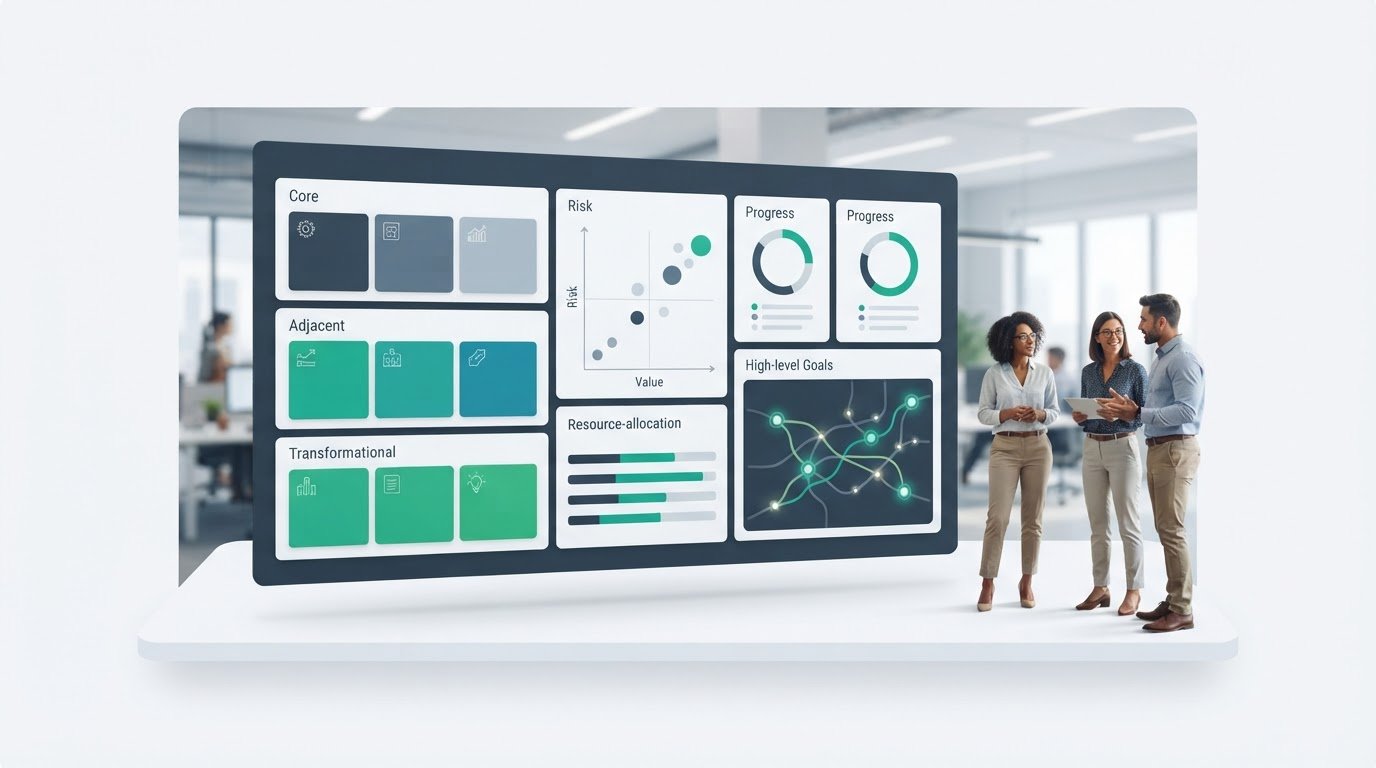
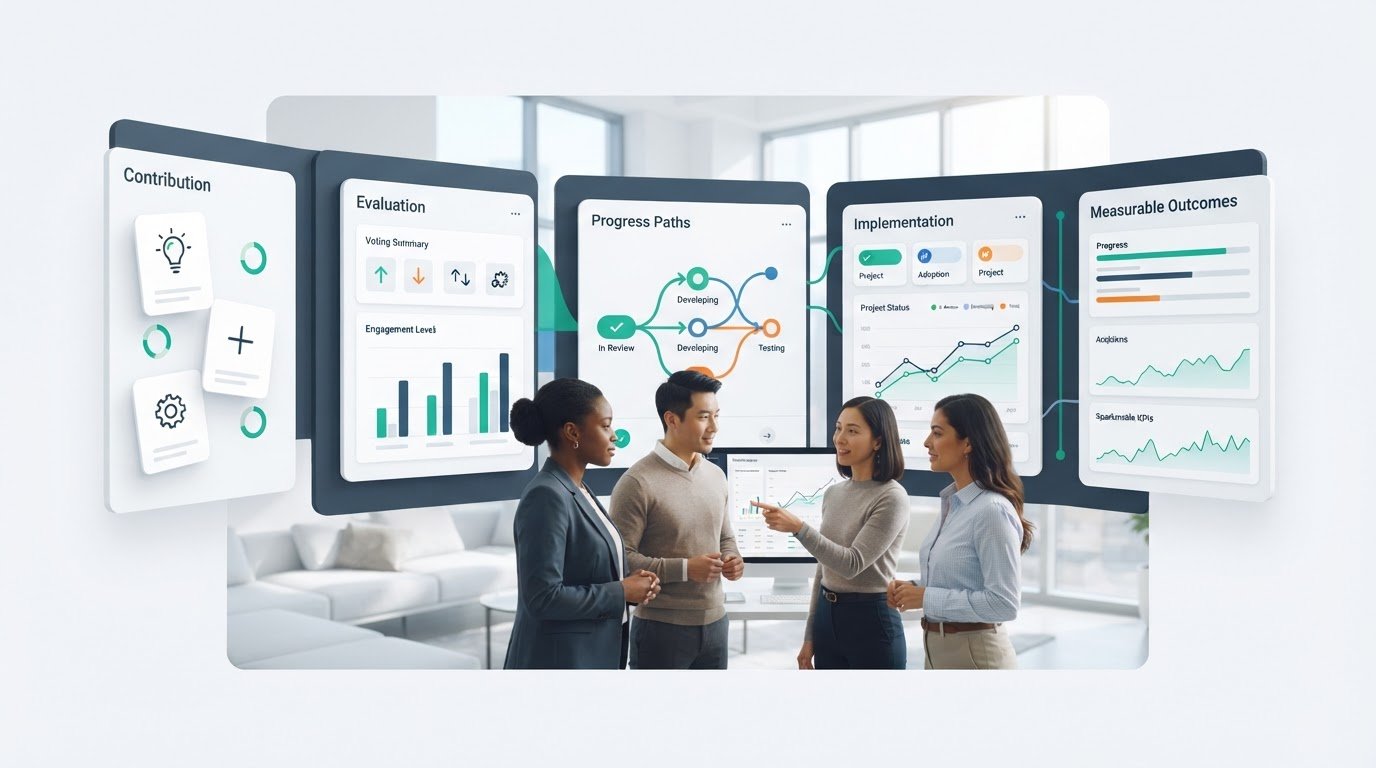
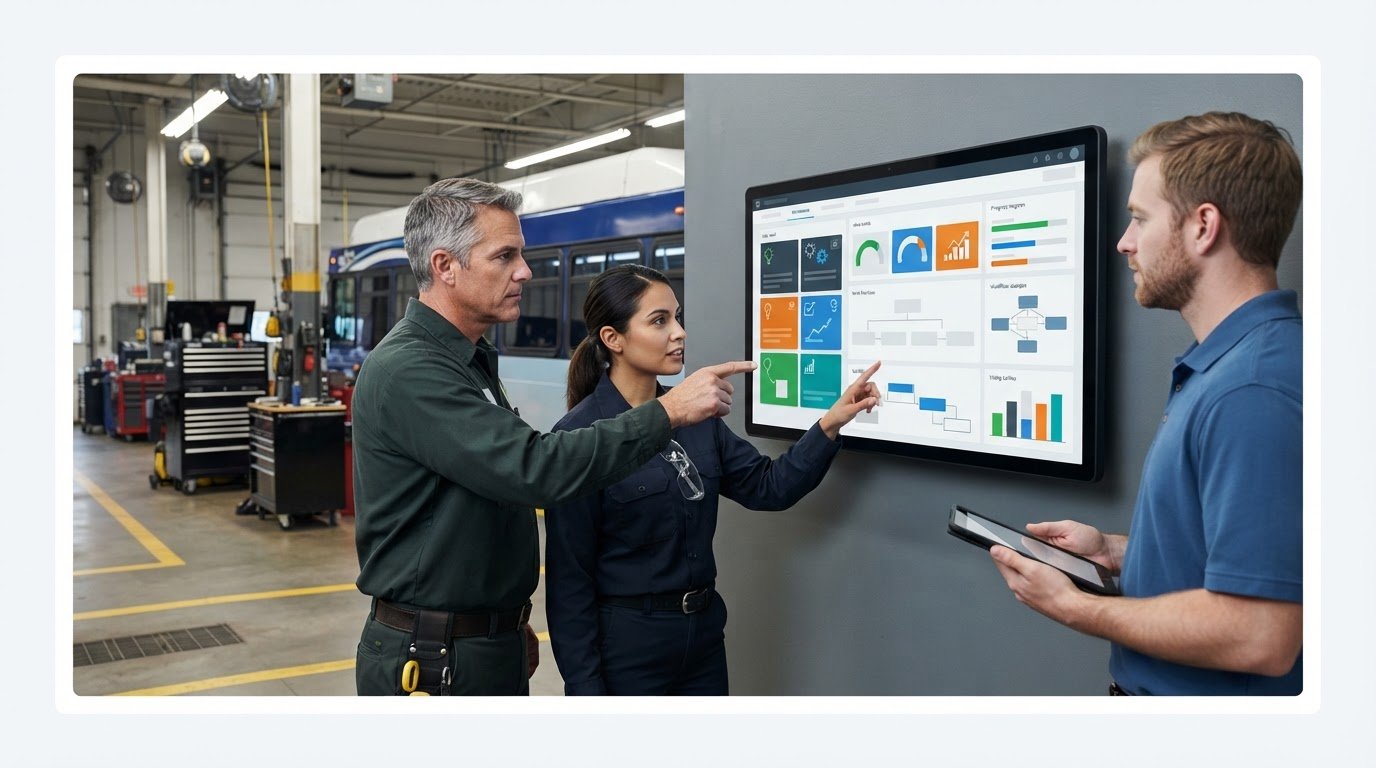
Transit employees evaluate and advance improvement ideas on an innovation management dashboard at a bus depot
Coby Skonord|
November 20, 2026

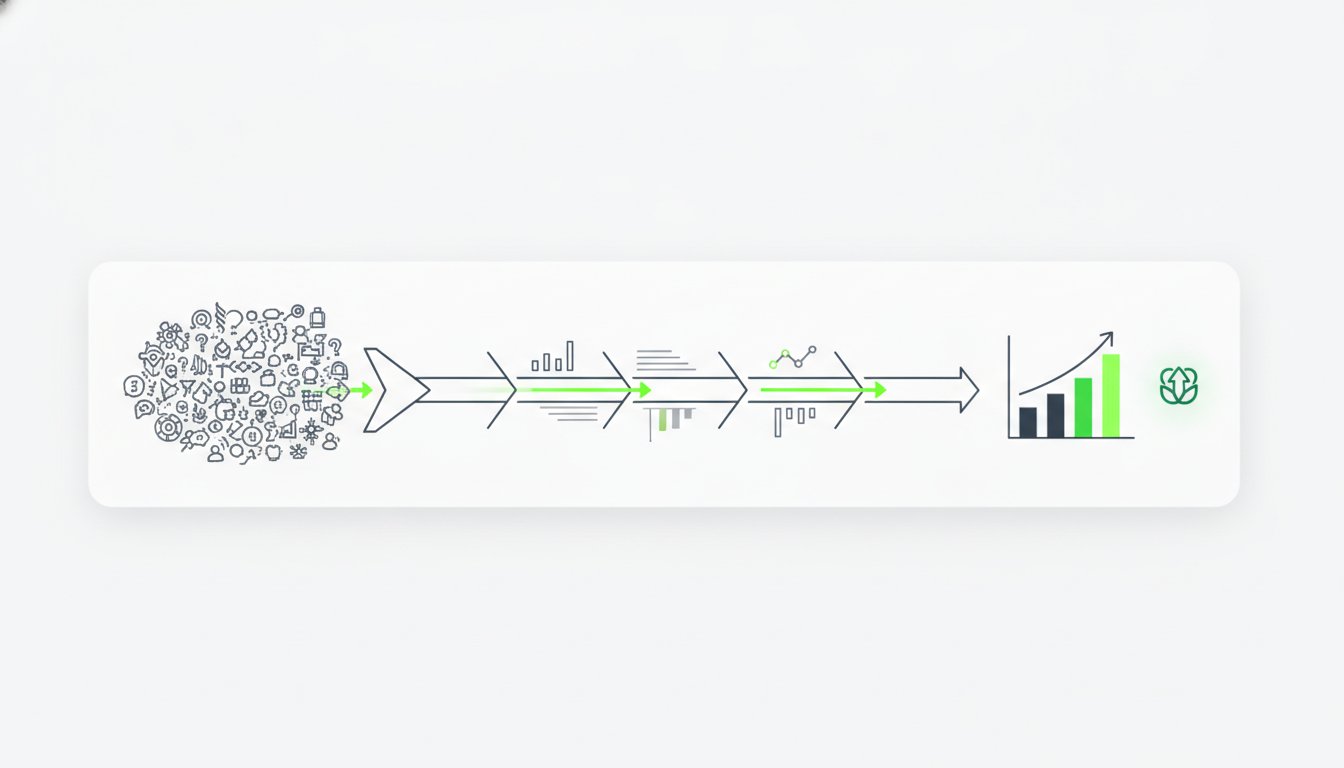
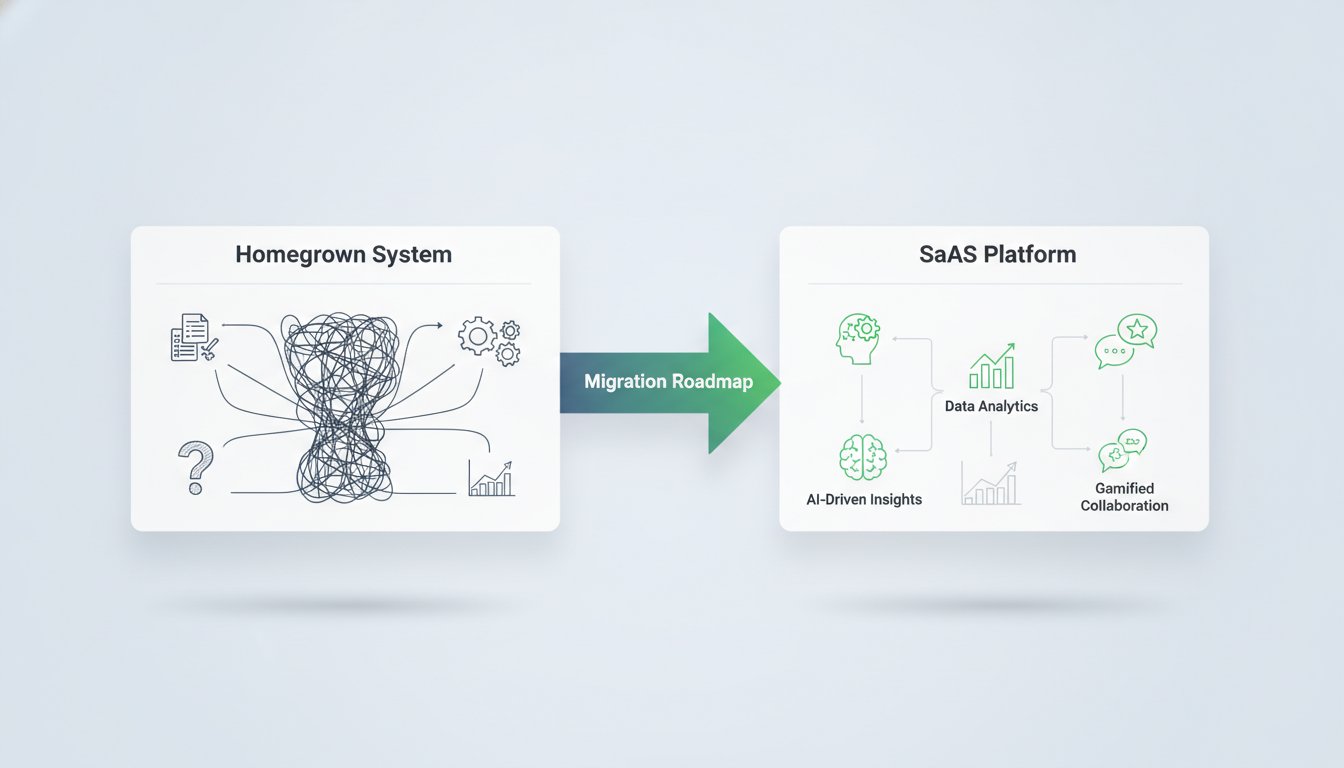
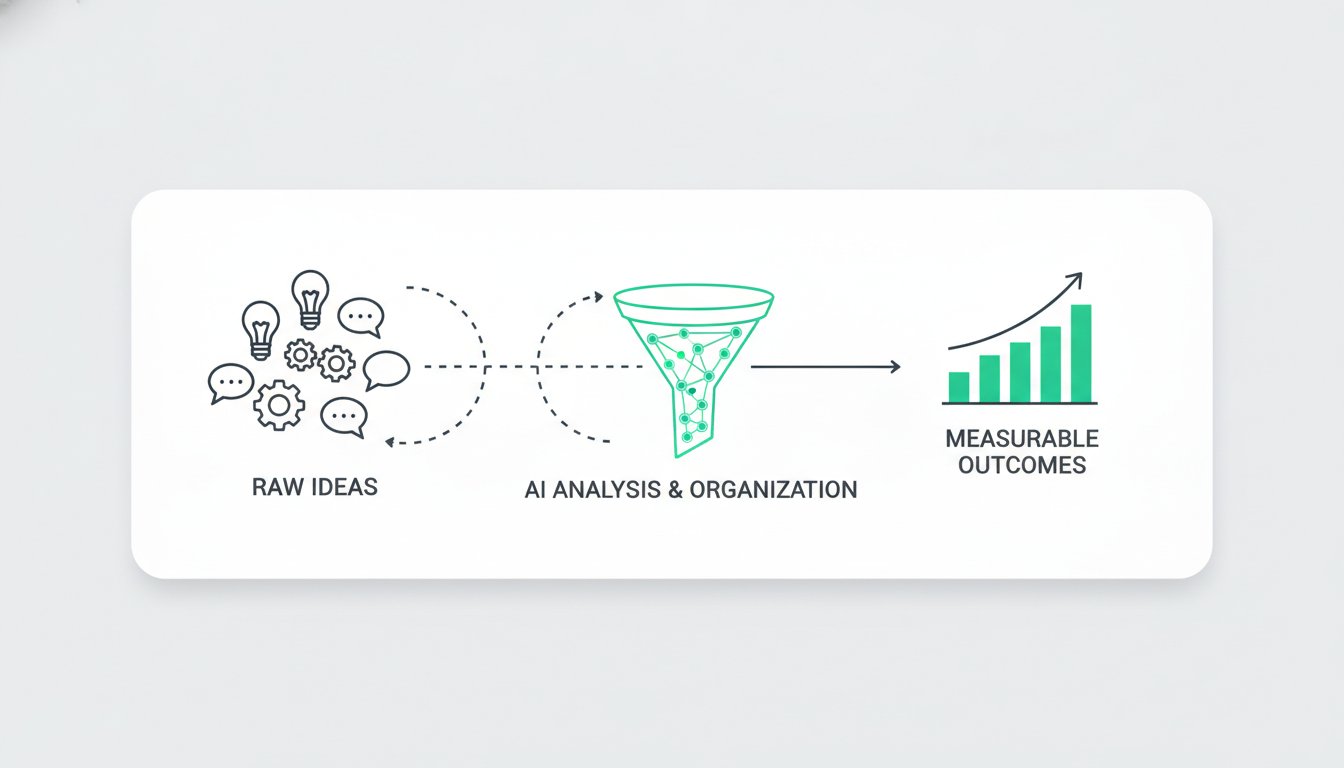
At a large organization, innovation rarely stalls because people lack ideas. It stalls when there’s no clear path from idea to launch. An innovation management process provides that path, moving ideas from generation through evaluation and development to implementation and market introduction.

That structure matters because enterprise innovation must connect promising ideas to business priorities without shutting down experimentation. You’ll learn what innovation management involves, how organizations collect and assess ideas, and how selected concepts move toward launch. This guide also explains how large organizations coordinate teams, decisions, and portfolios so innovation becomes repeatable rather than a collection of disconnected projects.

Key Takeaways

  • Use clear evaluation criteria to compare ideas, surface risks early, and decide what should advance, pause, or be saved for later.
  • Combine focused innovation challenges with ongoing idea submissions to capture both strategic opportunities and frontline insights.
  • Move selected concepts toward launch through staged development, testing, coordinated implementation, and feedback.
  • Track both early activity and business outcomes so innovation measures progress, not just the number of ideas collected.
  • As innovation scales across a large organization, align governance and portfolio decisions with enough flexibility for teams to experiment.

Evaluating, validating, and launching ideas

Selection turns a broad set of ideas into projects with a clear path forward. Leaders need consistent criteria, evidence from validation, and launch plans that connect decisions to execution.

Idea Evaluation and Selection Criteria

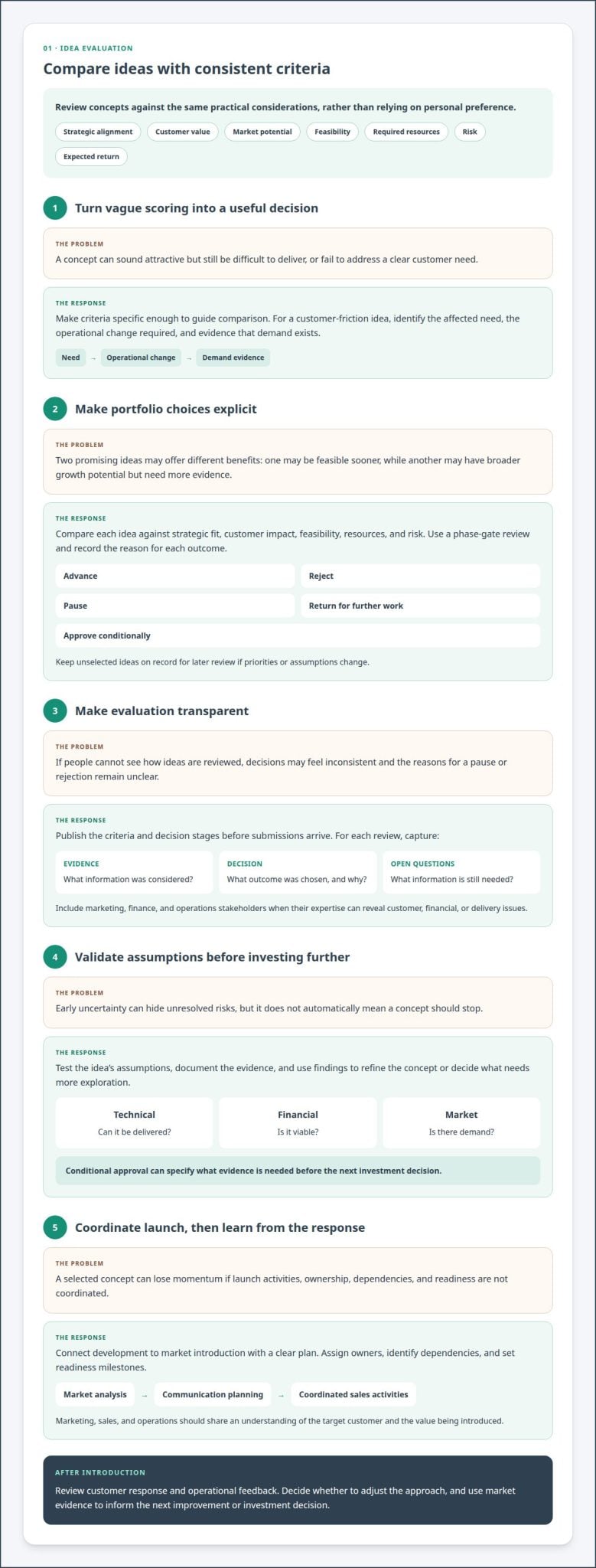
Idea evaluation and selection criteria are the standards used to compare concepts before committing resources. A practical review considers strategic alignment, customer value, market potential, feasibility, required resources, risk, and expected return. Together, these criteria help leaders distinguish promising ideas from attractive concepts that may be difficult to deliver.

Make the criteria specific enough to guide a decision. For example, a concept intended to reduce customer friction should identify the affected customer need, the operational change required, and the evidence that demand exists. A structured idea evaluation process helps reviewers apply the same questions across projects instead of relying on personal preference.

Prioritizing Innovations

Prioritizing innovations means comparing validated ideas with business goals and available capacity, then deciding which should advance. A phase-gate review gives each concept a decision point: advance, reject, pause, return for further work, or approve conditionally. Record the reason for each outcome and define the next step.

Consider two proposals: one improves an existing customer process, while another explores a new market. The first may be feasible sooner; the second may offer broader growth potential but need more evidence. Compare both against strategic fit, customer impact, feasibility, resources, and risk. Keep unselected ideas on record for later review, especially if priorities or assumptions change.

Transparent Evaluation Protocols

Transparent evaluation protocols explain who reviews ideas, which criteria apply, and how decisions are recorded. Publish the criteria and decision stages before submissions arrive. For each review, record the evidence considered, the decision and its rationale, and any information still needed.

Involve marketing, finance, and operations stakeholders when their expertise can reveal customer, financial, or delivery issues. For example, an operations reviewer can identify a workflow constraint before a concept enters development. Consistent records also help employees understand why an idea advanced or paused, supporting experimentation while preserving accountability.

Validate Before Investing Further

Validation tests an idea’s assumptions before a team commits to broader development. Examine technical feasibility, financial viability, and market demand, then record the evidence behind each conclusion. A customer-facing concept, for example, may need evidence of demand alongside an assessment of how it can be delivered.

Use the findings to refine the concept, identify unresolved risks, or return it for further exploration. Conditional approval can specify what evidence is needed before the next investment decision. This keeps the innovation management process evidence-led without treating early uncertainty as an automatic reason to stop.

Coordinate the Launch

A launch plan connects development to market introduction through market analysis, communication planning, and coordinated sales activities. Assign an owner to each activity, identify dependencies, and set readiness milestones. Marketing, sales, and operations should share an understanding of the target customer and the value being introduced.

Before launch, confirm that customer-facing messages reflect the tested value proposition and that delivery teams can support the offer. After introduction, review customer response and operational feedback, then decide whether to adjust the approach. Evaluation does not end at launch: market evidence informs the next improvement or investment decision.

Collecting employee ideas through challenges and open submissions

Employee ideas can come through focused challenges or an always-open channel, providing both targeted and unsolicited input. Common risks include vague prompts, low participation, duplicate submissions, biased screening, and ideas that receive no feedback or ownership.

Ideas-First and Needs-First Approaches

An ideas-first approach starts with a proposed solution, while a needs-first approach starts with a problem employees or customers experience. The distinction matters: a clever suggestion can miss the underlying need, while a clearly defined problem gives contributors room to explore different solutions.

Use open submissions to capture ideas employees notice in everyday work, then ask what problem each addresses. For example, a warehouse employee might suggest a new scheduling tool; follow-up could reveal that shift handoffs, not scheduling, cause delays. Focused challenges work well when leaders can define a need, such as reducing handoff errors or simplifying a service step.

A strong culture makes room for both approaches. Challenges create a shared focus, while open submissions can surface improvements beyond current priorities. Explain the challenge’s purpose, who can contribute, and how ideas will be reviewed. This helps employees connect their experience to organizational needs without forcing every suggestion into a predetermined solution.

Crowdsourced Feedback on Ideas

Crowdsourced feedback gathers reactions, refinements, and expertise from a group of employees rather than leaving screening to one reviewer. It matters because colleagues in different roles may identify implementation barriers or customer effects that the original contributor cannot see.

For useful feedback, present the problem, proposed idea, and specific prompts together. Ask colleagues to identify likely benefits, risks, missing information, or alternatives. A frontline employee may spot a workflow issue, while a customer-facing colleague may flag an unmet need. Make commenting and voting part of a clear evaluation process, not a popularity contest.

Advocacy can strengthen an idea’s case when supporters explain their reasoning and relevant experience. Still, leaders should distinguish enthusiasm from evidence. A screening step can group duplicates, clarify incomplete submissions, and route ideas to people with relevant knowledge. A structured employee ideation program can make participation and feedback part of ongoing improvement.

Recording and Sharing Ideas

Recording ideas means keeping each submission in a shared, searchable record with enough context for follow-up. Without one, ideas can disappear in email threads, meeting notes, or isolated forms, leaving teams unable to revisit useful suggestions.

Capture the problem, proposed change, affected team or customer, expected benefit, and supporting details. Add a status and owner so employees can see whether an idea needs clarification, is under review, or has moved forward. Share submissions with relevant colleagues, keeping discussion focused on useful feedback and next steps.

For example, a facilities team could record a recurring equipment issue and invite staff to suggest ways to reduce disruption. Related submissions can be grouped, discussed, and retained even if no immediate project proceeds. Close the loop by communicating decisions and reasons; otherwise, silence can weaken participation. To see how a digital approach can support this work, explore a guided platform walkthrough.

What is the Innovation Process?

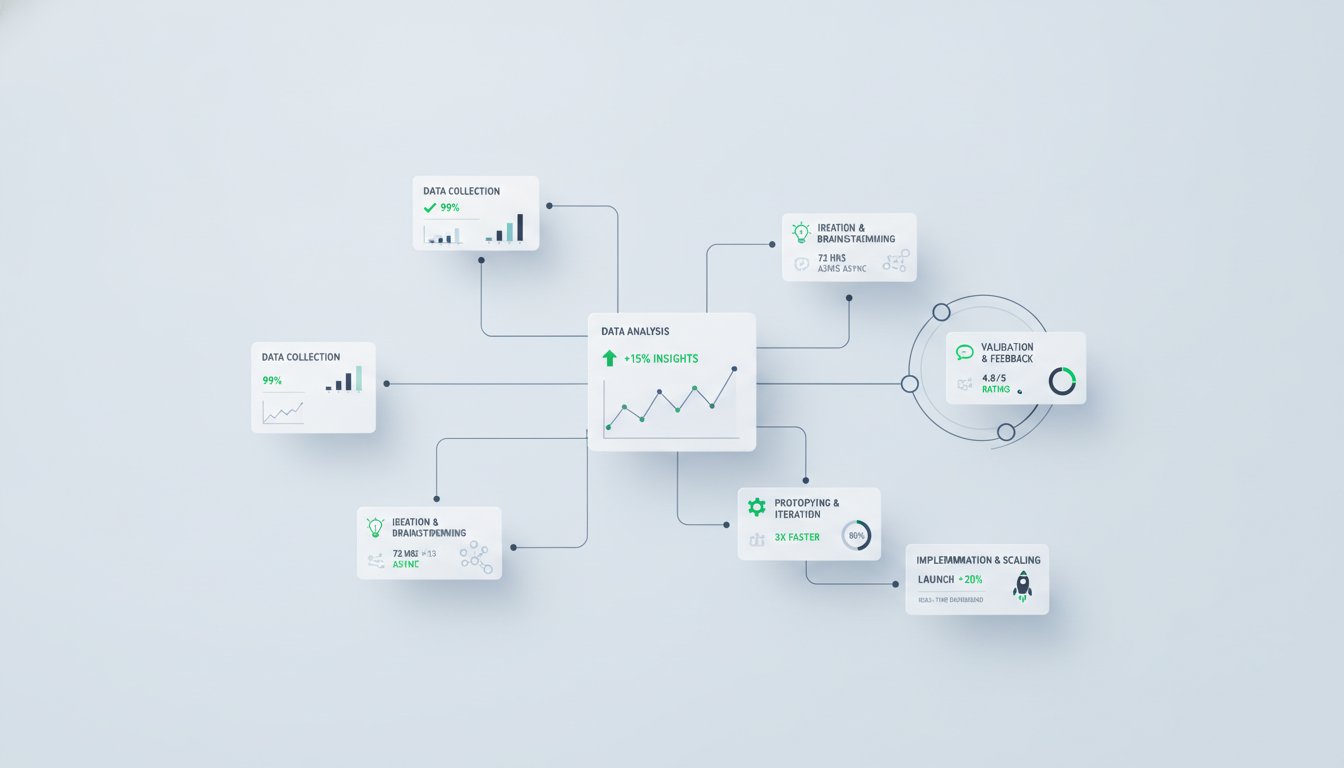
The innovation process moves a concept from a defined opportunity toward development, implementation, and adoption. It gives teams a practical route from strategic intent to action.

Organizations fund and resource innovation projects by aligning them with strategic priorities, assigning people and budget, and releasing additional resources as evidence supports progress. Internal teams, external partners, and staged investment can each contribute, depending on a project’s needs.

Innovation Strategy Development

An innovation strategy defines the opportunities an organization will pursue, the outcomes it wants, and the capabilities it can commit. It matters because leaders must balance near-term improvements with longer-term concepts that could open new markets.

Start by connecting innovation goals to business priorities, such as improving customer experience or operational efficiency. Then clarify which teams, expertise, and funding can support each goal. A portfolio can combine incremental improvements with more exploratory projects, helping leaders avoid spending all available capacity on one kind of opportunity. The distinction between incremental and radical innovation can help frame that balance.

Concept Development and Prototyping

Concept development turns an opportunity into a defined proposal, while prototyping creates a simple representation that supports learning. These steps help teams expose unclear assumptions before committing to full development.

A product concept should identify its intended user, the problem it addresses, and the value it offers. A team exploring a faster service handoff, for example, might sketch the revised workflow before building new systems. Depending on the concept, a prototype could be a sketch, digital simulation, or physical model. Keep it focused on the question the team needs to answer, such as whether users understand the new process.

Concept Testing

Concept testing evaluates assumptions with relevant users, stakeholders, or operational evidence before broader implementation. It helps reveal whether a proposed benefit matters and whether delivery conditions support it.

Choose a test that matches the uncertainty. A customer-facing concept might be assessed through user reactions to its value proposition; an internal process change might be tried with the employees who do the work. Record the response, assumptions tested, and resulting changes. If findings expose a gap, refine the concept and test again rather than treating early feedback as a final verdict.

Innovation Development and Implementation

Development and implementation turn a tested concept into an operating product, service, or process. Even a strong concept needs clear ownership and coordinated delivery to create practical value.

Build an implementation plan that connects development tasks to people, resources, milestones, production needs, and launch activities. For a new service, operations may prepare delivery workflows while marketing develops customer communications. External partners can contribute needed capabilities, with responsibilities agreed before work begins. Track dependencies and unresolved risks, then coordinate the launch across relevant teams. After implementation, use customer and operational feedback to guide improvements and further development.
The Innovation Management Process: A Practical Guide

What is innovation management?

Innovation management connects initiatives to evidence, learning, and measurable outcomes. Common frameworks include Lean Startup’s build-measure-learn loop, design thinking, stage-gate reviews, roadmapping, and idea management.

Innovation Performance Measurement

Innovation performance measurement tracks whether innovation work produces learning and business outcomes. Idea counts alone cannot show whether initiatives solve customer problems or improve operations.

Choose measures that fit each initiative’s goal. A service improvement might track customer satisfaction and process quality, while a new offer might track adoption, revenue growth, or time-to-market. Compare results with the initiative’s original objective, not an unrelated portfolio target.

Review measures at decision points, including after launch. If adoption is weak, examine customer feedback, implementation barriers, and original assumptions before deciding whether to adjust or stop. A consistent approach to measuring innovation programs helps leaders connect project evidence with portfolio outcomes.

Input and Output Metrics

Input metrics measure the resources and activity committed to innovation; output metrics measure what those efforts produce. Track both, because high activity does not automatically mean successful results.

Inputs can include employee participation, ideas submitted, experiments completed, and resources assigned. Outputs can include concepts advanced, projects launched, customer response, revenue growth, or operational improvements. For example, strong participation but few tested concepts may signal a bottleneck between collection and evaluation.

Pair each input with a relevant output, then review the relationship over time. If experiments increase but customer learning does not, teams may need better test questions. If launches occur but adoption remains limited, examine whether the offering addresses an important need. Metrics should prompt investigation, not reward activity without impact.

Innovation Management Tools and Frameworks

Innovation tools and frameworks organize idea capture, experimentation, decisions, and learning. Choose them to fit the uncertainty and delivery needs of each initiative.

Lean Startup uses a build-measure-learn loop: build a testable version, measure how people respond, and use feedback to decide what to change. A team testing a new service feature could release a limited version, observe customer use, and refine the concept. The loop is iterative, allowing teams to revisit assumptions instead of treating a launch as proof of success.

Design thinking helps teams investigate user needs and develop potential solutions. Stage-gate reviews structure decisions between project phases, while roadmaps connect initiatives to strategic priorities. Idea management supports collecting and tracking proposals. Choose a framework based on the challenge: uncertain customer demand calls for testing and learning; a defined operational improvement may need milestones, owners, and delivery measures.

Innovation management in large organizations

Large organizations need shared priorities without centralizing every experiment. Governance, portfolio oversight, and clear ownership connect ideas generated across departments to organization-wide goals.

Accenture reported that 96 percent of executives said long-term success depends on developing new ideas. Accenture also found that 82 percent of respondents did not distinguish meaningfully between significant innovation and incremental performance gains. Its research further reported that 72 percent of companies let innovations languish without a formal process or organizational home. These findings point to a coordination challenge: ideas need sponsors, resources, and decisions. Accenture’s innovation research highlights the need to connect ambition with execution.

Give each initiative an accountable owner and a route to decision-makers. A central innovation lead can coordinate portfolio priorities, while business units assess operational fit and contribute expertise. For example, a customer-service suggestion may need input from operations, IT, finance, and customer-facing teams before it becomes a funded project.

Set governance around decision rights, not layers of approval. Define who can sponsor an idea, assess its fit, allocate resources, and pause work when evidence changes. Use stage reviews for investment decisions, but keep early exploration lightweight. Standardize records and reporting while allowing teams to test solutions suited to their work.

Portfolio oversight helps leaders balance near-term improvements with longer-term opportunities. Review initiatives together, considering strategic fit, expected outcomes, resources, and dependencies. If technology changes customer expectations, revisit priorities instead of protecting projects simply because they already have support. Stopping work that no longer fits frees capacity for stronger opportunities.

Culture matters too. A study by Strategyn involving 393 innovation leaders found recurring innovation problems across nearly every organization studied. Leaders can address ambiguity by defining each initiative’s intended scope and outcome. An operational efficiency project and a new-market exploration effort may both matter, but they need different evidence and review criteria.

Make participation practical across locations and roles. Invite employees to contribute through challenges and ongoing channels, then communicate decisions and next steps. Innovation Leader reported that over 82% of executives in large organizations surveyed had used the Lean Startup Methodology in some way. Experimentation can support learning, but enterprise teams still need clear ownership to turn learning into coordinated action.

For large organizations, the key is to centralize priorities and accountability while distributing exploration and learning. A consistent framework should make it easy to see who owns each initiative, what evidence supports it, and where the next decision lies.

Ideawake

Ideawake offers a cloud-based platform for collecting, evaluating, and implementing ideas. It may be relevant when employee, customer, or partner ideas are spread across teams and need a defined path into innovation initiatives. Its Innovation Management Platform and Idea Management Platform cover stages of the innovation lifecycle, alongside Continuous Improvement and Ideawake AI.

For large organizations, a shared platform can provide a place to capture proposals, involve contributors in evaluation, and track ideas as they progress. Voting, leaderboards, and prizes are possible ways to encourage participation, while structured workflows can help teams handle ideas consistently. These capabilities can support focused innovation efforts as well as ongoing improvement.

Contact Ideawake to discuss whether its platform fits your organization’s innovation processes.

Make the next decision count

Put your innovation management process to work by choosing one business priority that needs fresh thinking. Name an accountable sponsor, define the decision the initiative should inform, and agree on what evidence would justify moving forward. This creates a focused starting point without requiring the entire organization to change at once.

Then make learning visible. Give teams a clear way to share progress, surface barriers, and explain what they need from decision-makers. A useful review helps leaders decide whether to continue, adjust, or redirect effort. That discipline makes innovation a leadership practice, not a side project competing with everyday work.

Ideawake supports organizations with an Innovation Management Platform, an Idea Management Platform, and Continuous Improvement capabilities. If you’re ready to discuss how these offerings could support your organization’s priorities, take the next step.

Start with a meaningful opportunity, learn from the work, and build from there. Progress begins with a decision your teams can act on.

Frequently Asked Questions

Where is the Phase-Gate process used?

Phase-Gate is used to manage projects that need staged reviews and investment decisions. Organizations can apply it to product development or operational improvements when work can be divided into stages with evidence reviewed at each decision point. A team may advance a concept, pause it for more evidence, recycle its assumptions, or stop it. The approach is most useful when leaders need explicit control over commitments and clear accountability at each gate.

What is the innovation management process?

The innovation management process is the coordinated way an organization develops promising ideas into implemented changes. It connects opportunities to business priorities, assigns ownership, and gives teams a way to learn from evidence. For example, an operations leader could use it to move a recurring service issue from employee observation to a tested process change. Its value lies in making innovation work visible and actionable, not merely collecting suggestions.

What are the key stages of an innovation management process?

Key stages typically include generating ideas, selecting and evaluating them, developing concepts, implementing solutions, and introducing them to users or markets. Teams may revisit stages when new evidence changes an assumption. For example, customer feedback during a limited release could send a concept back for refinement. The sequence gives leaders a shared map while allowing initiatives to move at different speeds based on uncertainty and delivery needs.

How do organizations generate and prioritize innovation ideas?

Organizations generate ideas through employee submissions, focused challenges, customer input, and collaboration with external partners. To prioritize them, leaders can compare each proposal with strategic goals, customer or operational needs, feasibility, resource demands, and potential risk. For example, a service team may rank suggestions by how directly they address a recurring customer problem. Keep lower-priority proposals on record so teams can reconsider them when conditions or priorities change.

How do companies evaluate the feasibility and business value of innovations?

Companies assess feasibility by examining whether a concept can be delivered with available technical capabilities, operational capacity, and resources. They assess business value by considering strategic fit, customer benefit, market demand, and expected returns. A proposal to simplify a service process, for instance, should address both user value and the team’s ability to implement it. Record assumptions separately from supporting evidence so decision-makers can identify what still needs testing.

How are innovation projects tested, developed, and launched?

Teams test a project’s riskiest assumptions using a method suited to the concept, such as a sketch, simulation, pilot, or limited release. They use feedback to refine requirements before broader development. During implementation, assign owners for delivery, operations, and communications. Before launch, confirm that the product or process is ready for its intended users. Afterward, review actual use and feedback to identify adjustments, support needs, or further opportunities.

What metrics measure innovation management performance?

Useful measures connect innovation activity to learning and outcomes. Input indicators can include participation, submissions, experiments, and resources committed; output indicators can include concepts tested, projects implemented, customer response, time-to-market, revenue growth, or operational improvement. Select measures based on each initiative’s objective. For example, a process-improvement effort should track its targeted operational result, not rely only on how many ideas employees submitted.

How does innovation management differ across industries and company sizes?

Innovation management varies with customer needs, operating conditions, project risks, and organizational structure. A manufacturer may emphasize production feasibility, while a service organization may focus on customer experience and workflow changes. Smaller organizations may coordinate decisions through fewer roles; larger enterprises often need clearer governance across departments. In either setting, adapt review steps and evidence requirements to the initiative while keeping ownership, decision criteria, and outcomes clear.

Article by

Coby Skonord

Coby Skonord is the co-founder and CEO of Ideawake. Since 2013 he has worked with enterprise innovation, continuous improvement, and HR leaders to turn employee ideas into measurable business impact.

How to Drive Innovation Using Microsoft Tools

College staff prioritize employee ideas on a physical innovation workflow beside a student check-in queue
Coby Skonord|
November 2, 2026

Innovation doesn’t come from adding more software to an already crowded stack. Enterprise innovation software helps employees capture ideas, use AI to explore and refine them, and collaborate across departments, while Microsoft tools can support the day-to-day work of sharing and developing those ideas. The key is connecting the tools to a clear process, so promising suggestions move beyond conversation and into evaluation and action.

It’s reasonable to expect familiar workplace tools to make collaboration easier, but access alone won’t create a repeatable innovation process. This article explains how to connect Microsoft tools with idea-sharing practices, where AI and generative AI can assist, and how cross-functional teams can evaluate ideas against business priorities. You’ll also learn what to consider when choosing enterprise innovation software and how to build a practical approach that employees can use across the organization.

Key Takeaways

  • Set clear business goals and a transparent evaluation process so employees can see how ideas move from submission toward action.
  • Use AI and generative AI to help organize and develop ideas, with human review and safeguards for sensitive information.
  • Choose tools that support collaboration across departments and make ownership, progress, and outcomes visible.
  • Assess software against your workflows, governance needs, and ability to manage ideas through implementation.
  • Connect familiar Microsoft tools with a dedicated idea management process when everyday collaboration alone isn’t enough.

How can companies encourage employees to contribute more innovative ideas?

Employees are more likely to contribute when leaders make participation useful, visible, and worth their time. Gallup’s 2024 State of the Global Workplace report found 23% of employees globally were engaged, 62% were not engaged, and 15% were actively disengaged. These figures underline why idea programs need more than an open submission form: leaders must make contribution part of meaningful work.

Middle managers shape that experience through everyday choices. Gallup reports that managers account for 70% of the variance in team engagement. Give managers a practical role: make space for suggestions during existing team routines, explain what happens after submission, and recognize useful contributions. For example, a manager can invite staff to describe a frustrating task and share the team’s response to the suggestions at a later meeting.

Make participation easier to sustain by linking ideas to outcomes employees can see. Gallup’s Q12 meta-analysis found that teams in the top engagement quartile had 23% higher profitability and 18% higher productivity than teams in the bottom quartile. These comparisons do not prove that an idea program alone creates those outcomes. They do show why leaders should connect employee participation with real organizational priorities.

Organizational change management should clarify what is changing, who will review ideas, and how decisions will be communicated. If employees submit suggestions but hear nothing back, they have little reason to contribute again. Enterprise innovation software can support a consistent process, but managers still need to explain its purpose and reinforce it in daily work. A clear response, including why an idea is deferred, helps maintain trust.

Managing Large Idea Volumes

Managing large volumes of ideas means organizing submissions so reviewers can spot patterns and assess proposals efficiently. Use topic labels such as safety, customer experience, or process improvement, then assign review responsibility by subject. This makes recurring concerns easier to identify and helps teams find related suggestions. Enterprise innovation software supports this work when its categories reflect how the business operates.

Selecting Enterprise Innovation Software

Choosing enterprise innovation software means matching a platform to your organization’s goals, workflows, and governance needs. Compare requirements for submission, review, access, reporting, and integrations. Test a realistic suggestion from intake through decision, and note where users need clarification. This practical evaluation reveals fit beyond a feature checklist.

Idea Management Software

Idea management software provides a dedicated place to submit, assess, and follow suggestions. It helps when email threads or spreadsheets make ownership difficult to track. For example, a team could collect proposals to reduce rework, group similar submissions, and route them to the relevant reviewers. Explore corporate innovation tools by considering how each supports that process.

AI and generative AI applications

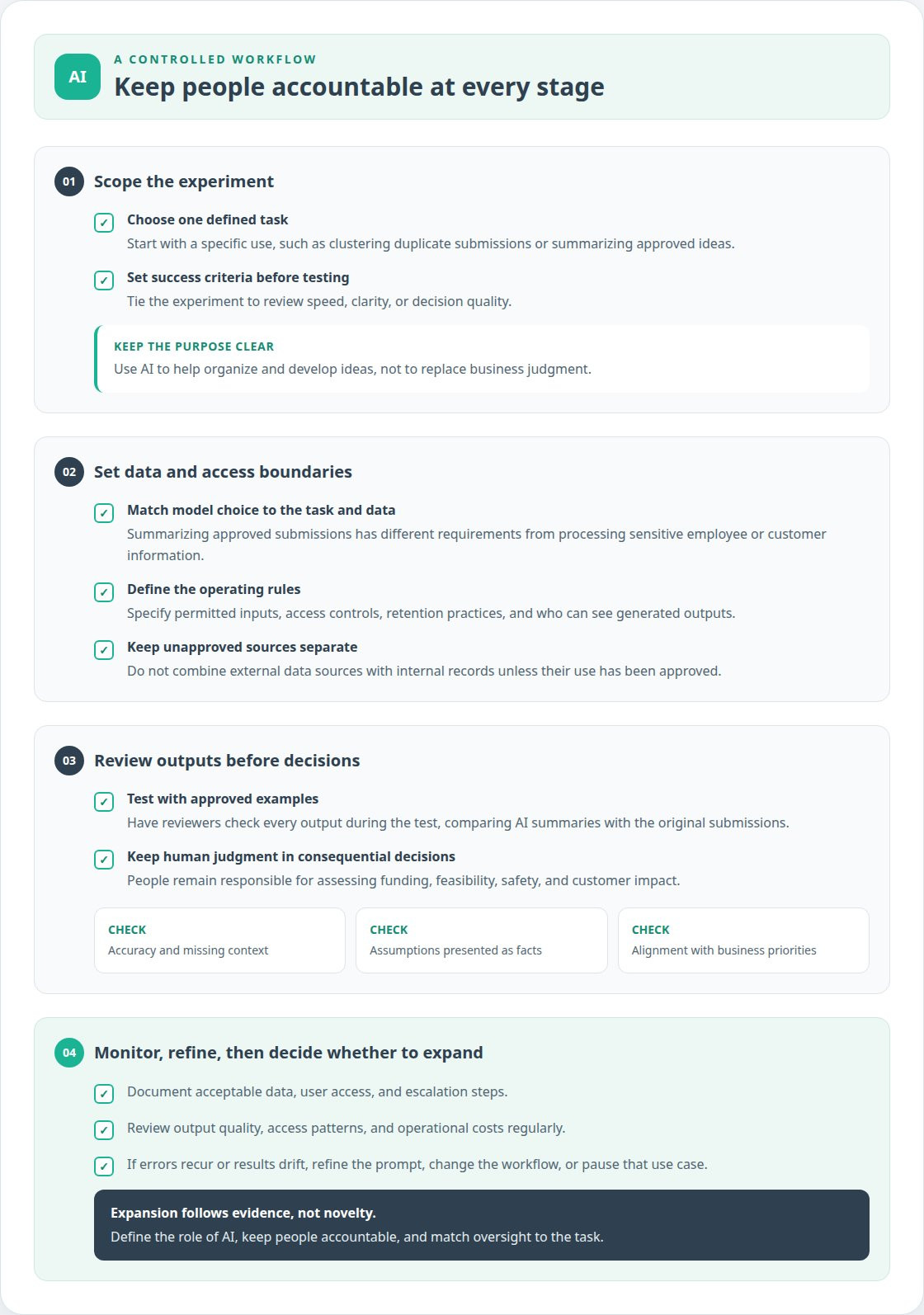
AI can help teams examine employee ideas, surface themes, and develop early concepts. Generative AI can also draft summaries or suggest questions for reviewers. These capabilities support innovation work, but they don’t replace business judgment. Start with one defined challenge, such as reducing repetitive service requests, and decide which task AI should assist with.

For example, an AI system could group submissions about confusing customer handoffs, then summarize common causes for a human review team. Generative AI could help turn a rough suggestion into a clearer problem statement or propose follow-up questions that reveal assumptions. Reviewers can then compare the refined idea with operational priorities. This assistance makes submissions easier to scan, without treating generated content as proof.

Choose an AI model based on the task and the data involved. A model that summarizes approved submissions has different requirements from one processing sensitive employee or customer information. Before deployment, define permitted inputs, access controls, retention practices, and who can see generated outputs. Keep external data sources separate from internal records unless their use has been approved. Clear boundaries reduce the risk of useful automation creating new information risks.

Generative systems can produce inaccurate statements, omit context, or present assumptions as facts. Human supervision is essential for decisions about funding, feasibility, safety, and customer impact. Ask reviewers to compare AI summaries with original submissions before advancing an idea. Monitor output quality, access patterns, and operational costs after deployment. If errors recur or results drift, refine the prompt, change the workflow, or pause that use case.

Move from experiment to practice through a controlled workflow:

  • Choose one specific task, such as clustering duplicate submissions.
  • Set success criteria tied to review speed, clarity, or decision quality.
  • Test with approved examples and have reviewers check every output.
  • Document acceptable data, user access, and escalation steps.
  • Review performance regularly before expanding automation.

This approach helps teams learn where AI adds value without letting novelty drive adoption. The same discipline applies to AI agents that assist with analysis, design, testing, or delivery: define their role, keep people accountable, and create oversight that matches the task. For practical examples of AI use in innovation workflows, explore AI tools for innovation managers. Well-scoped experiments can strengthen idea development while preserving human control and clear ownership.

AI adoption in enterprise software

AI adoption works best as a focused business transformation, not a technology add-on without a clear goal. An operations team might use AI to identify recurring production delays, while a service team could analyze common customer handoff problems. In either case, leaders should name the decision or workflow they want to improve before selecting a system. This keeps the project grounded in business needs.

Enterprise software has evolved through waves such as cloud computing and software as a service. AI represents another shift because it can assist with analysis, content creation, and workflow execution. For example, an innovation team might use AI to summarize employee submissions, then ask reviewers to validate the themes against original ideas. Technology supports the work, but accountable people still make decisions.

Build governance into the design rather than treating it as a late approval step. Define which information AI may process, who can access its outputs, and which decisions require human review. For example, separate general process suggestions from submissions that contain customer or employee details. Assign an owner to monitor output quality, access, and operational performance. Clear responsibility helps keep promising experiments from becoming unmanaged systems.

Data infrastructure and security determine whether an AI use case can move beyond a prototype. A team analyzing service feedback needs reliable input data, controlled access, and a way to review model performance over time. Organizational change matters too. Explain how AI affects existing roles, train employees on the revised workflow, and give them a way to flag errors. Without adoption planning, a tool can add steps instead of reducing friction.

Use a practical adoption sequence:

  • Choose a specific workflow and state the business outcome it should support.
  • Identify the data, users, and systems involved before configuring AI.
  • Set review rules for generated summaries, recommendations, or actions.
  • Test the workflow with real users and collect examples of errors.
  • Track performance and adjust governance before expanding its scope.

These steps connect technical delivery with daily work. For example, a department can start with AI-assisted idea categorization, review whether the categories help staff find relevant proposals, and refine the process before applying automation elsewhere. Keep the target narrow enough to measure but meaningful enough to matter. That balance gives leaders evidence for their next decision.

AI-enabled innovation workflows also need a clear operating model: named owners, review criteria, and a process for handling exceptions. Organizations planning that foundation can explore AI-powered innovation management as one approach to connecting AI with idea development. The priority is deliberate adoption, where governance, people, and technology advance together.

How to Drive Innovation Using Microsoft Tools

Cross-departmental collaboration

Cross-departmental collaboration brings people with different expertise together to solve a shared business problem. A customer handoff challenge, for example, may involve operations, sales, service, and technology. Each team sees a different part of the workflow, so working together can reveal causes one department might miss. Shared ownership matters: without it, ideas can stall between teams as each waits for another to act.

Microsoft Teams can support discussion, while SharePoint can provide a shared space for project materials. These tools help teams communicate, but collaboration still depends on clear decisions, owners, and handoffs. Define who frames the challenge, contributes expertise, assesses feasibility, and approves implementation. For a recurring service issue, operations might map the process, customer service could identify pain points, and technology staff could assess system dependencies.

Build engagement by giving each department a specific contribution instead of inviting everyone into a broad, undefined discussion. A useful working agreement identifies the problem, decision-maker, information needed, and how progress will be shared. During a process-improvement effort, frontline employees can describe workarounds, managers can explain performance targets, and analysts can examine available data. This division uses existing capabilities without letting one department dominate.

Manual handoffs can weaken otherwise strong ideas. Reduce that friction by recording decisions, assigning next steps, and setting a shared review point. For instance, when a proposal affects employee training and a customer-facing process, the training lead and service owner should review the same recommendation. Governance clarifies who resolves competing priorities. Continuous improvement then becomes part of the workflow, rather than a separate investment that fades after kickoff.

Use this collaboration checklist before launching a cross-functional effort:

  • Name the business problem and the outcome teams are working toward.
  • Include people with relevant frontline, operational, and technical expertise.
  • Assign one accountable owner for decisions and action tracking.
  • Agree how Microsoft Teams discussions and shared documents will support the work.
  • Review progress together and communicate decisions to contributors.

These practices connect engagement with action. A focused innovation challenge can give departments a common target, such as improving onboarding or reducing repeated service questions. Its value depends on participation, clear criteria, and follow-through, not just the number of submissions. Teams can use innovation challenge examples to shape a cross-functional effort around a specific need.

Leaders should recognize that collaboration takes time away from employees’ existing responsibilities. Make the work visible in planning, clarify which decisions need group input, and let specialists complete independent tasks between reviews. When departments understand their roles and see how decisions progress, they can combine their capabilities without creating another disconnected workflow.

What is enterprise innovation software and what features does it include?

Enterprise innovation software gives organizations a structured way to collect, assess, develop, and track ideas. Unlike a Microsoft Teams conversation or shared document, it can connect submissions to review stages and decisions. For example, an employee suggestion about reducing repeat customer questions can be recorded, assigned for review, and tracked through implementation. The system supports the process; leaders still set priorities and make decisions.

Think of the platform as a workflow from idea intake through follow-through. Employees submit proposals, reviewers assess them against shared criteria, and owners record what happens next. A proposal might move from “submitted” to “under review,” then to a decision and an implementation owner. These stages create visibility across departments and help teams see whether an idea needs clarification, further analysis, or action.

For a large organization, useful capabilities typically include:

  • Idea capture: forms or portals collect a problem, proposed change, and supporting context.
  • Review workflows: criteria and assigned reviewers make assessment more consistent.
  • Collaboration: comments and discussion help contributors build on proposals.
  • Portfolio visibility: dashboards show status, themes, and ownership across initiatives.
  • Reporting: records connect activity with decisions and documented outcomes.
  • Integrations: connections to workplace systems can reduce manual handoffs when configured for organizational workflows.

Microsoft tools can remain part of the working environment. Teams can host discussions, while a dedicated innovation system organizes submissions, evaluation, and progress. Enterprise innovation software distinguishes informal conversation from a managed process by recording an idea’s owner, status, decision, and next action. Before selecting tools, map an example from initial suggestion to final decision, then identify where information currently gets lost.

Feature lists alone don’t determine fit. Compare each platform with your organization’s governance model, access needs, review criteria, reporting requirements, and existing workflows. Ask how employees submit proposals, managers handle duplicates, reviewers document decisions, and implementation owners report progress. Enterprise innovation software should meet these requirements in daily use, not just during a product demonstration. A guided evaluation of innovation management software selection can help teams compare real workflows with platform capabilities.

Keep the first rollout focused on a defined use case, such as frontline suggestions for reducing rework. Set clear ownership, test the review path with real submissions, and see whether employees understand each stage. Then refine fields, criteria, and reporting based on where reviewers encounter friction. The right platform makes work visible from idea to decision, while a sound operating process turns that visibility into accountable action.

Ideawake: Innovation Management Platform

Ideawake provides an Innovation Management Platform for capturing, evaluating, and advancing employee, customer, and partner ideas. It’s a natural next step when Microsoft tools support everyday conversations but your teams need a dedicated process to manage ideas through their lifecycle.

The Idea Management Platform supports structured idea review, while Continuous Improvement helps teams organize improvement efforts. Ideawake AI can assist innovation work, and engagement features such as voting, leaderboards, and prizes can encourage participation. Together, these capabilities bring submissions into a shared process, reduce administrative complexity, and make progress easier to follow.

If your organization is ready to give ideas a clearer path from submission to action, visit ideawake.com to explore how Ideawake can support your innovation program.

Make innovation part of how work gets done

Connect your innovation priorities with the routines, owners, and measures your organization already uses. Choose a business challenge, define who will guide the work, and decide how progress will be reviewed. This gives employees a clear path to contribute and helps leaders assess whether enterprise innovation software fits their operating model.

Ideawake offers an Innovation Management Platform, an Idea Management Platform, and Continuous Improvement to help organizations build this process. Each can structure the management of ideas and improvement initiatives around your program’s needs.

Start with a focused next step, then give your teams the space and direction to turn useful insight into progress.

Frequently Asked Questions

How Does Software Help?

Software helps teams organize information and apply analytical tools to work that would otherwise remain scattered. McKinsey’s 2024 State of AI report found that 72% of respondents said their organizations used AI in at least one business function, up from 55% in 2023. The same report found regular generative AI use rose from 33% to 65%. These figures offer context for assessing software that supports analysis, not proof that a particular platform will deliver results.

How can enterprises identify which innovation opportunities are worth pursuing?

Enterprises can distinguish opportunities by asking whether they address an emerging need, improve an existing operation, or open a different path to growth. Keep these categories visible during review, since each may require different evidence and decision-makers. For example, a service improvement could be tested within an existing process, while a new market concept may need research before operational planning. This helps leaders avoid judging unlike opportunities by identical expectations.

How do large companies maintain innovation momentum over time?

Large companies sustain momentum by developing employee skills alongside their innovation programs. The World Economic Forum’s Future of Jobs Report 2023 projects that 44% of workers’ skills will be disrupted within five years, and 60% of workers will require training before 2027. Leaders can use these findings to plan learning around new workflows, emerging technology, and changing roles. Regularly updating those learning plans helps teams keep pace as priorities shift.

Why do innovation initiatives sometimes lose executive support?

Executive support can fade when an initiative competes with urgent operational demands and its sponsors can’t explain the trade-off. Connect each initiative to a current priority, then make a clear decision about whether it deserves continued attention. For example, if a strategic shift makes a project less relevant, leaders can pause or redirect it instead of continuing by default. Explicit decisions protect focus and trust.

What are the best platforms for enterprise innovation in 2026?

There is no universal best platform for every organization in 2026. The right fit depends on whether the program centers on employee suggestions, continuous improvement, challenges, or portfolio oversight. Start by defining the primary use case and the people who will administer it. Then evaluate how well each option supports that program’s governance, adoption, and reporting needs. A strong fit should support the organization’s operating model, not force teams into an unsuitable one.

How do innovation platforms compare by features and use cases?

Compare platforms by examining how each handles the specific needs of a use case. A challenge program may need participant communications and review criteria, while continuous improvement may depend more on recurring operational input and status tracking. For programs using AI, assess how people review generated outputs and maintain oversight. A comparison matrix can record these requirements alongside administration, access, and reporting, making meaningful differences easier to discuss.

What are the leading platform vendors and their customer reviews?

Customer reviews can help buyers understand common user experiences, but they shouldn’t determine the decision alone. Look for detailed comments about the program type, implementation context, administrator workload, and employee experience. Check whether reviews describe recent, firsthand use or broad impressions, and compare recurring themes with your requirements. Use this evidence to shape internal evaluation questions, then assess the product against your workflows and governance needs.

How do companies choose an innovation platform?

Companies can choose an innovation platform by involving the people who will use and administer it before procurement. Include an employee contributor, a reviewer, a program owner, and an IT or security representative in the evaluation. Ask each person to complete tasks relevant to their role, then record friction points, missing information, and access concerns. This cross-functional assessment can reveal practical adoption issues that a feature checklist or executive review might miss.

Article by

Coby Skonord

Coby Skonord is the co-founder and CEO of Ideawake. Since 2013 he has worked with enterprise innovation, continuous improvement, and HR leaders to turn employee ideas into measurable business impact.

Innovation Portfolio Management for Enterprise Investment Choices

Innovation Portfolio Management for Enterprise Investment Choices
Coby Skonord|
October 25, 2026

A stack of promising projects isn’t a strategy. Innovation portfolio management assesses, prioritizes, and monitors initiatives as a connected whole, helping leaders see how each supports enterprise goals. The right innovation portfolio management software centralizes initiatives and makes them easier to compare against consistent criteria, rather than treating every idea as an isolated bet.

Organizations want to protect promising ideas while focusing resources on work that can deliver value. The challenge is balancing near-term improvements with longer-term opportunities and making risk, progress, and strategic fit visible enough to guide investment decisions.

This article explains how portfolio management works and what to look for in supporting software. You’ll learn how analytics, AI, and collaboration tools can inform decisions about resources, risk, timing, and expected returns, as well as how to evaluate initiatives and adjust the portfolio when priorities change.

Key Takeaways

  • Connect collaboration tools to make initiative updates, ownership, and decisions easier to follow across teams.
  • Assess innovation initiatives as a portfolio, linking investment choices to enterprise strategy rather than reviewing each idea in isolation.
  • Balance core, adjacent, and transformational work, then redirect resources as evidence and priorities change.
  • Use analytics and AI to surface portfolio patterns, monitor progress, and support better-informed decisions.
  • Evaluate software by how well it centralizes initiatives, standardizes assessment, and gives leaders visibility into progress.

Integration with enterprise collaboration tools

Collaboration tools connect portfolio decisions with the conversations where work happens. For example, a team discussing a customer problem in Microsoft Teams can record the resulting initiative in a shared portfolio workflow. Preserve the context: the original need, its owner, strategic purpose, and next decision. Without those details, discussion can generate activity without giving the enterprise useful insight.

Start by mapping your innovation process and identifying where teams lose information. A product team might capture an employee suggestion, ask finance to assess resource needs, and invite operations to review implementation risks. A connected workflow makes ownership and decision history easier to follow, giving leaders a clearer basis for comparing proposals across business units.

A small business may need only a shared workspace with simple submission, discussion, and review steps. Large enterprises generally need portfolio-wide visibility, consistent evaluation, and coordination across teams, business areas, and external partners. In either case, choose tools based on the number of participants, decision complexity, and reporting needs, not company size alone.

Integration also supports long-term competitiveness by bringing outside knowledge into planning. Disruption expected to remain 5-10 years away can itself create risk, so organizations need ways to notice changing customer needs and emerging technologies. A partner ecosystem can contribute specialized expertise or access to pilot users. For example, a manufacturer could invite a supplier to review a materials pilot before expanding it.

Set clear collaboration rules before inviting partners into a pilot. Define who can submit ideas, who evaluates them, and how teams share progress. Keep sensitive details within appropriate groups and record decisions in each initiative’s history. Regular updates help surface blockers early, while a named owner ensures feedback leads to a next step rather than another meeting.

  • Use one decision record: Capture the proposal, evidence, owner, and review outcome in a shared location.
  • Make reviews structured: Ask participants to assess strategic fit, customer value, feasibility, and risk.
  • Close the feedback loop: Tell contributors whether an idea advances, changes direction, or stops, and explain why.

Employees may resist adoption if portfolio reviews feel like extra administration. Explain the purpose, connect initiatives to business strategy, train employees on the workflow, and recognize meaningful contributions. These steps make collaboration part of decision-making rather than a separate task. When teams and partners can see how their input informs decisions, the organization builds a stronger foundation for learning and future investment.

What Is Innovation Portfolio Management?

Strategic Portfolio Alignment

A strategic portfolio translates business priorities into choices about which initiatives to advance, reshape, or pause. Leaders can map proposals against growth goals, customer needs, and available capabilities, then identify gaps or excessive concentration. The Three Horizons model distinguishes core business development, emerging growth businesses, and future options, as described by McKinsey’s Three Horizons of Growth. That view helps teams test whether today’s portfolio supports current priorities and longer-term competitiveness.

Risk tolerance matters because strategic alignment isn’t the same as choosing only familiar projects. The Innovation Ambition Matrix helps frame initiatives by risk and ambition. Bansi Nagji and Geoff Tuff describe the framework in their Harvard Business Review article. A company focused on improving an existing service might pair that work with a more exploratory initiative. The useful test is whether each investment has a clear strategic purpose and an appropriate level of uncertainty.

Investment Decisions and ROI

Investment decisions weigh expected value against required resources, execution risks, and evidence of progress. Common measures include expected revenue growth, cost savings, time-to-market, strategic alignment, and risk exposure. A scoring model makes these criteria visible, while stage-gate reviews give leaders defined points to reassess assumptions. Choose measures that fit each initiative instead of forcing every development project into the same ROI formula.

ROI informs portfolio choices, but it shouldn’t be the only consideration. Early initiatives may build capabilities or test customer demand before financial returns become clear. Record assumptions, milestones, and evidence, then revisit funding as results emerge. This makes it easier to redirect resources from underperforming work to initiatives with stronger strategic value, rather than relying indefinitely on an initial business case.

For 2026, the best platform fit is one that supports portfolio visibility, consistent evaluation, and decisions aligned with your organization’s strategy. Compare how each option handles risk, maturity, business area, progress tracking, and the metrics leaders use to review investment choices.

Implement the system by defining strategic goals and evaluation criteria, organizing existing initiatives, assigning owners, and setting review points. Onboard teams, assess progress against agreed measures, and adjust the portfolio as evidence or priorities change.

Portfolio strategy should reflect the organization’s actual investment choices, not a fashionable template. Frameworks such as the Three Horizons model and Innovation Ambition Matrix can guide discussion, while teams tailor dimensions to their strategy. For practical selection criteria, explore this guide to choosing innovation management software.

Balancing resources, time, risk, options, and profitability

A balanced portfolio matches resources and timing to each initiative’s risk and expected return. Comparing core, adjacent, and transformational work helps an organization avoid relying on just one type of outcome.

Feasibility Assessment

Assess feasibility by examining the capabilities, technology, dependencies, and people each initiative requires. A service redesign, for example, may use existing systems, while a new digital offer could require technical development and customer testing. Record assumptions, identify resource gaps, and use stage-gate reviews to determine whether the evidence supports continued investment. This separates an attractive concept from work the organization can realistically deliver.

Resource Allocation and Waste Reduction

Resource allocation assigns people, budget, and leadership attention according to strategic value and delivery needs. During a portfolio review, compare active work with available capacity, then pause duplicated efforts or initiatives whose supporting evidence has weakened. Redirecting those resources toward stronger opportunities can reduce wasted development effort. Clear owners and decision dates help teams act on changes instead of letting low-value work continue by default.

Time is a portfolio constraint, not just a project schedule. A near-term process improvement may produce learning quickly, while a transformational technology initiative may require longer development and staged investment. Compare milestones and dependencies across initiatives before committing scarce specialists. If several projects need the same engineering skills, sequence the work or narrow its scope to protect progress without overloading the team.

Risk should be considered across the portfolio. Core initiatives often improve existing products or operations; adjacent initiatives extend current capabilities into a new market or offer; transformational initiatives pursue less familiar opportunities. A portfolio weighted heavily toward core work may limit future options, while too many uncertain bets can strain resources. Leaders can set a deliberate mix, then adjust it as customer evidence and strategic priorities change.

Profitability decisions should consider expected revenue growth, cost savings, time-to-market, and risk exposure. These measures help compare initiatives, but they need context: a pilot may be valuable for learning before its direct returns are clear. Review the assumptions behind each forecast and use scoring models or stage-gate discussions to determine what would justify further investment. The aim is informed decision-making, not false precision.

Innovators also need practical support to turn allocated resources into results. Give each initiative an accountable sponsor, access to relevant subject-matter expertise, and a clear way to resolve cross-team dependencies. A circular-economy project, for example, may need input from operations, procurement, and product development. Environmental, social, and governance measures, such as energy efficiency or emissions considerations, can connect transformation goals with resilience and profitability.

Data analytics, AI, and predictive modeling

Analytics connect initiative data to portfolio decisions, helping leaders assess value, progress, and emerging trends. Predictive models and dashboards make patterns easier to identify and act on.

Portfolio Analytics and Value Measurement

Start by centralizing initiative data, then compare projects against agreed measures. Common measures include expected revenue growth, cost savings, time-to-market, strategic alignment, and risk exposure. A dashboard, for example, can show that one business area has several delayed launches while another has available capacity. Leaders can investigate the cause and adjust priorities using consistent evidence.

Trend analysis adds context to these measures. An organization could group initiatives by customer segment, technology, maturity, or business area, then track changes in progress and expected value. Sentiment analysis can help identify themes in employee or customer comments, such as repeated requests for simpler onboarding. Teams should review the original feedback before treating a theme as a signal to invest.

AI-Assisted Analysis and Prioritization

Machine learning can identify patterns across initiative descriptions, evaluation scores, and historical outcomes. AI-assisted analysis, for example, could flag proposals with similar goals, highlight missing evidence, or group ideas addressing the same customer problem. Use these findings to inform prioritization, not replace accountable review. Leaders still need to weigh strategic fit, feasibility, risk, and available capabilities.

Set a clear workflow for AI-supported evaluation. First, define the criteria people use to assess initiatives. Next, check whether portfolio data is complete and consistently categorized. Then compare AI-generated themes with human assessments and record why a proposal advances or pauses. This keeps recommendations explainable and helps teams catch errors, such as treating duplicate concepts as separate opportunities.

Real-Time Analytics

Real-time dashboards give teams a current view of submissions, reviews, owners, and initiative progress. A portfolio manager can spot a stalled evaluation, identify the decision owner, and resolve a bottleneck before it affects downstream work. The value depends on timely updates and shared definitions. If one team marks a project “active” while another uses that status differently, portfolio comparisons lose meaning.

Make analytics useful by connecting each metric to a decision. Rising customer interest could trigger further discovery, while a missed milestone could prompt a resource review. Keep dashboards focused on signals leaders can act on and set a regular review cadence. Predictive analytics can support performance monitoring by highlighting patterns worth investigating, rather than presenting forecasts as fixed outcomes.

Innovation management software features

Innovation portfolio management software centralizes initiatives, supports consistent evaluation, and shows progress across a portfolio. Compare platforms by configurability, analytics, workflow fit, and ease of use, rather than relying on feature counts alone.

Feature Comparisons

Core capabilities include initiative tracking, configurable evaluation, portfolio views, and progress reporting. Useful systems let teams categorize work by risk, maturity, business area, technology, or function. Compare how each platform moves an opportunity from submission through assessment and review, and whether its workflows reflect your organization’s decision process.

Configurability matters because portfolio strategies differ. A team prioritizing emerging technologies may need maturity and risk views, while a continuous improvement program may focus on operational impact. Assess flexibility and analytics separately: flexibility shows whether workflows can adapt, while analytics show whether leaders can interpret portfolio activity.

Look for evidence behind feature claims. Ask how each capability works in a realistic workflow and test it with an initiative your team understands. Follow a proposal from submission through evaluation, then check whether reviewers can see its status, rationale, and next step. This reveals gaps that feature descriptions alone can obscure.

  • Portfolio structure: Can users group and filter initiatives using the dimensions leaders need?
  • Evaluation: Can reviewers apply shared criteria and record decision rationale?
  • Reporting: Can leaders see progress, ownership, and portfolio patterns together?
  • Adaptability: Can workflows change as priorities and processes evolve?

Usability Considerations

Usability determines whether employees and decision-makers can complete tasks without unnecessary friction. Test common actions, such as submitting an opportunity, completing an evaluation, and finding its latest status. Clear labels, focused forms, and role-appropriate views help users understand what to do next. Excessive fields or confusing navigation can slow adoption.

Test a scenario with people in different roles. Ask an employee to submit an idea, a reviewer to assess it, and a portfolio leader to compare initiatives. Note where users need guidance, repeat information, or lose sight of the next step. This shows whether the platform supports real workflows, not just an administrator’s ideal process.

Finally, distinguish usability from simplicity alone. Enterprise teams may need configurable workflows and detailed portfolio reporting, while smaller teams may prefer a lighter setup. Choose a platform that handles the required complexity without adding avoidable steps. A focused demonstration using your own evaluation criteria helps stakeholders compare the experience directly.

Ideawake: Innovation Management Platform

Ideawake’s Innovation Management Platform helps organizations capture, evaluate, and implement ideas from employees, customers, and partners. Turn portfolio priorities into a repeatable process: gather opportunities, assess them against your criteria, and track ideas toward implementation. Ideawake AI and gamification features, including voting and leaderboards, support participation and help teams surface promising contributions.

Consider Ideawake when ideas are scattered across disconnected channels or teams need a clearer path from submission to action. The platform supports the innovation lifecycle while reducing administrative complexity, helping decision-makers connect participation with evaluation and follow-through. Explore Ideawake to see how it could support your organization’s approach.

Contact Ideawake to discuss your innovation management needs.

Make your next investment decision actionable

Use an upcoming portfolio review to strengthen how your organization evaluates new opportunities. Define the decision you need to make, the evidence leaders will use, and how teams will record the outcome. Then assess whether innovation portfolio management software can support the process without adding unnecessary steps. Starting with a focused use case can turn a broad ambition into a practical operating rhythm.

Ideawake offers an Innovation Management Platform, an Idea Management Platform, and Continuous Improvement tools to help organizations develop and manage ideas. These offerings can bring employee contributions into a clearer process, from gathering suggestions to evaluating them and supporting follow-through. Start a conversation about your current priorities and how your teams make investment decisions.

Build a portfolio process that helps your people make informed choices and move promising work forward.

Frequently Asked Questions

What is innovation portfolio management?

Innovation portfolio management is the practice of deciding which innovation initiatives to fund, continue or stop so the overall mix supports company strategy. It treats ideas and projects as a portfolio of bets with different levels of risk, cost and expected return. The goal is to put limited money and people behind the initiatives most likely to create value.

How do you balance risk and impact in an innovation portfolio?

Spread investment across time horizons and risk levels, then review the mix on a fixed schedule. A common starting point is to put most resources into core improvements, a smaller share into adjacent opportunities and a small share into transformational bets, often described as a 70/20/10 split. Set clear evidence thresholds for each stage so higher-risk ideas earn more funding only as their assumptions are proven.

How do enterprises track innovation initiatives from idea to execution?

They use one system of record that follows each initiative from submission through evaluation, approval, implementation and measured results. Each stage has an owner, criteria and a due date, and status is visible to leaders and submitters. Ideawake tracks every idea through configurable stages and integrates with Jira and Asana so approved work can move into project tracking.

How should an innovation portfolio review make kill-or-continue decisions?

Decide in advance what evidence each initiative must show by the next review, then hold to it. Score every initiative on the same criteria, such as strategic fit, validated demand, cost to the next milestone and risk, and compare them side by side. Stopping weak initiatives quickly frees people and budget for stronger ones, so a healthy portfolio should kill some projects every quarter.

What features should innovation portfolio management software have?

Look for custom scorecards, multi-stage workflows, automated routing to reviewers, portfolio dashboards and ROI tracking that compares projected and actual value. Integrations with project tools and an API matter so approved work does not have to be re-entered. Our idea management software feature guide has a full checklist.

How is innovation portfolio management different from project portfolio management?

Project portfolio management governs approved projects that are already being delivered. Innovation portfolio management sits earlier: it decides which ideas become projects at all and keeps reassessing them while uncertainty is high. The two connect at the handoff, when an approved initiative moves into delivery with its business case and assumptions intact.

How much does innovation portfolio management software cost?

Cost depends on the number of users and administrators, workflow complexity, integrations and support. For Ideawake, most mid-size programs land in the middle of the Business plan range, around $1,000 to $1,500 per month, and enterprise portfolios with unlimited users are quoted. See the Ideawake pricing page and our innovation management software pricing guide.

Which innovation tools integrate with project management and collaboration systems?

Ideawake integrates with Microsoft Teams, Slack, Office 365, Jira and Asana, and offers an API and SCIM provisioning for custom connections. That lets ideas be submitted where people work and lets approved initiatives flow into project tracking without duplicate records. For financial systems, map which fields need to move and who owns them before choosing an integration approach.

Article by

Coby Skonord

Coby Skonord is the co-founder and CEO of Ideawake. Since 2013 he has worked with enterprise innovation, continuous improvement, and HR leaders to turn employee ideas into measurable business impact.

Frontline Innovation in Action: The Flamin’ Hot Cheetos Story

Frontline Innovation in Action: The Flamin’ Hot Cheetos Story
Coby Skonord|
October 11, 2026

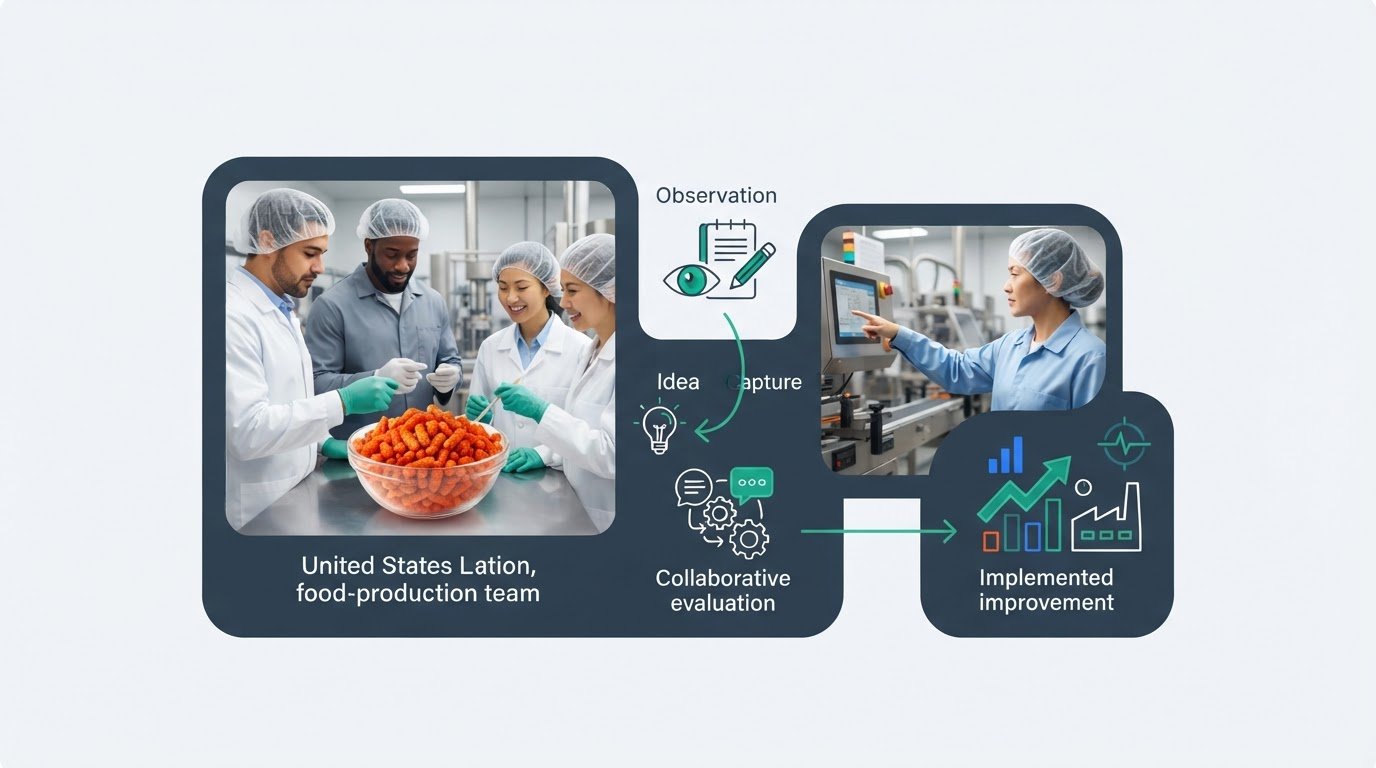
A frontline idea can become a meaningful improvement, but only if it moves from observation to action. That’s the challenge at the heart of frontline innovation: employees closest to the work often spot unmet needs first, yet their insights can stall before decision-makers assess them or explain what happens next.

The Flamin’ Hot Cheetos story is memorable, but it is not settled proof that one person invented a blockbuster product. Richard Montañez has described pitching a spicy Cheetos idea; Frito-Lay has disputed his role in creating the product line, saying it was developed by a team in Texas. The Los Angeles Times reported on the conflicting accounts. The distinction matters: an inspiring story can spark interest, but organizations need a repeatable way to capture, assess, and implement employee ideas.

This article considers what the story can teach without treating a contested origin as settled fact. You’ll learn what helps frontline observations progress, why clear feedback matters, and how to connect idea submissions with evaluation, implementation, and measurable results.

Key Takeaways

  • Learn how frontline innovation moves from an employee’s observation to a change put into practice.
  • Explore what the Flamin’ Hot Cheetos story can and can’t show about employee ideas and organizational innovation.
  • Use problem relevance, feasibility, expected value, and evidence to assess promising suggestions.
  • Build a repeatable process for inviting ideas, capturing context, evaluating proposals, responding to employees, and learning from outcomes.
  • See how an innovation platform can connect idea intake with evaluation, implementation, and ROI measurement.

What frontline innovation means, and why everyday work insights matter

Frontline innovation is a new or improved product, service, or work process shaped by insight from employees close to day-to-day operations and put into use. This working definition adapts the OECD’s Oslo Manual definition of innovation, which distinguishes an implemented change from an idea that has not yet been used. The distinction is important: an observation can reveal an opportunity, but it becomes an innovation only when a change is adopted.

Consider a warehouse employee who notices that a frequently used item is stored far from the packing area. The observation is the extra movement that happens repeatedly. A possible improvement is to relocate the item. If the organization assesses the proposal, tests the change, and adopts it, that implemented change is innovation. Collecting the initial comment alone doesn’t complete the journey.

Who counts as a frontline innovator?

Frontline innovators include customer-facing employees, operational staff, and others who work close to everyday processes. Their job titles may differ, but they share a useful perspective: they see how work actually unfolds. A customer support agent may hear the same point of confusion repeatedly; a technician may spot a maintenance step that causes delays; an administrative employee may notice duplicate data entry.

Repeated tasks give employees a practical vantage point. They can see where instructions don’t match reality, where workarounds become routine, or where customers’ needs aren’t being met. Job title alone doesn’t determine who can contribute. What matters is proximity to the process, interaction, or recurring problem, along with a way to explain what they see.

Frontline innovation versus employee suggestion collection

Collecting ideas is a starting point, not evidence that an organization has innovated. A suggestion still needs evaluation against the problem it addresses, its feasibility, and the value it may create. Someone must own the next steps, communicate a decision, and, where appropriate, support implementation. Reviewing the result helps teams refine the change or apply the insight elsewhere.

A structured process makes participation more meaningful by showing employees how an observation can move forward instead of disappearing into an inbox. The practical test is straightforward: can employees share useful context, understand what happens next, and see whether a proposal leads to action?

That follow-through turns frontline innovation from an occasional insight into a repeatable approach. A clear path from observation to implementation gives decision-makers better information and gives employees a reason to keep contributing. Practical guidance on implementing innovative ideas can help teams put that path into practice.

The Flamin’ Hot Cheetos story: an example to examine, not oversimplify

The Flamin’ Hot Cheetos origin story is often told as an example of an employee close to the work spotting a product opportunity. In Richard Montañez’s account, he was a Frito-Lay employee who recognized an opportunity to appeal to Hispanic consumers and pitched a spicy Cheetos idea. The story has become a popular illustration of how insight from within an organization might reach product decision-makers. However, the central claim about who created the product line is disputed.

In 2021, Frito-Lay said its records showed the product was developed by a team in Texas in 1989 and that Montañez wasn’t involved in creating the Flamin’ Hot line. The company also recognized his contributions and insights into Hispanic consumers. The Los Angeles Times reported on the conflicting accounts. Ideawake’s earlier account of the story offers another retelling, which should be considered alongside the company’s response and independent reporting.

What the story can illustrate about employee insight

Set aside the unresolved question of individual authorship, and a useful organizational lesson remains: an employee may notice a customer need or market opportunity that isn’t obvious from a central office. A frontline observation can become a product possibility when it reaches people with the authority and resources to assess it. That doesn’t mean every suggestion will succeed. It does mean relevant ideas need a route to be heard and considered.

How to handle disputed innovation origin stories

Innovation stories are compelling, but polished retellings can compress a complex process into a single-hero narrative. For an accurate account, distinguish what a person has said from what a company states and what independent reporting has established. Avoid presenting disputed authorship, chronology, or business impact as settled fact. This care strengthens the lesson: recognize employee insight while examining the evidence.

That balance matters for organizations, too. Crediting ideas clearly and recording how proposals develop can make contributions visible without simplifying teamwork or overstating results. The broader lesson of frontline innovation isn’t that one person always creates a breakthrough alone. It’s that organizations need a credible route for observations to reach decision-makers, be assessed on their merits, and inform what happens next.

A structured idea process can connect employee input with review and follow-through. Explore Ideawake’s idea management platform to see how teams can organize that process.

What separates a promising frontline idea from an implemented improvement?

A frontline suggestion isn’t an implemented improvement just because someone submits it. The organization must investigate the problem, evaluate a response, assign responsibility, and put a change into practice. Each stage calls for different information, so teams can make better decisions by distinguishing an early observation from a proposal that’s ready for action.

  1. Raw observation: An employee notices a recurring issue, such as customers repeatedly needing to correct the same detail in an order.
  2. Actionable idea: The employee describes the issue and proposes a possible response, such as changing how that detail is collected.
  3. Evaluated proposal: Relevant stakeholders assess the problem, evidence, feasibility, risks, and expected value of the change.
  4. Implemented change: An owner puts the approved response into practice, then reviews whether it addressed the original issue.

These stages don’t mean every proposal should be approved. They help teams review ideas consistently and explain what happens next. Submission counts show participation, not implementation or impact.

Evaluate the problem before judging the proposed solution

Start with the need, not the employee’s first proposed fix. Who encounters the issue? How often does it arise? What happens when it does? Evidence might include examples from daily work, recurring customer feedback, process records, or a small test. The right evidence depends on the problem: a repeated inconvenience and a safety concern call for different levels of scrutiny.

Then assess the proposal against criteria that fit the organization’s goals and the issue itself. Consider problem relevance, feasibility, expected value, available evidence, and potential risks. An idea intended to reduce customer effort may need a different evaluation from one intended to shorten internal processing. A clear set of criteria helps teams make consistent judgments without treating every suggestion as if it had the same purpose.

Make progress and outcomes visible

Once a proposal is under review, assign an owner who can coordinate evaluation and communicate its status. Contributors should hear whether an idea is being explored, approved, declined, or deferred, with a clear reason and next step where possible. Even when an idea can’t move forward, a considered response is more useful than silence. It shows that participation leads to a decision.

Measure the journey, not just the intake. Submission volume and participation indicate activity. Proposals evaluated, changes implemented, and results tied to the original problem show progress beyond activity. For example, a team testing a revised order form might track whether customers need fewer corrections, using a suitable baseline for comparison. Teams planning next steps can use a practical framework for implementing innovative ideas to connect decisions with ownership and action.

How organizations can make frontline innovation repeatable

Good intentions don’t create a reliable idea process. Employees need clear ways to contribute, while managers need a consistent method for understanding suggestions, deciding what happens next, and sharing the outcome. A practical sequence makes the work visible without implying that every submission will be adopted.

The OECD’s Oslo Manual defines innovation around a product or process that has been made available or brought into use. That distinction supports a useful operating principle: inviting and reviewing ideas are important steps, but they aren’t the same as implementing a change or learning from its results.

  1. Invite input: Focus on a real operational or customer challenge, and explain what kinds of observations would be useful.
  2. Capture context: Ask contributors to describe where the issue occurs, who experiences it, and what they’ve observed. Keep the questions brief enough to answer during a normal workday.
  3. Assess: Route submissions to people with relevant knowledge and decision-making authority. Review them consistently against the challenge’s purpose.
  4. Respond: Tell contributors whether an idea is under review, moving forward, or not being pursued, and explain the next step.
  5. Learn: Record what happened after a test or implementation, then use employee and operational feedback to improve the process.

Design participation around real work

A submission route only helps if employees can use it within the realities of their roles and work patterns. A desk-based form may suit some teams; others may benefit from a short facilitated discussion or a shared digital channel. Use clear prompts tied to a defined challenge, such as “Where do customers encounter avoidable delays?” Inviting input across teams can also bring different perspectives to a problem.

Close the loop from submission to action

Make responsibility explicit. An idea owner can keep a proposal moving, coordinate the right reviewers, and update the contributor when its status changes. If an idea is selected, clarify who will lead a test or implementation and what the team hopes to learn. If it isn’t selected, a concise explanation helps employees understand the decision and offer more relevant input next time.

Review both the process and its outcomes. Look for points where employees abandon submissions, decisions stall, or contributors don’t receive updates. Then adjust prompts, review routes, or communication practices. A repeatable process doesn’t promise that every idea will succeed; it provides a dependable way to hear input, make informed decisions, and learn from what follows.

Turn frontline insight into organized innovation with Ideawake

Once employees have a clear way to share observations and understand what happens next, the next challenge is keeping ideas organized as they move through review and action. An innovation management platform can give submissions, evaluation, implementation, and results a shared structure, helping teams follow progress rather than rely on scattered forms, emails, and spreadsheets.

Ideawake supports the innovation lifecycle, from idea submission through ROI measurement. Teams can use AI-driven insights to support their work, along with engagement features such as voting, leaderboards, and prizes to encourage participation. These capabilities can help organize a process, but they don’t replace leadership decisions. People still need to review proposals, assign owners, communicate outcomes, and assess results.

Where an innovation management platform can help

When employee ideas arrive through different channels, it can be difficult to see which ones need review, who is responsible, or what has already happened. A shared workflow can make submissions and their progress easier to manage while reducing administrative complexity. The process should fit the organization’s goals and help decision-makers act on relevant input.

Keep the workflow practical. For example, a team might define stages for new submissions, initial review, further evaluation, implementation, and results tracking. These stages clarify what information is needed and who takes responsibility as an idea progresses. Employees can then see that submitting an idea starts a process, rather than sending a suggestion into an untracked queue.

Start with a focused frontline innovation challenge

Choose a specific problem employees recognize from their work, such as a recurring service delay or a confusing handoff between teams. Invite perspectives from employees who encounter it, and explain how proposals will be assessed. Clear criteria help reviewers compare ideas fairly; regular feedback gives contributors context on decisions and next steps.

Start with a focused challenge that gives the team room to learn. After reviewing submissions, identify a suitable proposal to explore or test, assign an owner, and decide what evidence would help judge its usefulness. Record what happens, including where the process creates friction for contributors or reviewers. Then refine the challenge, evaluation questions, or workflow before inviting input on another problem. This keeps the technology in service of a human-led process.

Organizations can use Ideawake to support a structured path from frontline insight to evaluation, implementation, and ROI measurement. See how that workflow could support your approach.

Put the next frontline idea in motion

Frontline innovation can start with one recurring point of friction. Choose a problem employees recognize, identify whose experience can shed light on it, and decide what evidence would help determine whether a proposed change is useful. A focused starting point makes it easier to learn from real work instead of relying on assumptions.

Before inviting ideas, clarify who will review them and how contributors will hear about decisions. That commitment makes participation a meaningful exchange, even when a suggestion isn’t selected. Use what employees share, and what happens after a change is tried, to shape the next challenge. Progress comes from making the process more responsive over time.

Your employees already see opportunities in the work they do every day. Give those insights a clear path forward, and a useful improvement could begin with a conversation you make room to hear.

Frequently Asked Questions

When did Flamin’ Hot Cheetos come out?

Frito-Lay says Flamin’ Hot Cheetos were developed by a team in Plano, Texas, in 1989 and test-marketed starting in 1990, before expanding nationally. The exact origin story is disputed, which is why the product is now as famous for the debate as for the snack.

Who invented Flamin’ Hot Cheetos?

It is disputed. Richard Montañez, a former Frito-Lay janitor who became an executive, has said he created and pitched the idea. In 2021, Frito-Lay said its records show a team in Texas developed the line and that Montañez was not involved in creating it, while recognizing his other contributions. The Los Angeles Times reported on both accounts.

Was Richard Montañez really a janitor at Frito-Lay?

Yes. Montañez started as a janitor at Frito-Lay’s Rancho Cucamonga, California plant and later rose to executive roles at PepsiCo, Frito-Lay’s parent company. His career path is not in dispute; his role in creating Flamin’ Hot is.

Why is the Flamin’ Hot story used as an example of intrapreneurship?

Because it captures an idea every company wants to believe: that the next big product could come from anyone. Whatever the true origin, the story shows the value of employees who understand customers and act like owners. The practical lesson is to build a process that captures frontline ideas so they do not depend on one person’s persistence.

What is frontline innovation?

Frontline innovation is a product, service or process improvement that comes from employees’ direct experience of daily work. A suggestion is the idea; it becomes an innovation when the organization puts the change into use. Frontline workers often see problems in processes and customer experience long before they show up in reports.

How can companies encourage frontline employees to share ideas?

Ask specific questions, make submitting easy and always respond. Instead of asking for big ideas, ask “Which step in our returns process causes the most confusion?” Offer submission routes that fit shift work, such as a phone browser or email, allow anonymous posting for sensitive topics, and show what changed because of employee ideas.

What happens after a frontline employee submits an idea?

In a well-run program, the idea goes to a named reviewer, gets evaluated against clear criteria, and the submitter is told the decision and why. Approved ideas get an owner, a test or implementation plan and a measured result. Ideawake automates that loop with routing, status emails and value tracking, so no idea disappears.

Article by

Coby Skonord

Coby Skonord is the co-founder and CEO of Ideawake. Since 2013 he has worked with enterprise innovation, continuous improvement, and HR leaders to turn employee ideas into measurable business impact.

Gamification Innovation Software: Turn Participation Into Measurable Progress

Gamification Innovation Software: Turn Participation Into Measurable Progress
Coby Skonord|
September 27, 2026

What if the best measure of gamification isn’t how many people earn points, but how many ideas make it into practice? Gamification innovation software can make it easier to contribute, but points and prizes alone won’t show whether an idea is useful or what happens after submission.

Organizations often face the same challenges: participation fades, contributors don’t hear how their ideas progress, and activity metrics look healthy without showing business impact. The answer isn’t to remove game mechanics. It’s to connect them to a clear innovation process, so recognition encourages meaningful contributions and helps ideas move forward.

This article explains how to evaluate gamification innovation software, choose mechanics that fit your goals, and assess engagement alongside idea quality and realized value. You’ll also learn what to look for in a platform that connects idea submission, evaluation, implementation, and outcome tracking. The goal is to reward participation in ways that support progress, not just leaderboard activity.

Key Takeaways

  • Evaluate gamification innovation software by how well it supports idea progression, not just participation and rewards.
  • Use voting to surface interest, then apply clear evaluation criteria to guide decisions.
  • Compare platforms on workflow coverage, reporting, evaluation tools, and administrative effort.
  • Set transparent rules for eligibility, ownership, and follow-up before launching a challenge.
  • Track engagement alongside idea quality, implementation progress, and outcomes to understand what the program achieves.

What Gamification Innovation Software Does Beyond Points and Prizes

Gamification innovation software applies game mechanics, such as voting, recognition, or rewards, to a structured process for submitting, evaluating, and advancing ideas. Gamification can make participation more engaging, but it isn’t the innovation workflow itself. A contest may attract entries; a complete program also clarifies how ideas are reviewed, selected, implemented, and followed up. The broader concept of gamification covers game-design techniques used outside games. In an innovation program, those techniques should support progress toward a business question, not become the goal.

Activity and outcomes are different measures. Submission counts, comments, and votes show whether people are participating, but they don’t establish whether ideas are feasible, selected, or implemented. To understand a program’s value, assess contributions and track what happens to them after the initial activity.

Which innovation challenges does gamified software address?

Employees may hesitate to contribute when a challenge prompt is unclear, feedback is limited, or their idea disappears after submission. Software can make the process more visible by showing an idea’s status and communicating what comes next, such as discussion, evaluation, or a decision. This helps contributors understand what to expect and gives them a reason to stay involved. Gamification may encourage participation, but it can’t guarantee more ideas or stronger outcomes. Those depend on the challenge, review process, and follow-through.

Which capabilities belong in an innovation software platform?

A useful platform supports distinct stages rather than treating every action as a score. Idea submission captures contributions in response to a defined prompt. Comments let people clarify or build on ideas. Voting can surface interest, while structured evaluation applies consistent criteria. Decision-making identifies which proposals move forward, and implementation tracking records progress after selection.

Leaderboards and prizes are optional participation mechanics. They can recognize contributions, but they shouldn’t replace fair evaluation or give popularity the final say. A highly voted idea, for example, may still need review for feasibility, strategic fit, or expected value. The right innovation management platform connects engagement features to the broader workflow and helps administrators see where ideas stand, who owns the next step, and whether selected ideas are progressing. That’s the difference between rewarding activity and managing innovation.

How Gamification Mechanics Work Across an Innovation Workflow

Consider a challenge asking employees how to reduce delays in a routine process. A gamified program can make each step visible, but the mechanics should serve the work. The prompt gives people a clear focus, submissions capture suggestions, and discussion helps clarify how an idea might work. Reviewers then assess proposals against agreed criteria, make a decision, and communicate what happens next.

Engagement signals show how people interact with a program; validated innovation outcomes show which ideas were selected, implemented, and produced measurable value. This distinction keeps gamification innovation software from mistaking clicks or votes for proof of impact. It also anchors the program in a practical definition of innovation: ideas must progress toward useful change, not simply attract attention.

How do voting, leaderboards, and prizes affect participation?

Voting can reveal which suggestions resonate with peers and help reviewers spot ideas worth examining. It can’t establish feasibility, strategic fit, or business value. Leaderboards offer visible recognition, but set clear rules for what earns recognition and don’t let rankings dictate which ideas advance. Prizes are optional incentives. Use them only when they support the challenge’s purpose and don’t overshadow thoughtful contributions.

How does feedback keep contributors engaged after submission?

A status update can tell a contributor whether an idea is under review, needs clarification, has been selected, or won’t proceed. A brief explanation of the decision adds context and helps make the process credible. Assign someone to review submissions and communicate next steps, so follow-up doesn’t depend on informal reminders. Teams considering a gamified innovation platform can also consider how competition may shape participation while keeping evaluation grounded in consistent criteria.

Keep the mechanics tied to the challenge. If the goal is to improve a process, recognize useful collaboration and thoughtful proposals, not just high submission volume. Then track selected ideas through implementation and review outcomes against the original business question. To see how a platform can support this kind of idea workflow, explore an Ideawake platform walkthrough.

How to Evaluate Gamification Innovation Software Without Rewarding Activity Alone

A platform can generate submissions, votes, and leaderboard activity without helping an organization understand which ideas advance or why. Evaluate gamification innovation software by whether it supports participation and the work that follows: review, decisions, implementation, and measurement. The right fit makes progress visible without treating activity as a proxy for value.

Which engagement and workflow criteria should buyers compare?

Start with the program you plan to run. Check whether the software can present focused challenge prompts, collect submissions, support discussion and voting, and communicate updates. Then consider who needs to participate, whether the process is accessible to those contributors, and how much effort administrators will spend managing activity and follow-up. Choose a platform that fits the stakeholders and formats your organization actually expects to use.

Use a comparison table to assess vendors against the same requirements:

Criterion What to assess Useful question
Mechanics Voting, recognition, leaderboards, or prizes Can mechanics be aligned with program goals?
Workflow coverage Submission through decision and implementation Can teams see an idea’s status after it’s submitted?
Evaluation Criteria and review steps Can reviewers assess ideas consistently beyond popularity?
Reporting Participation, progress, and outcomes Can reports distinguish activity from implementation?
Administration Ownership, updates, and program setup Can the team manage the process and communicate next steps?

For a broader selection framework, see this guide on how to choose innovation management software.

How can buyers assess reporting and measurable outcomes?

Ask for a walkthrough of the reporting process, not just a dashboard preview. Can the team distinguish submissions and participation from evaluation progress, decisions, and ideas implemented? Can it record the measures your organization uses to assess results, such as adoption or realized value? Confirm who can access that information and how administrators can follow an idea through its lifecycle.

Keep the measures separate. Participation indicates engagement; evaluation records how ideas fare against criteria; adoption and realized value reflect what happens after a decision. Software can help organize this evidence, but a reported outcome alone doesn’t prove that a leaderboard, prize, or other mechanic caused it. Compare results with your program’s goals and context before drawing conclusions. This helps keep evaluation focused on progress, not just activity.

How to Design a Gamified Innovation Program That Stays Fair and Useful

A fair program starts before anyone earns points. Define the business question, decide how ideas will be handled, and make the rules visible before inviting people to participate. This gives contributors a clear reason to engage and reviewers a consistent basis for decisions. Gamification innovation software can support the process, but program governance determines whether participation leads to useful progress.

How should an organization set challenge goals and participation rules?

Use a focused rollout that connects the challenge to a real organizational need:

  1. Define the business question. State the problem to solve and what kinds of ideas are in scope. For example, ask for ways to reduce handoffs in a particular process rather than inviting ideas on an undefined topic.
  2. Set rules before launch. Explain who can participate, what submissions should include, whether and how voting works, and how recognition will be awarded. Publish the review criteria, timeline, and decision owner so contributors know what to expect.
  3. Launch a focused challenge. Use a prompt that makes the desired contribution clear. Choose recognition mechanics that fit the purpose, and avoid implying that participation or submission guarantees selection or a prize.
  4. Review consistently. Assign reviewers in advance and apply the stated criteria to submissions. Peer interest may inform review, but it shouldn’t replace evaluation.
  5. Communicate and learn. Share decisions and next steps, then review both participation and workflow progress. Look at who contributed and how ideas advanced, separately from implementation and realized value.

How can teams review ideas and close the feedback loop?

Before submissions arrive, identify who screens ideas, who evaluates them, and who communicates decisions. Consistent idea evaluation criteria help reviewers explain why a proposal advances, needs clarification, or isn’t selected. Give contributors a status update and a concise explanation, including when the answer is no. Clear follow-up respects the effort people invested and helps them understand how to participate in future challenges.

After the review, check whether the program followed its published rules, whether contributors received updates, and where ideas stand in the workflow. Treat submissions, votes, and comments as participation measures. Track evaluation decisions and implementation separately, then compare results with the business question the challenge was designed to address. This keeps a lively program accountable without claiming that activity alone proves impact.

Where Ideawake Fits in a Gamified Innovation Software Strategy

Once you’ve defined what your program needs from its mechanics, workflow, administration, and measurement, assess platforms against those criteria. Ideawake is one option to consider: its cloud-based innovation management software supports idea capture, evaluation, and implementation, with gamification features to support participation in challenges and other idea programs.

Voting, leaderboards, and prizes can encourage participation, but their value depends on how they fit the broader process. Ideawake supports the innovation lifecycle from initial submission through ROI measurement, helping teams consider not just engagement but also how ideas progress and what results they deliver. For a broader overview of platform capabilities and selection considerations, explore this guide to an innovation management platform.

How does Ideawake connect engagement with idea progression?

Teams can use voting to surface peer interest, leaderboards to recognize participation, and prizes as an optional incentive within an innovation challenge. These mechanics sit alongside idea evaluation and implementation support rather than replacing them. Ideawake also includes AI-driven insights. Organizations can assess how those capabilities fit their review and measurement needs as part of their platform evaluation.

For buyers, the practical question is whether a platform can support the stages their program requires and make progress visible to the people involved. Consider how ideas are captured, how evaluation is managed, and how teams can follow selected proposals toward implementation and ROI measurement. This end-to-end view keeps gamification innovation software focused on advancing ideas, not simply recording activity.

What should teams clarify before evaluating a platform demo?

Bring a real challenge to the conversation. Identify the intended participants, the problem the challenge should address, and the obstacles in your current process. Then ask how the platform could support review ownership, contributor updates, and the outcomes your organization wants to measure. Specific questions make it easier to judge practical fit rather than relying on a feature list.

If the workflow and capabilities align with your requirements, examine how they could support your program in practice.

Turn Engagement Into Ideas That Move Forward

Effective gamification innovation software connects participation to a well-managed idea process. Voting, leaderboards, and prizes can encourage involvement, but they shouldn’t replace clear evaluation, accountable follow-up, or outcome measurement. Track engagement alongside idea quality, implementation progress, and realized value to see whether your program is creating meaningful progress.

Ideawake supports the innovation lifecycle from idea submission through ROI measurement, with gamification features including voting, leaderboards, and prizes. Assess how those capabilities fit your goals, workflows, and contributors, then build a program that makes the next step clear.

Start with one focused challenge, set transparent expectations, and give promising ideas a clear path forward. Your next useful idea could begin with a better invitation to participate.

Frequently Asked Questions

What is gamification innovation software?

Gamification innovation software applies game mechanics, such as voting, recognition, or prizes, to a structured idea process. It can encourage people to participate in challenges and contribute suggestions, while the broader workflow supports reviewing, selecting, and implementing ideas. A leaderboard or reward campaign alone isn’t a complete innovation process. Look for tools that connect participation features to the stages ideas must pass through to produce useful change.

Does gamification improve employee innovation?

Gamification can encourage participation, but it doesn’t guarantee more ideas or better innovation outcomes. Its usefulness depends on a clear challenge, mechanics that fit the goal, and feedback about what happens to submitted ideas. Voting may show which suggestions attract interest, for example, while reviewers still need to assess feasibility and value. Judge the program by engagement and idea progress, not activity counts alone.

Which gamification features should innovation software include?

Choose features that suit your workflow rather than selecting mechanics for their novelty. Useful capabilities may include challenge prompts, idea submission, discussion, voting, and status updates, supported by evaluation and implementation tracking. Leaderboards and prizes can provide optional recognition, but they shouldn’t replace consistent review criteria. Reporting should distinguish participation from decisions and implemented ideas, while administration tools should make it practical to manage reviews and communicate next steps.

Can leaderboards make an idea program less fair?

Yes. Leaderboards can make a program feel less fair if rankings determine which ideas advance or reward only visible activity. Popularity may reflect peer interest, but it doesn’t establish feasibility, strategic fit, or business value. Set clear rules for what the leaderboard recognizes, explain how votes will be used, and keep idea evaluation separate. Reviewers should apply consistent criteria so quieter contributors and less widely supported ideas still receive appropriate consideration.

How do you measure ROI from gamified innovation software?

Measure ROI by tracking selected ideas through implementation and assessing their results against the organization’s chosen business measures. Keep that evidence separate from engagement indicators such as submissions, comments, or votes. A high vote count shows interest, not realized value. Define how outcomes will be recorded before launching the program, and avoid assuming that a software report proves a game mechanic caused a business result.

Is gamification software the same as idea management software?

No. Gamification describes the use of mechanics such as voting, leaderboards, and prizes to encourage participation. Idea management software supports capturing and evaluating ideas, and may also help teams follow them toward implementation. A platform can include both, but the terms describe different things: one refers to engagement techniques, the other to managing ideas. Assess whether the software connects those mechanics to the workflow your program needs.

How do you choose gamification innovation software?

Start by defining the challenge, intended participants, and steps ideas must follow from submission through decision and implementation. Then compare gamification innovation software on workflow coverage, evaluation, contributor updates, reporting, and administrative effort. Ask how it separates engagement metrics from implemented ideas and realized value. A practical demonstration using a real challenge can help your team assess whether the mechanics and workflow fit its goals.

Article by

Coby Skonord

Coby Skonord is the co-founder and CEO of Ideawake. Since 2013 he has worked with enterprise innovation, continuous improvement, and HR leaders to turn employee ideas into measurable business impact.

Customer Idea Management Platform: The 2026 Guide to Customer-Led Innovation

Customer Idea Management Platform: The 2026 Guide to Customer-Led Innovation
Coby Skonord|
September 6, 2026

By 2026, organizations that prioritize customer-led innovation are projected to see a 25% increase in customer satisfaction. You’ve likely felt the weight of unorganized feature requests and the lack of visibility into which ideas actually move the needle without a dedicated customer idea management platform. It’s a common struggle where the most valuable insights are often buried under a mounting administrative burden. You aren’t alone in feeling that your current feedback process is a cost center rather than a growth engine.

This guide provides the blueprint to transform that raw feedback into a high-ROI innovation pipeline. We’re moving beyond the suggestion box mentality to create a centralized vault for customer intelligence that drives measurable results. You’ll discover how to implement automated workflows that reduce admin time and leverage clear data to connect customer ideas to revenue growth. We are moving past mediocre, manual methods to build a high-performance innovation engine that scales with your ambition. No more guesswork. Just results.

Key Takeaways

  • Understand how a centralized system for capturing insights outperforms manual feedback logs and legacy innovation software by creating a single source of truth.
  • Discover the five core pillars required to transform raw customer requests into prioritized, actionable intelligence for your product roadmap.
  • Evaluate the total cost of ownership and operational advantages of a dedicated customer idea management platform compared to building custom internal tools.
  • Follow a tactical four-step blueprint to successfully launch your innovation portal and establish transparent, high-engagement feedback loops with your community.
  • Learn how to close the innovation loop by connecting specific customer submissions directly to measurable ROI and long-term revenue growth.

Beyond the Suggestion Box: Defining the Modern Customer Idea Management Platform

A customer idea management platform is a centralized system designed to capture, evaluate, and implement external insights with precision. Unlike legacy innovation software that often acted as a graveyard for unvetted suggestions, modern cloud-based platforms serve as active command centers. They replace fragmented manual systems with structured workflows that prioritize high-impact opportunities. In the competitive landscape of 2026, maintaining an edge requires more than just listening. It requires a systematic approach to customer involvement management that bridges the gap between raw feedback and executive decision-making.

A modern customer idea management platform is not a repository for requests; it’s a strategic ROI engine that converts external intelligence into market-dominating product cycles.

The Evolution of Feedback: From Passive to Proactive

Why Generalist Tools Fall Short at Scale

The 5 Pillars of a High-Performance Customer Ideation Strategy

A high-performance strategy requires more than a digital suggestion box. It demands a framework that moves beyond collection into execution. According to innovation management principles, the value lies in the filtration and evaluation process. A modern customer idea management platform must provide end-to-end lifecycle support, ensuring every submission is either validated or archived with transparent feedback. This transition from raw data to actionable intelligence is what separates market leaders from organizations simply “collecting feedback.”

AI-Driven Signal Detection and Deduplication

Administrative overhead is the silent killer of innovation programs. When hundreds of customers submit similar requests, manual sorting becomes impossible. Modern platforms use AI to cluster these submissions, identifying “megatrends” that signal market demand. By implementing Ideawake AI, managers can automate deduplication. This specific capability often reduces administrative hours by up to 80%. It allows teams to focus on evaluating the merit of an idea rather than managing the logistics of an inbox. Signal detection ensures that the loudest voices don’t drown out the most profitable opportunities.

Gamification: Incentivizing the Right Behaviors

Engagement isn’t a one-time event; it’s a habit. High participation rates depend on gamification elements like voting, leaderboards, and status-based prizes. These features tap into the psychology of social proof and organizational status, encouraging customers to submit higher-quality insights. When users see their peers engaging, they’re more likely to contribute meaningful feedback. To ensure this participation yields results, it’s vital to educate your community on what makes an idea great from a business perspective. Quality beats quantity every time.

The synergy between AI and gamification creates a self-sustaining ecosystem. You don’t just want more ideas. You want better ideas that are easier to manage and track toward a final ROI. If your current process feels like a manual struggle, it’s time to see how a structured approach can change your outcomes. You can explore these features in action to see how they fit your specific innovation goals. This modern architecture ensures that your innovation pipeline remains full, focused, and financially viable.

Build vs. Buy: Why Modern Architecture Trumps Custom Solutions

The Financial Reality of Innovation Software TCO

Security and Scalability in the Enterprise

Enterprise deployments demand rigorous data governance, robust access controls, and infrastructure resilience to protect proprietary concepts and customer intelligence from unauthorized exposure. As organizations expand their cloud-based application ecosystem, collaborating with an experienced IT solutions partner like ITS Canada Inc helps maintain comprehensive network protection and enterprise security standards.

Implementation Blueprint: Launching Your Customer Innovation Portal

Transitioning from a software purchase to a high-performance ecosystem requires a disciplined implementation blueprint. A customer idea management platform is only as effective as the strategy driving it. To move from a quiet portal to an active community, you must follow a tactical four-step process: define your success metrics, recruit internal champions, launch targeted challenges, and close the feedback loop with transparent communication. This structured approach prevents the “black hole” effect where customers feel their contributions are ignored. Executive sponsorship isn’t just a support function; it’s the cultural fuel that prevents innovation from becoming a side project.

Phase 1: Defining Success Metrics and Evaluation Criteria

Before inviting a single customer to your portal, you must establish how you will score their contributions. Effective evaluation relies on a three-pronged framework: desirability (do customers actually want this?), feasibility (can we build it?), and viability (does it align with our business goals?). Implementing a standardized idea evaluation process and criteria ensures that your team remains objective and data-driven. This funnel approach allows you to filter thousands of raw data points down to the top 1% of high-impact opportunities without succumbing to internal bias or “loudest voice” syndrome. Quantitative scoring provides the evidence needed to justify R&D investment to stakeholders.

Phase 2: Driving Adoption Through Targeted Challenges

While an “always-on” suggestion box has its place, the most successful programs utilize time-bound innovation challenges. These challenges focus customer energy on specific problem statements, such as “How might we reduce onboarding time by 20%?” rather than vague requests for feedback. This method mirrors the benefits of employee ideation programs, where constraints actually drive higher-quality solutions. By setting realistic expectations and providing clear deadlines, you create a sense of urgency and purpose. Customers are more likely to participate when they understand the specific problem you are trying to solve and how their input will be used.

Success in customer-led innovation depends on closing the loop. Every participant should receive an automated update when their idea moves to a new stage of evaluation. This transparency builds trust and encourages long-term engagement. When customers see that their insights lead to tangible product changes, they transition from passive users to active co-creators. This shift is the ultimate goal of a modern innovation strategy.

Ideawake: The Customer Idea Management Platform for Results-Driven Teams

Ideawake represents the logical evolution for organizations that have moved past the “suggestion box” era and demand measurable outcomes. While legacy systems often struggle with administrative bloat, this customer idea management platform is engineered to reduce complexity while maximizing output. It provides a modern architecture that bridges the gap between raw customer insights and the final delivery of high-value features. By focusing on the full lifecycle of an idea, from initial submission to final ROI measurement, Ideawake ensures that innovation is treated as a core business function rather than a secondary activity.

Turning Raw Ideas Into Pure ROI

The true test of any innovation program is its ability to deliver financial impact. Ideawake provides the “Modern Enterprise Edge” by combining AI-driven deduplication with a robust gamification suite to keep engagement levels high without increasing the workload for managers. Unlike tools that stop at the collection phase, Ideawake tracks the progress of ideas through the implementation phase to ensure nothing falls through the cracks. To see how these efficiencies translate into your specific context, you can use the Idea Management ROI Calculator to quantify potential gains. This data-driven approach removes the guesswork from product roadmapping and allows for more confident resource allocation.

Seamless Integration and Rapid Adoption

A high-performance platform is only valuable if it integrates into the way your team already works. Ideawake offers a variety of integrations that allow it to fit seamlessly into your existing tech stack, whether you rely on project management tools or enterprise communication suites. Our “no-nonsense” approach to user adoption means your community can start contributing within minutes, not weeks. This speed to value is critical for maintaining momentum during innovation challenges. We prioritize a clean, intuitive interface that encourages participation from both technical and non-technical users, ensuring you capture the widest possible range of customer intelligence.

The transformative potential of a dedicated customer idea management platform lies in its ability to turn every customer into a co-creator. By centralizing feedback and automating the evaluation process, you empower your organization to lead the market rather than react to it. Ideawake provides the structure, security, and scalability required for the enterprise of 2026. No more guesswork; just a clear path to customer-led growth.

Accelerating Innovation ROI Through Customer Intelligence

The transition toward customer-led innovation is no longer optional for organizations that intend to lead their markets. You’ve seen how a dedicated customer idea management platform eliminates the noise of unorganized requests and replaces it with a structured, high-performance pipeline. By leveraging modern architecture and AI-driven deduplication, your team can save up to 80% of administrative time while ensuring the most viable ideas reach implementation. This efficiency allows innovation managers to focus on strategic execution rather than manual sorting.

Success requires moving beyond the passive suggestion box to a proactive co-creation model that spans the entire lifecycle of an idea. Trusted by global enterprises, this approach connects every customer insight directly to measurable financial outcomes and long-term revenue growth. It’s time to stop drowning in unorganized feature requests and start driving transformative results. You have the blueprint for a modern innovation engine; now it’s time to execute and secure your competitive edge.

Frequently Asked Questions

What is the difference between a customer idea management platform and a CRM?

While a CRM focuses on managing customer relationships, sales pipelines, and business automation—areas where platforms like Optimo Software Co. specialize—a customer idea management platform is engineered specifically to collect, evaluate, and prioritize product feedback and user innovation.

How do you prevent a customer idea portal from becoming a list of complaints?

Can we integrate a customer idea management platform with our existing project management tools?

Yes, modern platforms are designed to fit seamlessly into your existing tech stack. You can integrate your customer idea management platform with tools like Jira, Trello, or Microsoft Teams to ensure a smooth transition from idea approval to project execution. These integrations eliminate data silos and reduce manual entry. This connectivity allows your product team to manage the development process without leaving their preferred environment.

How much time does it typically take to implement an enterprise-grade idea platform?

Implementation for a modern cloud-based platform typically takes a few weeks, which is significantly faster than the months required for legacy innovation software. Because these systems use a modern architecture, you don’t need extensive custom coding or hardware integration. Most of the time is spent on configuring your innovation challenges and setting up evaluation criteria. This rapid deployment ensures you start seeing a return on your investment quickly.

What are the most important evaluation criteria for customer-led ideas?

The most effective evaluation criteria focus on three core metrics: desirability, feasibility, and viability. You must determine if the customer actually wants the feature, if your engineering team can realistically build it, and if it aligns with your broader business goals. Using a standardized scoring system helps your team remain objective. This data-driven approach ensures that your R&D budget is allocated to the top 1% of high-impact opportunities.

Is AI really necessary for managing customer ideas, or is it just a buzzword?

AI is a critical requirement for managing innovation at scale, especially for deduplication and clustering. Manual sorting of thousands of requests is inefficient and prone to error. AI-driven features can reduce administrative hours by up to 80% by automatically identifying similar ideas and megatrends. Approximately 55% of idea management platforms now incorporate machine learning. It’s a fundamental tool for transforming raw data into actionable intelligence without increasing overhead.

How do you measure the ROI of a customer ideation program?

You measure ROI by tracking an idea from the initial submission through to its final implementation and subsequent impact on revenue or cost savings. Modern platforms provide end-to-end tracking to help you quantify these gains. You can compare the cost of development against the projected customer satisfaction increase or market share growth. Using an ROI calculator helps you provide concrete evidence to stakeholders that customer-led innovation is a profit center.

What is the best way to incentivize customers to share high-quality ideas?

The best way to drive high-quality contributions is through a combination of gamification and radical transparency. Features like voting, leaderboards, and prizes encourage healthy competition and sustain long-term engagement. However, the most powerful incentive is seeing an idea actually get implemented. When you close the feedback loop and show customers that their insights lead to tangible changes, you build a loyal community of active co-creators.

Article by

Coby Skonord

Coby Skonord is the co-founder and CEO of Ideawake. Since 2013 he has worked with enterprise innovation, continuous improvement, and HR leaders to turn employee ideas into measurable business impact.

Innovation Pipeline Management: A Data-Driven Guide to Maximizing ROI in 2026

Innovation Pipeline Management: A Data-Driven Guide to Maximizing ROI in 2026
Coby Skonord|
August 30, 2026

Did you know that 55% of innovation management platforms have already integrated AI to automate idea evaluation, yet many organizations still struggle to generate a tangible return on their investments? According to Business Research Insights, while 70% of enterprises prioritize an innovation culture, the gap between ideation and implementation remains a significant hurdle. You’ve likely felt the frustration of information silos and the heavy administrative burden of manually vetting thousands of submissions. Without a structured innovation pipeline management strategy, these ideas often become a source of friction rather than a driver of growth.

It’s difficult to justify budgets when you can’t point to a direct financial impact. This guide will show you how to replace chaotic suggestion boxes with a high-performance engine for measurable ROI. You’ll learn how to build a repeatable process for vetting ideas and capture the clear data required to prove your program’s value to stakeholders. We’ll explore how modern architecture and AI insights can eliminate evaluation bottlenecks, drive higher employee participation, and finally deliver the results your organization demands in 2026.

Key Takeaways

  • Learn how to transition from a passive suggestion box to a structured innovation pipeline management system that treats ideas as measurable financial assets.
  • Discover the five essential stages of the innovation lifecycle, from aligning idea generation with specific business challenges to leveraging internal crowdsourcing for faster refinement.
  • Identify the administrative bottlenecks inherent in legacy spreadsheets and learn how modern, cloud-based architectures reduce overhead through automated workflows.
  • Master data-driven metrics like Pipeline Velocity and Yield Ratio to provide clear evidence of your innovation program’s performance and justify future budgets.
  • Explore how AI-driven tools can automate the scoring and duplicate detection process, allowing your team to focus on high-impact implementation rather than manual evaluation.

The Architecture of a High-Impact Innovation Pipeline

Innovation pipeline management is the systematic process of converting raw concepts into implemented solutions that deliver measurable ROI. It’s the engine room of modern innovation management. In 2026, market leaders have largely abandoned the traditional “suggestion box” model. While a suggestion box is a passive repository that often leads to employee disengagement, a managed pipeline is an active, data-driven workflow. Research indicates that approximately 55% of platforms now use AI to improve evaluation, reflecting a shift toward objective decision making. Modern architecture is no longer optional. It’s essential for reducing the administrative friction that typically kills great ideas before they ever reach the prototype stage. Large enterprises, which hold nearly 78% of the market share, utilize these systems to ensure their innovation budgets are backed by hard data rather than optimistic speculation.

Why Pipeline Management is the Backbone of Corporate Growth

The Consequences of a Clogged or Leaky Pipeline

Pipelines fail when they become either “clogged” or “leaky.” A clog occurs when a small team of evaluators is overwhelmed by thousands of unranked ideas, leading to burnout and stagnation. This administrative burden stalls progress and discourages future participation. Conversely, a leaky pipeline loses high-potential projects due to poor evaluation criteria or a lack of stakeholder buy-in. Most innovation failures don’t happen because the ideas were bad. They happen because the pipeline couldn’t support the weight of the evaluation process or failed to provide transparency to the contributors. By 2026, effective innovation pipeline management relies on automated scoring and AI-driven insights to patch these leaks. This ensures that the most viable, data-backed concepts move toward implementation while administrative overhead remains manageable.

The 5 Essential Stages of Innovation Pipeline Management

Stage 1 & 2: Moving from Capture to Collaboration

The final stage, Implementation and ROI Measurement, is where the transition to operational reality occurs. Success here requires end-to-end lifecycle tracking to prove that the initial investment yielded the promised results. If you want to see how these stages can be automated for your team, you can book a free demo to explore modern pipeline workflows and start maximizing your innovation returns.

Legacy Systems vs. Modern Platforms: Identifying Your Bottlenecks

Many organizations attempt to manage their innovation efforts using general-purpose tools like Excel or SharePoint. While these might work for small teams, they fail to scale in a complex enterprise environment. Manual innovation pipeline management often leads to a massive administrative burden, consuming hundreds of hours that should be spent on execution. When you contrast the manual approach with automated platforms, the difference in efficiency is staggering. Legacy systems lack the real-time data flow needed to keep pace with market changes. This creates bottlenecks that stall high-potential projects and waste precious resources.

The Hidden Costs of Manual Pipeline Management

The true cost of using outdated tools isn’t just the software license fee. It’s the idea decay that occurs when slow response times kill momentum. According to the Ideawake vs Spreadsheets analysis, organizations using manual methods lose significant time on data entry and status tracking. This lack of speed results in lost ROI as competitors beat you to market. Beyond the financial impact, manual systems damage employee morale. When contributors don’t see progress or receive feedback, they stop participating. Transparency is the antidote to disengagement, and legacy tools simply cannot provide the visibility required to keep a workforce inspired.

Modern Features That Drive Pipeline Velocity

Data-Driven Metrics: How to Measure Pipeline Velocity and ROI

Effective innovation pipeline management requires more than just counting the number of ideas collected. You must treat your pipeline as a financial instrument where every stage has a measurable cost and a projected return. One of the most critical metrics to track is Pipeline Velocity. This is the average time an idea takes to move from the initial submission to a fully realized implementation. Organizations that fail to monitor velocity often see their most promising concepts die in committee. A slow pipeline is a leaky pipeline, as market conditions shift faster than your internal processes can react.

Another vital indicator is the Yield Ratio. This calculation compares the number of successful implementations against the total number of submissions. A low yield ratio might suggest that your strategic alignment is off or that your evaluation criteria are too broad. To balance your portfolio, you should also adopt “Innovation Accounting.” This framework is designed for high-uncertainty projects where traditional financial metrics don’t apply early on. It allows you to track progress through learning milestones and pivot points before you commit significant capital. Balancing these with non-financial metrics like employee engagement ensures the long-term health of your innovation ecosystem.

The ROI of Employee Ideation Programs

KPIs for Every Stage of the Funnel

To identify bottlenecks, you must track performance across the entire funnel. Each stage requires specific KPIs to ensure the engine is running smoothly:

  • Submission Metrics: Monitor the participation rate and idea diversity across different departments to ensure you aren’t stuck in an information silo.
  • Evaluation Metrics: Track the time-to-decision and evaluator throughput to prevent administrative clogs that stall momentum.
  • Outcome Metrics: Measure the final implementation rate and the realized net savings or revenue generated by each project.

Ideawake: Streamlining Your Innovation Lifecycle from Submission to ROI

Ideawake is specifically engineered to eliminate the administrative complexity that often paralyzes corporate growth. In a landscape where 55% of platforms now leverage AI, Ideawake leads by integrating advanced features that automate the most tedious parts of the lifecycle. By using Ideawake AI, your team can instantly handle duplicate detection and initial scoring, ensuring that reviewers only spend time on high-potential concepts. This transition from manual filtering to automated intelligence is the cornerstone of effective innovation pipeline management. Whether your organization is running high-impact hackathons or steady continuous improvement programs, the platform provides a unified environment to track every idea from the initial spark to the final financial outcome.

The implementation process is designed for speed, significantly reducing the time-to-value for large enterprises. Many legacy tools require months of configuration, but Ideawake’s modern architecture allows for a rapid rollout that starts delivering insights within weeks. This efficiency is critical for maintaining the momentum of your innovation culture and ensuring that employee engagement doesn’t wither during a long setup phase.

Why Modern Architecture Matters for Scalability

Scaling an innovation program across thousands of employees shouldn’t increase the burden on your innovation leads. Ideawake is built on a cloud-first architecture that supports massive user bases while maintaining enterprise-grade security. This makes it a premier choice for innovation management software. Managers can launch targeted Innovation Challenges to solve urgent problems, using structured workflows to ensure quality as participation grows.

Getting Started: From Chaos to Clarity

The journey from a chaotic suggestion box to a structured engine of growth is straightforward. The process is clear: Capture, Evaluate, Implement, and Measure. Each step is supported by real-time data and automated tracking to ensure no ROI is left on the table. If you’re ready to see this architecture in action, you can sign-up for a personalized demo. Don’t settle for manual tracking. Compare Ideawake to legacy tools to see the difference in ROI.

Building the High-Performance Innovation Engine of 2026

Effective innovation pipeline management is the bridge between a creative workforce and a growing bottom line. By moving away from legacy tools and embracing a structured, AI-driven approach, you eliminate the administrative friction that stalls organizational progress. You’ve seen how modern architecture reduces manual evaluation time by over 50%, enabling your team to focus on high-impact implementation rather than data entry. Trusted by global enterprises to drive ROI, this data-backed strategy provides the transparency needed to keep employees engaged and stakeholders informed.

The path from a chaotic suggestion box to a streamlined growth engine is shorter than you think. Start maximizing your organization’s untapped potential today.

Frequently Asked Questions

What is innovation pipeline management?

Innovation pipeline management is the systematic process of moving ideas from raw concepts to measurable ROI. It involves capturing, evaluating, and implementing ideas through a structured workflow. Unlike a passive suggestion box, it actively manages the lifecycle of an idea to ensure it delivers value. This process is essential for organizations that want to turn employee creativity into tangible financial gains without getting bogged down by administrative complexity.

How is an innovation pipeline different from a traditional project management funnel?

What are the most common bottlenecks in an innovation pipeline?

What are the most common bottlenecks in an innovation pipeline?

AI automates the heavy lifting of categorization, duplicate detection, and initial scoring. According to research from Business Research Insights, approximately 55% of platforms have integrated AI as of 2026 to improve evaluation. Tools like Ideawake AI use sentiment analysis and machine learning to surface high-potential concepts based on peer feedback. This ensures that human evaluators focus on the most viable ideas, significantly increasing the capacity of the review team.

How do you measure the ROI of an innovation pipeline?

You measure ROI by tracking realized net savings or revenue generated from implemented ideas against the total cost of the program. Organizations should also monitor “Pipeline Velocity,” which is the time an idea takes to move from submission to execution. Key KPIs include:

  • Participation rate across departments
  • Realized net savings or revenue

Tracking these metrics provides the hard data needed to justify innovation budgets.

Is innovation pipeline software better than using spreadsheets?

Specialized software is significantly more efficient than spreadsheets for large-scale enterprise innovation. Spreadsheets are static, prone to error, and lack the automated workflows required to manage thousands of submissions. They create significant time loss in data entry and status tracking. Modern platforms like Ideawake provide a centralized “single source of truth,” offering real-time transparency and automated reporting that manual tools simply cannot replicate. This shift allows teams to focus on implementation rather than spreadsheet maintenance.

How long does it take to implement an innovation management platform?

Implementation times vary based on organizational size, but modern cloud-based platforms are designed for rapid rollout. Because they use a modern architecture, these systems reduce the technical barriers that once made enterprise software deployments take months. Most organizations can launch their first innovation challenge within a few weeks. This fast time-to-value is critical for maintaining momentum and proving the program’s worth to stakeholders early in the process.

Can frontline employees participate in innovation pipeline management?

Frontline employees are often the most valuable contributors because they are closest to operational inefficiencies. Modern platforms utilize mobile-first submission and gamification features like leaderboards to encourage participation from all levels of the organization. By lowering the barrier to entry, companies can tap into the collective intelligence of their entire workforce. This inclusive approach to innovation pipeline management drives higher engagement and surfaces practical solutions that leadership might otherwise overlook.

Article by

Coby Skonord

Coby Skonord is the co-founder and CEO of Ideawake. Since 2013 he has worked with enterprise innovation, continuous improvement, and HR leaders to turn employee ideas into measurable business impact.

Moving From a Homegrown Idea Tool to a SaaS Platform: The 2026 Strategic Guide

Moving From a Homegrown Idea Tool to a SaaS Platform: The 2026 Strategic Guide
Coby Skonord|
August 2, 2026

With the global innovation management market projected to reach as high as $20.48 billion by 2026, the gap between companies using manual tools and those leveraging professional platforms has never been wider according to Insight Partners. You likely built your internal tool to save costs and maintain control, but now you’re facing the reality of stagnant employee engagement and an administrative nightmare of manual idea tracking. It’s frustrating to see great ideas stall simply because your current system can’t prove their financial impact to leadership. Moving from a homegrown idea tool to a SaaS platform isn’t just a software upgrade; it’s a strategic shift that automates your innovation pipeline and turns raw creativity into measurable ROI.

In this 2026 strategic guide, you’ll discover how to transition to a scalable system using gamification and AI-driven insights to maximize your organization’s untapped potential. We’ll outline the exact steps to eliminate manual bottlenecks and implement clear reporting that finally links every employee suggestion to the bottom line. It’s time to stop managing spreadsheets and start driving high-impact results through a modern, automated workflow.

Key Takeaways

  • Identify the critical signs that your internal portal has become a bottleneck, specifically how maintenance debt drains IT resources and stalls execution.
  • Learn why moving from a homegrown idea tool to a SaaS platform reduces total cost of ownership by eliminating hidden expenses related to hosting, security, and manual updates.
  • Discover how to leverage built-in gamification and AI-driven evaluation to drive sustained employee engagement and move beyond simple idea submission.
  • Follow a structured roadmap to audit your existing innovation data and select a partner that aligns with your organization’s specific maturity level.
  • Transition from a basic suggestion box to a full-lifecycle innovation ecosystem that supports specialized initiatives like hackathons and continuous improvement.

The Homegrown Ceiling: Identifying When Your Custom Tool Is Holding Back Innovation

Most organizations start their innovation journey with a simple internal portal or a shared spreadsheet. It feels like a strategic move at the time. You maintain full control, avoid recurring subscription fees, and build a tool tailored to your specific internal language. However, as your program matures, that custom-built solution often becomes a bottleneck rather than a catalyst. The shift toward professional innovation management requires more than just a place to park suggestions; it requires a system built for scale and execution.

The “Submission Trap” is the first sign of trouble. Internal portals are excellent at collecting ideas. They are essentially digital suggestion boxes. But they fail at the execution phase because they lack the automated workflows required to move an idea through a rigorous vetting process. When employees see their contributions disappear into a digital “black hole,” participation plummets. Moving from a homegrown idea tool to a SaaS platform solves this by providing transparency and structured feedback loops that keep the momentum alive.

Submission vs. Implementation: The Critical Gap

Generic tools rarely include the complex logic needed for multi-stage evaluation. Without automated notifications and stage-gate tracking, the administrative burden falls entirely on your innovation team. This manual overhead leads to burnout and slow response times. If you are comparing innovation resources: ideawake vs spreadsheets, the difference is clear. Professional platforms automate the “nudge” while homegrown tools require constant manual intervention to keep ideas moving toward implementation.

The Hidden Cost of Internal Maintenance

The tipping point arrives when the cost of missed opportunities exceeds the cost of a subscription. If your current tool can’t handle gamification, automated scoring, or AI-driven duplicate detection, you aren’t just losing time. You’re losing the high-impact ideas that could define your company’s future. Moving from a homegrown idea tool to a SaaS platform is the only way to ensure your innovation ecosystem remains future-proof and results-driven.

Strategic Advantages of Migrating to an Innovation Management SaaS Platform

Transitioning from a custom build to a dedicated platform provides a level of sophistication that few internal IT departments can replicate. This move enables organizations to leverage an academic guide to systems development logic, where the “buy” decision often yields superior long-term results through specialized functionality. Moving from a homegrown idea tool to a SaaS platform allows your team to shift focus from troubleshooting code to executing strategy. It provides immediate access to pre-built, best-in-class workflows that have been refined across thousands of innovation cycles.

AI-Powered Insights and Lifecycle Automation

One of the most significant leaps in performance comes from the integration of advanced automation. Ideawake AI specifically addresses the administrative bottlenecks that plague internal tools by automating the grouping and deduplication of ideas. This capability can reduce administrative overhead by 50% or more, allowing managers to bypass the manual labor of sorting through repetitive submissions. By using data-driven scoring models, the platform identifies high-potential “winners” faster than any manual review process could achieve. This ensures that resources are allocated to the ideas with the highest projected ROI before momentum fades.

Boosting Engagement Through Gamification

Homegrown tools often struggle with the “one and done” submission problem. Employees log in, submit an idea, and never return. A professional SaaS platform transforms this experience by utilizing the psychology of leaderboards, voting, and prizes. This gamified approach turns a static suggestion box into a dynamic, collaborative community. Participation rates typically see a significant lift when users can track their impact and compete for recognition. It fosters a culture where innovation is a continuous conversation rather than a sporadic task.

Scalability is the final pillar of this transition. A SaaS solution supports global teams across different time zones without requiring additional infrastructure investment or local server maintenance. It integrates seamlessly with your existing enterprise stack, including Microsoft Teams, Slack, and your CRM, ensuring that innovation happens where your employees already work. This level of connectivity is difficult to maintain in a custom tool without constant developer intervention. If you’re ready to see how these features can transform your current process, you might consider how to optimize your innovation pipeline with a dedicated solution.

The Build vs. Buy Debate: Why SaaS Delivers Higher Innovation ROI

Deciding whether to construct an internal portal or purchase a specialized solution is a pivotal strategic choice for any innovation leader. While the internal route feels like a cost-saving measure at first glance, the reality of moving from a homegrown idea tool to a SaaS platform often reveals a much higher return on investment. The primary differentiator is the “Time-to-Value” advantage. A professional platform can launch in weeks. In contrast, internal builds frequently stall in development for months or even years, delaying the capture of high-value employee insights. Moving from a homegrown idea tool to a SaaS platform allows you to stop acting as a software developer and start acting as an innovation strategist. You can find a deeper dive into these trade-offs in our guide on build vs buy idea management software.

Calculating Your Innovation TCO

Quantifying ROI Beyond Cost Savings

Measuring the financial impact of your innovation program shouldn’t be a guessing game. Professional platforms provide built-in analytics that track an idea from the moment of submission through to its final financial realization. This level of transparency is essential for securing long-term executive buy-in. To get a precise estimate for your organization, use our idea management ROI calculator. By 2026 enterprise standards, Innovation ROI is defined as the ratio of net financial gain, encompassing both cost savings and new revenue streams, relative to the total program investment, including software, administration, and implementation costs. This comprehensive view ensures you’re measuring the actual value delivered, not just activity levels.

A Step-by-Step Roadmap for Moving from Homegrown Tools to SaaS

Success in moving from a homegrown idea tool to a SaaS platform isn’t guaranteed by the software alone; it’s determined by the rigor of your migration strategy. Transitioning from a custom environment requires a surgical audit of your existing innovation pipeline to separate high-value insights from historical noise. You must categorize every record in your current system as something to keep, archive, or purge before the first byte is transferred. This disciplined start ensures your new environment remains a high-performance engine rather than a cluttered repository of abandoned suggestions.

The Data Migration Framework

Legacy systems are often filled with “zombie ideas” that have stalled due to lack of oversight. Prioritize active ideas and high-value historical data that can inform future trends while purging redundant or low-quality entries. Use robust integrations to bridge the gap between your old databases and the new platform, ensuring a seamless flow of information without manual entry errors. Cleaning your data is non-negotiable. If you migrate duplicate entries or incomplete profiles, you’re simply moving your “garbage in, garbage out” problem to a more expensive piece of software. Focus on high-fidelity records that provide clear context for evaluation and implementation.

Change Management and User Adoption

The technical shift is only half the battle. To ensure high user adoption on day one, you must communicate the “Why” behind the change. Employees need to know that moving from a homegrown idea tool to a SaaS platform means faster recognition for their contributions and a more transparent path to implementation. Training your stakeholders using implementation best practices will reduce friction and prevent the “new tool fatigue” that often kills innovation programs. Identify and leverage “Innovation Champions” within different departments to drive early activity. These power users act as internal advocates, demonstrating the platform’s value through active participation and collaborative problem-solving.

Future-Proofing Your Innovation Ecosystem with Ideawake

The final phase of moving from a homegrown idea tool to a SaaS platform is about shifting your perspective from “what we can build” to “what we can achieve.” A custom portal is often a static destination, but a modern architecture is a living ecosystem designed to evolve alongside advancements in AI and shifting enterprise needs. Ideawake provides a full-lifecycle environment that manages everything from initial crowdsourcing to final financial realization. This inherent flexibility allows your organization to launch specialized initiatives like high-energy hackathons or long-term continuous improvement programs without requiring a single hour of internal development time.

Scaling Innovation Across the Enterprise

Ideawake is engineered for the complexities of global team collaboration. It effectively bridges the gap between disparate departments and time zones, ensuring that a great idea in one region can be refined and supported by experts in another. This level of connectivity is one of the primary benefits of employee ideation programs, as it breaks down organizational silos and fosters a unified culture of proactive problem-solving. When you utilize a professional innovation management platform, you’re investing in a system that scales with your growth rather than one that requires constant technical patches to stay functional.

Measuring Success: The ROI of Implementation

  • Engagement Rate: Track participation levels across all target departments to ensure the change management strategy is working.
  • Velocity: Measure the average time it takes for an idea to move from submission to evaluation.
  • Pipeline Value: Calculate the projected financial impact of the top 10% of your submissions.
  • Efficiency Gain: Document the reduction in administrative hours previously spent on manual tracking and reporting.

Moving from a homegrown idea tool to a SaaS platform provides the structural integrity needed to turn innovation from an abstract goal into a repeatable business process. It replaces the inherent uncertainty of custom code with the reliability of an enterprise-grade engine. If you’re ready to see how a modern platform can transform your organization’s output and drive measurable results, it’s time to take the next step. Book a demo to see these capabilities in action and start your journey toward a more impactful innovation ecosystem.

Unlocking Enterprise Value Through Modern Innovation Management

The transition from an internal suggestion box to a professional ecosystem is no longer optional for organizations seeking measurable growth. We’ve explored how manual tracking creates a ceiling for your potential, whereas a dedicated platform provides the automation and AI-driven evaluation needed to reduce administrative time by 50%. Moving from a homegrown idea tool to a SaaS platform allows you to stop managing spreadsheets and start realizing the financial impact of every employee insight.

Global enterprises already use these modern architectures to manage thousands of ideas with precision. By focusing on a scalable, 2026-ready system, you ensure your innovation strategy remains resilient against shifting market demands. It’s time to replace maintenance debt with a results-driven engine that empowers your workforce. A modern, scalable architecture built for 2026 and beyond doesn’t just store ideas; it executes them. This shift ensures that every hackathon and continuous improvement initiative delivers tangible value to your bottom line.

Your team’s creativity is your most valuable asset. Give them a platform that matches their potential.

Frequently Asked Questions

What are the primary risks of staying with a homegrown idea management tool?

The biggest risks include technical obsolescence and the inability to integrate with modern communication stacks like Slack or Teams. Homegrown tools often lack mobile accessibility, which prevents frontline workers from participating in real time. This isolation leads to a fragmented innovation culture where valuable insights from the field never reach decision makers, eventually turning your portal into an expensive, unused asset.

How long does it typically take to move from an internal portal to a SaaS platform like Ideawake?

Moving from a homegrown idea tool to a SaaS platform typically takes between four and eight weeks. This period includes data migration, security reviews, and stakeholder training. While custom builds can take months to update with new features, a professional platform is ready for launch almost immediately after the initial configuration and user mapping are complete.

Will we lose our historical idea data during the migration process?

You won’t lose your historical data if you follow a structured migration framework. Most professional platforms allow you to import historical records via CSV or API integrations. This ensures that the context and institutional memory of previous innovation cycles are preserved. You can keep your valuable insights searchable and actionable within your new, more powerful environment without starting from zero.

Is a SaaS innovation platform more secure than our internal company servers?

How does gamification actually increase employee participation in innovation programs?

Gamification increases participation by introducing social proof and intrinsic rewards into the innovation workflow. Features like leaderboards, digital badges, and voting systems transform a lonely submission process into a collaborative community. When employees see their colleagues getting recognized for their contributions, it creates a positive feedback loop that drives sustained engagement and higher submission quality over the long term.

What is the typical ROI timeframe when switching to a professional innovation management platform?

Organizations generally see a measurable return on investment within six to twelve months of switching. This timeframe allows enough time for the first wave of high-potential ideas to move through the evaluation and implementation phases. By using professional analytics, you can track the realized value of these ideas as they begin to impact your company’s bottom line through cost savings or new revenue.

Do we need significant IT involvement to implement a SaaS innovation tool?

IT involvement is remarkably low compared to the resources required to maintain a custom tool. Your technical team will primarily be involved in the initial setup of Single Sign-On (SSO) and a standard security review. For organizations that lack an internal IT department to oversee cloud transitions and system security, partnering with a managed service provider like Trinity Networx, LLC can help streamline implementation. Once the platform is live, your innovation team can manage workflows and challenges independently without needing to submit tickets for every minor feature request.

How does AI improve the idea evaluation process compared to manual methods?

AI improves the process by instantly identifying duplicate submissions and grouping related concepts together for faster review. Moving from a homegrown idea tool to a SaaS platform gives you access to sentiment analysis and automated scoring models. This allows managers to focus their energy on the top 10% of high-impact ideas rather than manually sorting through hundreds of low-value entries.

Article by

Coby Skonord

Coby Skonord is the co-founder and CEO of Ideawake. Since 2013 he has worked with enterprise innovation, continuous improvement, and HR leaders to turn employee ideas into measurable business impact.

Strategies for Fostering Innovation in the Workplace: The 2026 Enterprise Guide

Strategies for Fostering Innovation in the Workplace: The 2026 Enterprise Guide
Coby Skonord|
July 8, 2026

According to McKinsey research, 84% of CEOs believe innovation is the primary engine for growth, yet fewer than 10% are satisfied with their organization’s actual results. It is a staggering disconnect that often stems from a lack of systemized structure rather than a lack of talent. While the global idea management market has climbed to $1.8 billion in 2026, many enterprises remain trapped in a cycle of low employee engagement and high administrative friction. You’ve likely felt the frustration of watching high-potential ideas stall in review or struggling to quantify the financial impact of your initiatives to the board.

This guide changes that narrative. You’ll discover evidence-based strategies for fostering innovation in the workplace that transform your workforce into a high-output engine and move your programs from passive ideation to measurable ROI. We are moving beyond the traditional suggestion box to provide a structured framework that increases participation across departments; utilizes AI to slash administrative overhead; and ensures clear ROI tracking for every implemented idea. It is time to stop settling for average results and start building a culture where innovation is a predictable, scalable outcome.

Key Takeaways

  • Learn why moving from a centralized R&D model to decentralized, bottom-up participation is the only way to scale innovation in 2026.
  • Discover proven cultural strategies for fostering innovation in the workplace by building psychological safety and leveraging cognitive diversity.
  • Eliminate administrative bottlenecks by replacing outdated spreadsheets with AI-driven scoring systems that categorize thousands of ideas instantly.
  • Execute high-impact innovation challenges that focus your team’s energy on specific business problems to ensure every idea has a clear path to implementation.
  • Master the KPIs necessary to prove financial ROI to the C-suite and justify the long-term value of your innovation initiatives.

Beyond the Suggestion Box: Defining Innovation in the 2026 Workplace

Innovation isn’t just about “new ideas.” It’s a rigorous business process. By 2026, the global innovation management market is estimated to reach $3.12 billion. This growth reflects a fundamental shift from centralized R&D labs to decentralized, bottom-up models. To stay competitive, leaders must adopt strategies for fostering innovation in the workplace that empower every employee to act as a problem-solver. Without a structured pipeline, even the most creative organizations struggle; research indicates that a lack of process is the primary reason many initiatives fail to scale.

Creativity vs. Innovation: Why the Difference Matters

It’s vital to distinguish between raw creativity and commercial innovation. Creativity is the generation of novel ideas, while innovation is the disciplined implementation of those ideas to generate value. Many companies have a “creativity surplus” but an “execution deficit.” Understanding the gap between creativity vs. innovation is essential for setting clear business expectations. High execution capability is what separates market leaders from those who simply brainstorm without results. ROI is only achieved when an idea moves from a whiteboard to a workflow.

The Death of the Physical Suggestion Box

The traditional suggestion box is a relic of the past. These passive systems are often perceived as “black holes” where employee insights go to die, leading to rapid disengagement. In contrast, a digital employee suggestion platform provides the transparency necessary to drive 3x higher participation rates compared to legacy methods. Modern innovation management frameworks replace these static boxes with dynamic, collaborative environments where ideas are visible, debated, and refined.

This evolution leads us to the “Innovation Lifecycle.” This modern standard treats growth as a repeatable system rather than a series of lucky accidents. By moving toward a decentralized model, you ensure that your innovation pipeline is fed by real-world data from the front lines. This structured approach is the foundation for any successful enterprise growth strategy in the coming years. It allows organizations to move beyond passive feedback and start building a high-output engine for sustainable performance.

Cultural Strategies for Fostering Inclusive Innovation

Building Psychological Safety in Remote and Hybrid Teams

With 70% of remote-capable workers preferring hybrid models in 2026, maintaining a culture of open dissent is harder but more vital than ever. Managers must actively foster innovation in the workplace by rewarding the reporting of errors and the sharing of “wild” ideas. You can encourage this through a simple three-point approach during meetings:

  • Frame the work as a learning problem: Shift the focus from pure execution to discovery.
  • Acknowledge your own fallibility: When leaders admit they don’t have all the answers, it gives others permission to speak up.
  • Model curiosity: Ask open-ended questions that require more than a “yes” or “no” response.

Digital platforms also play a key role here by allowing for anonymous idea submissions, which significantly reduces the fear of judgment from peers.

Lessons from Google’s 20% Time and Other Success Stories

Autonomy is a powerful driver of employee engagement. Analyzing Google’s 20% time program reveals that giving employees dedicated space to pursue side projects can lead to breakthroughs like Gmail. However, innovation isn’t reserved for engineers. The Flamin’ Hot Cheetos story proves that a janitor’s insight can be just as transformative as a C-suite strategy. The challenge for modern enterprises is balancing this “innovation time” with daily operational excellence. You don’t necessarily need to allocate a full day each week. Even a 5% allocation of dedicated time can yield significant results if it’s supported by a structured pipeline.

Incentivizing these behaviors shouldn’t rely solely on monetary rewards. Gamification, such as leaderboards and digital badges, often drives higher long-term participation than one-off bonuses. These methods tap into the intrinsic desire for mastery and purpose. If you’re ready to see how these cultural shifts look in practice, you might schedule a walkthrough to explore modern engagement tools that support these frameworks.

Systematizing Innovation: The Role of Modern Idea Management Platforms

Innovation is often romanticized as a “soft” cultural trait, but without a rigorous business process, it quickly becomes an organizational liability. To move from passive ideation to measurable ROI, you need a modern innovation management platform that treats ideas as valuable assets. Many organizations face the Build vs. Buy dilemma when establishing their infrastructure. While custom-built tools seem attractive, they rarely keep pace with the rapid evolution of AI and cloud-based deployments, which now account for 68% of the market. A dedicated system ensures that your strategies for fostering innovation in the workplace are backed by a hard business process rather than just good intentions.

AI and Automation in the Innovation Lifecycle

Administrative friction is the primary reason innovation programs stall. Ideawake AI addresses this by identifying duplicate ideas and emerging trends in real-time, preventing the “review fatigue” that plagues manual systems. By leveraging AI tools for innovation managers, leadership can automatically categorize and score thousands of submissions based on strategic alignment. This automation drastically reduces the “time-to-feedback” loop. When employees receive rapid, data-backed responses to their contributions, engagement levels remain high, and the path from ideation to implementation becomes a predictable pipeline rather than a guessing game.

Spreadsheets vs. Dedicated Software: A Performance Comparison

Relying on spreadsheets for innovation is a recipe for version control chaos and manual tracking nightmares. The Ideawake vs. Spreadsheets comparison highlights how manual systems fail to scale once participation crosses departmental lines. Implementing structured strategies for fostering innovation in the workplace means having a “Value Vault,” where every submission is searchable and preserved for future R&D cycles. This structural transparency removes the user adoption barriers common in legacy systems. Instead of hunting through email threads or static documents, stakeholders have a single source of truth that tracks the progress and financial impact of every initiative in real-time.

A Step-by-Step Framework for Executing Workplace Innovation

The most significant hurdle in enterprise growth isn’t a lack of ideas; it’s the “Implementation Gap.” Organizations frequently collect thousands of suggestions only to watch them stagnate in a backlog because they lack a structured execution framework. To move from passive ideation to tangible results, you must replace vague brainstorming with a rigorous, stage-gated process. This requires specific strategies for fostering innovation in the workplace that prioritize high-impact business problems over general feedback. By focusing employee energy on clearly defined objectives, you ensure that every hour spent on innovation contributes directly to the bottom line.

Phase 1: Capturing and Crowdsourcing Ideas

Effective innovation starts with precision. Instead of asking for general improvements, launch structured innovation challenges that target specific operational pain points. The methodology behind successful idea crowdsourcing relies on high-quality “Challenge Statements.” A well-crafted statement doesn’t just ask for ideas; it defines the constraints, the target outcome, and the available resources. This level of detail inspires actionable solutions rather than abstract concepts. Frontline employees are your most valuable asset in this phase. They are uniquely positioned to identify “Lean Waste” and operational inefficiencies that are often invisible to upper management. Using the best crowdsourcing platforms allows you to decentralize this discovery process, capturing insights from every corner of the organization simultaneously.

Phase 2: Evaluation and Implementation

Selection bias is the silent killer of enterprise innovation. To remove subjectivity, you must establish a standardized idea evaluation process using weighted scorecards. These scorecards should measure ideas against key business drivers such as technical feasibility, strategic alignment, and projected ROI. Once the “winners” are identified, move immediately into a rapid prototyping phase. This allows you to test assumptions with minimal resource investment before a full-scale rollout. Learning how to implement innovative ideas without disrupting core operations is a balancing act that requires integrating innovation workflows with your existing project management tools. Incremental innovation is the primary driver of 2026 operational excellence, focusing on steady, continuous improvements to existing products and processes.

Execution is a discipline, not an accident. By systematizing your framework, you turn innovation into a predictable business function rather than a series of sporadic events. This structure provides the clarity employees need to participate confidently and the data leaders need to invest decisively. If you’re ready to bridge the gap between ideation and execution, you can see our framework in action with a personalized walkthrough of our platform’s execution tools.

Measuring Success: Turning Workplace Ideas into Tangible ROI

What isn’t measured can’t be defended. To maintain executive buy-in, your strategies for fostering innovation in the workplace must transition from anecdotal success stories to rigorous, data-driven reporting. The C-suite demands a clear line of sight between employee contributions and organizational growth. By focusing on three primary KPIs, participation rate, implementation rate, and realized financial impact, you transform innovation from a perceived cost center into a verifiable profit driver. It’s about proving that every dollar invested in the system returns a multiple in operational efficiency or new revenue.

Calculating the Financial Impact of Innovation

Proving ROI is the only way to secure long-term funding for your initiatives. Organizations should utilize an idea management ROI calculator to forecast potential gains before a full-scale rollout. Beyond hard currency, you must also track “soft ROI” metrics. Research from Paylocity revealed that 82% of employees would consider leaving their job due to burnout; however, robust employee ideation programs significantly improve retention by giving workers a sense of agency and purpose. To measure the health of your pipeline, calculate your “Innovation Yield,” which is the ratio of total ideas submitted to the total financial value implemented. This metric provides a snapshot of your system’s efficiency and helps identify where ideas are stalling in the review process.

Scaling Innovation: From Pilot to Enterprise-Wide

The transition from passive ideation to a high-output innovation engine is a journey of systematization and cultural commitment. By leveraging modern platforms, you remove the administrative burden and let the data speak for itself. If you’re ready to see how a structured approach can drive measurable results for your organization, sign up for a demo to explore how Ideawake automates these frameworks and provides real-time ROI tracking for every implemented idea.

Future-Proofing Your Enterprise Innovation Engine

The transition from a passive suggestion box to a high-performance innovation engine is no longer optional. As we move through 2026, the organizations that thrive will be those that treat employee ideas as strategic assets rather than administrative burdens. By implementing structured strategies for fostering innovation in the workplace, you move beyond the “Implementation Gap” and begin delivering measurable financial value to the board. Success requires a balance of psychological safety, decentralized participation, and a rigorous execution framework that prioritizes ROI over raw ideation.

Modern enterprise scale demands modern tools. Ideawake provides the architecture needed to manage global operations while utilizing AI-driven insights to evaluate ideas 10x faster than manual processes. With end-to-end ROI tracking from submission to implementation, you can finally prove the tangible impact of your programs. Stop the chaos and start innovating. See how Ideawake automates your innovation lifecycle. You already have the talent; now it’s time to give them the system they deserve.

Frequently Asked Questions

What are the most effective strategies for fostering innovation in a remote workplace?

Digital infrastructure is the most critical component for remote teams. Effective strategies for fostering innovation in the workplace during remote shifts include using asynchronous collaboration tools that allow for 24/7 participation. This ensures that employees in different time zones aren’t excluded from the ideation process. By centralizing all submissions in a single digital hub, you create a level playing field that maintains momentum without requiring constant live meetings.

How can I encourage employees who are afraid of failure to share their ideas?

Establishing anonymity and gamified rewards can significantly reduce the fear of failure. Many employees don’t share ideas because they worry about looking foolish in front of peers or management. Providing an anonymous submission option removes this social friction. Additionally, rewarding the “act of sharing” through digital badges or recognition points shifts the focus from perfect outcomes to active participation, making the process feel safer for everyone involved.

What is the difference between an employee suggestion box and an idea management platform?

Transparency and lifecycle management are the primary differences. A traditional suggestion box is a one-way, opaque channel where ideas often disappear into an administrative “black hole.” In contrast, an idea management platform offers a visible pipeline where contributors can track progress, receive feedback, and collaborate with peers in real-time. This digital approach ensures every idea is evaluated fairly and contributors are kept informed of the status.

How do I measure the ROI of my company’s innovation efforts?

You should track the implementation rate and the resulting cost savings or revenue growth generated by new initiatives. While participation numbers are useful for measuring engagement, true ROI is found in the net value of executed ideas. It’s best to compare the total cost of your innovation program against the verified financial gains of implemented projects over a 12 to 24 month period to see the full impact.

Can AI really help in the brainstorming and ideation process?

Yes, AI is a powerful tool for scaling the evaluation phase of ideation and identifying high-value trends. It doesn’t just “brainstorm” for you; it identifies patterns in thousands of submissions and flags duplicates instantly. This allows innovation managers to focus on high-potential concepts rather than manually sorting through repetitive data. AI can also help summarize complex technical proposals, making them easier for non-technical stakeholders to evaluate quickly.

What are some examples of successful bottom-up innovation in large companies?

The development of Post-it Notes at 3M is a classic example of an employee-led breakthrough that started as a failed adhesive experiment. Another significant example is Amazon Prime, which began as a suggestion from a software engineer looking to simplify the shipping experience. These successes demonstrate that frontline employees often possess the technical insights and customer-facing perspectives needed to create high-value, market-shifting products and services.

How often should we run innovation challenges or hackathons?

Most high-performing enterprises run structured innovation challenges on a quarterly basis. This cadence prevents “innovation fatigue” while maintaining a steady pulse of new ideas throughout the fiscal year. Smaller, department-specific hackathons can occur more frequently to solve immediate operational bottlenecks or technical hurdles. The key is to ensure that you have the resources available to actually implement the winning ideas from each event before starting the next one.

What role does leadership play in fostering a culture of innovation?

Leadership must act as the primary facilitator by allocating specific budgets and time for experimentation. Beyond funding, leaders must model the behavior they want to see by actively participating in challenges and publicly celebrating both successful implementations and the lessons learned from failed ones. When executives prioritize innovation in their communication, it signals to the entire organization that creative problem-solving is a core business requirement rather than a side project.

Article by

Coby Skonord

Coby Skonord is the co-founder and CEO of Ideawake. Since 2013 he has worked with enterprise innovation, continuous improvement, and HR leaders to turn employee ideas into measurable business impact.

Innovation Management for Remote Teams: A Data-Driven Guide to Distributed Creativity

Innovation Management for Remote Teams: A Data-Driven Guide to Distributed Creativity
Coby Skonord|
June 29, 2026

Organizations with well-managed remote and hybrid environments report productivity improvements of 10% to 20%, yet many enterprise leaders still struggle to capture a single breakthrough idea outside of a physical conference room. The reality is that innovation management for remote teams isn’t about recreating the office. It’s about building a superior, data-driven system that thrives on distribution.

You’ve likely felt Zoom fatigue stifle your team’s creative energy while the loss of spontaneous hallway conversations leaves your innovation pipeline feeling stagnant. Managing a creative lifecycle across multiple time zones shouldn’t feel like a logistical nightmare that yields little more than frustration. It’s a common hurdle, but it’s one that your competitors are likely failing to clear because they’re stuck using outdated, synchronous habits.

This guide provides the roadmap to solve these challenges by introducing asynchronous frameworks that turn global distribution into a creative engine. You’ll learn how to replace physical whiteboards with high-impact tools and implement methodologies to measure remote innovation ROI with total clarity. We’re moving past the “watercooler” myth to help you build a repeatable, scalable system for distributed creativity.

Key Takeaways

  • Build a resilient framework for innovation management for remote teams that eliminates proximity bias and ensures the best ideas rise to the top, regardless of geography.
  • Apply cognitive science principles to mitigate screen fatigue and “visual narrowing,” ensuring your distributed talent remains capable of high-level divergent thinking.
  • Master a 5-stage asynchronous innovation lifecycle—Capture, Evaluate, Refine, Implement, and Measure—to maintain momentum without meeting-heavy schedules.
  • Leverage targeted Innovation Challenges to focus your organization’s creative energy on solving high-priority business problems with measurable financial impact.
  • Discover how to consolidate your innovation stack and reduce administrative overhead by up to 80% through specialized automation and tracking tools.

The Remote Innovation Paradox: Why Traditional Methods Fail in 2026

The traditional innovation model died the moment the office became optional. In 2026, hybrid work is the standard for 52% of remote-capable employees, yet many organizations still try to force 20th-century creativity into a 21st-century reality. This disconnect creates a paradox: remote work offers the focus needed for deep work, but it often kills the spontaneous spark that ignites new projects. Solving this requires a transition to formal innovation management for remote teams.

Effective innovation management for remote teams is the structured discipline of capturing, evaluating, and implementing ideas across distributed networks. It’s the move from accidental discovery to intentional systemization. We’ve moved past the “physical whiteboard” era. Those analog tools were messy, localized, and impossible to scale. Today, a digital-first mandate is required to ensure that a breakthrough idea in London isn’t lost because the decision-makers are in New York.

The Death of the Spontaneous Idea

The loss of “watercooler moments” isn’t just a cultural shift. It’s a data-backed threat to R&D pipelines. Research indicates that videoconferencing can reduce the number of creative ideas generated because it narrows the visual and cognitive field. When every interaction is a scheduled meeting, creativity feels like a chore. Scheduled “brainstorming calls” often backfire by fueling groupthink and screen fatigue. To counter this, teams need digital spaces for low-stakes idea sharing that exist outside of the calendar. This allows for the “slow hunch” to develop without the pressure of a ticking clock.

Overcoming Proximity Bias in Hybrid Settings

Proximity bias is the silent killer of remote R&D. It’s a cognitive shortcut where managers naturally favor ideas from the people they see in person. Remote employees are frequently sidelined during high-level innovation cycles because they aren’t “in the room.” This exclusion isn’t just a morale issue; it’s a strategic failure that ignores a significant portion of your intellectual capital. Overcoming this requires a shift to centralised idea management. By moving the process to a digital environment, you level the playing field through:

  • Transparent Evaluation: Use standardized criteria that focus on data rather than the contributor’s location.
  • Asynchronous Refinement: Allow team members to build on ideas across different time zones.
  • Equitable Visibility: Ensure every submitted idea is tracked and visible to leadership, regardless of where it originated.

This approach ensures that merit, not geography, drives your innovation pipeline.

The Cognitive Science of Virtual Creativity and Screen Fatigue

Staring at a screen isn’t just tiring; it’s a biological barrier to breakthrough thinking. Research from 2025 indicates that “visual narrowing” caused by fixed monitor focus restricts peripheral awareness, which is the exact neurological state required for creative insight. Cognitive scope is the mental breadth of attention and associative capacity available for divergent thinking during a specific task. When this scope is restricted by the physical confines of a laptop screen, the brain naturally shifts into a detail-oriented, convergent mode that is excellent for spreadsheets but detrimental to ideation.

Why Video Calls Kill Divergent Thinking

Eye contact on a screen is a simulation that the brain recognizes as “uncanny,” leading to a constant state of low-level social anxiety. The presence of the “self-view” window acts like a digital mirror, triggering heightened self-consciousness. This makes participants more risk-averse and less likely to share unpolished or radical ideas, effectively sterilizing the creative process. Implementing “camera-off” sessions for the initial ideation phase can alleviate this pressure, allowing the brain to focus entirely on the problem at hand without the tax of social performance.

Leveraging Asynchronous Advantages

Asynchronous, text-based ideation often outperforms live sessions because it respects the “incubation period” required for deep thought. It allows team members to “sleep on it,” letting the subconscious mind process complex challenges away from the pressure of a live call. This structure also clarifies the difference between creativity vs innovation by giving contributors the time to move from a raw spark to a refined, viable concept.

Digital platforms provide a level of egalitarianism that physical rooms lack. By utilizing anonymous submission features, you remove the social friction that prevents junior staff from challenging established norms. This data-driven approach ensures that the most impactful ideas move forward based on their potential ROI rather than the charisma of the presenter. It’s a fundamental shift in innovation management for remote teams, prioritizing intellectual merit over social hierarchy. If you’re ready to move beyond the limitations of video calls, you can explore how modern platforms automate these creative workflows.

Building a High-Impact Asynchronous Innovation Lifecycle

Innovation management for remote teams isn’t a single event; it’s a continuous, data-driven cycle that operates independently of real-time presence. To move beyond the limitations of “visual narrowing” discussed previously, organizations must implement a structured 5-stage lifecycle: Capture, Evaluate, Refine, Implement, and Measure. This framework ensures that creativity isn’t left to chance but is instead systematized into a predictable engine for growth. By shifting to an asynchronous model, you eliminate the pressure of performing on-camera and allow the best ideas to mature at their own pace.

Stage 1 & 2: Distributed Capture and Evaluation

Capture must be frictionless. High-impact innovation often originates with frontline workers who aren’t sitting at a desk. Utilizing mobile-first platforms allows these team members to submit insights the moment they occur, preventing “idea decay.” Once captured, the process moves to evaluation. Implementing transparent idea evaluation criteria is critical to building trust within a remote workforce. When employees understand the “why” behind a decision, they remain invested in the system. Peer-voting mechanisms can then be used to surface high-potential concepts quickly, using the “wisdom of the crowd” to filter out noise before leadership intervention.

Stage 3 & 4: Virtual Refinement and Execution

Once an idea is validated, it moves into refinement. In a distributed setting, this is best handled by cross-functional “squads” working across time zones. These small, agile groups use digital collaboration tools to develop prototypes and business cases without the need for constant synchronous check-ins. It’s also where you must proactively manage innovation failures. In a transparent digital environment, a failed experiment isn’t a setback; it’s a data point that informs the next cycle. Streamlining the handoff from these innovation squads to implementation leads ensures that breakthroughs don’t stall in the “digital drawer” but move rapidly toward measurable ROI.

Essential Frameworks and Tools for Remote Innovation Managers

Follow this five-step framework to modernize your remote innovation stack:

  • Step 1: Audit for Remote Compatibility. Review your current tools to see if they support asynchronous contribution. If your process relies on everyone being in a room at once, it’s not remote-compatible.
  • Step 2: Implement a Dedicated Platform. Move beyond spreadsheets and chat threads. Use a specialized innovation management platform to centralize submissions, tracking, and evaluation in one transparent location.
  • Step 3: Establish Virtual Hackathons. Drive short-term bursts of creativity by hosting 24 to 48-hour digital events. These provide the high-energy “sprints” needed to move from concept to prototype rapidly.
  • Step 4: Deploy AI Clustering. Use machine learning to group similar ideas together automatically. This prevents your innovation managers from drowning in repetitive data.
  • Step 5: Integrate Existing Workflows. Ensure your platform connects with tools like Jira or Slack. This meets employees where they already work, reducing the “app fatigue” that often hinders participation.

The Role of AI in Scaling Remote Idea Management

Measuring Success: Data Over Distance

You cannot manage what you do not measure. In a remote setting, physical presence is no longer a proxy for productivity. You must rely on hard metrics like participation rates, idea-to-implementation velocity, and projected financial impact. It’s critical to assess idea management ROI early to justify your program spend to stakeholders. Transparent leaderboards can also be used to drive healthy competition across time zones, rewarding the quality of contributions rather than just the volume. This data-driven approach replaces the “gut feel” of traditional management with objective proof of value. To see how these tools work in a live environment, you can book a free demo of our innovation platform.

Driving ROI with Ideawake: The Modern Remote Innovation Solution

The transition to a digital-first model isn’t a multi-year ordeal. The implementation process for global enterprises is designed for speed, ensuring that you can launch your first challenge and begin collecting data-backed insights in weeks, not months. This efficiency is what enables true employee-led innovation. When every team member, from the frontline to the C-suite, has an equitable platform to contribute, the organization becomes more resilient and better equipped to handle the shifting economic realities of 2026.

Why Ideawake Beats Spreadsheets for Remote Teams

Many organizations attempt to manage their R&D pipeline using static documents, but the hidden costs are staggering. Managing a growing list of ideas in a spreadsheet leads to “data silos” where transparency dies and proximity bias thrives. Comparing Ideawake vs spreadsheets reveals a fundamental difference in remote transparency. While a document is a passive record, a dedicated platform is an active ecosystem that uses real-time notifications and peer-voting to keep the momentum alive. We’ve seen remote teams find “The Next Big Thing” simply by opening the floor to digital crowdsourcing, surfacing ideas that would have otherwise been lost in a localized office conversation.

Ready to Scale Your Remote Innovation?

The paradox of remote work is that it can either isolate your best thinkers or provide them with the ultimate environment for deep work. The choice depends entirely on the systems you provide. If you’re ready to move past the limitations of screen fatigue and accidental ideation, it’s time to systematize your approach. You can explore our extensive library of innovation resources to see how other enterprise leaders are driving measurable ROI through employee engagement.

Don’t let your next breakthrough idea get lost in a meeting that should’ve been an asynchronous thread. Start your remote innovation journey with Ideawake today and turn your distributed workforce into your greatest competitive advantage.

The Future of Distributed R&D: Turning Geography into a Competitive Advantage

Transitioning to a high-performance model for innovation management for remote teams requires moving past the “virtual watercooler” myth and adopting a structured, asynchronous lifecycle. We’ve seen that divergent thinking thrives when teams have the cognitive space to work outside the visual narrowing of video calls. By replacing static documents with a centralized platform, you eliminate proximity bias and ensure that breakthrough ideas move from capture to implementation with total transparency.

Ideawake is trusted by global enterprises to manage thousands of ideas through AI-powered features that eliminate manual administrative work. It’s a proven system for increasing employee engagement in distributed environments while providing the hard metrics needed to justify every dollar of R&D spend. Book a demo to see how Ideawake powers innovation for the world’s leading remote teams. Your organization’s next breakthrough is already out there; it’s just waiting for the right system to bring it to life.

Frequently Asked Questions

How do you encourage innovation in a remote team?

You encourage innovation by shifting from accidental “watercooler” moments to structured, time-bound Innovation Challenges that target specific business goals. This creates a psychological “safe zone” for ideation that isn’t dependent on real-time presence. By gamifying the process with leaderboards and digital recognition, you maintain engagement across distributed networks. This ensures that innovation management for remote teams becomes a repeatable habit rather than a sporadic event.

What are the best tools for managing innovation remotely?

The best tools are those that separate real-time communication from long-term idea tracking and evaluation. While Slack and Microsoft Teams are excellent for daily chat, they lack the data structure needed for an R&D pipeline. You need a dedicated Idea Management Platform to house the 5-stage lifecycle of Capture, Evaluate, Refine, Implement, and Measure. Modern stacks also include AI-driven clustering tools to reduce administrative noise and mobile-first capture apps for frontline workers.

Can remote teams be as creative as in-person teams?

Remote teams can outperform in-person teams if they leverage asynchronous workflows to eliminate cognitive biases. Traditional brainstorming often rewards the loudest voice, but digital environments allow for anonymous submissions and “incubation periods” that improve idea quality. Research indicates that organizations with well-managed remote environments report productivity improvements of 10% to 20%. Success depends on mitigating screen fatigue and allowing for deep, divergent thinking away from the camera.

How do you measure the ROI of a remote innovation program?

Measuring ROI requires tracking hard metrics like pipeline velocity, participation rates, and the financial impact of implemented ideas. You should use a specialized calculator to assess the projected value of your innovation funnel against the cost of the program. Tracking “cost avoidance” and “revenue generation” from employee suggestions provides the objective proof needed to justify R&D spend. This data-driven approach replaces subjective “gut feels” with verifiable organizational transformation.

What is the biggest challenge for innovation in remote work?

The biggest challenge is proximity bias, where leaders unconsciously favor ideas from those they see in person. This often leaves remote workers excluded from high-level innovation cycles, leading to “innovation decay” and disengagement. Without a centralized system, spontaneous ideation also declines because it isn’t intentionally scheduled. Overcoming this requires a digital-first mandate that ensures every idea is evaluated on its merit rather than the contributor’s physical location.

How do virtual hackathons work for global companies?

Virtual hackathons work by gathering cross-functional “squads” in a time-bound digital environment to solve specific business problems. Participants use collaborative whiteboards and asynchronous threads to move from raw concepts to working prototypes within 24 to 48 hours. These events drive short-term bursts of creativity and help global companies bridge time zones. They’re a powerful tool for accelerating innovation management for remote teams by focusing collective intelligence on high-stakes objectives.

Is innovation management software necessary for small remote teams?

How does AI help in remote idea management?

AI helps by automating the deduplication and clustering of similar ideas, which reduces the administrative burden on innovation managers by up to 80%. Machine learning can identify patterns across global departments that human reviewers might miss, surfacing radical breakthroughs faster. Additionally, AI-assisted sentiment analysis monitors engagement levels within your challenges. This allows you to proactively address burnout and ensure your remote innovation pipeline remains active and high-performing.

Article by

Coby Skonord

Coby Skonord is the co-founder and CEO of Ideawake. Since 2013 he has worked with enterprise innovation, continuous improvement, and HR leaders to turn employee ideas into measurable business impact.