Tag Archives: innovation ROI

Scalable Innovation Platform: How to Scale Ideas Into Measurable Impact

Scalable Innovation Platform: How to Scale Ideas Into Measurable Impact
Coby Skonord|
October 4, 2026

A bigger idea inbox won’t scale innovation. It will scale the backlog. A scalable innovation platform connects ideas to decisions, implementation, and measurable outcomes, so promising initiatives don’t get lost across teams and tools.

As innovation programs expand, coordination gets harder. Participation can dip beyond early adopters, ownership can become unclear, and leaders may struggle to see which ideas are progressing or delivering value. Adding campaigns or software alone won’t solve these problems. Scale depends on connected workflows, clear governance, and a process people can use consistently.

This article explains what makes an innovation platform scalable across an organization and how to build a repeatable approach from idea intake through evaluation and implementation. You’ll learn how to clarify ownership, sustain participation across teams, and track progress against meaningful business outcomes. The goal isn’t simply to collect more ideas. It’s to create an operating system that helps good ideas move forward and makes their impact visible.

Key Takeaways

  • A scalable innovation platform manages more than idea submissions. It connects participants, initiatives, workflows, governance, and measurement.
  • Map the path from idea capture to implementation and impact, with clear evaluation criteria and ownership at each stage.
  • Compare platforms by lifecycle coverage, flexibility, participation, governance, reporting, and usability. Look for ways to reduce disconnected work.
  • Start with a focused initiative, learn from how it works in practice, then refine the process before expanding to more teams.
  • AI-driven insights and gamification can support evaluation and participation, while clear governance keeps decisions and outcomes accountable.

What Makes a Scalable Innovation Platform Different From an Idea Repository?

A scalable innovation platform is a system for moving ideas from submission through evaluation, ownership, implementation, and impact measurement. A digital suggestion box collects input. A platform helps an organization decide what to do with it and track what happens next.

That distinction matters as an innovation program grows. Scale isn’t simply a larger number of users. It means teams can repeat a clear process across different initiatives and stakeholder groups, with governance and measurement that make decisions understandable. Employees, customers, or partners may contribute ideas, while teams run distinct initiatives, from continuous improvement to innovation challenges. The process should support that variety without leaving every group to invent its own rules.

What does scalable mean in an innovation program?

Organizational scalability is the ability to apply a repeatable approach across teams, initiative types, and participants. It’s different from technical capacity, which concerns whether a system can handle more activity. A program can accommodate more users and still fail to scale if review criteria, decision rights, and follow-through vary from one team to another.

Consider an employee suggestion to reduce a recurring step in a work process. A consistent workflow routes it to the right reviewer, assesses it against shared criteria, and assigns an owner if it’s selected. That owner coordinates implementation, and the team records whether the change produced the intended result. Each stage has a next step and someone responsible. That’s a repeatable process, not just a submission stored for later.

Innovation management connects the work of developing ideas with putting them into practice. A useful platform gives that discipline an operational structure, helping an initiative move beyond collecting suggestions. Organizations exploring different innovation approaches can also compare incremental and radical innovation as they define which kinds of ideas their processes should support.

How is a platform different from an idea repository?

Clear status visibility and accountable ownership make progress easier to follow across teams. Reviewers can see where decisions are needed, contributors can understand what’s happening to their ideas, and leaders can connect activity with outcomes instead of relying on submission counts alone. For a broader overview of the discipline, Innovation management provides useful context. The practical test is simple: does the system only preserve ideas, or does it help the organization act on them and learn from the results?

How a Scalable Innovation Platform Connects Ideas to Outcomes

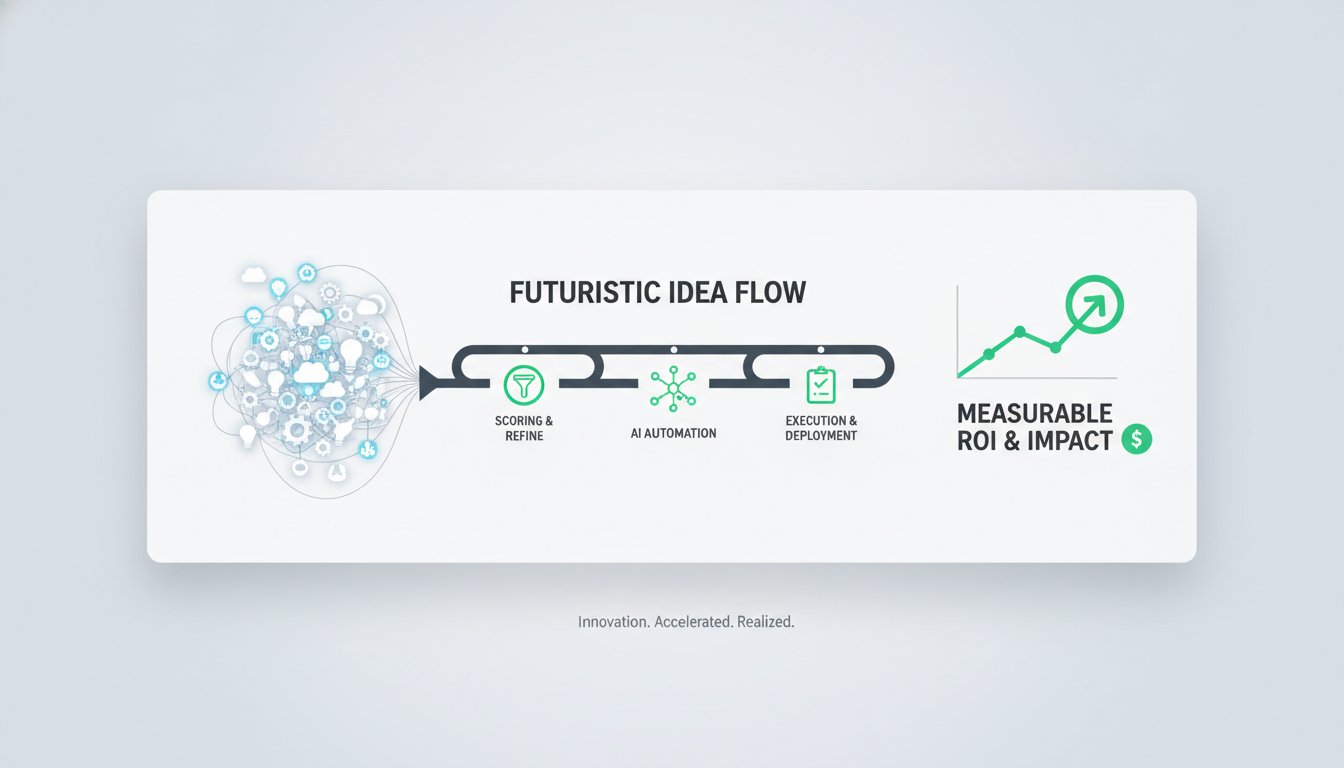
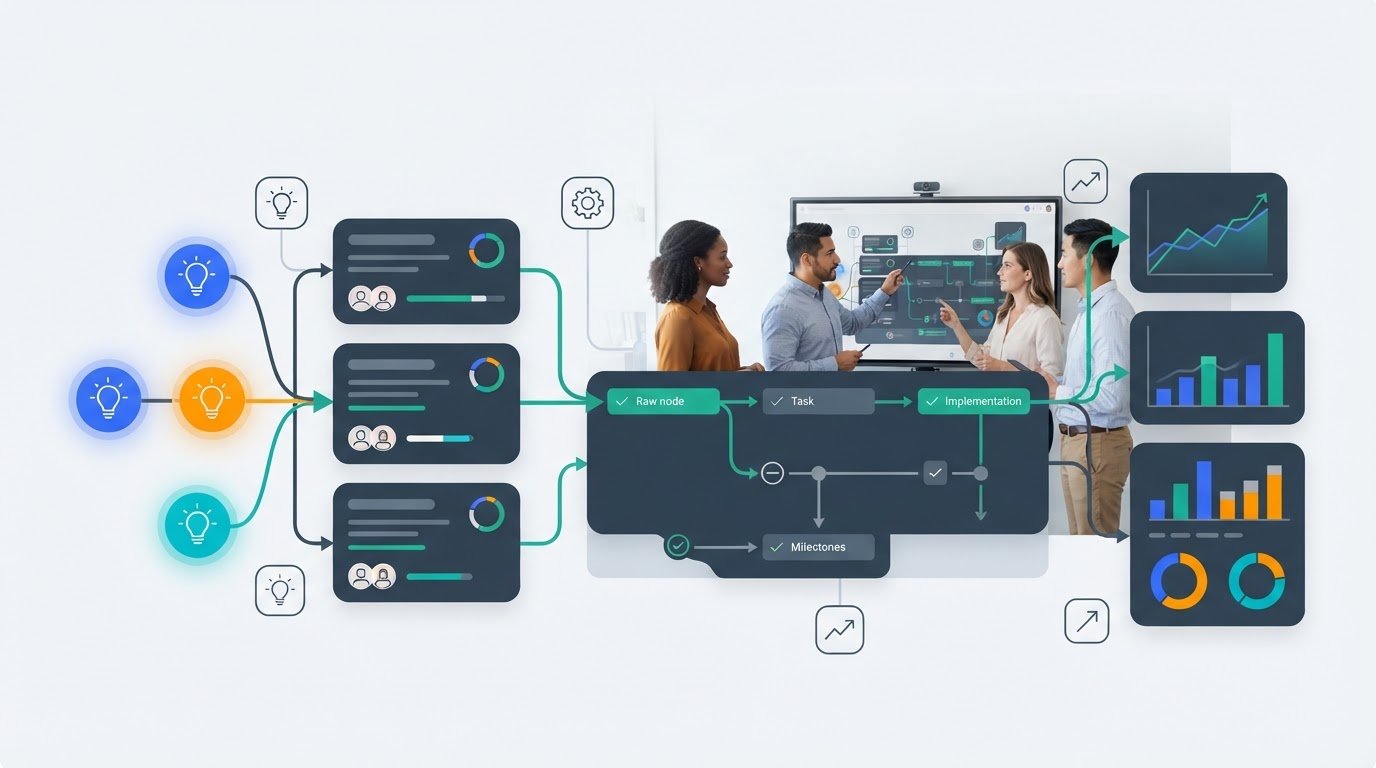
A connected lifecycle gives every idea a clear route: capture, clarify, evaluate, prioritize, assign, implement, and measure. Each transition should preserve context and decision history. Teams can then see what was proposed, why it advanced, who is responsible, and what resulted.

From idea submission to evaluation and prioritization

Start with a guided submission that asks for information reviewers can use, such as the problem, who it affects, and the proposed improvement. Keep prompts focused. Overly complex forms can make participation harder, while sparse submissions leave reviewers guessing. Next, apply consistent criteria tied to the initiative’s goals. Teams might assess strategic fit, feasibility, and potential benefit, then record why an idea was advanced, deferred, or declined.

Voting and gamification can draw attention to ideas and encourage participation, but popularity isn’t the same as business value. Use engagement signals as one input, not a substitute for evaluation. AI-driven insights can help organize submissions or surface patterns for review, but people still need to interpret the findings, apply program criteria, and make accountable decisions. In broader enterprise work management, platforms such as Tolvane address this by combining execution workflows with a dedicated AI governance fabric to keep automated analysis transparent and accountable.

From implementation tracking to ROI measurement

Once an idea is selected, assign an owner and define the next steps, milestones, and status updates. For example, a customer suggestion to simplify an onboarding step might move from review to a team-owned test, then into implementation if the results support the change. A visible record helps contributors and decision-makers follow progress instead of relying on scattered updates.

Measurement should distinguish activity from outcomes. Submission totals, votes, and review completion show participation and process movement. They don’t establish whether an implemented idea created value. Define a relevant outcome measure before work begins, such as time saved, fewer process errors, or another operational improvement aligned with the initiative. A scalable innovation platform makes lifecycle data useful by connecting decisions, ownership, implementation, and results in one traceable view.

That connection turns reporting into organizational learning: teams can see where ideas stall and which approaches deliver. Bain & Company’s discussion of the best practices of great scalers also emphasizes embedding repeatable practices as organizations grow. To see how connected workflows can support idea evaluation and follow-through, explore an innovation platform walkthrough.

How to Evaluate Scalable Innovation Platforms Without Adding Complexity

A platform should make innovation work easier to coordinate, not add another layer of administration. Evaluate it against your program goals, participants, decision rights, and existing processes. The right fit supports a consistent approach to managing ideas while allowing teams to adapt workflows when initiatives genuinely differ.

Which platform capabilities matter as programs grow?

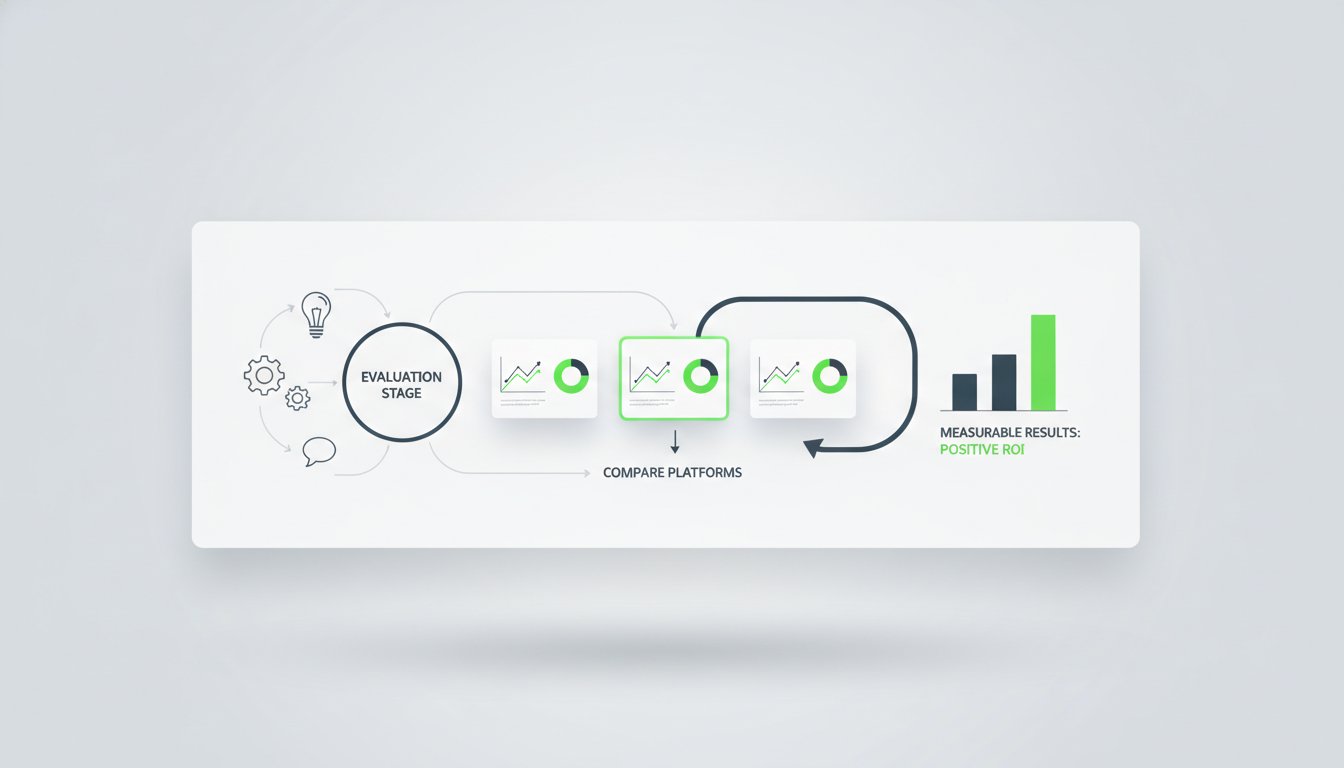
Use the criteria below to compare how a platform supports work across an initiative’s lifecycle. Look beyond feature lists. Ask how each capability would help your teams make decisions, keep work visible, and learn from results.

Evaluation area What to assess
Lifecycle coverage Can teams carry ideas from submission through evaluation, implementation, and outcome measurement?
Workflow flexibility Can distinct challenges use relevant steps and criteria without forcing every initiative into one template?
Participation Can the process support employees, customers, or partners where their input is relevant?
Governance Are decision rights, review criteria, and ownership clear at each stage?
Reporting Can teams follow status and connect program activity to outcomes?
Usability Are submission and review journeys straightforward for participants and administrators?

These criteria work together. A customer-focused challenge may need different prompts from an employee process-improvement initiative, while both can use clear ownership and progress reporting. A scalable innovation platform should make that variation manageable without fragmenting data or obscuring decisions.

How can teams avoid complexity and low adoption?

Start with the user journey. Participants should understand what information to provide and what happens after submission. Reviewers should be able to apply the program’s criteria without unnecessary steps. Governance needs enough consistency to make decisions explainable, but not so much rigidity that every initiative follows an ill-fitting process.

For organizations modernizing older processes, this guide to innovation software alternatives can help frame the transition. Compare platforms using a real initiative and the people who would run it. That practical test reveals whether the system can support meaningful flexibility while keeping work clear, traceable, and manageable.

How to Scale an Innovation Program in Practical Stages

Expanding an innovation program works best as a sequence of deliberate steps, not a company-wide launch that assumes every team is ready at once. Begin with a meaningful, bounded use case. Clarify accountability, configure the workflow, launch with a defined group, learn from actual participation, and expand what proves useful. This gives teams room to improve the process before more initiatives depend on it.

Start with a focused use case and clear ownership

Choose a business challenge specific enough to guide action, such as reducing friction in a process or improving a customer experience. Identify who can contribute, who makes decisions, and what outcome would indicate progress. Assign responsibility for screening submissions, evaluating ideas, implementing selected proposals, and communicating decisions. Without those owners, ideas can stall between approval and action.

Configure only the workflow needed for that initiative. Set clear submission prompts, review criteria, and decision points, then select measures that reflect activity and outcomes. Participation and review completion help show whether the program is functioning; an outcome measure should reflect the challenge itself. An idea management ROI calculator can help teams think through how to connect implemented ideas with value.

Expand through feedback, learning, and repeatable workflows

After launch, review where participants drop off, which steps create avoidable friction, and whether decisions are communicated clearly. Ask contributors and reviewers what was confusing, then refine prompts, criteria, and updates before adding another initiative. Share decisions, including why ideas move forward or don’t, so participation feels connected to real action.

As the program grows, standardize the elements that support consistency, such as decision roles and status definitions, while allowing workflows to reflect different initiative goals. A scalable innovation platform can help keep those processes connected, but the operating practice matters just as much: clear communication, useful feedback, and visible follow-through. Expand when the initial workflow is understood and owners can carry it into the next context without rebuilding the process from scratch.

How Ideawake Supports a Scalable Innovation Platform Strategy

A platform’s value depends on how well its capabilities fit the work an organization needs to coordinate. Ideawake supports a scalable innovation platform strategy with a cloud-based innovation management platform that connects idea capture, evaluation, implementation, and ROI measurement. This lifecycle coverage helps teams follow ideas beyond submission and examine progress through to outcomes.

The platform supports ideas from employees, customers, and partners, along with initiatives such as innovation challenges and hackathons. These sources and formats can serve different program goals. Consider who will participate, who will evaluate submissions, and how selected ideas will move into action. The aim is a connected process, not a one-size-fits-all initiative.

Where Ideawake fits in the innovation lifecycle

Ideawake supports the path from an initial idea to evaluation, implementation, and ROI measurement. AI-driven insights can assist with analyzing ideas, while gamification can support participation. Neither removes the need for clear criteria, accountable decision-makers, or thoughtful follow-through. Those practices help teams use platform capabilities in line with their program’s purpose.

For example, an organization could use a challenge to gather ideas from a defined participant group, evaluate submissions against its objectives, and track selected ideas through implementation. The workflow and outcome measures should reflect the initiative rather than assume results in advance.

What to explore in a platform demonstration

Bring a real use case to a demonstration and trace it through the lifecycle. Consider how participants submit ideas, how reviewers assess them, who owns implementation, and how the organization records outcomes. This makes it easier to judge whether the workflow supports your governance needs and addresses friction in the current process.

Also identify where administrative work can be simplified and where flexibility is needed for different initiatives. A demonstration should connect platform capabilities to the way your teams operate, so you can assess fit based on the work rather than a feature list.

Turn a repeatable innovation process into lasting impact. Innovation scales when ideas move through connected workflows, with clear ownership, consistent evaluation, and outcomes leaders can track. A scalable innovation platform is more than a place to collect submissions. It helps teams build a repeatable path from idea to implementation while adapting the process to different initiatives.

Start with a focused use case, make decisions visible, and learn from participant feedback before expanding. Ideawake’s cloud-based innovation management platform supports the lifecycle from idea submission through ROI measurement, including ideas from employees, customers, and partners. AI-driven insights and gamification can support analysis and participation, while clear governance keeps accountability with the people making and carrying out decisions.

See how those workflows could apply to your organization’s innovation goals.

Book a free Ideawake demo

Frequently Asked Questions

What is a scalable innovation platform?

A scalable innovation platform is software that runs the full idea lifecycle, from submission and evaluation to ownership, implementation and measured results, across many teams without adding administrators at the same rate. It gives every program consistent workflows and governance while letting each team adapt prompts and criteria. Unlike a digital suggestion box, it turns ideas into tracked outcomes.

How should you structure innovation teams for enterprise scale?

Most enterprises use a hub-and-spoke model: a small central team owns the platform, governance and reporting, while champions in each business unit run their own challenges and reviews. The central team sets shared criteria and ROI definitions; the spokes adapt them to local goals. This keeps standards consistent without creating a bottleneck at the center.

How do you evaluate innovation tools for long-term scalability?

Test whether the tool can add users, business units and use cases without a services project each time. Check SAML single sign-on and SCIM provisioning, multiple communities, group-based permissions, configurable workflows, automation limits, an API and reporting that rolls up across programs. Then run a realistic pilot workflow, not a feature demo.

How can an organization scale innovation without creating more bureaucracy?

Collect only the information each decision needs, automate the routine steps and keep workflows short at launch. Define who reviews, who approves and who communicates outcomes, then let automation handle routing, reminders and status updates. Add stages only when a real decision requires them.

Can AI help scale innovation management?

Yes. AI absorbs the work that grows with volume: flagging duplicate ideas, helping submitters complete missing details, summarizing ideas for reviewers and drafting business case content. In Ideawake, AI features are opt-in per feature and people keep every decision, so programs can grow participation without growing the admin team at the same pace.

How do you measure the ROI of an innovation platform?

Connect implemented ideas to measured outcomes, such as cost savings, revenue or time saved, and compare that value with total program cost. Track participation and implementation rate as leading indicators, but do not treat submission counts as proof of impact. Our idea management analytics guide covers the KPIs by program stage.

Which idea management platforms scale best for enterprises?

The platforms that scale best combine enterprise identity and permissions with low administrative overhead. Ideawake supports multiple communities, SAML SSO, SCIM provisioning and integrations with Teams, Slack, Jira and Asana, and holds a 4.8 out of 5 rating on Gartner Peer Insights. For side-by-side detail against IdeaScale, Brightidea, Qmarkets and others, see our comparison pages.

How should a company start scaling its innovation program?

Start with one bounded business challenge, a clear owner and a simple workflow. Launch with the intended group, review participation and process friction, then expand to the next team using what worked. Scaling a proven process is far easier than launching an organization-wide program at once.


Article by

Coby Skonord

Coby Skonord is the co-founder and CEO of Ideawake. Since 2013 he has worked with enterprise innovation, continuous improvement, and HR leaders to turn employee ideas into measurable business impact.

Innovation Leaderboard Software: Driving Engagement and ROI in 2026

Innovation Leaderboard Software: Driving Engagement and ROI in 2026
Coby Skonord|
September 13, 2026

A staggering 90% of employees report that gamification makes them more productive at work, yet many organizations still rely on static suggestion boxes that collect dust rather than breakthroughs. If your innovation program feels like a chore for your team, it’s because it lacks the psychological triggers that drive consistent participation. Implementing high-performance innovation leaderboard software isn’t just about adding a scoreboard; it’s about building a transparent ecosystem where contribution is visible, measurable, and rewarded in real time.

You likely recognize that manual administration of rewards and the inability to identify your top-tier innovators are holding your culture back from its full potential. This article will show you how to leverage game mechanics to transform stagnant idea portals into high-participation engines that deliver clear, data-backed results. We’ll examine the specific strategies for 2026 that automate recognition, provide clear data on top contributors, and secure a proven ROI from employee-generated ideas.

Key Takeaways

  • Transition from static suggestion boxes to dynamic digital hubs that offer real-time transparency and peer-driven ranking.
  • Discover how modern innovation leaderboard software uses automated point-based incentives to drive participation while eliminating manual administrative tasks.
  • Leverage core psychological drivers like the Endowment Effect to foster a deep sense of idea ownership and sustained intrinsic motivation.
  • Apply a rigorous 5-step framework to align your gamification mechanics with measurable business outcomes and innovation KPIs.
  • Identify the critical differences between modern, AI-enhanced platforms and legacy tools to maximize your program’s long-term ROI.

What is Innovation Leaderboard Software?

Innovation leaderboard software is a specialized digital ecosystem designed to track, rank, and incentivize employee contributions to the organizational innovation process. It functions as a centralized engine that quantifies engagement by assigning values to specific behaviors, such as submitting an idea, collaborating on a colleague’s proposal, or participating in the evaluation phase. By providing a real-time view of top contributors, this software transforms abstract participation into a tangible, performance-driven metric.

The primary goal of these platforms is to foster a culture of continuous improvement through visibility. When employees see their contributions acknowledged publicly, it validates their effort and encourages sustained engagement. Core components typically include automated point systems, activity tracking modules, and dynamic ranking displays that update instantly as new data enters the system.

The Evolution from Suggestion Boxes to Gamified Platforms

Traditional suggestion boxes often represented a passive feedback loop where ideas were submitted and then effectively disappeared. This lack of transparency created a black hole effect that discouraged future participation. Modern platforms solve this by clarifying the distinction between creativity vs innovation. While creativity involves the generation of raw concepts, innovation requires the structured refinement and implementation of those concepts. Innovation leaderboard software makes this entire journey visible, replacing the silence of email-based suggestions with a transparent, social, and interactive hub.

Why Modern Enterprises are Moving Toward Gamification

Enterprises are increasingly adopting Gamification techniques because they align workplace tasks with fundamental human psychology. Research indicates that 83% of employees who receive gamified training feel more motivated in their work, a sentiment that carries over into ideation programs. Leaderboards directly address the visibility gap often found in remote and hybrid teams by ensuring that high-performing innovators are recognized regardless of their physical location.

Beyond individual motivation, these systems provide critical data for leadership. By tracking who the top contributors are, companies can identify emerging talent and subject matter experts who might otherwise remain hidden. This structured approach to recognition is one of the key benefits of employee ideation programs, as it links individual performance to broader organizational health and long-term retention strategies. The result is a self-sustaining cycle of participation that drives actual business value.

Core Features of High-Impact Innovation Leaderboards

High-impact innovation leaderboard software functions as more than a simple ranking tool. It’s a sophisticated engine that drives specific cultural behaviors. By utilizing points-based incentives for actions like submissions, detailed comments, and peer voting, organizations can reward the quality of collaboration as much as the initial spark of an idea. This granular tracking ensures that every meaningful contribution is captured and valued.

Tiered ranking systems are essential for maintaining engagement across large enterprises. While a global leaderboard highlights top-tier talent, departmental or regional tiers prevent lower-ranked employees from feeling discouraged by distant leaders. Research on the Impact of Tier-Based Leaderboards suggests that localized competition often yields higher sustained participation rates. This software also automates the administrative burden of prize fulfillment and awards digital badges to verify expertise, ensuring that recognition is both immediate and public.

AI-Driven Scoring and Evaluation

Human bias is a common pitfall in traditional innovation programs. Integrating AI tools for innovation managers ensures that idea evaluation remains objective and data-driven. Ideawake AI, for example, acts as an automated filter that scores proposals based on strategic alignment and feasibility. This prevents the leaderboard from becoming a popularity contest. AI also clusters similar concepts, which keeps the platform organized and prevents repetitive submissions from diluting the impact of unique breakthroughs.

Transparency and Social Proof Mechanics

Peer voting serves as a critical validation layer. It allows the collective intelligence of the workforce to filter high-potential ideas before they ever reach a manager’s desk. Public leaderboards leverage social proof to create a healthy sense of accountability. When employees see their peers making progress on the activity feed, it reinforces the belief that their contributions will lead to actual change. If you’re ready to see how these mechanics can scale your program, you can book a free demo to explore the platform’s full capabilities.

The Psychology of Competition: Why Leaderboards Drive Participation

Understanding why humans are drawn to digital rankings requires a deep dive into behavioral science. High-performance innovation leaderboard software does not just display names; it leverages core psychological triggers that convert passive observation into active contribution. By making progress visible, organizations tap into the “Endowment Effect,” a phenomenon where individuals attribute higher value to things they feel they own. When an employee sees their idea gaining traction on a leaderboard, they develop a psychological sense of possession, leading to a 60% increase in engagement as they work to defend and refine their concept.

A primary concern for many leaders is the risk of “toxic” competition. However, modern platforms mitigate this by utilizing collaborative scoring logic. Instead of rewarding only the quantity of submissions, points are distributed for peer-voting, constructive commenting, and refining the ideas of others. This ensures that the leaderboard reflects a culture of mutual support rather than a zero-sum game. This visibility also serves as powerful social proof, signaling to “lurkers” that innovation is the cultural norm, which eventually pulls them into the participation cycle.

Intrinsic vs. Extrinsic Rewards

While cash prizes can trigger initial interest, data shows that 83% of employees feel more motivated by gamified systems that prioritize recognition. Innovation leaderboard software excels at providing “status,” a powerful intrinsic motivator. High-performers are often more driven by visible expertise and professional standing than by small monetary bonuses. Effective programs frequently use non-monetary rewards, such as professional development opportunities or a lunch with the CEO, to validate the contributor’s value to the organization’s future. For milestone or annual innovation challenges, companies sometimes pair peer recognition with memorable experiential rewards, such as adventure travel arranged through Astro Safaris and Tours Ltd, to celebrate transformative contributions.

Avoiding Participation Fatigue

Sustaining momentum requires a strategic approach to reinforcement. If a leaderboard is static and permanent, new employees may feel they’ll never catch up to early leaders, which leads to burnout. To prevent this, organizations use sprint-based challenges that reset periodically. This creates a sense of urgency and provides multiple “fresh starts” for the workforce. This structured approach is a critical lesson learned from Google’s 20% time program, which demonstrated that while autonomy is essential, a lack of clear milestones and structured competition can lead to inconsistent participation over time. By using intermittent reinforcement, you keep the excitement of the “game” alive without exhausting your team’s creative energy.

Implementing Innovation Leaderboard Software: A 5-Step Framework

Transitioning from a passive suggestion box to a high-participation ecosystem requires more than just new tools. It requires a structured strategy. While legacy consultants often claim that enterprise implementation takes six to twelve months, modern cloud-based innovation leaderboard software allows organizations to deploy and scale in a fraction of that time. To ensure your program delivers immediate value, follow this 5-step framework.

  • Step 1: Define clear KPIs. Establish baseline metrics for success, such as a target participation rate or a specific idea-to-implementation ratio, to track progress from day one.
  • Step 2: Configure point values. Align your gamification mechanics with your business goals by assigning higher point values to the behaviors you want to encourage most.
  • Step 3: Establish a multi-tiered prize structure. Use a mix of departmental and global rewards to ensure that employees at every level feel they have a realistic chance to win, from everyday micro-incentives to aspirational grand prizes like Kenyan wildlife tours with Ketsafaris.
  • Step 4: Execute a high-energy internal launch. Build momentum through a dedicated internal campaign that explains the “why” behind the new system and showcases potential rewards.
  • Step 5: Monitor the evaluation cycle. Consistently review the idea evaluation process to ensure that high-ranking ideas on the leaderboard are moving toward implementation.

Setting the Right Point Values

Success isn’t just about the volume of submissions. It’s about the quality of collaboration. You should reward constructive feedback and peer evaluations more heavily than simple “likes” to drive meaningful refinement. Weighting points for the four main types of business collaboration ensures that the individuals who help bridge the gap between a raw concept and a viable solution are just as visible as the original submitters. To keep the competition fresh, consider resetting leaderboards quarterly. This prevents early leaders from becoming untouchable and gives new participants a recurring opportunity to top the charts.

Measuring ROI and Long-Term Success

To secure continued executive buy-in, you must translate leaderboard activity into financial impact. Leveraging an idea management ROI calculator allows you to tie specific employee engagement metrics to tangible bottom-line gains. Tracking the “Innovation Pipeline” from the moment an idea hits the leaderboard to its final market-ready state provides a clear narrative of success. When reporting to stakeholders, lead with data-backed metrics that show how gamification has reduced administrative overhead and accelerated the delivery of high-potential projects.

Choosing the Best Innovation Leaderboard Software for Your Organization

Selecting the right innovation leaderboard software requires looking past superficial features to evaluate the underlying architecture. Legacy systems often rely on rigid, complex frameworks that require extensive training and heavy manual oversight. In contrast, modern platforms prioritize automation to eliminate the administrative burden of tracking points and fulfilling rewards. You should seek an “AI-first” solution that supports the entire innovation lifecycle, from initial ideation to final ROI measurement, rather than a simple front-end submission tool. This ensures that your program remains scalable and results-driven as it grows.

Build vs. Buy: The Case for Dedicated Platforms

Many organizations initially attempt to build leaderboards using internal tools like SharePoint or standard spreadsheets. However, the hidden costs of maintenance, security vulnerabilities, and limited scalability often outweigh any perceived savings. For a detailed breakdown of these trade-offs, decision-makers should consult our build vs buy idea management software guide. Dedicated SaaS platforms offer a superior path forward by providing out-of-the-box gamification mechanics that are purpose-built for enterprise security and rapid global scaling, ensuring that your data remains protected while your program expands.

Why Ideawake is the Leader in Gamified Innovation

Ideawake stands out as a premier strategic innovation management platform because it combines modern architecture with a focus on user experience. Unlike legacy tools that can take months to deploy, Ideawake is designed for rapid implementation, allowing teams to launch high-participation challenges in weeks. The platform leverages Ideawake AI to automate scoring and evaluation, ensuring the leaderboard remains a fair and objective reflection of real business value rather than just a popularity contest.

The intuitive interface and seamless social features drive sustained participation without the need for constant management intervention. This shift from manual administration to automated engagement is what allows organizations to scale their innovation engines effectively across multiple departments. If you’re ready to transform your culture and see these mechanics in action, sign up for a demo today to explore how our leaderboard technology drives measurable ROI and identifies your organization’s top-tier talent.

Building a Sustainable Culture of High-Performance Innovation

Transforming your organization’s creative potential into a measurable financial asset requires moving beyond the passive feedback loops of the past. By integrating high-performance innovation leaderboard software, you tap into the psychological drivers that turn average employees into top-tier contributors. Success in 2026 hinges on objective, AI-driven scoring and a tiered ranking system that maintains momentum across every department. These mechanics ensure that participation remains high while administrative chaos disappears.

Ideawake provides the modern architecture needed to launch these programs in weeks rather than months. Leading enterprises already use our platform to capture thousands of actionable ideas; meanwhile, our AI-driven evaluation tools reduce manual administrative work by up to 80%. It’s time to stop settling for stagnant suggestion boxes and start building a self-sustaining innovation engine that rewards excellence and drives growth.

Your team’s next breakthrough is waiting for the right platform to bring it to light. Empower your workforce and secure your competitive advantage today.

Frequently Asked Questions

How do I prevent people from ‘gaming’ the leaderboard points system?

You prevent gaming by weighting point values toward high-impact behaviors rather than simple activity volume. Instead of awarding points for every comment, innovation leaderboard software should prioritize points for peer-validated refinements and successful evaluations. Ideawake AI further mitigates this by objectively scoring the quality of ideas, ensuring that only strategically aligned contributions rise to the top. This shift from quantity to quality discourages participants from spamming the system for artificial rank.

Will an innovation leaderboard discourage introverted employees from sharing ideas?

Leaderboards actually empower introverted employees by providing a structured, digital environment that bypasses the need for vocal dominance in meetings. These platforms offer a transparent hub where ideas are judged on merit rather than presentation style. Because the software facilitates asynchronous collaboration through voting and commenting, it allows thoughtful contributors to engage at their own pace. This ensures that valuable insights from all personality types are captured and recognized within the organizational hierarchy.

What are the most effective prizes for a corporate innovation leaderboard?

The most effective prizes blend extrinsic rewards with high-status intrinsic recognition. While gift cards provide immediate gratification, long-term engagement is driven by professional development opportunities, such as “lunch with the CEO” or sponsorship for a certification course. Digital badges and public expertise rankings also serve as powerful motivators. According to research, 83% of employees feel more motivated when their training and contributions are gamified through these non-monetary status symbols.

Can I integrate innovation leaderboard software with tools like Slack or Microsoft Teams?

Seamless integration with Slack and Microsoft Teams is a standard feature of modern innovation platforms. These integrations allow employees to submit ideas, vote, and track leaderboard standings directly within their existing workflows. By removing the need to log into a separate system, organizations significantly reduce adoption barriers and maintain a steady pulse of engagement. This ensures that the innovation leaderboard software remains a central part of the daily digital workplace rather than an isolated tool.

How often should an innovation leaderboard be reset to maintain engagement?

Resetting your leaderboard quarterly or at the end of specific “sprint” challenges is the most effective way to maintain long-term engagement. Periodic resets prevent a few early leaders from becoming untouchable, which can discourage new participants from joining the program. By providing “fresh starts,” you create recurring opportunities for different departments and individuals to reach the top. This cadence keeps the competitive element exciting and ensures that the culture of innovation remains dynamic and inclusive.

Is gamification suitable for highly regulated industries like healthcare or finance?

Companies using gamification in their programs report up to a 60% increase in engagement compared to traditional, non-gamified methods. While a passive suggestion box might see participation from only a small fraction of the workforce, a leaderboard-driven system taps into core human psychological drivers for progress and recognition. This shift in performance transforms innovation from a niche activity into a company-wide engine that consistently generates high-quality, actionable ideas for the business.

How does AI help in managing a large-scale innovation leaderboard?

AI manages the administrative complexity of large-scale leaderboards by automating the scoring and evaluation of thousands of ideas. Ideawake AI uses machine learning to cluster similar concepts and rank submissions based on their strategic alignment, which reduces manual administrative work by up to 80%. This allows innovation managers to focus on high-potential projects rather than getting bogged down in data entry. AI ensures that the leaderboard remains an objective, data-backed reflection of the most valuable contributions.

Article by

Coby Skonord

Coby Skonord is the co-founder and CEO of Ideawake. Since 2013 he has worked with enterprise innovation, continuous improvement, and HR leaders to turn employee ideas into measurable business impact.

Innovation Pipeline Management: A Data-Driven Guide to Maximizing ROI in 2026

Innovation Pipeline Management: A Data-Driven Guide to Maximizing ROI in 2026
Coby Skonord|
August 30, 2026

Did you know that 55% of innovation management platforms have already integrated AI to automate idea evaluation, yet many organizations still struggle to generate a tangible return on their investments? According to Business Research Insights, while 70% of enterprises prioritize an innovation culture, the gap between ideation and implementation remains a significant hurdle. You’ve likely felt the frustration of information silos and the heavy administrative burden of manually vetting thousands of submissions. Without a structured innovation pipeline management strategy, these ideas often become a source of friction rather than a driver of growth.

It’s difficult to justify budgets when you can’t point to a direct financial impact. This guide will show you how to replace chaotic suggestion boxes with a high-performance engine for measurable ROI. You’ll learn how to build a repeatable process for vetting ideas and capture the clear data required to prove your program’s value to stakeholders. We’ll explore how modern architecture and AI insights can eliminate evaluation bottlenecks, drive higher employee participation, and finally deliver the results your organization demands in 2026.

Key Takeaways

  • Learn how to transition from a passive suggestion box to a structured innovation pipeline management system that treats ideas as measurable financial assets.
  • Discover the five essential stages of the innovation lifecycle, from aligning idea generation with specific business challenges to leveraging internal crowdsourcing for faster refinement.
  • Identify the administrative bottlenecks inherent in legacy spreadsheets and learn how modern, cloud-based architectures reduce overhead through automated workflows.
  • Master data-driven metrics like Pipeline Velocity and Yield Ratio to provide clear evidence of your innovation program’s performance and justify future budgets.
  • Explore how AI-driven tools can automate the scoring and duplicate detection process, allowing your team to focus on high-impact implementation rather than manual evaluation.

The Architecture of a High-Impact Innovation Pipeline

Innovation pipeline management is the systematic process of converting raw concepts into implemented solutions that deliver measurable ROI. It’s the engine room of modern innovation management. In 2026, market leaders have largely abandoned the traditional “suggestion box” model. While a suggestion box is a passive repository that often leads to employee disengagement, a managed pipeline is an active, data-driven workflow. Research indicates that approximately 55% of platforms now use AI to improve evaluation, reflecting a shift toward objective decision making. Modern architecture is no longer optional. It’s essential for reducing the administrative friction that typically kills great ideas before they ever reach the prototype stage. Large enterprises, which hold nearly 78% of the market share, utilize these systems to ensure their innovation budgets are backed by hard data rather than optimistic speculation.

Why Pipeline Management is the Backbone of Corporate Growth

The Consequences of a Clogged or Leaky Pipeline

Pipelines fail when they become either “clogged” or “leaky.” A clog occurs when a small team of evaluators is overwhelmed by thousands of unranked ideas, leading to burnout and stagnation. This administrative burden stalls progress and discourages future participation. Conversely, a leaky pipeline loses high-potential projects due to poor evaluation criteria or a lack of stakeholder buy-in. Most innovation failures don’t happen because the ideas were bad. They happen because the pipeline couldn’t support the weight of the evaluation process or failed to provide transparency to the contributors. By 2026, effective innovation pipeline management relies on automated scoring and AI-driven insights to patch these leaks. This ensures that the most viable, data-backed concepts move toward implementation while administrative overhead remains manageable.

The 5 Essential Stages of Innovation Pipeline Management

Stage 1 & 2: Moving from Capture to Collaboration

The final stage, Implementation and ROI Measurement, is where the transition to operational reality occurs. Success here requires end-to-end lifecycle tracking to prove that the initial investment yielded the promised results. If you want to see how these stages can be automated for your team, you can book a free demo to explore modern pipeline workflows and start maximizing your innovation returns.

Legacy Systems vs. Modern Platforms: Identifying Your Bottlenecks

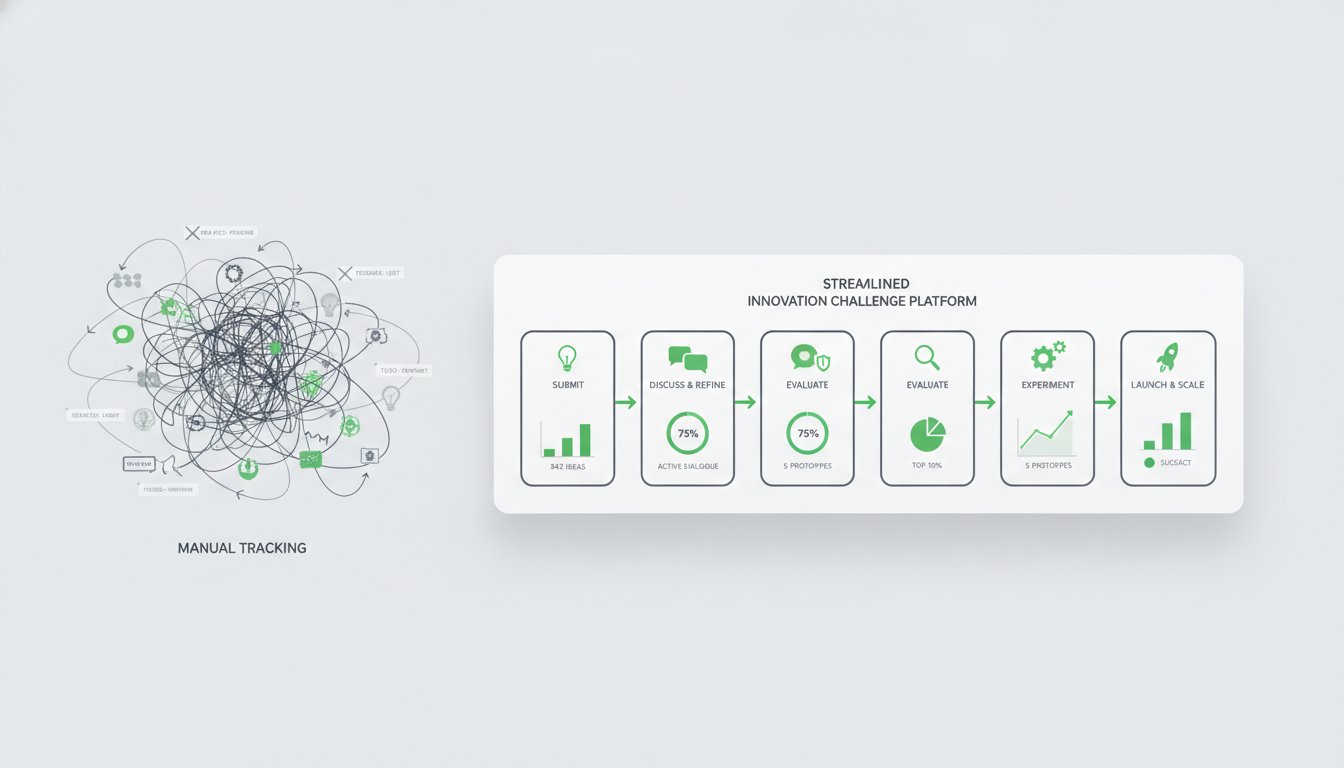
Many organizations attempt to manage their innovation efforts using general-purpose tools like Excel or SharePoint. While these might work for small teams, they fail to scale in a complex enterprise environment. Manual innovation pipeline management often leads to a massive administrative burden, consuming hundreds of hours that should be spent on execution. When you contrast the manual approach with automated platforms, the difference in efficiency is staggering. Legacy systems lack the real-time data flow needed to keep pace with market changes. This creates bottlenecks that stall high-potential projects and waste precious resources.

The Hidden Costs of Manual Pipeline Management

The true cost of using outdated tools isn’t just the software license fee. It’s the idea decay that occurs when slow response times kill momentum. According to the Ideawake vs Spreadsheets analysis, organizations using manual methods lose significant time on data entry and status tracking. This lack of speed results in lost ROI as competitors beat you to market. Beyond the financial impact, manual systems damage employee morale. When contributors don’t see progress or receive feedback, they stop participating. Transparency is the antidote to disengagement, and legacy tools simply cannot provide the visibility required to keep a workforce inspired.

Modern Features That Drive Pipeline Velocity

Data-Driven Metrics: How to Measure Pipeline Velocity and ROI

Effective innovation pipeline management requires more than just counting the number of ideas collected. You must treat your pipeline as a financial instrument where every stage has a measurable cost and a projected return. One of the most critical metrics to track is Pipeline Velocity. This is the average time an idea takes to move from the initial submission to a fully realized implementation. Organizations that fail to monitor velocity often see their most promising concepts die in committee. A slow pipeline is a leaky pipeline, as market conditions shift faster than your internal processes can react.

Another vital indicator is the Yield Ratio. This calculation compares the number of successful implementations against the total number of submissions. A low yield ratio might suggest that your strategic alignment is off or that your evaluation criteria are too broad. To balance your portfolio, you should also adopt “Innovation Accounting.” This framework is designed for high-uncertainty projects where traditional financial metrics don’t apply early on. It allows you to track progress through learning milestones and pivot points before you commit significant capital. Balancing these with non-financial metrics like employee engagement ensures the long-term health of your innovation ecosystem.

The ROI of Employee Ideation Programs

KPIs for Every Stage of the Funnel

To identify bottlenecks, you must track performance across the entire funnel. Each stage requires specific KPIs to ensure the engine is running smoothly:

  • Submission Metrics: Monitor the participation rate and idea diversity across different departments to ensure you aren’t stuck in an information silo.
  • Evaluation Metrics: Track the time-to-decision and evaluator throughput to prevent administrative clogs that stall momentum.
  • Outcome Metrics: Measure the final implementation rate and the realized net savings or revenue generated by each project.

Ideawake: Streamlining Your Innovation Lifecycle from Submission to ROI

Ideawake is specifically engineered to eliminate the administrative complexity that often paralyzes corporate growth. In a landscape where 55% of platforms now leverage AI, Ideawake leads by integrating advanced features that automate the most tedious parts of the lifecycle. By using Ideawake AI, your team can instantly handle duplicate detection and initial scoring, ensuring that reviewers only spend time on high-potential concepts. This transition from manual filtering to automated intelligence is the cornerstone of effective innovation pipeline management. Whether your organization is running high-impact hackathons or steady continuous improvement programs, the platform provides a unified environment to track every idea from the initial spark to the final financial outcome.

The implementation process is designed for speed, significantly reducing the time-to-value for large enterprises. Many legacy tools require months of configuration, but Ideawake’s modern architecture allows for a rapid rollout that starts delivering insights within weeks. This efficiency is critical for maintaining the momentum of your innovation culture and ensuring that employee engagement doesn’t wither during a long setup phase.

Why Modern Architecture Matters for Scalability

Scaling an innovation program across thousands of employees shouldn’t increase the burden on your innovation leads. Ideawake is built on a cloud-first architecture that supports massive user bases while maintaining enterprise-grade security. This makes it a premier choice for innovation management software. Managers can launch targeted Innovation Challenges to solve urgent problems, using structured workflows to ensure quality as participation grows.

Getting Started: From Chaos to Clarity

The journey from a chaotic suggestion box to a structured engine of growth is straightforward. The process is clear: Capture, Evaluate, Implement, and Measure. Each step is supported by real-time data and automated tracking to ensure no ROI is left on the table. If you’re ready to see this architecture in action, you can sign-up for a personalized demo. Don’t settle for manual tracking. Compare Ideawake to legacy tools to see the difference in ROI.

Building the High-Performance Innovation Engine of 2026

Effective innovation pipeline management is the bridge between a creative workforce and a growing bottom line. By moving away from legacy tools and embracing a structured, AI-driven approach, you eliminate the administrative friction that stalls organizational progress. You’ve seen how modern architecture reduces manual evaluation time by over 50%, enabling your team to focus on high-impact implementation rather than data entry. Trusted by global enterprises to drive ROI, this data-backed strategy provides the transparency needed to keep employees engaged and stakeholders informed.

The path from a chaotic suggestion box to a streamlined growth engine is shorter than you think. Start maximizing your organization’s untapped potential today.

Frequently Asked Questions

What is innovation pipeline management?

Innovation pipeline management is the systematic process of moving ideas from raw concepts to measurable ROI. It involves capturing, evaluating, and implementing ideas through a structured workflow. Unlike a passive suggestion box, it actively manages the lifecycle of an idea to ensure it delivers value. This process is essential for organizations that want to turn employee creativity into tangible financial gains without getting bogged down by administrative complexity.

How is an innovation pipeline different from a traditional project management funnel?

What are the most common bottlenecks in an innovation pipeline?

What are the most common bottlenecks in an innovation pipeline?

AI automates the heavy lifting of categorization, duplicate detection, and initial scoring. According to research from Business Research Insights, approximately 55% of platforms have integrated AI as of 2026 to improve evaluation. Tools like Ideawake AI use sentiment analysis and machine learning to surface high-potential concepts based on peer feedback. This ensures that human evaluators focus on the most viable ideas, significantly increasing the capacity of the review team.

How do you measure the ROI of an innovation pipeline?

You measure ROI by tracking realized net savings or revenue generated from implemented ideas against the total cost of the program. Organizations should also monitor “Pipeline Velocity,” which is the time an idea takes to move from submission to execution. Key KPIs include:

  • Participation rate across departments
  • Realized net savings or revenue

Tracking these metrics provides the hard data needed to justify innovation budgets.

Is innovation pipeline software better than using spreadsheets?

Specialized software is significantly more efficient than spreadsheets for large-scale enterprise innovation. Spreadsheets are static, prone to error, and lack the automated workflows required to manage thousands of submissions. They create significant time loss in data entry and status tracking. Modern platforms like Ideawake provide a centralized “single source of truth,” offering real-time transparency and automated reporting that manual tools simply cannot replicate. This shift allows teams to focus on implementation rather than spreadsheet maintenance.

How long does it take to implement an innovation management platform?

Implementation times vary based on organizational size, but modern cloud-based platforms are designed for rapid rollout. Because they use a modern architecture, these systems reduce the technical barriers that once made enterprise software deployments take months. Most organizations can launch their first innovation challenge within a few weeks. This fast time-to-value is critical for maintaining momentum and proving the program’s worth to stakeholders early in the process.

Can frontline employees participate in innovation pipeline management?

Frontline employees are often the most valuable contributors because they are closest to operational inefficiencies. Modern platforms utilize mobile-first submission and gamification features like leaderboards to encourage participation from all levels of the organization. By lowering the barrier to entry, companies can tap into the collective intelligence of their entire workforce. This inclusive approach to innovation pipeline management drives higher engagement and surfaces practical solutions that leadership might otherwise overlook.

Article by

Coby Skonord

Coby Skonord is the co-founder and CEO of Ideawake. Since 2013 he has worked with enterprise innovation, continuous improvement, and HR leaders to turn employee ideas into measurable business impact.

Beyond IdeaPlace: The Top Spigit Alternative for Enterprise Innovation in 2026

Beyond IdeaPlace: The Top Spigit Alternative for Enterprise Innovation in 2026
Coby Skonord|
August 23, 2026

Legacy innovation software has officially become a “participation tax” that drains corporate resources without delivering clear financial returns. While the global innovation management market is projected to reach $20.48 billion in 2026, many organizations searching for a modern Spigit alternative find themselves stuck with platforms that require full-time administrative teams just to keep the lights on. You likely recognize the frustration. High-potential ideas often stall because the manual evaluation process is too slow or the interface is too clunky for widespread adoption.

Finding a superior solution isn’t just about switching vendors; it’s about moving from a passive suggestion box to a results-driven ecosystem. This article explains why enterprises are transitioning away from complex legacy systems in favor of agile, AI-first platforms that automate the innovation lifecycle. We’ll examine how to select a solution that uses gamification to drive participation and provides the end-to-end ROI measurement necessary to prove your program’s value to the board. By the end, you’ll have a clear framework for selecting a partner that turns raw creativity into a measurable competitive advantage.

Key Takeaways

  • Understand the shift from centralized databases to collaborative ecosystems and learn how to eliminate the administrative burden inherent in legacy systems.
  • Identify a Spigit alternative that utilizes AI-driven automation to reduce manual administrative tasks by up to 50% through automated duplicate detection.
  • Compare implementation timelines to see how modern cloud-native architectures enable full enterprise deployment in just 4 to 6 weeks.
  • Discover how to leverage gamification and leaderboards to drive sustained employee engagement and increase participation across your innovation pipeline.
  • Follow a structured framework for auditing existing data and transitioning active ideas to ensure zero disruption to your innovation ROI.

The Evolution of Innovation Management: Why Legacy Spigit Users are Switching

The landscape of innovation management has undergone a fundamental transformation since the early days of centralized databases. In the “Idea Management 1.0” era, platforms functioned as static repositories where suggestions often went to die. Today, the 2026 enterprise requires a collaborative ecosystem that prioritizes action over storage. Many organizations are realizing that their legacy tools are essentially digital suggestion boxes that fail to drive real growth. This realization is fueling the search for a modern Spigit alternative that can handle the complexities of a decentralized workforce while maintaining high levels of engagement and transparency.

One of the most significant burdens of legacy systems is the “Administrative Tax.” Older platforms often require one or two full-time administrators just to manage workflows, filter duplicates, and chase status updates. This overhead is a hidden cost that eats into the program’s budget. Common administrative drains include:

  • Manual categorization of hundreds of similar submissions.
  • Constant follow-up with subject matter experts for evaluations.
  • Generating manual reports for executive leadership.

The Rise of the Agile Innovation Lifecycle

The rigid, waterfall-style workflows of the past have been replaced by iterative, agile pipelines. Speed-to-market is now the primary metric for success. Organizations must balance incremental vs radical innovation to stay competitive in a digital-first world. A modern Spigit alternative facilitates this by allowing teams to test, pivot, and scale ideas quickly. This shift ensures that the innovation lifecycle remains fluid rather than getting stuck in endless committee reviews. It’s about moving fast and learning faster to capture value before the market shifts.

The Adoption Problem: Why “Shelfware” Happens

Software only works if people use it. Complex, over-engineered user interfaces often lead to a sharp decline in employee participation. Some industry professionals report that poorly designed platforms can see engagement drop by as much as 70% over time. These innovation failures often stem from the psychological barrier of “tool fatigue.” Instead of focusing on innovation skills for generating new ideas, employees spend their time trying to navigate confusing forms. Success in 2026 requires a platform that feels as intuitive as a consumer app, removing friction at every touchpoint to keep the creative pipeline full.

4 Non-Negotiable Features of a Modern Spigit Alternative

Selecting a Spigit alternative in 2026 requires looking beyond basic feature lists. You need a platform that actively reduces the workload for your innovation team while maximizing the quality of output. Legacy tools often fail because they focus on the volume of ideas rather than the velocity of implementation. To avoid the “shelfware” trap discussed in the previous section, your new platform must excel in four specific areas: AI-driven automation, strategic gamification, verifiable ROI tracking, and administrative self-sufficiency. These aren’t just “nice-to-haves.” They are the backbone of a program that survives the first year of deployment.

AI Tools for Innovation Managers: The Efficiency Leap

The primary bottleneck in enterprise innovation is evaluation. Using AI tools for innovation managers allows your team to score and prioritize thousands of submissions without manual intervention. Instead of spending weeks on keyword searches, Ideawake AI automates the “first pass” evaluation by clustering similar ideas and detecting duplicates instantly. This saves hundreds of hours of administrative work. AI also provides sentiment analysis and trend spotting across global teams, identifying high-potential concepts that might otherwise be buried in the noise. It turns a chaotic inbox into a prioritized roadmap.

Gamification and Employee Engagement Dynamics

Sustaining long-term interest in employee ideation programs requires more than just a submission form. Strategic gamification, including leaderboards and voting, creates a sense of community and healthy competition. Industry research suggests that gamified platforms can increase participation rates significantly compared to static systems. You can also deploy specific “Innovation Challenges” to solve urgent business problems in under 30 days. These time-bound sprints focus the collective intelligence of your workforce on high-value targets, ensuring engagement stays high because employees see their contributions leading to tangible action.

Finally, your platform must offer end-to-end ROI tracking and administrative efficiency. You should be able to link a raw idea directly to its final dollar-value impact through a transparent dashboard. If you need to change a workflow or update a scoring criterion, you shouldn’t have to call an expensive consultant. This level of self-service configuration is what defines a top-tier Spigit alternative. If you’re ready to see how these features function in a live environment, you can explore our full suite of innovation tools to see how they fit your specific needs.

Comparing Planview IdeaPlace vs. Modern Alternatives

When evaluating a Spigit alternative, the primary differentiator is the technical architecture. Planview IdeaPlace is integrated into a broad Work Resource Management suite, which often results in a complex, legacy-integrated structure. In contrast, modern platforms like Ideawake are cloud-native. This architectural difference directly impacts implementation speed. While legacy enterprise deployment can drag on for 6 to 12 months, a modern cloud-native system allows organizations to go live in just 4 to 6 weeks. This speed is critical for maintaining momentum and proving early value to stakeholders.

The user interface also marks a clear divide. Legacy tools often mirror the design of 2010-era enterprise software. A modern alternative provides a consumer-grade UX that feels as intuitive as the apps employees use in their personal lives. This reduces the learning curve and encourages adoption across all departments, not just the R&D team. When software is easy to navigate, participation rates remain stable rather than tapering off after the initial launch.

Administrative Complexity: The Hidden Cost

The total cost of ownership (TCO) for legacy software extends far beyond the licensing fee. You must account for the administrative headcount required to keep the system functional. When applying the build vs buy idea management software logic, buying a modern platform is almost always more cost-effective than maintaining a legacy one. For example, launching a new innovation challenge in a legacy system might require dozens of clicks and manual configuration. Ideawake’s implementation model focuses on self-sufficiency, allowing innovation managers to set up new workflows in minutes without calling a consultant. This shift from manual labor to automated configuration significantly lowers long-term operational costs.

Integrations and the Modern Tech Stack

In 2026, an innovation platform cannot exist in a vacuum. It must integrate seamlessly with the tools your employees already use daily. Robust software integrations with Microsoft Teams, Slack, and Jira are non-negotiable. A successful Spigit alternative meets employees where they work, reducing the friction of switching between multiple tabs. Advanced APIs also allow for the automatic pushing of data from the innovation platform directly into ERP systems or project management tools. This connectivity ensures that high-potential ideas aren’t just captured but are automatically funneled into the execution pipeline, creating a unified flow from raw concept to final product.

Maximizing ROI: How to Transition Without Disrupting Your Pipeline

Transitioning to a Spigit alternative doesn’t have to be a high-risk operation that halts your current innovation momentum. A successful migration is built on a foundation of data hygiene and strategic planning. Start by conducting a comprehensive audit of your existing pipeline. You should categorize every submission as active, archived, or “junk” to ensure only high-value data moves to the new system. This prevents legacy clutter from obscuring fresh opportunities in your new environment. It’s often better to leave the noise behind and focus on the concepts that truly align with your 2026 strategic goals.

Once you’ve cleaned your data, map your historical submissions to your new idea evaluation process and criteria. This alignment allows for consistent reporting and helps you track the long-term progress of ideas that originated in the legacy system. To secure executive support, use a dedicated idea management ROI calculator. Presenting the CFO with a side-by-side comparison of legacy maintenance costs versus the projected efficiency gains of a modern platform makes the financial case for migration undeniable. Proving a potential adoption lift through a small pilot challenge can also validate the switch before a full-scale rollout.

Data Migration Best Practices

Exporting data from Planview IdeaPlace requires careful attention to metadata preservation. You don’t want to lose the timestamps, contributor histories, or evaluation scores that provide vital context for your innovation archive. It’s best to maintain a read-only archive of historical data while starting fresh with active challenges in your modern tool. During this transfer, prioritize security protocols. Ensure your new provider adheres to SOC2 or GDPR standards to maintain data integrity and corporate compliance throughout the migration process. This keeps your intellectual property safe while you modernize your infrastructure.

Change Management: Getting Buy-in from the Frontline

Many employee suggestion programs fail because they don’t clearly communicate the personal value to the user. When switching to a Spigit alternative, highlight the simplified user experience and new gamification features like leaderboards or instant recognition. This reduces the psychological barrier to entry that often plagues over-engineered enterprise tools. Training a group of “Innovation Champions” within different departments is also essential. These internal advocates lead by example, demonstrating how the new platform makes it easier to submit ideas and see them through to execution without the administrative friction of the past.

Why Ideawake is the Leading Enterprise Alternative to Spigit

Ideawake stands out as the premier Spigit alternative because it directly addresses the administrative burnout that kills most enterprise programs. While legacy systems focus on complex resource management, our platform is built to reduce manual administrative work by up to 50%. This efficiency gain allows your team to focus on high-level strategy rather than filtering through redundant submissions. Choosing a modern Spigit alternative shouldn’t be a gamble; it should be a strategic upgrade to your company’s growth engine that prioritizes user adoption and measurable financial impact over rigid, outdated workflows.

The 2026 innovation landscape demands more than just a suggestion box. According to the AI-driven innovation software: the 2026 enterprise trend report, the most successful organizations are those that leverage intelligent automation to bridge the gap between ideation and execution. You can explore our specific product features to see how we’ve integrated these trends into a cohesive, user-friendly experience. We encourage you to compare innovation management platforms side-by-side to see how our cloud-native architecture outperforms legacy-integrated suites in both speed and flexibility.

The Ideawake Advantage: Built for ROI

The Ideawake Advantage: Built for ROI

It’s time to move past the limitations of legacy tools and embrace a platform that works as hard as your team does. We offer a no-nonsense implementation guarantee, ensuring your program is up and running in weeks, not months. You’ll see a definitive lift in participation and a significant reduction in the time spent on manual evaluations. Don’t let your best ideas get lost in a complex, legacy database. Book a demo of the Ideawake platform today and see how we can transform your organization’s creative potential into a measurable competitive advantage.

Future-Proof Your Enterprise Innovation Strategy

The transition toward agile, AI-first innovation management is no longer a luxury for enterprises looking to maintain a competitive edge in 2026. Moving to a modern Spigit alternative allows your organization to reclaim the vast resources currently lost to legacy “administrative taxes.” By automating the evaluation process and utilizing end-to-end ROI measurement, you can transform a passive suggestion box into a high-impact growth engine that drives tangible financial results.

Ideawake specifically targets these historical pain points by reducing administrative complexity by up to 50% through AI-driven automated idea evaluation. This ensures your innovation team spends less time on manual data entry and more time on high-value implementation. With a cloud-native architecture that deploys in weeks rather than months, the path to a more efficient and engaged workforce is clearer than ever. It’s time to stop settling for low adoption rates and start empowering your employees with a platform built for the modern era.

Your organization has untapped creative potential waiting to be harnessed. Taking the next step toward a modernized innovation lifecycle is the surest way to guarantee long-term success and a measurable return on your investment.

Frequently Asked Questions

What happened to Spigit and is it the same as Planview IdeaPlace?

Spigit was acquired by Planview in December 2018 and has since been rebranded as Planview IdeaPlace. While it remains a functional part of the Planview suite, the rebranding reflects its integration into a larger Work Resource Management ecosystem. This shift is why many organizations now seek a specialized Spigit alternative that focuses exclusively on the innovation lifecycle rather than being a small piece of a much broader enterprise resource tool.

How long does it typically take to migrate from Spigit to a modern alternative?

Migrating to a cloud-native platform like Ideawake typically takes 4 to 6 weeks. This timeline is significantly faster than the 6 to 12 months often required for legacy enterprise deployments. The speed of transition depends on how much active data you choose to migrate. Modern architectures allow for rapid configuration, ensuring your innovation pipeline remains functional and productive throughout the entire process of switching vendors.

Can I keep my historical idea data when switching innovation platforms?

You can retain your historical data by exporting metadata and contributor histories into a structured format before the transition. Most organizations choose to maintain a read-only archive of legacy ideas while moving active, high-priority concepts into their new platform. This strategy ensures you don’t lose valuable intellectual property or past insights. It provides a clean slate for new challenges without sacrificing your long-term innovation record or historical context.

Does Ideawake integrate with my existing enterprise tools like Microsoft Teams?

Ideawake offers robust, native integrations with essential tools including Microsoft Teams, Slack, and Jira. These connections allow employees to submit ideas and participate in voting directly within the applications they use daily. By meeting users where they already work, you remove the friction associated with logging into a separate destination. This seamless connectivity is a critical requirement for any modern Spigit alternative aiming for high employee adoption rates.

How does the pricing of modern Spigit alternatives compare to legacy licenses?

Modern platforms generally offer a lower total cost of ownership by eliminating the administrative tax associated with legacy systems. Older tools often require dedicated full-time staff for maintenance and complex configurations, which adds significant overhead. Modern alternatives prioritize self-service and automated workflows, reducing the need for expensive third-party consultants. This shift in operational efficiency often results in a more sustainable and predictable budget for your innovation program.

What are the main benefits of using an AI-driven innovation platform?

AI-driven platforms provide an efficiency leap by automating the most time-consuming parts of the innovation lifecycle. Key benefits include automated duplicate detection, idea clustering, and sentiment analysis across global teams. These tools allow innovation managers to process thousands of submissions in a fraction of the time it takes manually. By scoring and prioritizing concepts automatically, you ensure that high-potential ideas reach the evaluation stage faster, increasing your overall speed-to-market.

Is Ideawake suitable for global enterprises with 10,000+ employees?

The platform is specifically designed to handle the scale and complexity of global enterprises with tens of thousands of users. Its cloud-native architecture ensures consistent performance across different geographical regions and time zones. Features like multi-language support and decentralized administrative controls allow large organizations to run simultaneous innovation challenges across multiple departments. This scalability ensures your program can grow alongside your workforce without hitting the technical or performance bottlenecks of legacy systems.

How does Ideawake help in measuring the ROI of employee ideas?

Ideawake provides a transparent, end-to-end dashboard that tracks every idea from the initial submission to its final implementation. By linking specific outcomes to their original concepts, you can calculate the exact dollar-value impact of your innovation program. This data-driven approach allows you to justify program costs to executive leadership with verifiable evidence. It moves your reporting from subjective engagement metrics to objective financial returns that prove the program’s strategic value.

Article by

Coby Skonord

Coby Skonord is the co-founder and CEO of Ideawake. Since 2013 he has worked with enterprise innovation, continuous improvement, and HR leaders to turn employee ideas into measurable business impact.

AI for Innovation ROI: A Data-Driven Guide for 2026

AI for Innovation ROI: A Data-Driven Guide for 2026
Coby Skonord|
August 9, 2026

While 78% of organizations have integrated AI into their business functions, a staggering 61% still cannot attribute a single dollar of EBIT impact to these investments. For most innovation leaders, the process remains a black hole where capital enters and vague cultural shifts come out. You’ve likely spent hours wrestling with manual spreadsheets or trying to explain to a skeptical CFO why a failed pilot was actually a success. It’s frustrating to watch high-potential ideas wither because you lack the data to defend their budget. Using AI to measure innovation ROI changes this dynamic by replacing guesswork with real-time, predictive analytics.

This guide provides a definitive framework to transform your innovation department into a high-performance engine of measurable growth. You’ll learn how to automate reporting that satisfies strict financial requirements and gain the confidence to allocate capital where it generates the highest impact. We’ll also cover how to stay compliant with the 2026 regulatory landscape, including the EU AI Act and other emerging data transparency regulations. It’s time to stop treating innovation as a luxury and start managing it as a predictable driver of your bottom line.

Key Takeaways

  • Replace manual tracking with automated systems to prevent the 30% data decay rate common in traditional innovation spreadsheets.
  • Discover how using AI to measure innovation ROI allows you to quantify “soft” benefits like employee engagement through automated sentiment analysis.
  • Transition from historical reporting to predictive value forecasting by utilizing Monte Carlo simulations to assess project success probabilities.
  • Implement a five-step framework to centralize your innovation data and establish a single source of truth for all financial reporting.
  • Utilize real-time dashboards to translate raw ideas into boardroom-ready impact reports that align with strict 2026 regulatory standards.

The Challenge of Quantifying Innovation in the Modern Enterprise

Innovation departments often operate as financial black holes. Management sees the creative spark but rarely sees the resulting cash flow. This disconnect creates the “innovation gap,” where brilliant ideas fail to receive funding because their value isn’t proven. Most leaders still rely on manual spreadsheets to bridge this gap. However, industry benchmarks suggest that legacy tracking methods lead to a 30% data decay rate as information gets lost across departments. Manual entry is slow; it’s prone to human error; it’s fundamentally unscalable. Using AI to measure innovation ROI solves this by aggregating fragmented data from every business unit into a single, actionable stream.

The corporate world is moving away from “soft” metrics like participation rates. In 2026, the only metric that matters is EBITDA impact. Using AI to measure innovation ROI allows you to track this impact from the moment an idea is submitted to its final implementation. By centralizing your data, you eliminate the silos that prevent a holistic view of your innovation portfolio’s health.

The Limitations of Historical ROI Reporting

Looking backward is a strategic death sentence. Traditional Return on Investment (ROI) reporting usually occurs months after a project concludes. By then, the opportunity for agile resource reallocation has passed. Market volatility in 2026 demands faster, more aggressive reporting cycles. If you rely on vanity metrics or historical post-mortems, you’ll likely continue funding “zombie projects” that drain capital without delivering value. Real-time visibility is the only way to remain competitive in a landscape where 42% of companies abandoned their AI initiatives in 2025 due to poor tracking.

Bridging the Gap Between Creativity and the Balance Sheet

Financial validation requires a clear understanding of the difference between creativity vs. innovation. While creativity generates the raw material, innovation is the process of turning that material into profit. Effective data capture must span the four main types of business collaboration to ensure no value is missed. This complexity is why the role of the Chief Innovation Officer has become essential for standardizing measurement. They serve as the critical link between creative output and the balance sheet, ensuring every project is held accountable to the bottom line through standardized, AI-driven reporting.

How AI Automates the Innovation ROI Lifecycle

The technical mechanism behind this involves continuous data synchronization. Instead of waiting for quarterly reviews, machine learning models analyze thousands of historical data points to identify patterns in successful projects. They recognize team compositions or initial budget allocations that typically lead to high returns. This predictive capability ensures that resources are directed toward projects with the highest statistical probability of delivering a return, effectively using AI to measure innovation ROI before a project even leaves the ideation phase.

Automated Data Capture for Idea Management

Standardizing the Idea Evaluation Process

Subjectivity often kills great ideas because human evaluators are prone to internal politics or risk aversion. Algorithmic weighting helps reduce the cognitive bias that typically plagues manual reviews. By applying a standardized idea evaluation and scoring model, AI identifies “hidden gems” that might be overlooked by human evaluators focused solely on short-term gains. This objective approach is a key component of a broader 5-Step Framework for Measuring Innovation, which emphasizes the need for consistent, data-backed metrics across the entire organization. If you’re still relying on manual scoring, you’re likely missing out on significant value. You can schedule a personalized platform walkthrough to see how automated scoring can refine your pipeline.

Predictive Analytics: Moving from Post-Mortems to Value Forecasting

Historical reporting is an autopsy. It tells you why a project died but does nothing to save the patient. Predictive analytics shifts the focus from what happened to what is likely to occur. By using AI to measure innovation ROI, organizations move beyond static spreadsheets into dynamic forecasting. One powerful method involves Monte Carlo simulations, which run thousands of “what-if” scenarios to predict the probability of a project’s success based on variables like market saturation and resource availability. This approach provides a robust framework for measuring AI ROI by identifying potential financial outcomes before significant capital is committed.

Forecasting Financial Impact Before Implementation

Identifying and Mitigating Innovation Failures

Failure is an expensive teacher. However, by analyzing past innovation failures, AI models learn the early warning signs of a project in distress. These systems act as a tripwire for projects that exceed their ROI payback period or fail to hit key milestones. Using AI to measure innovation ROI creates an early warning system that protects your capital. Predictive ROI is a risk-mitigation tool that protects your capital by providing objective data to pivot or stop projects that are statistically unlikely to succeed. It ensures that your innovation portfolio isn’t just a list of ideas, but a curated set of high-probability financial assets.

A 5-Step Framework for Implementing AI-Driven ROI Tracking

Accountability in innovation isn’t accidental. It requires a rigorous, five-phase approach to ensure every idea is tracked from its inception to its final impact on the balance sheet. Phase 1 starts with centralizing your innovation database to create a “Single Source of Truth.” This eliminates the data silos that typically obscure the true cost of development. Phase 2 involves defining your Hard and Soft ROI KPIs within your AI model, ensuring you capture both direct financial gains and indirect cultural benefits. Using AI to measure innovation ROI effectively requires this level of foundational clarity before any analysis begins.

Laying the Data Foundation

The choice between ideawake vs. spreadsheets is a choice between growth and stagnation. Spreadsheets lack the version control and real-time synchronization required for modern enterprise reporting. By mapping diverse data sources, from frontline employee suggestions to operational savings, you create a robust environment for AI to operate. Security is paramount here; you must ensure your system maintains strict data privacy standards while aggregating these high-value insights.

Defining High-Impact ROI Metrics

Precision is everything. You must move beyond surface-level participation rates and focus on calculating labor cost reductions through automation while measuring the benefits of employee ideation programs on employee retention. These metrics provide a holistic view of value that satisfies both the CFO and HR. Using AI to measure innovation ROI allows you to plug these variables into an ROI calculator for automated, real-time tracking that proves the worth of your innovation pipeline.

Ideawake: The Modern Engine for Real-Time Innovation ROI

Ideawake is engineered to eliminate the administrative complexity that traditionally suffocates innovation departments. Its modern architecture provides a unified environment where high-velocity measurement isn’t just possible; it’s the standard. By using AI to measure innovation ROI, the platform transforms thousands of raw submissions into a prioritized list of financial assets. Real-time dashboards provide an immediate translation of employee activity into hard financial impact reports, giving leadership the visibility they’ve lacked for decades. This level of transparency ensures that innovation is managed with the same financial rigor as any other core business function.

Administrative overhead is one of the biggest silent killers of innovation ROI. Ideawake addresses this by offering automated workflows that reduce manual tasks by 40%. This efficiency allows innovation managers to focus on high-value strategy rather than chasing data in spreadsheets. Using AI to measure innovation ROI allows you to maintain a lean operation while scaling your output. These data-backed implementation strategies ensure that once an idea is validated, the path to market is clear and statistically optimized for success.

Beyond the Suggestion Box: A Strategic Partner

Take Control of Your Innovation Pipeline

Success in 2026 requires more than just a collection of good thoughts. It demands a structured implementation process that tracks every dollar from submission to savings. Ideawake provides the tools to move beyond the experimentation phase and into a state of predictable growth. You can start with a data-driven trial to see how these predictive tools can refine your specific pipeline and reduce your risk profile. Don’t let your best ideas get lost in the noise of manual reporting.

Standardizing Financial Accountability in Innovation

The transition from manual, error-prone spreadsheets to automated data capture is no longer optional. Organizations that fail to adapt are essentially operating in the dark, losing critical insights to data decay and administrative friction. By using AI to measure innovation ROI, you transform your pipeline from a series of high-stakes guesses into a predictable financial engine. Predictive analytics allow you to identify and kill low-value projects early, preserving capital for high-impact initiatives that drive genuine EBITDA growth.

To further verify the logic and reasoning behind these institutional capital decisions, you can visit askOdin to explore their AI-driven judgment infrastructure.

Ideawake provides the end-to-end visibility required to satisfy strict 2026 financial requirements. It’s a platform built to track millions in OpEx savings while ensuring every employee suggestion is evaluated with objective, algorithmic precision. You don’t have to settle for “soft” metrics when hard financial data is within reach. It’s time to leverage the tools that turn raw creativity into a measurable balance sheet asset.

Take control of your innovation destiny and stop treating organizational growth as a happy accident. With the right data-driven framework, your next breakthrough is a matter of math, not luck.

Frequently Asked Questions

How does AI actually calculate the ROI of an idea before it is implemented?

AI calculates pre-implementation ROI by correlating current idea attributes with historical success data. It uses machine learning to identify patterns in team composition, project scope, and initial budget that previously led to profitable outcomes. By running Monte Carlo simulations, the system assigns a probability score to the projected financial impact. This allows leaders to prioritize initiatives based on statistical likelihood rather than subjective intuition.

What is the difference between “Hard ROI” and “Soft ROI” in innovation management?

Hard ROI refers to tangible financial gains such as EBITDA growth, OpEx savings, or direct revenue from new products. Soft ROI encompasses intangible benefits like improved employee engagement, cultural shifts toward experimentation, and talent retention. While traditional methods struggle to quantify the latter, modern platforms use sentiment analysis and engagement metrics to assign a data-backed value to these cultural improvements, ensuring they aren’t ignored during budget reviews.

Can AI accurately measure ROI for incremental innovations like process improvements?

AI is exceptionally effective at measuring ROI for incremental innovations because these projects often have clear, existing benchmarks. By analyzing process data before and after an improvement, the system calculates precise labor cost reductions or waste elimination. Using AI to measure innovation ROI in these process improvements provides a closed-loop reporting system that tracks minor efficiency gains that usually go unnoticed in manual spreadsheets.

Do I need a large data set to start using AI for innovation measurement?

You don’t need decades of data to begin. Most platforms use pre-trained models and industry benchmarks to provide initial insights while your specific organizational data matures. As you feed more implementation results back into the system, the predictive accuracy increases through a continuous feedback loop. Starting early allows the engine to begin identifying patterns in your specific business environment, eventually creating a highly customized ROI forecasting model.

How does AI-driven ROI tracking help with innovation budget approval?

Using AI to measure innovation ROI replaces speculative pitches with data-backed financial forecasts that satisfy strict CFO requirements. It provides real-time visibility into the innovation funnel, showing exactly how much value is being generated at each stage. When you can present a report showing a high probability of a specific return based on historical performance, budget approval transitions from a negotiation into a logical capital allocation decision.

Is AI measurement more accurate than traditional financial reporting for innovation?

AI measurement is significantly more accurate because it eliminates the data decay rate associated with manual entry and human error. Traditional financial reporting is often a retrospective analysis that looks backward. In contrast, AI provides real-time, objective analysis that reduces cognitive bias in project scoring. It creates a single source of truth that captures every dollar of impact, ensuring that no value is lost across departmental silos.

What are the most important KPIs to track using AI in an innovation program?

The most critical KPIs include total pipeline value, implementation velocity, and projected vs. actual OpEx savings. AI also allows you to track project success probability and “Time to Value,” which measures how quickly an idea moves from submission to financial impact. By monitoring these metrics through an automated dashboard, leadership can maintain an agile portfolio that reallocates resources away from underperforming projects toward those with the highest verified potential.

How can I integrate my existing finance tools with an AI-driven innovation platform?

Article by

Coby Skonord

Coby Skonord is the co-founder and CEO of Ideawake. Since 2013 he has worked with enterprise innovation, continuous improvement, and HR leaders to turn employee ideas into measurable business impact.

Improving Corporate Innovation Culture: A Data-Driven Execution Guide

Improving Corporate Innovation Culture: A Data-Driven Execution Guide
Coby Skonord|
July 7, 2026

Only 39% of organizations effectively track the return on investment of their innovation initiatives, according to recent research. This leaves a staggering majority of companies stuck in “innovation theater,” where activity is high but tangible outcomes are non-existent. If you’ve struggled with improving corporate innovation culture, you’ve likely faced the same wall: low participation rates, crushing administrative bottlenecks, and a lack of executive buy-in for anything that doesn’t show immediate profit.

It’s exhausting to manage ideation programs that produce more noise than value. You know that creativity isn’t the problem; it’s the lack of a structured system to capture, triage, and evaluate it. You’ll discover how to operationalize innovation by moving beyond random brainstorming into a world of structured processes and psychological safety. This guide provides a data-driven execution framework that leverages modern AI tools to reduce administrative overhead and ensure every idea is measured against its potential for real-world impact.

Key Takeaways

  • Contrast “Innovation Theater” against a results-driven execution model that treats culture as a systematic framework of habits and tools.
  • Identify the critical link between psychological safety and radical innovation to eliminate leadership behaviors that act as “innovation killers.”
  • Transition to a “Challenge-Led” model for improving corporate innovation culture by aligning employee creativity with specific business needs and North Star metrics.
  • Utilize modern AI tools to automate administrative tasks like sentiment analysis, allowing innovation leads to focus on high-value strategic execution.
  • Implement a dual-metric tracking system that measures both participation inputs and hard output data like Innovation Velocity and ROI.

The Anatomy of a High-Performance Innovation Culture

Innovation culture isn’t a byproduct of casual Fridays or colorful furniture. It’s a repeatable, systematic framework composed of specific habits, digital tools, and leadership behaviors. For leaders focused on improving corporate innovation culture, the first step is distinguishing between “Innovation Theater” and “Innovation Execution.” Theater is purely performative. It involves high-profile hackathons that result in press releases but zero actual product launches. Execution is results-driven, focusing on measurable outcomes that impact the bottom line. McKinsey research indicates that organizational health is the strongest predictor of long-term enterprise survival, yet many firms treat it as a secondary concern. This structural foundation is the Anatomy of a High-Performance Innovation Culture.

The Four Pillars of Cultural Maturity

Why Passive Suggestion Boxes Kill Culture

The traditional “suggestion box” is where good ideas go to die. This “Black Hole” effect occurs when employees submit thoughts but never hear back, leading to immediate disengagement and a decline in future participation. Passive systems also suffer from a lack of strategic alignment. Asking for “any idea” usually produces low-value noise that clogs the evaluation pipeline and frustrates managers. To drive real growth, organizations must move toward a structured idea submission process. This shift moves the company from top-down directives to a bottom-up model where the people closest to the problems are empowered to solve them. By focusing creativity on specific business challenges, you ensure that improving corporate innovation culture leads directly to operational excellence and measurable ROI.

Step 1: Establishing Psychological Safety and Inclusivity

Psychological safety is the bedrock of any high-performance team. Without it, the fear of professional embarrassment kills radical ideas before they ever reach a whiteboard. Data consistently shows that psychological safety directly correlates with the volume of high-impact, non-incremental ideas generated by a workforce. When leaders prioritize Creating a Culture of Innovation, they effectively neutralize “Innovation Killers” like micromanagement and extreme risk-aversion. These behaviors signal to the workforce that only “safe” or “perfect” ideas are welcome, which effectively shuts down the innovation pipeline and keeps the organization stuck in the status quo.

True progress in improving corporate innovation culture happens when you treat every employee as an intrapreneurial stakeholder in company growth. Inclusivity isn’t just a social metric; it’s a strategic necessity that expands the cognitive diversity of your innovation pipeline by bringing in perspectives from different departments, backgrounds, and hierarchies. By empowering everyone to contribute, you move from a “Boss-led” model to an “Employee-led” engine of growth. This shift ensures that the people closest to the problems are the ones tasked with solving them.

Building Trust Through Transparency

Transparency is the ultimate antidote to disengagement. Many organizations fail because they reject ideas without explanation, creating a “black hole” where employee enthusiasm disappears. Using objective scorecards to provide feedback on rejected concepts shows employees that their contributions were taken seriously, even if they aren’t moving to a pilot phase. “Fail-Forward” sessions further de-stigmatize unsuccessful projects by treating them as vital data-gathering exercises rather than personal failures. This level of cultural openness is one of the primary benefits of employee ideation programs, as it builds a resilient environment where experimentation is celebrated rather than feared.

Empowering the Frontline

Frontline employees often identify the most valuable opportunities for incremental innovation and lean waste reduction. They see the daily operational friction that executives often miss. A classic example of this is the Flamin’ Hot Cheetos story, where a janitor’s observation about a product gap transformed an entire food category. Managers should actively solicit ideas during standard workflows rather than waiting for a formal annual meeting. To capture these insights effectively, consider these practical steps:

  • Integrate “innovation minutes” into daily stand-ups or huddles.
  • Provide mobile-friendly submission tools for workers who don’t work at a desk.
  • Publicly recognize small, incremental wins to build momentum for larger cultural shifts.

If you’re ready to see how a structured platform can facilitate this trust and drive participation, you can schedule a personalized demo to explore the impact on your organization’s bottom line.

Step 2: Transitioning to Structured Innovation Challenges

Broad, open-ended suggestion boxes are where momentum dies. To succeed in improving corporate innovation culture, you must shift to a “Challenge-Led” model. This approach focuses employee creativity on specific, high-priority business problems rather than vague requests for “innovation.” By narrowing the scope, you provide the constraints necessary for truly actionable ideas to emerge. Transitioning to this structured model isn’t just a trend; it aligns with the ISO 56001:2024 standard, which provides the first certifiable framework for innovation management systems. It forces the organization to stop guessing and start solving.

Each campaign should have a “North Star” metric. Are you looking for a 10% reduction in churn or a new revenue stream from an adjacent market? Defining these goals upfront is essential for Fostering Successful Innovation that actually moves the needle. Without clear targets, you’re just collecting noise. Urgency is another powerful catalyst. Programs that stay open indefinitely lose steam. Instead, use time-bound events lasting four to six weeks. This creates a focused window for participation and prevents the initiative from fading into the background of daily operations.

Gamification elements like leaderboards and peer voting boost engagement levels significantly. These aren’t just toys; they are social proof mechanisms that encourage employees to contribute and refine each other’s work. When people see their colleagues participating and receiving recognition, they’re more likely to jump in themselves. This creates a self-sustaining cycle of engagement that transforms innovation from a top-down directive into a shared cultural habit.

Designing a High-Impact Challenge

Effective challenges start by distinguishing between “Pain Points” and “Opportunities.” Pain points focus on fixing existing inefficiencies, while opportunities explore untapped market potential. Both are valid, but they require different evaluation criteria. Set these criteria before you launch. When employees know exactly how their ideas will be judged, the quality of submissions increases. Use cross-functional teams to refine raw ideas. This ensures that a great concept from marketing is vetted for technical feasibility by engineering early in the process, reducing the risk of pursuing unworkable projects.

Scaling Participation Without Chaos

High participation is a win, but it can quickly lead to an “Administrative Wall” if not managed correctly. Collaborative filtering allows the community to help triage submissions, highlighting the most promising concepts through peer review and sentiment analysis. This prevents “Idea Fatigue” by ensuring managers only spend time on high-potential leads rather than wading through hundreds of duplicate or low-value entries. To execute this at scale, organizations often look for the best innovation management software to automate the workflow. These tools handle the logistics of improving corporate innovation culture, so you can focus on the strategy of execution across the entire enterprise.

Step 3: Leveraging AI to Remove Administrative Friction

The “Administrative Wall” is the primary reason why even the most enthusiastic managers eventually stop supporting innovation programs. When an ideation campaign is successful, it often generates hundreds of submissions, creating a crushing workload for the people responsible for evaluating them. Without the right technology, improving corporate innovation culture becomes a burden rather than a benefit. AI solves this by automating the most tedious parts of the process, such as idea deduplication and initial sentiment analysis.

Instead of reviewing ten variations of the same suggestion, AI clusters related entries into “Super-Ideas” that carry higher impact and clearer implementation paths. This allows innovation leads to stop acting like data entry clerks and start acting like strategists. AI-driven insights provide a bird’s-eye view of the innovation landscape, highlighting trends and gaps that would be impossible to spot manually. It transforms a chaotic pile of suggestions into a prioritized roadmap for growth.

AI-Enhanced Evaluation

Modern AI tools for innovation managers can now score ideas against specific strategic goals with remarkable accuracy. This objective scoring ensures that the most relevant concepts rise to the top of the pile immediately. AI also automates the feedback loop, ensuring that every employee receives a response without requiring a manual email from a manager. This keeps the “black hole” effect mentioned earlier at bay. Ideawake AI further accelerates the process by identifying potential resource requirements and technical hurdles during the initial submission phase, significantly reducing the time it takes to move from a concept to a pilot.

Reducing the Cost of Innovation

To see how these automated workflows can revolutionize your internal processes, you can book a free demo of the Ideawake platform today.

Step 4: Measuring Cultural Maturity and Innovation ROI

Culture is often dismissed as a “soft” metric, but in high-performance organizations, it’s treated with the same analytical rigor as a quarterly earnings report. When you’re focused on improving corporate innovation culture, you must distinguish between input metrics and output metrics. Input metrics, like the number of ideas submitted or employee participation rates, measure engagement and initial buy-in. Output metrics, however, track the actual financial impact on the organization. It’s the difference between being busy and being profitable. If you aren’t measuring the dollar value of your culture, you aren’t managing it.

One of the most critical KPIs to track is Innovation Velocity. This measures the total time elapsed from the moment an idea is submitted to the launch of a pilot program. Slow velocity indicates bureaucratic friction that kills employee enthusiasm. You should also monitor your Cultural Net Promoter Score (cNPS). This metric asks employees how likely they are to recommend your organization’s innovation process to a peer. High cNPS scores correlate directly with reduced recruitment costs and improved employee retention. People don’t leave companies where they feel empowered to build the future. It transforms a standard job into a mission with visible impact.

Hard Metrics for Executive Buy-In

To secure long-term executive buy-in, you need hard data. You can’t rely on anecdotes about “creativity” or “synergy.” Instead, focus on calculating the ROI of idea management by tracking cost savings from continuous improvement initiatives and revenue generated from new product lines. When you can show that a single internal challenge resulted in $500,000 in operational savings, the conversation shifts from “culture” to “competitive advantage.” These figures provide the accountability that leadership demands, proving that culture is a driver of the bottom line rather than a cost center.

The Innovation Maturity Scale

Organizations typically move through an Innovation Maturity Scale, ranging from Level 1 (Ad-hoc and reactive) to Level 5 (Optimized and embedded). Level 1 organizations only innovate when a crisis hits, while Level 5 firms have innovation in their DNA. To move up this ladder, conduct quarterly “Culture Audits” to identify bottlenecks like slow approval times or lack of manager feedback. As your program scales, your technological needs will evolve. Developing a clear roadmap for how to choose the best innovation management software ensures that your infrastructure can support a Level 5 culture. This isn’t just about improving corporate innovation culture today; it’s about building a permanent, results-driven engine for enterprise growth.

Transforming Your Innovation Strategy Into a Competitive Engine

The transition from performative “innovation theater” to a results-driven culture requires more than just good intentions. It demands a systematic approach that combines psychological safety with structured, time-bound challenges. By focusing employee creativity on specific business problems and providing transparent feedback, you ensure that improving corporate innovation culture becomes a repeatable process rather than a random occurrence. The goal is to move up the maturity scale until innovation is embedded in your organization’s DNA.

Technology is the catalyst that makes this scale possible without drowning your managers in paperwork. Modern tools reduce administrative complexity by up to 80% through automated triage and AI-driven insights. This efficiency allows your team to focus on high-value strategic execution and end-to-end lifecycle management from the first submission to final ROI tracking. If you’re ready to operationalize your creativity and see tangible financial impact, book a free demo of Ideawake's platform today. It’s time to stop guessing and start building the future of your enterprise with data-backed confidence.

Frequently Asked Questions

What is the most effective way to start improving corporate innovation culture?

The most effective starting point is launching a narrow, high-impact pilot challenge rather than attempting a company-wide cultural overhaul. By focusing on a specific business problem that frontline employees can solve within a few weeks, you demonstrate immediate value. This builds the necessary momentum and social proof to justify larger cultural shifts and executive investment in the future.

How do you measure the success of an innovation culture shift?

Success is measured through a combination of Innovation Velocity and the Cultural Net Promoter Score (cNPS). Innovation Velocity tracks the time from idea submission to the launch of a pilot, revealing how much bureaucratic friction exists. A rising cNPS indicates that employees feel more empowered and psychologically safe, which is a leading indicator of long-term participation and radical idea generation.

Why do most corporate innovation programs fail within the first two years?

Most programs collapse because they hit the “Administrative Wall.” When managers are overwhelmed by manual triage and employees don’t see their ideas move toward implementation, engagement disappears. Without a structured system to manage the lifecycle of an idea, the program becomes perceived as “Innovation Theater,” leading executives to withdraw support when they don’t see a clear ROI.

How can AI help in building a more innovative culture?

AI removes the administrative friction that kills momentum by automating deduplication and initial sentiment analysis. It ensures that every employee receives prompt, data-backed feedback on their submissions. This responsiveness is critical for improving corporate innovation culture because it proves to the workforce that their contributions are valued and evaluated against objective strategic goals rather than subjective opinions.

Does a culture of innovation require a large budget?

A robust culture is built on psychological safety and structured processes rather than massive capital expenditure. While investing in an execution platform is necessary for scale, the cost of “Innovation Theater” and lost productivity far exceeds the price of modern tools. Most radical innovations come from better utilizing the existing cognitive diversity of your workforce rather than spending on physical prototyping labs.

How do you encourage employees to participate in ideation without offering cash prizes?

Intrinsic motivators like autonomy, peer recognition, and the opportunity to lead a project are more effective than cash. Gamification elements such as leaderboards and voting systems create a sense of community and social proof. Employees are most motivated when they see their ideas actually implemented, as it gives them a sense of ownership over the company’s future growth.

What role does psychological safety play in corporate innovation?

Psychological safety is the prerequisite for any non-incremental growth. If employees fear professional embarrassment or career repercussions for a failed experiment, they’ll only submit “safe” or obvious ideas. Safety creates an environment where “failing forward” is treated as a data-gathering exercise. This openness is a cornerstone of improving corporate innovation culture and driving radical breakthroughs that challenge the status quo.

How often should a company run innovation challenges to maintain culture?

A quarterly rhythm is ideal for maintaining momentum without causing “Idea Fatigue” among your staff. This schedule provides enough time to evaluate and pilot the winning ideas from the previous cycle while keeping innovation top-of-mind. Regular, time-bound events create a healthy sense of urgency and ensure that the innovation process is viewed as a permanent system rather than a one-off initiative.

Article by

Coby Skonord

Coby Skonord is the co-founder and CEO of Ideawake. Since 2013 he has worked with enterprise innovation, continuous improvement, and HR leaders to turn employee ideas into measurable business impact.

Innovation Program ROI Tracking: The 2026 Enterprise Reference Guide

Innovation Program ROI Tracking: The 2026 Enterprise Reference Guide
Coby Skonord|
July 5, 2026

Why do 56% of CEOs report zero revenue growth or cost savings from their massive AI investments despite global spending projected to hit $2.5 trillion in 2026? This staggering accountability gap, highlighted in a January 2026 PwC survey, proves that throwing capital at “innovation” without a rigorous system for innovation program ROI tracking is a recipe for executive skepticism. You likely agree that relying on vanity metrics like idea volume is no longer enough to justify your budget. It’s frustrating to manage spreadsheet chaos while leadership demands to see exactly how employee suggestions impact the bottom line.

We promise to help you bridge this gap by mastering the tiered data architectures and automated workflows required to transform raw concepts into measurable strategic growth. This reference guide provides a standardized framework for reporting financial returns that aligns with the new ISO 56001:2024 standards. You’ll learn how to replace manual evaluation overhead with high-performance tracking that secures increased investment and turns your innovation hub into a verified profit center. It’s time to stop guessing and start proving your program’s worth with hard data.

Key Takeaways

  • Transition from tracking vanity metrics to a tiered architecture that prioritizes cost savings and revenue growth as the ultimate measures of success.
  • Implement a centralized data infrastructure for innovation program ROI tracking to accurately capture baselines and the financial impact of implemented ideas.
  • Utilize metered funding and portfolio management strategies to balance risk, ensuring that 100% success rates don’t mask a lack of ambitious, high-return initiatives.
  • Automate the innovation lifecycle with AI to reduce administrative evaluation overhead by up to 80%, allowing teams to focus on execution rather than data entry.

Defining Innovation Program ROI Tracking: From Vanity to Value

Innovation program ROI tracking isn’t a simple calculation of dollars in versus dollars out. It’s a comprehensive measurement of the financial, strategic, and cultural returns generated relative to every resource invested in your innovation ecosystem. In 2026, the definition has shifted from vague “creativity” to rigorous accountability. You can’t just claim your program is successful; you have to prove it with hard data that satisfies the scrutiny of a CFO.

Many leaders fall into the “Vanity Metric Trap.” They celebrate 500 ideas submitted or 80% employee participation. These are activity metrics, not impact metrics. While engagement matters, counting ideas without tracking their implementation is a recipe for budget cuts. To combat this, elite organizations use Innovation Accounting to measure progress during the early stages when traditional financial ROI hasn’t materialized yet. This approach bridges the gap between lead indicators, like pipeline health, and lag indicators, such as direct cost savings or top-line revenue growth.

Establishing a clear innovation lifecycle management process is the only way to create a traceable path from a raw concept to a measurable financial outcome. Without this infrastructure, ideas die in the “valley of death” between ideation and implementation. You need a system that captures data at every stage to ensure that innovation program ROI tracking remains accurate and transparent.

The ROI Maturity Model

Your tracking capabilities usually evolve through three distinct stages. Level 1 is activity-based, focusing on participation rates and raw idea counts. Level 2 moves to efficiency, measuring time-to-implementation and the cost-per-validated-idea. The gold standard is Level 3: Impact-based tracking. This level focuses on validated financial returns and direct alignment with corporate strategic goals. Reaching Level 3 requires moving beyond manual data entry and embracing automated tracking workflows.

Why 61% of Organizations Fail to Track ROI

The Three Pillars of Innovation ROI: Financial, Strategic, and Cultural

Constructing a comprehensive innovation program ROI tracking report requires a holistic view that satisfies three distinct internal stakeholders: the CFO, the Chief Strategy Officer, and the Head of HR. If you only present financial gains, you ignore the long-term value of a resilient culture. If you only present engagement scores, you risk losing your budget. You must balance hard financial data with strategic alignment and cultural health to secure lasting executive buy-in.

Hard ROI: Cost Savings and Revenue Generation

Hard ROI represents the tangible, audited financial impact of implemented ideas. To track cost savings effectively, many enterprises utilize the 8 forms of lean waste framework. This allows teams to categorize ideas by their ability to reduce overproduction, waiting times, or defects, translating operational improvements directly into OpEx reductions. For revenue generation, distinguish between incremental improvements to existing service lines and entirely new product revenue. Because innovation projects often span years, calculating the Net Present Value (NPV) is critical for comparing the future value of these initiatives against today’s investment costs. Following a five-step process for measuring innovation ensures that these financial calculations remain consistent and auditable across the entire portfolio.

Strategic and Cultural ROI

Measuring “Strategic Fit” allows you to quantify how effectively your innovation pipeline supports your organization’s annual goals. This is measured by tracking the percentage of implemented ideas that directly contribute to specific corporate objectives. Cultural ROI is the long-term increase in organizational agility and problem-solving capacity. While it feels abstract, it has significant financial implications. High participation in an employee suggestion program correlates strongly with increased empowerment scores and decreased turnover. The benefits of employee ideation programs extend far beyond the ideas themselves; they foster a sense of ownership that improves retention. Reducing turnover by even a few percentage points can save an enterprise millions in recruitment costs annually. To see how these pillars come together in a unified dashboard, you can book a demo with our team to explore automated innovation program ROI tracking workflows.

Building the ROI Tracking Infrastructure: Data, Baselines, and AI

Infrastructure is the silent killer or catalyst of enterprise innovation success. To move beyond the vanity metrics discussed in previous sections, you need a centralized data vault that tracks every idea from the moment of submission through to implementation and final financial audit. This digital paper trail is essential for innovation program ROI tracking because it eliminates the “black hole” where high-potential ideas often disappear. Without a dedicated infrastructure, you’re left guessing which initiatives actually contributed to the bottom line.

The most significant shift in 2026 is the integration of AI driven innovation software as the primary engine for automated reporting. While global AI spending is projected to reach $2.59 trillion this year, many organizations still struggle with an accountability gap. Modern platforms solve this by using machine learning to predict financial impact based on historical performance and real-time market data. This automation reduces the administrative burden of evaluation by up to 80%, allowing your team to focus on execution rather than manual data entry.

Relying on manual tools often leads to “spreadsheet chaos.” When comparing ideawake vs spreadsheets, the primary risk of manual tracking is data fragmentation. Spreadsheets are static and prone to version control errors, making it nearly impossible to maintain a “source of truth” across departments. A dedicated platform provides a dynamic environment where data flows seamlessly from HR and Finance systems to validate every claim of success.

Establishing Reliable Baselines

Accurate measurement is impossible without a clear starting point. Baselining involves capturing current state data before an innovation is implemented to measure the delta in performance. You must collaborate with Finance and HR to access verified “Source of Truth” data, such as current OpEx for a specific process or existing employee retention rates. For process innovations, setting up control groups is a highly effective way to isolate the impact of your initiative. If historical records are missing, use industry benchmarks or a “burn-in” period of data collection to establish a credible foundation.

The Build vs. Buy Dilemma for ROI Tracking

Many enterprises consider developing a custom internal tool to track their innovation pipeline. However, the hidden costs of maintenance, security updates, and integration often outweigh the initial perceived savings. Our build vs buy idea management software guide highlights that modern platforms offer a significantly lower Total Cost of Ownership (TCO). These solutions provide out-of-the-box integrations with your existing tech stack, ensuring that your innovation program ROI tracking is both scalable and secure from day one.

Managing the Innovation Portfolio: Balancing Risk and Return

A 100% success rate is a red flag. If every project in your pipeline hits its target, your program is failing to take the risks necessary for breakthrough growth. High-performance innovation program ROI tracking requires you to view your pipeline as a portfolio, not a list of guaranteed wins. You must balance the “Exploit” side, which involves optimizing your core business, with the “Explore” side, where disruptive, high-potential ideas live. Settling for safe, incremental gains alone ensures long-term stagnation while your competitors chase transformative shifts.

To manage this balance, you need enterprise innovation tools that provide a visual map of your risk distribution. This visibility allows you to stop guessing about pipeline health and start making data-driven decisions that align with your risk appetite. Moving beyond a “suggestion box” mentality requires a rigorous approach to how capital is deployed and reclaimed based on performance.

Metered Funding and Evidence-Based Decisions

Traditional annual budgeting is the enemy of agility. Instead of releasing a full budget upfront, elite organizations use metered funding to maintain accountability. Metered funding is an incremental investment strategy that reduces financial risk by requiring evidence of value at each stage. This approach allows you to set “Kill Gates,” which are predefined milestones where a project must prove its viability or face termination. By failing fast, you significantly reduce “Innovation Waste” and can reallocate those resources to projects showing real traction. This ensures that your innovation program ROI tracking reflects actual progress rather than just sunk costs.

Incremental vs. Radical Innovation ROI

Not all returns follow the same timeline. Incremental vs radical innovation requires different measurement horizons and expectations. Incremental improvements offer faster, more predictable ROI, often focusing on immediate cost savings or service line enhancements. These are your program’s “bread and butter.” Conversely, “Moonshot” projects may have a 5-10 year horizon. These radical initiatives require a balanced scorecard that weights potential market dominance against current implementation costs. While 83% of companies rank innovation as a top priority, only 3% feel prepared to execute. Closing this gap requires a reporting framework that respects these different lifecycles without sacrificing financial rigor.

Ready to transform your portfolio’s financial reporting from a guessing game into a verified profit center? Book a free demo to see how we automate risk and return tracking for global enterprises.

Automating the ROI Lifecycle with Modern Innovation Platforms

Manual evaluation is the bottleneck of enterprise growth. When teams rely on human review for every submission, administrative overhead balloons, leading to the “innovation fatigue” that kills programs before they scale. Implementing a dedicated innovation management platform changes this dynamic by reducing administrative evaluation tasks by up to 80%. This shift allows innovation managers to move from data entry to strategic execution. Automated innovation program ROI tracking ensures that every implemented idea is automatically logged, valued, and reported without manual intervention.

Real-time visibility is no longer a luxury; it’s a requirement for executive buy-in. Automated dashboards provide leadership with an instant view of the pipeline’s health, from the cost of participation to the validated net present value of implemented projects. This level of transparency transforms the innovation department from a mysterious cost center into a verified engine of financial performance. It’s the difference between asking for a budget and proving why you deserve a larger one.

AI-Driven ROI Insights

Closing the Loop: From Implementation to Reporting

True accountability requires connecting your innovation pipeline to your financial “Source of Truth.” This means utilizing integrations with your ERP and CRM systems to pull actual financial performance data post-implementation. When an idea is implemented, the system tracks the delta in cost savings or revenue growth directly from your business records. This closes the “ROI Loop.” Sharing these verified success stories across the organization does more than just satisfy the board; it drives a higher quality of future submissions by showing employees exactly how their contributions impact the company’s bottom line.

Comprehensive innovation program ROI tracking is the lifeblood of a sustainable, scalable innovation culture. It’s time to stop treating innovation as an intangible asset and start measuring it with the same rigor as any other business unit. To see the potential impact on your organization, Access the Ideawake ROI Calculator to start your journey toward data-driven innovation leadership.

Securing the Future of Your Innovation Strategy

Transitioning from vanity metrics to a rigorous data architecture is the only way to ensure your program survives the accountability demands of 2026. By integrating financial, strategic, and cultural pillars, you transform a simple suggestion box into a verified engine for organizational growth. We’ve seen how establishing reliable baselines and utilizing metered funding allows you to manage risk while pursuing radical breakthroughs. Modernizing your innovation program ROI tracking isn’t just about reporting; it’s about building a culture where every employee’s contribution has a traceable path to the bottom line.

Ideawake is trusted by global organizations to manage thousands of ideas through end-to-end lifecycle tracking from raw concept to financial validation. Our AI-driven insights reduce administrative overhead by up to 80%, giving you the freedom to focus on implementation rather than spreadsheet management. It’s time to stop guessing and start proving your impact with financial validation. Access the Idea Management ROI Calculator today to visualize your potential returns and secure the executive buy-in your initiatives deserve. Your path to measurable strategic impact starts now.

Frequently Asked Questions

What is the most important metric for innovation program ROI tracking?

The most important metric is validated financial impact, specifically Net Present Value (NPV), which accounts for the time value of money in multi-year projects. While engagement metrics provide lead indicators, executive leadership prioritizes hard ROI such as direct cost savings and top-line revenue growth. Aligning these figures with the 8 Forms of Lean Waste ensures that every dollar claimed is auditable and grounded in operational reality.

How long does it typically take to see a positive ROI from an innovation program?

Enterprises typically see a positive return within 6 to 18 months when focusing on incremental improvements and process optimizations. Radical or moonshot innovations often require a three to five year horizon before achieving significant financial validation. By utilizing metered funding and failing fast on low-potential projects, organizations can accelerate the timeline to profitability and reduce the overall cost of the innovation pipeline.

Can you track ROI for “Soft” innovations like cultural changes?

You can track cultural ROI by measuring proxy metrics such as employee retention rates, empowerment scores, and participation levels in continuous improvement initiatives. Cultural shifts lead to tangible financial gains through reduced turnover costs and increased organizational agility. In 2026, leading firms correlate high participation in an employee suggestion program with lower recruitment expenses, proving that a healthy innovation culture directly contributes to the bottom line.

What is the difference between ROI and ROE (Return on Expectation) in innovation?

ROI focuses strictly on financial gains relative to investment, while ROE measures how well a program meets predefined strategic or qualitative goals. If a project is designed to improve brand perception or test a new market, ROE tracks success against those specific objectives even if immediate revenue is low. A balanced innovation program ROI tracking strategy uses both to provide a complete picture of value to diverse stakeholders.

How much should an enterprise invest in innovation tracking software?

Investment should be based on the Total Cost of Ownership (TCO) relative to the administrative hours saved and the value of the ideas captured. The software should ideally pay for itself by reducing evaluation overhead by up to 80% through automation and AI-driven scoring. Organizations should avoid the build trap; custom internal tools often carry hidden maintenance costs that far exceed the annual subscription fees of professional platforms.

Is it possible to track ROI for ideas that were never implemented?

It is possible to track the value of non-implemented ideas by measuring “Innovation Waste” reduction and the cost of avoided failures. Identifying a flawed concept early through a Kill Gate saves the organization from future sunk costs, which represents a form of defensive ROI. Additionally, these ideas contribute to an organization’s Option Value, providing a library of insights that may become viable as market conditions or technologies evolve.

How do you handle “Double Counting” when multiple departments claim the same ROI?

Resolve double counting by establishing strict attribution rules and using a centralized data vault that acts as the single source of truth. If multiple departments contribute to an idea’s success, the ROI should be split based on predefined percentages of resource contribution or impact. This level of transparency prevents inflated reporting and maintains the credibility of your innovation program ROI tracking efforts with the finance department.

What role does the CFO play in innovation program ROI tracking?

The CFO acts as the ultimate auditor and strategic partner, ensuring that all reported financial gains meet corporate accounting standards. They provide the Source of Truth data required for baselining and help define the criteria for what constitutes a hard return. Engaging the CFO early in the process transforms them from a potential skeptic into a champion who can help secure increased budgets for future initiatives.

Article by

Coby Skonord

Coby Skonord is the co-founder and CEO of Ideawake. Since 2013 he has worked with enterprise innovation, continuous improvement, and HR leaders to turn employee ideas into measurable business impact.

Internal Innovation Challenge Platform: The 2026 Enterprise Launch Template

Internal Innovation Challenge Platform: The 2026 Enterprise Launch Template
Coby Skonord|
July 4, 2026

Most enterprise innovation programs fail because they treat creativity as a hobby rather than a measurable business asset. While over 65% of Fortune 500 companies have adopted formal innovation management solutions, many organizations still struggle with passive suggestion boxes that yield little more than administrative burnout. If you’re manually tracking ideas in spreadsheets, you aren’t running a program; you’re managing a bottleneck. Transitioning to a dedicated internal innovation challenge platform is no longer a luxury for the forward-thinking. It’s an operational necessity for any leader tasked with delivering documented financial impact in a market projected to reach over $3 billion by the end of 2026.

You likely recognize that the “post and pray” method of idea collection doesn’t work, yet finding the time to build a repeatable, automated system often feels out of reach. This guide changes that by providing a technical blueprint for launching challenges that scale without increasing your administrative workload. You’ll gain a comprehensive framework for automating evaluation workflows and generating the precise ROI reporting your executive stakeholders demand. We’ll explore how to move past the chaos of manual tracking and toward a system that turns internal insights into implemented, high-value results.

Key Takeaways

  • Learn how to transition from passive suggestion boxes to an active internal innovation challenge platform that focuses on solving specific business bottlenecks.
  • Master a repeatable 5-phase framework designed to move ideas from initial problem definition through to final implementation and ROI reporting.
  • Discover how to leverage AI-driven insights to automate the deduplication and categorization of ideas, eliminating administrative burnout.
  • Identify the critical difference between vanity metrics and impact metrics to provide executive stakeholders with clear evidence of financial gain.
  • Understand the technical requirements for a modern innovation architecture that balances high employee engagement with structured evaluation workflows.

Beyond the Suggestion Box: Why Modern Enterprises Need an Internal Innovation Challenge Platform

The digital suggestion box is where good ideas go to die. For decades, organizations have relied on passive feedback loops that result in cluttered spreadsheets and ignored submissions. An internal innovation challenge platform represents a fundamental shift from this “post and pray” model to a structured engine for problem solving. It isn’t just about collecting ideas; it’s about defining high-value problems and using a modern framework to automate the path to implementation. This approach aligns with the broader principles of open innovation, where internal and external insights are leveraged to drive technological and operational advancement.

Innovation chaos carries a heavy price tag. When ideas are lost in email threads or buried in outdated portals, you don’t just lose potential revenue; you lose employee trust. Disengaged employees stop contributing, and R&D spend is frequently wasted on projects that don’t align with core business goals. As we move through 2026, enterprise leaders are shifting toward outcome-oriented innovation. Over 65% of Fortune 500 companies have already adopted formal innovation management solutions to ensure their crowdsourcing efforts are linked directly to strategic OpEx targets and measurable growth.

The Failure of Legacy Innovation Software

First-generation platforms often failed because they prioritized volume over value. They created massive administrative overhead, requiring dedicated teams just to sort through repetitive or low-quality submissions. This created a “black hole” effect where employees never heard back about their ideas, leading to a rapid drop in participation. Modern architecture has solved this bottleneck. By utilizing intelligent triage and automated workflows, organizations can now reduce implementation time from months to just a few weeks. It’s a move from high-friction maintenance to high-impact execution.

Driving Cultural Transformation Through Structured Events

Active challenges do more than solve technical problems; they break down the departmental silos that stifle enterprise growth. When you launch a targeted event, you invite cross-functional collaboration that rarely happens during daily operations. This visibility allows leadership to validate employee contributions in real time, which is one of the primary benefits of employee ideation programs. By leveraging an internal innovation challenge platform, you transform innovation from a mysterious corporate buzzword into a repeatable, transparent process that rewards performance and drives cultural change across the entire organization.

The 2026 Internal Innovation Challenge Template: A 5-Phase Framework for Success

Structure creates the freedom to innovate. Without a repeatable process, even the most advanced internal innovation challenge platform becomes a source of organizational noise. High-performing enterprises don’t just ask for ideas; they deploy a rigorous 5-phase framework to move from initial problem identification to measurable financial gain. This systematic approach ensures that every challenge remains aligned with corporate strategy and delivers a documented return on investment.

  • Phase 1: Problem Definition – Move away from “give us your best ideas” toward “solve this specific operational bottleneck.” Precision is the primary driver of quality.
  • Phase 2: Targeted Crowdsourcing – Use your platform to segment audiences. Engaging the right stakeholders at the right time prevents participant fatigue and increases the relevance of submissions.
  • Phase 3: Collaborative Refinement – Raw concepts rarely survive contact with reality. Social features allow peers to build upon, critique, and strengthen initial ideas before they reach the evaluation stage.
  • Phase 4: Multi-Stage Evaluation – Shift from gut-feel decisions to data-driven scoring. This model is used by organizations like Challenge.gov to ensure transparency and objective solution sourcing in high-stakes environments.
  • Phase 5: Implementation and ROI Tracking – Close the loop. This final step transforms an idea from a digital submission into a verified business outcome.

Crafting the Perfect Challenge Statement

Success starts in the “Goldilocks Zone” of scope. If a challenge statement is too broad, you receive thousands of unactionable ideas. If it’s too narrow, you stifle creativity. Use a results-oriented formula: “How might we [action] for [stakeholder] to achieve [specific metric]?” This ensures every challenge aligns with your phases of continuous improvement, providing a clear path for executive buy-in and resource allocation.

Setting Evaluation Criteria That Predict Success

Transparency builds trust. Evaluate every submission based on three core pillars: feasibility (can we build it?), desirability (do users want it?), and viability (should we do it?). Providing a clear idea evaluation process and criteria prevents the “black hole” effect and keeps employees engaged for future events. If you’re ready to see how these automated evaluation phases look in practice, you can explore our platform's automated workflows to see how we remove the administrative burden from your team.

Essential Platform Features: The Technology Required to Scale Participation Without Chaos

Scaling an innovation program across a global enterprise requires more than just a good process; it requires a robust technical foundation. An internal innovation challenge platform must act as an intelligent filter rather than a simple bucket for raw data. Take NASA’s internal innovation challenge platform, NASA @ WORK, which has successfully sourced critical solutions since 2011. To achieve that level of longevity and impact, your technology must automate the heavy lifting that usually burns out innovation managers. Without the right features, you aren’t managing innovation; you’re just managing noise.

The Role of AI in Modern Innovation Management

Gamification: Why Competition Drives Participation

Engagement isn’t accidental; it’s engineered through social psychology. Gamification and incentives turn a corporate requirement into an engaging social experience. Leaderboards, digital badges, and voting mechanisms tap into the power of social proof. When employees see their peers participating and being recognized, they’re far more likely to contribute their own insights. For a deeper dive into these mechanics, see our guide on gamification for employee engagement to understand how to drive healthy competition. Remember that the most effective incentives often prioritize recognition and professional growth over simple monetary rewards.

Workflows and Security for the Global Enterprise

Flexibility and security are non-negotiable for modern organizations. Your internal innovation challenge platform must support custom stage-gate processes that adapt to the specific needs of different departments. A quick hackathon requires a different workflow than a multi-year R&D project. Finally, protect your internal intellectual property with enterprise-grade security. SOC 2 compliance and robust data protection ensure that your most valuable competitive advantages remain secure while still being accessible to the right internal stakeholders. This balance of transparency and security is what allows innovation to scale without compromising corporate integrity.

Measuring Impact: How to Quantify ROI and Long-Term Value from Internal Challenges

Stop measuring the wrong things. Many organizations fall into the trap of tracking “vanity metrics,” such as the total number of ideas submitted or the percentage of employees who logged in. While these numbers look good in a quarterly report, they don’t represent business value. A high-performance internal innovation challenge platform must prioritize “impact metrics” instead. These include verified cost savings, new revenue streams, and measurable improvements in operational efficiency. If your data doesn’t move the needle on your P&L statement, you aren’t measuring innovation; you’re measuring activity.

To provide a clear picture of success, you need an “Innovation Pipeline” view. This tracks the movement of concepts from the initial crowdsourcing phase through pilot testing and into final implementation. By monitoring this funnel, you can identify where ideas are stalling and address the “cost of inaction.” Calculating what your organization loses by ignoring a specific bottleneck often provides a more compelling case for executive stakeholders than the projected gains alone. Additionally, tracking year-over-year participation growth serves as a critical indicator of your organization’s cultural health and long-term commitment to problem-solving.

The Innovation ROI Calculator

Calculating the financial return of a single implemented idea requires a structured framework. Focus on tangible outcomes, such as the reduction of “Lean Waste” or the automation of manual tasks that previously consumed hundreds of labor hours. When you quantify these shifts, the value of your innovation program becomes undeniable. To simplify this process, you can access our idea management ROI calculator to determine the exact financial impact of your initiatives. Using data-backed calculations ensures your reporting remains authoritative and objective during budget reviews.

Closing the Loop: Feedback as a Retention Tool

Data shows that employees are significantly more engaged when they receive transparent feedback on their contributions. The “Implementation Gap,” which is the space between generating an idea and seeing it in action, is where most programs fail. Bridging this gap requires platform automation that keeps participants informed at every stage of the evaluation process. Failing to close this loop leads to the “black hole” effect mentioned earlier, which is one of the most common innovation failures seen in enterprise environments. When you demonstrate that employee insights lead to real change, you turn your innovation program into a powerful tool for talent retention.

Ready to transform your reporting from surface-level stats to deep financial insights? You can book a free demo today to see our ROI tracking and automated reporting features in action.

Why Ideawake is the Preferred Internal Innovation Challenge Platform for Modern Enterprises

Technology selection is the single most important factor in determining whether your innovation program survives its first year. Many legacy systems are essentially glorified databases that require months of configuration and extensive user training. Ideawake is engineered to eliminate this friction. Our internal innovation challenge platform is built for rapid deployment and high user adoption, ensuring that your team spends time solving problems rather than managing software. We provide a comprehensive, end-to-end solution that handles everything from the initial challenge launch to the final ROI measurement with surgical precision.

Choosing Ideawake means choosing a partnership for success. We recognize that software alone cannot fix a broken culture, which is why we provide the implementation support necessary to ensure your challenges actually deliver results. Our competitive edge is defined by three core outcomes: lower administrative overhead through automation, significantly higher employee participation rates, and a proven ability to document financial impact. We don’t just provide a portal; we provide a high-performance engine for organizational transformation.

Strategic Integration into Your Tech Stack

Innovation should not happen in a vacuum. To drive participation, your platform must fit seamlessly into the tools your employees already use every day. Ideawake facilitates this through a robust library of integrations, allowing ideas to flow between your innovation hub and your existing project management tools. We prioritize ease of access with Single Sign-On (SSO) and a mobile-first design that empowers frontline workers to contribute insights from the factory floor or the field. This commitment to accessibility is a primary reason why we are consistently ranked among the best innovation management software options for modern enterprises.

Taking the Next Step: Build vs. Buy

Many organizations initially attempt to build their own internal tools using generic platforms like SharePoint. This “build it yourself” approach often leads to the administrative chaos we have discussed in previous sections. Generic tools lack the specialized gamification, AI triage, and automated evaluation workflows that drive engagement. Research indicates that specialized platforms outperform generic internal builds by 10x in terms of employee participation and implemented ideas. Before committing internal R&D resources to a custom build, review our comprehensive build vs buy idea management software guide to understand the long-term total cost of ownership and the impact on your innovation ROI.

Transform Your Organization into a Problem-Solving Engine

Innovation is no longer a peripheral corporate activity; it’s a core operational discipline that requires a structured framework to succeed. By moving beyond the passive suggestion box and adopting a rigorous 5-phase template, you transform raw employee insights into implemented solutions that drive measurable growth. Integrating a dedicated internal innovation challenge platform ensures that your program scales without the administrative chaos of manual tracking or redundant submissions. You’ve seen how AI-driven triage and data-driven ROI reporting can bridge the implementation gap, turning potential ideas into verified financial assets.

Ideawake is SOC 2 Type II Certified and has been voted #1 for Ease of Use and Implementation by global enterprises that have used our system to drive millions in documented ROI. We provide the modern architecture and expert partnership necessary to help you outpace the competition and foster a high-performance culture of continuous improvement. Your organization’s next major breakthrough is likely already sitting in the minds of your frontline workers. It’s time to build the automated system that brings those insights to life and delivers the results your stakeholders demand.

Ready to launch your first challenge? Sign up for a demo of Ideawake today.

Frequently Asked Questions

What is an internal innovation challenge platform?

An internal innovation challenge platform is a structured software solution designed to crowdsource solutions to specific business problems from an organization’s own workforce. Unlike a passive suggestion box, it facilitates “active challenges” where leadership defines a clear problem statement and employees collaborate to solve it. It serves as a centralized engine for managing the entire lifecycle of an idea, from initial submission and peer refinement to final implementation and ROI tracking.

How do I choose the best platform for innovation challenges?

Prioritize three core pillars: ease of use, automation capabilities, and reporting depth. You need a solution that offers SOC 2 Type II security and integrates with your existing tech stack via SSO to ensure high adoption rates. A modern internal innovation challenge platform should also include AI-driven triage to handle high submission volumes without increasing your administrative workload. Focus on tools that offer a transparent evaluation process to maintain employee trust.

How long does it take to implement an innovation challenge platform?

Modern cloud-based solutions typically require two to four weeks for full deployment. While legacy enterprise software often demanded months of custom development and extensive training, current architectures allow for rapid onboarding and immediate challenge launching. This speed is critical because it allows organizations to respond to market shifts in real time. Implementation success is usually driven by how quickly you can move from software setup to your first live event.

Can we run a challenge without specialized software?

You can use spreadsheets or generic tools like SharePoint, but these methods often lead to administrative burnout and “innovation chaos.” Manual tracking lacks the automated evaluation workflows and gamification features that drive engagement, which often results in a 10x lower participation rate than specialized tools. Without a dedicated platform, you’ll likely struggle to prove the financial impact of your program to executive stakeholders, making it difficult to sustain long-term funding.

How do we motivate employees to participate in innovation challenges?

Motivation is driven by a combination of social recognition and transparent feedback loops. Use gamification elements like leaderboards and digital badges to tap into social proof and healthy competition. Research shows that employees are most engaged when they see their ideas move through a visible pipeline and receive direct acknowledgement from leadership. It’s about moving away from monetary rewards and toward professional growth and the opportunity to impact the company’s future.

What are the common pitfalls of internal innovation challenges?

The most frequent failure is the “black hole” effect, where employees never hear back about their submissions. This leads to immediate disengagement and a rapid drop in future participation. Other pitfalls include setting challenge statements that are too broad, failing to define evaluation criteria early, or ignoring the “cost of inaction” when reviewing potential solutions. Success requires closing the loop on every idea, whether it moves to implementation or not.

How does AI improve the innovation challenge process?

What is the typical ROI for an internal innovation challenge?

Typical ROI focuses on “impact metrics” such as verified cost savings, new revenue generation, and the reduction of lean waste. Organizations using a dedicated internal innovation challenge platform frequently document millions in returns by identifying operational bottlenecks that were previously invisible to leadership. With cloud-based solutions accounting for nearly 75% of deployments, the ability to track these financial gains in real time has become a standard requirement for any high-performing enterprise program.

Article by

Coby Skonord

Coby Skonord is the co-founder and CEO of Ideawake. Since 2013 he has worked with enterprise innovation, continuous improvement, and HR leaders to turn employee ideas into measurable business impact.

How to Streamline Your Idea Implementation Process: A 2026 Enterprise Guide

How to Streamline Your Idea Implementation Process: A 2026 Enterprise Guide
Coby Skonord|
July 1, 2026

Most enterprise innovation programs are little more than expensive suggestion boxes where high-impact ideas go to retire. While 64% of organizations have integrated AI into their operations as of early 2026, the majority still struggle to move beyond surface-level experimentation. You’ve likely seen brilliant concepts stall in endless review meetings because there’s no clear path to funding or because your team lacks the specialized expertise to evaluate technical submissions. It’s a waste of human capital that keeps your time-to-market sluggish.

We’re here to change that narrative. You’ll learn the exact framework to streamline idea implementation process workflows, effectively bridging the gap between ideation and execution while stripping away administrative friction. By leveraging the latest ISO 56001:2024 certification standards, you can stop guessing and start delivering measurable results. This guide previews a system that decouples evaluation from execution, ensures clear ROI tracking for every dollar of innovation spend, and slashes the overhead that currently bogs down your most creative minds.

Key Takeaways

  • Close the “Implementation Gap” by shifting organizational focus from high-volume ideation to a structured, high-velocity execution framework.
  • Discover how to streamline idea implementation process workflows by adopting decentralized intake models that bypass traditional administrative bottlenecks.
  • Replace subjective decision-making with objective, weighted scoring systems that prioritize ideas based on strategic alignment, feasibility, and impact.
  • Leverage AI-driven automation to intelligently route technical submissions to the correct subject matter experts, slashing review times and friction.
  • Establish clear accountability by tracking critical innovation metrics, including time-to-market, implementation rates, and verified financial ROI.

The Implementation Gap: Why Enterprise Ideas Stagnate

Innovation theater is a chronic condition in the modern enterprise. It’s the practice of hosting high-energy workshops and collecting thousands of employee suggestions while lacking the infrastructure to move a single concept to production. This creates a massive Implementation Gap: the stark disconnect between high-volume ideation and low-volume execution. While organizations are often proficient at the creative side of the house, industry research consistently indicates that 70% to 90% of innovations fail not because the ideas were poor, but because of execution failures. This failure occurs in the “Valley of Death,” the precarious transition point where a validated idea loses its momentum during the hand-off from innovation teams to operational departments.

The foundational definition of implementation focuses on the realization of an application or execution of a plan. In an enterprise setting, this requires more than just enthusiasm; it requires an engineered workflow. To truly streamline idea implementation process cycles, leaders must stop treating execution as an afterthought and start treating it as a core competency. Failing to do so ensures that your innovation program remains a cost center rather than a growth engine. Engineering a way to streamline idea implementation process steps is no longer optional in a landscape where speed is the ultimate competitive advantage.

Common Barriers to Execution Velocity

Execution doesn’t stall by accident. It’s usually the result of three specific friction points. First, administrative friction creates a bottleneck where endless committee reviews kill employee enthusiasm. If an idea takes six months to clear a compliance check, the market has already moved on. Second, resource misalignment ensures that even the best ideas die without a dedicated implementation budget. Most departments are incentivized to maintain the status quo, leaving no room for non-core projects. Finally, an expertise deficit often prevents innovation managers from effectively evaluating specialized technical ideas, leading to “safe” but mediocre choices.

The Cost of Inaction

The price of a broken process is higher than most executives realize. Idea decay doesn’t just result in lost revenue; it actively erodes employee engagement. When staff see their contributions vanish into a black hole, they stop contributing. This leads to a talent drain as your most innovative thinkers move to competitors who can actually ship products. In a high-velocity 2026 market where AI-driven competitors move at light speed, a slow implementation rate is a terminal risk. Adopting a structured idea implementation framework is the only way to mitigate these risks and ensure your organization remains relevant.

5 Steps to Streamline Your Idea Implementation Process

Bridging the gap between a validated concept and a funded project requires more than a simple workflow. It demands a lean, modern execution framework engineered for speed and scalability. To effectively streamline idea implementation process cycles, organizations must move beyond the static “suggestion box” model and adopt a dynamic, five-step pipeline that prioritizes impact over volume. This system ensures that resources aren’t wasted on low-value experiments while accelerating the journey for high-potential winners.

  • Step 1: Decentralized Intake. Move away from a single, generic suggestion box. Use category-specific challenges to ensure ideas are pre-aligned with business needs.
  • Step 2: Automated Screening. With 64% of organizations already utilizing AI in operations, use automated filters to remove duplicates and low-feasibility submissions instantly.
  • Step 3: Collaborative Refinement. Harness internal crowdsourcing to strengthen ideas. Peer feedback identifies technical gaps before a formal review even begins.
  • Step 4: Rapid Prototyping and Validation. Test core assumptions through minimal viable experiments. In 2026, low-code technologies allow teams to build and test 70% of new applications without heavy IT involvement.
  • Step 5: Structured Hand-off. Transfer validated concepts to business units with comprehensive documentation and clear ownership.

Phase 1: Filtering for High-Potential Winners

The first hurdle in any innovation program is the noise. Using AI-driven insights allows innovation managers to spot duplicates or low-feasibility concepts in seconds, preventing them from clogging the pipeline. Objectivity is maintained through the use of idea evaluation and scoring tools, which shift the focus from popularity to strategic value. Instead of simple “voting” systems that favor the most charismatic submitter, weighted scoring ensures that every idea is judged on its feasibility, impact, and alignment with corporate goals. If you want to see how this looks in practice, you can schedule a personalized walkthrough of these automated workflows.

Phase 2: Validation and the Hand-off

Once an idea is filtered, it enters the validation stage. This is where “micro-pilots” prove value without requiring massive capital expenditure. These small-scale tests provide the data needed to secure buy-in from department heads. To streamline idea implementation process hand-offs, create a standardized “Implementation Package” that includes technical requirements, projected ROI, and resource needs. This documentation removes the ambiguity that often leads to projects stalling at the departmental level. Finally, ensure accountability by assigning a clear owner at the moment of transfer, preventing the idea from being lost during the transition.

Scoring and Prioritization: The Engine of Faster Execution

Subjectivity is the silent killer of enterprise progress. When projects are selected based on the loudest voice in the room or a vague “gut feeling,” the result is a clogged pipeline of mediocre initiatives. To streamline idea implementation process workflows, you must replace intuition with a mathematical engine. A weighted scoring system provides the necessary objectivity to filter out noise and focus resources on the high-impact opportunities that align with your 2026 strategic objectives.

The most effective scoring models evaluate three core pillars: Strategic Alignment, Feasibility, and Impact. Alignment ensures the idea supports your current mission. Feasibility accounts for technical hurdles and regulatory constraints, such as the EU AI Act transparency requirements effective August 2, 2026. Impact measures the potential for efficiency gains or revenue growth. However, a one-size-fits-all approach is a mistake. You must utilize distinct scoring criteria for incremental vs radical innovation to ensure that low-risk improvements don’t starve high-reward breakthroughs of capital.

The RICE Framework for Innovation Managers

Adapting the RICE framework allows for a granular comparison of disparate ideas. Start with Reach: how many employees or customers will this implementation actually touch? Next, calculate Impact: will it deliver a slight productivity bump or a shift in performance? According to a June 2026 Deloitte report, 66% of organizations are seeing efficiency gains from AI, but only 20% report revenue growth. Your Confidence score should reflect how certain you are about these projections based on pilot data. Finally, factor in Effort: the total requirement of time, money, and labor. This calculation gives you a single, comparable score for every submission.

Balancing the Innovation Portfolio

A streamlined process requires a healthy mix of “Quick Wins” and “Big Bets.” High-impact, low-effort projects provide the immediate momentum needed to sustain program funding. Conversely, transformative bets ensure long-term market relevance. If your portfolio is 100% safe, you’re falling behind. Use your scoring data to justify resource allocation to skeptical executive stakeholders, proving that your roadmap is built on empirical evidence rather than speculation. This transparency builds the trust necessary to secure the budgets required for large-scale implementation.

Leveraging AI and Automation to Remove Implementation Friction

Automation also serves as the primary defense against “idea decay.” When a submission enters the pipeline, automated notification triggers keep stakeholders accountable, while scheduled status updates ensure the submitter remains engaged. This transparency eliminates the “black hole” syndrome that historically plagues employee suggestion programs. By integrating your innovation pipeline directly with execution tools like Jira, Trello, or Microsoft Teams, you ensure that a validated idea becomes a trackable ticket in your existing project management ecosystem without a single manual data entry step.

Beyond Spreadsheets: Why Legacy Tools Fail

Many organizations still attempt to manage innovation through Excel or SharePoint, but these legacy tools lack the scalability required for high-volume execution. When you compare Ideawake vs Spreadsheets, the difference in audit trails and data integrity is stark. Spreadsheets are static and prone to human error, whereas specialized platforms provide a centralized source of truth. Research indicates that switching to a dedicated innovation management system can reduce administrative time by up to 80% by automating repetitive tasks like reporting and scoring aggregation. This reclaimed time allows your team to focus on high-value validation rather than document management.

The Smart Integration Ecosystem

A truly streamlined process doesn’t exist in a vacuum. With the average enterprise now utilizing 897 separate applications, integration is the only way to prevent data silos. Ideawake’s integrations bridge the gap between “Idea” and “Project” by allowing real-time data flow between your innovation pipeline and your ERP or CRM. This connectivity ensures that when an idea is moved to the implementation stage, all relevant financial and customer data is already present. This level of technical cohesion is exactly what’s required to scale AI from pilot to production in a fragmented regulatory environment. To see these automated workflows in action, you can book a free demo and explore how we connect your innovation strategy to your tech stack.

Measuring Impact: From Implementation to Tangible ROI

Measurement isn’t just an administrative chore; it’s the ultimate accountability mechanism for any innovation program. Without empirical data, you aren’t innovating; you’re just spending. Implementation is only successful if it delivers measurable value back to the business. To truly streamline idea implementation process cycles, you must move beyond vanity metrics like “number of ideas submitted” and focus on the hard data that executive stakeholders demand. Success isn’t defined by how many ideas you start, but by the tangible value they generate upon completion.

Key performance indicators should center on three specific areas. First, Time-to-Market measures the speed at which an idea travels from validation to production. Second, the Implementation Rate tracks the percentage of validated concepts that actually reach the finish line. Finally, Financial ROI provides the ultimate justification for your budget. Don’t ignore “Soft ROI” either. Tracking improvements in employee engagement and cultural transformation is vital, as these factors directly impact your firm’s ability to retain top-tier talent in a competitive 2026 market. According to a June 2026 Deloitte report, 66% of organizations are seeing efficiency gains from AI, and tracking these specific productivity bumps is a critical part of proving your program’s worth.

Calculating the Hard Numbers

Projecting returns early in the lifecycle is the best way to secure continued funding. You can use an Idea Management ROI Calculator to model potential gains before committing significant resources. It’s important to distinguish between cost savings generated by continuous improvement initiatives and the new revenue streams created by radical product innovations. Linking these innovation KPIs to broader organizational growth goals ensures that your program remains a strategic priority rather than a line-item expense. This data-backed approach builds the credibility needed to scale your efforts across the entire enterprise.

Continuous Optimization of the Process

The most successful organizations don’t treat their workflow as static. They treat their implementation process as a product that requires constant iteration. Use your implementation data to identify specific bottlenecks, such as a department head who consistently stalls project hand-offs or a technical review stage that takes too long. A Post-Implementation Audit allows your team to refine future workflows based on what actually happened during execution. This cycle of feedback and adjustment is the only way to maintain a lean, effective pipeline. If you’re ready to stop settling for average results and start shipping high-impact solutions, it’s time to execute faster with Ideawake’s modern innovation platform.

Mastering the Art of Enterprise Execution

Maintaining a competitive edge in 2026 requires more than a high volume of suggestions; it demands a rigorous, engineered path to production. You’ve seen how bridging the “Implementation Gap” requires a shift from subjective voting to objective, data-backed scoring models like RICE. By leveraging AI-driven automation to route technical reviews and integrating your pipeline with existing execution tools, you can finally eliminate the administrative friction that stalls progress. It’s time to stop treating innovation as a creative exercise and start treating it as a core operational discipline.

To effectively streamline idea implementation process workflows, your organization needs a platform built on modern architecture that handles everything from initial submission to final ROI measurement. Ideawake provides these end-to-end capabilities, using AI-driven insights to boost engagement and drastically reduce administrative complexity. This technical cohesion ensures that your most promising concepts don’t just sit in a database but actually reach the market where they can deliver measurable value.

Your next breakthrough is waiting; you just need the right engine to bring it to life.

Frequently Asked Questions

What is the difference between idea management and idea implementation?

Idea management focuses on the front-end capture, categorization, and initial evaluation of concepts, while idea implementation is the operational execution that transforms those concepts into tangible products or process improvements. Think of management as the “what” and implementation as the “how.” To successfully streamline idea implementation process cycles, you must bridge these two phases with a structured hand-off that includes technical validation and resource allocation.

How long should the idea implementation process take in a large enterprise?

In a large enterprise, the timeline varies by complexity, but a streamlined “Quick Win” should move from submission to pilot in under 30 days. Radical innovations often require 6 to 18 months depending on regulatory hurdles like the EU AI Act requirements. The goal is to reduce “wait time” between stages, ensuring that no idea sits in a review queue for more than 72 hours without an automated status update.

Why do most employee ideas fail to get implemented?

Most ideas fail due to execution bottlenecks rather than a lack of creativity, with research suggesting 70% to 90% of innovations stall during the hand-off to operational departments. This “Valley of Death” occurs when there is no dedicated implementation budget or when the idea lacks a clear owner to drive it through technical hurdles. Without a structured framework, even high-potential concepts are eventually abandoned as administrative friction kills initial momentum.

How can I measure the ROI of a streamlined idea implementation process?

ROI is measured by comparing the total cost of implementation against the verified financial gains, such as increased revenue or operational cost savings. Use hard data from a ROI calculator to track these figures. You should also factor in “Soft ROI,” including improvements in employee retention and engagement, which are critical metrics for high-performing 2026 organizations that prioritize a culture of continuous improvement.

Should we use Jira or a specialized innovation platform for implementation?

Jira is an excellent project management tool, but it lacks the front-end engagement, crowdsourcing, and automated scoring capabilities of a specialized innovation platform. While Jira handles the “Build” phase, a dedicated platform is necessary to streamline idea implementation process workflows by managing the “Evaluate” and “Validate” stages. The best approach is to integrate the two, allowing validated ideas to flow automatically into your technical team’s existing backlog.

How do I get executive buy-in for a new idea implementation framework?

Secure executive buy-in by presenting a data-backed business case that links innovation to specific organizational growth goals. Focus on the cost of inaction, such as the risk of falling behind AI-driven competitors or losing top talent to more agile firms. Show them a pilot plan with clear, weighted scoring criteria that proves you are prioritizing financial impact over vanity metrics.

What role does AI play in streamlining the innovation lifecycle in 2026?

AI has evolved into an orchestration engine that automatically routes technical submissions to the correct subject matter experts for rapid review. By early 2026, 64% of organizations were already using AI to drive operational efficiency. In the innovation lifecycle, AI identifies duplicate ideas, predicts implementation feasibility based on historical data, and automates status communications to keep the entire workforce engaged without increasing administrative overhead.

How do I handle “failed” implementations without discouraging employees?

Treat every failed implementation as a paid research project that provides data for the next iteration. Conduct a Post-Implementation Audit to document exactly why the project stalled, whether it was a technical hurdle, a market shift, or a resource gap. Communicate these findings transparently to the submitter to maintain trust. This approach transforms “failure” into a learning asset that refines your future selection criteria and strengthens the overall innovation culture.

Article by

Coby Skonord

Coby Skonord is the co-founder and CEO of Ideawake. Since 2013 he has worked with enterprise innovation, continuous improvement, and HR leaders to turn employee ideas into measurable business impact.

Best Platform for Innovation Challenges: The 2026 Buyer’s Comparison Guide

Best Platform for Innovation Challenges: The 2026 Buyer’s Comparison Guide
Coby Skonord|
June 30, 2026

One organization using a top-tier innovation platform recently reported a realized Annual Operating Income Contribution of $262 million, proving that selecting the best platform for innovation challenges transforms ideation from a cost center into a massive profit engine. You likely already know that manual spreadsheets and passive suggestion boxes are where great ideas go to die. It’s frustrating to watch your team spend dozens of hours on administrative data entry while employee engagement numbers continue to crater. Most leaders are tired of “innovation theater” that fails to move the needle on the bottom line.

This 2026 guide will help you cut through the noise by breaking down the top-rated platforms and the specific criteria you need to evaluate to drive high engagement and measurable ROI. You’ll learn how to leverage new AI capabilities for trend reporting and decision coaching, ensuring your program produces viable business outcomes without doubling your workload. We’ll examine the shift toward customized pricing and end-to-end lifecycle support to help you choose a partner that provides a superior path forward. It’s time to stop settling for average results and start scaling your impact.

Key Takeaways

  • Understand why user experience is the primary driver of adoption and how intuitive design prevents employee engagement from plummeting.
  • Identify the best platform for innovation challenges by prioritizing agile, lightweight architectures that favor rapid deployment over legacy administrative bloat.
  • Learn to eliminate “innovation theater” by implementing multi-stage evaluation workflows that move beyond ideation toward measurable execution.
  • Discover how to secure executive buy-in by presenting performance metrics and data-backed insights that align directly with C-suite financial priorities.
  • Explore how AI-powered automation can strip away the most tedious administrative tasks, allowing your team to focus on high-value strategic growth.

What is an Innovation Challenge Platform?

An innovation challenge platform isn’t just a digital repository; it’s a high-impact engine designed to solve specific business problems through structured, time-bound initiatives. It provides a centralized environment where organizations launch, manage, and scale their most critical problem-solving efforts. Unlike passive systems, it operates on a “pull” model. This means leadership identifies a specific operational bottleneck or market opportunity and invites the workforce to solve it. This proactive approach is exactly why the best platform for innovation challenges must offer more than just a place to submit ideas. It must coordinate cross-functional teams, manage external crowdsourcing, and track the financial impact of every successful pilot directly against the company’s bottom line.

The core components of these platforms involve submission portals that capture structured data, evaluation workflows that utilize multi-stage scoring, and impact tracking modules that link innovation to the P&L. Without these elements, you aren’t innovating; you’re just hosting a digital suggestion box. High-performance platforms ensure that every stakeholder, from the frontline employee to the C-suite executive, has visibility into the process, turning abstract creativity into a repeatable, data-driven workflow.

Innovation Challenges vs. Traditional Idea Management

Traditional idea management often suffers from the “evergreen” trap where ideas trickle in without context, leading to a massive backlog of irrelevant suggestions. Innovation challenges flip the script. By using structured Challenge Briefs, you guide participants toward high-priority strategic goals. This focused approach is a core tenet of open innovation, where internal and external talent collaborate on specific outcomes. Organizations that leverage idea crowdsourcing within these time-bound windows see significantly higher engagement rates because there’s a clear deadline and a defined “why” behind the effort. It creates a sense of urgency that passive suggestion loops simply cannot replicate.

The Role of Modern Architecture in 2026

Legacy R&D systems are failing to meet the speed requirements of modern business. They’re too slow, too rigid, and disconnected from the frontline. Modern architecture is cloud-based and mobile-first, ensuring that a technician on the factory floor has the same level of access as an analyst in the corporate office. Speed is the new currency of competitive advantage. In 2026, the best platform for innovation challenges must incorporate AI-driven analytics to automate the most tedious parts of the manager’s job, such as trend reporting and decision coaching. Computing innovation is the process of creating and implementing new technologies, such as cloud-native software and AI-driven analytics, to solve complex problems and improve organizational efficiency. By utilizing this modern architecture, organizations can move ideas from submission to implementation in days rather than quarters, ensuring they don’t miss critical windows of opportunity.

Key Criteria for Selecting the Best Platform for Innovation Challenges

Beyond the interface, your evaluation workflow must be robust enough to handle the volume of a global organization. You don’t want 500 ideas dumped on one manager’s desk. You need a system capable of multi-stage reviews and expert scoring. This ensures that only the top 5% of submissions, those with the highest potential for impact, move toward implementation. Real-world examples like the Community College Innovation Challenge demonstrate how structured, engaging environments drive significant participation in complex problem-solving. To see how these criteria translate into actual results, you can schedule a personalized walkthrough of our platform.

Real-time reporting is non-negotiable. You need visibility into the innovation pipeline to defend your budget. The best platform for innovation challenges provides dashboards that translate raw engagement data into projected ROI. This allows you to show stakeholders exactly how much value is being generated at every stage of the funnel. To maintain this momentum, look for gamification for employee engagement features like leaderboards and social voting. These aren’t just “fun” additions; they’re psychological triggers that keep your workforce engaged over the long term.

Administrative Efficiency and AI Integration

Manual de-duplication is a productivity killer. When you receive hundreds of submissions, AI should handle the heavy lifting of categorizing and flagging duplicates. Using AI tools for innovation managers allows your team to focus on strategic coaching rather than data entry. Automated notifications and follow-ups are equally vital. They ensure that no idea falls into a “black hole,” which is the fastest way to kill employee trust in your program.

Build vs. Buy: The Strategic Decision

Developing an internal tool often seems cost-effective at first glance. However, the hidden costs of maintenance, security compliance, and feature updates quickly erode any perceived savings. Before committing your dev team, consult a build vs buy idea management software guide to help you calculate the true total cost of ownership. Specialized platforms offer immediate speed-to-market and robust security that custom-built tools rarely match. This allows you to start generating results in days rather than waiting months for a development cycle to finish.

Top Innovation Challenge Platforms Compared

Selecting the best platform for innovation challenges requires looking past marketing brochures to the actual architectural philosophy of the software. The market in 2026 has split into two distinct categories. On one side, you have legacy enterprise suites designed for massive, multi-year deployments. On the other, agile solutions focus on immediate impact and high user adoption. Your choice depends entirely on whether you prioritize exhaustive feature lists or the speed of actual business results. Most leaders are moving away from bloated systems that require months of training in favor of intuitive solutions that integrate into existing workflows.

Deployment speed is the most critical differentiator. Legacy systems often take three to six months to fully implement, involving complex data migrations and extensive IT oversight. Modern architecture reduces this timeline to days. These newer platforms prioritize “plug-and-play” functionality, allowing you to launch your first challenge almost immediately. This agility is essential for responding to sudden market shifts or urgent operational bottlenecks. Scalability is equally vital; a platform must be capable of starting with a single department pilot and expanding to a global enterprise without a total system overhaul. Integration is seamless in the modern stack, connecting directly with Microsoft Teams, Slack, and Jira to ensure innovation becomes a natural part of the daily tech stack.

Traditional Enterprise Suites: Complexity vs. Control

Legacy innovation management systems are built for organizations with highly complex, multi-layered innovation departments. These platforms offer unparalleled depth in configuration, making them a fit for users who need to manage thousands of concurrent projects with intricate governance requirements. They provide high levels of customization for every stage of the funnel. However, this complexity is a double-edged sword. The administrative overhead required to maintain these systems often necessitates dedicated full-time staff just to manage the software, which can lead to administrative friction that slows down the very innovation it’s meant to accelerate.

Modern Agile Platforms: The Ideawake Approach

Modern solutions have gained significant ground by prioritizing the user experience and low administrative friction. These best ideation platforms software solutions are built on architecture that favors mobile accessibility and frontline engagement. They recognize that if a factory floor worker or a field technician can’t submit an idea in 30 seconds, they simply won’t participate. By focusing on an end-to-end lifecycle from a single dashboard, Ideawake automates the most tedious parts of the process. This ensures that the best platform for innovation challenges doesn’t just collect data, but provides a clear, automated path to implementation and measurable ROI reporting.

Overcoming the Common Pitfalls of Innovation Challenges

Even the best platform for innovation challenges will fail if the underlying process is designed for “Innovation Theater” rather than actual execution. This trap occurs when leadership celebrates the sheer volume of ideas while ignoring the implementation rate. It’s a hollow exercise that eventually leads to cynicism. To drive real results, you must move beyond the vanity metric of “total submissions” and focus on how many concepts actually reach the pilot stage. Administrative friction is the primary culprit here; when managers are buried in spreadsheets, they lack the capacity to move winning ideas forward.

Engagement drop-off is another silent killer. Statistics show that most challenges experience a massive surge in the first 48 hours followed by a steep decline. Maintaining momentum requires more than just an initial announcement. You need a system that uses social proof, automated triggers, and peer recognition to keep the conversation alive. Without these psychological drivers, your challenge risks becoming a one-off event rather than a sustained problem-solving effort. Solving these bottlenecks is the difference between a program that generates “good vibes” and one that generates a measurable return on investment.

Establishing Clear Evaluation Criteria

Transparency is the foundation of participant trust. If employees don’t understand how their contributions are being judged, they won’t participate in the next round. You must establish a visible scoring rubric that aligns with your strategic goals from day one. Utilizing a structured idea evaluation process and criteria ensures that every submission is handled fairly and objectively. Expert Review Panels play a critical role here, providing the technical validation needed to separate high-potential concepts from those that aren’t feasible for the current market.

Measuring What Matters: ROI and Impact

Executive buy-in is won or lost on the P&L, not the suggestion count. To secure long-term funding, you must present data that resonates with C-suite financial priorities. Stop reporting on “engagement” in isolation and start reporting on projected financial impact. By using an idea management ROI calculator, you can translate raw innovation data into hard dollars. This allows you to track implementation progress and ensure that winning ideas aren’t just celebrated, but actually reach the market to drive growth. If you’re ready to eliminate the administrative friction that stalls your innovation program, book a free demo today to see our automated evaluation workflows in action.

Why Ideawake is the Strategic Choice for 2026 Challenges

Choosing the best platform for innovation challenges isn’t just about selecting software; it’s about selecting a partner that understands the urgency of business transformation. Ideawake is engineered to eliminate the administrative friction that stalls most enterprise programs. While legacy systems often require months of configuration and heavy IT oversight, our platform is built for speed. You can move from procurement to your first live challenge in days. This rapid deployment ensures that your organization captures market opportunities while they’re still relevant rather than waiting for a long development cycle to finish.

Efficiency is driven by Ideawake AI, which automates the most tedious aspects of the innovation manager’s role. Our system handles de-duplication, categorization, and initial sentiment analysis, allowing your team to focus on high-value strategic coaching. We provide full lifecycle support that spans from the initial spark of a hackathon to the final ROI report. By integrating directly into the tools your team already uses, like Microsoft Teams and Slack, we ensure that innovation becomes a seamless extension of the workday. We don’t just collect ideas; we provide the architecture to execute them.

The Ideawake Advantage: Modern Architecture

Get Started with Your First Challenge

Success begins with a guided implementation process designed to ensure your first challenge delivers immediate value. We don’t just hand you the keys; we provide the framework for a repeatable, scalable innovation engine. You can explore our extensive library of innovation resources to find templates and challenge briefs that have proven successful in other enterprise environments. For a detailed technical blueprint on how to structure and launch your program, our internal innovation challenge platform enterprise launch template provides a step-by-step framework proven to drive measurable results. If you’re ready to see how our platform can transform your organization’s output and eliminate the “innovation theater” trap, sign up for a personalized walkthrough. It’s time to stop settling for average engagement and start driving measurable financial impact.

Scale Your Innovation Impact in 2026

Transitioning from a passive suggestion box to a proactive, challenge-driven model is the only way to ensure your innovation program survives the scrutiny of the 2026 fiscal year. By prioritizing user experience and modern architecture, you eliminate the administrative friction that typically kills employee participation. Identifying the best platform for innovation challenges requires a partner that values execution over “innovation theater,” moving your team from simple ideation to verifiable financial impact. Organizations like HP and United Healthcare have already made this shift, leveraging tools that prioritize security and speed.

Our SOC 2 Type II Certified platform is designed to reduce administrative time by up to 80%, allowing your managers to focus on strategic growth rather than manual data entry. We provide the transparency and automated workflows needed to build lasting trust with your workforce while delivering the ROI metrics your C-suite demands. Don’t let another quarter pass with untapped potential sitting in a spreadsheet. Ready to see how Ideawake can scale your innovation program? Book a demo today.

Your organization already has the talent to solve its toughest problems. We simply provide the system to unlock it.

Frequently Asked Questions

What is the best platform for innovation challenges for a large enterprise?

The best platform for innovation challenges for a large enterprise is one that balances robust governance with high user adoption. While legacy systems often target organizations with multi-layered requirements, modern platforms focus on reducing administrative friction to ensure frontline engagement. Enterprise buyers should prioritize SOC 2 compliance and seamless integrations with existing stacks like Microsoft Teams or Slack to ensure the tool becomes a natural part of the daily workflow.

How much does innovation challenge software typically cost?

Most industry leaders have moved to a customized pricing model, requiring direct consultation to determine costs based on seat count and feature requirements. However, industry benchmarks like Traction Technology list pricing at $4,000 per standard seat per year as of June 2026. Buyers should evaluate the total cost of ownership, including potential setup fees and the internal resource hours required to manage the system, rather than just the initial licensing fee.

Can I run a virtual hackathon using these platforms?

Yes, these platforms are specifically designed to host virtual hackathons by providing a centralized environment for team formation, idea submission, and expert judging. Unlike generic collaboration tools, an innovation platform tracks the entire lifecycle of the event, from initial brainstorming to the final ROI report. This structure prevents the “black hole” effect where ideas from a hackathon are celebrated but never implemented, ensuring a clear path from creativity to production.

How do I ensure high employee engagement in an innovation challenge?

High engagement is achieved through a mix of intuitive user experience and consistent feedback loops. If the submission process takes longer than 30 seconds, participation rates will drop significantly. Successful programs use gamification for employee engagement features like leaderboards and social voting to maintain momentum beyond the first 48 hours. Most importantly, you must demonstrate that ideas are being evaluated and implemented, as perceived “innovation theater” is the fastest way to kill future participation.

What is the difference between idea management and innovation challenges?

Idea management is typically an “evergreen” process where suggestions are collected continuously, often leading to administrative backlogs and irrelevant submissions. Innovation challenges are time-bound, structured initiatives focused on solving a specific business problem. This “pull” model creates a sense of urgency and provides participants with a clear “Challenge Brief,” resulting in higher quality ideas that align directly with current strategic priorities and executive goals.

How does AI help in managing innovation challenges?

AI significantly reduces administrative overhead by automating the de-duplication and categorization of hundreds of submissions. Modern platforms use AI for sentiment analysis, trend reporting, and even decision coaching to help managers identify high-potential concepts faster. By stripping away the most tedious parts of the evaluation process, AI allows your innovation team to focus on strategic implementation and coaching rather than manual data entry and spreadsheet management.

Is it better to build our own internal innovation tool or buy a platform?

Buying a specialized platform is almost always superior to building an internal tool due to speed-to-market and lower maintenance costs. Custom-built tools often suffer from security vulnerabilities and lack the robust feature sets, such as AI-powered de-duplication, found in dedicated software. Specialized providers offer immediate SOC 2 compliance and continuous updates, allowing your internal development team to focus on your core product while you start generating ROI in days. If you’re evaluating how to structure your rollout, the 2026 enterprise launch template for an internal innovation challenge platform offers a practical framework for getting your program off the ground quickly.

Article by

Coby Skonord

Coby Skonord is the co-founder and CEO of Ideawake. Since 2013 he has worked with enterprise innovation, continuous improvement, and HR leaders to turn employee ideas into measurable business impact.