

Tag Archives: Innovation Metrics

The Innovation Management Process: A Practical Guide

Transit employees evaluate and advance improvement ideas on an innovation management dashboard at a bus depot
Coby Skonord|
November 20, 2026

At a large organization, innovation rarely stalls because people lack ideas. It stalls when there’s no clear path from idea to launch. An innovation management process provides that path, moving ideas from generation through evaluation and development to implementation and market introduction.

That structure matters because enterprise innovation must connect promising ideas to business priorities without shutting down experimentation. You’ll learn what innovation management involves, how organizations collect and assess ideas, and how selected concepts move toward launch. This guide also explains how large organizations coordinate teams, decisions, and portfolios so innovation becomes repeatable rather than a collection of disconnected projects.

Key Takeaways

  • Use clear evaluation criteria to compare ideas, surface risks early, and decide what should advance, pause, or be saved for later.
  • Combine focused innovation challenges with ongoing idea submissions to capture both strategic opportunities and frontline insights.
  • Move selected concepts toward launch through staged development, testing, coordinated implementation, and feedback.
  • Track both early activity and business outcomes so innovation measures progress, not just the number of ideas collected.
  • As innovation scales across a large organization, align governance and portfolio decisions with enough flexibility for teams to experiment.

Evaluating, validating, and launching ideas

Selection turns a broad set of ideas into projects with a clear path forward. Leaders need consistent criteria, evidence from validation, and launch plans that connect decisions to execution.

Idea Evaluation and Selection Criteria

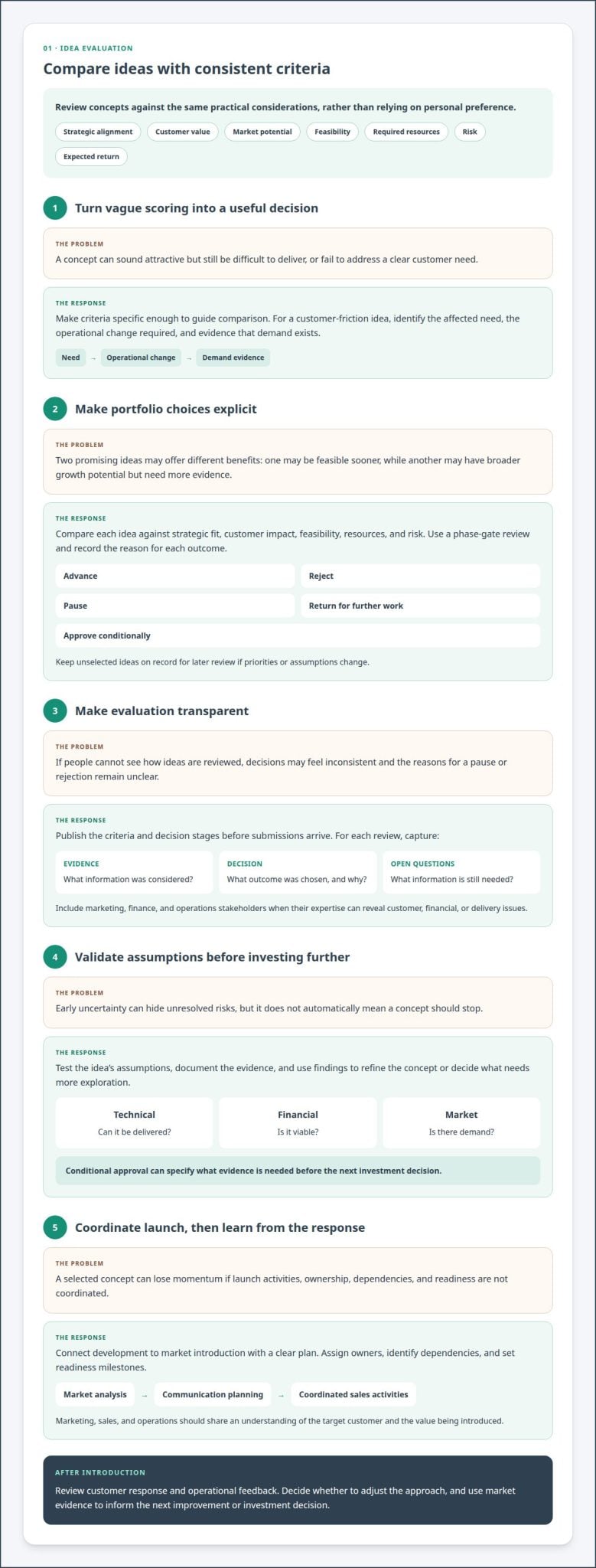
Idea evaluation and selection criteria are the standards used to compare concepts before committing resources. A practical review considers strategic alignment, customer value, market potential, feasibility, required resources, risk, and expected return. Together, these criteria help leaders distinguish promising ideas from attractive concepts that may be difficult to deliver.

Make the criteria specific enough to guide a decision. For example, a concept intended to reduce customer friction should identify the affected customer need, the operational change required, and the evidence that demand exists. A structured idea evaluation process helps reviewers apply the same questions across projects instead of relying on personal preference.

Prioritizing Innovations

Prioritizing innovations means comparing validated ideas with business goals and available capacity, then deciding which should advance. A phase-gate review gives each concept a decision point: advance, reject, pause, return for further work, or approve conditionally. Record the reason for each outcome and define the next step.

Consider two proposals: one improves an existing customer process, while another explores a new market. The first may be feasible sooner; the second may offer broader growth potential but need more evidence. Compare both against strategic fit, customer impact, feasibility, resources, and risk. Keep unselected ideas on record for later review, especially if priorities or assumptions change.

Transparent Evaluation Protocols

Transparent evaluation protocols explain who reviews ideas, which criteria apply, and how decisions are recorded. Publish the criteria and decision stages before submissions arrive. For each review, record the evidence considered, the decision and its rationale, and any information still needed.

Involve marketing, finance, and operations stakeholders when their expertise can reveal customer, financial, or delivery issues. For example, an operations reviewer can identify a workflow constraint before a concept enters development. Consistent records also help employees understand why an idea advanced or paused, supporting experimentation while preserving accountability.

Validate Before Investing Further

Validation tests an idea’s assumptions before a team commits to broader development. Examine technical feasibility, financial viability, and market demand, then record the evidence behind each conclusion. A customer-facing concept, for example, may need evidence of demand alongside an assessment of how it can be delivered.

Use the findings to refine the concept, identify unresolved risks, or return it for further exploration. Conditional approval can specify what evidence is needed before the next investment decision. This keeps the innovation management process evidence-led without treating early uncertainty as an automatic reason to stop.

Coordinate the Launch

A launch plan connects development to market introduction through market analysis, communication planning, and coordinated sales activities. Assign an owner to each activity, identify dependencies, and set readiness milestones. Marketing, sales, and operations should share an understanding of the target customer and the value being introduced.

Before launch, confirm that customer-facing messages reflect the tested value proposition and that delivery teams can support the offer. After introduction, review customer response and operational feedback, then decide whether to adjust the approach. Evaluation does not end at launch: market evidence informs the next improvement or investment decision.

Collecting employee ideas through challenges and open submissions

Employee ideas can come through focused challenges or an always-open channel, providing both targeted and unsolicited input. Common risks include vague prompts, low participation, duplicate submissions, biased screening, and ideas that receive no feedback or ownership.

Ideas-First and Needs-First Approaches

An ideas-first approach starts with a proposed solution, while a needs-first approach starts with a problem employees or customers experience. The distinction matters: a clever suggestion can miss the underlying need, while a clearly defined problem gives contributors room to explore different solutions.

Use open submissions to capture ideas employees notice in everyday work, then ask what problem each addresses. For example, a warehouse employee might suggest a new scheduling tool; follow-up could reveal that shift handoffs, not scheduling, cause delays. Focused challenges work well when leaders can define a need, such as reducing handoff errors or simplifying a service step.

A strong culture makes room for both approaches. Challenges create a shared focus, while open submissions can surface improvements beyond current priorities. Explain the challenge’s purpose, who can contribute, and how ideas will be reviewed. This helps employees connect their experience to organizational needs without forcing every suggestion into a predetermined solution.

Crowdsourced Feedback on Ideas

Crowdsourced feedback gathers reactions, refinements, and expertise from a group of employees rather than leaving screening to one reviewer. It matters because colleagues in different roles may identify implementation barriers or customer effects that the original contributor cannot see.

For useful feedback, present the problem, proposed idea, and specific prompts together. Ask colleagues to identify likely benefits, risks, missing information, or alternatives. A frontline employee may spot a workflow issue, while a customer-facing colleague may flag an unmet need. Make commenting and voting part of a clear evaluation process, not a popularity contest.

Advocacy can strengthen an idea’s case when supporters explain their reasoning and relevant experience. Still, leaders should distinguish enthusiasm from evidence. A screening step can group duplicates, clarify incomplete submissions, and route ideas to people with relevant knowledge. A structured employee ideation program can make participation and feedback part of ongoing improvement.

Recording and Sharing Ideas

Recording ideas means keeping each submission in a shared, searchable record with enough context for follow-up. Without one, ideas can disappear in email threads, meeting notes, or isolated forms, leaving teams unable to revisit useful suggestions.

Capture the problem, proposed change, affected team or customer, expected benefit, and supporting details. Add a status and owner so employees can see whether an idea needs clarification, is under review, or has moved forward. Share submissions with relevant colleagues, keeping discussion focused on useful feedback and next steps.

For example, a facilities team could record a recurring equipment issue and invite staff to suggest ways to reduce disruption. Related submissions can be grouped, discussed, and retained even if no immediate project proceeds. Close the loop by communicating decisions and reasons; otherwise, silence can weaken participation. To see how a digital approach can support this work, explore a guided platform walkthrough.

What is the Innovation Process?

The innovation process moves a concept from a defined opportunity toward development, implementation, and adoption. It gives teams a practical route from strategic intent to action.

Organizations fund and resource innovation projects by aligning them with strategic priorities, assigning people and budget, and releasing additional resources as evidence supports progress. Internal teams, external partners, and staged investment can each contribute, depending on a project’s needs.

Innovation Strategy Development

An innovation strategy defines the opportunities an organization will pursue, the outcomes it wants, and the capabilities it can commit. It matters because leaders must balance near-term improvements with longer-term concepts that could open new markets.

Start by connecting innovation goals to business priorities, such as improving customer experience or operational efficiency. Then clarify which teams, expertise, and funding can support each goal. A portfolio can combine incremental improvements with more exploratory projects, helping leaders avoid spending all available capacity on one kind of opportunity. The distinction between incremental and radical innovation can help frame that balance.

Concept Development and Prototyping

Concept development turns an opportunity into a defined proposal, while prototyping creates a simple representation that supports learning. These steps help teams expose unclear assumptions before committing to full development.

A product concept should identify its intended user, the problem it addresses, and the value it offers. A team exploring a faster service handoff, for example, might sketch the revised workflow before building new systems. Depending on the concept, a prototype could be a sketch, digital simulation, or physical model. Keep it focused on the question the team needs to answer, such as whether users understand the new process.

Concept Testing

Concept testing evaluates assumptions with relevant users, stakeholders, or operational evidence before broader implementation. It helps reveal whether a proposed benefit matters and whether delivery conditions support it.

Choose a test that matches the uncertainty. A customer-facing concept might be assessed through user reactions to its value proposition; an internal process change might be tried with the employees who do the work. Record the response, assumptions tested, and resulting changes. If findings expose a gap, refine the concept and test again rather than treating early feedback as a final verdict.

Innovation Development and Implementation

Development and implementation turn a tested concept into an operating product, service, or process. Even a strong concept needs clear ownership and coordinated delivery to create practical value.

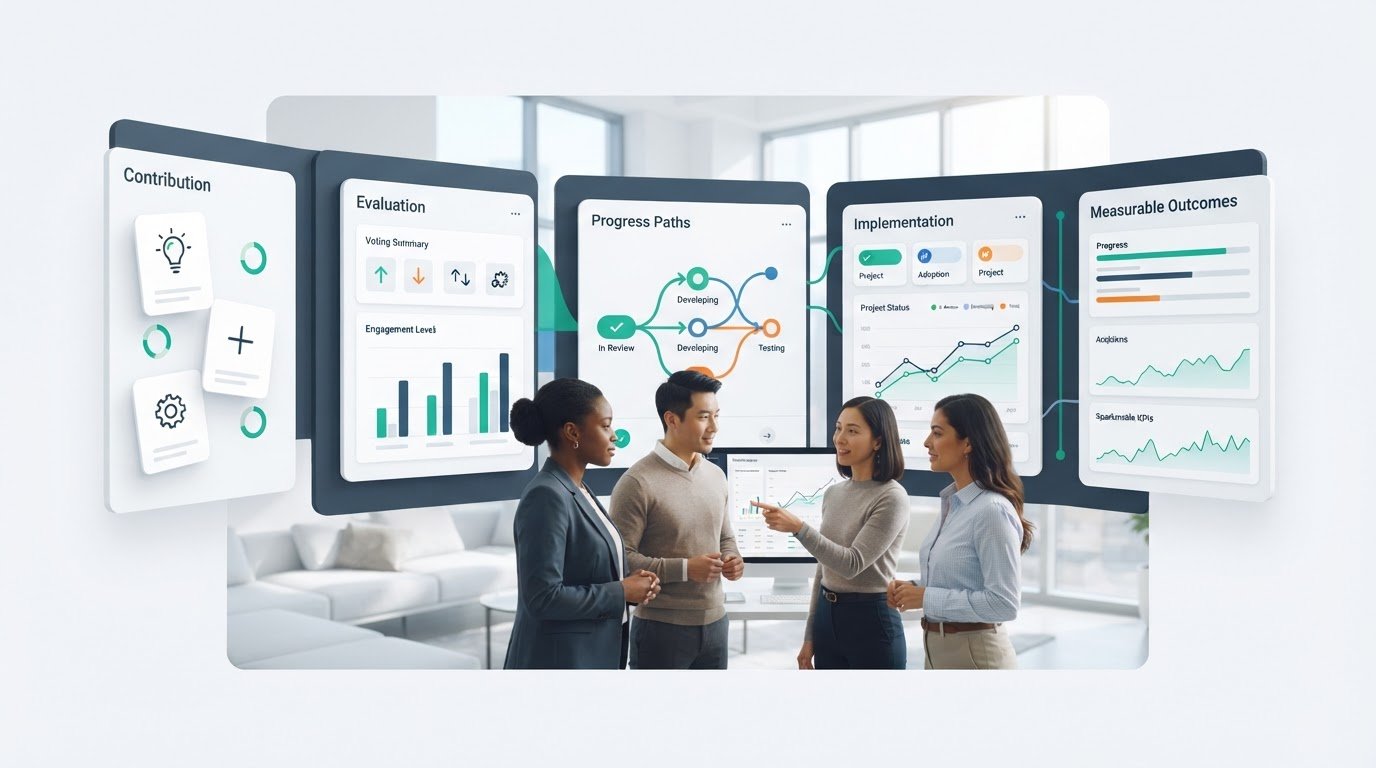
Build an implementation plan that connects development tasks to people, resources, milestones, production needs, and launch activities. For a new service, operations may prepare delivery workflows while marketing develops customer communications. External partners can contribute needed capabilities, with responsibilities agreed before work begins. Track dependencies and unresolved risks, then coordinate the launch across relevant teams. After implementation, use customer and operational feedback to guide improvements and further development.
The Innovation Management Process: A Practical Guide

What is innovation management?

Innovation management connects initiatives to evidence, learning, and measurable outcomes. Common frameworks include Lean Startup’s build-measure-learn loop, design thinking, stage-gate reviews, roadmapping, and idea management.

Innovation Performance Measurement

Innovation performance measurement tracks whether innovation work produces learning and business outcomes. Idea counts alone cannot show whether initiatives solve customer problems or improve operations.

Choose measures that fit each initiative’s goal. A service improvement might track customer satisfaction and process quality, while a new offer might track adoption, revenue growth, or time-to-market. Compare results with the initiative’s original objective, not an unrelated portfolio target.

Review measures at decision points, including after launch. If adoption is weak, examine customer feedback, implementation barriers, and original assumptions before deciding whether to adjust or stop. A consistent approach to measuring innovation programs helps leaders connect project evidence with portfolio outcomes.

Input and Output Metrics

Input metrics measure the resources and activity committed to innovation; output metrics measure what those efforts produce. Track both, because high activity does not automatically mean successful results.

Inputs can include employee participation, ideas submitted, experiments completed, and resources assigned. Outputs can include concepts advanced, projects launched, customer response, revenue growth, or operational improvements. For example, strong participation but few tested concepts may signal a bottleneck between collection and evaluation.

Pair each input with a relevant output, then review the relationship over time. If experiments increase but customer learning does not, teams may need better test questions. If launches occur but adoption remains limited, examine whether the offering addresses an important need. Metrics should prompt investigation, not reward activity without impact.

Innovation Management Tools and Frameworks

Innovation tools and frameworks organize idea capture, experimentation, decisions, and learning. Choose them to fit the uncertainty and delivery needs of each initiative.

Lean Startup uses a build-measure-learn loop: build a testable version, measure how people respond, and use feedback to decide what to change. A team testing a new service feature could release a limited version, observe customer use, and refine the concept. The loop is iterative, allowing teams to revisit assumptions instead of treating a launch as proof of success.

Design thinking helps teams investigate user needs and develop potential solutions. Stage-gate reviews structure decisions between project phases, while roadmaps connect initiatives to strategic priorities. Idea management supports collecting and tracking proposals. Choose a framework based on the challenge: uncertain customer demand calls for testing and learning; a defined operational improvement may need milestones, owners, and delivery measures.

Innovation management in large organizations

Large organizations need shared priorities without centralizing every experiment. Governance, portfolio oversight, and clear ownership connect ideas generated across departments to organization-wide goals.

Accenture reported that 96 percent of executives said long-term success depends on developing new ideas. Accenture also found that 82 percent of respondents did not distinguish meaningfully between significant innovation and incremental performance gains. Its research further reported that 72 percent of companies let innovations languish without a formal process or organizational home. These findings point to a coordination challenge: ideas need sponsors, resources, and decisions. Accenture’s innovation research highlights the need to connect ambition with execution.

Give each initiative an accountable owner and a route to decision-makers. A central innovation lead can coordinate portfolio priorities, while business units assess operational fit and contribute expertise. For example, a customer-service suggestion may need input from operations, IT, finance, and customer-facing teams before it becomes a funded project.

Set governance around decision rights, not layers of approval. Define who can sponsor an idea, assess its fit, allocate resources, and pause work when evidence changes. Use stage reviews for investment decisions, but keep early exploration lightweight. Standardize records and reporting while allowing teams to test solutions suited to their work.

Portfolio oversight helps leaders balance near-term improvements with longer-term opportunities. Review initiatives together, considering strategic fit, expected outcomes, resources, and dependencies. If technology changes customer expectations, revisit priorities instead of protecting projects simply because they already have support. Stopping work that no longer fits frees capacity for stronger opportunities.

Culture matters too. A study by Strategyn involving 393 innovation leaders found recurring innovation problems across nearly every organization studied. Leaders can address ambiguity by defining each initiative’s intended scope and outcome. An operational efficiency project and a new-market exploration effort may both matter, but they need different evidence and review criteria.

Make participation practical across locations and roles. Invite employees to contribute through challenges and ongoing channels, then communicate decisions and next steps. Innovation Leader reported that over 82% of executives in large organizations surveyed had used the Lean Startup Methodology in some way. Experimentation can support learning, but enterprise teams still need clear ownership to turn learning into coordinated action.

For large organizations, the key is to centralize priorities and accountability while distributing exploration and learning. A consistent framework should make it easy to see who owns each initiative, what evidence supports it, and where the next decision lies.

Ideawake

Ideawake offers a cloud-based platform for collecting, evaluating, and implementing ideas. It may be relevant when employee, customer, or partner ideas are spread across teams and need a defined path into innovation initiatives. Its Innovation Management Platform and Idea Management Platform cover stages of the innovation lifecycle, alongside Continuous Improvement and Ideawake AI.

For large organizations, a shared platform can provide a place to capture proposals, involve contributors in evaluation, and track ideas as they progress. Voting, leaderboards, and prizes are possible ways to encourage participation, while structured workflows can help teams handle ideas consistently. These capabilities can support focused innovation efforts as well as ongoing improvement.

Contact Ideawake to discuss whether its platform fits your organization’s innovation processes.

Make the next decision count

Put your innovation management process to work by choosing one business priority that needs fresh thinking. Name an accountable sponsor, define the decision the initiative should inform, and agree on what evidence would justify moving forward. This creates a focused starting point without requiring the entire organization to change at once.

Then make learning visible. Give teams a clear way to share progress, surface barriers, and explain what they need from decision-makers. A useful review helps leaders decide whether to continue, adjust, or redirect effort. That discipline makes innovation a leadership practice, not a side project competing with everyday work.

Ideawake supports organizations with an Innovation Management Platform, an Idea Management Platform, and Continuous Improvement capabilities. If you’re ready to discuss how these offerings could support your organization’s priorities, take the next step.

Start with a meaningful opportunity, learn from the work, and build from there. Progress begins with a decision your teams can act on.

Frequently Asked Questions

Where is the Phase-Gate process used?

Phase-Gate is used to manage projects that need staged reviews and investment decisions. Organizations can apply it to product development or operational improvements when work can be divided into stages with evidence reviewed at each decision point. A team may advance a concept, pause it for more evidence, recycle its assumptions, or stop it. The approach is most useful when leaders need explicit control over commitments and clear accountability at each gate.

What is the innovation management process?

The innovation management process is the coordinated way an organization develops promising ideas into implemented changes. It connects opportunities to business priorities, assigns ownership, and gives teams a way to learn from evidence. For example, an operations leader could use it to move a recurring service issue from employee observation to a tested process change. Its value lies in making innovation work visible and actionable, not merely collecting suggestions.

What are the key stages of an innovation management process?

Key stages typically include generating ideas, selecting and evaluating them, developing concepts, implementing solutions, and introducing them to users or markets. Teams may revisit stages when new evidence changes an assumption. For example, customer feedback during a limited release could send a concept back for refinement. The sequence gives leaders a shared map while allowing initiatives to move at different speeds based on uncertainty and delivery needs.

How do organizations generate and prioritize innovation ideas?

Organizations generate ideas through employee submissions, focused challenges, customer input, and collaboration with external partners. To prioritize them, leaders can compare each proposal with strategic goals, customer or operational needs, feasibility, resource demands, and potential risk. For example, a service team may rank suggestions by how directly they address a recurring customer problem. Keep lower-priority proposals on record so teams can reconsider them when conditions or priorities change.

How do companies evaluate the feasibility and business value of innovations?

Companies assess feasibility by examining whether a concept can be delivered with available technical capabilities, operational capacity, and resources. They assess business value by considering strategic fit, customer benefit, market demand, and expected returns. A proposal to simplify a service process, for instance, should address both user value and the team’s ability to implement it. Record assumptions separately from supporting evidence so decision-makers can identify what still needs testing.

How are innovation projects tested, developed, and launched?

Teams test a project’s riskiest assumptions using a method suited to the concept, such as a sketch, simulation, pilot, or limited release. They use feedback to refine requirements before broader development. During implementation, assign owners for delivery, operations, and communications. Before launch, confirm that the product or process is ready for its intended users. Afterward, review actual use and feedback to identify adjustments, support needs, or further opportunities.

What metrics measure innovation management performance?

Useful measures connect innovation activity to learning and outcomes. Input indicators can include participation, submissions, experiments, and resources committed; output indicators can include concepts tested, projects implemented, customer response, time-to-market, revenue growth, or operational improvement. Select measures based on each initiative’s objective. For example, a process-improvement effort should track its targeted operational result, not rely only on how many ideas employees submitted.

How does innovation management differ across industries and company sizes?

Innovation management varies with customer needs, operating conditions, project risks, and organizational structure. A manufacturer may emphasize production feasibility, while a service organization may focus on customer experience and workflow changes. Smaller organizations may coordinate decisions through fewer roles; larger enterprises often need clearer governance across departments. In either setting, adapt review steps and evidence requirements to the initiative while keeping ownership, decision criteria, and outcomes clear.
Article by

Coby Skonord

Coby Skonord is the co-founder and CEO of Ideawake. Since 2013 he has worked with enterprise innovation, continuous improvement, and HR leaders to turn employee ideas into measurable business impact.

Gamification Innovation Software: Turn Participation Into Measurable Progress

Gamification Innovation Software: Turn Participation Into Measurable Progress
Coby Skonord|
September 27, 2026

What if the best measure of gamification isn’t how many people earn points, but how many ideas make it into practice? Gamification innovation software can make it easier to contribute, but points and prizes alone won’t show whether an idea is useful or what happens after submission.

Organizations often face the same challenges: participation fades, contributors don’t hear how their ideas progress, and activity metrics look healthy without showing business impact. The answer isn’t to remove game mechanics. It’s to connect them to a clear innovation process, so recognition encourages meaningful contributions and helps ideas move forward.

This article explains how to evaluate gamification innovation software, choose mechanics that fit your goals, and assess engagement alongside idea quality and realized value. You’ll also learn what to look for in a platform that connects idea submission, evaluation, implementation, and outcome tracking. The goal is to reward participation in ways that support progress, not just leaderboard activity.

Key Takeaways

  • Evaluate gamification innovation software by how well it supports idea progression, not just participation and rewards.
  • Use voting to surface interest, then apply clear evaluation criteria to guide decisions.
  • Compare platforms on workflow coverage, reporting, evaluation tools, and administrative effort.
  • Set transparent rules for eligibility, ownership, and follow-up before launching a challenge.
  • Track engagement alongside idea quality, implementation progress, and outcomes to understand what the program achieves.

What Gamification Innovation Software Does Beyond Points and Prizes

Gamification innovation software applies game mechanics, such as voting, recognition, or rewards, to a structured process for submitting, evaluating, and advancing ideas. Gamification can make participation more engaging, but it isn’t the innovation workflow itself. A contest may attract entries; a complete program also clarifies how ideas are reviewed, selected, implemented, and followed up. The broader concept of gamification covers game-design techniques used outside games. In an innovation program, those techniques should support progress toward a business question, not become the goal.

Activity and outcomes are different measures. Submission counts, comments, and votes show whether people are participating, but they don’t establish whether ideas are feasible, selected, or implemented. To understand a program’s value, assess contributions and track what happens to them after the initial activity.

Which innovation challenges does gamified software address?

Employees may hesitate to contribute when a challenge prompt is unclear, feedback is limited, or their idea disappears after submission. Software can make the process more visible by showing an idea’s status and communicating what comes next, such as discussion, evaluation, or a decision. This helps contributors understand what to expect and gives them a reason to stay involved. Gamification may encourage participation, but it can’t guarantee more ideas or stronger outcomes. Those depend on the challenge, review process, and follow-through.

Which capabilities belong in an innovation software platform?

A useful platform supports distinct stages rather than treating every action as a score. Idea submission captures contributions in response to a defined prompt. Comments let people clarify or build on ideas. Voting can surface interest, while structured evaluation applies consistent criteria. Decision-making identifies which proposals move forward, and implementation tracking records progress after selection.

Leaderboards and prizes are optional participation mechanics. They can recognize contributions, but they shouldn’t replace fair evaluation or give popularity the final say. A highly voted idea, for example, may still need review for feasibility, strategic fit, or expected value. The right innovation management platform connects engagement features to the broader workflow and helps administrators see where ideas stand, who owns the next step, and whether selected ideas are progressing. That’s the difference between rewarding activity and managing innovation.

How Gamification Mechanics Work Across an Innovation Workflow

Consider a challenge asking employees how to reduce delays in a routine process. A gamified program can make each step visible, but the mechanics should serve the work. The prompt gives people a clear focus, submissions capture suggestions, and discussion helps clarify how an idea might work. Reviewers then assess proposals against agreed criteria, make a decision, and communicate what happens next.

Engagement signals show how people interact with a program; validated innovation outcomes show which ideas were selected, implemented, and produced measurable value. This distinction keeps gamification innovation software from mistaking clicks or votes for proof of impact. It also anchors the program in a practical definition of innovation: ideas must progress toward useful change, not simply attract attention.

How do voting, leaderboards, and prizes affect participation?

Voting can reveal which suggestions resonate with peers and help reviewers spot ideas worth examining. It can’t establish feasibility, strategic fit, or business value. Leaderboards offer visible recognition, but set clear rules for what earns recognition and don’t let rankings dictate which ideas advance. Prizes are optional incentives. Use them only when they support the challenge’s purpose and don’t overshadow thoughtful contributions.

How does feedback keep contributors engaged after submission?

A status update can tell a contributor whether an idea is under review, needs clarification, has been selected, or won’t proceed. A brief explanation of the decision adds context and helps make the process credible. Assign someone to review submissions and communicate next steps, so follow-up doesn’t depend on informal reminders. Teams considering a gamified innovation platform can also consider how competition may shape participation while keeping evaluation grounded in consistent criteria.

Keep the mechanics tied to the challenge. If the goal is to improve a process, recognize useful collaboration and thoughtful proposals, not just high submission volume. Then track selected ideas through implementation and review outcomes against the original business question. To see how a platform can support this kind of idea workflow, explore an Ideawake platform walkthrough.

How to Evaluate Gamification Innovation Software Without Rewarding Activity Alone

A platform can generate submissions, votes, and leaderboard activity without helping an organization understand which ideas advance or why. Evaluate gamification innovation software by whether it supports participation and the work that follows: review, decisions, implementation, and measurement. The right fit makes progress visible without treating activity as a proxy for value.

Which engagement and workflow criteria should buyers compare?

Start with the program you plan to run. Check whether the software can present focused challenge prompts, collect submissions, support discussion and voting, and communicate updates. Then consider who needs to participate, whether the process is accessible to those contributors, and how much effort administrators will spend managing activity and follow-up. Choose a platform that fits the stakeholders and formats your organization actually expects to use.

Use a comparison table to assess vendors against the same requirements:

Criterion What to assess Useful question
Mechanics Voting, recognition, leaderboards, or prizes Can mechanics be aligned with program goals?
Workflow coverage Submission through decision and implementation Can teams see an idea’s status after it’s submitted?
Evaluation Criteria and review steps Can reviewers assess ideas consistently beyond popularity?
Reporting Participation, progress, and outcomes Can reports distinguish activity from implementation?
Administration Ownership, updates, and program setup Can the team manage the process and communicate next steps?

For a broader selection framework, see this guide on how to choose innovation management software.

How can buyers assess reporting and measurable outcomes?

Ask for a walkthrough of the reporting process, not just a dashboard preview. Can the team distinguish submissions and participation from evaluation progress, decisions, and ideas implemented? Can it record the measures your organization uses to assess results, such as adoption or realized value? Confirm who can access that information and how administrators can follow an idea through its lifecycle.

Keep the measures separate. Participation indicates engagement; evaluation records how ideas fare against criteria; adoption and realized value reflect what happens after a decision. Software can help organize this evidence, but a reported outcome alone doesn’t prove that a leaderboard, prize, or other mechanic caused it. Compare results with your program’s goals and context before drawing conclusions. This helps keep evaluation focused on progress, not just activity.

How to Design a Gamified Innovation Program That Stays Fair and Useful

A fair program starts before anyone earns points. Define the business question, decide how ideas will be handled, and make the rules visible before inviting people to participate. This gives contributors a clear reason to engage and reviewers a consistent basis for decisions. Gamification innovation software can support the process, but program governance determines whether participation leads to useful progress.

How should an organization set challenge goals and participation rules?

Use a focused rollout that connects the challenge to a real organizational need:

  1. Define the business question. State the problem to solve and what kinds of ideas are in scope. For example, ask for ways to reduce handoffs in a particular process rather than inviting ideas on an undefined topic.
  2. Set rules before launch. Explain who can participate, what submissions should include, whether and how voting works, and how recognition will be awarded. Publish the review criteria, timeline, and decision owner so contributors know what to expect.
  3. Launch a focused challenge. Use a prompt that makes the desired contribution clear. Choose recognition mechanics that fit the purpose, and avoid implying that participation or submission guarantees selection or a prize.
  4. Review consistently. Assign reviewers in advance and apply the stated criteria to submissions. Peer interest may inform review, but it shouldn’t replace evaluation.
  5. Communicate and learn. Share decisions and next steps, then review both participation and workflow progress. Look at who contributed and how ideas advanced, separately from implementation and realized value.

How can teams review ideas and close the feedback loop?

Before submissions arrive, identify who screens ideas, who evaluates them, and who communicates decisions. Consistent idea evaluation criteria help reviewers explain why a proposal advances, needs clarification, or isn’t selected. Give contributors a status update and a concise explanation, including when the answer is no. Clear follow-up respects the effort people invested and helps them understand how to participate in future challenges.

After the review, check whether the program followed its published rules, whether contributors received updates, and where ideas stand in the workflow. Treat submissions, votes, and comments as participation measures. Track evaluation decisions and implementation separately, then compare results with the business question the challenge was designed to address. This keeps a lively program accountable without claiming that activity alone proves impact.

Where Ideawake Fits in a Gamified Innovation Software Strategy

Once you’ve defined what your program needs from its mechanics, workflow, administration, and measurement, assess platforms against those criteria. Ideawake is one option to consider: its cloud-based innovation management software supports idea capture, evaluation, and implementation, with gamification features to support participation in challenges and other idea programs.

Voting, leaderboards, and prizes can encourage participation, but their value depends on how they fit the broader process. Ideawake supports the innovation lifecycle from initial submission through ROI measurement, helping teams consider not just engagement but also how ideas progress and what results they deliver. For a broader overview of platform capabilities and selection considerations, explore this guide to an innovation management platform.

How does Ideawake connect engagement with idea progression?

Teams can use voting to surface peer interest, leaderboards to recognize participation, and prizes as an optional incentive within an innovation challenge. These mechanics sit alongside idea evaluation and implementation support rather than replacing them. Ideawake also includes AI-driven insights. Organizations can assess how those capabilities fit their review and measurement needs as part of their platform evaluation.

For buyers, the practical question is whether a platform can support the stages their program requires and make progress visible to the people involved. Consider how ideas are captured, how evaluation is managed, and how teams can follow selected proposals toward implementation and ROI measurement. This end-to-end view keeps gamification innovation software focused on advancing ideas, not simply recording activity.

What should teams clarify before evaluating a platform demo?

Bring a real challenge to the conversation. Identify the intended participants, the problem the challenge should address, and the obstacles in your current process. Then ask how the platform could support review ownership, contributor updates, and the outcomes your organization wants to measure. Specific questions make it easier to judge practical fit rather than relying on a feature list.

If the workflow and capabilities align with your requirements, examine how they could support your program in practice.

Turn Engagement Into Ideas That Move Forward

Effective gamification innovation software connects participation to a well-managed idea process. Voting, leaderboards, and prizes can encourage involvement, but they shouldn’t replace clear evaluation, accountable follow-up, or outcome measurement. Track engagement alongside idea quality, implementation progress, and realized value to see whether your program is creating meaningful progress.

Ideawake supports the innovation lifecycle from idea submission through ROI measurement, with gamification features including voting, leaderboards, and prizes. Assess how those capabilities fit your goals, workflows, and contributors, then build a program that makes the next step clear.

Start with one focused challenge, set transparent expectations, and give promising ideas a clear path forward. Your next useful idea could begin with a better invitation to participate.

Frequently Asked Questions

What is gamification innovation software?

Gamification innovation software applies game mechanics, such as voting, recognition, or prizes, to a structured idea process. It can encourage people to participate in challenges and contribute suggestions, while the broader workflow supports reviewing, selecting, and implementing ideas. A leaderboard or reward campaign alone isn’t a complete innovation process. Look for tools that connect participation features to the stages ideas must pass through to produce useful change.

Does gamification improve employee innovation?

Gamification can encourage participation, but it doesn’t guarantee more ideas or better innovation outcomes. Its usefulness depends on a clear challenge, mechanics that fit the goal, and feedback about what happens to submitted ideas. Voting may show which suggestions attract interest, for example, while reviewers still need to assess feasibility and value. Judge the program by engagement and idea progress, not activity counts alone.

Which gamification features should innovation software include?

Choose features that suit your workflow rather than selecting mechanics for their novelty. Useful capabilities may include challenge prompts, idea submission, discussion, voting, and status updates, supported by evaluation and implementation tracking. Leaderboards and prizes can provide optional recognition, but they shouldn’t replace consistent review criteria. Reporting should distinguish participation from decisions and implemented ideas, while administration tools should make it practical to manage reviews and communicate next steps.

Can leaderboards make an idea program less fair?

Yes. Leaderboards can make a program feel less fair if rankings determine which ideas advance or reward only visible activity. Popularity may reflect peer interest, but it doesn’t establish feasibility, strategic fit, or business value. Set clear rules for what the leaderboard recognizes, explain how votes will be used, and keep idea evaluation separate. Reviewers should apply consistent criteria so quieter contributors and less widely supported ideas still receive appropriate consideration.

How do you measure ROI from gamified innovation software?

Measure ROI by tracking selected ideas through implementation and assessing their results against the organization’s chosen business measures. Keep that evidence separate from engagement indicators such as submissions, comments, or votes. A high vote count shows interest, not realized value. Define how outcomes will be recorded before launching the program, and avoid assuming that a software report proves a game mechanic caused a business result.

Is gamification software the same as idea management software?

No. Gamification describes the use of mechanics such as voting, leaderboards, and prizes to encourage participation. Idea management software supports capturing and evaluating ideas, and may also help teams follow them toward implementation. A platform can include both, but the terms describe different things: one refers to engagement techniques, the other to managing ideas. Assess whether the software connects those mechanics to the workflow your program needs.

How do you choose gamification innovation software?

Start by defining the challenge, intended participants, and steps ideas must follow from submission through decision and implementation. Then compare gamification innovation software on workflow coverage, evaluation, contributor updates, reporting, and administrative effort. Ask how it separates engagement metrics from implemented ideas and realized value. A practical demonstration using a real challenge can help your team assess whether the mechanics and workflow fit its goals.

Article by

Coby Skonord

Coby Skonord is the co-founder and CEO of Ideawake. Since 2013 he has worked with enterprise innovation, continuous improvement, and HR leaders to turn employee ideas into measurable business impact.

How to Measure Innovation Culture: A Data-Driven Guide for Enterprise Leaders

How to Measure Innovation Culture: A Data-Driven Guide for Enterprise Leaders
Coby Skonord|
July 6, 2026

Innovation culture is not a “feeling” your HR team surveys once a year; it is the measurable efficiency with which your organization converts raw human potential into implemented ROI. Most enterprise leaders understand that a stagnant culture kills growth, yet they struggle to prove it to a skeptical board when the only data available comes from low-participation suggestion boxes. It’s difficult to justify cultural initiatives when you can’t connect them to the bottom line. This guide provides the exact framework you need to learn how to measure innovation culture using hard data that turns subjective sentiment into a concrete driver of performance. A 2026 global survey revealed that 21 new entrants joined the list of the Top 100 global innovators, proving that the competitive landscape is shifting rapidly for those who can’t quantify their creative output. You’ll gain a repeatable audit process and the specific KPIs required to prove that cultural shifts lead directly to higher implementation rates. We’re moving beyond “vibes” to establish an evidence-driven system that secures your competitive advantage.

Key Takeaways

  • Move beyond subjective “vibes” by defining innovation culture as a set of observable behaviors that directly accelerate your idea-to-value lifecycle.
  • Learn how to measure innovation culture by distinguishing between leading indicators like psychological safety and lagging indicators like financial ROI.
  • Execute a repeatable five-step audit process to map your organization’s idea journey and identify the specific friction points that stall progress.
  • Discover why shifting from spreadsheets to a dedicated innovation management platform is a critical step in scaling a high-performance culture.
  • Use AI-powered tools to eliminate the “culture tax” of manual administration and provide the real-time visibility required for executive buy-in.

Defining Innovation Culture: Why “Vibes” Aren’t Enough in 2026

Innovation culture is often mistakenly reduced to employee perks or creative office layouts. In reality, it’s the specific set of organizational behaviors that either accelerate or obstruct the journey from a raw concept to realized market value. As we move through 2026, the era of “theatrical innovation,” characterized by aesthetic brainstorming sessions and sticky notes, has ended. Enterprise standards now demand structural innovation. This requires moving toward data-backed systems that treat culture as a measurable asset rather than an abstract feeling. Understanding how to measure innovation culture involves adopting “Innovation Accounting,” a framework that bridges the gap between cultural health and financial performance. By grounding these efforts in the principles of innovation management, leaders can stop relying on intuition and start calculating impact.

The Financial Risk of an Unmeasured Culture

When culture remains unmeasured, organizations suffer from “innovation leaks.” These are the critical points where high-value ideas perish due to middle management bottlenecks or a lack of clear feedback loops. This isn’t just a morale issue; it’s a significant financial drain on the organization. Research into the benefits of employee ideation programs shows that structured engagement reduces turnover and optimizes operational efficiency. Without measurement, you also risk funding “zombie projects.” These are initiatives that persist purely because the culture lacks the psychological safety to admit failure and cut losses. A measured culture provides the data necessary to kill these drains on resources before they impact the bottom line.

Innovation as an Outcome of Internal Systems

Think of your culture as the “operating system” and your digital tools as the hardware. High-performance hardware is useless if the underlying OS is riddled with bugs. To fix this, leaders must distinguish between creativity vs. innovation. Creativity is the act of generating ideas. Innovation is the successful implementation of those ideas to create tangible value. Truly knowing how to measure innovation culture involves auditing the systems that support this transition. This requires a structured idea submission process that tracks every concept from inception to impact. When the process is visible and structured, culture becomes a predictable engine for growth rather than a series of happy accidents.

The 3 Core Pillars of a Measurable Innovation Culture

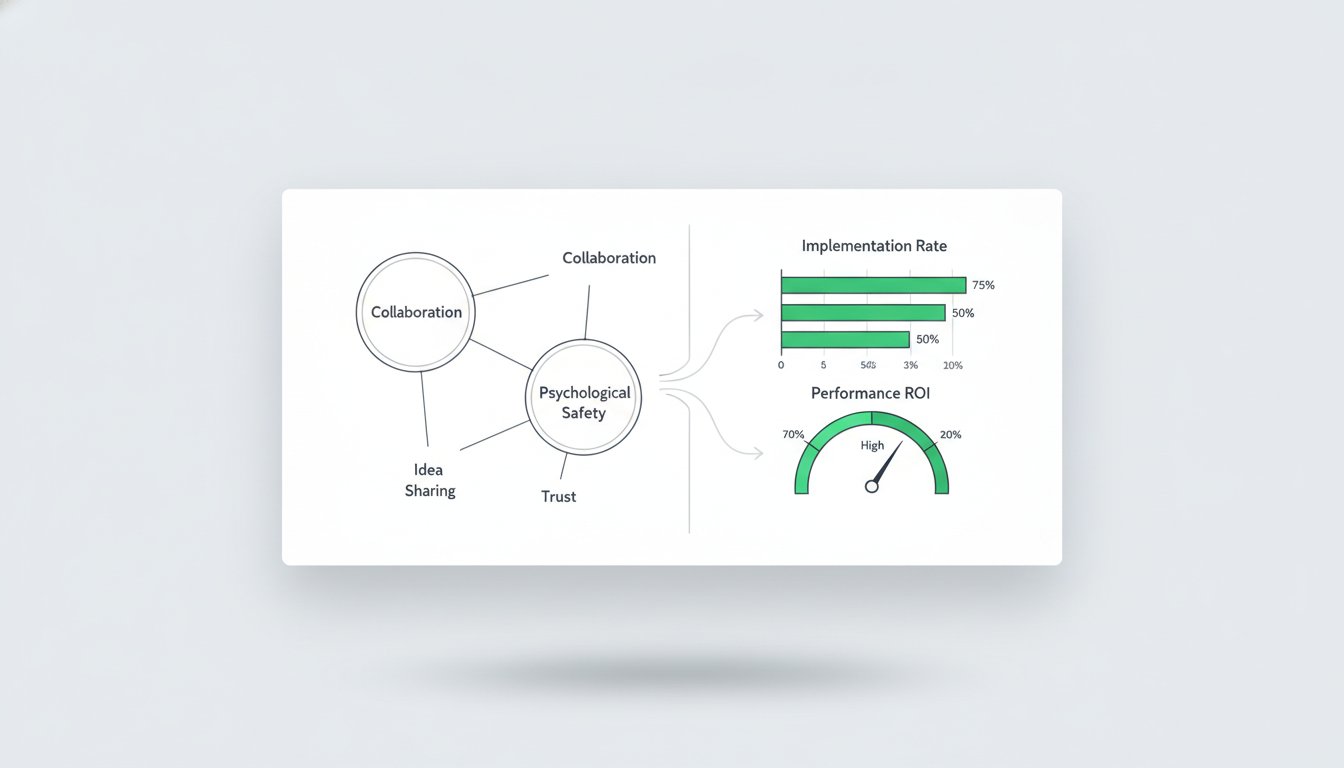
Culture is not a monolith. It is a high-performance engine built on three quantifiable pillars that dictate your organization’s ability to evolve. When enterprise leaders ask how to measure innovation culture, they must look beyond employee satisfaction scores. You need to analyze the specific behaviors that drive the High-Performance Innovation Loop: the continuous cycle of ideation, validation, and implementation. Without these pillars, your innovation strategy is just a collection of expensive slides. By measuring psychological safety, resource accessibility, and leadership responsiveness, you transform culture into a predictable driver of ROI.

Measuring Psychological Safety and Risk Tolerance

Psychological safety is the bedrock of any creative organization. It is not about being “nice”; it is about the freedom to fail without career-ending repercussions. We track this through the “Failure Rate” as a positive cultural metric. In a healthy ecosystem, innovation failures are not sunk costs; they are high-value learning data points that prevent future mistakes. Psychological safety is the primary predictor of success for both incremental vs. radical innovation. If your team only submits “safe” ideas, your culture is effectively stalled. You must measure the frequency of “risky” or “radical” ideas submitted to gauge the true level of trust within your workforce.

Resource Accessibility and the “20% Time” Myth

Intent is nothing without access. Many firms claim to support new ideas but provide zero budget or time for employees to explore them. Google’s 20% time program serves as a legendary benchmark for resource allocation, yet many enterprises fail to implement the underlying mechanics. To truly understand how to measure innovation culture, you must track “Time-to-Resource” as a critical KPI. This measures how quickly a validated idea receives the necessary funding or headcount. This prevents the stagnation found in the 8 forms of lean waste, specifically the waste of underutilized human talent. If your team cannot access resources without a 12-month committee review, you don’t have an innovation culture; you have a bureaucracy.

Leadership responsiveness completes the loop. Transparency in decision-making builds the trust required for high-volume participation. If feedback takes six months, the momentum dies. Measuring the velocity of the “Yes/No” decision is critical for cultural health. If you want to see how these metrics look in a real-world environment, schedule a platform walkthrough to explore our data-driven dashboards.

Quantitative vs. Qualitative: Choosing Your Innovation Metrics

Distinguishing between what we can count and what we can feel is the most significant challenge when determining how to measure innovation culture. Leading indicators act as early warning systems, predicting future success based on current engagement levels. These include the volume of active contributors and the frequency of structured sessions like reverse brainstorming. Conversely, lagging indicators such as implementation rates and time-to-market reflect the historical performance of your systems. A 2026 European benchmark study of over 100 innovation teams is currently formalizing these KPIs to help organizations move from activity-based reporting to impact-based results. A holistic “Culture Scorecard” weights these metrics to ensure that high activity actually translates into commercial value.

Hard Metrics: Participation Rates and Pipeline Velocity

Soft Metrics: Sentiment Analysis and Collaborative Diversity

A 5-Step Process to Audit Your Organization’s Innovation Health

Enterprise leaders often get lost in the theoretical “how” of cultural transformation. To master how to measure innovation culture, you need a repeatable audit process that exposes the hidden friction in your operations. This audit isn’t a one-time event; it is a systematic review of how ideas flow or stall within your existing hierarchy. By following a structured five-step approach, you can identify precisely where your organization is leaking value. It’s about moving from anecdotal evidence to a rigorous, data-driven assessment of your innovation health.

  • Step 1: Establish a Baseline. Run a blinded cultural assessment to identify perceived bottlenecks.
  • Step 2: Map the Idea Journey. Track a single concept from the initial employee suggestion through to implementation.
  • Step 3: Analyze Collaborative Reach. Measure the depth of cross-departmental involvement in a single project.
  • Step 4: Audit Feedback Loops. Calculate the Mean Time to Feedback (MTTF) provided by management.
  • Step 5: Review Implementation Success. Compare the rate of implemented ideas against baseline cultural sentiment scores.

Establishing a Baseline with Employee Surveys

The first step requires radical honesty. You must ask questions that target “permission to fail” and “clarity of strategy.” For example, ask employees if they feel safe proposing an idea that contradicts current business units or if they understand the specific criteria for a “winning” project. It’s also vital to assess innovation skills alongside attitude. A willing team without the right skills will still fail to execute. This baseline measurement provides the starting point for the phases of continuous improvement, ensuring you aren’t building on a fractured foundation.

Analyzing the Idea Pipeline for Cultural Friction

Once you have a baseline, you must look at the pipeline itself. Ideas frequently stall during the idea evaluation process because of opaque decision-making or excessive bureaucracy. This is where the “Innovation Friction Coefficient” comes into play. The Innovation Friction Coefficient is the ratio of submitted ideas to those that receive a formal evaluation. High friction indicates a culture that discourages participation through silence. Utilizing a centralized idea management database makes this audit possible by providing a single source of truth for every interaction. It allows you to see where momentum dies and which managers are acting as catalysts rather than gatekeepers.

Auditing these five steps reveals the true state of your organization’s creative health. If your MTTF is over 30 days, your culture will inevitably stagnate regardless of your vision. If you’re ready to stop guessing and start measuring these metrics in real-time, schedule a platform demo to see our automated audit dashboards in action.

Scaling Culture with Modern Innovation Management Platforms

Scaling a high-performance culture across a global enterprise is impossible when using manual, disconnected tools. The decision between Ideawake vs. Spreadsheets is more than a technical preference; it’s a critical cultural choice. Spreadsheets are static and siloed, often acting as the place where engagement and visibility go to die. In contrast, a modern platform provides the transparency required to understand how to measure innovation culture at every level of the hierarchy. By automating the administrative burden, AI tools for innovation managers eliminate the “culture tax” that often prevents middle management from buying into new initiatives. To ensure long-term adoption, deep integrations with existing communication stacks keep innovation within the daily workflow, making participation as natural as sending a message.

Leveraging AI for Real-Time Cultural Mapping

Implementation: Moving from Data to Action

Transitioning to a data-driven system requires a clear implementation roadmap. It begins with setting specific baseline KPIs and then rolling out the platform to pilot groups to gather initial sentiment data. The ultimate goal is to foster the kind of environment that produced the 10 innovative product examples that have defined market leadership in recent years. Culture is a powerful competitive edge, but it requires a modern platform to sustain and scale. If you’re ready to stop managing innovation through guesswork and start seeing the hard data behind your creative output, sign up for a demonstration to see your cultural metrics in action.

Transforming Cultural Insight into Measurable Performance

The era of treating organizational culture as a nebulous “vibe” has been replaced by a demand for rigorous, evidence-based management. You now have the framework to move beyond subjective surveys and implement a system where psychological safety and resource accessibility are tracked with the same precision as financial OpEx. By mastering how to measure innovation culture, you empower your organization to identify “innovation leaks” and bridge the gap between raw creativity and realized market value. Success in the competitive environment of 2026 requires more than just good intentions. It demands an infrastructure that makes the intangible tangible. Ideawake is trusted by enterprise leaders to manage the full innovation lifecycle by providing built-in AI sentiment analysis for cultural health tracking. With proven ROI measurement tools for C-suite reporting, you can finally demonstrate the direct link between cultural health and the bottom line. It’s time to stop guessing and start leading with data.

Ready to see your innovation metrics in real-time? Book a demo of Ideawake today.

Your organization’s untapped potential is waiting for a system that can finally prove its value. By taking these steps, you aren’t just measuring a culture; you’re building a resilient engine for future growth.

Frequently Asked Questions

Is innovation culture really measurable or is it just a buzzword?

Innovation culture is a measurable asset defined by observable behaviors rather than a vague corporate buzzword. You can quantify it by tracking specific interactions within your idea pipeline, such as the frequency of cross-departmental contributions and the speed of resource allocation. When you treat culture as a data set, you move from subjective sentiment to objective performance tracking that identifies exactly where your organization is leaking potential.

What are the most important KPIs for measuring innovation culture?

The most effective KPIs for determining how to measure innovation culture include leading indicators like the percentage of active contributors and the volume of radical versus incremental ideas. You should also track lagging indicators such as your idea conversion rate and the total ROI per implemented project. These metrics provide a holistic view of your innovation health by connecting employee engagement directly to financial outcomes.

How often should an organization audit its innovation culture?

Organizations should perform deep-dive audits annually while maintaining real-time pulse checks through their innovation management platform. Continuous data collection allows you to spot cultural friction as it happens rather than waiting for a yearly report to reveal a drop in engagement. This proactive approach ensures your innovation engine remains optimized and your teams stay aligned with strategic business objectives throughout the fiscal year.

Can software like Ideawake actually improve our company culture?

Software provides the necessary infrastructure to scale the behaviors you want to see in your organization. Ideawake improves culture by providing a transparent, meritocratic environment where every employee sees their ideas evaluated through a structured, bias-free process. This visibility builds the trust required for high-volume participation and eliminates the administrative bottlenecks that typically discourage employees from sharing their best concepts.

What is the difference between an engagement survey and an innovation culture audit?

Engagement surveys measure general employee satisfaction and morale, whereas an innovation culture audit measures the efficiency of your idea-to-value lifecycle. While an employee might be happy at work, they may still feel the organization is too risk-averse to support new initiatives. An audit specifically targets the systems, feedback loops, and resource access points that dictate your company’s actual capacity for change and growth.

How do we measure psychological safety in a corporate environment?

You can measure psychological safety by analyzing the ratio of “risky” or radical ideas submitted compared to safe, incremental suggestions. Another critical metric is the participation rate following a failed project; if engagement drops after a failure, it indicates a lack of safety. High-performance cultures show steady participation levels because employees know that well-managed risk is a valued part of the learning process.

Should we reward employees for ideas that fail?

You should reward the rigor of the process and the data gathered rather than the failure itself. Celebrating the “smart failure” of a well-tested hypothesis encourages risk-taking and helps kill zombie projects before they drain excessive resources. This cultural shift ensures that employees focus on high-impact experimentation without fear of career repercussions, which is a core component of how to measure innovation culture effectively.

How do we connect cultural metrics to financial ROI?

Connecting culture to ROI requires tracking how improvements in engagement and feedback velocity lead to higher implementation rates. By reducing your “Innovation Friction Coefficient,” you increase the volume of ideas that reach the market, which directly impacts your bottom line. Use an ROI calculator to assign dollar values to the time saved through automated triage and the revenue generated from employee-led continuous improvement initiatives.

Article by

Coby Skonord

Coby Skonord is the co-founder and CEO of Ideawake. Since 2013 he has worked with enterprise innovation, continuous improvement, and HR leaders to turn employee ideas into measurable business impact.