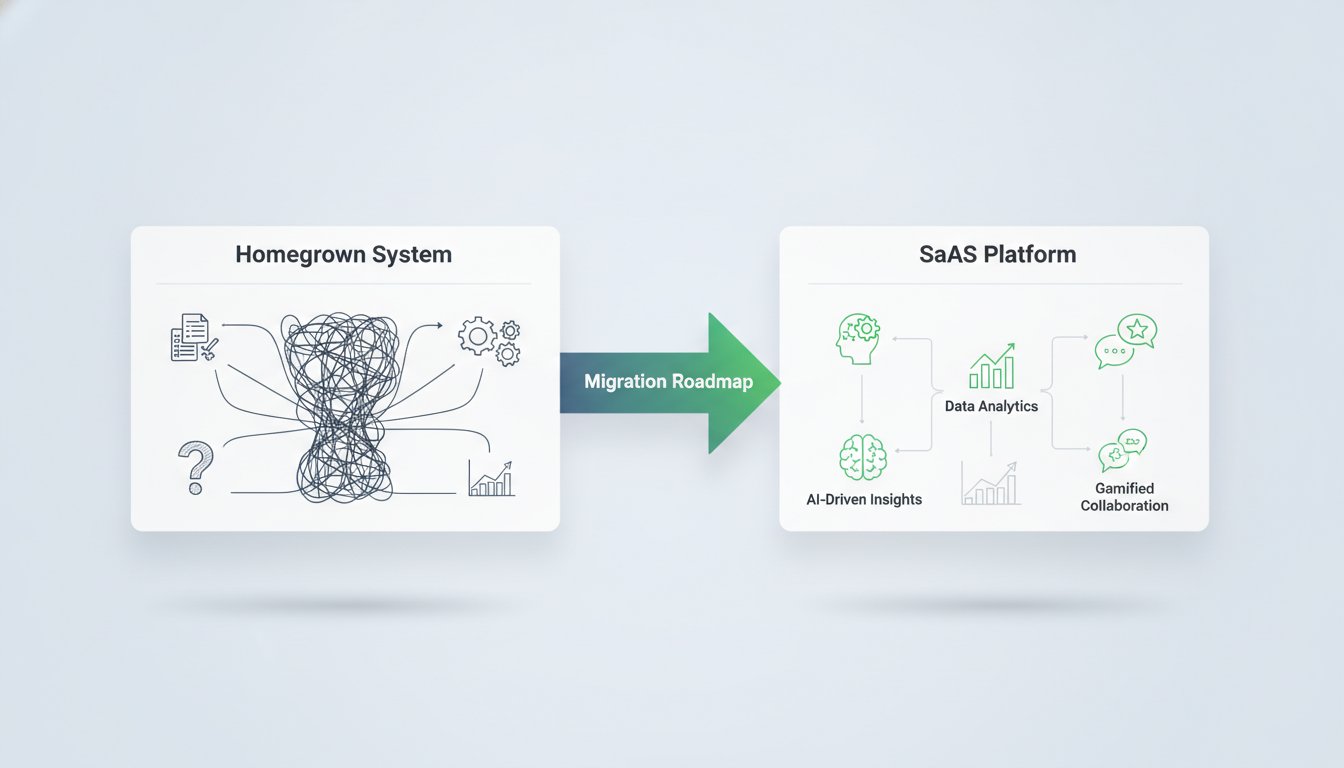
Tag Archives: innovation management

The Innovation Management Process: A Practical Guide

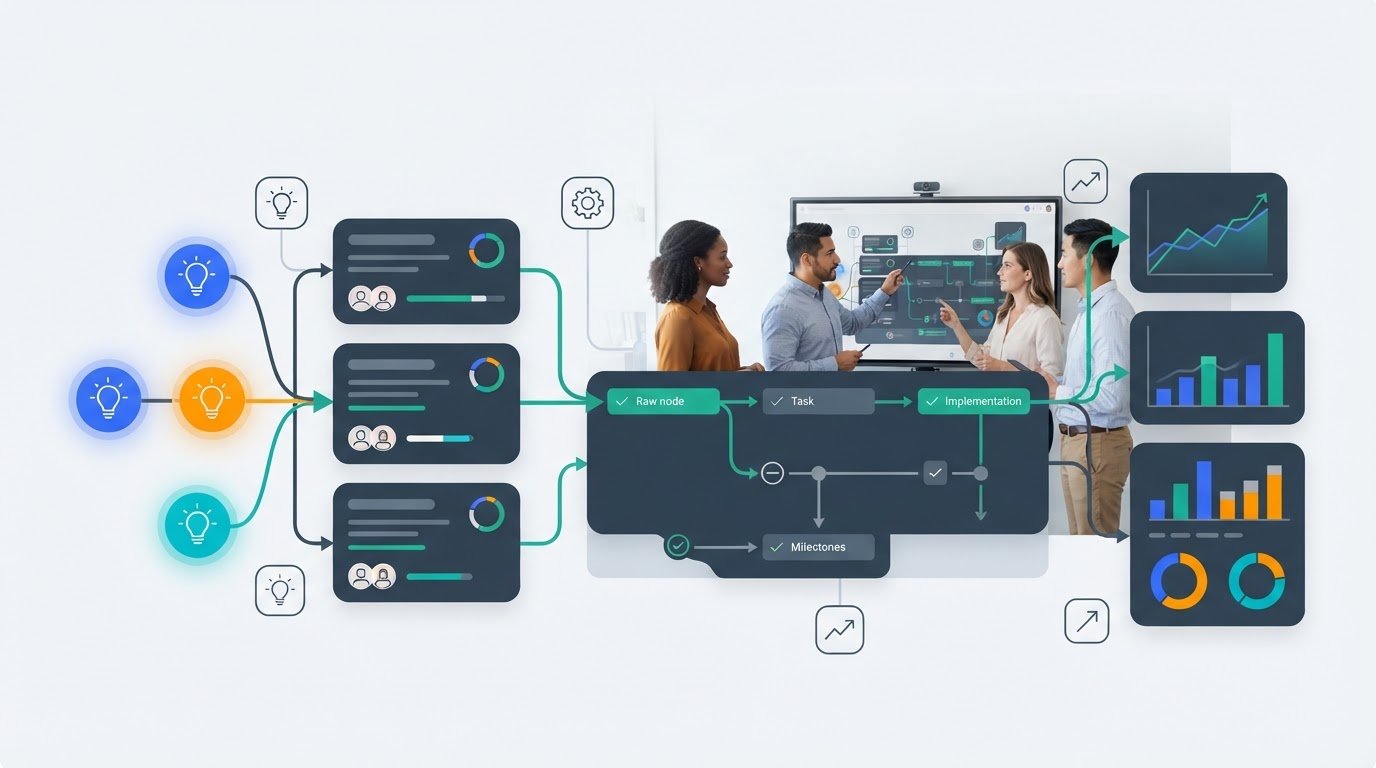
Transit employees evaluate and advance improvement ideas on an innovation management dashboard at a bus depot
Coby Skonord|
November 20, 2026

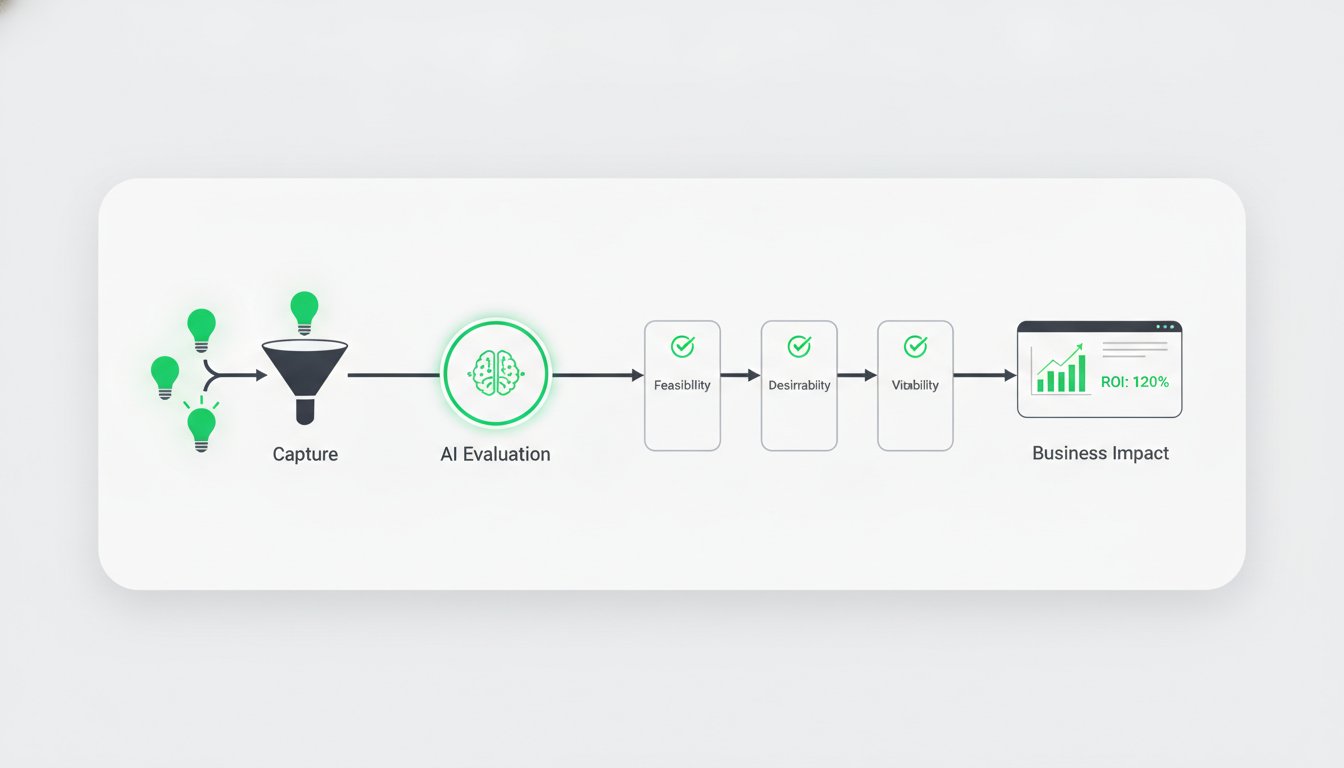
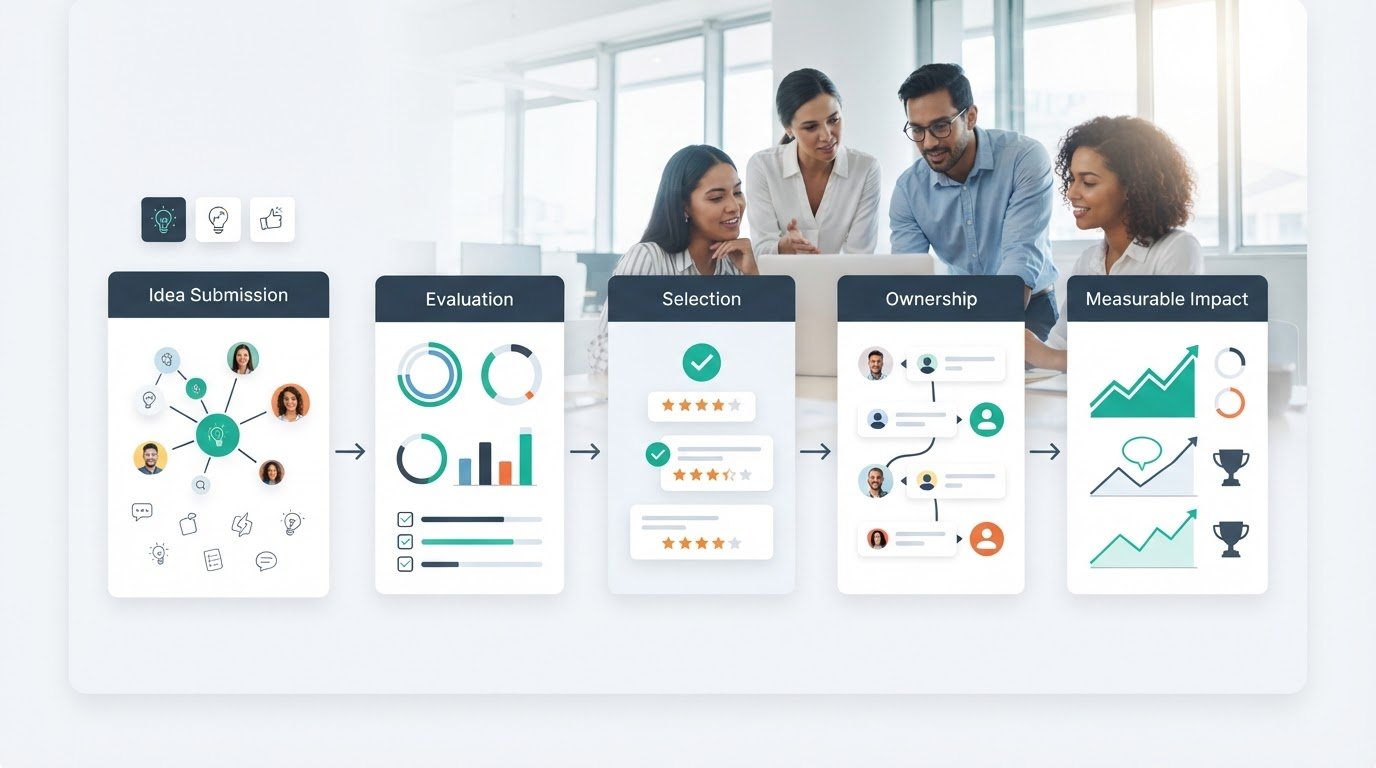
At a large organization, innovation rarely stalls because people lack ideas. It stalls when there’s no clear path from idea to launch. An innovation management process provides that path, moving ideas from generation through evaluation and development to implementation and market introduction.

That structure matters because enterprise innovation must connect promising ideas to business priorities without shutting down experimentation. You’ll learn what innovation management involves, how organizations collect and assess ideas, and how selected concepts move toward launch. This guide also explains how large organizations coordinate teams, decisions, and portfolios so innovation becomes repeatable rather than a collection of disconnected projects.

Key Takeaways

  • Use clear evaluation criteria to compare ideas, surface risks early, and decide what should advance, pause, or be saved for later.
  • Combine focused innovation challenges with ongoing idea submissions to capture both strategic opportunities and frontline insights.
  • Move selected concepts toward launch through staged development, testing, coordinated implementation, and feedback.
  • Track both early activity and business outcomes so innovation measures progress, not just the number of ideas collected.
  • As innovation scales across a large organization, align governance and portfolio decisions with enough flexibility for teams to experiment.

Evaluating, validating, and launching ideas

Selection turns a broad set of ideas into projects with a clear path forward. Leaders need consistent criteria, evidence from validation, and launch plans that connect decisions to execution.

Idea Evaluation and Selection Criteria

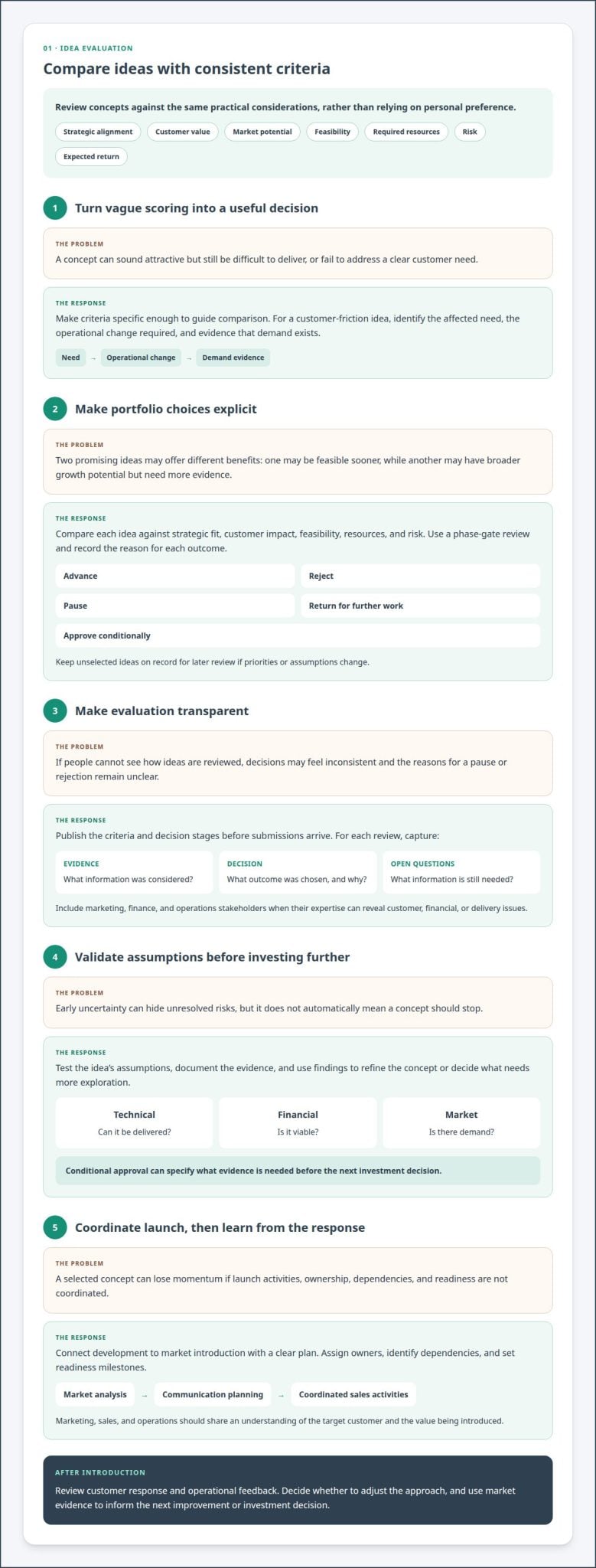
Idea evaluation and selection criteria are the standards used to compare concepts before committing resources. A practical review considers strategic alignment, customer value, market potential, feasibility, required resources, risk, and expected return. Together, these criteria help leaders distinguish promising ideas from attractive concepts that may be difficult to deliver.

Make the criteria specific enough to guide a decision. For example, a concept intended to reduce customer friction should identify the affected customer need, the operational change required, and the evidence that demand exists. A structured idea evaluation process helps reviewers apply the same questions across projects instead of relying on personal preference.

Prioritizing Innovations

Prioritizing innovations means comparing validated ideas with business goals and available capacity, then deciding which should advance. A phase-gate review gives each concept a decision point: advance, reject, pause, return for further work, or approve conditionally. Record the reason for each outcome and define the next step.

Consider two proposals: one improves an existing customer process, while another explores a new market. The first may be feasible sooner; the second may offer broader growth potential but need more evidence. Compare both against strategic fit, customer impact, feasibility, resources, and risk. Keep unselected ideas on record for later review, especially if priorities or assumptions change.

Transparent Evaluation Protocols

Transparent evaluation protocols explain who reviews ideas, which criteria apply, and how decisions are recorded. Publish the criteria and decision stages before submissions arrive. For each review, record the evidence considered, the decision and its rationale, and any information still needed.

Involve marketing, finance, and operations stakeholders when their expertise can reveal customer, financial, or delivery issues. For example, an operations reviewer can identify a workflow constraint before a concept enters development. Consistent records also help employees understand why an idea advanced or paused, supporting experimentation while preserving accountability.

Validate Before Investing Further

Validation tests an idea’s assumptions before a team commits to broader development. Examine technical feasibility, financial viability, and market demand, then record the evidence behind each conclusion. A customer-facing concept, for example, may need evidence of demand alongside an assessment of how it can be delivered.

Use the findings to refine the concept, identify unresolved risks, or return it for further exploration. Conditional approval can specify what evidence is needed before the next investment decision. This keeps the innovation management process evidence-led without treating early uncertainty as an automatic reason to stop.

Coordinate the Launch

A launch plan connects development to market introduction through market analysis, communication planning, and coordinated sales activities. Assign an owner to each activity, identify dependencies, and set readiness milestones. Marketing, sales, and operations should share an understanding of the target customer and the value being introduced.

Before launch, confirm that customer-facing messages reflect the tested value proposition and that delivery teams can support the offer. After introduction, review customer response and operational feedback, then decide whether to adjust the approach. Evaluation does not end at launch: market evidence informs the next improvement or investment decision.

Collecting employee ideas through challenges and open submissions

Employee ideas can come through focused challenges or an always-open channel, providing both targeted and unsolicited input. Common risks include vague prompts, low participation, duplicate submissions, biased screening, and ideas that receive no feedback or ownership.

Ideas-First and Needs-First Approaches

An ideas-first approach starts with a proposed solution, while a needs-first approach starts with a problem employees or customers experience. The distinction matters: a clever suggestion can miss the underlying need, while a clearly defined problem gives contributors room to explore different solutions.

Use open submissions to capture ideas employees notice in everyday work, then ask what problem each addresses. For example, a warehouse employee might suggest a new scheduling tool; follow-up could reveal that shift handoffs, not scheduling, cause delays. Focused challenges work well when leaders can define a need, such as reducing handoff errors or simplifying a service step.

A strong culture makes room for both approaches. Challenges create a shared focus, while open submissions can surface improvements beyond current priorities. Explain the challenge’s purpose, who can contribute, and how ideas will be reviewed. This helps employees connect their experience to organizational needs without forcing every suggestion into a predetermined solution.

Crowdsourced Feedback on Ideas

Crowdsourced feedback gathers reactions, refinements, and expertise from a group of employees rather than leaving screening to one reviewer. It matters because colleagues in different roles may identify implementation barriers or customer effects that the original contributor cannot see.

For useful feedback, present the problem, proposed idea, and specific prompts together. Ask colleagues to identify likely benefits, risks, missing information, or alternatives. A frontline employee may spot a workflow issue, while a customer-facing colleague may flag an unmet need. Make commenting and voting part of a clear evaluation process, not a popularity contest.

Advocacy can strengthen an idea’s case when supporters explain their reasoning and relevant experience. Still, leaders should distinguish enthusiasm from evidence. A screening step can group duplicates, clarify incomplete submissions, and route ideas to people with relevant knowledge. A structured employee ideation program can make participation and feedback part of ongoing improvement.

Recording and Sharing Ideas

Recording ideas means keeping each submission in a shared, searchable record with enough context for follow-up. Without one, ideas can disappear in email threads, meeting notes, or isolated forms, leaving teams unable to revisit useful suggestions.

Capture the problem, proposed change, affected team or customer, expected benefit, and supporting details. Add a status and owner so employees can see whether an idea needs clarification, is under review, or has moved forward. Share submissions with relevant colleagues, keeping discussion focused on useful feedback and next steps.

For example, a facilities team could record a recurring equipment issue and invite staff to suggest ways to reduce disruption. Related submissions can be grouped, discussed, and retained even if no immediate project proceeds. Close the loop by communicating decisions and reasons; otherwise, silence can weaken participation. To see how a digital approach can support this work, explore a guided platform walkthrough.

What is the Innovation Process?

The innovation process moves a concept from a defined opportunity toward development, implementation, and adoption. It gives teams a practical route from strategic intent to action.

Organizations fund and resource innovation projects by aligning them with strategic priorities, assigning people and budget, and releasing additional resources as evidence supports progress. Internal teams, external partners, and staged investment can each contribute, depending on a project’s needs.

Innovation Strategy Development

An innovation strategy defines the opportunities an organization will pursue, the outcomes it wants, and the capabilities it can commit. It matters because leaders must balance near-term improvements with longer-term concepts that could open new markets.

Start by connecting innovation goals to business priorities, such as improving customer experience or operational efficiency. Then clarify which teams, expertise, and funding can support each goal. A portfolio can combine incremental improvements with more exploratory projects, helping leaders avoid spending all available capacity on one kind of opportunity. The distinction between incremental and radical innovation can help frame that balance.

Concept Development and Prototyping

Concept development turns an opportunity into a defined proposal, while prototyping creates a simple representation that supports learning. These steps help teams expose unclear assumptions before committing to full development.

A product concept should identify its intended user, the problem it addresses, and the value it offers. A team exploring a faster service handoff, for example, might sketch the revised workflow before building new systems. Depending on the concept, a prototype could be a sketch, digital simulation, or physical model. Keep it focused on the question the team needs to answer, such as whether users understand the new process.

Concept Testing

Concept testing evaluates assumptions with relevant users, stakeholders, or operational evidence before broader implementation. It helps reveal whether a proposed benefit matters and whether delivery conditions support it.

Choose a test that matches the uncertainty. A customer-facing concept might be assessed through user reactions to its value proposition; an internal process change might be tried with the employees who do the work. Record the response, assumptions tested, and resulting changes. If findings expose a gap, refine the concept and test again rather than treating early feedback as a final verdict.

Innovation Development and Implementation

Development and implementation turn a tested concept into an operating product, service, or process. Even a strong concept needs clear ownership and coordinated delivery to create practical value.

Build an implementation plan that connects development tasks to people, resources, milestones, production needs, and launch activities. For a new service, operations may prepare delivery workflows while marketing develops customer communications. External partners can contribute needed capabilities, with responsibilities agreed before work begins. Track dependencies and unresolved risks, then coordinate the launch across relevant teams. After implementation, use customer and operational feedback to guide improvements and further development.
The Innovation Management Process: A Practical Guide

What is innovation management?

Innovation management connects initiatives to evidence, learning, and measurable outcomes. Common frameworks include Lean Startup’s build-measure-learn loop, design thinking, stage-gate reviews, roadmapping, and idea management.

Innovation Performance Measurement

Innovation performance measurement tracks whether innovation work produces learning and business outcomes. Idea counts alone cannot show whether initiatives solve customer problems or improve operations.

Choose measures that fit each initiative’s goal. A service improvement might track customer satisfaction and process quality, while a new offer might track adoption, revenue growth, or time-to-market. Compare results with the initiative’s original objective, not an unrelated portfolio target.

Review measures at decision points, including after launch. If adoption is weak, examine customer feedback, implementation barriers, and original assumptions before deciding whether to adjust or stop. A consistent approach to measuring innovation programs helps leaders connect project evidence with portfolio outcomes.

Input and Output Metrics

Input metrics measure the resources and activity committed to innovation; output metrics measure what those efforts produce. Track both, because high activity does not automatically mean successful results.

Inputs can include employee participation, ideas submitted, experiments completed, and resources assigned. Outputs can include concepts advanced, projects launched, customer response, revenue growth, or operational improvements. For example, strong participation but few tested concepts may signal a bottleneck between collection and evaluation.

Pair each input with a relevant output, then review the relationship over time. If experiments increase but customer learning does not, teams may need better test questions. If launches occur but adoption remains limited, examine whether the offering addresses an important need. Metrics should prompt investigation, not reward activity without impact.

Innovation Management Tools and Frameworks

Innovation tools and frameworks organize idea capture, experimentation, decisions, and learning. Choose them to fit the uncertainty and delivery needs of each initiative.

Lean Startup uses a build-measure-learn loop: build a testable version, measure how people respond, and use feedback to decide what to change. A team testing a new service feature could release a limited version, observe customer use, and refine the concept. The loop is iterative, allowing teams to revisit assumptions instead of treating a launch as proof of success.

Design thinking helps teams investigate user needs and develop potential solutions. Stage-gate reviews structure decisions between project phases, while roadmaps connect initiatives to strategic priorities. Idea management supports collecting and tracking proposals. Choose a framework based on the challenge: uncertain customer demand calls for testing and learning; a defined operational improvement may need milestones, owners, and delivery measures.

Innovation management in large organizations

Large organizations need shared priorities without centralizing every experiment. Governance, portfolio oversight, and clear ownership connect ideas generated across departments to organization-wide goals.

Accenture reported that 96 percent of executives said long-term success depends on developing new ideas. Accenture also found that 82 percent of respondents did not distinguish meaningfully between significant innovation and incremental performance gains. Its research further reported that 72 percent of companies let innovations languish without a formal process or organizational home. These findings point to a coordination challenge: ideas need sponsors, resources, and decisions. Accenture’s innovation research highlights the need to connect ambition with execution.

Give each initiative an accountable owner and a route to decision-makers. A central innovation lead can coordinate portfolio priorities, while business units assess operational fit and contribute expertise. For example, a customer-service suggestion may need input from operations, IT, finance, and customer-facing teams before it becomes a funded project.

Set governance around decision rights, not layers of approval. Define who can sponsor an idea, assess its fit, allocate resources, and pause work when evidence changes. Use stage reviews for investment decisions, but keep early exploration lightweight. Standardize records and reporting while allowing teams to test solutions suited to their work.

Portfolio oversight helps leaders balance near-term improvements with longer-term opportunities. Review initiatives together, considering strategic fit, expected outcomes, resources, and dependencies. If technology changes customer expectations, revisit priorities instead of protecting projects simply because they already have support. Stopping work that no longer fits frees capacity for stronger opportunities.

Culture matters too. A study by Strategyn involving 393 innovation leaders found recurring innovation problems across nearly every organization studied. Leaders can address ambiguity by defining each initiative’s intended scope and outcome. An operational efficiency project and a new-market exploration effort may both matter, but they need different evidence and review criteria.

Make participation practical across locations and roles. Invite employees to contribute through challenges and ongoing channels, then communicate decisions and next steps. Innovation Leader reported that over 82% of executives in large organizations surveyed had used the Lean Startup Methodology in some way. Experimentation can support learning, but enterprise teams still need clear ownership to turn learning into coordinated action.

For large organizations, the key is to centralize priorities and accountability while distributing exploration and learning. A consistent framework should make it easy to see who owns each initiative, what evidence supports it, and where the next decision lies.

Ideawake

Ideawake offers a cloud-based platform for collecting, evaluating, and implementing ideas. It may be relevant when employee, customer, or partner ideas are spread across teams and need a defined path into innovation initiatives. Its Innovation Management Platform and Idea Management Platform cover stages of the innovation lifecycle, alongside Continuous Improvement and Ideawake AI.

For large organizations, a shared platform can provide a place to capture proposals, involve contributors in evaluation, and track ideas as they progress. Voting, leaderboards, and prizes are possible ways to encourage participation, while structured workflows can help teams handle ideas consistently. These capabilities can support focused innovation efforts as well as ongoing improvement.

Contact Ideawake to discuss whether its platform fits your organization’s innovation processes.

Make the next decision count

Put your innovation management process to work by choosing one business priority that needs fresh thinking. Name an accountable sponsor, define the decision the initiative should inform, and agree on what evidence would justify moving forward. This creates a focused starting point without requiring the entire organization to change at once.

Then make learning visible. Give teams a clear way to share progress, surface barriers, and explain what they need from decision-makers. A useful review helps leaders decide whether to continue, adjust, or redirect effort. That discipline makes innovation a leadership practice, not a side project competing with everyday work.

Ideawake supports organizations with an Innovation Management Platform, an Idea Management Platform, and Continuous Improvement capabilities. If you’re ready to discuss how these offerings could support your organization’s priorities, take the next step.

Start with a meaningful opportunity, learn from the work, and build from there. Progress begins with a decision your teams can act on.

Frequently Asked Questions

Where is the Phase-Gate process used?

Phase-Gate is used to manage projects that need staged reviews and investment decisions. Organizations can apply it to product development or operational improvements when work can be divided into stages with evidence reviewed at each decision point. A team may advance a concept, pause it for more evidence, recycle its assumptions, or stop it. The approach is most useful when leaders need explicit control over commitments and clear accountability at each gate.

What is the innovation management process?

The innovation management process is the coordinated way an organization develops promising ideas into implemented changes. It connects opportunities to business priorities, assigns ownership, and gives teams a way to learn from evidence. For example, an operations leader could use it to move a recurring service issue from employee observation to a tested process change. Its value lies in making innovation work visible and actionable, not merely collecting suggestions.

What are the key stages of an innovation management process?

Key stages typically include generating ideas, selecting and evaluating them, developing concepts, implementing solutions, and introducing them to users or markets. Teams may revisit stages when new evidence changes an assumption. For example, customer feedback during a limited release could send a concept back for refinement. The sequence gives leaders a shared map while allowing initiatives to move at different speeds based on uncertainty and delivery needs.

How do organizations generate and prioritize innovation ideas?

Organizations generate ideas through employee submissions, focused challenges, customer input, and collaboration with external partners. To prioritize them, leaders can compare each proposal with strategic goals, customer or operational needs, feasibility, resource demands, and potential risk. For example, a service team may rank suggestions by how directly they address a recurring customer problem. Keep lower-priority proposals on record so teams can reconsider them when conditions or priorities change.

How do companies evaluate the feasibility and business value of innovations?

Companies assess feasibility by examining whether a concept can be delivered with available technical capabilities, operational capacity, and resources. They assess business value by considering strategic fit, customer benefit, market demand, and expected returns. A proposal to simplify a service process, for instance, should address both user value and the team’s ability to implement it. Record assumptions separately from supporting evidence so decision-makers can identify what still needs testing.

How are innovation projects tested, developed, and launched?

Teams test a project’s riskiest assumptions using a method suited to the concept, such as a sketch, simulation, pilot, or limited release. They use feedback to refine requirements before broader development. During implementation, assign owners for delivery, operations, and communications. Before launch, confirm that the product or process is ready for its intended users. Afterward, review actual use and feedback to identify adjustments, support needs, or further opportunities.

What metrics measure innovation management performance?

Useful measures connect innovation activity to learning and outcomes. Input indicators can include participation, submissions, experiments, and resources committed; output indicators can include concepts tested, projects implemented, customer response, time-to-market, revenue growth, or operational improvement. Select measures based on each initiative’s objective. For example, a process-improvement effort should track its targeted operational result, not rely only on how many ideas employees submitted.

How does innovation management differ across industries and company sizes?

Innovation management varies with customer needs, operating conditions, project risks, and organizational structure. A manufacturer may emphasize production feasibility, while a service organization may focus on customer experience and workflow changes. Smaller organizations may coordinate decisions through fewer roles; larger enterprises often need clearer governance across departments. In either setting, adapt review steps and evidence requirements to the initiative while keeping ownership, decision criteria, and outcomes clear.
Article by

Coby Skonord

Coby Skonord is the co-founder and CEO of Ideawake. Since 2013 he has worked with enterprise innovation, continuous improvement, and HR leaders to turn employee ideas into measurable business impact.

Innovation Portfolio Management for Enterprise Investment Choices

Innovation Portfolio Management for Enterprise Investment Choices
Coby Skonord|
October 25, 2026

A stack of promising projects isn’t a strategy. Innovation portfolio management assesses, prioritizes, and monitors initiatives as a connected whole, helping leaders see how each supports enterprise goals. The right innovation portfolio management software centralizes initiatives and makes them easier to compare against consistent criteria, rather than treating every idea as an isolated bet.

Organizations want to protect promising ideas while focusing resources on work that can deliver value. The challenge is balancing near-term improvements with longer-term opportunities and making risk, progress, and strategic fit visible enough to guide investment decisions.

This article explains how portfolio management works and what to look for in supporting software. You’ll learn how analytics, AI, and collaboration tools can inform decisions about resources, risk, timing, and expected returns, as well as how to evaluate initiatives and adjust the portfolio when priorities change.

Key Takeaways

  • Connect collaboration tools to make initiative updates, ownership, and decisions easier to follow across teams.
  • Assess innovation initiatives as a portfolio, linking investment choices to enterprise strategy rather than reviewing each idea in isolation.
  • Balance core, adjacent, and transformational work, then redirect resources as evidence and priorities change.
  • Use analytics and AI to surface portfolio patterns, monitor progress, and support better-informed decisions.
  • Evaluate software by how well it centralizes initiatives, standardizes assessment, and gives leaders visibility into progress.

Integration with enterprise collaboration tools

Collaboration tools connect portfolio decisions with the conversations where work happens. For example, a team discussing a customer problem in Microsoft Teams can record the resulting initiative in a shared portfolio workflow. Preserve the context: the original need, its owner, strategic purpose, and next decision. Without those details, discussion can generate activity without giving the enterprise useful insight.

Start by mapping your innovation process and identifying where teams lose information. A product team might capture an employee suggestion, ask finance to assess resource needs, and invite operations to review implementation risks. A connected workflow makes ownership and decision history easier to follow, giving leaders a clearer basis for comparing proposals across business units.

A small business may need only a shared workspace with simple submission, discussion, and review steps. Large enterprises generally need portfolio-wide visibility, consistent evaluation, and coordination across teams, business areas, and external partners. In either case, choose tools based on the number of participants, decision complexity, and reporting needs, not company size alone.

Integration also supports long-term competitiveness by bringing outside knowledge into planning. Disruption expected to remain 5-10 years away can itself create risk, so organizations need ways to notice changing customer needs and emerging technologies. A partner ecosystem can contribute specialized expertise or access to pilot users. For example, a manufacturer could invite a supplier to review a materials pilot before expanding it.

Set clear collaboration rules before inviting partners into a pilot. Define who can submit ideas, who evaluates them, and how teams share progress. Keep sensitive details within appropriate groups and record decisions in each initiative’s history. Regular updates help surface blockers early, while a named owner ensures feedback leads to a next step rather than another meeting.

  • Use one decision record: Capture the proposal, evidence, owner, and review outcome in a shared location.
  • Make reviews structured: Ask participants to assess strategic fit, customer value, feasibility, and risk.
  • Close the feedback loop: Tell contributors whether an idea advances, changes direction, or stops, and explain why.

Employees may resist adoption if portfolio reviews feel like extra administration. Explain the purpose, connect initiatives to business strategy, train employees on the workflow, and recognize meaningful contributions. These steps make collaboration part of decision-making rather than a separate task. When teams and partners can see how their input informs decisions, the organization builds a stronger foundation for learning and future investment.

What Is Innovation Portfolio Management?

Strategic Portfolio Alignment

A strategic portfolio translates business priorities into choices about which initiatives to advance, reshape, or pause. Leaders can map proposals against growth goals, customer needs, and available capabilities, then identify gaps or excessive concentration. The Three Horizons model distinguishes core business development, emerging growth businesses, and future options, as described by McKinsey’s Three Horizons of Growth. That view helps teams test whether today’s portfolio supports current priorities and longer-term competitiveness.

Risk tolerance matters because strategic alignment isn’t the same as choosing only familiar projects. The Innovation Ambition Matrix helps frame initiatives by risk and ambition. Bansi Nagji and Geoff Tuff describe the framework in their Harvard Business Review article. A company focused on improving an existing service might pair that work with a more exploratory initiative. The useful test is whether each investment has a clear strategic purpose and an appropriate level of uncertainty.

Investment Decisions and ROI

Investment decisions weigh expected value against required resources, execution risks, and evidence of progress. Common measures include expected revenue growth, cost savings, time-to-market, strategic alignment, and risk exposure. A scoring model makes these criteria visible, while stage-gate reviews give leaders defined points to reassess assumptions. Choose measures that fit each initiative instead of forcing every development project into the same ROI formula.

ROI informs portfolio choices, but it shouldn’t be the only consideration. Early initiatives may build capabilities or test customer demand before financial returns become clear. Record assumptions, milestones, and evidence, then revisit funding as results emerge. This makes it easier to redirect resources from underperforming work to initiatives with stronger strategic value, rather than relying indefinitely on an initial business case.

For 2026, the best platform fit is one that supports portfolio visibility, consistent evaluation, and decisions aligned with your organization’s strategy. Compare how each option handles risk, maturity, business area, progress tracking, and the metrics leaders use to review investment choices.

Implement the system by defining strategic goals and evaluation criteria, organizing existing initiatives, assigning owners, and setting review points. Onboard teams, assess progress against agreed measures, and adjust the portfolio as evidence or priorities change.

Portfolio strategy should reflect the organization’s actual investment choices, not a fashionable template. Frameworks such as the Three Horizons model and Innovation Ambition Matrix can guide discussion, while teams tailor dimensions to their strategy. For practical selection criteria, explore this guide to choosing innovation management software.

Balancing resources, time, risk, options, and profitability

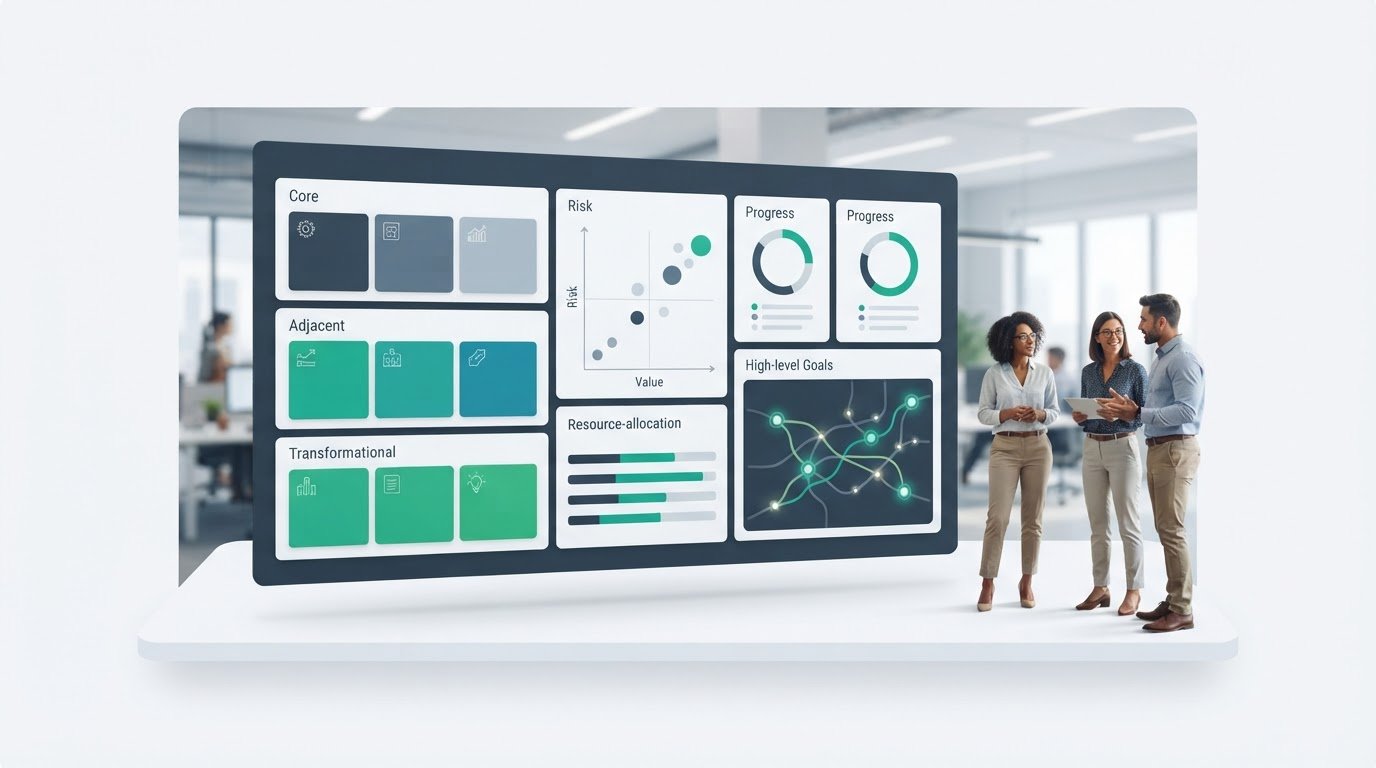
A balanced portfolio matches resources and timing to each initiative’s risk and expected return. Comparing core, adjacent, and transformational work helps an organization avoid relying on just one type of outcome.

Feasibility Assessment

Assess feasibility by examining the capabilities, technology, dependencies, and people each initiative requires. A service redesign, for example, may use existing systems, while a new digital offer could require technical development and customer testing. Record assumptions, identify resource gaps, and use stage-gate reviews to determine whether the evidence supports continued investment. This separates an attractive concept from work the organization can realistically deliver.

Resource Allocation and Waste Reduction

Resource allocation assigns people, budget, and leadership attention according to strategic value and delivery needs. During a portfolio review, compare active work with available capacity, then pause duplicated efforts or initiatives whose supporting evidence has weakened. Redirecting those resources toward stronger opportunities can reduce wasted development effort. Clear owners and decision dates help teams act on changes instead of letting low-value work continue by default.

Time is a portfolio constraint, not just a project schedule. A near-term process improvement may produce learning quickly, while a transformational technology initiative may require longer development and staged investment. Compare milestones and dependencies across initiatives before committing scarce specialists. If several projects need the same engineering skills, sequence the work or narrow its scope to protect progress without overloading the team.

Risk should be considered across the portfolio. Core initiatives often improve existing products or operations; adjacent initiatives extend current capabilities into a new market or offer; transformational initiatives pursue less familiar opportunities. A portfolio weighted heavily toward core work may limit future options, while too many uncertain bets can strain resources. Leaders can set a deliberate mix, then adjust it as customer evidence and strategic priorities change.

Profitability decisions should consider expected revenue growth, cost savings, time-to-market, and risk exposure. These measures help compare initiatives, but they need context: a pilot may be valuable for learning before its direct returns are clear. Review the assumptions behind each forecast and use scoring models or stage-gate discussions to determine what would justify further investment. The aim is informed decision-making, not false precision.

Innovators also need practical support to turn allocated resources into results. Give each initiative an accountable sponsor, access to relevant subject-matter expertise, and a clear way to resolve cross-team dependencies. A circular-economy project, for example, may need input from operations, procurement, and product development. Environmental, social, and governance measures, such as energy efficiency or emissions considerations, can connect transformation goals with resilience and profitability.

Data analytics, AI, and predictive modeling

Analytics connect initiative data to portfolio decisions, helping leaders assess value, progress, and emerging trends. Predictive models and dashboards make patterns easier to identify and act on.

Portfolio Analytics and Value Measurement

Start by centralizing initiative data, then compare projects against agreed measures. Common measures include expected revenue growth, cost savings, time-to-market, strategic alignment, and risk exposure. A dashboard, for example, can show that one business area has several delayed launches while another has available capacity. Leaders can investigate the cause and adjust priorities using consistent evidence.

Trend analysis adds context to these measures. An organization could group initiatives by customer segment, technology, maturity, or business area, then track changes in progress and expected value. Sentiment analysis can help identify themes in employee or customer comments, such as repeated requests for simpler onboarding. Teams should review the original feedback before treating a theme as a signal to invest.

AI-Assisted Analysis and Prioritization

Machine learning can identify patterns across initiative descriptions, evaluation scores, and historical outcomes. AI-assisted analysis, for example, could flag proposals with similar goals, highlight missing evidence, or group ideas addressing the same customer problem. Use these findings to inform prioritization, not replace accountable review. Leaders still need to weigh strategic fit, feasibility, risk, and available capabilities.

Set a clear workflow for AI-supported evaluation. First, define the criteria people use to assess initiatives. Next, check whether portfolio data is complete and consistently categorized. Then compare AI-generated themes with human assessments and record why a proposal advances or pauses. This keeps recommendations explainable and helps teams catch errors, such as treating duplicate concepts as separate opportunities.

Real-Time Analytics

Real-time dashboards give teams a current view of submissions, reviews, owners, and initiative progress. A portfolio manager can spot a stalled evaluation, identify the decision owner, and resolve a bottleneck before it affects downstream work. The value depends on timely updates and shared definitions. If one team marks a project “active” while another uses that status differently, portfolio comparisons lose meaning.

Make analytics useful by connecting each metric to a decision. Rising customer interest could trigger further discovery, while a missed milestone could prompt a resource review. Keep dashboards focused on signals leaders can act on and set a regular review cadence. Predictive analytics can support performance monitoring by highlighting patterns worth investigating, rather than presenting forecasts as fixed outcomes.

Innovation management software features

Innovation portfolio management software centralizes initiatives, supports consistent evaluation, and shows progress across a portfolio. Compare platforms by configurability, analytics, workflow fit, and ease of use, rather than relying on feature counts alone.

Feature Comparisons

Core capabilities include initiative tracking, configurable evaluation, portfolio views, and progress reporting. Useful systems let teams categorize work by risk, maturity, business area, technology, or function. Compare how each platform moves an opportunity from submission through assessment and review, and whether its workflows reflect your organization’s decision process.

Configurability matters because portfolio strategies differ. A team prioritizing emerging technologies may need maturity and risk views, while a continuous improvement program may focus on operational impact. Assess flexibility and analytics separately: flexibility shows whether workflows can adapt, while analytics show whether leaders can interpret portfolio activity.

Look for evidence behind feature claims. Ask how each capability works in a realistic workflow and test it with an initiative your team understands. Follow a proposal from submission through evaluation, then check whether reviewers can see its status, rationale, and next step. This reveals gaps that feature descriptions alone can obscure.

  • Portfolio structure: Can users group and filter initiatives using the dimensions leaders need?
  • Evaluation: Can reviewers apply shared criteria and record decision rationale?
  • Reporting: Can leaders see progress, ownership, and portfolio patterns together?
  • Adaptability: Can workflows change as priorities and processes evolve?

Usability Considerations

Usability determines whether employees and decision-makers can complete tasks without unnecessary friction. Test common actions, such as submitting an opportunity, completing an evaluation, and finding its latest status. Clear labels, focused forms, and role-appropriate views help users understand what to do next. Excessive fields or confusing navigation can slow adoption.

Test a scenario with people in different roles. Ask an employee to submit an idea, a reviewer to assess it, and a portfolio leader to compare initiatives. Note where users need guidance, repeat information, or lose sight of the next step. This shows whether the platform supports real workflows, not just an administrator’s ideal process.

Finally, distinguish usability from simplicity alone. Enterprise teams may need configurable workflows and detailed portfolio reporting, while smaller teams may prefer a lighter setup. Choose a platform that handles the required complexity without adding avoidable steps. A focused demonstration using your own evaluation criteria helps stakeholders compare the experience directly.

Ideawake: Innovation Management Platform

Ideawake’s Innovation Management Platform helps organizations capture, evaluate, and implement ideas from employees, customers, and partners. Turn portfolio priorities into a repeatable process: gather opportunities, assess them against your criteria, and track ideas toward implementation. Ideawake AI and gamification features, including voting and leaderboards, support participation and help teams surface promising contributions.

Consider Ideawake when ideas are scattered across disconnected channels or teams need a clearer path from submission to action. The platform supports the innovation lifecycle while reducing administrative complexity, helping decision-makers connect participation with evaluation and follow-through. Explore Ideawake to see how it could support your organization’s approach.

Contact Ideawake to discuss your innovation management needs.

Make your next investment decision actionable

Use an upcoming portfolio review to strengthen how your organization evaluates new opportunities. Define the decision you need to make, the evidence leaders will use, and how teams will record the outcome. Then assess whether innovation portfolio management software can support the process without adding unnecessary steps. Starting with a focused use case can turn a broad ambition into a practical operating rhythm.

Ideawake offers an Innovation Management Platform, an Idea Management Platform, and Continuous Improvement tools to help organizations develop and manage ideas. These offerings can bring employee contributions into a clearer process, from gathering suggestions to evaluating them and supporting follow-through. Start a conversation about your current priorities and how your teams make investment decisions.

Build a portfolio process that helps your people make informed choices and move promising work forward.

Frequently Asked Questions

What is innovation portfolio management?

Innovation portfolio management is the practice of deciding which innovation initiatives to fund, continue or stop so the overall mix supports company strategy. It treats ideas and projects as a portfolio of bets with different levels of risk, cost and expected return. The goal is to put limited money and people behind the initiatives most likely to create value.

How do you balance risk and impact in an innovation portfolio?

Spread investment across time horizons and risk levels, then review the mix on a fixed schedule. A common starting point is to put most resources into core improvements, a smaller share into adjacent opportunities and a small share into transformational bets, often described as a 70/20/10 split. Set clear evidence thresholds for each stage so higher-risk ideas earn more funding only as their assumptions are proven.

How do enterprises track innovation initiatives from idea to execution?

They use one system of record that follows each initiative from submission through evaluation, approval, implementation and measured results. Each stage has an owner, criteria and a due date, and status is visible to leaders and submitters. Ideawake tracks every idea through configurable stages and integrates with Jira and Asana so approved work can move into project tracking.

How should an innovation portfolio review make kill-or-continue decisions?

Decide in advance what evidence each initiative must show by the next review, then hold to it. Score every initiative on the same criteria, such as strategic fit, validated demand, cost to the next milestone and risk, and compare them side by side. Stopping weak initiatives quickly frees people and budget for stronger ones, so a healthy portfolio should kill some projects every quarter.

What features should innovation portfolio management software have?

Look for custom scorecards, multi-stage workflows, automated routing to reviewers, portfolio dashboards and ROI tracking that compares projected and actual value. Integrations with project tools and an API matter so approved work does not have to be re-entered. Our idea management software feature guide has a full checklist.

How is innovation portfolio management different from project portfolio management?

Project portfolio management governs approved projects that are already being delivered. Innovation portfolio management sits earlier: it decides which ideas become projects at all and keeps reassessing them while uncertainty is high. The two connect at the handoff, when an approved initiative moves into delivery with its business case and assumptions intact.

How much does innovation portfolio management software cost?

Cost depends on the number of users and administrators, workflow complexity, integrations and support. For Ideawake, most mid-size programs land in the middle of the Business plan range, around $1,000 to $1,500 per month, and enterprise portfolios with unlimited users are quoted. See the Ideawake pricing page and our innovation management software pricing guide.

Which innovation tools integrate with project management and collaboration systems?

Ideawake integrates with Microsoft Teams, Slack, Office 365, Jira and Asana, and offers an API and SCIM provisioning for custom connections. That lets ideas be submitted where people work and lets approved initiatives flow into project tracking without duplicate records. For financial systems, map which fields need to move and who owns them before choosing an integration approach.

Article by

Coby Skonord

Coby Skonord is the co-founder and CEO of Ideawake. Since 2013 he has worked with enterprise innovation, continuous improvement, and HR leaders to turn employee ideas into measurable business impact.

Innovation Challenge Software: A Practical Guide for 2026

Innovation Challenge Software: A Practical Guide for 2026
Coby Skonord|
October 18, 2026

What good is a challenge full of ideas if no one can tell which ones deserve attention or what happens next? Innovation challenge software should do more than collect submissions. It should give participants a clear way to contribute and help teams move promising ideas through review, decisions, and follow-through.

If submissions are scattered across forms, spreadsheets, and chat threads, it’s harder to keep people engaged, compare ideas consistently, and make ownership visible. A campaign can attract plenty of activity yet still fall short if submissions aren’t focused or selected ideas stall after evaluation. The platform matters, but so does the process behind it.

This guide explains how innovation challenge software fits into an innovation program and what to assess, from submission forms and participant engagement to review workflows and outcome tracking. You’ll learn how to set a useful challenge brief, compare platforms against your process, and connect participation with measurable results. The goal is a challenge that doesn’t end when submissions close, but creates a clear path from contribution to action.

Key Takeaways

  • Distinguish a time-bound innovation challenge from ongoing idea collection so the process matches the goal.
  • Use innovation challenge software to make review stages, decision ownership, and next steps easier to follow.
  • Compare platforms by program fit, participant experience, evaluation, reporting, and integrations, not by feature count alone.
  • Set the challenge problem, evaluation criteria, and success measures before launch to focus participation and assess results.
  • Connect engagement tools and analytics with workflows and ROI tracking to understand what happens after ideas are submitted.

What innovation challenge software does, and where it fits

Innovation challenge software is a digital system for collecting ideas in response to a defined need and managing the challenge from launch through review. It gives organizers a structured way to explain the problem, invite relevant participants, gather submissions, and coordinate what happens next.

A challenge is one format within the broader practice of innovation management. It turns a specific question into a focused program rather than treating every contribution as an isolated suggestion. The software can organize participation and make the process visible, but the organization still sets priorities, weighs trade-offs, and decides which ideas to pursue.

What makes an innovation challenge different from an idea box?

An idea box invites suggestions, often on any topic and at any time. A challenge is more focused: organizers define a question, identify who should contribute, and explain what the program is trying to learn or address. A clear brief gives participants useful boundaries without prescribing the answer. For example, it might describe a process problem and ask employees for practical ways to improve it. This structure also supports organized employee ideation programs.

Challenges are often time-bound, with a launch, submission period, and review phase. That creates a shared moment for participation and gives reviewers a defined set of ideas to consider. Ongoing idea collection, by contrast, keeps a channel open for contributions across different topics. An unstructured brainstorm may generate discussion, but without a specific prompt or process, ideas can be difficult to compare or carry forward.

Who uses innovation challenge software?

Innovation teams use challenge tools to coordinate contributions from employees, customers, or partners, depending on the question and intended audience. A team might invite employees to suggest ways to simplify an internal process, ask customers to identify unmet needs, or gather partner perspectives on a shared business challenge. Choose participants for their relevant experience or insight, not simply to maximize the size of the group.

The software helps organizers present the brief, collect responses in one place, and manage participation and review. It supports a program; it doesn’t choose the strategic problem or decide which proposal deserves investment. Those responsibilities remain with the organization’s leaders and reviewers.

That distinction matters. A well-framed challenge connects a real organizational need with people who can offer useful perspectives. The platform provides structure for gathering and assessing those perspectives, while clear goals and human judgment guide decisions. Without that combination, a challenge can become just another submission form. With it, focused participation has a defined purpose.

How challenge software moves ideas from submission to evaluation

A challenge needs a clear operating path, not just a place to submit ideas. Innovation challenge software can organize that path so participants know what to provide and reviewers can see what has been considered, what needs a decision, and who owns the next step. A practical sequence is:

  1. Define the challenge. Set the problem, intended audience, submission window, and review approach.
  2. Collect ideas. Use a structured form to gather submissions in a consistent format.
  3. Review submissions. Screen for relevance, clarify details, and organize similar proposals.
  4. Select candidates. Compare eligible ideas against agreed criteria and record decisions.
  5. Track next steps. Assign owners and move selected ideas into further assessment or action.

Set evaluation criteria before reviewing submissions so every idea is assessed against the same expectations. Criteria might cover alignment with the challenge, potential benefit, feasibility, or evidence needed for further review. Without a shared basis, reviewers may rely on different assumptions, making comparisons less consistent and decisions harder to explain.

From challenge brief to structured submissions

A useful brief states the problem, who the challenge is for, relevant context, and what participants should submit. Forms can then prompt for information that helps reviewers understand each proposal, such as the need addressed, the suggested change, and any assumptions or resources involved. Keep prompts relevant: unnecessary questions add effort without improving the review. Optional anonymous posting can be useful when organizers want contributions assessed without displaying the submitter’s identity, but it need not be enabled for every challenge.

Similar submissions also need a sensible handling process. Semantic duplicate detection can flag ideas with related meaning even when participants use different wording. Depending on the review rules, similar ideas can be grouped for evaluation or merged, while preserving useful distinctions. Reviewers should still check whether proposals that sound alike contain different details or approaches.

From evaluation to accountable next steps

Scorecards help reviewers apply shared criteria, while configurable workflows and approval stages show where an idea sits and who is responsible for moving it forward. Assigned owners can record a decision, request clarification, or coordinate the next review. This makes progression visible instead of leaving submissions in an inbox with no clear status. A structured idea evaluation process and criteria can help teams make review more consistent and transparent.

Comments and collaboration let participants or reviewers add context, and voting can help surface ideas for consideration. These inputs can inform deliberation, but they shouldn’t replace evaluation against the challenge’s criteria. Once a decision is made, record the rationale and next action, whether an idea advances, needs more information, or isn’t selected. That feedback closes the loop for participants and gives the team a usable record of the challenge. If you’re assessing how a platform could support this flow, you can explore a challenge workflow in a demo.

How to assess innovation challenge software beyond its feature list

A long feature list doesn’t tell you whether a platform fits your challenge. Start with the program you need to run, then assess whether the software helps participants contribute, administrators manage the process, reviewers make informed decisions, and responsible teams take selected ideas forward. Requirements vary with the audience and workflow, so compare platforms against your own needs rather than looking for a universal best.

Use a comparison framework that connects each capability to a practical need:

Area What to assess
Program fit Can you set up the challenge around its purpose, audience, and submission needs?
Participant experience Can participants access the challenge, understand expectations, and receive updates?
Evaluation Can reviewers use shared criteria and record decisions?
Workflow Can administrators see submission status, ownership, approvals, and next steps?
Reporting Can teams track relevant KPIs and understand what happens to selected ideas?
Integrations Can the platform fit alongside the tools teams already use?

Match platform capabilities to your challenge goals

For targeted feedback, focus on challenge setup, participant access, and submission forms that gather relevant details. A cross-functional program may need collaboration, routing, and configurable review stages so different teams can contribute without losing sight of ownership. If outcome tracking is central, assess whether administrators can create KPIs, view dashboards, and use financial ROI charts to monitor progress. An innovation software selection framework can help organize broader platform requirements around these goals.

Separate essentials from enhancements. A challenge with a narrow audience may prioritize clear forms and simple review, while a program involving several teams may depend on configurable workflows and collaboration. Notifications, gamification, and analytics can support engagement and visibility, but they’re valuable only when they serve the challenge’s purpose. Assess each capability in context: does it solve a real problem in the work your team needs to do?

Check adoption, security, and system fit

Evaluate the experience from both sides. Participants need a straightforward way to access the challenge on desktop or mobile, see announcements, receive notifications, and understand what happens after they submit. Administrators need to track submissions, communicate updates, and hand selected ideas to the teams responsible for assessment or implementation. Consider how participant feedback will be collected and used, too.

Security and integration choices also matter. Ideawake describes its security approach as zero data retention, and states that customer data is not used to train external models. Its integrations include Microsoft Teams, Jira, Asana, and Slack. An integration can connect systems, but that doesn’t mean every workflow or handoff happens automatically. Identify the information each connection needs to support and how it fits the team’s process. For a practical look at challenge workflows, you can explore Ideawake in a demo.

How to plan a challenge that earns participation and useful ideas

Strong participation starts before launch. Give people a clear reason to contribute, make the task easy to understand, and decide in advance how you’ll judge whether the challenge was useful. A practical sequence keeps planning focused:

  1. Define the problem. Frame a specific need that participants can meaningfully address.
  2. Choose the audience. Invite people with relevant experience, knowledge, or perspective.
  3. Set evaluation criteria. Agree on what reviewers will consider and who will make decisions.
  4. Launch and support participation. Share the brief, explain how to submit, and send useful reminders.
  5. Review and communicate. Update participants on progress, decisions, and next steps.

Before launch, select success measures that fit the challenge. These might include the relevance of submissions, participation across the intended audience, completion of review stages, or progress of selected ideas into further assessment. Set a baseline or define how each measure will be recorded, so the team can learn from the campaign without assuming a particular participation or ROI result. A platform can help organize idea crowdsourcing, but a clear purpose and timely communication give people a reason to take part.

Set the challenge up for focused participation

Use a concise problem statement, then explain why it matters and what participants are being asked to contribute. Choose an audience suited to the question, and describe submission expectations in plain language. People should understand what information to provide, how their input will be reviewed, and when they can expect updates. Points, leaderboards, or prizes may suit some programs, but treat them as optional engagement approaches, not guaranteed drivers of useful ideas or results.

Keep the brief focused enough to guide contributions without dictating a solution. For example, if the goal is to identify friction in an internal process, invite participants who encounter or support that process and ask them to describe the issue and a possible improvement. Make the invitation accessible through the channels the audience uses, and use announcements or notifications to clarify deadlines and answer common questions.

Close the feedback loop after submissions arrive

Tell participants what happens after submission and provide progress updates at meaningful points, such as when review begins or decisions are communicated. Challenge owners should share outcomes clearly, including when an idea needs more work or isn’t selected. For ideas that advance, assign an owner and connect the next steps to a workflow or project tracking process. That handoff gives promising contributions a route toward action; a defined approach to implementing innovative ideas can help teams carry the work forward.

Use the close of the challenge to capture lessons as well. Compare results with the measures set before launch, note where participants needed more guidance, and identify review bottlenecks. Those observations can sharpen the next brief and improve the participant experience. The goal isn’t simply to collect submissions. It’s to run a process people can understand, learn from, and trust.

How Ideawake supports innovation challenges from ideas to impact

Ideawake is an enterprise-grade idea and innovation management platform that supports challenges beyond the submission stage. It connects idea collection with evaluation, configurable workflows, participant engagement, and ROI tracking. For teams that need to keep submissions organized and make follow-through visible, the value is in linking these steps in one managed program rather than treating each idea as a separate record.

Ideawake reports average participation rates of 50 % - 80 % versus typical 5 % - 15 % with other tools. These are company-reported averages, not a promise of results for any individual challenge. Ideawake also reports an average six-month financial impact of $1,000,000. Outcomes depend on the program and how ideas are evaluated and acted on, so use measures that fit your own challenge when assessing performance.

Bring challenge participation into a managed workflow

Challenge submissions can move through evaluation stages, assigned ownership, and progress tracking in configurable workflows. That structure helps organizers see what is awaiting review, what decision has been made, and where selected ideas go next. Duplicate detection can help teams identify similar submissions, while notifications and collaboration tools support communication among participants and reviewers.

Engagement options include points, leaderboards, and prizes, which organizers can use to support participation. Analytics and reporting extend visibility beyond activity: Ideawake includes customizable dashboards, KPI creation, and financial ROI charts. Together, these capabilities help teams monitor defined measures and connect challenge activity with the progress and value they track, without assuming that submissions automatically become business results.

Explore whether Ideawake fits your challenge program

Ideawake also offers configurable AI agents for evaluation, tagging, short-listing, and market research. These capabilities support specific parts of the challenge process; they don’t remove the need for human review and decisions. AI-generated ideas and insights are listed as Coming Soon, so they aren’t currently available capabilities.

Assess the platform against your challenge requirements: the participant experience, review approach, workflow ownership, and measures you need to follow. Ideawake’s reported averages can provide context, but your success criteria should reflect your program’s purpose and baseline. A walkthrough can show how the platform’s challenge capabilities relate to your process.

Turn your next challenge into a clear next step

Choose one business question worth exploring and decide how you’ll recognize useful progress. Set a clear starting measure, identify who will review submissions, and name the team responsible for moving selected ideas forward. That preparation gives your innovation challenge software a purpose beyond collecting responses: it helps your organization learn what participants can contribute and what the program should improve next.

Ideawake reports average participation rates of 50 % - 80 % versus typical 5 % - 15 % with other tools, and an average six-month financial impact of $1,000,000. These are company-reported averages, not a guarantee of results. Use them as context, then define measures that reflect your own challenge goals and follow-through.

A well-run challenge can create a practical starting point for better questions, stronger collaboration, and ideas with a clear path forward. Book a free Ideawake demo to see how the platform can support your next challenge.

Frequently Asked Questions

What is innovation challenge software?

Innovation challenge software runs focused idea campaigns around a specific problem, from launch and promotion to idea submission, voting, expert evaluation and selecting winners. It replaces email and spreadsheets with one place where participants submit and collaborate and reviewers score ideas consistently. The best platforms also track what happens after the challenge, so winning ideas actually get implemented.

What are examples of innovation challenges?

Effective challenges ask one specific question. Examples from Ideawake customers include: What are your 2 or 3 most time-consuming tasks? How can we reduce customer complaints about a specific product? How can we lower distribution and shipping costs? How can we improve satisfaction for our patients and their families? Challenges tied to a measurable goal and a deadline produce more usable ideas than open-ended prompts.

How long does it take to launch an innovation challenge?

Most of the time goes into choosing the challenge question, the reviewers and the prizes, not into the software. A typical launch checklist covers KPIs, SSO, user upload, the submission form, the review workflow, promotion and 5 to 10 seed ideas from champions before inviting everyone. With Ideawake, Sargento ran its first challenge with no training and still exceeded its usage goals.

How much does innovation challenge software cost?

Pricing usually depends on users, administrators and how many challenges you run. For Ideawake, most mid-size programs land in the middle of the Business plan range, around $1,000 to $1,500 per month, and enterprise plans are quoted. See the Ideawake pricing page and our innovation management software pricing guide for the full budget picture.

How do you get employees to participate in an innovation challenge?

Ask a clear question people care about, make submitting take a minute, and show that ideas will get a response. Promote the challenge through leadership emails, team meetings and Teams or Slack, and offer recognition such as points, leaderboards or prizes. The strongest incentive is letting winners help implement their own idea.

Can you run an innovation challenge in spreadsheets?

You can for a very small challenge, but it breaks quickly. Spreadsheets cannot notify submitters, route ideas to reviewers, catch duplicates or keep a consistent scorecard, so organizers end up chasing people by email. Dedicated software handles those steps automatically and keeps the full decision record.

Can innovation challenge software be used for hackathons?

Yes. A hackathon is a time-boxed challenge with team submissions and judging, which maps to the same building blocks: a challenge brief, team members on each submission, judging scorecards and a winner announcement. In Ideawake, ideas can have co-submitters and team members, and judges score entries in a configurable evaluation stage.

How do you measure the success of an innovation challenge?

Measure participation, idea quality and outcomes. Track participation rate, ideas submitted and ideas advanced during the challenge, then projected value of shortlisted ideas and, later, implemented ideas and their actual value. Keep projected and actual value separate so reports stay credible.

Article by

Coby Skonord

Coby Skonord is the co-founder and CEO of Ideawake. Since 2013 he has worked with enterprise innovation, continuous improvement, and HR leaders to turn employee ideas into measurable business impact.

Scalable Innovation Platform: How to Scale Ideas Into Measurable Impact

Scalable Innovation Platform: How to Scale Ideas Into Measurable Impact
Coby Skonord|
October 4, 2026

A bigger idea inbox won’t scale innovation. It will scale the backlog. A scalable innovation platform connects ideas to decisions, implementation, and measurable outcomes, so promising initiatives don’t get lost across teams and tools.

As innovation programs expand, coordination gets harder. Participation can dip beyond early adopters, ownership can become unclear, and leaders may struggle to see which ideas are progressing or delivering value. Adding campaigns or software alone won’t solve these problems. Scale depends on connected workflows, clear governance, and a process people can use consistently.

This article explains what makes an innovation platform scalable across an organization and how to build a repeatable approach from idea intake through evaluation and implementation. You’ll learn how to clarify ownership, sustain participation across teams, and track progress against meaningful business outcomes. The goal isn’t simply to collect more ideas. It’s to create an operating system that helps good ideas move forward and makes their impact visible.

Key Takeaways

  • A scalable innovation platform manages more than idea submissions. It connects participants, initiatives, workflows, governance, and measurement.
  • Map the path from idea capture to implementation and impact, with clear evaluation criteria and ownership at each stage.
  • Compare platforms by lifecycle coverage, flexibility, participation, governance, reporting, and usability. Look for ways to reduce disconnected work.
  • Start with a focused initiative, learn from how it works in practice, then refine the process before expanding to more teams.
  • AI-driven insights and gamification can support evaluation and participation, while clear governance keeps decisions and outcomes accountable.

What Makes a Scalable Innovation Platform Different From an Idea Repository?

A scalable innovation platform is a system for moving ideas from submission through evaluation, ownership, implementation, and impact measurement. A digital suggestion box collects input. A platform helps an organization decide what to do with it and track what happens next.

That distinction matters as an innovation program grows. Scale isn’t simply a larger number of users. It means teams can repeat a clear process across different initiatives and stakeholder groups, with governance and measurement that make decisions understandable. Employees, customers, or partners may contribute ideas, while teams run distinct initiatives, from continuous improvement to innovation challenges. The process should support that variety without leaving every group to invent its own rules.

What does scalable mean in an innovation program?

Organizational scalability is the ability to apply a repeatable approach across teams, initiative types, and participants. It’s different from technical capacity, which concerns whether a system can handle more activity. A program can accommodate more users and still fail to scale if review criteria, decision rights, and follow-through vary from one team to another.

Consider an employee suggestion to reduce a recurring step in a work process. A consistent workflow routes it to the right reviewer, assesses it against shared criteria, and assigns an owner if it’s selected. That owner coordinates implementation, and the team records whether the change produced the intended result. Each stage has a next step and someone responsible. That’s a repeatable process, not just a submission stored for later.

Innovation management connects the work of developing ideas with putting them into practice. A useful platform gives that discipline an operational structure, helping an initiative move beyond collecting suggestions. Organizations exploring different innovation approaches can also compare incremental and radical innovation as they define which kinds of ideas their processes should support.

How is a platform different from an idea repository?

Clear status visibility and accountable ownership make progress easier to follow across teams. Reviewers can see where decisions are needed, contributors can understand what’s happening to their ideas, and leaders can connect activity with outcomes instead of relying on submission counts alone. For a broader overview of the discipline, Innovation management provides useful context. The practical test is simple: does the system only preserve ideas, or does it help the organization act on them and learn from the results?

How a Scalable Innovation Platform Connects Ideas to Outcomes

A connected lifecycle gives every idea a clear route: capture, clarify, evaluate, prioritize, assign, implement, and measure. Each transition should preserve context and decision history. Teams can then see what was proposed, why it advanced, who is responsible, and what resulted.

From idea submission to evaluation and prioritization

Start with a guided submission that asks for information reviewers can use, such as the problem, who it affects, and the proposed improvement. Keep prompts focused. Overly complex forms can make participation harder, while sparse submissions leave reviewers guessing. Next, apply consistent criteria tied to the initiative’s goals. Teams might assess strategic fit, feasibility, and potential benefit, then record why an idea was advanced, deferred, or declined.

Voting and gamification can draw attention to ideas and encourage participation, but popularity isn’t the same as business value. Use engagement signals as one input, not a substitute for evaluation. AI-driven insights can help organize submissions or surface patterns for review, but people still need to interpret the findings, apply program criteria, and make accountable decisions. In broader enterprise work management, platforms such as Tolvane address this by combining execution workflows with a dedicated AI governance fabric to keep automated analysis transparent and accountable.

From implementation tracking to ROI measurement

Once an idea is selected, assign an owner and define the next steps, milestones, and status updates. For example, a customer suggestion to simplify an onboarding step might move from review to a team-owned test, then into implementation if the results support the change. A visible record helps contributors and decision-makers follow progress instead of relying on scattered updates.

Measurement should distinguish activity from outcomes. Submission totals, votes, and review completion show participation and process movement. They don’t establish whether an implemented idea created value. Define a relevant outcome measure before work begins, such as time saved, fewer process errors, or another operational improvement aligned with the initiative. A scalable innovation platform makes lifecycle data useful by connecting decisions, ownership, implementation, and results in one traceable view.

That connection turns reporting into organizational learning: teams can see where ideas stall and which approaches deliver. Bain & Company’s discussion of the best practices of great scalers also emphasizes embedding repeatable practices as organizations grow. To see how connected workflows can support idea evaluation and follow-through, explore an innovation platform walkthrough.

How to Evaluate Scalable Innovation Platforms Without Adding Complexity

A platform should make innovation work easier to coordinate, not add another layer of administration. Evaluate it against your program goals, participants, decision rights, and existing processes. The right fit supports a consistent approach to managing ideas while allowing teams to adapt workflows when initiatives genuinely differ.

Which platform capabilities matter as programs grow?

Use the criteria below to compare how a platform supports work across an initiative’s lifecycle. Look beyond feature lists. Ask how each capability would help your teams make decisions, keep work visible, and learn from results.

Evaluation area What to assess
Lifecycle coverage Can teams carry ideas from submission through evaluation, implementation, and outcome measurement?
Workflow flexibility Can distinct challenges use relevant steps and criteria without forcing every initiative into one template?
Participation Can the process support employees, customers, or partners where their input is relevant?
Governance Are decision rights, review criteria, and ownership clear at each stage?
Reporting Can teams follow status and connect program activity to outcomes?
Usability Are submission and review journeys straightforward for participants and administrators?

These criteria work together. A customer-focused challenge may need different prompts from an employee process-improvement initiative, while both can use clear ownership and progress reporting. A scalable innovation platform should make that variation manageable without fragmenting data or obscuring decisions.

How can teams avoid complexity and low adoption?

Start with the user journey. Participants should understand what information to provide and what happens after submission. Reviewers should be able to apply the program’s criteria without unnecessary steps. Governance needs enough consistency to make decisions explainable, but not so much rigidity that every initiative follows an ill-fitting process.

For organizations modernizing older processes, this guide to innovation software alternatives can help frame the transition. Compare platforms using a real initiative and the people who would run it. That practical test reveals whether the system can support meaningful flexibility while keeping work clear, traceable, and manageable.

How to Scale an Innovation Program in Practical Stages

Expanding an innovation program works best as a sequence of deliberate steps, not a company-wide launch that assumes every team is ready at once. Begin with a meaningful, bounded use case. Clarify accountability, configure the workflow, launch with a defined group, learn from actual participation, and expand what proves useful. This gives teams room to improve the process before more initiatives depend on it.

Start with a focused use case and clear ownership

Choose a business challenge specific enough to guide action, such as reducing friction in a process or improving a customer experience. Identify who can contribute, who makes decisions, and what outcome would indicate progress. Assign responsibility for screening submissions, evaluating ideas, implementing selected proposals, and communicating decisions. Without those owners, ideas can stall between approval and action.

Configure only the workflow needed for that initiative. Set clear submission prompts, review criteria, and decision points, then select measures that reflect activity and outcomes. Participation and review completion help show whether the program is functioning; an outcome measure should reflect the challenge itself. An idea management ROI calculator can help teams think through how to connect implemented ideas with value.

Expand through feedback, learning, and repeatable workflows

After launch, review where participants drop off, which steps create avoidable friction, and whether decisions are communicated clearly. Ask contributors and reviewers what was confusing, then refine prompts, criteria, and updates before adding another initiative. Share decisions, including why ideas move forward or don’t, so participation feels connected to real action.

As the program grows, standardize the elements that support consistency, such as decision roles and status definitions, while allowing workflows to reflect different initiative goals. A scalable innovation platform can help keep those processes connected, but the operating practice matters just as much: clear communication, useful feedback, and visible follow-through. Expand when the initial workflow is understood and owners can carry it into the next context without rebuilding the process from scratch.

How Ideawake Supports a Scalable Innovation Platform Strategy

A platform’s value depends on how well its capabilities fit the work an organization needs to coordinate. Ideawake supports a scalable innovation platform strategy with a cloud-based innovation management platform that connects idea capture, evaluation, implementation, and ROI measurement. This lifecycle coverage helps teams follow ideas beyond submission and examine progress through to outcomes.

The platform supports ideas from employees, customers, and partners, along with initiatives such as innovation challenges and hackathons. These sources and formats can serve different program goals. Consider who will participate, who will evaluate submissions, and how selected ideas will move into action. The aim is a connected process, not a one-size-fits-all initiative.

Where Ideawake fits in the innovation lifecycle

Ideawake supports the path from an initial idea to evaluation, implementation, and ROI measurement. AI-driven insights can assist with analyzing ideas, while gamification can support participation. Neither removes the need for clear criteria, accountable decision-makers, or thoughtful follow-through. Those practices help teams use platform capabilities in line with their program’s purpose.

For example, an organization could use a challenge to gather ideas from a defined participant group, evaluate submissions against its objectives, and track selected ideas through implementation. The workflow and outcome measures should reflect the initiative rather than assume results in advance.

What to explore in a platform demonstration

Bring a real use case to a demonstration and trace it through the lifecycle. Consider how participants submit ideas, how reviewers assess them, who owns implementation, and how the organization records outcomes. This makes it easier to judge whether the workflow supports your governance needs and addresses friction in the current process.

Also identify where administrative work can be simplified and where flexibility is needed for different initiatives. A demonstration should connect platform capabilities to the way your teams operate, so you can assess fit based on the work rather than a feature list.

Turn a repeatable innovation process into lasting impact. Innovation scales when ideas move through connected workflows, with clear ownership, consistent evaluation, and outcomes leaders can track. A scalable innovation platform is more than a place to collect submissions. It helps teams build a repeatable path from idea to implementation while adapting the process to different initiatives.

Start with a focused use case, make decisions visible, and learn from participant feedback before expanding. Ideawake’s cloud-based innovation management platform supports the lifecycle from idea submission through ROI measurement, including ideas from employees, customers, and partners. AI-driven insights and gamification can support analysis and participation, while clear governance keeps accountability with the people making and carrying out decisions.

See how those workflows could apply to your organization’s innovation goals.

Book a free Ideawake demo

Frequently Asked Questions

What is a scalable innovation platform?

A scalable innovation platform is software that runs the full idea lifecycle, from submission and evaluation to ownership, implementation and measured results, across many teams without adding administrators at the same rate. It gives every program consistent workflows and governance while letting each team adapt prompts and criteria. Unlike a digital suggestion box, it turns ideas into tracked outcomes.

How should you structure innovation teams for enterprise scale?

Most enterprises use a hub-and-spoke model: a small central team owns the platform, governance and reporting, while champions in each business unit run their own challenges and reviews. The central team sets shared criteria and ROI definitions; the spokes adapt them to local goals. This keeps standards consistent without creating a bottleneck at the center.

How do you evaluate innovation tools for long-term scalability?

Test whether the tool can add users, business units and use cases without a services project each time. Check SAML single sign-on and SCIM provisioning, multiple communities, group-based permissions, configurable workflows, automation limits, an API and reporting that rolls up across programs. Then run a realistic pilot workflow, not a feature demo.

How can an organization scale innovation without creating more bureaucracy?

Collect only the information each decision needs, automate the routine steps and keep workflows short at launch. Define who reviews, who approves and who communicates outcomes, then let automation handle routing, reminders and status updates. Add stages only when a real decision requires them.

Can AI help scale innovation management?

Yes. AI absorbs the work that grows with volume: flagging duplicate ideas, helping submitters complete missing details, summarizing ideas for reviewers and drafting business case content. In Ideawake, AI features are opt-in per feature and people keep every decision, so programs can grow participation without growing the admin team at the same pace.

How do you measure the ROI of an innovation platform?

Connect implemented ideas to measured outcomes, such as cost savings, revenue or time saved, and compare that value with total program cost. Track participation and implementation rate as leading indicators, but do not treat submission counts as proof of impact. Our idea management analytics guide covers the KPIs by program stage.

Which idea management platforms scale best for enterprises?

The platforms that scale best combine enterprise identity and permissions with low administrative overhead. Ideawake supports multiple communities, SAML SSO, SCIM provisioning and integrations with Teams, Slack, Jira and Asana, and holds a 4.8 out of 5 rating on Gartner Peer Insights. For side-by-side detail against IdeaScale, Brightidea, Qmarkets and others, see our comparison pages.

How should a company start scaling its innovation program?

Start with one bounded business challenge, a clear owner and a simple workflow. Launch with the intended group, review participation and process friction, then expand to the next team using what worked. Scaling a proven process is far easier than launching an organization-wide program at once.

Article by

Coby Skonord

Coby Skonord is the co-founder and CEO of Ideawake. Since 2013 he has worked with enterprise innovation, continuous improvement, and HR leaders to turn employee ideas into measurable business impact.

Customer Idea Management Platform: The 2026 Guide to Customer-Led Innovation

Customer Idea Management Platform: The 2026 Guide to Customer-Led Innovation
Coby Skonord|
September 6, 2026

By 2026, organizations that prioritize customer-led innovation are projected to see a 25% increase in customer satisfaction. You’ve likely felt the weight of unorganized feature requests and the lack of visibility into which ideas actually move the needle without a dedicated customer idea management platform. It’s a common struggle where the most valuable insights are often buried under a mounting administrative burden. You aren’t alone in feeling that your current feedback process is a cost center rather than a growth engine.

This guide provides the blueprint to transform that raw feedback into a high-ROI innovation pipeline. We’re moving beyond the suggestion box mentality to create a centralized vault for customer intelligence that drives measurable results. You’ll discover how to implement automated workflows that reduce admin time and leverage clear data to connect customer ideas to revenue growth. We are moving past mediocre, manual methods to build a high-performance innovation engine that scales with your ambition. No more guesswork. Just results.

Key Takeaways

  • Understand how a centralized system for capturing insights outperforms manual feedback logs and legacy innovation software by creating a single source of truth.
  • Discover the five core pillars required to transform raw customer requests into prioritized, actionable intelligence for your product roadmap.
  • Evaluate the total cost of ownership and operational advantages of a dedicated customer idea management platform compared to building custom internal tools.
  • Follow a tactical four-step blueprint to successfully launch your innovation portal and establish transparent, high-engagement feedback loops with your community.
  • Learn how to close the innovation loop by connecting specific customer submissions directly to measurable ROI and long-term revenue growth.

Beyond the Suggestion Box: Defining the Modern Customer Idea Management Platform

A customer idea management platform is a centralized system designed to capture, evaluate, and implement external insights with precision. Unlike legacy innovation software that often acted as a graveyard for unvetted suggestions, modern cloud-based platforms serve as active command centers. They replace fragmented manual systems with structured workflows that prioritize high-impact opportunities. In the competitive landscape of 2026, maintaining an edge requires more than just listening. It requires a systematic approach to customer involvement management that bridges the gap between raw feedback and executive decision-making.

A modern customer idea management platform is not a repository for requests; it’s a strategic ROI engine that converts external intelligence into market-dominating product cycles.

The Evolution of Feedback: From Passive to Proactive

Why Generalist Tools Fall Short at Scale

The 5 Pillars of a High-Performance Customer Ideation Strategy

A high-performance strategy requires more than a digital suggestion box. It demands a framework that moves beyond collection into execution. According to innovation management principles, the value lies in the filtration and evaluation process. A modern customer idea management platform must provide end-to-end lifecycle support, ensuring every submission is either validated or archived with transparent feedback. This transition from raw data to actionable intelligence is what separates market leaders from organizations simply “collecting feedback.”

AI-Driven Signal Detection and Deduplication

Administrative overhead is the silent killer of innovation programs. When hundreds of customers submit similar requests, manual sorting becomes impossible. Modern platforms use AI to cluster these submissions, identifying “megatrends” that signal market demand. By implementing Ideawake AI, managers can automate deduplication. This specific capability often reduces administrative hours by up to 80%. It allows teams to focus on evaluating the merit of an idea rather than managing the logistics of an inbox. Signal detection ensures that the loudest voices don’t drown out the most profitable opportunities.

Gamification: Incentivizing the Right Behaviors

Engagement isn’t a one-time event; it’s a habit. High participation rates depend on gamification elements like voting, leaderboards, and status-based prizes. These features tap into the psychology of social proof and organizational status, encouraging customers to submit higher-quality insights. When users see their peers engaging, they’re more likely to contribute meaningful feedback. To ensure this participation yields results, it’s vital to educate your community on what makes an idea great from a business perspective. Quality beats quantity every time.

The synergy between AI and gamification creates a self-sustaining ecosystem. You don’t just want more ideas. You want better ideas that are easier to manage and track toward a final ROI. If your current process feels like a manual struggle, it’s time to see how a structured approach can change your outcomes. You can explore these features in action to see how they fit your specific innovation goals. This modern architecture ensures that your innovation pipeline remains full, focused, and financially viable.

Build vs. Buy: Why Modern Architecture Trumps Custom Solutions

The Financial Reality of Innovation Software TCO

Security and Scalability in the Enterprise

Enterprise deployments demand rigorous data governance, robust access controls, and infrastructure resilience to protect proprietary concepts and customer intelligence from unauthorized exposure. As organizations expand their cloud-based application ecosystem, collaborating with an experienced IT solutions partner like ITS Canada Inc helps maintain comprehensive network protection and enterprise security standards.

Implementation Blueprint: Launching Your Customer Innovation Portal

Transitioning from a software purchase to a high-performance ecosystem requires a disciplined implementation blueprint. A customer idea management platform is only as effective as the strategy driving it. To move from a quiet portal to an active community, you must follow a tactical four-step process: define your success metrics, recruit internal champions, launch targeted challenges, and close the feedback loop with transparent communication. This structured approach prevents the “black hole” effect where customers feel their contributions are ignored. Executive sponsorship isn’t just a support function; it’s the cultural fuel that prevents innovation from becoming a side project.

Phase 1: Defining Success Metrics and Evaluation Criteria

Before inviting a single customer to your portal, you must establish how you will score their contributions. Effective evaluation relies on a three-pronged framework: desirability (do customers actually want this?), feasibility (can we build it?), and viability (does it align with our business goals?). Implementing a standardized idea evaluation process and criteria ensures that your team remains objective and data-driven. This funnel approach allows you to filter thousands of raw data points down to the top 1% of high-impact opportunities without succumbing to internal bias or “loudest voice” syndrome. Quantitative scoring provides the evidence needed to justify R&D investment to stakeholders.

Phase 2: Driving Adoption Through Targeted Challenges

While an “always-on” suggestion box has its place, the most successful programs utilize time-bound innovation challenges. These challenges focus customer energy on specific problem statements, such as “How might we reduce onboarding time by 20%?” rather than vague requests for feedback. This method mirrors the benefits of employee ideation programs, where constraints actually drive higher-quality solutions. By setting realistic expectations and providing clear deadlines, you create a sense of urgency and purpose. Customers are more likely to participate when they understand the specific problem you are trying to solve and how their input will be used.

Success in customer-led innovation depends on closing the loop. Every participant should receive an automated update when their idea moves to a new stage of evaluation. This transparency builds trust and encourages long-term engagement. When customers see that their insights lead to tangible product changes, they transition from passive users to active co-creators. This shift is the ultimate goal of a modern innovation strategy.

Ideawake: The Customer Idea Management Platform for Results-Driven Teams

Ideawake represents the logical evolution for organizations that have moved past the “suggestion box” era and demand measurable outcomes. While legacy systems often struggle with administrative bloat, this customer idea management platform is engineered to reduce complexity while maximizing output. It provides a modern architecture that bridges the gap between raw customer insights and the final delivery of high-value features. By focusing on the full lifecycle of an idea, from initial submission to final ROI measurement, Ideawake ensures that innovation is treated as a core business function rather than a secondary activity.

Turning Raw Ideas Into Pure ROI

The true test of any innovation program is its ability to deliver financial impact. Ideawake provides the “Modern Enterprise Edge” by combining AI-driven deduplication with a robust gamification suite to keep engagement levels high without increasing the workload for managers. Unlike tools that stop at the collection phase, Ideawake tracks the progress of ideas through the implementation phase to ensure nothing falls through the cracks. To see how these efficiencies translate into your specific context, you can use the Idea Management ROI Calculator to quantify potential gains. This data-driven approach removes the guesswork from product roadmapping and allows for more confident resource allocation.

Seamless Integration and Rapid Adoption

A high-performance platform is only valuable if it integrates into the way your team already works. Ideawake offers a variety of integrations that allow it to fit seamlessly into your existing tech stack, whether you rely on project management tools or enterprise communication suites. Our “no-nonsense” approach to user adoption means your community can start contributing within minutes, not weeks. This speed to value is critical for maintaining momentum during innovation challenges. We prioritize a clean, intuitive interface that encourages participation from both technical and non-technical users, ensuring you capture the widest possible range of customer intelligence.

The transformative potential of a dedicated customer idea management platform lies in its ability to turn every customer into a co-creator. By centralizing feedback and automating the evaluation process, you empower your organization to lead the market rather than react to it. Ideawake provides the structure, security, and scalability required for the enterprise of 2026. No more guesswork; just a clear path to customer-led growth.

Accelerating Innovation ROI Through Customer Intelligence

The transition toward customer-led innovation is no longer optional for organizations that intend to lead their markets. You’ve seen how a dedicated customer idea management platform eliminates the noise of unorganized requests and replaces it with a structured, high-performance pipeline. By leveraging modern architecture and AI-driven deduplication, your team can save up to 80% of administrative time while ensuring the most viable ideas reach implementation. This efficiency allows innovation managers to focus on strategic execution rather than manual sorting.

Success requires moving beyond the passive suggestion box to a proactive co-creation model that spans the entire lifecycle of an idea. Trusted by global enterprises, this approach connects every customer insight directly to measurable financial outcomes and long-term revenue growth. It’s time to stop drowning in unorganized feature requests and start driving transformative results. You have the blueprint for a modern innovation engine; now it’s time to execute and secure your competitive edge.

Frequently Asked Questions

What is the difference between a customer idea management platform and a CRM?

While a CRM focuses on managing customer relationships, sales pipelines, and business automation—areas where platforms like Optimo Software Co. specialize—a customer idea management platform is engineered specifically to collect, evaluate, and prioritize product feedback and user innovation.

How do you prevent a customer idea portal from becoming a list of complaints?

Can we integrate a customer idea management platform with our existing project management tools?

Yes, modern platforms are designed to fit seamlessly into your existing tech stack. You can integrate your customer idea management platform with tools like Jira, Trello, or Microsoft Teams to ensure a smooth transition from idea approval to project execution. These integrations eliminate data silos and reduce manual entry. This connectivity allows your product team to manage the development process without leaving their preferred environment.

How much time does it typically take to implement an enterprise-grade idea platform?

Implementation for a modern cloud-based platform typically takes a few weeks, which is significantly faster than the months required for legacy innovation software. Because these systems use a modern architecture, you don’t need extensive custom coding or hardware integration. Most of the time is spent on configuring your innovation challenges and setting up evaluation criteria. This rapid deployment ensures you start seeing a return on your investment quickly.

What are the most important evaluation criteria for customer-led ideas?

The most effective evaluation criteria focus on three core metrics: desirability, feasibility, and viability. You must determine if the customer actually wants the feature, if your engineering team can realistically build it, and if it aligns with your broader business goals. Using a standardized scoring system helps your team remain objective. This data-driven approach ensures that your R&D budget is allocated to the top 1% of high-impact opportunities.

Is AI really necessary for managing customer ideas, or is it just a buzzword?

AI is a critical requirement for managing innovation at scale, especially for deduplication and clustering. Manual sorting of thousands of requests is inefficient and prone to error. AI-driven features can reduce administrative hours by up to 80% by automatically identifying similar ideas and megatrends. Approximately 55% of idea management platforms now incorporate machine learning. It’s a fundamental tool for transforming raw data into actionable intelligence without increasing overhead.

How do you measure the ROI of a customer ideation program?

You measure ROI by tracking an idea from the initial submission through to its final implementation and subsequent impact on revenue or cost savings. Modern platforms provide end-to-end tracking to help you quantify these gains. You can compare the cost of development against the projected customer satisfaction increase or market share growth. Using an ROI calculator helps you provide concrete evidence to stakeholders that customer-led innovation is a profit center.

What is the best way to incentivize customers to share high-quality ideas?

The best way to drive high-quality contributions is through a combination of gamification and radical transparency. Features like voting, leaderboards, and prizes encourage healthy competition and sustain long-term engagement. However, the most powerful incentive is seeing an idea actually get implemented. When you close the feedback loop and show customers that their insights lead to tangible changes, you build a loyal community of active co-creators.

Article by

Coby Skonord

Coby Skonord is the co-founder and CEO of Ideawake. Since 2013 he has worked with enterprise innovation, continuous improvement, and HR leaders to turn employee ideas into measurable business impact.

Beyond IdeaPlace: The Top Spigit Alternative for Enterprise Innovation in 2026

Beyond IdeaPlace: The Top Spigit Alternative for Enterprise Innovation in 2026
Coby Skonord|
August 23, 2026

Legacy innovation software has officially become a “participation tax” that drains corporate resources without delivering clear financial returns. While the global innovation management market is projected to reach $20.48 billion in 2026, many organizations searching for a modern Spigit alternative find themselves stuck with platforms that require full-time administrative teams just to keep the lights on. You likely recognize the frustration. High-potential ideas often stall because the manual evaluation process is too slow or the interface is too clunky for widespread adoption.

Finding a superior solution isn’t just about switching vendors; it’s about moving from a passive suggestion box to a results-driven ecosystem. This article explains why enterprises are transitioning away from complex legacy systems in favor of agile, AI-first platforms that automate the innovation lifecycle. We’ll examine how to select a solution that uses gamification to drive participation and provides the end-to-end ROI measurement necessary to prove your program’s value to the board. By the end, you’ll have a clear framework for selecting a partner that turns raw creativity into a measurable competitive advantage.

Key Takeaways

  • Understand the shift from centralized databases to collaborative ecosystems and learn how to eliminate the administrative burden inherent in legacy systems.
  • Identify a Spigit alternative that utilizes AI-driven automation to reduce manual administrative tasks by up to 50% through automated duplicate detection.
  • Compare implementation timelines to see how modern cloud-native architectures enable full enterprise deployment in just 4 to 6 weeks.
  • Discover how to leverage gamification and leaderboards to drive sustained employee engagement and increase participation across your innovation pipeline.
  • Follow a structured framework for auditing existing data and transitioning active ideas to ensure zero disruption to your innovation ROI.

The Evolution of Innovation Management: Why Legacy Spigit Users are Switching

The landscape of innovation management has undergone a fundamental transformation since the early days of centralized databases. In the “Idea Management 1.0” era, platforms functioned as static repositories where suggestions often went to die. Today, the 2026 enterprise requires a collaborative ecosystem that prioritizes action over storage. Many organizations are realizing that their legacy tools are essentially digital suggestion boxes that fail to drive real growth. This realization is fueling the search for a modern Spigit alternative that can handle the complexities of a decentralized workforce while maintaining high levels of engagement and transparency.

One of the most significant burdens of legacy systems is the “Administrative Tax.” Older platforms often require one or two full-time administrators just to manage workflows, filter duplicates, and chase status updates. This overhead is a hidden cost that eats into the program’s budget. Common administrative drains include:

  • Manual categorization of hundreds of similar submissions.
  • Constant follow-up with subject matter experts for evaluations.
  • Generating manual reports for executive leadership.

The Rise of the Agile Innovation Lifecycle

The rigid, waterfall-style workflows of the past have been replaced by iterative, agile pipelines. Speed-to-market is now the primary metric for success. Organizations must balance incremental vs radical innovation to stay competitive in a digital-first world. A modern Spigit alternative facilitates this by allowing teams to test, pivot, and scale ideas quickly. This shift ensures that the innovation lifecycle remains fluid rather than getting stuck in endless committee reviews. It’s about moving fast and learning faster to capture value before the market shifts.

The Adoption Problem: Why “Shelfware” Happens

Software only works if people use it. Complex, over-engineered user interfaces often lead to a sharp decline in employee participation. Some industry professionals report that poorly designed platforms can see engagement drop by as much as 70% over time. These innovation failures often stem from the psychological barrier of “tool fatigue.” Instead of focusing on innovation skills for generating new ideas, employees spend their time trying to navigate confusing forms. Success in 2026 requires a platform that feels as intuitive as a consumer app, removing friction at every touchpoint to keep the creative pipeline full.

4 Non-Negotiable Features of a Modern Spigit Alternative

Selecting a Spigit alternative in 2026 requires looking beyond basic feature lists. You need a platform that actively reduces the workload for your innovation team while maximizing the quality of output. Legacy tools often fail because they focus on the volume of ideas rather than the velocity of implementation. To avoid the “shelfware” trap discussed in the previous section, your new platform must excel in four specific areas: AI-driven automation, strategic gamification, verifiable ROI tracking, and administrative self-sufficiency. These aren’t just “nice-to-haves.” They are the backbone of a program that survives the first year of deployment.

AI Tools for Innovation Managers: The Efficiency Leap

The primary bottleneck in enterprise innovation is evaluation. Using AI tools for innovation managers allows your team to score and prioritize thousands of submissions without manual intervention. Instead of spending weeks on keyword searches, Ideawake AI automates the “first pass” evaluation by clustering similar ideas and detecting duplicates instantly. This saves hundreds of hours of administrative work. AI also provides sentiment analysis and trend spotting across global teams, identifying high-potential concepts that might otherwise be buried in the noise. It turns a chaotic inbox into a prioritized roadmap.

Gamification and Employee Engagement Dynamics

Sustaining long-term interest in employee ideation programs requires more than just a submission form. Strategic gamification, including leaderboards and voting, creates a sense of community and healthy competition. Industry research suggests that gamified platforms can increase participation rates significantly compared to static systems. You can also deploy specific “Innovation Challenges” to solve urgent business problems in under 30 days. These time-bound sprints focus the collective intelligence of your workforce on high-value targets, ensuring engagement stays high because employees see their contributions leading to tangible action.

Finally, your platform must offer end-to-end ROI tracking and administrative efficiency. You should be able to link a raw idea directly to its final dollar-value impact through a transparent dashboard. If you need to change a workflow or update a scoring criterion, you shouldn’t have to call an expensive consultant. This level of self-service configuration is what defines a top-tier Spigit alternative. If you’re ready to see how these features function in a live environment, you can explore our full suite of innovation tools to see how they fit your specific needs.

Comparing Planview IdeaPlace vs. Modern Alternatives

When evaluating a Spigit alternative, the primary differentiator is the technical architecture. Planview IdeaPlace is integrated into a broad Work Resource Management suite, which often results in a complex, legacy-integrated structure. In contrast, modern platforms like Ideawake are cloud-native. This architectural difference directly impacts implementation speed. While legacy enterprise deployment can drag on for 6 to 12 months, a modern cloud-native system allows organizations to go live in just 4 to 6 weeks. This speed is critical for maintaining momentum and proving early value to stakeholders.

The user interface also marks a clear divide. Legacy tools often mirror the design of 2010-era enterprise software. A modern alternative provides a consumer-grade UX that feels as intuitive as the apps employees use in their personal lives. This reduces the learning curve and encourages adoption across all departments, not just the R&D team. When software is easy to navigate, participation rates remain stable rather than tapering off after the initial launch.

Administrative Complexity: The Hidden Cost

The total cost of ownership (TCO) for legacy software extends far beyond the licensing fee. You must account for the administrative headcount required to keep the system functional. When applying the build vs buy idea management software logic, buying a modern platform is almost always more cost-effective than maintaining a legacy one. For example, launching a new innovation challenge in a legacy system might require dozens of clicks and manual configuration. Ideawake’s implementation model focuses on self-sufficiency, allowing innovation managers to set up new workflows in minutes without calling a consultant. This shift from manual labor to automated configuration significantly lowers long-term operational costs.

Integrations and the Modern Tech Stack

In 2026, an innovation platform cannot exist in a vacuum. It must integrate seamlessly with the tools your employees already use daily. Robust software integrations with Microsoft Teams, Slack, and Jira are non-negotiable. A successful Spigit alternative meets employees where they work, reducing the friction of switching between multiple tabs. Advanced APIs also allow for the automatic pushing of data from the innovation platform directly into ERP systems or project management tools. This connectivity ensures that high-potential ideas aren’t just captured but are automatically funneled into the execution pipeline, creating a unified flow from raw concept to final product.

Maximizing ROI: How to Transition Without Disrupting Your Pipeline

Transitioning to a Spigit alternative doesn’t have to be a high-risk operation that halts your current innovation momentum. A successful migration is built on a foundation of data hygiene and strategic planning. Start by conducting a comprehensive audit of your existing pipeline. You should categorize every submission as active, archived, or “junk” to ensure only high-value data moves to the new system. This prevents legacy clutter from obscuring fresh opportunities in your new environment. It’s often better to leave the noise behind and focus on the concepts that truly align with your 2026 strategic goals.

Once you’ve cleaned your data, map your historical submissions to your new idea evaluation process and criteria. This alignment allows for consistent reporting and helps you track the long-term progress of ideas that originated in the legacy system. To secure executive support, use a dedicated idea management ROI calculator. Presenting the CFO with a side-by-side comparison of legacy maintenance costs versus the projected efficiency gains of a modern platform makes the financial case for migration undeniable. Proving a potential adoption lift through a small pilot challenge can also validate the switch before a full-scale rollout.

Data Migration Best Practices

Exporting data from Planview IdeaPlace requires careful attention to metadata preservation. You don’t want to lose the timestamps, contributor histories, or evaluation scores that provide vital context for your innovation archive. It’s best to maintain a read-only archive of historical data while starting fresh with active challenges in your modern tool. During this transfer, prioritize security protocols. Ensure your new provider adheres to SOC2 or GDPR standards to maintain data integrity and corporate compliance throughout the migration process. This keeps your intellectual property safe while you modernize your infrastructure.

Change Management: Getting Buy-in from the Frontline

Many employee suggestion programs fail because they don’t clearly communicate the personal value to the user. When switching to a Spigit alternative, highlight the simplified user experience and new gamification features like leaderboards or instant recognition. This reduces the psychological barrier to entry that often plagues over-engineered enterprise tools. Training a group of “Innovation Champions” within different departments is also essential. These internal advocates lead by example, demonstrating how the new platform makes it easier to submit ideas and see them through to execution without the administrative friction of the past.

Why Ideawake is the Leading Enterprise Alternative to Spigit

Ideawake stands out as the premier Spigit alternative because it directly addresses the administrative burnout that kills most enterprise programs. While legacy systems focus on complex resource management, our platform is built to reduce manual administrative work by up to 50%. This efficiency gain allows your team to focus on high-level strategy rather than filtering through redundant submissions. Choosing a modern Spigit alternative shouldn’t be a gamble; it should be a strategic upgrade to your company’s growth engine that prioritizes user adoption and measurable financial impact over rigid, outdated workflows.

The 2026 innovation landscape demands more than just a suggestion box. According to the AI-driven innovation software: the 2026 enterprise trend report, the most successful organizations are those that leverage intelligent automation to bridge the gap between ideation and execution. You can explore our specific product features to see how we’ve integrated these trends into a cohesive, user-friendly experience. We encourage you to compare innovation management platforms side-by-side to see how our cloud-native architecture outperforms legacy-integrated suites in both speed and flexibility.

The Ideawake Advantage: Built for ROI

The Ideawake Advantage: Built for ROI

It’s time to move past the limitations of legacy tools and embrace a platform that works as hard as your team does. We offer a no-nonsense implementation guarantee, ensuring your program is up and running in weeks, not months. You’ll see a definitive lift in participation and a significant reduction in the time spent on manual evaluations. Don’t let your best ideas get lost in a complex, legacy database. Book a demo of the Ideawake platform today and see how we can transform your organization’s creative potential into a measurable competitive advantage.

Future-Proof Your Enterprise Innovation Strategy

The transition toward agile, AI-first innovation management is no longer a luxury for enterprises looking to maintain a competitive edge in 2026. Moving to a modern Spigit alternative allows your organization to reclaim the vast resources currently lost to legacy “administrative taxes.” By automating the evaluation process and utilizing end-to-end ROI measurement, you can transform a passive suggestion box into a high-impact growth engine that drives tangible financial results.

Ideawake specifically targets these historical pain points by reducing administrative complexity by up to 50% through AI-driven automated idea evaluation. This ensures your innovation team spends less time on manual data entry and more time on high-value implementation. With a cloud-native architecture that deploys in weeks rather than months, the path to a more efficient and engaged workforce is clearer than ever. It’s time to stop settling for low adoption rates and start empowering your employees with a platform built for the modern era.

Your organization has untapped creative potential waiting to be harnessed. Taking the next step toward a modernized innovation lifecycle is the surest way to guarantee long-term success and a measurable return on your investment.

Frequently Asked Questions

What happened to Spigit and is it the same as Planview IdeaPlace?

Spigit was acquired by Planview in December 2018 and has since been rebranded as Planview IdeaPlace. While it remains a functional part of the Planview suite, the rebranding reflects its integration into a larger Work Resource Management ecosystem. This shift is why many organizations now seek a specialized Spigit alternative that focuses exclusively on the innovation lifecycle rather than being a small piece of a much broader enterprise resource tool.

How long does it typically take to migrate from Spigit to a modern alternative?

Migrating to a cloud-native platform like Ideawake typically takes 4 to 6 weeks. This timeline is significantly faster than the 6 to 12 months often required for legacy enterprise deployments. The speed of transition depends on how much active data you choose to migrate. Modern architectures allow for rapid configuration, ensuring your innovation pipeline remains functional and productive throughout the entire process of switching vendors.

Can I keep my historical idea data when switching innovation platforms?

You can retain your historical data by exporting metadata and contributor histories into a structured format before the transition. Most organizations choose to maintain a read-only archive of legacy ideas while moving active, high-priority concepts into their new platform. This strategy ensures you don’t lose valuable intellectual property or past insights. It provides a clean slate for new challenges without sacrificing your long-term innovation record or historical context.

Does Ideawake integrate with my existing enterprise tools like Microsoft Teams?

Ideawake offers robust, native integrations with essential tools including Microsoft Teams, Slack, and Jira. These connections allow employees to submit ideas and participate in voting directly within the applications they use daily. By meeting users where they already work, you remove the friction associated with logging into a separate destination. This seamless connectivity is a critical requirement for any modern Spigit alternative aiming for high employee adoption rates.

How does the pricing of modern Spigit alternatives compare to legacy licenses?

Modern platforms generally offer a lower total cost of ownership by eliminating the administrative tax associated with legacy systems. Older tools often require dedicated full-time staff for maintenance and complex configurations, which adds significant overhead. Modern alternatives prioritize self-service and automated workflows, reducing the need for expensive third-party consultants. This shift in operational efficiency often results in a more sustainable and predictable budget for your innovation program.

What are the main benefits of using an AI-driven innovation platform?

AI-driven platforms provide an efficiency leap by automating the most time-consuming parts of the innovation lifecycle. Key benefits include automated duplicate detection, idea clustering, and sentiment analysis across global teams. These tools allow innovation managers to process thousands of submissions in a fraction of the time it takes manually. By scoring and prioritizing concepts automatically, you ensure that high-potential ideas reach the evaluation stage faster, increasing your overall speed-to-market.

Is Ideawake suitable for global enterprises with 10,000+ employees?

The platform is specifically designed to handle the scale and complexity of global enterprises with tens of thousands of users. Its cloud-native architecture ensures consistent performance across different geographical regions and time zones. Features like multi-language support and decentralized administrative controls allow large organizations to run simultaneous innovation challenges across multiple departments. This scalability ensures your program can grow alongside your workforce without hitting the technical or performance bottlenecks of legacy systems.

How does Ideawake help in measuring the ROI of employee ideas?

Ideawake provides a transparent, end-to-end dashboard that tracks every idea from the initial submission to its final implementation. By linking specific outcomes to their original concepts, you can calculate the exact dollar-value impact of your innovation program. This data-driven approach allows you to justify program costs to executive leadership with verifiable evidence. It moves your reporting from subjective engagement metrics to objective financial returns that prove the program’s strategic value.

Article by

Coby Skonord

Coby Skonord is the co-founder and CEO of Ideawake. Since 2013 he has worked with enterprise innovation, continuous improvement, and HR leaders to turn employee ideas into measurable business impact.

How to Capture Employee Ideas: 2026 Innovation Guide

How to Capture Employee Ideas: 2026 Innovation Guide
Coby Skonord|
August 16, 2026

Your frontline is sitting on a goldmine of operational efficiency, but if your current system is just a digital version of a wooden box, you’re throwing money away. Most organizations treat employee insights like junk mail, leaving high-value potential to rot in an unmonitored inbox while managers drown in manual sorting. If you don’t have a structured way to capture employee ideas, you aren’t just missing out on innovation; you’re actively draining your company’s competitive edge and fostering a culture of suggestion fatigue.

We understand that a suggestion box is a liability when it lacks a clear path to execution. This 2026 guide promises to transform your approach by replacing manual overhead with an automated, AI-driven pipeline that ensures every submission is either actioned or expertly archived. You’ll learn how to implement modern capture frameworks that drive engagement and provide the clear ROI data your leadership demands. We’ll break down the exact steps to move from a graveyard of spreadsheets to a high-performance engine that fuels measurable business value and organizational transformation.

Key Takeaways

  • Transitioning from passive suggestion boxes to a systematic capture framework is critical for preventing the “idea graveyard” and maintaining long-term employee morale.
  • Sustainable innovation requires a culture of psychological safety where every submission receives a transparent, leadership-backed response to combat suggestion fatigue.
  • Leveraging AI allows organizations to capture employee ideas at scale by automating deduplication and solving the “signal-to-noise” problem inherent in high-volume environments.
  • High-impact workflows rely on objective evaluation criteria—Feasibility, Desirability, and Viability—to move concepts from raw submission to measurable business value.
  • Modern innovation management platforms significantly reduce administrative overhead while providing the precise ROI data needed to prove the financial impact of your program.

The Strategic Necessity of Capturing Employee Insights in 2026

The systematic effort to capture employee ideas is no longer an optional HR initiative or a “nice-to-have” culture builder. In 2026, it is a core business function. We define this process as a structured, repeatable pipeline for sourcing, evaluating, and implementing operational improvements and new product concepts directly from your workforce. Without a rigorous framework, your company is essentially operating with a blind spot. You’re ignoring the people who see your processes, customers, and product flaws every single day.

Beyond the Digital Suggestion Box

Traditional, unstructured feedback methods fail to scale in enterprise environments because they lack a validation mechanism. Historically, employee suggestion systems were passive tools that often devolved into complaint collections. There is a massive difference between a platform that gathers grievances and one that facilitates strategic ideation. To move the needle, organizations must transition to a structured best idea management software that provides visibility across the entire innovation lifecycle. This shift ensures that ideas are categorized, ranked, and moved toward implementation rather than sitting in a stagnant database.

The Frontline Advantage: Identifying Operational Risks

Employees on the ground often identify efficiency leaks and operational risks months before they appear on a management dashboard. They see the friction in the supply chain and the bugs in the software interface in real-time. Capturing these incremental improvements can drive significant long-term OpEx savings that aggregate into substantial financial gains. The power of the frontline is perhaps best illustrated by the Flamin’ Hot Cheetos case study, where a janitor’s observation led to one of the most successful product lines in snack history. By building a system to capture employee ideas, you empower every member of your team to act as a catalyst for growth, turning localized insights into enterprise-wide advantages.

Creating a Culture of Continuous Idea Generation

Leadership plays a non-negotiable role in this ecosystem. When executives actively participate in the platform, they validate the effort required to innovate. This top-down engagement signals that the organization values intellectual contribution as much as daily output. If you want to see how these cultural shifts look in practice, you can explore a modern innovation framework that automates these feedback loops and reduces administrative friction.

Incentives and Recognition Strategy

While monetary rewards are common, evidence suggests that public recognition and professional growth often provide more sustainable motivation. A well-designed system gives employees public credit for their contributions, potentially linking innovation performance to career advancement opportunities. Gamification elements like leaderboards and peer voting turn the act of sharing ideas into a social, engaging experience. These tools help maintain momentum and prevent the program from feeling like an extra chore for the frontline.

Using structured “Innovation Challenges” is another effective tactic to capture employee ideas with precision. By focusing the collective intelligence of your workforce on a specific problem for a limited time, you create a sense of urgency and purpose. This targeted approach prevents the system from becoming a catch-all for complaints. Instead, it aligns every captured idea with current strategic goals. Recognition in this context isn’t just a pat on the back. It is a verification of an employee’s expertise and their direct impact on the company’s future success.

Leveraging AI to Streamline Idea Collection and Evaluation

AI-Powered Deduplication: Maintaining a High-Signal Pipeline

Manual sorting is the primary reason innovation programs fail to scale. When you use Ideawake AI, the system automatically clusters similar concepts during the submission phase itself. If an employee starts typing an idea that has already been proposed, the platform surfaces the existing entry in real-time. This doesn’t just prevent duplicate work. It encourages contributors to collaborate on existing threads rather than competing for attention. By automating this initial sorting, organizations can reduce administrative time by up to 80%, allowing managers to focus on implementation rather than data entry.

Automated Routing and Expert Evaluation

The true value of an idea is often invisible to generalist managers. It requires the eyes of a subject matter expert. AI streamlines this by matching submissions to specific departmental leads based on historical data and keyword relevance. Instead of an idea sitting in a queue for weeks, it’s instantly routed to the person best equipped to judge its feasibility. By integrating these workflows with enterprise collaboration tools like Microsoft Teams, you ensure that evaluation becomes a natural part of the workday. This automation can shorten the evaluation lifecycle from several weeks to just a few days.

From Capture to Implementation: Building a High-Impact Workflow

Developing Transparent Evaluation Criteria

Objectivity is the enemy of bias. To maintain trust in your program, you must utilize weighted scoring models that rank submissions against three core pillars: Feasibility, Desirability, and Viability. Standardizing the idea evaluation process ensures that every employee feels their contribution was judged fairly. When an idea is rejected, communicating “The Why” is just as important as the rejection itself. This transparency prevents resentment and educates the workforce on what constitutes a high-value concept, effectively training them to submit better insights in the future.

A multi-stage vetting process usually begins with peer-level crowd-voting to gauge desirability. This is followed by a deep-dive expert review where subject matter experts assess technical feasibility and financial viability. This tiered approach prevents your most expensive resources from wasting time on concepts that don’t have internal support. Once an idea clears these hurdles, it must be assigned a clear owner and integrated into a project roadmap with specific milestones and deadlines.

Measuring the ROI of Employee-Led Innovation

To secure long-term executive buy-in, you must translate creative output into financial data. Setting specific KPIs, such as direct cost savings, new revenue streams, or reduced time-to-market, allows you to quantify the impact of your program. Using a specialized ROI calculator helps innovation managers justify program expansion by showing the exact dollar value generated for every hour spent on ideation. For small and medium-sized businesses monitoring these operational improvements and ongoing project budgets, an integrated management system like Flowgres can help track cost efficiencies and sales performance across teams. This data-driven approach moves the conversation from “culture building” to “bottom-line impact.”

Beyond hard financial metrics, it’s vital to document the “soft” benefits of capturing employee ideas. Increased retention rates, higher engagement scores, and a more resilient corporate culture are tangible outcomes of a successful program. When you close the loop by communicating these results back to the original submitter, you reinforce the value of their contribution. This creates a virtuous cycle of participation that sustains the program long after the initial launch excitement has faded.

Ideawake: The Modern Standard for Capturing Employee Ideas

Legacy innovation tools are often where high-value insights go to die. They’re typically clunky, slow, and require excessive administrative maintenance just to keep the lights on. Ideawake represents a fundamental shift in how organizations capture employee ideas, replacing manual complexity with a streamlined, AI-driven architecture. A critical decision for modern leadership is the choice to build vs buy an ideation platform. While internal builds might seem attractive for customization, they frequently collapse under the weight of technical debt and lack the specialized AI capabilities required for deduplication and ROI tracking.

Choosing a purpose-built platform like Ideawake significantly reduces implementation time compared to legacy innovation software. Instead of months of configuration, organizations can launch high-impact challenges in days. This speed allows you to move quickly from identifying a problem to implementing a solution, ensuring that your innovation program delivers immediate, visible results to the executive suite.

Reducing Administrative Overhead with Smart Automation

The primary goal of any innovation manager should be implementing change, not managing paperwork. Ideawake is engineered to automate the “boring” parts of the innovation lifecycle. This level of scalability is vital; whether your team generates 100 ideas or 10,000, the administrative burden remains virtually unchanged thanks to AI-powered sorting and routing. We’ve found that a modern, intuitive UI is the single biggest factor in sustained frontline participation. If the tool feels like a natural part of the workday rather than an extra chore, adoption rates stay high, and your pipeline remains filled with actionable insights without the need for additional headcount.

Winning the Market with Strategic Innovation

Providing end-to-end visibility is what separates high-performance organizations from the rest. Ideawake allows you to track an idea from the first spark of inspiration through to the final ROI report, providing a clear audit trail of value creation. This transparency effectively transforms your entire workforce into a 24/7 R&D department, uncovering efficiency leaks and growth opportunities that traditional top-down management would never see. The long-term impact of employee ideation programs goes beyond simple cost-cutting; it fosters a culture of continuous improvement and radical accountability.

Stop settling for the mediocrity of spreadsheets and unmonitored inboxes. It’s time to leverage a platform that ensures every idea is either actioned or expertly archived while providing the hard data your leadership demands. Transforming your organization’s untapped potential into measurable business value requires the right technology and a results-driven partner. For business owners navigating broader organizational change and strategic execution, working with mentors such as SA Business Coaching can also help align leadership with long-term company goals.

Book a demo to see Ideawake in action

Transform Your Frontline into a Strategic Engine

The days of passive suggestion boxes and stagnant spreadsheets are over. To effectively capture employee ideas in 2026, organizations must deploy automated frameworks that bridge the gap between initial insight and final execution. By leveraging AI-driven deduplication, you can reduce administrative overhead by up to 80% while ensuring that high-signal concepts reach the right experts in days, not months.

This shift to a structured innovation pipeline separates market leaders from those stuck in mediocrity. With end-to-end ROI tracking and a platform trusted by Fortune 500 innovation leaders, you can finally prove the financial impact of your workforce’s creativity. The untapped potential within your frontline is your greatest competitive advantage. It’s time to stop letting it go to waste. Start building a high-impact engine for growth today.

Frequently Asked Questions

How do I encourage employees to share their ideas?

Encouraging participation starts with psychological safety and leadership visibility. You must create a culture where “half-baked” concepts are welcomed and refined through collaboration. Use specific “Innovation Challenges” to give employees a clear problem to solve; this prevents choice paralysis. When leadership actively participates by commenting or voting, it signals that the organization values intellectual contribution. Providing a user-friendly way to capture employee ideas ensures the process feels like a natural workflow.

What is the best way to evaluate a large volume of employee suggestions?

Implement a tiered evaluation framework that starts with peer-level crowd-voting. This identifies “desirability” before expensive subject matter experts are involved. Next, apply a weighted scoring model based on feasibility and viability. Using a digital platform allows you to automate this pipeline, ensuring that only the highest-potential concepts reach the final review stage. This structured approach prevents bottlenecks and ensures that every submission is processed fairly and efficiently without manual sorting.

Can AI really help in capturing and sorting employee ideas?

AI is essential for managing the “signal-to-noise” problem in large organizations. Modern platforms use natural language processing to identify and cluster similar submissions during the entry phase. This prevents redundant work and encourages collaboration on existing threads. Additionally, AI can automatically route ideas to the most relevant departmental experts based on historical data. This automation reduces administrative time by up to 80% and ensures a high-signal pipeline for every decision-maker.

How do I measure the financial impact of an employee idea program?

You must track the hard financial outcomes of every implemented project, such as direct cost savings, new revenue generated, or reduced time-to-market. Use a specialized ROI calculator to quantify these gains against the cost of the program. Beyond hard numbers, monitor “soft” metrics like employee retention and engagement scores. Documenting these results provides the evidence needed to justify program expansion and secure long-term executive buy-in for your innovation initiatives.

What are the common reasons why employee suggestion programs fail?

Most programs fail because they become an “Idea Graveyard” where suggestions go in but never come out. When employees don’t receive timely feedback, they quickly develop suggestion fatigue and stop participating. Other common failures include a lack of clear evaluation criteria and a failure to secure leadership commitment. Without a transparent process and a dedicated implementation roadmap, the program will be seen as a superficial HR initiative rather than a strategic driver.

Should I use a digital platform or a physical suggestion box?

Physical suggestion boxes are obsolete because they lack transparency, scalability, and data tracking. A digital platform provides a centralized hub where employees can collaborate, vote, and see the status of their submissions in real-time. Digital tools also allow for AI-powered sorting and automated feedback loops that are impossible with physical methods. To effectively capture employee ideas across distributed teams, a cloud-based system is required to maintain momentum and ensure end-to-end visibility.

How do I give feedback to employees whose ideas are not implemented?

Always provide clear, constructive reasons why an idea was not moved forward. Use your standardized evaluation criteria, feasibility, desirability, and viability, to explain the decision objectively. This transparency maintains trust and educates the employee on what makes a concept valuable to the organization. Closing the loop ensures that even rejected contributors feel heard, which prevents resentment and encourages them to refine their thinking for future submissions to the program.

What kind of rewards work best for employee innovation?

While monetary incentives are common, public recognition and career advancement opportunities often drive more sustainable engagement. Use leaderboards and peer voting to give contributors public credit for their expertise. Non-monetary rewards, such as presenting an idea to the executive board or receiving dedicated time to work on a pet project, validate the employee’s status as an innovator. A balanced reward strategy aligns individual achievements with the company’s long-term strategic transformation goals.

Article by

Coby Skonord

Coby Skonord is the co-founder and CEO of Ideawake. Since 2013 he has worked with enterprise innovation, continuous improvement, and HR leaders to turn employee ideas into measurable business impact.

AI for Innovation ROI: A Data-Driven Guide for 2026

AI for Innovation ROI: A Data-Driven Guide for 2026
Coby Skonord|
August 9, 2026

While 78% of organizations have integrated AI into their business functions, a staggering 61% still cannot attribute a single dollar of EBIT impact to these investments. For most innovation leaders, the process remains a black hole where capital enters and vague cultural shifts come out. You’ve likely spent hours wrestling with manual spreadsheets or trying to explain to a skeptical CFO why a failed pilot was actually a success. It’s frustrating to watch high-potential ideas wither because you lack the data to defend their budget. Using AI to measure innovation ROI changes this dynamic by replacing guesswork with real-time, predictive analytics.

This guide provides a definitive framework to transform your innovation department into a high-performance engine of measurable growth. You’ll learn how to automate reporting that satisfies strict financial requirements and gain the confidence to allocate capital where it generates the highest impact. We’ll also cover how to stay compliant with the 2026 regulatory landscape, including the EU AI Act and other emerging data transparency regulations. It’s time to stop treating innovation as a luxury and start managing it as a predictable driver of your bottom line.

Key Takeaways

  • Replace manual tracking with automated systems to prevent the 30% data decay rate common in traditional innovation spreadsheets.
  • Discover how using AI to measure innovation ROI allows you to quantify “soft” benefits like employee engagement through automated sentiment analysis.
  • Transition from historical reporting to predictive value forecasting by utilizing Monte Carlo simulations to assess project success probabilities.
  • Implement a five-step framework to centralize your innovation data and establish a single source of truth for all financial reporting.
  • Utilize real-time dashboards to translate raw ideas into boardroom-ready impact reports that align with strict 2026 regulatory standards.

The Challenge of Quantifying Innovation in the Modern Enterprise

Innovation departments often operate as financial black holes. Management sees the creative spark but rarely sees the resulting cash flow. This disconnect creates the “innovation gap,” where brilliant ideas fail to receive funding because their value isn’t proven. Most leaders still rely on manual spreadsheets to bridge this gap. However, industry benchmarks suggest that legacy tracking methods lead to a 30% data decay rate as information gets lost across departments. Manual entry is slow; it’s prone to human error; it’s fundamentally unscalable. Using AI to measure innovation ROI solves this by aggregating fragmented data from every business unit into a single, actionable stream.

The corporate world is moving away from “soft” metrics like participation rates. In 2026, the only metric that matters is EBITDA impact. Using AI to measure innovation ROI allows you to track this impact from the moment an idea is submitted to its final implementation. By centralizing your data, you eliminate the silos that prevent a holistic view of your innovation portfolio’s health.

The Limitations of Historical ROI Reporting

Looking backward is a strategic death sentence. Traditional Return on Investment (ROI) reporting usually occurs months after a project concludes. By then, the opportunity for agile resource reallocation has passed. Market volatility in 2026 demands faster, more aggressive reporting cycles. If you rely on vanity metrics or historical post-mortems, you’ll likely continue funding “zombie projects” that drain capital without delivering value. Real-time visibility is the only way to remain competitive in a landscape where 42% of companies abandoned their AI initiatives in 2025 due to poor tracking.

Bridging the Gap Between Creativity and the Balance Sheet

Financial validation requires a clear understanding of the difference between creativity vs. innovation. While creativity generates the raw material, innovation is the process of turning that material into profit. Effective data capture must span the four main types of business collaboration to ensure no value is missed. This complexity is why the role of the Chief Innovation Officer has become essential for standardizing measurement. They serve as the critical link between creative output and the balance sheet, ensuring every project is held accountable to the bottom line through standardized, AI-driven reporting.

How AI Automates the Innovation ROI Lifecycle

The technical mechanism behind this involves continuous data synchronization. Instead of waiting for quarterly reviews, machine learning models analyze thousands of historical data points to identify patterns in successful projects. They recognize team compositions or initial budget allocations that typically lead to high returns. This predictive capability ensures that resources are directed toward projects with the highest statistical probability of delivering a return, effectively using AI to measure innovation ROI before a project even leaves the ideation phase.

Automated Data Capture for Idea Management

Standardizing the Idea Evaluation Process

Subjectivity often kills great ideas because human evaluators are prone to internal politics or risk aversion. Algorithmic weighting helps reduce the cognitive bias that typically plagues manual reviews. By applying a standardized idea evaluation and scoring model, AI identifies “hidden gems” that might be overlooked by human evaluators focused solely on short-term gains. This objective approach is a key component of a broader 5-Step Framework for Measuring Innovation, which emphasizes the need for consistent, data-backed metrics across the entire organization. If you’re still relying on manual scoring, you’re likely missing out on significant value. You can schedule a personalized platform walkthrough to see how automated scoring can refine your pipeline.

Predictive Analytics: Moving from Post-Mortems to Value Forecasting

Historical reporting is an autopsy. It tells you why a project died but does nothing to save the patient. Predictive analytics shifts the focus from what happened to what is likely to occur. By using AI to measure innovation ROI, organizations move beyond static spreadsheets into dynamic forecasting. One powerful method involves Monte Carlo simulations, which run thousands of “what-if” scenarios to predict the probability of a project’s success based on variables like market saturation and resource availability. This approach provides a robust framework for measuring AI ROI by identifying potential financial outcomes before significant capital is committed.

Forecasting Financial Impact Before Implementation

Identifying and Mitigating Innovation Failures

Failure is an expensive teacher. However, by analyzing past innovation failures, AI models learn the early warning signs of a project in distress. These systems act as a tripwire for projects that exceed their ROI payback period or fail to hit key milestones. Using AI to measure innovation ROI creates an early warning system that protects your capital. Predictive ROI is a risk-mitigation tool that protects your capital by providing objective data to pivot or stop projects that are statistically unlikely to succeed. It ensures that your innovation portfolio isn’t just a list of ideas, but a curated set of high-probability financial assets.

A 5-Step Framework for Implementing AI-Driven ROI Tracking

Accountability in innovation isn’t accidental. It requires a rigorous, five-phase approach to ensure every idea is tracked from its inception to its final impact on the balance sheet. Phase 1 starts with centralizing your innovation database to create a “Single Source of Truth.” This eliminates the data silos that typically obscure the true cost of development. Phase 2 involves defining your Hard and Soft ROI KPIs within your AI model, ensuring you capture both direct financial gains and indirect cultural benefits. Using AI to measure innovation ROI effectively requires this level of foundational clarity before any analysis begins.

Laying the Data Foundation

The choice between ideawake vs. spreadsheets is a choice between growth and stagnation. Spreadsheets lack the version control and real-time synchronization required for modern enterprise reporting. By mapping diverse data sources, from frontline employee suggestions to operational savings, you create a robust environment for AI to operate. Security is paramount here; you must ensure your system maintains strict data privacy standards while aggregating these high-value insights.

Defining High-Impact ROI Metrics

Precision is everything. You must move beyond surface-level participation rates and focus on calculating labor cost reductions through automation while measuring the benefits of employee ideation programs on employee retention. These metrics provide a holistic view of value that satisfies both the CFO and HR. Using AI to measure innovation ROI allows you to plug these variables into an ROI calculator for automated, real-time tracking that proves the worth of your innovation pipeline.

Ideawake: The Modern Engine for Real-Time Innovation ROI

Ideawake is engineered to eliminate the administrative complexity that traditionally suffocates innovation departments. Its modern architecture provides a unified environment where high-velocity measurement isn’t just possible; it’s the standard. By using AI to measure innovation ROI, the platform transforms thousands of raw submissions into a prioritized list of financial assets. Real-time dashboards provide an immediate translation of employee activity into hard financial impact reports, giving leadership the visibility they’ve lacked for decades. This level of transparency ensures that innovation is managed with the same financial rigor as any other core business function.

Administrative overhead is one of the biggest silent killers of innovation ROI. Ideawake addresses this by offering automated workflows that reduce manual tasks by 40%. This efficiency allows innovation managers to focus on high-value strategy rather than chasing data in spreadsheets. Using AI to measure innovation ROI allows you to maintain a lean operation while scaling your output. These data-backed implementation strategies ensure that once an idea is validated, the path to market is clear and statistically optimized for success.

Beyond the Suggestion Box: A Strategic Partner

Take Control of Your Innovation Pipeline

Success in 2026 requires more than just a collection of good thoughts. It demands a structured implementation process that tracks every dollar from submission to savings. Ideawake provides the tools to move beyond the experimentation phase and into a state of predictable growth. You can start with a data-driven trial to see how these predictive tools can refine your specific pipeline and reduce your risk profile. Don’t let your best ideas get lost in the noise of manual reporting.

Standardizing Financial Accountability in Innovation

The transition from manual, error-prone spreadsheets to automated data capture is no longer optional. Organizations that fail to adapt are essentially operating in the dark, losing critical insights to data decay and administrative friction. By using AI to measure innovation ROI, you transform your pipeline from a series of high-stakes guesses into a predictable financial engine. Predictive analytics allow you to identify and kill low-value projects early, preserving capital for high-impact initiatives that drive genuine EBITDA growth.

To further verify the logic and reasoning behind these institutional capital decisions, you can visit askOdin to explore their AI-driven judgment infrastructure.

Ideawake provides the end-to-end visibility required to satisfy strict 2026 financial requirements. It’s a platform built to track millions in OpEx savings while ensuring every employee suggestion is evaluated with objective, algorithmic precision. You don’t have to settle for “soft” metrics when hard financial data is within reach. It’s time to leverage the tools that turn raw creativity into a measurable balance sheet asset.

Take control of your innovation destiny and stop treating organizational growth as a happy accident. With the right data-driven framework, your next breakthrough is a matter of math, not luck.

Frequently Asked Questions

How does AI actually calculate the ROI of an idea before it is implemented?

AI calculates pre-implementation ROI by correlating current idea attributes with historical success data. It uses machine learning to identify patterns in team composition, project scope, and initial budget that previously led to profitable outcomes. By running Monte Carlo simulations, the system assigns a probability score to the projected financial impact. This allows leaders to prioritize initiatives based on statistical likelihood rather than subjective intuition.

What is the difference between “Hard ROI” and “Soft ROI” in innovation management?

Hard ROI refers to tangible financial gains such as EBITDA growth, OpEx savings, or direct revenue from new products. Soft ROI encompasses intangible benefits like improved employee engagement, cultural shifts toward experimentation, and talent retention. While traditional methods struggle to quantify the latter, modern platforms use sentiment analysis and engagement metrics to assign a data-backed value to these cultural improvements, ensuring they aren’t ignored during budget reviews.

Can AI accurately measure ROI for incremental innovations like process improvements?

AI is exceptionally effective at measuring ROI for incremental innovations because these projects often have clear, existing benchmarks. By analyzing process data before and after an improvement, the system calculates precise labor cost reductions or waste elimination. Using AI to measure innovation ROI in these process improvements provides a closed-loop reporting system that tracks minor efficiency gains that usually go unnoticed in manual spreadsheets.

Do I need a large data set to start using AI for innovation measurement?

You don’t need decades of data to begin. Most platforms use pre-trained models and industry benchmarks to provide initial insights while your specific organizational data matures. As you feed more implementation results back into the system, the predictive accuracy increases through a continuous feedback loop. Starting early allows the engine to begin identifying patterns in your specific business environment, eventually creating a highly customized ROI forecasting model.

How does AI-driven ROI tracking help with innovation budget approval?

Using AI to measure innovation ROI replaces speculative pitches with data-backed financial forecasts that satisfy strict CFO requirements. It provides real-time visibility into the innovation funnel, showing exactly how much value is being generated at each stage. When you can present a report showing a high probability of a specific return based on historical performance, budget approval transitions from a negotiation into a logical capital allocation decision.

Is AI measurement more accurate than traditional financial reporting for innovation?

AI measurement is significantly more accurate because it eliminates the data decay rate associated with manual entry and human error. Traditional financial reporting is often a retrospective analysis that looks backward. In contrast, AI provides real-time, objective analysis that reduces cognitive bias in project scoring. It creates a single source of truth that captures every dollar of impact, ensuring that no value is lost across departmental silos.

What are the most important KPIs to track using AI in an innovation program?

The most critical KPIs include total pipeline value, implementation velocity, and projected vs. actual OpEx savings. AI also allows you to track project success probability and “Time to Value,” which measures how quickly an idea moves from submission to financial impact. By monitoring these metrics through an automated dashboard, leadership can maintain an agile portfolio that reallocates resources away from underperforming projects toward those with the highest verified potential.

How can I integrate my existing finance tools with an AI-driven innovation platform?

Article by

Coby Skonord

Coby Skonord is the co-founder and CEO of Ideawake. Since 2013 he has worked with enterprise innovation, continuous improvement, and HR leaders to turn employee ideas into measurable business impact.

Moving From a Homegrown Idea Tool to a SaaS Platform: The 2026 Strategic Guide

Moving From a Homegrown Idea Tool to a SaaS Platform: The 2026 Strategic Guide
Coby Skonord|
August 2, 2026

With the global innovation management market projected to reach as high as $20.48 billion by 2026, the gap between companies using manual tools and those leveraging professional platforms has never been wider according to Insight Partners. You likely built your internal tool to save costs and maintain control, but now you’re facing the reality of stagnant employee engagement and an administrative nightmare of manual idea tracking. It’s frustrating to see great ideas stall simply because your current system can’t prove their financial impact to leadership. Moving from a homegrown idea tool to a SaaS platform isn’t just a software upgrade; it’s a strategic shift that automates your innovation pipeline and turns raw creativity into measurable ROI.

In this 2026 strategic guide, you’ll discover how to transition to a scalable system using gamification and AI-driven insights to maximize your organization’s untapped potential. We’ll outline the exact steps to eliminate manual bottlenecks and implement clear reporting that finally links every employee suggestion to the bottom line. It’s time to stop managing spreadsheets and start driving high-impact results through a modern, automated workflow.

Key Takeaways

  • Identify the critical signs that your internal portal has become a bottleneck, specifically how maintenance debt drains IT resources and stalls execution.
  • Learn why moving from a homegrown idea tool to a SaaS platform reduces total cost of ownership by eliminating hidden expenses related to hosting, security, and manual updates.
  • Discover how to leverage built-in gamification and AI-driven evaluation to drive sustained employee engagement and move beyond simple idea submission.
  • Follow a structured roadmap to audit your existing innovation data and select a partner that aligns with your organization’s specific maturity level.
  • Transition from a basic suggestion box to a full-lifecycle innovation ecosystem that supports specialized initiatives like hackathons and continuous improvement.

The Homegrown Ceiling: Identifying When Your Custom Tool Is Holding Back Innovation

Most organizations start their innovation journey with a simple internal portal or a shared spreadsheet. It feels like a strategic move at the time. You maintain full control, avoid recurring subscription fees, and build a tool tailored to your specific internal language. However, as your program matures, that custom-built solution often becomes a bottleneck rather than a catalyst. The shift toward professional innovation management requires more than just a place to park suggestions; it requires a system built for scale and execution.

The “Submission Trap” is the first sign of trouble. Internal portals are excellent at collecting ideas. They are essentially digital suggestion boxes. But they fail at the execution phase because they lack the automated workflows required to move an idea through a rigorous vetting process. When employees see their contributions disappear into a digital “black hole,” participation plummets. Moving from a homegrown idea tool to a SaaS platform solves this by providing transparency and structured feedback loops that keep the momentum alive.

Submission vs. Implementation: The Critical Gap

Generic tools rarely include the complex logic needed for multi-stage evaluation. Without automated notifications and stage-gate tracking, the administrative burden falls entirely on your innovation team. This manual overhead leads to burnout and slow response times. If you are comparing innovation resources: ideawake vs spreadsheets, the difference is clear. Professional platforms automate the “nudge” while homegrown tools require constant manual intervention to keep ideas moving toward implementation.

The Hidden Cost of Internal Maintenance

The tipping point arrives when the cost of missed opportunities exceeds the cost of a subscription. If your current tool can’t handle gamification, automated scoring, or AI-driven duplicate detection, you aren’t just losing time. You’re losing the high-impact ideas that could define your company’s future. Moving from a homegrown idea tool to a SaaS platform is the only way to ensure your innovation ecosystem remains future-proof and results-driven.

Strategic Advantages of Migrating to an Innovation Management SaaS Platform

Transitioning from a custom build to a dedicated platform provides a level of sophistication that few internal IT departments can replicate. This move enables organizations to leverage an academic guide to systems development logic, where the “buy” decision often yields superior long-term results through specialized functionality. Moving from a homegrown idea tool to a SaaS platform allows your team to shift focus from troubleshooting code to executing strategy. It provides immediate access to pre-built, best-in-class workflows that have been refined across thousands of innovation cycles.

AI-Powered Insights and Lifecycle Automation

One of the most significant leaps in performance comes from the integration of advanced automation. Ideawake AI specifically addresses the administrative bottlenecks that plague internal tools by automating the grouping and deduplication of ideas. This capability can reduce administrative overhead by 50% or more, allowing managers to bypass the manual labor of sorting through repetitive submissions. By using data-driven scoring models, the platform identifies high-potential “winners” faster than any manual review process could achieve. This ensures that resources are allocated to the ideas with the highest projected ROI before momentum fades.

Boosting Engagement Through Gamification

Homegrown tools often struggle with the “one and done” submission problem. Employees log in, submit an idea, and never return. A professional SaaS platform transforms this experience by utilizing the psychology of leaderboards, voting, and prizes. This gamified approach turns a static suggestion box into a dynamic, collaborative community. Participation rates typically see a significant lift when users can track their impact and compete for recognition. It fosters a culture where innovation is a continuous conversation rather than a sporadic task.

Scalability is the final pillar of this transition. A SaaS solution supports global teams across different time zones without requiring additional infrastructure investment or local server maintenance. It integrates seamlessly with your existing enterprise stack, including Microsoft Teams, Slack, and your CRM, ensuring that innovation happens where your employees already work. This level of connectivity is difficult to maintain in a custom tool without constant developer intervention. If you’re ready to see how these features can transform your current process, you might consider how to optimize your innovation pipeline with a dedicated solution.

The Build vs. Buy Debate: Why SaaS Delivers Higher Innovation ROI

Deciding whether to construct an internal portal or purchase a specialized solution is a pivotal strategic choice for any innovation leader. While the internal route feels like a cost-saving measure at first glance, the reality of moving from a homegrown idea tool to a SaaS platform often reveals a much higher return on investment. The primary differentiator is the “Time-to-Value” advantage. A professional platform can launch in weeks. In contrast, internal builds frequently stall in development for months or even years, delaying the capture of high-value employee insights. Moving from a homegrown idea tool to a SaaS platform allows you to stop acting as a software developer and start acting as an innovation strategist. You can find a deeper dive into these trade-offs in our guide on build vs buy idea management software.

Calculating Your Innovation TCO

Quantifying ROI Beyond Cost Savings

Measuring the financial impact of your innovation program shouldn’t be a guessing game. Professional platforms provide built-in analytics that track an idea from the moment of submission through to its final financial realization. This level of transparency is essential for securing long-term executive buy-in. To get a precise estimate for your organization, use our idea management ROI calculator. By 2026 enterprise standards, Innovation ROI is defined as the ratio of net financial gain, encompassing both cost savings and new revenue streams, relative to the total program investment, including software, administration, and implementation costs. This comprehensive view ensures you’re measuring the actual value delivered, not just activity levels.

A Step-by-Step Roadmap for Moving from Homegrown Tools to SaaS

Success in moving from a homegrown idea tool to a SaaS platform isn’t guaranteed by the software alone; it’s determined by the rigor of your migration strategy. Transitioning from a custom environment requires a surgical audit of your existing innovation pipeline to separate high-value insights from historical noise. You must categorize every record in your current system as something to keep, archive, or purge before the first byte is transferred. This disciplined start ensures your new environment remains a high-performance engine rather than a cluttered repository of abandoned suggestions.

The Data Migration Framework

Legacy systems are often filled with “zombie ideas” that have stalled due to lack of oversight. Prioritize active ideas and high-value historical data that can inform future trends while purging redundant or low-quality entries. Use robust integrations to bridge the gap between your old databases and the new platform, ensuring a seamless flow of information without manual entry errors. Cleaning your data is non-negotiable. If you migrate duplicate entries or incomplete profiles, you’re simply moving your “garbage in, garbage out” problem to a more expensive piece of software. Focus on high-fidelity records that provide clear context for evaluation and implementation.

Change Management and User Adoption

The technical shift is only half the battle. To ensure high user adoption on day one, you must communicate the “Why” behind the change. Employees need to know that moving from a homegrown idea tool to a SaaS platform means faster recognition for their contributions and a more transparent path to implementation. Training your stakeholders using implementation best practices will reduce friction and prevent the “new tool fatigue” that often kills innovation programs. Identify and leverage “Innovation Champions” within different departments to drive early activity. These power users act as internal advocates, demonstrating the platform’s value through active participation and collaborative problem-solving.

Future-Proofing Your Innovation Ecosystem with Ideawake

The final phase of moving from a homegrown idea tool to a SaaS platform is about shifting your perspective from “what we can build” to “what we can achieve.” A custom portal is often a static destination, but a modern architecture is a living ecosystem designed to evolve alongside advancements in AI and shifting enterprise needs. Ideawake provides a full-lifecycle environment that manages everything from initial crowdsourcing to final financial realization. This inherent flexibility allows your organization to launch specialized initiatives like high-energy hackathons or long-term continuous improvement programs without requiring a single hour of internal development time.

Scaling Innovation Across the Enterprise

Ideawake is engineered for the complexities of global team collaboration. It effectively bridges the gap between disparate departments and time zones, ensuring that a great idea in one region can be refined and supported by experts in another. This level of connectivity is one of the primary benefits of employee ideation programs, as it breaks down organizational silos and fosters a unified culture of proactive problem-solving. When you utilize a professional innovation management platform, you’re investing in a system that scales with your growth rather than one that requires constant technical patches to stay functional.

Measuring Success: The ROI of Implementation

  • Engagement Rate: Track participation levels across all target departments to ensure the change management strategy is working.
  • Velocity: Measure the average time it takes for an idea to move from submission to evaluation.
  • Pipeline Value: Calculate the projected financial impact of the top 10% of your submissions.
  • Efficiency Gain: Document the reduction in administrative hours previously spent on manual tracking and reporting.

Moving from a homegrown idea tool to a SaaS platform provides the structural integrity needed to turn innovation from an abstract goal into a repeatable business process. It replaces the inherent uncertainty of custom code with the reliability of an enterprise-grade engine. If you’re ready to see how a modern platform can transform your organization’s output and drive measurable results, it’s time to take the next step. Book a demo to see these capabilities in action and start your journey toward a more impactful innovation ecosystem.

Unlocking Enterprise Value Through Modern Innovation Management

The transition from an internal suggestion box to a professional ecosystem is no longer optional for organizations seeking measurable growth. We’ve explored how manual tracking creates a ceiling for your potential, whereas a dedicated platform provides the automation and AI-driven evaluation needed to reduce administrative time by 50%. Moving from a homegrown idea tool to a SaaS platform allows you to stop managing spreadsheets and start realizing the financial impact of every employee insight.

Global enterprises already use these modern architectures to manage thousands of ideas with precision. By focusing on a scalable, 2026-ready system, you ensure your innovation strategy remains resilient against shifting market demands. It’s time to replace maintenance debt with a results-driven engine that empowers your workforce. A modern, scalable architecture built for 2026 and beyond doesn’t just store ideas; it executes them. This shift ensures that every hackathon and continuous improvement initiative delivers tangible value to your bottom line.

Your team’s creativity is your most valuable asset. Give them a platform that matches their potential.

Frequently Asked Questions

What are the primary risks of staying with a homegrown idea management tool?

The biggest risks include technical obsolescence and the inability to integrate with modern communication stacks like Slack or Teams. Homegrown tools often lack mobile accessibility, which prevents frontline workers from participating in real time. This isolation leads to a fragmented innovation culture where valuable insights from the field never reach decision makers, eventually turning your portal into an expensive, unused asset.

How long does it typically take to move from an internal portal to a SaaS platform like Ideawake?

Moving from a homegrown idea tool to a SaaS platform typically takes between four and eight weeks. This period includes data migration, security reviews, and stakeholder training. While custom builds can take months to update with new features, a professional platform is ready for launch almost immediately after the initial configuration and user mapping are complete.

Will we lose our historical idea data during the migration process?

You won’t lose your historical data if you follow a structured migration framework. Most professional platforms allow you to import historical records via CSV or API integrations. This ensures that the context and institutional memory of previous innovation cycles are preserved. You can keep your valuable insights searchable and actionable within your new, more powerful environment without starting from zero.

Is a SaaS innovation platform more secure than our internal company servers?

How does gamification actually increase employee participation in innovation programs?

Gamification increases participation by introducing social proof and intrinsic rewards into the innovation workflow. Features like leaderboards, digital badges, and voting systems transform a lonely submission process into a collaborative community. When employees see their colleagues getting recognized for their contributions, it creates a positive feedback loop that drives sustained engagement and higher submission quality over the long term.

What is the typical ROI timeframe when switching to a professional innovation management platform?

Organizations generally see a measurable return on investment within six to twelve months of switching. This timeframe allows enough time for the first wave of high-potential ideas to move through the evaluation and implementation phases. By using professional analytics, you can track the realized value of these ideas as they begin to impact your company’s bottom line through cost savings or new revenue.

Do we need significant IT involvement to implement a SaaS innovation tool?

IT involvement is remarkably low compared to the resources required to maintain a custom tool. Your technical team will primarily be involved in the initial setup of Single Sign-On (SSO) and a standard security review. For organizations that lack an internal IT department to oversee cloud transitions and system security, partnering with a managed service provider like Trinity Networx, LLC can help streamline implementation. Once the platform is live, your innovation team can manage workflows and challenges independently without needing to submit tickets for every minor feature request.

How does AI improve the idea evaluation process compared to manual methods?

AI improves the process by instantly identifying duplicate submissions and grouping related concepts together for faster review. Moving from a homegrown idea tool to a SaaS platform gives you access to sentiment analysis and automated scoring models. This allows managers to focus their energy on the top 10% of high-impact ideas rather than manually sorting through hundreds of low-value entries.

Article by

Coby Skonord

Coby Skonord is the co-founder and CEO of Ideawake. Since 2013 he has worked with enterprise innovation, continuous improvement, and HR leaders to turn employee ideas into measurable business impact.

Overcoming Resistance to New Ideas in Business: A Research-Backed Framework for 2026

Overcoming Resistance to New Ideas in Business: A Research-Backed Framework for 2026
Coby Skonord|
July 19, 2026

According to research from McKinsey & Company published in May 2026, approximately 70% of organizational transformations fail to reach their objectives because they lack internal buy-in. This staggering figure proves that overcoming resistance to new ideas in business isn’t just a leadership challenge; it’s a significant threat to your bottom line. You’ve likely seen high-potential projects stall because of bureaucratic gatekeeping or a culture stuck in the “this is how we’ve always done it” mindset. It’s exhausting. Watching innovation programs suffer from low engagement while competitors move faster is a recipe for mediocrity.

We’re here to change that narrative. You’ll learn the psychological and structural strategies required to transform organizational inertia into a measurable competitive advantage. This article provides a repeatable framework for idea adoption, leveraging research-backed methods to reduce middle management friction and increase the ROI on your internal innovation projects. We’re moving beyond stagnant experimentation toward a high-performance culture that treats innovation as a predictable science rather than a roll of the dice.

Key Takeaways

  • Identify the biological roots of “Status Quo Bias” to shift your strategy from simple persuasion to creating genuine psychological safety.
  • Focus on dismantling structural and psychological “friction” instead of merely adding more incentives, which can often inadvertently increase defensiveness.
  • Implement small-scale “Beacon Projects” to provide tangible proof of concept and drastically reduce the perceived risk for high-level stakeholders.
  • Develop a transparent, five-step lifecycle for overcoming resistance to new ideas in business by eliminating the information gaps that fuel employee fear.
  • Deploy modern idea management platforms to automate the evaluation process and use AI-driven insights to strip away human bias and gatekeeping.

The Psychology of “No”: Why Businesses Resist New Ideas

The “Not Invented Here” (NIH) syndrome adds another layer of complexity. It triggers an automatic rejection of ideas originating from outside a specific department, effectively strangling cross-functional collaboration. Understanding the Diffusion of Innovations Theory is critical here; it explains that adoption depends less on the objective quality of an idea and more on how it’s perceived within the social system of your company. If an idea feels foreign, the system rejects it.

Cognitive Biases That Kill Innovation

Managers often suffer from the “Endowment Effect,” where they overvalue existing processes simply because they currently own and operate them. This creates a massive barrier when trying to distinguish between creativity vs. innovation in a practical setting. However, you can pivot this psychological hurdle by leveraging the “IKEA Effect.” When people contribute to the creation of a solution, they value it more highly. By involving stakeholders early in the idea evaluation process and criteria development, you transform potential critics into invested co-creators. Research indicates that high cognitive load significantly increases resistance to novelty, as the brain lacks the energy required to process complex changes. Simplify the message to lower the barrier to entry.

The Institutional “Immunological Response”

Fuel vs. Friction: A Framework for Idea Adoption

Most leaders assume that overcoming resistance to new ideas in business requires a more compelling sales pitch. Much like in professional sales training—where resources like justgosell.com coach teams to address underlying buyer hesitations rather than simply pitching harder—internal champions must learn to look beyond superficial persuasion. They focus on “Fuel”—the incentives, benefits, and data designed to push an idea forward. While fuel is necessary to spark interest, it’s rarely enough to sustain momentum. When you encounter pushback, adding more fuel often backfires. It signals to your team that the change is so difficult or undesirable that it requires an aggressive bribe to accept. Real progress happens when you stop pushing and start identifying the “Friction” holding your organization back. Friction is the psychological and structural drag that makes even the best ideas feel like a burden.

To dismantle this resistance, you must address four specific types of friction:

  • Inertia: The powerful urge to stick with the default path because it’s familiar.
  • Effort: The actual or perceived energy required to implement the new idea.
  • Emotion: The fear of looking foolish, losing status, or failing in a new system.
  • Reactance: The defensive response people have when they feel their autonomy is being threatened.

Why Incentives (Fuel) Often Fail

Relying on external rewards can trigger the “Overjustification Effect,” where employees lose their intrinsic motivation because the focus shifts to the reward rather than the value of the work itself. Furthermore, dumping “more data” on skeptical stakeholders rarely changes minds. Skeptics often view excessive data as a manipulation tactic rather than evidence. If you look at historical innovation failures, the root cause is rarely a lack of benefits. It’s almost always a failure to account for the human friction that makes adoption feel impossible. If the friction is high enough, no amount of fuel will move the needle.

Identifying and Neutralizing Friction

Effort friction is the most common silent killer of new initiatives. Administrative hurdles, such as complex submission forms or redundant approval layers, stop ideas before they’re even voiced. Behavioral science suggests that every additional “click” or step in a process can reduce participation by significant margins. To win, you must make the right path the easiest path. Emotional friction is equally dangerous; it’s the quiet fear that a new process will make a manager’s current skills obsolete. You must frame new ideas as tools that enhance existing status rather than replace it. If you’re ready to see how a streamlined system can remove these barriers, you might consider how to optimize your innovation workflow to ensure the best ideas actually reach the finish line.

Structural De-risking: Using “Beacon Projects” and Prototypes

Familiarity is your strongest ally in de-risking. Humans are biologically wired to seek patterns and safety in the known. If an idea feels like a radical departure from the norm, it triggers the institutional “immunological response” that attacks foreign concepts. Successful innovators frame their proposals as logical extensions of existing success. You aren’t replacing the system; you’re providing the high-performance upgrade it currently lacks. This framing makes the “new” feel like a natural evolution rather than a dangerous disruption.

The Power of Incremental vs. Radical Innovation

Measuring ROI Early to Silence Critics

Skepticism dies in the face of hard data. You must measure performance from day one to silence the critics who view innovation as an expensive “cost center.” It’s helpful to use an innovation ROI calculator to project potential gains and set benchmarks before you even launch. Social proof from a successful pilot project consistently overrides theoretical objections. When you can show that a new idea delivers tangible results in a real-world scenario, you remove the last hiding place for institutional resistance.

Transparency and Gamification: Building a Culture of Buy-in

The “IKEA Effect” is a powerful psychological tool for building buy-in. Research shows that people value things more when they have a hand in building them. By involving employees in the refinement and voting stages of an idea, you move them from passive observers to active owners. This shift is critical for long-term adoption. Unlike static spreadsheets that hide data from the very people who generated it, a modern platform ensures that the entire lifecycle is open for inspection. This visibility builds trust and ensures that even rejected ideas provide value through clear, constructive feedback loops.

A transparent idea lifecycle follows five critical stages:

  • Open Submission: Removing barriers to entry to ensure every voice is heard.
  • Peer Review: Using public voting to surface high-potential concepts early.
  • Expert Evaluation: Utilizing transparent, data-backed criteria to score ideas fairly.
  • Selection Feedback: Providing clear, logical reasons for the path forward.
  • ROI Tracking: Showing the tangible impact of the implemented idea to prove value.

The Role of Psychological Safety

Innovation requires a baseline of psychological safety. As Harvard Business School professor Amy Edmondson has demonstrated, teams that feel safe to take risks and admit mistakes are significantly more effective at implementing new ideas. A “blame-free” environment is a prerequisite for any successful innovation program. If an employee fears looking foolish for suggesting a concept, they’ll stop contributing altogether. To sustain momentum, you must handle rejected ideas with extreme care. Providing data-backed reasons for why an idea wasn’t selected ensures that the individual feels heard and remains willing to participate in the future.

Gamification Mechanics That Work

Gamification isn’t about trivializing work; it’s about turning organizational change into a shared challenge. Public voting and leaderboards are excellent tools to validate ideas before they ever reach management. This peer-level validation provides a layer of “social proof” that reduces the burden on leadership to act as the sole gatekeepers. When you use these mechanics, you unlock the benefits of employee ideation programs by creating a sense of community around improvement. While spreadsheets often lead to administrative waste and silos, a gamified platform creates a high-energy environment where the best ideas naturally rise to the top through collective intelligence.

Scaling Innovation: How Idea Management Platforms Automate Buy-in

While many leaders treat overcoming resistance to new ideas in business as a purely psychological challenge, the reality is often structural. Traditional methods like the physical “Suggestion Box” or unmonitored email aliases are high-friction systems destined to fail. They offer no transparency, provide zero feedback, and eventually become a graveyard for employee creativity. In contrast, a modern idea management platform automates the very processes that usually trigger organizational pushback. By centralizing the entire lifecycle, you create a “single source of truth” that provides the accountability and visibility necessary to win over even the most cynical stakeholders.

AI and the Future of Idea Evaluation

The introduction of Ideawake AI has fundamentally changed how organizations handle the evaluation phase. By using machine learning to score ideas against predefined criteria, you strip away human bias and political gatekeeping from the decision-making process. This objectivity is vital for building trust across the organization. Automated workflows drastically reduce “Effort Friction” for both the submitter and the evaluator, ensuring that no high-potential concept is lost to administrative fatigue. If you’re currently researching tools, review the best idea management software list for 2026 to see how these AI capabilities are being integrated into top-tier solutions.

Transitioning from Spreadsheets to Platforms

Many organizations attempt to manage innovation through Excel, but this often leads to “Innovation Chaos.” Spreadsheets are static, siloed, and lack the real-time engagement features required to build a culture of buy-in. There’s a significant efficiency gap when you compare Ideawake vs Spreadsheets, particularly regarding data integrity and ROI tracking. Fragmentation creates confusion, and confusion breeds resistance. A centralized platform ensures that every stakeholder has access to the same information at the same time, removing the uncertainty that fuels fear. It’s time to stop fighting a broken system and start building one that drives results.

Sign up for a demo today to see how to dismantle resistance and scale your innovation program with total confidence.

Turning Resistance into Your Competitive Engine

The landscape of organizational innovation is shifting from a battle of wills to a science of adoption. You’ve seen how identifying friction points like reactance and effort can dismantle barriers that no amount of incentives could overcome. By utilizing small-scale beacon projects and leveraging the IKEA effect, you can transform skeptics into invested co-creators. The future of overcoming resistance to new ideas in business depends on replacing administrative gatekeeping with transparent, AI-driven workflows that provide a single source of truth.

Ideawake is trusted by enterprise leaders to scale innovation through a platform built on modern architecture. Our AI-driven evaluation removes human bias while proven ROI tracking capabilities provide the hard data needed to satisfy executive stakeholders. It is time to stop fighting the system and start building one that empowers every employee to contribute to your success.

Frequently Asked Questions

How do you handle a boss who is resistant to new ideas?

What are the most common reasons employees resist change in 2026?

In 2026, the primary drivers of resistance include fear of AI-driven displacement and a lack of transparency regarding how new processes impact individual roles. Research from McKinsey indicates that 70% of transformations fail due to lack of buy-in. Employees don’t necessarily resist the change itself; they resist being changed without their input. Addressing “Information Asymmetry” through transparent, automated communication is the most effective way to dismantle these defensive barriers.

Can gamification actually improve innovation adoption rates?

Gamification significantly improves adoption rates by leveraging the “IKEA Effect,” where people value solutions more when they participate in their creation. Features like public voting, leaderboards, and peer recognition turn “change” into a collaborative challenge rather than a top-down mandate. This creates social proof, showing that peers already support the initiative, which reduces the perceived risk and psychological friction for the rest of the workforce.

How does an innovation management platform reduce psychological friction?

An innovation management platform reduces psychological friction by providing a transparent, predictable lifecycle for every submission. Friction often stems from the “black hole” effect, where ideas are submitted but never receive feedback. By automating status updates and providing clear evaluation criteria, these platforms eliminate the uncertainty and perceived unfairness that lead to employee disengagement and institutional resistance.

What is the “Not Invented Here” syndrome and how do I fix it?

“Not Invented Here” (NIH) syndrome is the automatic rejection of ideas originating from outside a specific department or group. You fix it by involving cross-functional stakeholders during the early ideation phase rather than after the solution is finalized. When teams from different departments co-create a concept, they develop a sense of ownership that bypasses the natural “immunological response” usually triggered by “foreign” ideas.

Is it better to build or buy an idea management solution?

Buying a specialized solution is almost always superior to building one internally due to the complexity of modern AI integration and the high cost of ongoing maintenance. Internal tools often lack the gamification and automated evaluation features required for overcoming resistance to new ideas in business. A purpose-built platform reduces implementation time and administrative overhead, allowing your team to focus on high-value innovation rather than troubleshooting software.

How do you measure the ROI of a new idea before it is fully implemented?

You measure the ROI of a new idea by establishing clear baseline metrics and using an innovation ROI calculator to project potential gains against implementation costs. During the initial pilot phase, track specific KPIs like time saved, waste reduced, or participation levels. This early data provides the “social proof” needed to silence critics and justifies the resources required for a full-scale rollout across the organization.

What role does AI play in overcoming organizational bias?

AI plays a critical role in overcoming organizational bias by scoring submissions against objective data rather than subjective human opinions. Human evaluators often fall victim to the “Endowment Effect” or political gatekeeping. AI-driven evaluation ensures that every idea is judged on its merits and alignment with corporate strategy, which builds a culture of fairness and encourages participation from every level of the workforce.

Article by

Coby Skonord

Coby Skonord is the co-founder and CEO of Ideawake. Since 2013 he has worked with enterprise innovation, continuous improvement, and HR leaders to turn employee ideas into measurable business impact.