
Tag Archives: innovation framework

Internal Innovation Challenge Platform: The 2026 Enterprise Launch Template

Internal Innovation Challenge Platform: The 2026 Enterprise Launch Template
Coby Skonord|
July 4, 2026

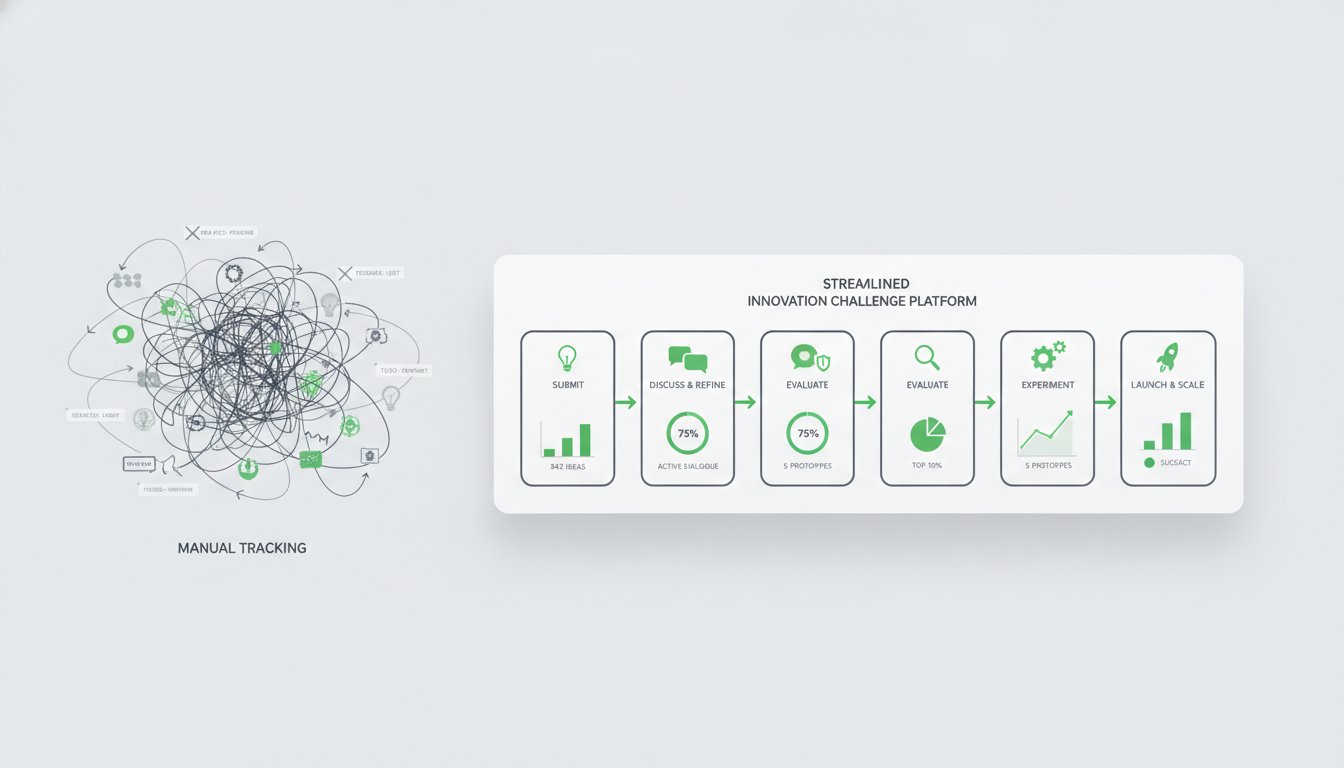
Most enterprise innovation programs fail because they treat creativity as a hobby rather than a measurable business asset. While over 65% of Fortune 500 companies have adopted formal innovation management solutions, many organizations still struggle with passive suggestion boxes that yield little more than administrative burnout. If you’re manually tracking ideas in spreadsheets, you aren’t running a program; you’re managing a bottleneck. Transitioning to a dedicated internal innovation challenge platform is no longer a luxury for the forward-thinking. It’s an operational necessity for any leader tasked with delivering documented financial impact in a market projected to reach over $3 billion by the end of 2026.

You likely recognize that the “post and pray” method of idea collection doesn’t work, yet finding the time to build a repeatable, automated system often feels out of reach. This guide changes that by providing a technical blueprint for launching challenges that scale without increasing your administrative workload. You’ll gain a comprehensive framework for automating evaluation workflows and generating the precise ROI reporting your executive stakeholders demand. We’ll explore how to move past the chaos of manual tracking and toward a system that turns internal insights into implemented, high-value results.

Key Takeaways

  • Learn how to transition from passive suggestion boxes to an active internal innovation challenge platform that focuses on solving specific business bottlenecks.
  • Master a repeatable 5-phase framework designed to move ideas from initial problem definition through to final implementation and ROI reporting.
  • Discover how to leverage AI-driven insights to automate the deduplication and categorization of ideas, eliminating administrative burnout.
  • Identify the critical difference between vanity metrics and impact metrics to provide executive stakeholders with clear evidence of financial gain.
  • Understand the technical requirements for a modern innovation architecture that balances high employee engagement with structured evaluation workflows.

Beyond the Suggestion Box: Why Modern Enterprises Need an Internal Innovation Challenge Platform

The digital suggestion box is where good ideas go to die. For decades, organizations have relied on passive feedback loops that result in cluttered spreadsheets and ignored submissions. An internal innovation challenge platform represents a fundamental shift from this “post and pray” model to a structured engine for problem solving. It isn’t just about collecting ideas; it’s about defining high-value problems and using a modern framework to automate the path to implementation. This approach aligns with the broader principles of open innovation, where internal and external insights are leveraged to drive technological and operational advancement.

Innovation chaos carries a heavy price tag. When ideas are lost in email threads or buried in outdated portals, you don’t just lose potential revenue; you lose employee trust. Disengaged employees stop contributing, and R&D spend is frequently wasted on projects that don’t align with core business goals. As we move through 2026, enterprise leaders are shifting toward outcome-oriented innovation. Over 65% of Fortune 500 companies have already adopted formal innovation management solutions to ensure their crowdsourcing efforts are linked directly to strategic OpEx targets and measurable growth.

The Failure of Legacy Innovation Software

First-generation platforms often failed because they prioritized volume over value. They created massive administrative overhead, requiring dedicated teams just to sort through repetitive or low-quality submissions. This created a “black hole” effect where employees never heard back about their ideas, leading to a rapid drop in participation. Modern architecture has solved this bottleneck. By utilizing intelligent triage and automated workflows, organizations can now reduce implementation time from months to just a few weeks. It’s a move from high-friction maintenance to high-impact execution.

Driving Cultural Transformation Through Structured Events

Active challenges do more than solve technical problems; they break down the departmental silos that stifle enterprise growth. When you launch a targeted event, you invite cross-functional collaboration that rarely happens during daily operations. This visibility allows leadership to validate employee contributions in real time, which is one of the primary benefits of employee ideation programs. By leveraging an internal innovation challenge platform, you transform innovation from a mysterious corporate buzzword into a repeatable, transparent process that rewards performance and drives cultural change across the entire organization.

The 2026 Internal Innovation Challenge Template: A 5-Phase Framework for Success

Structure creates the freedom to innovate. Without a repeatable process, even the most advanced internal innovation challenge platform becomes a source of organizational noise. High-performing enterprises don’t just ask for ideas; they deploy a rigorous 5-phase framework to move from initial problem identification to measurable financial gain. This systematic approach ensures that every challenge remains aligned with corporate strategy and delivers a documented return on investment.

  • Phase 1: Problem Definition – Move away from “give us your best ideas” toward “solve this specific operational bottleneck.” Precision is the primary driver of quality.
  • Phase 2: Targeted Crowdsourcing – Use your platform to segment audiences. Engaging the right stakeholders at the right time prevents participant fatigue and increases the relevance of submissions.
  • Phase 3: Collaborative Refinement – Raw concepts rarely survive contact with reality. Social features allow peers to build upon, critique, and strengthen initial ideas before they reach the evaluation stage.
  • Phase 4: Multi-Stage Evaluation – Shift from gut-feel decisions to data-driven scoring. This model is used by organizations like Challenge.gov to ensure transparency and objective solution sourcing in high-stakes environments.
  • Phase 5: Implementation and ROI Tracking – Close the loop. This final step transforms an idea from a digital submission into a verified business outcome.

Crafting the Perfect Challenge Statement

Success starts in the “Goldilocks Zone” of scope. If a challenge statement is too broad, you receive thousands of unactionable ideas. If it’s too narrow, you stifle creativity. Use a results-oriented formula: “How might we [action] for [stakeholder] to achieve [specific metric]?” This ensures every challenge aligns with your phases of continuous improvement, providing a clear path for executive buy-in and resource allocation.

Setting Evaluation Criteria That Predict Success

Transparency builds trust. Evaluate every submission based on three core pillars: feasibility (can we build it?), desirability (do users want it?), and viability (should we do it?). Providing a clear idea evaluation process and criteria prevents the “black hole” effect and keeps employees engaged for future events. If you’re ready to see how these automated evaluation phases look in practice, you can explore our platform's automated workflows to see how we remove the administrative burden from your team.

Essential Platform Features: The Technology Required to Scale Participation Without Chaos

Scaling an innovation program across a global enterprise requires more than just a good process; it requires a robust technical foundation. An internal innovation challenge platform must act as an intelligent filter rather than a simple bucket for raw data. Take NASA’s internal innovation challenge platform, NASA @ WORK, which has successfully sourced critical solutions since 2011. To achieve that level of longevity and impact, your technology must automate the heavy lifting that usually burns out innovation managers. Without the right features, you aren’t managing innovation; you’re just managing noise.

The Role of AI in Modern Innovation Management

Gamification: Why Competition Drives Participation

Engagement isn’t accidental; it’s engineered through social psychology. Gamification and incentives turn a corporate requirement into an engaging social experience. Leaderboards, digital badges, and voting mechanisms tap into the power of social proof. When employees see their peers participating and being recognized, they’re far more likely to contribute their own insights. For a deeper dive into these mechanics, see our guide on gamification for employee engagement to understand how to drive healthy competition. Remember that the most effective incentives often prioritize recognition and professional growth over simple monetary rewards.

Workflows and Security for the Global Enterprise

Flexibility and security are non-negotiable for modern organizations. Your internal innovation challenge platform must support custom stage-gate processes that adapt to the specific needs of different departments. A quick hackathon requires a different workflow than a multi-year R&D project. Finally, protect your internal intellectual property with enterprise-grade security. SOC 2 compliance and robust data protection ensure that your most valuable competitive advantages remain secure while still being accessible to the right internal stakeholders. This balance of transparency and security is what allows innovation to scale without compromising corporate integrity.

Measuring Impact: How to Quantify ROI and Long-Term Value from Internal Challenges

Stop measuring the wrong things. Many organizations fall into the trap of tracking “vanity metrics,” such as the total number of ideas submitted or the percentage of employees who logged in. While these numbers look good in a quarterly report, they don’t represent business value. A high-performance internal innovation challenge platform must prioritize “impact metrics” instead. These include verified cost savings, new revenue streams, and measurable improvements in operational efficiency. If your data doesn’t move the needle on your P&L statement, you aren’t measuring innovation; you’re measuring activity.

To provide a clear picture of success, you need an “Innovation Pipeline” view. This tracks the movement of concepts from the initial crowdsourcing phase through pilot testing and into final implementation. By monitoring this funnel, you can identify where ideas are stalling and address the “cost of inaction.” Calculating what your organization loses by ignoring a specific bottleneck often provides a more compelling case for executive stakeholders than the projected gains alone. Additionally, tracking year-over-year participation growth serves as a critical indicator of your organization’s cultural health and long-term commitment to problem-solving.

The Innovation ROI Calculator

Calculating the financial return of a single implemented idea requires a structured framework. Focus on tangible outcomes, such as the reduction of “Lean Waste” or the automation of manual tasks that previously consumed hundreds of labor hours. When you quantify these shifts, the value of your innovation program becomes undeniable. To simplify this process, you can access our idea management ROI calculator to determine the exact financial impact of your initiatives. Using data-backed calculations ensures your reporting remains authoritative and objective during budget reviews.

Closing the Loop: Feedback as a Retention Tool

Data shows that employees are significantly more engaged when they receive transparent feedback on their contributions. The “Implementation Gap,” which is the space between generating an idea and seeing it in action, is where most programs fail. Bridging this gap requires platform automation that keeps participants informed at every stage of the evaluation process. Failing to close this loop leads to the “black hole” effect mentioned earlier, which is one of the most common innovation failures seen in enterprise environments. When you demonstrate that employee insights lead to real change, you turn your innovation program into a powerful tool for talent retention.

Ready to transform your reporting from surface-level stats to deep financial insights? You can book a free demo today to see our ROI tracking and automated reporting features in action.

Why Ideawake is the Preferred Internal Innovation Challenge Platform for Modern Enterprises

Technology selection is the single most important factor in determining whether your innovation program survives its first year. Many legacy systems are essentially glorified databases that require months of configuration and extensive user training. Ideawake is engineered to eliminate this friction. Our internal innovation challenge platform is built for rapid deployment and high user adoption, ensuring that your team spends time solving problems rather than managing software. We provide a comprehensive, end-to-end solution that handles everything from the initial challenge launch to the final ROI measurement with surgical precision.

Choosing Ideawake means choosing a partnership for success. We recognize that software alone cannot fix a broken culture, which is why we provide the implementation support necessary to ensure your challenges actually deliver results. Our competitive edge is defined by three core outcomes: lower administrative overhead through automation, significantly higher employee participation rates, and a proven ability to document financial impact. We don’t just provide a portal; we provide a high-performance engine for organizational transformation.

Strategic Integration into Your Tech Stack

Innovation should not happen in a vacuum. To drive participation, your platform must fit seamlessly into the tools your employees already use every day. Ideawake facilitates this through a robust library of integrations, allowing ideas to flow between your innovation hub and your existing project management tools. We prioritize ease of access with Single Sign-On (SSO) and a mobile-first design that empowers frontline workers to contribute insights from the factory floor or the field. This commitment to accessibility is a primary reason why we are consistently ranked among the best innovation management software options for modern enterprises.

Taking the Next Step: Build vs. Buy

Many organizations initially attempt to build their own internal tools using generic platforms like SharePoint. This “build it yourself” approach often leads to the administrative chaos we have discussed in previous sections. Generic tools lack the specialized gamification, AI triage, and automated evaluation workflows that drive engagement. Research indicates that specialized platforms outperform generic internal builds by 10x in terms of employee participation and implemented ideas. Before committing internal R&D resources to a custom build, review our comprehensive build vs buy idea management software guide to understand the long-term total cost of ownership and the impact on your innovation ROI.

Transform Your Organization into a Problem-Solving Engine

Innovation is no longer a peripheral corporate activity; it’s a core operational discipline that requires a structured framework to succeed. By moving beyond the passive suggestion box and adopting a rigorous 5-phase template, you transform raw employee insights into implemented solutions that drive measurable growth. Integrating a dedicated internal innovation challenge platform ensures that your program scales without the administrative chaos of manual tracking or redundant submissions. You’ve seen how AI-driven triage and data-driven ROI reporting can bridge the implementation gap, turning potential ideas into verified financial assets.

Ideawake is SOC 2 Type II Certified and has been voted #1 for Ease of Use and Implementation by global enterprises that have used our system to drive millions in documented ROI. We provide the modern architecture and expert partnership necessary to help you outpace the competition and foster a high-performance culture of continuous improvement. Your organization’s next major breakthrough is likely already sitting in the minds of your frontline workers. It’s time to build the automated system that brings those insights to life and delivers the results your stakeholders demand.

Ready to launch your first challenge? Sign up for a demo of Ideawake today.

Frequently Asked Questions

What is an internal innovation challenge platform?

An internal innovation challenge platform is a structured software solution designed to crowdsource solutions to specific business problems from an organization’s own workforce. Unlike a passive suggestion box, it facilitates “active challenges” where leadership defines a clear problem statement and employees collaborate to solve it. It serves as a centralized engine for managing the entire lifecycle of an idea, from initial submission and peer refinement to final implementation and ROI tracking.

How do I choose the best platform for innovation challenges?

Prioritize three core pillars: ease of use, automation capabilities, and reporting depth. You need a solution that offers SOC 2 Type II security and integrates with your existing tech stack via SSO to ensure high adoption rates. A modern internal innovation challenge platform should also include AI-driven triage to handle high submission volumes without increasing your administrative workload. Focus on tools that offer a transparent evaluation process to maintain employee trust.

How long does it take to implement an innovation challenge platform?

Modern cloud-based solutions typically require two to four weeks for full deployment. While legacy enterprise software often demanded months of custom development and extensive training, current architectures allow for rapid onboarding and immediate challenge launching. This speed is critical because it allows organizations to respond to market shifts in real time. Implementation success is usually driven by how quickly you can move from software setup to your first live event.

Can we run a challenge without specialized software?

You can use spreadsheets or generic tools like SharePoint, but these methods often lead to administrative burnout and “innovation chaos.” Manual tracking lacks the automated evaluation workflows and gamification features that drive engagement, which often results in a 10x lower participation rate than specialized tools. Without a dedicated platform, you’ll likely struggle to prove the financial impact of your program to executive stakeholders, making it difficult to sustain long-term funding.

How do we motivate employees to participate in innovation challenges?

Motivation is driven by a combination of social recognition and transparent feedback loops. Use gamification elements like leaderboards and digital badges to tap into social proof and healthy competition. Research shows that employees are most engaged when they see their ideas move through a visible pipeline and receive direct acknowledgement from leadership. It’s about moving away from monetary rewards and toward professional growth and the opportunity to impact the company’s future.

What are the common pitfalls of internal innovation challenges?

The most frequent failure is the “black hole” effect, where employees never hear back about their submissions. This leads to immediate disengagement and a rapid drop in future participation. Other pitfalls include setting challenge statements that are too broad, failing to define evaluation criteria early, or ignoring the “cost of inaction” when reviewing potential solutions. Success requires closing the loop on every idea, whether it moves to implementation or not.

How does AI improve the innovation challenge process?

What is the typical ROI for an internal innovation challenge?

Typical ROI focuses on “impact metrics” such as verified cost savings, new revenue generation, and the reduction of lean waste. Organizations using a dedicated internal innovation challenge platform frequently document millions in returns by identifying operational bottlenecks that were previously invisible to leadership. With cloud-based solutions accounting for nearly 75% of deployments, the ability to track these financial gains in real time has become a standard requirement for any high-performing enterprise program.

Article by

Coby Skonord

Coby Skonord is the co-founder and CEO of Ideawake. Since 2013 he has worked with enterprise innovation, continuous improvement, and HR leaders to turn employee ideas into measurable business impact.

Idea Selection Criteria for Innovation: The 2026 Framework for Data-Driven Scoring

Idea Selection Criteria for Innovation: The 2026 Framework for Data-Driven Scoring
Coby Skonord|
June 28, 2026

While global AI spending is projected to hit $2.52 trillion in 2026, a January 2026 PwC survey revealed that 56% of CEOs have seen zero revenue growth or cost savings from these significant investments. The problem isn’t a lack of technology; it’s a failure of selection. Most innovation pipelines are currently clogged with low-value “pet projects” that survive on executive whim rather than data-backed potential. You’ve likely felt the frustration of watching high-potential concepts stall while mediocre ideas drain your resources and damage your credibility with the board.

It’s time to move beyond the “gut-feel” voting that turns innovation into a gamble. You’ll master the objective idea selection criteria for innovation and the weighted scoring tools necessary to filter noise and identify the high-impact ideas that drive measurable enterprise ROI. We’ll break down the 2026 framework for multi-dimensional evaluation, ensuring your process aligns with the new ISO 56001:2024 certifiable standards while removing the subjective bias that kills performance. By the end of this guide, you’ll have a repeatable system to transform your pipeline from a chaotic backlog into a strategic driver for growth.

Key Takeaways

  • Solve the “signal-to-noise” problem by identifying the high-impact concepts that deliver measurable enterprise value rather than just volume.
  • Establish objective idea selection criteria for innovation to eliminate executive bias and ensure every project aligns with your 2026 corporate objectives.
  • Master weighted scoring mechanics to objectively rank ideas based on their potential ROI versus the technical complexity of implementation.
  • Replace error-prone spreadsheets with dedicated scoring tools that provide real-time visibility and automated reporting across your entire innovation pipeline.
  • Leverage AI-enhanced evaluation to automatically detect duplicates and predict implementation success based on historical performance data.

What is Idea Selection Criteria and Why Does It Matter in 2026?

In 2026, the primary bottleneck for enterprise growth isn’t a lack of ideas; it’s the inability to identify the winners. Idea selection criteria for innovation are the objective benchmarks used to assess the viability, scalability, and strategic value of a concept before a single dollar is committed to development. Without these filters, organizations fall into the “Signal-to-Noise” trap. While AI tools have made it easier to generate thousands of suggestions, a high volume of ideas often leads to less actual innovation because the truly transformative concepts get buried under a mountain of low-value noise.

Successful enterprises have abandoned popularity-based voting systems. Likes and comments are social metrics, not business ones. Instead, high-performing leaders now rely on evidence-based scoring that requires a structured idea submission process to ensure every entry contains the data points necessary for a rigorous evaluation. This transition turns the selection engine from a black box into a transparent, high-performance filter that prioritizes outcomes over optics.

The High Cost of Subjective Innovation

When selection is left to intuition, the “HiPPO” (Highest Paid Person’s Opinion) effect dominates the room. This hierarchy-driven decision making silences diverse perspectives and favors “safe” projects that align with an executive’s personal preferences rather than market reality. Research into organizational behavior consistently shows that cognitive biases lead teams to choose incremental improvements over radical breakthroughs because they feel less risky. This subjectivity is expensive. The Innovation Gap is the measurable distance between the volume of ideas generated and the percentage of those ideas that successfully reach implementation.

Transitioning from Intuition to Data-Driven Decisions

The Weighted Scoring Model: A Framework for Objective Evaluation

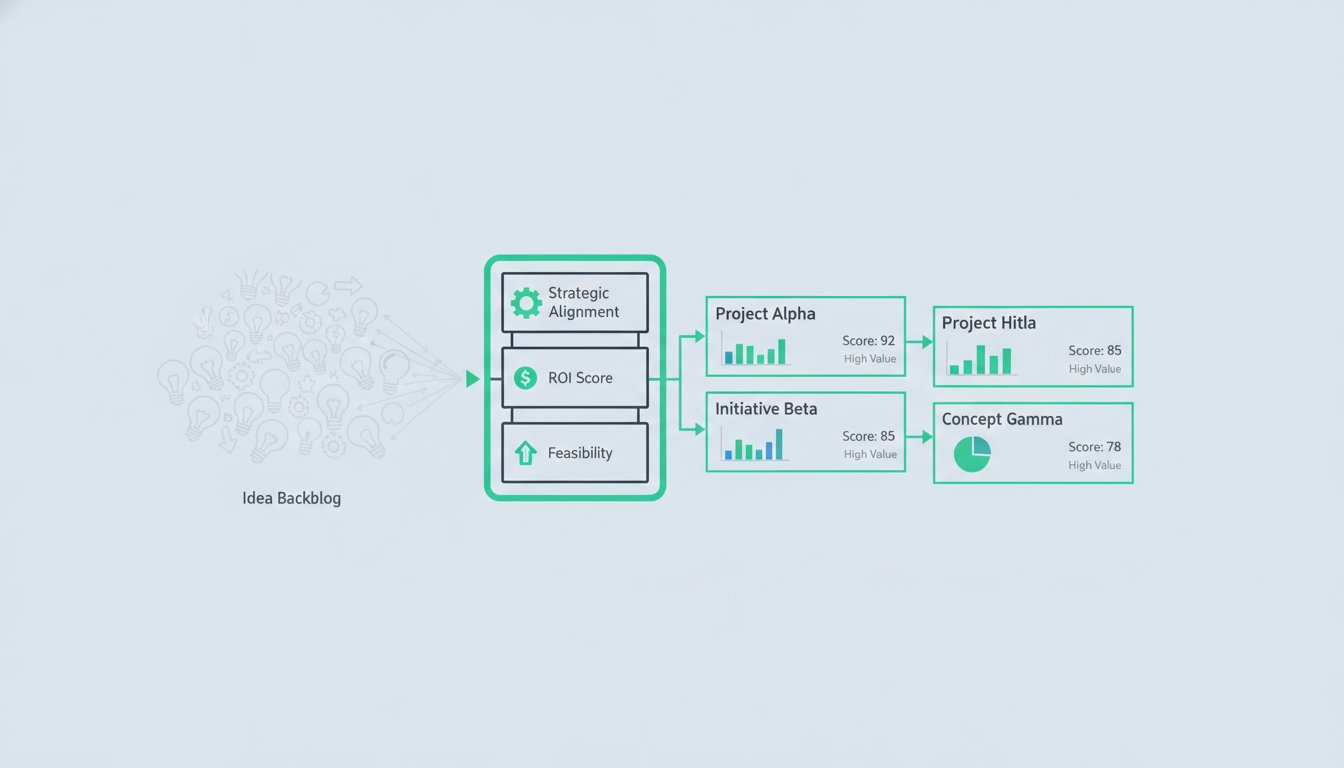
Stop treating every metric as if it carries the same weight. In a high-performance innovation ecosystem, an idea’s potential market impact must always outweigh its ease of implementation. If you prioritize “low-hanging fruit” simply because it’s easy to do, you’ll inevitably build a portfolio of mediocrity that fails to move the needle on corporate strategy. A weighted scoring model corrects this by assigning a percentage of importance to each of your idea selection criteria for innovation, ensuring that the most transformative concepts rise to the top.

The mechanics are straightforward but powerful. For every idea, evaluators provide a raw score for specific criteria, which is then multiplied by a predetermined weight (Score x Weight = Total Value). This mathematical approach creates a single, undeniable ranking of your pipeline. To maintain high standards, organizations should implement a “Threshold” concept. This is a minimum aggregate score an idea must achieve to move from the discovery phase into prototyping. If a concept doesn’t hit the mark, it’s archived, preventing your team from wasting cycles on projects that lack the “DNA” of a winner. Tracking these scores requires a centralized innovation database rather than disconnected documents to ensure historical data informs future decisions.

Defining Your Evaluation Scales

Precision starts with your scale. While a 10-point scale offers more nuance, it often leads to “score creep” where evaluators struggle to distinguish a 7 from an 8. A 5-point scale is typically the sweet spot for enterprise evaluation because it forces more decisive choices. To ensure consistency across different departments, you must define “anchor points.” For example, a “5” in Strategic Alignment should mean the idea directly addresses a top-three corporate KPI for the current fiscal year. Choosing an odd-numbered scale like 1 to 5 allows for a middle ground, but be careful. Including “Neutral” options in evaluation scales often leads to decision paralysis because it allows stakeholders to avoid taking a definitive stance on high-potential risks.

Balancing Qualitative and Quantitative Inputs

Numbers provide the structure, but expert commentary provides the soul. A robust framework integrates numerical scores with qualitative feedback to give leadership a holistic view of an idea’s potential. This is particularly important when weighing “Strategic Alignment” against “Technical Feasibility.” An idea might score perfectly on alignment but poorly on feasibility; the qualitative input explains whether that feasibility gap is a temporary resource issue or a permanent technological barrier. Remember that evaluation is a multi-stage process. You shouldn’t demand a detailed ROI projection in the early funnel. Use broader criteria for initial screening and save the intensive, data-heavy scoring for the final few candidates. To see how these models look in action, you can explore a live evaluation framework designed for enterprise scale.

Idea Evaluation and Scoring Tool: Spreadsheets vs. Dedicated Platforms

Many organizations start their innovation journey with a spreadsheet. It’s accessible and familiar. However, once your pipeline expands beyond a handful of concepts, manual tracking becomes a primary driver of “Innovation Overhead.” Spreadsheets suffer from chronic version control issues and lack the real-time collaboration required for cross-functional teams. When your idea selection criteria for innovation are trapped in a static document, the process slows to a crawl, often leading to the very “pet projects” you’re trying to avoid. Manual data entry isn’t just tedious; it’s a liability that introduces human error into your most critical investment decisions.

Transitioning to a dedicated idea evaluation and scoring tool changes the game. These platforms automate the complex math and reporting that consume hours of administrative time. By shifting from manual calculations to automated systems, innovation managers can focus on strategy rather than logistics. Data from the Ideawake vs Spreadsheets comparison shows that organizations can reduce the time spent on administrative tasks by up to 80%, allowing teams to move from submission to implementation at a significantly faster pace.

The Hidden Complexity of Manual Scoring

Manual tools fail the moment you scale. Handling 100 or more ideas from diverse departments creates a logistical nightmare in Excel. Data silos form quickly, as insights from one evaluator are rarely visible to another in a meaningful way. Legacy innovation software often replicates these silos by offering rigid structures that don’t adapt to your specific needs. Modern platforms solve this by enabling “Blind Scoring.” This feature hides the identity of the idea submitter and other evaluators’ scores until the process is complete, which is a critical step in neutralizing the cognitive biases discussed earlier. For organizations ready to move beyond these limitations, a collaborative idea management platform provides the cross-functional visibility and structured workflows needed to evaluate ideas at enterprise scale.

Features to Look for in a Modern Scoring Platform

5 Essential Idea Selection Criteria for Maximum ROI in 2026

  • Strategic Alignment: Does the idea directly solve a problem identified in your 2026 corporate roadmap?
  • Customer/Market Impact: Will this fundamentally solve a pain point for the end-user, or is it just a “nice-to-have” feature?
  • Technical & Financial Feasibility: Do we possess the internal expertise to execute this, and is the cost-to-benefit ratio favorable?
  • Scalability: Can this solution be expanded across other departments or global markets without a linear increase in resource consumption?
  • Risk Level: What are the regulatory hurdles, and could a failure cause significant reputational or financial damage?

Strategic Alignment: The Ultimate Filter

Alignment is the difference between genuine progress and “Innovation Theater.” You will frequently encounter “great” ideas that are technically brilliant but completely irrelevant to your company’s current focus. You must have the discipline to reject these. Pursuing projects that look good on paper but lack strategic depth drains your resources and creates a “drift” that confuses stakeholders and investors. To quantify the value of staying on track, use an Ideawake ROI calculator to model how tight alignment correlates with long-term financial outcomes.

Feasibility vs. Desirability

The “Sweet Spot” of innovation exists where high user desirability intersects with organizational capability. If you find an idea that customers crave but your team cannot build, it is a hallucination. Conversely, building something your team excels at that no one actually wants is a waste of capital. Use a 2×2 matrix to visualize your pipeline, separating “Low Hanging Fruit” from “Big Bets.” Involve your technical leads early in the feasibility scoring phase to prevent “zombie projects” from eating your budget before they’re even prototyped. To see how these idea selection criteria for innovation are built into a high-performance workflow, you can book a free demo of our evaluation framework today.

Beyond Human Bias: Leveraging AI in the Selection Process

The human element is both the greatest asset and the largest liability in the evaluation process. Even with the most robust idea selection criteria for innovation, human reviewers are susceptible to fatigue, departmental favoritism, and subconscious “safe” choices. By 2026, the pivot toward AI accountability requires more than just human intuition to justify capital allocation. Integrating Ideawake AI into your workflow provides a neutral layer of analysis that identifies patterns humans often miss. Automated duplicate detection immediately flags redundant concepts, while sentiment analysis helps gauge the underlying enthusiasm or skepticism within the workforce before a project is even greenlit.

These AI tools for innovation managers serve as a force multiplier for stretched teams. They can summarize thousand-word proposals into actionable executive briefs, allowing for a faster review of complex technical concepts. However, it’s vital to remember that AI is designed to assist, not replace, the final human decision. The technology provides the data-backed “why,” but leadership provides the strategic “how.” By using machine learning to cross-reference new ideas with historical data, organizations can better predict implementation success and avoid the ROI disconnect that currently plagues 56% of enterprise AI investments.

Mitigating Cognitive Bias with Machine Learning

Machine learning models excel at identifying the subtle patterns of bias that skew human scoring. Whether it is a preference for certain departments or a gender-based tilt in project approval, AI can audit historical scoring data to flag inconsistencies. This ensures that your idea selection criteria for innovation are applied with total objectivity across the entire enterprise. Looking ahead, “Predictive Scoring” is becoming the standard. By cross-referencing new submissions with real-time market trends and internal performance metrics, AI can predict implementation success with higher accuracy than a traditional committee. It can even suggest diverse “Review Committees” by identifying subject matter experts across the organization who possess the specific knowledge required to evaluate a niche concept.

Accelerating the Review Cycle

The traditional innovation funnel is often where high-potential concepts go to die. Slow decision-making kills enthusiasm and allows competitors to move first. Leveraging automated workflows can reduce the time-to-decision from months to mere days. When an idea is submitted, the system can provide instant feedback or request missing data points immediately, maintaining a high-energy culture of participation. This speed isn’t just about efficiency; it’s about competitive survival. In a market where 57% of leaders report AI is already embedded in core processes, the ability to filter and fund winners faster than the competition is the ultimate differentiator. Ready to see data-driven selection in action? Sign up for a demo of Ideawake and transform your innovation pipeline today.

Transforming Your Pipeline into a Strategic Growth Engine

The era of “innovation theater” is over. Success in 2026 requires a shift from gut-feel voting to rigorous, weighted scoring models. By establishing objective idea selection criteria for innovation, you eliminate the cognitive biases that lead to mediocre “safe” projects and instead prioritize concepts with the highest potential for enterprise ROI. Moving beyond manual spreadsheets allows your organization to scale without the administrative burden that typically stalls early-stage concepts. It’s time to stop gambling on intuition and start investing in proven winners.

Ideawake provides an end-to-end platform used by Fortune 500 companies to transform their innovation culture into a measurable financial driver. Our AI-driven insights reduce administrative overhead by 80%; this allows your team to focus on implementation rather than data entry. Master your innovation pipeline with Ideawake’s evaluation tools and secure your organization’s competitive edge. Your next breakthrough is waiting for a better filter.

Frequently Asked Questions

What are the most common idea selection criteria for enterprise innovation?

The most common criteria include strategic alignment, customer impact, technical feasibility, scalability, and financial risk. These benchmarks ensure that a concept isn’t just creative but actually viable within the organization’s current resource constraints. By using these five pillars, leaders can filter out noise and focus on concepts that deliver a measurable return on investment.

How do you weigh different criteria in an innovation scoring model?

You weigh criteria by assigning a percentage value to each category based on your current corporate priorities. For example, a growth-focused firm might weight “Market Impact” at 40% while keeping “Ease of Implementation” at 10%. This ensures that high-impact ideas aren’t penalized simply because they require more effort to execute. The total weight across all categories must always equal 100%.

Can an idea management platform really remove human bias?

While no tool can eliminate human bias entirely, a dedicated platform significantly mitigates it through features like “Blind Scoring” and AI-driven sentiment analysis. These tools hide the identity of the submitter and prevent evaluators from seeing each other’s scores until the process is complete. This forces reviewers to focus on the objective data rather than personal or departmental favoritism.

What is the difference between idea evaluation and idea selection?

Idea evaluation is the analytical process of scoring a concept against specific benchmarks; selection is the final decision to allocate resources or fund the project. Evaluation provides the data-backed evidence needed to make an informed choice. Selection is the strategic action that moves an idea from the “Value Pipeline” into active development or prototyping.

How many people should be involved in the scoring process?

Most high-performing organizations involve 3 to 5 subject matter experts per idea to ensure a balanced perspective. Including too few reviewers increases the risk of individual bias; including more than five often leads to administrative bottlenecks and decision paralysis. The goal is to gather diverse insights from technical, financial, and market-facing leads without stalling the review cycle.

Why is strategic alignment considered the most important criterion?

Strategic alignment is the most critical idea selection criteria for innovation because it ensures that every project directly supports the organization’s long-term roadmap. Even a technically brilliant idea is a waste of capital if it doesn’t solve a problem the company is actually trying to fix. Alignment prevents the “Innovation Theater” that drains budgets without producing a strategic advantage.

How often should we update our selection criteria?

You should review and update your selection criteria at least once a year or whenever your corporate strategy undergoes a major shift. As market conditions change, what was considered a “high impact” project last year might be irrelevant today. Keeping your filters updated ensures your innovation pipeline remains responsive to new competitive threats and market opportunities.

What is the “weighted scoring” method exactly?

The weighted scoring method is a mathematical formula where you multiply a raw score by a predetermined weight to reach a final value. If “Strategic Alignment” has a weight of 0.5 and the idea scores an 8, the weighted value is 4. This method provides a clear, numerical ranking that makes it impossible for subjective opinions to override your data-backed priorities.

Article by

Coby Skonord

Coby Skonord is the co-founder and CEO of Ideawake. Since 2013 he has worked with enterprise innovation, continuous improvement, and HR leaders to turn employee ideas into measurable business impact.

Innovation Lifecycle Management: From Raw Concept to Measurable ROI in 2026

Innovation Lifecycle Management: From Raw Concept to Measurable ROI in 2026
Coby Skonord|
June 10, 2026

Stop pretending that a “suggestion box” is a strategy. Most organizations treat innovation as a creative hobby rather than a high-velocity engine, watching helplessly as their most transformative concepts vanish into an administrative black hole. You’ve likely felt the sting of a brilliant idea stalling out because of manual tracking, slow approval loops, and low employee engagement. It’s frustrating, it’s expensive, and in a market where 88% of companies are already weaponizing AI to accelerate their growth, it’s a recipe for obsolescence.

You’re here because you’re tired of average results and ready to master a discipline that actually moves the needle. This article provides the definitive framework for innovation lifecycle management, designed to transform your chaotic ideation into a streamlined, high-impact pipeline. We’ll show you how to leverage the latest ISO 56001 standards and automated workflows to slash your time-to-market. You’ll learn to bridge the gap between a raw concept and measurable ROI, turning your organization into a relentless innovation machine that leaves the competition behind. It’s time to stop guessing and start engineering success.

Key Takeaways

  • Shift from accidental innovation to a disciplined, end-to-end system that captures and scales high-value concepts with total precision.
  • Deploy a high-velocity 5-stage innovation lifecycle management framework that uses clear gate criteria to stop resource waste before it starts.
  • Eliminate the “Innovation Black Hole” and administrative chaos that kill momentum and drain employee engagement across your enterprise.
  • Weaponize AI and automated workflows to strip away manual grunt work, leaving your team free to focus on driving massive organizational transformation.
  • Learn how to achieve a dramatic reduction in implementation time by adopting a modern architecture built for speed and measurable ROI.

What is Innovation Lifecycle Management?

Stop crossing your fingers and hoping for a breakthrough. Most companies suffer from “accidental innovation,” a lucky strike that they can’t repeat. True innovation lifecycle management is the aggressive, end-to-end system for capturing, vetting, and scaling value. It’s the difference between a one-hit wonder and a high-impact engine. If you aren’t engineering your success, you’re just waiting for a miracle that might never come. This is about taking control of the chaos and turning it into a predictable, repeatable revenue driver.

This discipline moves beyond abstract concepts. It is grounded in the broader field of Innovation Management; however, it focuses specifically on the flow of an idea from a raw spark to a line item on your balance sheet. Without a structured lifecycle, you’re stuck in “innovation theater.” That’s the dangerous trap where you have plenty of brainstorming sessions and colorful sticky notes but zero market impact. Modern leaders are ditching manual spreadsheets and fragmented emails. They are moving toward dedicated innovation management platforms to gain total visibility over their pipeline and ensure every dollar spent is an investment, not a gamble.

The Strategic Core: Why Structure Wins

Structure isn’t a cage; it’s a launchpad. Effective innovation lifecycle management aligns every frontline suggestion with your top-down corporate goals. It ensures that your team isn’t wasting energy on “cool” projects that don’t serve the bottom line. Transparency is the secret weapon here. When employees see a clear, visible path for their ideas, trust skyrockets. They stop feeling like their contributions are falling into a void. Structure protects the creative process by providing the resources and roadmap needed to turn a vision into reality. It gives you the power to say “no” to distractions so you can say “yes” to disruption.

Linear vs. Iterative Lifecycles

Forget the old myth of the straight line. In 2026, the idea that you move perfectly from “Step A” to “Step B” is dead. Modern development requires high-velocity “fail fast” loops. You need a cyclical approach where you test, break, and refine concepts in real-time. This iterative flow is the heart of continuous improvement. It allows you to kill low-value projects early before they drain your budget. This isn’t just about speed. It’s about building a resilient system that learns from every failure to ensure the final output is bulletproof. You don’t just launch; you evolve.

The 5 High-Velocity Stages of the Innovation Lifecycle

Stop treating your innovation pipeline like a dumping ground. Most organizations fail because they lack a filter, allowing low-value “noise” to drown out the billion-dollar breakthroughs. A high-performance innovation lifecycle management system acts as a rigorous sieve, designed for speed and absolute accountability. You need a model that moves fast but refuses to compromise on quality. Each stage must have strict “gate” criteria to stop resource waste before it starts. If a concept can’t prove its worth at the gate, it dies. This isn’t cruelty; it’s a competitive necessity. This lifecycle is a continuous loop that feeds back into your continuous improvement efforts, ensuring that every launch informs the next spark.

Stage 1 & 2: Capture and Refine

Innovation is a team sport, not an executive privilege. You must crowdsource ideas from your employees, customers, and partners simultaneously to gain a 360-degree view of your potential. Raw ideas are often messy. Use collaborative refinement to let your community polish those concepts into something viable. This is where gamification becomes your best friend. Use voting and leaderboards to spark healthy competition; it’s the fastest way to drive high-quality participation. When the stakes are visible, the best ideas naturally rise to the top. If you want to see this in action, consider how an automated idea management platform can handle this volume without breaking a sweat.

Stage 3 & 4: Evaluate and Validate

Remove the “who you know” bias from your selection process. You need objective scoring models that weigh ideas against your strategic goals, technical feasibility, and market demand. This keeps the process fair and results-driven. These stages serve as the ultimate stress tests. Use rapid prototyping and business case development to find the cracks in a concept before you commit serious capital. For a deeper look at how to structure these gates, the Innovation Management Framework provides a research-backed approach to balancing risk and reward. You can also run targeted innovation challenges to solve specific, high-stakes problems with laser precision.

Stage 5: Implement and Measure ROI

This is where the rubber meets the road. Successful concepts must transition seamlessly from the innovation pipeline to your project management office for full-scale execution. ROI tracking is the only true metric of innovation success. If you can’t measure the financial impact, you’re just playing around. You must link every implemented idea back to hard financial or operational KPIs, such as cost savings, new revenue streams, or hours of labor recovered. This data doesn’t just justify your program; it fuels the next cycle of growth by proving that innovation is a profit center, not a cost center.

Stop the Chaos: Why Most Innovation Lifecycles Fail

Most innovation programs are dead on arrival. They quickly devolve into a “Black Hole” where brilliant ideas go to die, swallowed by bureaucratic silence and indecision. This is the ultimate failure of innovation lifecycle management. When your best people realize their contributions vanish without a trace, they stop contributing entirely. You can’t run a high-performance engine on an empty tank. If your intake process isn’t followed by immediate, visible action, you aren’t managing innovation; you’re just hosting a digital graveyard.

Subjectivity is the enemy of ROI. Far too often, the “HIPPO”, which is the Highest Paid Person’s Opinion, dictates which projects move forward. This ego-driven selection process ignores market data and technical feasibility, leading to massive resource waste on vanity projects. Worse yet, a lack of executive visibility means leadership can’t see the value being created. Without clear dashboards and real-time reporting, innovation looks like a nebulous expense. When the next budget cycle hits, these invisible programs are the first to be gutted. You need data to defend your seat at the table.

The Administrative Overhead Trap

Administrative Paralysis is the #1 killer of enterprise innovation. If your process relies on a chaotic mess of emails and spreadsheets, you’re bleeding time and money. Consider the hidden financial drain of manual tracking. Managers spend countless hours updating status reports and chasing approvals through fragmented channels. This friction leads to inconsistent evaluations and missed opportunities. High-impact concepts stall in the pipeline while mediocre ideas stay on life support simply because no one has the data to kill them. Manual “Email and Spreadsheet” innovation isn’t just slow; it’s a recipe for total stagnation. To break this cycle, organizations need enterprise innovation tools designed for execution rather than just ideation.

The Engagement Gap

Top-down mandates fail because they ignore the goldmine of frontline insights. The most dangerous failure in the lifecycle is the broken feedback loop. When a contributor is left in the dark, the psychological fallout is devastating. They don’t just stop submitting ideas; they lose faith in the organization’s mission. A non-transparent process breeds a culture of cynicism where employees feel like their expertise is irrelevant. You don’t just lose a single idea; you lose the very spirit of innovation across your workforce. To dominate in 2026, you must replace this “Black Hole” with radical transparency and automated updates that keep every contributor in the loop.

Modernizing the Workflow: AI and Automation in 2026

AI-Powered Idea Evaluation

Stop drowning in a sea of duplicate submissions and fragmented data. AI now automatically categorizes and deduplicates hundreds of entries in seconds, ensuring your pipeline remains lean and relevant. It uses sophisticated sentiment analysis to gauge community excitement, identifying the “hidden gems” that resonate most with your workforce. By leveraging historical data, AI-driven scoring models flag high-potential concepts with surgical precision. This removes human bias and ensures that the most impactful winners get the attention they deserve. It’s not just about efficiency. It’s a total reimagining of how we value and prioritize human creativity.

Automating the Implementation Pipeline

The transition from a winning idea to a live project is usually where momentum dies. Automation fixes this by triggering workflows the moment a “gate” approval is granted. You don’t need to send another “status update” email ever again. These systems keep every stakeholder informed through automated notifications, ensuring absolute accountability across the board. By integrating your innovation lifecycle management platform directly with execution tools like Jira or Trello, you bridge the gap between inspiration and implementation. If you’re ready to weaponize these tools and eliminate administrative friction, explore how the Ideawake Idea Management Platform can automate your entire workflow from spark to scale.

The Ideawake Edge: Innovation Lifecycles Built for Scale

Stop settling for fragmented tools that only handle half the job. Most platforms are nothing more than glorified digital suggestion boxes that leave you stranded when it’s time to actually execute. Ideawake is the modern architecture built for high-impact results. It provides a relentless, end-to-end framework that takes you from the first raw spark to a definitive ROI calculation. This is the only innovation lifecycle management solution designed to eliminate administrative friction and maximize output. It’s built for leaders who demand speed and refuse to accept mediocrity. By automating the grunt work, you can dramatically slash implementation time and focus your energy on scaling the winners.

End-to-End Visibility and Accountability

Chaos is the enemy of growth. Ideawake provides a “Single Source of Truth” that brings every stakeholder into alignment. No more chasing updates across multiple departments or losing track of high-potential concepts in buried email threads. Our executive dashboard turns your innovation pipeline into a predictable line item, giving leadership the real-time data they need to make bold decisions. We don’t just ask for participation; we engineer it. Our gamification features ensure total engagement from the frontline, turning the ideation process into a high-energy competition where everyone is invested in the outcome. This isn’t just software. It’s a culture shift.

ROI Measurement That Numbers Don’t Lie About

Innovation without measurement is just a hobby. Ideawake provides specialized tools that track the hard financial impact of every implemented idea. Whether it’s direct cost savings or new revenue streams, you’ll have the data to prove exactly how much value your program is generating. This level of transparency is your strongest weapon during budget season. Use our data-driven analytics to justify your spend and expand your innovation initiatives with total confidence. You aren’t just guessing anymore. You’re operating with a level of precision that makes success inevitable. See how Ideawake turns ideas into ROI today and stop leaving your organization’s future to chance.

Dominate the Future of Innovation

The era of “hoping for the best” is over. You’ve seen how a high-velocity innovation lifecycle management framework replaces administrative chaos with a streamlined engine for growth. By leveraging AI-driven innovation insights and gamified participation engines, you can finally capture the untapped potential of your entire workforce. It’s time to stop letting brilliant ideas die in the void and start scaling the concepts that actually move your bottom line. Mediocrity is a choice, and it’s one your organization can no longer afford to make.

You have the roadmap. Now you need the high-performance engine to drive it. Ideawake provides the end-to-end visibility and specialized ROI tracking capabilities required to turn innovation from a nebulous cost center into a massive, predictable profit driver. Don’t let your competition outpace you while you’re stuck managing manual spreadsheets and broken feedback loops. Take absolute control of your organization’s destiny and build a culture where measurable results are the only metric that matters. Your transformation into a market leader starts with a single, decisive step.

Ready to turn raw ideas into pure ROI? Book a high-energy demo of Ideawake today.

Success isn’t a happy accident. It’s engineered. Go out and build the future you’ve been talking about.

Frequently Asked Questions

What is the main goal of innovation lifecycle management?

The primary objective is to transform raw, chaotic ideas into measurable business value with maximum velocity and zero waste. It isn’t just about collecting suggestions; it’s about engineering a repeatable, high-performance flow from the initial spark to full-scale implementation. By creating a disciplined system, you ensure that innovation becomes a predictable revenue driver rather than a series of lucky accidents.

How does innovation lifecycle management differ from project management?

Innovation management focuses on the “what” and “why,” while project management handles the “how.” While project management is about execution and efficiency within defined parameters, innovation lifecycle management is about discovery, vetting, and validating concepts before they ever reach the project stage. It acts as the critical filter that ensures your project management office only works on high-impact winners.

Can innovation lifecycle management work for small teams or is it just for enterprises?

Structure is essential for small teams that cannot afford to waste limited resources on low-value experiments. Small teams actually have a speed advantage, allowing them to iterate through failure loops much faster than bloated enterprises. Implementing a structured lifecycle early prevents the administrative chaos that typically kills growth as a team begins to scale and the volume of ideas increases.

How do you measure the success of an innovation lifecycle?

Success is measured by hard financial and operational KPIs, specifically ROI, cost savings, and new revenue generated. You should also track velocity metrics, such as the time it takes to move an idea from intake to implementation. If you can’t link an innovation initiative back to a line item on your balance sheet, you haven’t reached the end of the lifecycle yet.

What role does AI play in the innovation lifecycle in 2026?

In 2026, AI acts as a force multiplier by automating idea categorization, deduplication, and predictive scoring. It removes the manual grunt work of vetting hundreds of submissions and identifies market trends before they become obvious to your competitors. This allows managers to shift from reactive tracking to proactive strategy, using data-driven insights to launch targeted innovation challenges that solve future problems today.

How do you prevent an innovation pipeline from becoming a “black hole” for ideas?

Radical transparency and automated feedback loops are the only way to kill the black hole effect. Contributors must receive instant, visible updates on the status of their ideas at every stage of the gate process. When you use an innovation lifecycle management platform to automate these communications, you maintain high engagement and prove to your team that their insights are actually being valued.

What are the most common bottlenecks in the innovation lifecycle?

The most frequent bottlenecks occur at the evaluation and approval stages due to subjective decision-making and slow manual sign-offs. Programs often stall when they rely on a single executive’s opinion rather than objective scoring models. Transitioning from the innovation pipeline to the execution team is another common friction point that can be solved through automated workflow triggers and deep platform integration.

Is innovation lifecycle management software worth the investment for a startup?

It is a critical investment because startups live or die by their ability to pivot and scale the right ideas. Relying on ad-hoc methods leads to inconsistent results and burned capital. A dedicated platform provides the structure needed to attract investors by showing a disciplined, data-backed approach to product development and market disruption from day one.

Article by

Coby Skonord

Coby Skonord is the co-founder and CEO of Ideawake. Since 2013 he has worked with enterprise innovation, continuous improvement, and HR leaders to turn employee ideas into measurable business impact.