
Tag Archives: Frontline Innovation

Frontline Innovation in Action: The Flamin’ Hot Cheetos Story

Frontline Innovation in Action: The Flamin’ Hot Cheetos Story
Coby Skonord|
October 11, 2026

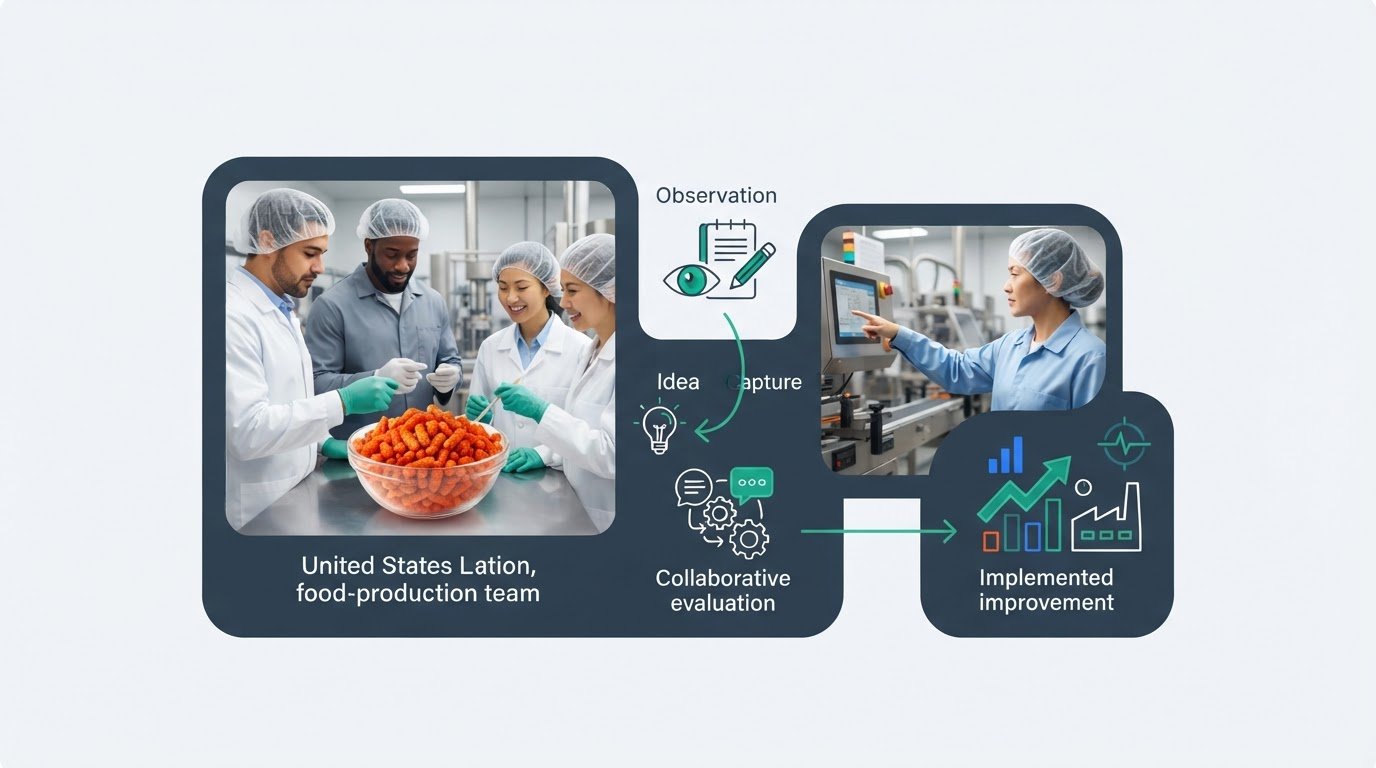
A frontline idea can become a meaningful improvement, but only if it moves from observation to action. That’s the challenge at the heart of frontline innovation: employees closest to the work often spot unmet needs first, yet their insights can stall before decision-makers assess them or explain what happens next.

The Flamin’ Hot Cheetos story is memorable, but it is not settled proof that one person invented a blockbuster product. Richard Montañez has described pitching a spicy Cheetos idea; Frito-Lay has disputed his role in creating the product line, saying it was developed by a team in Texas. The Los Angeles Times reported on the conflicting accounts. The distinction matters: an inspiring story can spark interest, but organizations need a repeatable way to capture, assess, and implement employee ideas.

This article considers what the story can teach without treating a contested origin as settled fact. You’ll learn what helps frontline observations progress, why clear feedback matters, and how to connect idea submissions with evaluation, implementation, and measurable results.

Key Takeaways

  • Learn how frontline innovation moves from an employee’s observation to a change put into practice.
  • Explore what the Flamin’ Hot Cheetos story can and can’t show about employee ideas and organizational innovation.
  • Use problem relevance, feasibility, expected value, and evidence to assess promising suggestions.
  • Build a repeatable process for inviting ideas, capturing context, evaluating proposals, responding to employees, and learning from outcomes.
  • See how an innovation platform can connect idea intake with evaluation, implementation, and ROI measurement.

What frontline innovation means, and why everyday work insights matter

Frontline innovation is a new or improved product, service, or work process shaped by insight from employees close to day-to-day operations and put into use. This working definition adapts the OECD’s Oslo Manual definition of innovation, which distinguishes an implemented change from an idea that has not yet been used. The distinction is important: an observation can reveal an opportunity, but it becomes an innovation only when a change is adopted.

Consider a warehouse employee who notices that a frequently used item is stored far from the packing area. The observation is the extra movement that happens repeatedly. A possible improvement is to relocate the item. If the organization assesses the proposal, tests the change, and adopts it, that implemented change is innovation. Collecting the initial comment alone doesn’t complete the journey.

Who counts as a frontline innovator?

Frontline innovators include customer-facing employees, operational staff, and others who work close to everyday processes. Their job titles may differ, but they share a useful perspective: they see how work actually unfolds. A customer support agent may hear the same point of confusion repeatedly; a technician may spot a maintenance step that causes delays; an administrative employee may notice duplicate data entry.

Repeated tasks give employees a practical vantage point. They can see where instructions don’t match reality, where workarounds become routine, or where customers’ needs aren’t being met. Job title alone doesn’t determine who can contribute. What matters is proximity to the process, interaction, or recurring problem, along with a way to explain what they see.

Frontline innovation versus employee suggestion collection

Collecting ideas is a starting point, not evidence that an organization has innovated. A suggestion still needs evaluation against the problem it addresses, its feasibility, and the value it may create. Someone must own the next steps, communicate a decision, and, where appropriate, support implementation. Reviewing the result helps teams refine the change or apply the insight elsewhere.

A structured process makes participation more meaningful by showing employees how an observation can move forward instead of disappearing into an inbox. The practical test is straightforward: can employees share useful context, understand what happens next, and see whether a proposal leads to action?

That follow-through turns frontline innovation from an occasional insight into a repeatable approach. A clear path from observation to implementation gives decision-makers better information and gives employees a reason to keep contributing. Practical guidance on implementing innovative ideas can help teams put that path into practice.

The Flamin’ Hot Cheetos story: an example to examine, not oversimplify

The Flamin’ Hot Cheetos origin story is often told as an example of an employee close to the work spotting a product opportunity. In Richard Montañez’s account, he was a Frito-Lay employee who recognized an opportunity to appeal to Hispanic consumers and pitched a spicy Cheetos idea. The story has become a popular illustration of how insight from within an organization might reach product decision-makers. However, the central claim about who created the product line is disputed.

In 2021, Frito-Lay said its records showed the product was developed by a team in Texas in 1989 and that Montañez wasn’t involved in creating the Flamin’ Hot line. The company also recognized his contributions and insights into Hispanic consumers. The Los Angeles Times reported on the conflicting accounts. Ideawake’s earlier account of the story offers another retelling, which should be considered alongside the company’s response and independent reporting.

What the story can illustrate about employee insight

Set aside the unresolved question of individual authorship, and a useful organizational lesson remains: an employee may notice a customer need or market opportunity that isn’t obvious from a central office. A frontline observation can become a product possibility when it reaches people with the authority and resources to assess it. That doesn’t mean every suggestion will succeed. It does mean relevant ideas need a route to be heard and considered.

How to handle disputed innovation origin stories

Innovation stories are compelling, but polished retellings can compress a complex process into a single-hero narrative. For an accurate account, distinguish what a person has said from what a company states and what independent reporting has established. Avoid presenting disputed authorship, chronology, or business impact as settled fact. This care strengthens the lesson: recognize employee insight while examining the evidence.

That balance matters for organizations, too. Crediting ideas clearly and recording how proposals develop can make contributions visible without simplifying teamwork or overstating results. The broader lesson of frontline innovation isn’t that one person always creates a breakthrough alone. It’s that organizations need a credible route for observations to reach decision-makers, be assessed on their merits, and inform what happens next.

A structured idea process can connect employee input with review and follow-through. Explore Ideawake’s idea management platform to see how teams can organize that process.

What separates a promising frontline idea from an implemented improvement?

A frontline suggestion isn’t an implemented improvement just because someone submits it. The organization must investigate the problem, evaluate a response, assign responsibility, and put a change into practice. Each stage calls for different information, so teams can make better decisions by distinguishing an early observation from a proposal that’s ready for action.

  1. Raw observation: An employee notices a recurring issue, such as customers repeatedly needing to correct the same detail in an order.
  2. Actionable idea: The employee describes the issue and proposes a possible response, such as changing how that detail is collected.
  3. Evaluated proposal: Relevant stakeholders assess the problem, evidence, feasibility, risks, and expected value of the change.
  4. Implemented change: An owner puts the approved response into practice, then reviews whether it addressed the original issue.

These stages don’t mean every proposal should be approved. They help teams review ideas consistently and explain what happens next. Submission counts show participation, not implementation or impact.

Evaluate the problem before judging the proposed solution

Start with the need, not the employee’s first proposed fix. Who encounters the issue? How often does it arise? What happens when it does? Evidence might include examples from daily work, recurring customer feedback, process records, or a small test. The right evidence depends on the problem: a repeated inconvenience and a safety concern call for different levels of scrutiny.

Then assess the proposal against criteria that fit the organization’s goals and the issue itself. Consider problem relevance, feasibility, expected value, available evidence, and potential risks. An idea intended to reduce customer effort may need a different evaluation from one intended to shorten internal processing. A clear set of criteria helps teams make consistent judgments without treating every suggestion as if it had the same purpose.

Make progress and outcomes visible

Once a proposal is under review, assign an owner who can coordinate evaluation and communicate its status. Contributors should hear whether an idea is being explored, approved, declined, or deferred, with a clear reason and next step where possible. Even when an idea can’t move forward, a considered response is more useful than silence. It shows that participation leads to a decision.

Measure the journey, not just the intake. Submission volume and participation indicate activity. Proposals evaluated, changes implemented, and results tied to the original problem show progress beyond activity. For example, a team testing a revised order form might track whether customers need fewer corrections, using a suitable baseline for comparison. Teams planning next steps can use a practical framework for implementing innovative ideas to connect decisions with ownership and action.

How organizations can make frontline innovation repeatable

Good intentions don’t create a reliable idea process. Employees need clear ways to contribute, while managers need a consistent method for understanding suggestions, deciding what happens next, and sharing the outcome. A practical sequence makes the work visible without implying that every submission will be adopted.

The OECD’s Oslo Manual defines innovation around a product or process that has been made available or brought into use. That distinction supports a useful operating principle: inviting and reviewing ideas are important steps, but they aren’t the same as implementing a change or learning from its results.

  1. Invite input: Focus on a real operational or customer challenge, and explain what kinds of observations would be useful.
  2. Capture context: Ask contributors to describe where the issue occurs, who experiences it, and what they’ve observed. Keep the questions brief enough to answer during a normal workday.
  3. Assess: Route submissions to people with relevant knowledge and decision-making authority. Review them consistently against the challenge’s purpose.
  4. Respond: Tell contributors whether an idea is under review, moving forward, or not being pursued, and explain the next step.
  5. Learn: Record what happened after a test or implementation, then use employee and operational feedback to improve the process.

Design participation around real work

A submission route only helps if employees can use it within the realities of their roles and work patterns. A desk-based form may suit some teams; others may benefit from a short facilitated discussion or a shared digital channel. Use clear prompts tied to a defined challenge, such as “Where do customers encounter avoidable delays?” Inviting input across teams can also bring different perspectives to a problem.

Close the loop from submission to action

Make responsibility explicit. An idea owner can keep a proposal moving, coordinate the right reviewers, and update the contributor when its status changes. If an idea is selected, clarify who will lead a test or implementation and what the team hopes to learn. If it isn’t selected, a concise explanation helps employees understand the decision and offer more relevant input next time.

Review both the process and its outcomes. Look for points where employees abandon submissions, decisions stall, or contributors don’t receive updates. Then adjust prompts, review routes, or communication practices. A repeatable process doesn’t promise that every idea will succeed; it provides a dependable way to hear input, make informed decisions, and learn from what follows.

Turn frontline insight into organized innovation with Ideawake

Once employees have a clear way to share observations and understand what happens next, the next challenge is keeping ideas organized as they move through review and action. An innovation management platform can give submissions, evaluation, implementation, and results a shared structure, helping teams follow progress rather than rely on scattered forms, emails, and spreadsheets.

Ideawake supports the innovation lifecycle, from idea submission through ROI measurement. Teams can use AI-driven insights to support their work, along with engagement features such as voting, leaderboards, and prizes to encourage participation. These capabilities can help organize a process, but they don’t replace leadership decisions. People still need to review proposals, assign owners, communicate outcomes, and assess results.

Where an innovation management platform can help

When employee ideas arrive through different channels, it can be difficult to see which ones need review, who is responsible, or what has already happened. A shared workflow can make submissions and their progress easier to manage while reducing administrative complexity. The process should fit the organization’s goals and help decision-makers act on relevant input.

Keep the workflow practical. For example, a team might define stages for new submissions, initial review, further evaluation, implementation, and results tracking. These stages clarify what information is needed and who takes responsibility as an idea progresses. Employees can then see that submitting an idea starts a process, rather than sending a suggestion into an untracked queue.

Start with a focused frontline innovation challenge

Choose a specific problem employees recognize from their work, such as a recurring service delay or a confusing handoff between teams. Invite perspectives from employees who encounter it, and explain how proposals will be assessed. Clear criteria help reviewers compare ideas fairly; regular feedback gives contributors context on decisions and next steps.

Start with a focused challenge that gives the team room to learn. After reviewing submissions, identify a suitable proposal to explore or test, assign an owner, and decide what evidence would help judge its usefulness. Record what happens, including where the process creates friction for contributors or reviewers. Then refine the challenge, evaluation questions, or workflow before inviting input on another problem. This keeps the technology in service of a human-led process.

Organizations can use Ideawake to support a structured path from frontline insight to evaluation, implementation, and ROI measurement. See how that workflow could support your approach.

Put the next frontline idea in motion

Frontline innovation can start with one recurring point of friction. Choose a problem employees recognize, identify whose experience can shed light on it, and decide what evidence would help determine whether a proposed change is useful. A focused starting point makes it easier to learn from real work instead of relying on assumptions.

Before inviting ideas, clarify who will review them and how contributors will hear about decisions. That commitment makes participation a meaningful exchange, even when a suggestion isn’t selected. Use what employees share, and what happens after a change is tried, to shape the next challenge. Progress comes from making the process more responsive over time.

Your employees already see opportunities in the work they do every day. Give those insights a clear path forward, and a useful improvement could begin with a conversation you make room to hear.

Frequently Asked Questions

When did Flamin’ Hot Cheetos come out?

Frito-Lay says Flamin’ Hot Cheetos were developed by a team in Plano, Texas, in 1989 and test-marketed starting in 1990, before expanding nationally. The exact origin story is disputed, which is why the product is now as famous for the debate as for the snack.

Who invented Flamin’ Hot Cheetos?

It is disputed. Richard Montañez, a former Frito-Lay janitor who became an executive, has said he created and pitched the idea. In 2021, Frito-Lay said its records show a team in Texas developed the line and that Montañez was not involved in creating it, while recognizing his other contributions. The Los Angeles Times reported on both accounts.

Was Richard Montañez really a janitor at Frito-Lay?

Yes. Montañez started as a janitor at Frito-Lay’s Rancho Cucamonga, California plant and later rose to executive roles at PepsiCo, Frito-Lay’s parent company. His career path is not in dispute; his role in creating Flamin’ Hot is.

Why is the Flamin’ Hot story used as an example of intrapreneurship?

Because it captures an idea every company wants to believe: that the next big product could come from anyone. Whatever the true origin, the story shows the value of employees who understand customers and act like owners. The practical lesson is to build a process that captures frontline ideas so they do not depend on one person’s persistence.

What is frontline innovation?

Frontline innovation is a product, service or process improvement that comes from employees’ direct experience of daily work. A suggestion is the idea; it becomes an innovation when the organization puts the change into use. Frontline workers often see problems in processes and customer experience long before they show up in reports.

How can companies encourage frontline employees to share ideas?

Ask specific questions, make submitting easy and always respond. Instead of asking for big ideas, ask “Which step in our returns process causes the most confusion?” Offer submission routes that fit shift work, such as a phone browser or email, allow anonymous posting for sensitive topics, and show what changed because of employee ideas.

What happens after a frontline employee submits an idea?

In a well-run program, the idea goes to a named reviewer, gets evaluated against clear criteria, and the submitter is told the decision and why. Approved ideas get an owner, a test or implementation plan and a measured result. Ideawake automates that loop with routing, status emails and value tracking, so no idea disappears.
Article by

Coby Skonord

Coby Skonord is the co-founder and CEO of Ideawake. Since 2013 he has worked with enterprise innovation, continuous improvement, and HR leaders to turn employee ideas into measurable business impact.

The Synergy of Employee Engagement and Innovation: A Strategic Framework for 2026

The Synergy of Employee Engagement and Innovation: A Strategic Framework for 2026
Coby Skonord|
July 9, 2026

Gallup’s 2026 State of the Global Workplace report reveals that global employee engagement has stagnated at a mere 20%, a decline that costs the global economy an estimated $10 trillion in lost productivity. For most organizations, the disconnect between employee engagement and innovation isn’t just a cultural hurdle; it’s a structural failure that leaves high-value ideas trapped in the minds of frontline staff. You’ve likely seen the symptoms: low participation in outdated suggestion programs and an administrative burden that makes managing new ideas feel like a full-time job.

It’s time to stop treating engagement as a soft HR metric and start leveraging it as a high-performance engine for growth. Research shows that motivated employees are 29% more creative, yet traditional tools fail to turn that creativity into bottom-line results. In this article, you’ll discover a strategic framework to build a scalable system for capturing insights while driving higher retention through meaningful contribution. We’ll outline how to bridge the gap between frontline intelligence and executive strategy to ensure your innovation pipeline never runs dry.

Key Takeaways

  • Learn to distinguish between passive job satisfaction and active innovation engagement to build a high-performance feedback loop that drives better decision-making.
  • Master the four stages of engagement-led innovation, starting with using frontline insights to identify real-world friction points and operational waste.
  • Identify the structural failures of traditional suggestion boxes that lead to the “black hole” effect and learn how to replace them with sustainable, enterprise-scale systems.
  • Discover how to leverage AI and gamification to scale employee engagement and innovation while reducing the administrative burden of manual idea management.
  • Streamline your entire innovation lifecycle by adopting modern platforms that track every idea from the initial brainstorming phase to measurable ROI.

Defining the Feedback Loop: Why Engagement and Innovation are Inseparable

The relationship between employee engagement and innovation is not a linear path; it’s a self-sustaining feedback loop. When employees actively participate in solving organizational challenges, they generate high-quality data that allows leadership to make informed, evidence-based decisions. This cycle creates a culture where contribution is rewarded with visibility, which in turn fuels further participation. Organizations that master this loop don’t just collect ideas; they build a strategic asset that compounds in value over time.

We must distinguish between passive job satisfaction and active innovation engagement. A satisfied employee is content with their current role and environment. In contrast, Employee engagement in an innovation context involves an active commitment to improving the business. According to Gallup’s 2026 data, while global engagement remains low, companies with high-engagement cultures see 20% higher productivity and a significant boost in creative output. Innovation is the highest form of engagement because it satisfies the three core human drivers: autonomy, mastery, and purpose.

The Psychological Safety Requirement

Employees won’t innovate if they don’t feel safe to fail. Psychological safety is the bedrock of any successful framework. You need transparent evaluation processes that show exactly how ideas are vetted to build long-term trust. When the workforce understands that “Micro-Innovation”, small, incremental improvements, is valued just as much as a major product launch, they become more willing to share insights. This builds a culture of continuous improvement where the fear of making a mistake is replaced by the drive to find a better way.

Engagement as a Leading Indicator of Innovation ROI

Tracking participation rates allows you to predict future product breakthroughs before they appear on a balance sheet. High-performing organizations have moved away from soft happiness surveys toward quantitative ideation metrics. By measuring how many employees are actively contributing to challenges, you can see the tangible benefits of employee ideation programs in real-time. This shift ensures that engagement is treated as a critical business metric rather than a secondary HR concern. It’s the difference between guessing at your company’s potential and measuring your engine’s actual horsepower.

The Four Stages of Engagement-Led Innovation

To transform the feedback loop into a repeatable engine, organizations must move beyond random acts of ideation. Research published by the National Institutes of Health highlights a clear link between employee engagement and innovative behavior, suggesting that when staff feel connected to their work, they naturally seek ways to improve it. This framework breaks that natural impulse into four distinct, manageable stages: Discovery, Ideation, Championing, and Implementation.

Discovery: Tapping into Frontline Intelligence

Once a problem is clearly defined, you move to Stage 2: Ideation. This involves crowdsourcing diverse perspectives from across the organization. By inviting different departments to solve a single identified friction point, you prevent siloed thinking and ensure the resulting solutions are robust and multi-dimensional.

Championing: From Suggestion to Ownership

The third stage is Championing, where the “suggester” transitions into an intrapreneur. It’s not enough to just have a good idea; employees need the innovation skills necessary to build a business case and pitch it to stakeholders. Rewarding these “Idea Champions” shouldn’t just be about financial bonuses. Recognition, increased autonomy, and professional development opportunities often carry more weight and sustain long-term commitment without triggering team friction. If you want to see how a structured system can bridge the gap between ideation and execution, you can explore our platform's championing tools.

Finally, Stage 4 is Implementation. This is where you turn validated ideas into operational reality. Many organizations suffer from a “Valley of Death” where ideas are approved but never executed due to lack of ownership or budget. Closing this loop is non-negotiable. If an idea is validated but never implemented, you’re not just losing ROI; you’re actively training your staff to stop participating. Successful implementation proves that employee engagement and innovation are two sides of the same coin, each driving the other toward measurable business outcomes.

Why Traditional Suggestion Boxes Kill Employee Engagement

The traditional suggestion box is a graveyard for great ideas. While it was once a staple of corporate life, it has become a symbol of administrative inefficiency and executive disconnect. In 2026, with a global workforce that is increasingly hybrid or remote, a physical box is practically invisible to over 60% of employees. Relying on these relics doesn’t just result in missed opportunities; it actively damages the relationship between employee engagement and innovation by creating what we call the “Black Hole” effect.

The Black Hole occurs when an employee submits a thoughtful insight and receives no feedback. Silence is a powerful message. It tells the contributor that their perspective is irrelevant to the company’s strategy. This leads to immediate disengagement. Beyond the cultural cost, there’s a heavy administrative tax. Managing ideas through manual email chains or paper forms is unsustainable for any enterprise. It creates a bottleneck where innovation managers spend more time on data entry than on actual strategy, leading to a system that is slow, biased, and prone to gatekeeping.

Traditional hierarchies often stifle the very “radical innovation” companies need to survive. When ideas must pass through multiple layers of middle management before reaching a decision-maker, the most transformative concepts are often diluted or discarded. A modern system bypasses these barriers, ensuring that every voice has a direct path to impact without the friction of legacy gatekeeping.

The Myth of “I Don’t Have Time to Innovate”

The most common objection to new initiatives is a perceived lack of time. Many leaders treat innovation as an “extra” task rather than a core function of the job. This is a fundamental misunderstanding. We must reframe innovation as a primary time-saver. By engaging employees in identifying efficiencies, you aren’t adding to their plate; you’re helping them clear it. While models like Google’s 20% time showed the power of dedicated creative space, they also serve as a warning. Without a structured platform to capture and evaluate that output, “free time” quickly turns into unguided chaos.

Legacy Software vs. Modern Idea Platforms

Strategies to Scale Engagement and Innovation in 2026

Scaling employee engagement and innovation across a global enterprise requires more than just a mandate from leadership. It demands a deliberate architecture that balances human creativity with automated efficiency. To move from a handful of participants to total workforce involvement, organizations must implement structures that reward contribution, provide instant feedback, and maintain absolute transparency throughout the ideation lifecycle. This shift ensures that innovation isn’t just an annual event but a continuous, high-performance habit.

Gamification: The Science of Participation

Beyond gamification, the most effective way to scale is through targeted innovation challenges. Generic “suggestion boxes” fail because they’re too broad. By focusing engagement on specific business problems—such as reducing customer churn or optimizing supply chain logistics—you provide the constraints that actually fuel creativity. This ensures the ideas you receive are relevant, actionable, and directly tied to executive strategy.

AI-Driven Innovation: Scaling the Human Element

AI should act as a co-pilot, not a replacement for human judgment. It excels at the heavy lifting of data organization, freeing up human experts to focus on high-level strategy and implementation. When employees see their ideas moving through a transparent, automated workflow, their trust in the system grows. They can see exactly where their contribution sits in the pipeline, which reinforces the value of their input. If you’re ready to see how these automated workflows can transform your innovation output, you can schedule a demo of our innovation platform today.

The strategies we’ve discussed require a robust, enterprise-grade foundation to succeed. Ideawake provides the specialized infrastructure necessary to turn employee engagement and innovation from abstract concepts into a measurable competitive advantage. While general-purpose tools often fail due to high friction, our platform is built specifically to maximize adoption by reducing the “learning tax” that typically kills new initiatives. If the interface isn’t intuitive, your frontline staff won’t use it, and your innovation pipeline will remain empty.

We manage the entire innovation lifecycle within a single environment. This starts with the very first reverse brainstorming session, where teams identify potential failures before they happen, and continues through to full implementation. By consolidating these stages, you eliminate the data silos that prevent executive leadership from seeing the true value of employee insights. It’s a seamless transition from a raw idea to a tracked, operational reality.

When deciding how to deploy this architecture, many organizations face the build vs buy idea management software dilemma. While building an internal tool might seem cost-effective initially, it rarely matches the security, integrations, and specialized feature sets of a dedicated platform. Ideawake fits into your existing tech stack, ensuring that your data is secure while providing the specific tools innovation managers need to scale.

Measuring What Matters

You can’t manage what you don’t measure. To move beyond qualitative metrics, you must provide hard data on the financial impact of your engagement efforts. Using our idea management ROI calculator, you can quantify the exact value your innovation program generates. Our real-time dashboards provide a transparent view of the health of your innovation culture, showing participation rates and the progress of every validated idea. We also automate the feedback loop by sending “Thank You” and “Next Steps” messages, ensuring contributors never feel like they’re shouting into a void.

Ready to Transform Your Culture?

Engagement is a high-value asset you’ve already paid for through your payroll. It’s time to stop letting that potential go to waste and start unlocking its true value. Organizations that fail to adapt will continue to struggle with disengagement and stagnant growth, while those that embrace a structured framework will dominate their markets. Don’t settle for average results when a superior path is available. We invite you to see the power of our platform firsthand and sign up for a demo of Ideawake to begin your transformation.

Build a Culture That Outperforms the Competition

The gap between a stagnant organization and a market leader often comes down to how effectively they bridge the divide between employee engagement and innovation. We’ve established that traditional suggestion boxes are obsolete and that a structured framework is required to turn frontline insights into operational reality. By moving away from manual tracking and adopting a centralized architecture, you don’t just collect ideas; you empower your workforce to act as a force multiplier for organizational growth.

Ideawake is designed to support this transformation by reducing administrative overhead by up to 80% and managing the full lifecycle from submission to ROI. Our platform uses AI-driven insights to identify high-impact ideas faster, ensuring your team focuses on execution rather than data entry. It’s time to unlock the potential you’ve already paid for and build a system that rewards contribution with tangible impact. Your employees are ready to contribute. Give them the platform they deserve.

Book a Demo to See How Ideawake Drives Engaged Innovation

Frequently Asked Questions

How does employee engagement directly impact innovation ROI?

Employee engagement directly impacts innovation ROI by increasing the volume and quality of actionable insights available to leadership. When employees feel a deep connection to their work, they’re 29% more creative and likely to identify operational efficiencies. This participation creates a larger pool of data, allowing organizations to select high-impact projects with higher success rates. Without this active contribution, innovation becomes a guessing game played only by executive leadership.

Can innovation management software work for small teams?

Innovation management software provides small teams with a centralized architecture that prevents high-value ideas from disappearing into email threads or chat apps. Even for teams of ten, having a single source of truth for continuous improvement ensures that every insight is tracked and evaluated. Establishing these workflows early creates a scalable culture that maintains its innovative edge as the organization grows.

What are the best ways to reward employees for innovative ideas?

The most effective rewards for employee engagement and innovation balance tangible prizes with professional recognition. While financial bonuses are common, providing employees with greater autonomy or the chance to lead their own projects often drives deeper long-term commitment. Public recognition from senior leadership also validates the employee’s contribution, reinforcing their sense of purpose and encouraging a culture of healthy competition across the department.

How do you maintain engagement in a long-term innovation program?

Maintaining engagement requires a consistent commitment to transparent feedback and visible implementation. If employees don’t see their ideas moving through the pipeline, they’ll stop contributing. You must close the loop by showing exactly how previous submissions have improved the business. Regular innovation challenges and gamified leaderboards also help sustain momentum by giving staff new, specific problems to solve throughout the year.

What is the difference between an employee suggestion program and an innovation challenge?

An employee suggestion program is a passive, always-on mechanism, whereas an innovation challenge is a time-bound event focused on a specific business problem. Suggestion boxes often lead to a high volume of low-quality ideas that are difficult to manage. In contrast, challenges provide the constraints necessary to fuel targeted creativity, resulting in higher-quality submissions that align directly with current organizational priorities.

How can AI help scale employee engagement in large organizations?

AI scales engagement by removing the administrative bottleneck that typically delays feedback in large enterprises. Using employee engagement and innovation platforms powered by AI allows for instant clustering of similar ideas and automated duplicate removal. This ensures that even in a workforce of thousands, every contributor receives a response in seconds rather than weeks, effectively eliminating the “Black Hole” effect.

What are the most common failures in employee innovation programs?

The most common failure is the “Black Hole” effect, where ideas are submitted but never acknowledged or acted upon. When employees feel their insights aren’t valued, engagement levels drop immediately. Other failures include a lack of dedicated budget for implementation and complex submission portals that create too much friction. If the process is harder than the problem, your team simply won’t participate.

How do you measure the “health” of an innovation culture?

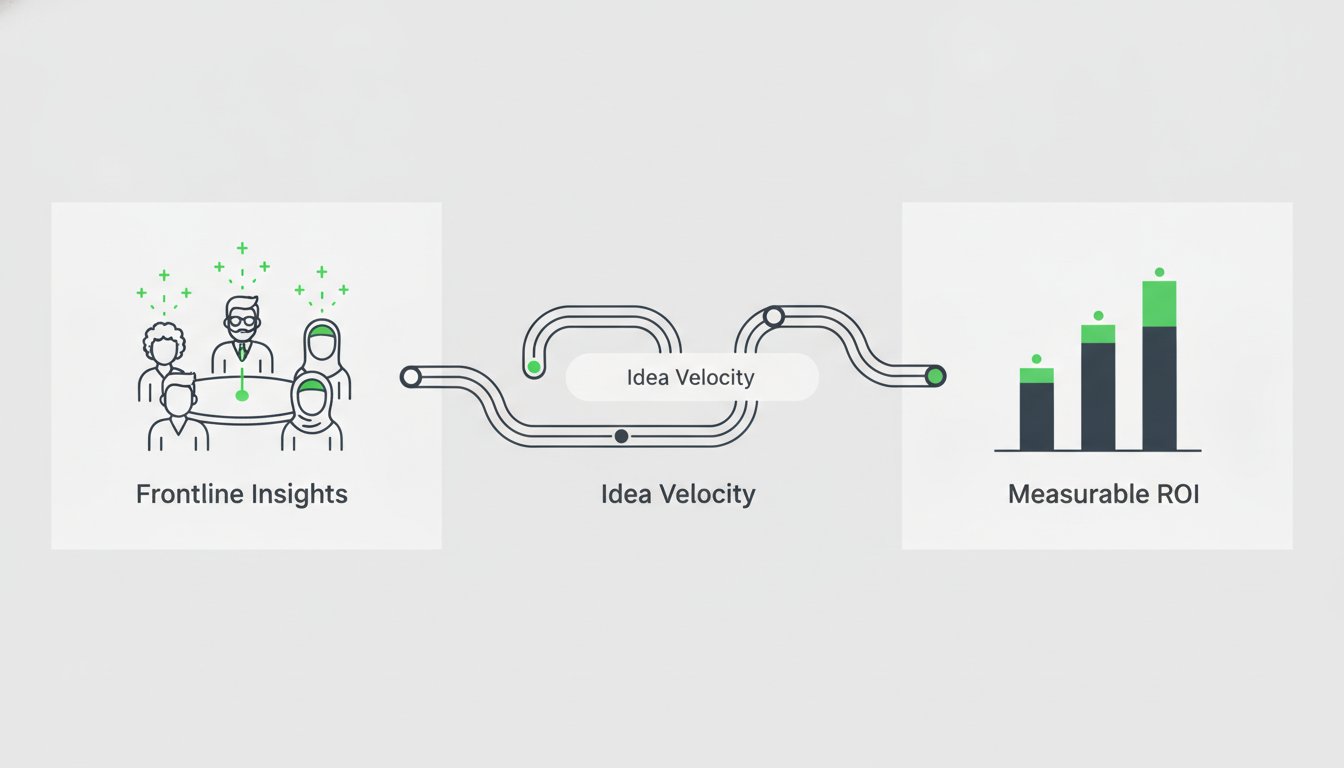
You measure the health of an innovation culture by tracking quantitative ideation metrics rather than relying on qualitative surveys. Key indicators include your participation rate, idea velocity, and the ratio of submitted ideas to those that reach implementation. A healthy culture shows steady growth in these areas, proving that employees trust the system and see a clear path from their initial insight to measurable ROI.

Article by

Coby Skonord

Coby Skonord is the co-founder and CEO of Ideawake. Since 2013 he has worked with enterprise innovation, continuous improvement, and HR leaders to turn employee ideas into measurable business impact.