Tag Archives: enterprise innovation

The Innovation Management Process: A Practical Guide

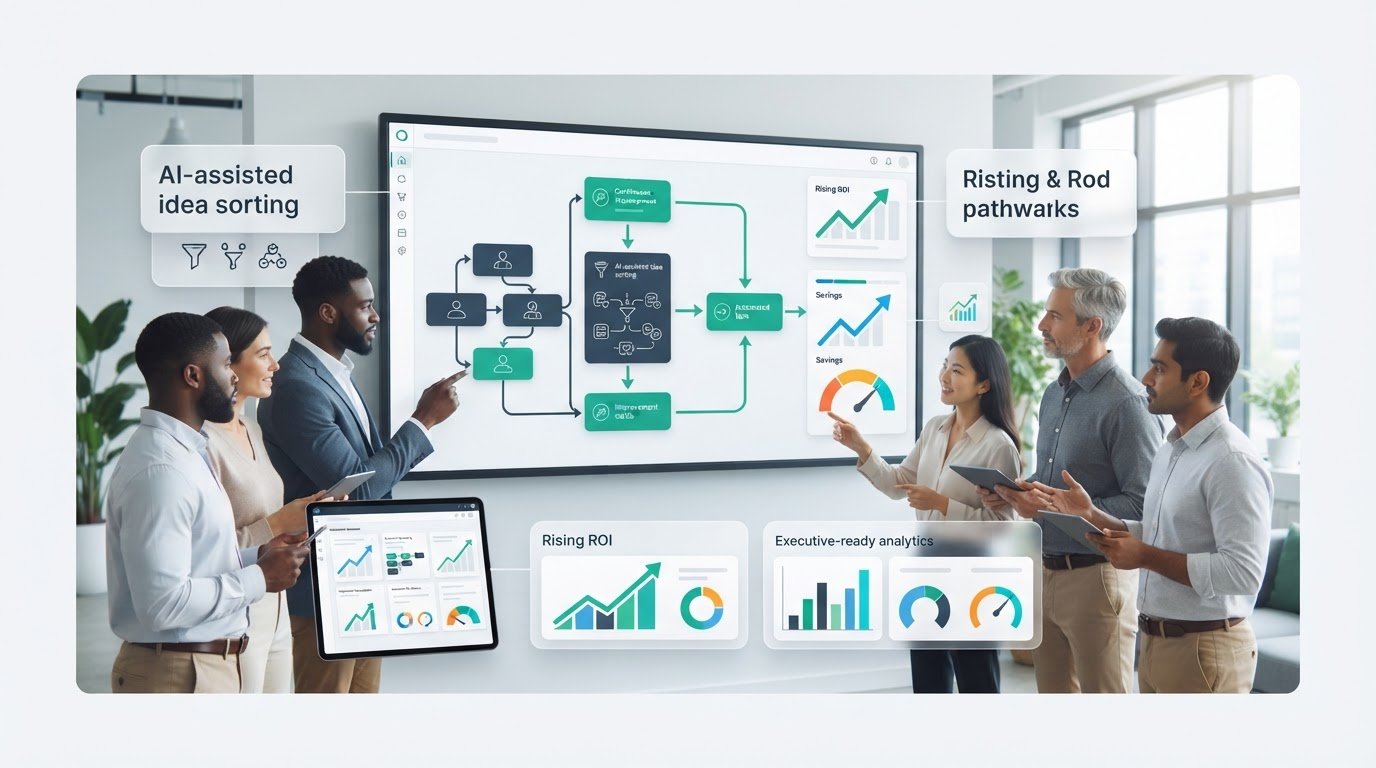
Transit employees evaluate and advance improvement ideas on an innovation management dashboard at a bus depot
Coby Skonord|
November 20, 2026

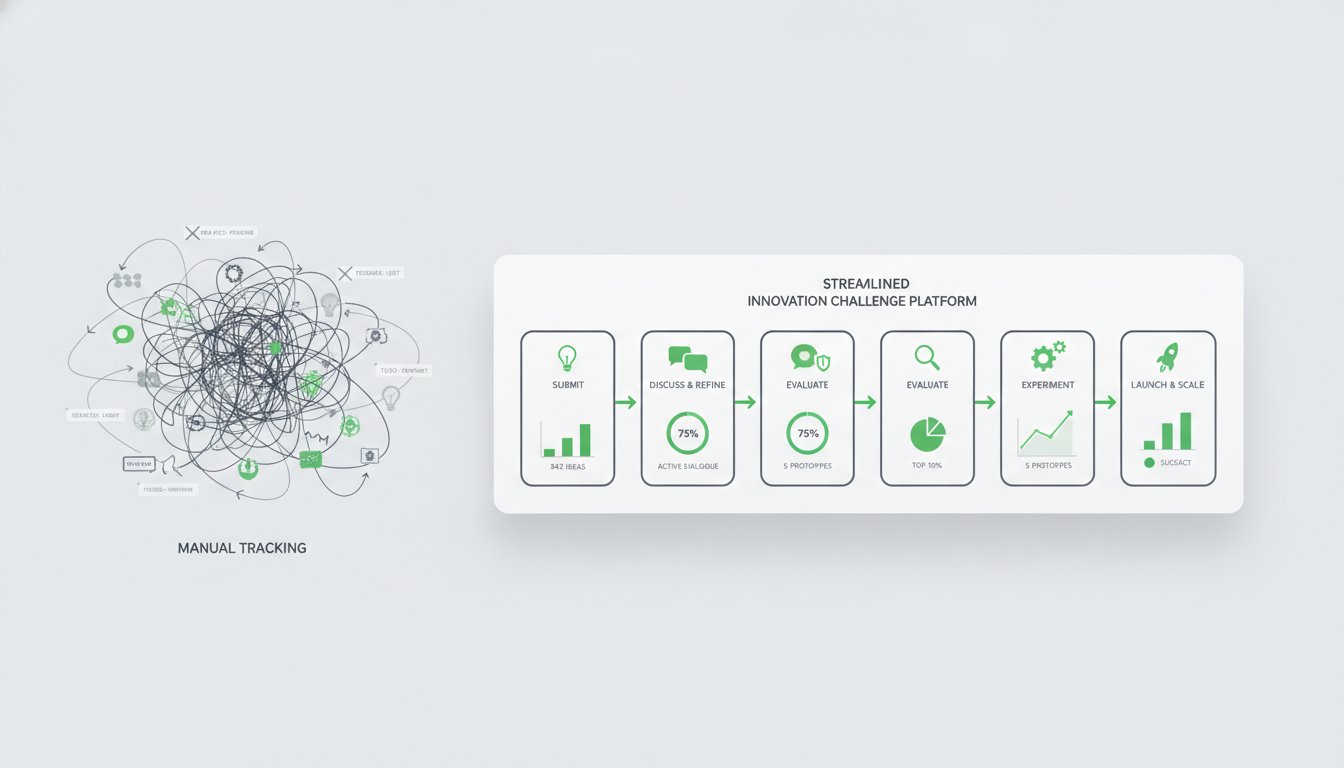
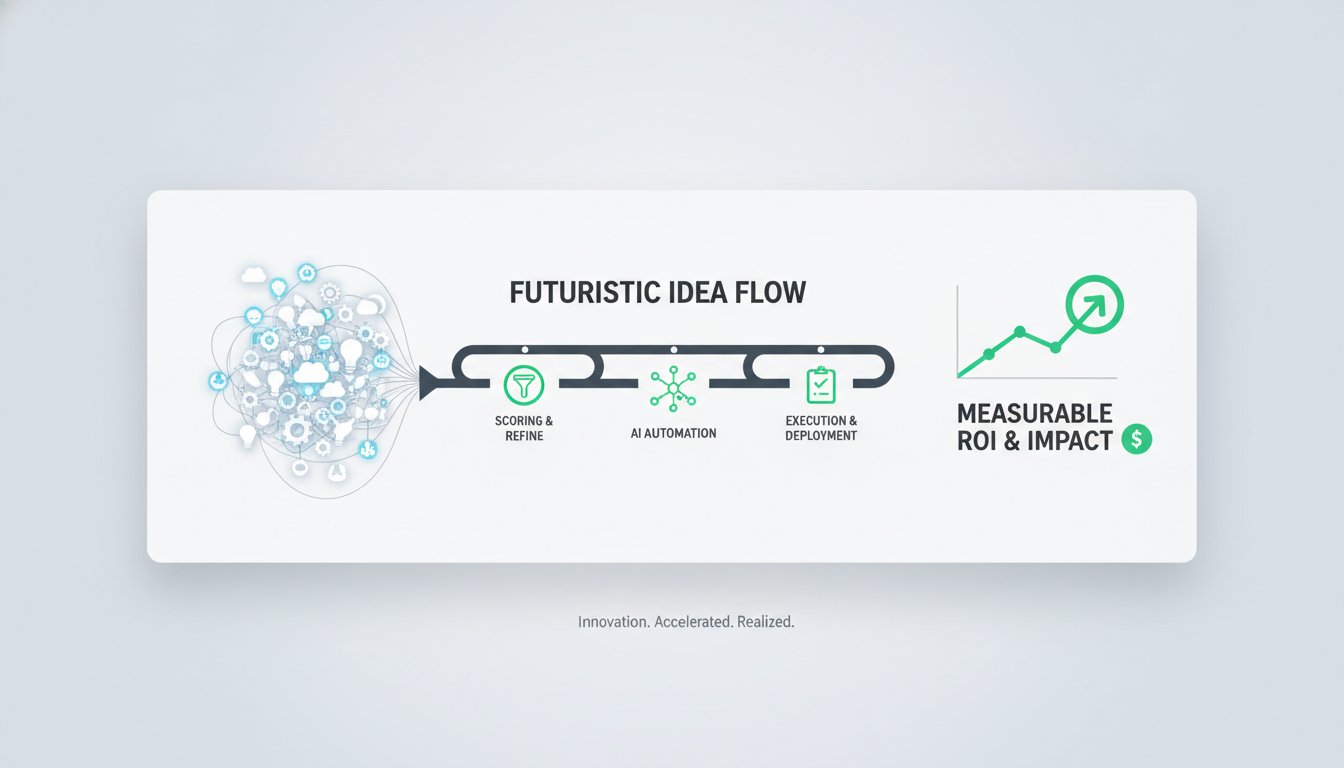
At a large organization, innovation rarely stalls because people lack ideas. It stalls when there’s no clear path from idea to launch. An innovation management process provides that path, moving ideas from generation through evaluation and development to implementation and market introduction.

That structure matters because enterprise innovation must connect promising ideas to business priorities without shutting down experimentation. You’ll learn what innovation management involves, how organizations collect and assess ideas, and how selected concepts move toward launch. This guide also explains how large organizations coordinate teams, decisions, and portfolios so innovation becomes repeatable rather than a collection of disconnected projects.

Key Takeaways

  • Use clear evaluation criteria to compare ideas, surface risks early, and decide what should advance, pause, or be saved for later.
  • Combine focused innovation challenges with ongoing idea submissions to capture both strategic opportunities and frontline insights.
  • Move selected concepts toward launch through staged development, testing, coordinated implementation, and feedback.
  • Track both early activity and business outcomes so innovation measures progress, not just the number of ideas collected.
  • As innovation scales across a large organization, align governance and portfolio decisions with enough flexibility for teams to experiment.

Evaluating, validating, and launching ideas

Selection turns a broad set of ideas into projects with a clear path forward. Leaders need consistent criteria, evidence from validation, and launch plans that connect decisions to execution.

Idea Evaluation and Selection Criteria

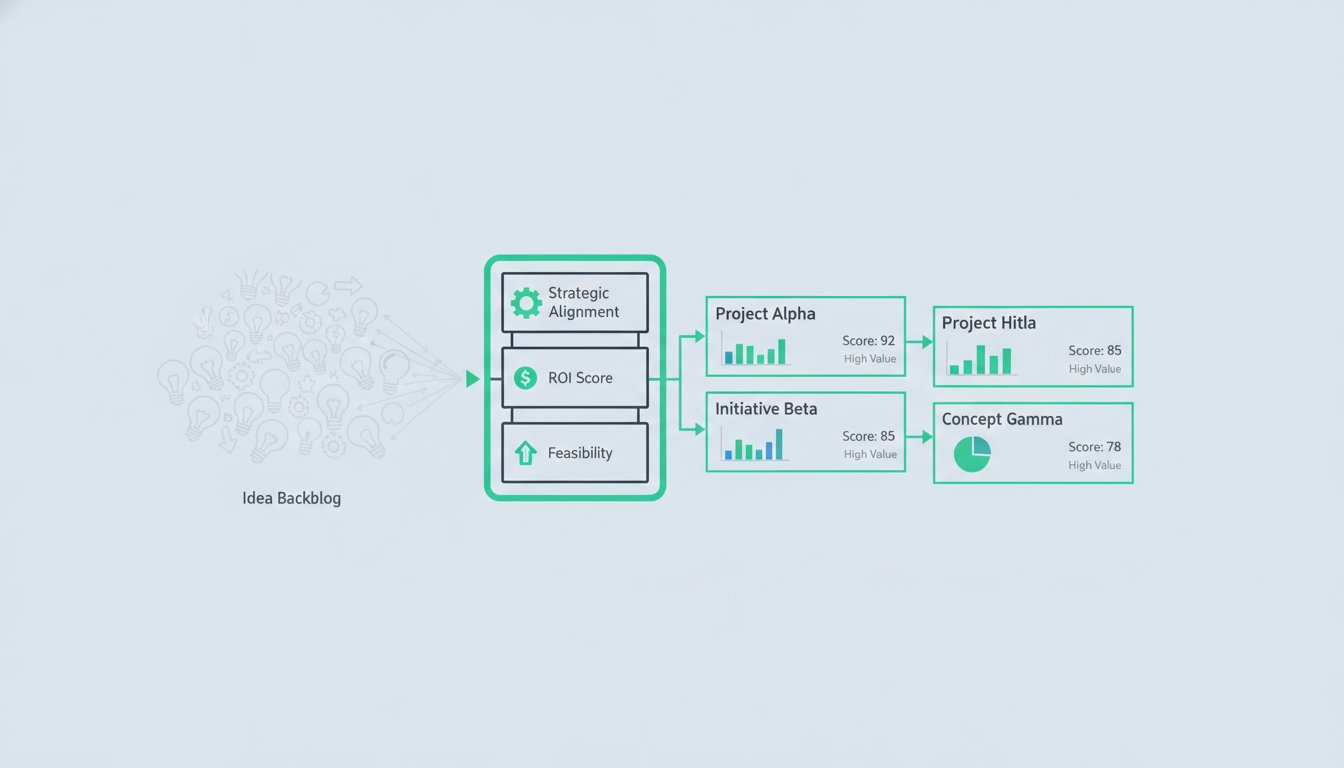
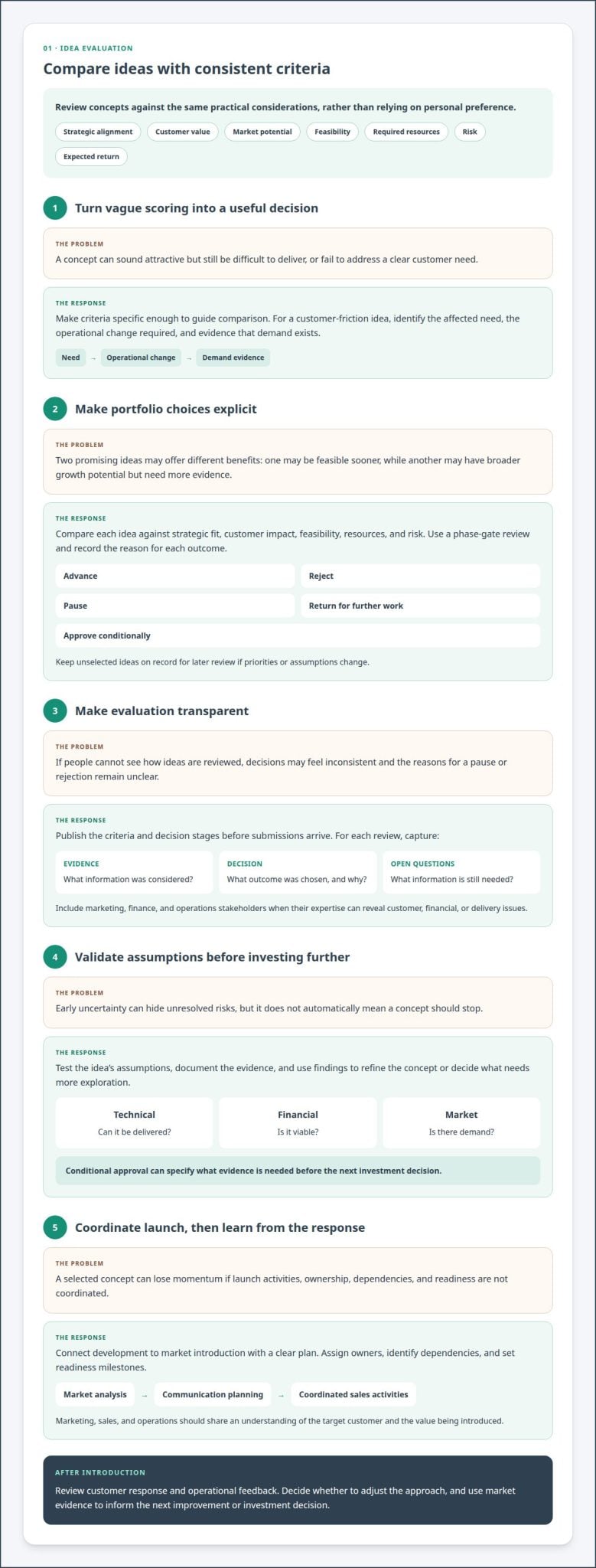
Idea evaluation and selection criteria are the standards used to compare concepts before committing resources. A practical review considers strategic alignment, customer value, market potential, feasibility, required resources, risk, and expected return. Together, these criteria help leaders distinguish promising ideas from attractive concepts that may be difficult to deliver.

Make the criteria specific enough to guide a decision. For example, a concept intended to reduce customer friction should identify the affected customer need, the operational change required, and the evidence that demand exists. A structured idea evaluation process helps reviewers apply the same questions across projects instead of relying on personal preference.

Prioritizing Innovations

Prioritizing innovations means comparing validated ideas with business goals and available capacity, then deciding which should advance. A phase-gate review gives each concept a decision point: advance, reject, pause, return for further work, or approve conditionally. Record the reason for each outcome and define the next step.

Consider two proposals: one improves an existing customer process, while another explores a new market. The first may be feasible sooner; the second may offer broader growth potential but need more evidence. Compare both against strategic fit, customer impact, feasibility, resources, and risk. Keep unselected ideas on record for later review, especially if priorities or assumptions change.

Transparent Evaluation Protocols

Transparent evaluation protocols explain who reviews ideas, which criteria apply, and how decisions are recorded. Publish the criteria and decision stages before submissions arrive. For each review, record the evidence considered, the decision and its rationale, and any information still needed.

Involve marketing, finance, and operations stakeholders when their expertise can reveal customer, financial, or delivery issues. For example, an operations reviewer can identify a workflow constraint before a concept enters development. Consistent records also help employees understand why an idea advanced or paused, supporting experimentation while preserving accountability.

Validate Before Investing Further

Validation tests an idea’s assumptions before a team commits to broader development. Examine technical feasibility, financial viability, and market demand, then record the evidence behind each conclusion. A customer-facing concept, for example, may need evidence of demand alongside an assessment of how it can be delivered.

Use the findings to refine the concept, identify unresolved risks, or return it for further exploration. Conditional approval can specify what evidence is needed before the next investment decision. This keeps the innovation management process evidence-led without treating early uncertainty as an automatic reason to stop.

Coordinate the Launch

A launch plan connects development to market introduction through market analysis, communication planning, and coordinated sales activities. Assign an owner to each activity, identify dependencies, and set readiness milestones. Marketing, sales, and operations should share an understanding of the target customer and the value being introduced.

Before launch, confirm that customer-facing messages reflect the tested value proposition and that delivery teams can support the offer. After introduction, review customer response and operational feedback, then decide whether to adjust the approach. Evaluation does not end at launch: market evidence informs the next improvement or investment decision.

Collecting employee ideas through challenges and open submissions

Employee ideas can come through focused challenges or an always-open channel, providing both targeted and unsolicited input. Common risks include vague prompts, low participation, duplicate submissions, biased screening, and ideas that receive no feedback or ownership.

Ideas-First and Needs-First Approaches

An ideas-first approach starts with a proposed solution, while a needs-first approach starts with a problem employees or customers experience. The distinction matters: a clever suggestion can miss the underlying need, while a clearly defined problem gives contributors room to explore different solutions.

Use open submissions to capture ideas employees notice in everyday work, then ask what problem each addresses. For example, a warehouse employee might suggest a new scheduling tool; follow-up could reveal that shift handoffs, not scheduling, cause delays. Focused challenges work well when leaders can define a need, such as reducing handoff errors or simplifying a service step.

A strong culture makes room for both approaches. Challenges create a shared focus, while open submissions can surface improvements beyond current priorities. Explain the challenge’s purpose, who can contribute, and how ideas will be reviewed. This helps employees connect their experience to organizational needs without forcing every suggestion into a predetermined solution.

Crowdsourced Feedback on Ideas

Crowdsourced feedback gathers reactions, refinements, and expertise from a group of employees rather than leaving screening to one reviewer. It matters because colleagues in different roles may identify implementation barriers or customer effects that the original contributor cannot see.

For useful feedback, present the problem, proposed idea, and specific prompts together. Ask colleagues to identify likely benefits, risks, missing information, or alternatives. A frontline employee may spot a workflow issue, while a customer-facing colleague may flag an unmet need. Make commenting and voting part of a clear evaluation process, not a popularity contest.

Advocacy can strengthen an idea’s case when supporters explain their reasoning and relevant experience. Still, leaders should distinguish enthusiasm from evidence. A screening step can group duplicates, clarify incomplete submissions, and route ideas to people with relevant knowledge. A structured employee ideation program can make participation and feedback part of ongoing improvement.

Recording and Sharing Ideas

Recording ideas means keeping each submission in a shared, searchable record with enough context for follow-up. Without one, ideas can disappear in email threads, meeting notes, or isolated forms, leaving teams unable to revisit useful suggestions.

Capture the problem, proposed change, affected team or customer, expected benefit, and supporting details. Add a status and owner so employees can see whether an idea needs clarification, is under review, or has moved forward. Share submissions with relevant colleagues, keeping discussion focused on useful feedback and next steps.

For example, a facilities team could record a recurring equipment issue and invite staff to suggest ways to reduce disruption. Related submissions can be grouped, discussed, and retained even if no immediate project proceeds. Close the loop by communicating decisions and reasons; otherwise, silence can weaken participation. To see how a digital approach can support this work, explore a guided platform walkthrough.

What is the Innovation Process?

The innovation process moves a concept from a defined opportunity toward development, implementation, and adoption. It gives teams a practical route from strategic intent to action.

Organizations fund and resource innovation projects by aligning them with strategic priorities, assigning people and budget, and releasing additional resources as evidence supports progress. Internal teams, external partners, and staged investment can each contribute, depending on a project’s needs.

Innovation Strategy Development

An innovation strategy defines the opportunities an organization will pursue, the outcomes it wants, and the capabilities it can commit. It matters because leaders must balance near-term improvements with longer-term concepts that could open new markets.

Start by connecting innovation goals to business priorities, such as improving customer experience or operational efficiency. Then clarify which teams, expertise, and funding can support each goal. A portfolio can combine incremental improvements with more exploratory projects, helping leaders avoid spending all available capacity on one kind of opportunity. The distinction between incremental and radical innovation can help frame that balance.

Concept Development and Prototyping

Concept development turns an opportunity into a defined proposal, while prototyping creates a simple representation that supports learning. These steps help teams expose unclear assumptions before committing to full development.

A product concept should identify its intended user, the problem it addresses, and the value it offers. A team exploring a faster service handoff, for example, might sketch the revised workflow before building new systems. Depending on the concept, a prototype could be a sketch, digital simulation, or physical model. Keep it focused on the question the team needs to answer, such as whether users understand the new process.

Concept Testing

Concept testing evaluates assumptions with relevant users, stakeholders, or operational evidence before broader implementation. It helps reveal whether a proposed benefit matters and whether delivery conditions support it.

Choose a test that matches the uncertainty. A customer-facing concept might be assessed through user reactions to its value proposition; an internal process change might be tried with the employees who do the work. Record the response, assumptions tested, and resulting changes. If findings expose a gap, refine the concept and test again rather than treating early feedback as a final verdict.

Innovation Development and Implementation

Development and implementation turn a tested concept into an operating product, service, or process. Even a strong concept needs clear ownership and coordinated delivery to create practical value.

Build an implementation plan that connects development tasks to people, resources, milestones, production needs, and launch activities. For a new service, operations may prepare delivery workflows while marketing develops customer communications. External partners can contribute needed capabilities, with responsibilities agreed before work begins. Track dependencies and unresolved risks, then coordinate the launch across relevant teams. After implementation, use customer and operational feedback to guide improvements and further development.
The Innovation Management Process: A Practical Guide

What is innovation management?

Innovation management connects initiatives to evidence, learning, and measurable outcomes. Common frameworks include Lean Startup’s build-measure-learn loop, design thinking, stage-gate reviews, roadmapping, and idea management.

Innovation Performance Measurement

Innovation performance measurement tracks whether innovation work produces learning and business outcomes. Idea counts alone cannot show whether initiatives solve customer problems or improve operations.

Choose measures that fit each initiative’s goal. A service improvement might track customer satisfaction and process quality, while a new offer might track adoption, revenue growth, or time-to-market. Compare results with the initiative’s original objective, not an unrelated portfolio target.

Review measures at decision points, including after launch. If adoption is weak, examine customer feedback, implementation barriers, and original assumptions before deciding whether to adjust or stop. A consistent approach to measuring innovation programs helps leaders connect project evidence with portfolio outcomes.

Input and Output Metrics

Input metrics measure the resources and activity committed to innovation; output metrics measure what those efforts produce. Track both, because high activity does not automatically mean successful results.

Inputs can include employee participation, ideas submitted, experiments completed, and resources assigned. Outputs can include concepts advanced, projects launched, customer response, revenue growth, or operational improvements. For example, strong participation but few tested concepts may signal a bottleneck between collection and evaluation.

Pair each input with a relevant output, then review the relationship over time. If experiments increase but customer learning does not, teams may need better test questions. If launches occur but adoption remains limited, examine whether the offering addresses an important need. Metrics should prompt investigation, not reward activity without impact.

Innovation Management Tools and Frameworks

Innovation tools and frameworks organize idea capture, experimentation, decisions, and learning. Choose them to fit the uncertainty and delivery needs of each initiative.

Lean Startup uses a build-measure-learn loop: build a testable version, measure how people respond, and use feedback to decide what to change. A team testing a new service feature could release a limited version, observe customer use, and refine the concept. The loop is iterative, allowing teams to revisit assumptions instead of treating a launch as proof of success.

Design thinking helps teams investigate user needs and develop potential solutions. Stage-gate reviews structure decisions between project phases, while roadmaps connect initiatives to strategic priorities. Idea management supports collecting and tracking proposals. Choose a framework based on the challenge: uncertain customer demand calls for testing and learning; a defined operational improvement may need milestones, owners, and delivery measures.

Innovation management in large organizations

Large organizations need shared priorities without centralizing every experiment. Governance, portfolio oversight, and clear ownership connect ideas generated across departments to organization-wide goals.

Accenture reported that 96 percent of executives said long-term success depends on developing new ideas. Accenture also found that 82 percent of respondents did not distinguish meaningfully between significant innovation and incremental performance gains. Its research further reported that 72 percent of companies let innovations languish without a formal process or organizational home. These findings point to a coordination challenge: ideas need sponsors, resources, and decisions. Accenture’s innovation research highlights the need to connect ambition with execution.

Give each initiative an accountable owner and a route to decision-makers. A central innovation lead can coordinate portfolio priorities, while business units assess operational fit and contribute expertise. For example, a customer-service suggestion may need input from operations, IT, finance, and customer-facing teams before it becomes a funded project.

Set governance around decision rights, not layers of approval. Define who can sponsor an idea, assess its fit, allocate resources, and pause work when evidence changes. Use stage reviews for investment decisions, but keep early exploration lightweight. Standardize records and reporting while allowing teams to test solutions suited to their work.

Portfolio oversight helps leaders balance near-term improvements with longer-term opportunities. Review initiatives together, considering strategic fit, expected outcomes, resources, and dependencies. If technology changes customer expectations, revisit priorities instead of protecting projects simply because they already have support. Stopping work that no longer fits frees capacity for stronger opportunities.

Culture matters too. A study by Strategyn involving 393 innovation leaders found recurring innovation problems across nearly every organization studied. Leaders can address ambiguity by defining each initiative’s intended scope and outcome. An operational efficiency project and a new-market exploration effort may both matter, but they need different evidence and review criteria.

Make participation practical across locations and roles. Invite employees to contribute through challenges and ongoing channels, then communicate decisions and next steps. Innovation Leader reported that over 82% of executives in large organizations surveyed had used the Lean Startup Methodology in some way. Experimentation can support learning, but enterprise teams still need clear ownership to turn learning into coordinated action.

For large organizations, the key is to centralize priorities and accountability while distributing exploration and learning. A consistent framework should make it easy to see who owns each initiative, what evidence supports it, and where the next decision lies.

Ideawake

Ideawake offers a cloud-based platform for collecting, evaluating, and implementing ideas. It may be relevant when employee, customer, or partner ideas are spread across teams and need a defined path into innovation initiatives. Its Innovation Management Platform and Idea Management Platform cover stages of the innovation lifecycle, alongside Continuous Improvement and Ideawake AI.

For large organizations, a shared platform can provide a place to capture proposals, involve contributors in evaluation, and track ideas as they progress. Voting, leaderboards, and prizes are possible ways to encourage participation, while structured workflows can help teams handle ideas consistently. These capabilities can support focused innovation efforts as well as ongoing improvement.

Contact Ideawake to discuss whether its platform fits your organization’s innovation processes.

Make the next decision count

Put your innovation management process to work by choosing one business priority that needs fresh thinking. Name an accountable sponsor, define the decision the initiative should inform, and agree on what evidence would justify moving forward. This creates a focused starting point without requiring the entire organization to change at once.

Then make learning visible. Give teams a clear way to share progress, surface barriers, and explain what they need from decision-makers. A useful review helps leaders decide whether to continue, adjust, or redirect effort. That discipline makes innovation a leadership practice, not a side project competing with everyday work.

Ideawake supports organizations with an Innovation Management Platform, an Idea Management Platform, and Continuous Improvement capabilities. If you’re ready to discuss how these offerings could support your organization’s priorities, take the next step.

Start with a meaningful opportunity, learn from the work, and build from there. Progress begins with a decision your teams can act on.

Frequently Asked Questions

Where is the Phase-Gate process used?

Phase-Gate is used to manage projects that need staged reviews and investment decisions. Organizations can apply it to product development or operational improvements when work can be divided into stages with evidence reviewed at each decision point. A team may advance a concept, pause it for more evidence, recycle its assumptions, or stop it. The approach is most useful when leaders need explicit control over commitments and clear accountability at each gate.

What is the innovation management process?

The innovation management process is the coordinated way an organization develops promising ideas into implemented changes. It connects opportunities to business priorities, assigns ownership, and gives teams a way to learn from evidence. For example, an operations leader could use it to move a recurring service issue from employee observation to a tested process change. Its value lies in making innovation work visible and actionable, not merely collecting suggestions.

What are the key stages of an innovation management process?

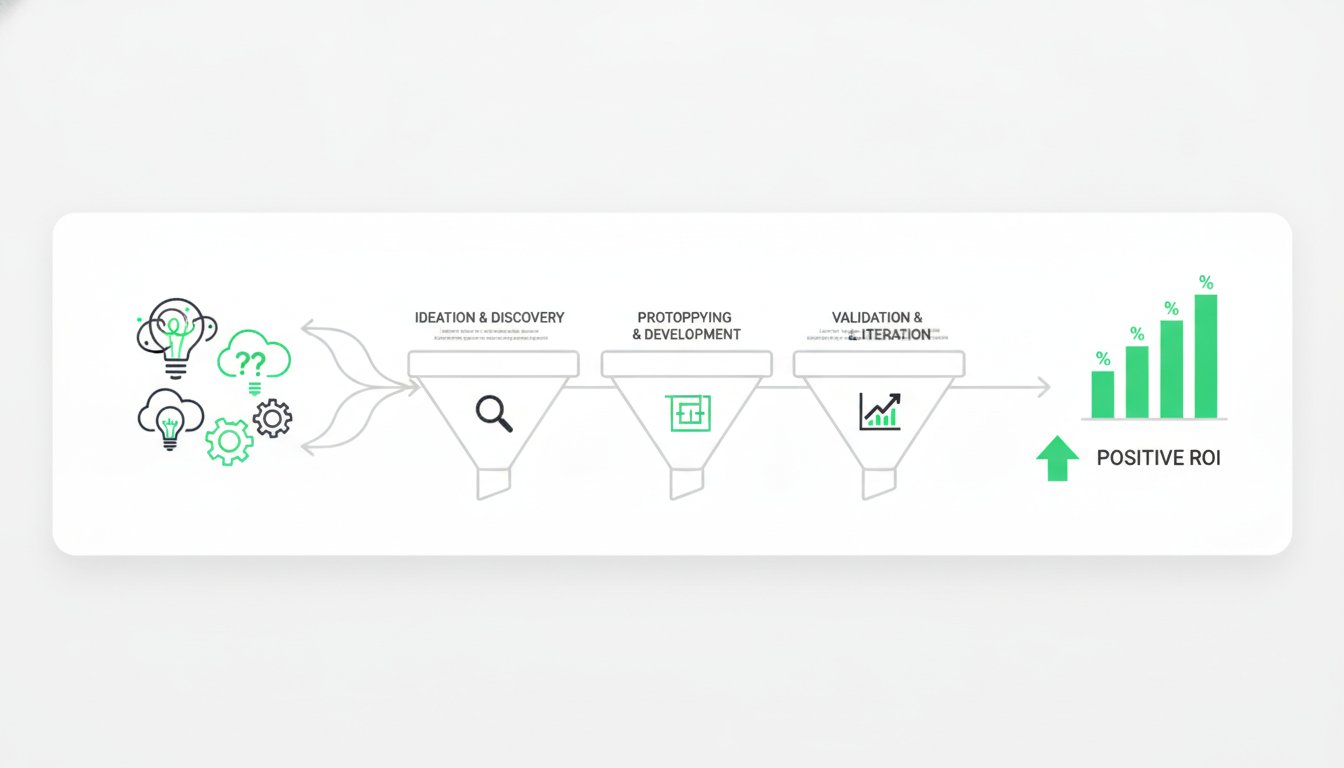
Key stages typically include generating ideas, selecting and evaluating them, developing concepts, implementing solutions, and introducing them to users or markets. Teams may revisit stages when new evidence changes an assumption. For example, customer feedback during a limited release could send a concept back for refinement. The sequence gives leaders a shared map while allowing initiatives to move at different speeds based on uncertainty and delivery needs.

How do organizations generate and prioritize innovation ideas?

Organizations generate ideas through employee submissions, focused challenges, customer input, and collaboration with external partners. To prioritize them, leaders can compare each proposal with strategic goals, customer or operational needs, feasibility, resource demands, and potential risk. For example, a service team may rank suggestions by how directly they address a recurring customer problem. Keep lower-priority proposals on record so teams can reconsider them when conditions or priorities change.

How do companies evaluate the feasibility and business value of innovations?

Companies assess feasibility by examining whether a concept can be delivered with available technical capabilities, operational capacity, and resources. They assess business value by considering strategic fit, customer benefit, market demand, and expected returns. A proposal to simplify a service process, for instance, should address both user value and the team’s ability to implement it. Record assumptions separately from supporting evidence so decision-makers can identify what still needs testing.

How are innovation projects tested, developed, and launched?

Teams test a project’s riskiest assumptions using a method suited to the concept, such as a sketch, simulation, pilot, or limited release. They use feedback to refine requirements before broader development. During implementation, assign owners for delivery, operations, and communications. Before launch, confirm that the product or process is ready for its intended users. Afterward, review actual use and feedback to identify adjustments, support needs, or further opportunities.

What metrics measure innovation management performance?

Useful measures connect innovation activity to learning and outcomes. Input indicators can include participation, submissions, experiments, and resources committed; output indicators can include concepts tested, projects implemented, customer response, time-to-market, revenue growth, or operational improvement. Select measures based on each initiative’s objective. For example, a process-improvement effort should track its targeted operational result, not rely only on how many ideas employees submitted.

How does innovation management differ across industries and company sizes?

Innovation management varies with customer needs, operating conditions, project risks, and organizational structure. A manufacturer may emphasize production feasibility, while a service organization may focus on customer experience and workflow changes. Smaller organizations may coordinate decisions through fewer roles; larger enterprises often need clearer governance across departments. In either setting, adapt review steps and evidence requirements to the initiative while keeping ownership, decision criteria, and outcomes clear.

Article by

Coby Skonord

Coby Skonord is the co-founder and CEO of Ideawake. Since 2013 he has worked with enterprise innovation, continuous improvement, and HR leaders to turn employee ideas into measurable business impact.

High-Impact Hackathon Ideas to Drive Real Innovation

Hackathon teammates demonstrate a focused AI prototype beside an idea-voting and judging dashboard
Coby Skonord|
November 13, 2026

The strongest hackathon ideas tackle a specific problem and demonstrate a practical solution. Keep the scope small enough for your team to build and explain clearly. A working prototype gives judges something concrete to assess.

It’s tempting to chase the flashiest technology, but a compelling project also needs a clear user, a practical use case, and a straightforward way to show whether it works. For enterprise teams, that means connecting creativity to real operational needs without letting the scope overwhelm the build.

This article will help you choose an idea that suits your team, align it with judging criteria, and shape a clear demo. Explore concepts across AI, hardware, and the Internet of Things, plus practical ways to assess feasibility and refine a promising concept before you start building.

Key Takeaways

  • Choose a focused problem and a single end-to-end feature your team can demonstrate, rather than trying to build a complete product.
  • Match the project to the judging rubric by making its user, practical value, and evidence of success easy to understand.
  • Explore AI concepts at different levels of complexity, using a small, relevant dataset to keep evaluation manageable.
  • Turn brainstorming into a decision process: capture assumptions and unknowns, then narrow ideas by feasibility and impact.
  • For hardware and IoT concepts, account for setup and device failure risks while keeping the core demonstration useful even if a component fails.

1. AI hackathon project concepts organized by difficulty

Choose an AI project that fits your team’s skills and build time. A focused project with one working feature is easier to demonstrate than a broad concept with unfinished parts. For a short event, consider a meeting action-item extractor or a support-ticket assistant. Both have a clear input, output, and way to evaluate results.

For an entry-level build, create a text classifier that sorts employee suggestions into themes. Sample comments can provide test material, while a simple interface displays categories and examples. An intermediate project could analyze product feedback and group recurring themes. A more advanced team might build a vision tool to identify defects in labeled images. Keep the model’s task narrow, then show one correct result and one error case.

Social-good and sustainability concepts include a tool that matches offers of reusable materials with local organizations, or an assistant that explains recycling instructions. A strong concept identifies one community need, a usable data source, and a practical outcome, such as making sorting instructions easier to understand.

For healthcare, education, and accessibility, consider a plain-language explainer for health information, a study coach that organizes lecture notes, or an image-description prototype for people with low vision. Use synthetic or public sample data, and make the demo’s limits clear. A study coach, for example, can organize selected lecture notes into topics and practice prompts.

Common building blocks include a language-model API, a vision API, a public dataset, and a lightweight interface. Teams can connect them through a notebook or basic web application. Choose tools your team already understands, and test a complete input-to-output path before adding features.

Teams without coding experience can still develop useful concepts: map an employee suggestion journey, storyboard a recycling assistant, or create a clickable screen mockup. Assign roles for user research, process design, and presentation. Newcomers can shape a credible workflow even if they aren’t writing code.

For a themed event, turn the theme into a specific user problem before choosing technology. Validate the concept early by sketching the user journey, reviewing sample data, and defining a practical test. Make the prototype easy to demonstrate, then connect its evidence to the judging criteria. In the pitch, explain the problem, solution, and evaluation, then rehearse your delivery.

Make participation welcoming by sharing the challenge, approved data, and tool access before teams begin. Offer roles for builders and non-coders, and keep the first task small enough to complete together. Strong concepts need a path beyond the demo: implementing innovative ideas requires clear ownership and a next step.

2. Choosing an idea to match the judging rubric

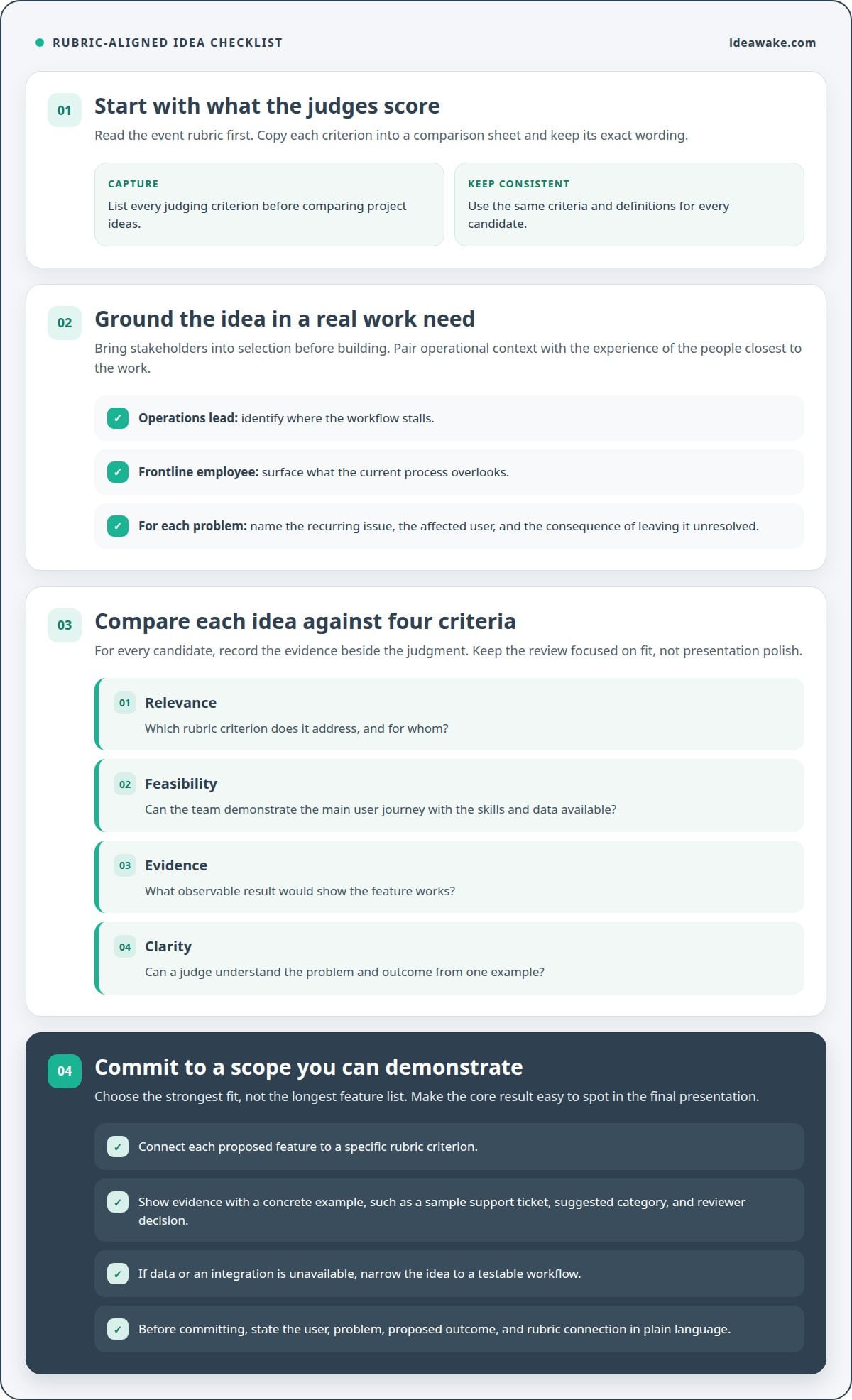
A promising concept can miss the mark if it solves a problem judges aren’t scoring. Start by reading the event rubric, then copy each criterion into a comparison sheet. Common examples include user impact, feasibility, originality, and demonstration quality. Use the rubric’s exact wording, because each event defines success differently.

Next, connect every proposed feature to a criterion. For example, a support-ticket assistant might demonstrate operational value with a sample ticket, a suggested category, and a reviewer’s decision. If the rubric emphasizes accessibility, show how a user with a specific need completes the same task. One clear example gives judges evidence, not just a claim.

Bring stakeholders into idea selection before the event begins. An operations lead can explain where a workflow stalls, while a frontline employee can point out what current processes overlook. Ask each person to name a recurring problem, the user affected, and the consequence of leaving it unresolved. Those details help teams distinguish an urgent need from an interesting technology looking for a use.

Compare candidate projects against a shared set of questions:

  • Relevance: Which rubric criterion does the project address, and for whom?
  • Feasibility: Can the team demonstrate the main user journey with available skills and data?
  • Evidence: What observable result would show the feature works?
  • Clarity: Can a judge understand the problem and outcome from one example?

Keep the evaluation consistent across submissions. Use the same criteria and definitions for every team, and ask reviewers to record evidence beside each judgment. A shared process reduces the influence of presentation polish alone. A simple idea evaluation process can also help organizers separate potential impact from build readiness.

Choose the idea with the strongest fit, not the longest feature list. If a concept depends on unavailable data or an unfamiliar integration, narrow it to a testable workflow. For example, demonstrate how a reviewer routes a sample suggestion before building a complete enterprise system. Make the core result easy to spot in the final presentation.

Before teams commit, have them state the user, problem, proposed outcome, and rubric connection in plain language. Organizers can use that short pitch to spot mismatches early and redirect scope. For enterprise events, a structured hackathon planning discussion can help align challenges, stakeholders, and judging criteria before teams start building.

3. AI-focused hackathon challenges

A strong AI challenge starts with a work problem, not a tool demonstration. Ask teams to explore how secure, useful AI could support employees’ daily work. This framing gives participants a practical goal while leaving room to examine different workflows. For example, teams might help staff find internal guidance or summarize recurring operational questions.

Define the challenge with four parts: a specific user, a recurring task, an approved information source, and an observable outcome. “Improve onboarding” is too broad. “Help new hires find the correct internal procedure, then show the source passage” gives teams a user and a testable result. The source matters: an answer that can’t be traced to reliable material may create more work than it saves.

Set expectations before teams begin. State which data they may use, which AI tools are approved, and what information must stay out of prompts. Use sample or synthetic records when sensitive employee, customer, or operational information isn’t necessary. Clear boundaries let teams focus on solving the challenge instead of guessing what they can access.

Make the evaluation criteria visible in advance. A practical checklist can include:

  • Task completion: Does the prototype complete the stated workflow?
  • Source quality: Can a user inspect the material behind an answer?
  • Failure handling: Does it explain when information is missing or unclear?
  • Human review: Can a person correct or reject an output?
  • Adoption path: Does the team explain where the tool fits into existing work?

For a policy assistant, test it with representative questions based on approved sample documents. Record whether each response answers the question, points to relevant source material, or correctly acknowledges a gap. This focused evaluation won’t prove broad performance, but it gives judges concrete behavior to inspect. Ask teams to explain what the results do and don’t show.

Challenge themes can also focus on employee support, knowledge access, or process improvement. For example, an AI assistant could turn a long procedure into a step-by-step checklist while preserving links to the original sections. Another team might identify repeated themes in anonymized feedback and present examples for a human reviewer. In both cases, the expected value is clearer when teams name the user and the decision their prototype supports.

End with a demonstration that follows one realistic task from input to output. Have teams show the source, explain one limitation, and describe a next test after the event. That discipline keeps an AI challenge grounded in responsible use and practical value, rather than impressive-sounding features alone.

High-Impact Hackathon Ideas to Drive Real Innovation

4. Hackathon brainstorming

Brainstorming works best when teams turn a broad theme into a specific user problem. Start with the event prompt, then note who is affected, the obstacle, and when it occurs. For a sustainability theme, “reduce waste” is too broad. “Help a facilities team spot reusable materials before disposal” gives participants a clear situation to investigate.

Capture promising concepts in a shared document before choosing one. For each, record the solution, key assumptions, and critical unknowns. A materials-reuse tool might assume staff can identify items accurately, while an unknown is whether nearby organizations can accept them. Naming that uncertainty helps the team decide what its prototype needs to test.

Use prompts that explore different angles on the same challenge. Ask who encounters the problem, what information they lack, and what action could change the outcome. For a campus sustainability event, one group might explore reuse matching; another might focus on detecting contamination in recycling. Keep both concepts visible while comparing their users, data needs, and demonstration paths.

Examples make brainstorming more productive when teams examine the mechanism, not just the technology. A blockchain concept could use Soulbound NFTs to verify educational certificates, following EIP-4671. A job-matching concept could compare skill tags across 30 fictional profiles. Each example suggests a different test: certificate authenticity for one, or whether profile attributes support a useful match for the other.

Move from idea generation to selection with a short review. Ask each team member to explain the user, problem, and proposed change. Then identify the assumption most likely to undermine the concept. If a reuse-matching idea depends on reliable item descriptions, focus the next discussion on how users will provide them.

Time-box validation around evidence, not debate. One proposed hackathon theme is testing a new market idea within two weeks; another is testing each product idea in a week. Teams can use these prompts to design a small experiment, such as presenting a concept to potential users and recording their reactions. The goal is to uncover an important unknown, not claim full market proof.

Before teams commit, compare concepts with the event’s purpose and available capabilities. A detection prototype may need images, while a certificate-verification concept may need sample records. Review the strongest assumptions, name the data each test requires, and document why the selected idea merits a build. A structured idea crowdsourcing approach can help organizers gather and sort concepts from participants before the event.

5. Hardware and Internet of Things

Hardware can make a hackathon solution tangible: a sensor detects a condition, software interprets it, and an interface shows what happens next. Consider an energy-monitoring concept that displays equipment use, or a leak detector that sends a visible alert. Each example connects a physical signal to a user need, giving the demo a clear purpose.

Keep the prototype focused on one complete path. Describe what the device senses, how the signal reaches the application, and what action the user sees. For an indoor air-quality concept, the demo might show a sensor reading, a threshold comparison, and an on-screen alert. That end-to-end sequence communicates more than a collection of disconnected components.

Hardware failure is a real project risk. A loose connection, depleted battery, or unavailable device can interrupt a live demo. Reduce the risk by testing each component independently, then testing the full flow. Prepare a recorded or simulated sensor input as a fallback, so the team can still explain the software behavior if the physical device stops responding.

Before selecting a build, map the practical requirements:

  • Input: Identify the sensor or device and the signal it provides.
  • Connection: Describe how data reaches the prototype, such as a local connection or network message.
  • Response: Specify what the application displays or triggers after receiving data.
  • Fallback: Prepare a sample reading that demonstrates the same workflow.

For a sustainability challenge, teams could prototype a room-occupancy display to help staff identify unused spaces. The demo should show how an occupancy signal changes the display, not claim energy savings without measuring them. This keeps the pitch credible: present the observed behavior, then explain what a later field test would need to assess.

Choose components that suit the team’s existing skills and the event’s environment. A team familiar with simple microcontrollers may prefer one sensor and a basic dashboard. A team without hardware experience can model incoming readings and build the interface first. Either approach can produce a useful proof of concept when the user, signal, and response are clear.

Judge the project by its usefulness, reliability, and clarity, not by the number of devices. One working sensor can support a stronger story than several untested components. For broader planning considerations, the enterprise hackathon guide connects prototype decisions to event design and follow-through.

Ideawake: Idea Management Platform

Ideawake’s Idea Management Platform helps organizations capture, evaluate, and implement employee, customer, and partner ideas. It’s a natural next step when a hackathon produces promising concepts that need clear evaluation and a path to implementation.

Ideawake’s Hackathons offering connects event participation with broader innovation work. Ideas can move beyond a final presentation into a process for assessing their potential and deciding what to advance. For organizations seeking ongoing participation, the platform also supports continuous improvement and innovation management.

Contact Ideawake to discuss how its Idea Management Platform can support your organization’s hackathon and idea-to-implementation process.

Turn the Next Experiment Into Ongoing Progress

The most valuable next step is deciding how promising work will continue after the event. Give each selected concept an owner, a decision path, and a clear learning goal. This creates a bridge from a short-term experiment to the organization’s broader priorities, without treating every prototype as a finished solution.

Ideawake’s Innovation Management Platform and Continuous Improvement tools help organizations connect new opportunities with ongoing innovation work. For teams ready to bring promising hackathon ideas into a more structured process, Ideawake can help make participation and follow-through part of a wider innovation effort.

Build on your teams’ momentum and shape the next step together.

Your next useful experiment can start with one focused challenge and a clear path forward.

Frequently Asked Questions

What makes a strong hackathon project in 2026?

Strong hackathon ideas address a specific user problem and give the team a clear way to demonstrate progress. A project should connect its solution to a real workflow, rather than adding AI or connected devices without a reason. For example, a prototype that helps staff find the right internal form makes the task, user, and result clear. Make the idea memorable through useful execution, not technological novelty alone.

What are the best hackathon project ideas for beginners?

Beginner-friendly projects use familiar workflows and simple inputs. A room-equipment checkout tracker could let staff record borrowed items and see what remains available. Another option is a supply-request dashboard that groups sample requests by department. Teams can map the process, sketch screens, and test whether a colleague understands the next step. These projects let non-coders contribute through research, workflow design, copy, and presentation while technical teammates build a small demo.

What are unique hackathon ideas for 2026?

Look for overlooked friction between teams, not just headline-grabbing technology. A handoff tracker could make unclear ownership visible when work moves between departments. A repair-or-replace guide could help facilities staff compare options using their chosen criteria. For a distinctive result, show how a real user makes one decision with the prototype. A fresh angle comes from the problem, audience, and experience, not from adding features without a clear purpose.

What are good AI hackathon project ideas?

Useful AI projects can help staff compare policy revisions, check whether a procurement request includes required information, or find definitions in an internal glossary. Each concept should use approved sample material and make its output easy to review. For a policy comparison demo, show the original and revised passages beside a short summary. This lets judges assess whether the AI highlights meaningful changes and whether a person can inspect the underlying text.

How do you choose a project that can be built in 24 to 48 hours?

For a 48-hour build, choose a single user journey with accessible data and a visible result. First, define the user and their task. Then list the minimum inputs, output, and tools required. Remove features that don’t support the main demonstration. Before building, sketch the flow and test whether the team can explain it clearly. If a key dependency is unavailable, replace it with sample data or narrow the prototype.

What makes a hackathon project stand out to judges?

A project stands out when judges can quickly see who benefits and what changes for them. Show one realistic task from beginning to end, then identify what the demo proves and what still needs testing. For example, a maintenance-request prototype might show how a technician receives a clearer description of a reported issue. A concise presentation, a working core interaction, and candid limits make the pitch easier to assess.

What are common hackathon rules and judging criteria?

Rules vary by event, so organizers should clearly state eligibility, team formation, submission deadlines, permitted tools, and data restrictions. Judging criteria often assess usefulness, feasibility, originality, execution, and presentation, but the rubric should define each term. Teams should also know what to submit, such as a demo or project description. For AI projects, organizers can specify approved tools and data, then apply the same criteria consistently.

Article by

Coby Skonord

Coby Skonord is the co-founder and CEO of Ideawake. Since 2013 he has worked with enterprise innovation, continuous improvement, and HR leaders to turn employee ideas into measurable business impact.

How to Drive Innovation Using Microsoft Tools

College staff prioritize employee ideas on a physical innovation workflow beside a student check-in queue
Coby Skonord|
November 2, 2026

Innovation doesn’t come from adding more software to an already crowded stack. Enterprise innovation software helps employees capture ideas, use AI to explore and refine them, and collaborate across departments, while Microsoft tools can support the day-to-day work of sharing and developing those ideas. The key is connecting the tools to a clear process, so promising suggestions move beyond conversation and into evaluation and action.

It’s reasonable to expect familiar workplace tools to make collaboration easier, but access alone won’t create a repeatable innovation process. This article explains how to connect Microsoft tools with idea-sharing practices, where AI and generative AI can assist, and how cross-functional teams can evaluate ideas against business priorities. You’ll also learn what to consider when choosing enterprise innovation software and how to build a practical approach that employees can use across the organization.

Key Takeaways

  • Set clear business goals and a transparent evaluation process so employees can see how ideas move from submission toward action.
  • Use AI and generative AI to help organize and develop ideas, with human review and safeguards for sensitive information.
  • Choose tools that support collaboration across departments and make ownership, progress, and outcomes visible.
  • Assess software against your workflows, governance needs, and ability to manage ideas through implementation.
  • Connect familiar Microsoft tools with a dedicated idea management process when everyday collaboration alone isn’t enough.

How can companies encourage employees to contribute more innovative ideas?

Employees are more likely to contribute when leaders make participation useful, visible, and worth their time. Gallup’s 2024 State of the Global Workplace report found 23% of employees globally were engaged, 62% were not engaged, and 15% were actively disengaged. These figures underline why idea programs need more than an open submission form: leaders must make contribution part of meaningful work.

Middle managers shape that experience through everyday choices. Gallup reports that managers account for 70% of the variance in team engagement. Give managers a practical role: make space for suggestions during existing team routines, explain what happens after submission, and recognize useful contributions. For example, a manager can invite staff to describe a frustrating task and share the team’s response to the suggestions at a later meeting.

Make participation easier to sustain by linking ideas to outcomes employees can see. Gallup’s Q12 meta-analysis found that teams in the top engagement quartile had 23% higher profitability and 18% higher productivity than teams in the bottom quartile. These comparisons do not prove that an idea program alone creates those outcomes. They do show why leaders should connect employee participation with real organizational priorities.

Organizational change management should clarify what is changing, who will review ideas, and how decisions will be communicated. If employees submit suggestions but hear nothing back, they have little reason to contribute again. Enterprise innovation software can support a consistent process, but managers still need to explain its purpose and reinforce it in daily work. A clear response, including why an idea is deferred, helps maintain trust.

Managing Large Idea Volumes

Managing large volumes of ideas means organizing submissions so reviewers can spot patterns and assess proposals efficiently. Use topic labels such as safety, customer experience, or process improvement, then assign review responsibility by subject. This makes recurring concerns easier to identify and helps teams find related suggestions. Enterprise innovation software supports this work when its categories reflect how the business operates.

Selecting Enterprise Innovation Software

Choosing enterprise innovation software means matching a platform to your organization’s goals, workflows, and governance needs. Compare requirements for submission, review, access, reporting, and integrations. Test a realistic suggestion from intake through decision, and note where users need clarification. This practical evaluation reveals fit beyond a feature checklist.

Idea Management Software

Idea management software provides a dedicated place to submit, assess, and follow suggestions. It helps when email threads or spreadsheets make ownership difficult to track. For example, a team could collect proposals to reduce rework, group similar submissions, and route them to the relevant reviewers. Explore corporate innovation tools by considering how each supports that process.

AI and generative AI applications

AI can help teams examine employee ideas, surface themes, and develop early concepts. Generative AI can also draft summaries or suggest questions for reviewers. These capabilities support innovation work, but they don’t replace business judgment. Start with one defined challenge, such as reducing repetitive service requests, and decide which task AI should assist with.

For example, an AI system could group submissions about confusing customer handoffs, then summarize common causes for a human review team. Generative AI could help turn a rough suggestion into a clearer problem statement or propose follow-up questions that reveal assumptions. Reviewers can then compare the refined idea with operational priorities. This assistance makes submissions easier to scan, without treating generated content as proof.

Choose an AI model based on the task and the data involved. A model that summarizes approved submissions has different requirements from one processing sensitive employee or customer information. Before deployment, define permitted inputs, access controls, retention practices, and who can see generated outputs. Keep external data sources separate from internal records unless their use has been approved. Clear boundaries reduce the risk of useful automation creating new information risks.

Generative systems can produce inaccurate statements, omit context, or present assumptions as facts. Human supervision is essential for decisions about funding, feasibility, safety, and customer impact. Ask reviewers to compare AI summaries with original submissions before advancing an idea. Monitor output quality, access patterns, and operational costs after deployment. If errors recur or results drift, refine the prompt, change the workflow, or pause that use case.

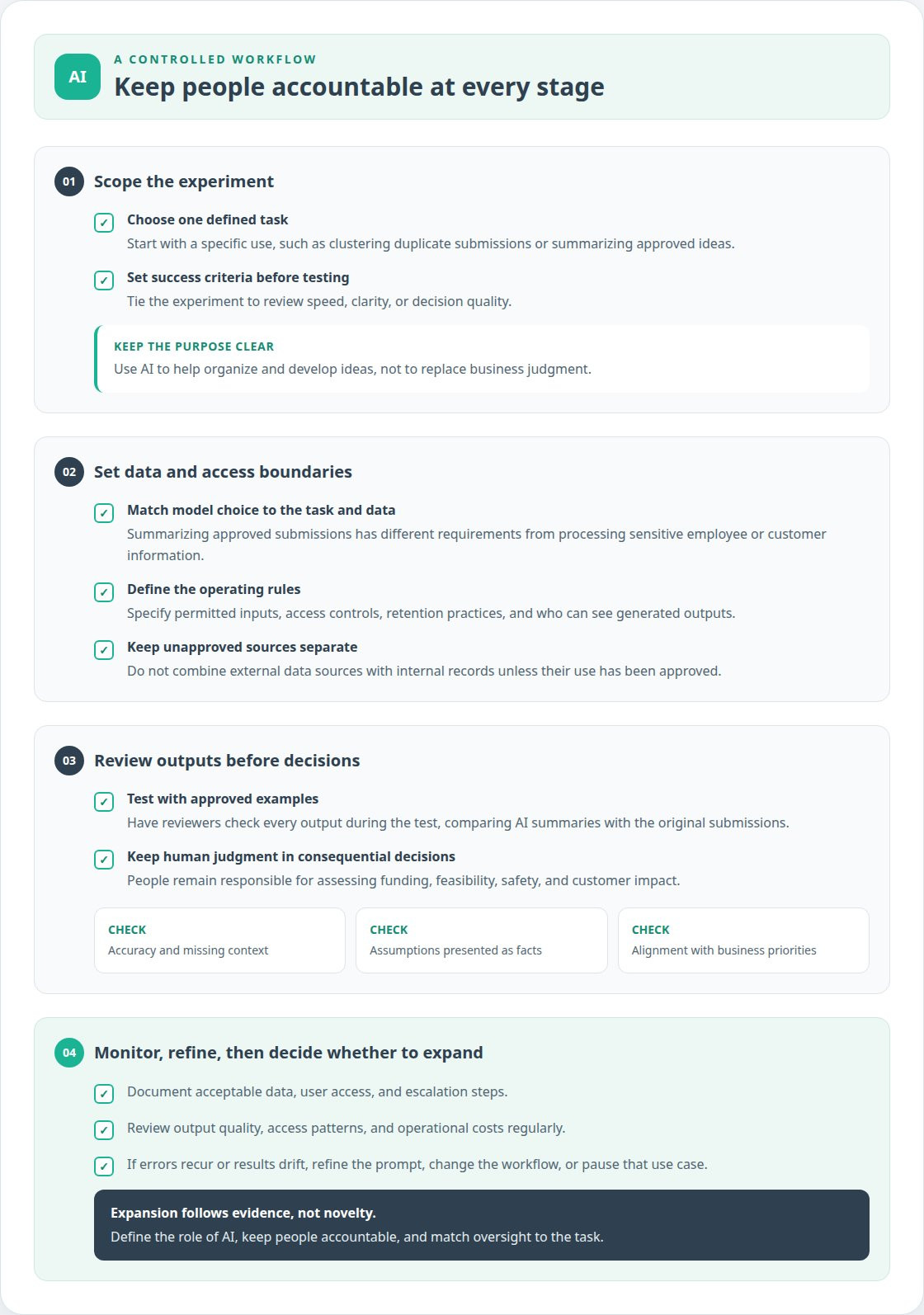
Move from experiment to practice through a controlled workflow:

  • Choose one specific task, such as clustering duplicate submissions.
  • Set success criteria tied to review speed, clarity, or decision quality.
  • Test with approved examples and have reviewers check every output.
  • Document acceptable data, user access, and escalation steps.
  • Review performance regularly before expanding automation.

This approach helps teams learn where AI adds value without letting novelty drive adoption. The same discipline applies to AI agents that assist with analysis, design, testing, or delivery: define their role, keep people accountable, and create oversight that matches the task. For practical examples of AI use in innovation workflows, explore AI tools for innovation managers. Well-scoped experiments can strengthen idea development while preserving human control and clear ownership.

AI adoption in enterprise software

AI adoption works best as a focused business transformation, not a technology add-on without a clear goal. An operations team might use AI to identify recurring production delays, while a service team could analyze common customer handoff problems. In either case, leaders should name the decision or workflow they want to improve before selecting a system. This keeps the project grounded in business needs.

Enterprise software has evolved through waves such as cloud computing and software as a service. AI represents another shift because it can assist with analysis, content creation, and workflow execution. For example, an innovation team might use AI to summarize employee submissions, then ask reviewers to validate the themes against original ideas. Technology supports the work, but accountable people still make decisions.

Build governance into the design rather than treating it as a late approval step. Define which information AI may process, who can access its outputs, and which decisions require human review. For example, separate general process suggestions from submissions that contain customer or employee details. Assign an owner to monitor output quality, access, and operational performance. Clear responsibility helps keep promising experiments from becoming unmanaged systems.

Data infrastructure and security determine whether an AI use case can move beyond a prototype. A team analyzing service feedback needs reliable input data, controlled access, and a way to review model performance over time. Organizational change matters too. Explain how AI affects existing roles, train employees on the revised workflow, and give them a way to flag errors. Without adoption planning, a tool can add steps instead of reducing friction.

Use a practical adoption sequence:

  • Choose a specific workflow and state the business outcome it should support.
  • Identify the data, users, and systems involved before configuring AI.
  • Set review rules for generated summaries, recommendations, or actions.
  • Test the workflow with real users and collect examples of errors.
  • Track performance and adjust governance before expanding its scope.

These steps connect technical delivery with daily work. For example, a department can start with AI-assisted idea categorization, review whether the categories help staff find relevant proposals, and refine the process before applying automation elsewhere. Keep the target narrow enough to measure but meaningful enough to matter. That balance gives leaders evidence for their next decision.

AI-enabled innovation workflows also need a clear operating model: named owners, review criteria, and a process for handling exceptions. Organizations planning that foundation can explore AI-powered innovation management as one approach to connecting AI with idea development. The priority is deliberate adoption, where governance, people, and technology advance together.

How to Drive Innovation Using Microsoft Tools

Cross-departmental collaboration

Cross-departmental collaboration brings people with different expertise together to solve a shared business problem. A customer handoff challenge, for example, may involve operations, sales, service, and technology. Each team sees a different part of the workflow, so working together can reveal causes one department might miss. Shared ownership matters: without it, ideas can stall between teams as each waits for another to act.

Microsoft Teams can support discussion, while SharePoint can provide a shared space for project materials. These tools help teams communicate, but collaboration still depends on clear decisions, owners, and handoffs. Define who frames the challenge, contributes expertise, assesses feasibility, and approves implementation. For a recurring service issue, operations might map the process, customer service could identify pain points, and technology staff could assess system dependencies.

Build engagement by giving each department a specific contribution instead of inviting everyone into a broad, undefined discussion. A useful working agreement identifies the problem, decision-maker, information needed, and how progress will be shared. During a process-improvement effort, frontline employees can describe workarounds, managers can explain performance targets, and analysts can examine available data. This division uses existing capabilities without letting one department dominate.

Manual handoffs can weaken otherwise strong ideas. Reduce that friction by recording decisions, assigning next steps, and setting a shared review point. For instance, when a proposal affects employee training and a customer-facing process, the training lead and service owner should review the same recommendation. Governance clarifies who resolves competing priorities. Continuous improvement then becomes part of the workflow, rather than a separate investment that fades after kickoff.

Use this collaboration checklist before launching a cross-functional effort:

  • Name the business problem and the outcome teams are working toward.
  • Include people with relevant frontline, operational, and technical expertise.
  • Assign one accountable owner for decisions and action tracking.
  • Agree how Microsoft Teams discussions and shared documents will support the work.
  • Review progress together and communicate decisions to contributors.

These practices connect engagement with action. A focused innovation challenge can give departments a common target, such as improving onboarding or reducing repeated service questions. Its value depends on participation, clear criteria, and follow-through, not just the number of submissions. Teams can use innovation challenge examples to shape a cross-functional effort around a specific need.

Leaders should recognize that collaboration takes time away from employees’ existing responsibilities. Make the work visible in planning, clarify which decisions need group input, and let specialists complete independent tasks between reviews. When departments understand their roles and see how decisions progress, they can combine their capabilities without creating another disconnected workflow.

What is enterprise innovation software and what features does it include?

Enterprise innovation software gives organizations a structured way to collect, assess, develop, and track ideas. Unlike a Microsoft Teams conversation or shared document, it can connect submissions to review stages and decisions. For example, an employee suggestion about reducing repeat customer questions can be recorded, assigned for review, and tracked through implementation. The system supports the process; leaders still set priorities and make decisions.

Think of the platform as a workflow from idea intake through follow-through. Employees submit proposals, reviewers assess them against shared criteria, and owners record what happens next. A proposal might move from “submitted” to “under review,” then to a decision and an implementation owner. These stages create visibility across departments and help teams see whether an idea needs clarification, further analysis, or action.

For a large organization, useful capabilities typically include:

  • Idea capture: forms or portals collect a problem, proposed change, and supporting context.
  • Review workflows: criteria and assigned reviewers make assessment more consistent.
  • Collaboration: comments and discussion help contributors build on proposals.
  • Portfolio visibility: dashboards show status, themes, and ownership across initiatives.
  • Reporting: records connect activity with decisions and documented outcomes.
  • Integrations: connections to workplace systems can reduce manual handoffs when configured for organizational workflows.

Microsoft tools can remain part of the working environment. Teams can host discussions, while a dedicated innovation system organizes submissions, evaluation, and progress. Enterprise innovation software distinguishes informal conversation from a managed process by recording an idea’s owner, status, decision, and next action. Before selecting tools, map an example from initial suggestion to final decision, then identify where information currently gets lost.

Feature lists alone don’t determine fit. Compare each platform with your organization’s governance model, access needs, review criteria, reporting requirements, and existing workflows. Ask how employees submit proposals, managers handle duplicates, reviewers document decisions, and implementation owners report progress. Enterprise innovation software should meet these requirements in daily use, not just during a product demonstration. A guided evaluation of innovation management software selection can help teams compare real workflows with platform capabilities.

Keep the first rollout focused on a defined use case, such as frontline suggestions for reducing rework. Set clear ownership, test the review path with real submissions, and see whether employees understand each stage. Then refine fields, criteria, and reporting based on where reviewers encounter friction. The right platform makes work visible from idea to decision, while a sound operating process turns that visibility into accountable action.

Ideawake: Innovation Management Platform

Ideawake provides an Innovation Management Platform for capturing, evaluating, and advancing employee, customer, and partner ideas. It’s a natural next step when Microsoft tools support everyday conversations but your teams need a dedicated process to manage ideas through their lifecycle.

The Idea Management Platform supports structured idea review, while Continuous Improvement helps teams organize improvement efforts. Ideawake AI can assist innovation work, and engagement features such as voting, leaderboards, and prizes can encourage participation. Together, these capabilities bring submissions into a shared process, reduce administrative complexity, and make progress easier to follow.

If your organization is ready to give ideas a clearer path from submission to action, visit ideawake.com to explore how Ideawake can support your innovation program.

Make innovation part of how work gets done

Connect your innovation priorities with the routines, owners, and measures your organization already uses. Choose a business challenge, define who will guide the work, and decide how progress will be reviewed. This gives employees a clear path to contribute and helps leaders assess whether enterprise innovation software fits their operating model.

Ideawake offers an Innovation Management Platform, an Idea Management Platform, and Continuous Improvement to help organizations build this process. Each can structure the management of ideas and improvement initiatives around your program’s needs.

Start with a focused next step, then give your teams the space and direction to turn useful insight into progress.

Frequently Asked Questions

How Does Software Help?

Software helps teams organize information and apply analytical tools to work that would otherwise remain scattered. McKinsey’s 2024 State of AI report found that 72% of respondents said their organizations used AI in at least one business function, up from 55% in 2023. The same report found regular generative AI use rose from 33% to 65%. These figures offer context for assessing software that supports analysis, not proof that a particular platform will deliver results.

How can enterprises identify which innovation opportunities are worth pursuing?

Enterprises can distinguish opportunities by asking whether they address an emerging need, improve an existing operation, or open a different path to growth. Keep these categories visible during review, since each may require different evidence and decision-makers. For example, a service improvement could be tested within an existing process, while a new market concept may need research before operational planning. This helps leaders avoid judging unlike opportunities by identical expectations.

How do large companies maintain innovation momentum over time?

Large companies sustain momentum by developing employee skills alongside their innovation programs. The World Economic Forum’s Future of Jobs Report 2023 projects that 44% of workers’ skills will be disrupted within five years, and 60% of workers will require training before 2027. Leaders can use these findings to plan learning around new workflows, emerging technology, and changing roles. Regularly updating those learning plans helps teams keep pace as priorities shift.

Why do innovation initiatives sometimes lose executive support?

Executive support can fade when an initiative competes with urgent operational demands and its sponsors can’t explain the trade-off. Connect each initiative to a current priority, then make a clear decision about whether it deserves continued attention. For example, if a strategic shift makes a project less relevant, leaders can pause or redirect it instead of continuing by default. Explicit decisions protect focus and trust.

What are the best platforms for enterprise innovation in 2026?

There is no universal best platform for every organization in 2026. The right fit depends on whether the program centers on employee suggestions, continuous improvement, challenges, or portfolio oversight. Start by defining the primary use case and the people who will administer it. Then evaluate how well each option supports that program’s governance, adoption, and reporting needs. A strong fit should support the organization’s operating model, not force teams into an unsuitable one.

How do innovation platforms compare by features and use cases?

Compare platforms by examining how each handles the specific needs of a use case. A challenge program may need participant communications and review criteria, while continuous improvement may depend more on recurring operational input and status tracking. For programs using AI, assess how people review generated outputs and maintain oversight. A comparison matrix can record these requirements alongside administration, access, and reporting, making meaningful differences easier to discuss.

What are the leading platform vendors and their customer reviews?

Customer reviews can help buyers understand common user experiences, but they shouldn’t determine the decision alone. Look for detailed comments about the program type, implementation context, administrator workload, and employee experience. Check whether reviews describe recent, firsthand use or broad impressions, and compare recurring themes with your requirements. Use this evidence to shape internal evaluation questions, then assess the product against your workflows and governance needs.

How do companies choose an innovation platform?

Companies can choose an innovation platform by involving the people who will use and administer it before procurement. Include an employee contributor, a reviewer, a program owner, and an IT or security representative in the evaluation. Ask each person to complete tasks relevant to their role, then record friction points, missing information, and access concerns. This cross-functional assessment can reveal practical adoption issues that a feature checklist or executive review might miss.

Article by

Coby Skonord

Coby Skonord is the co-founder and CEO of Ideawake. Since 2013 he has worked with enterprise innovation, continuous improvement, and HR leaders to turn employee ideas into measurable business impact.

Innovation Portfolio Management for Enterprise Investment Choices

Innovation Portfolio Management for Enterprise Investment Choices
Coby Skonord|
October 25, 2026

A stack of promising projects isn’t a strategy. Innovation portfolio management assesses, prioritizes, and monitors initiatives as a connected whole, helping leaders see how each supports enterprise goals. The right innovation portfolio management software centralizes initiatives and makes them easier to compare against consistent criteria, rather than treating every idea as an isolated bet.

Organizations want to protect promising ideas while focusing resources on work that can deliver value. The challenge is balancing near-term improvements with longer-term opportunities and making risk, progress, and strategic fit visible enough to guide investment decisions.

This article explains how portfolio management works and what to look for in supporting software. You’ll learn how analytics, AI, and collaboration tools can inform decisions about resources, risk, timing, and expected returns, as well as how to evaluate initiatives and adjust the portfolio when priorities change.

Key Takeaways

  • Connect collaboration tools to make initiative updates, ownership, and decisions easier to follow across teams.
  • Assess innovation initiatives as a portfolio, linking investment choices to enterprise strategy rather than reviewing each idea in isolation.
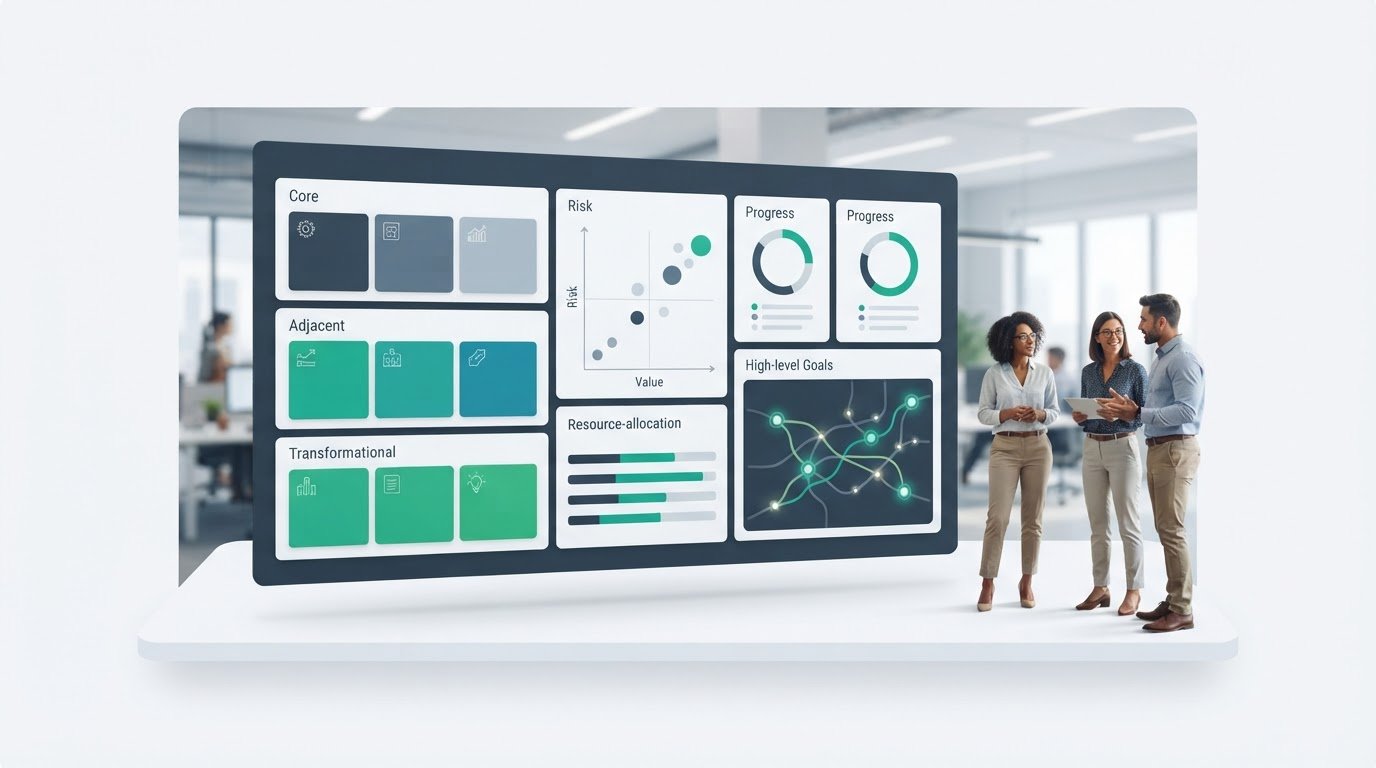
  • Balance core, adjacent, and transformational work, then redirect resources as evidence and priorities change.
  • Use analytics and AI to surface portfolio patterns, monitor progress, and support better-informed decisions.
  • Evaluate software by how well it centralizes initiatives, standardizes assessment, and gives leaders visibility into progress.

Integration with enterprise collaboration tools

Collaboration tools connect portfolio decisions with the conversations where work happens. For example, a team discussing a customer problem in Microsoft Teams can record the resulting initiative in a shared portfolio workflow. Preserve the context: the original need, its owner, strategic purpose, and next decision. Without those details, discussion can generate activity without giving the enterprise useful insight.

Start by mapping your innovation process and identifying where teams lose information. A product team might capture an employee suggestion, ask finance to assess resource needs, and invite operations to review implementation risks. A connected workflow makes ownership and decision history easier to follow, giving leaders a clearer basis for comparing proposals across business units.

A small business may need only a shared workspace with simple submission, discussion, and review steps. Large enterprises generally need portfolio-wide visibility, consistent evaluation, and coordination across teams, business areas, and external partners. In either case, choose tools based on the number of participants, decision complexity, and reporting needs, not company size alone.

Integration also supports long-term competitiveness by bringing outside knowledge into planning. Disruption expected to remain 5-10 years away can itself create risk, so organizations need ways to notice changing customer needs and emerging technologies. A partner ecosystem can contribute specialized expertise or access to pilot users. For example, a manufacturer could invite a supplier to review a materials pilot before expanding it.

Set clear collaboration rules before inviting partners into a pilot. Define who can submit ideas, who evaluates them, and how teams share progress. Keep sensitive details within appropriate groups and record decisions in each initiative’s history. Regular updates help surface blockers early, while a named owner ensures feedback leads to a next step rather than another meeting.

  • Use one decision record: Capture the proposal, evidence, owner, and review outcome in a shared location.
  • Make reviews structured: Ask participants to assess strategic fit, customer value, feasibility, and risk.
  • Close the feedback loop: Tell contributors whether an idea advances, changes direction, or stops, and explain why.

Employees may resist adoption if portfolio reviews feel like extra administration. Explain the purpose, connect initiatives to business strategy, train employees on the workflow, and recognize meaningful contributions. These steps make collaboration part of decision-making rather than a separate task. When teams and partners can see how their input informs decisions, the organization builds a stronger foundation for learning and future investment.

What Is Innovation Portfolio Management?

Strategic Portfolio Alignment

A strategic portfolio translates business priorities into choices about which initiatives to advance, reshape, or pause. Leaders can map proposals against growth goals, customer needs, and available capabilities, then identify gaps or excessive concentration. The Three Horizons model distinguishes core business development, emerging growth businesses, and future options, as described by McKinsey’s Three Horizons of Growth. That view helps teams test whether today’s portfolio supports current priorities and longer-term competitiveness.

Risk tolerance matters because strategic alignment isn’t the same as choosing only familiar projects. The Innovation Ambition Matrix helps frame initiatives by risk and ambition. Bansi Nagji and Geoff Tuff describe the framework in their Harvard Business Review article. A company focused on improving an existing service might pair that work with a more exploratory initiative. The useful test is whether each investment has a clear strategic purpose and an appropriate level of uncertainty.

Investment Decisions and ROI

Investment decisions weigh expected value against required resources, execution risks, and evidence of progress. Common measures include expected revenue growth, cost savings, time-to-market, strategic alignment, and risk exposure. A scoring model makes these criteria visible, while stage-gate reviews give leaders defined points to reassess assumptions. Choose measures that fit each initiative instead of forcing every development project into the same ROI formula.

ROI informs portfolio choices, but it shouldn’t be the only consideration. Early initiatives may build capabilities or test customer demand before financial returns become clear. Record assumptions, milestones, and evidence, then revisit funding as results emerge. This makes it easier to redirect resources from underperforming work to initiatives with stronger strategic value, rather than relying indefinitely on an initial business case.

For 2026, the best platform fit is one that supports portfolio visibility, consistent evaluation, and decisions aligned with your organization’s strategy. Compare how each option handles risk, maturity, business area, progress tracking, and the metrics leaders use to review investment choices.

Implement the system by defining strategic goals and evaluation criteria, organizing existing initiatives, assigning owners, and setting review points. Onboard teams, assess progress against agreed measures, and adjust the portfolio as evidence or priorities change.

Portfolio strategy should reflect the organization’s actual investment choices, not a fashionable template. Frameworks such as the Three Horizons model and Innovation Ambition Matrix can guide discussion, while teams tailor dimensions to their strategy. For practical selection criteria, explore this guide to choosing innovation management software.

Balancing resources, time, risk, options, and profitability

A balanced portfolio matches resources and timing to each initiative’s risk and expected return. Comparing core, adjacent, and transformational work helps an organization avoid relying on just one type of outcome.

Feasibility Assessment

Assess feasibility by examining the capabilities, technology, dependencies, and people each initiative requires. A service redesign, for example, may use existing systems, while a new digital offer could require technical development and customer testing. Record assumptions, identify resource gaps, and use stage-gate reviews to determine whether the evidence supports continued investment. This separates an attractive concept from work the organization can realistically deliver.

Resource Allocation and Waste Reduction

Resource allocation assigns people, budget, and leadership attention according to strategic value and delivery needs. During a portfolio review, compare active work with available capacity, then pause duplicated efforts or initiatives whose supporting evidence has weakened. Redirecting those resources toward stronger opportunities can reduce wasted development effort. Clear owners and decision dates help teams act on changes instead of letting low-value work continue by default.

Time is a portfolio constraint, not just a project schedule. A near-term process improvement may produce learning quickly, while a transformational technology initiative may require longer development and staged investment. Compare milestones and dependencies across initiatives before committing scarce specialists. If several projects need the same engineering skills, sequence the work or narrow its scope to protect progress without overloading the team.

Risk should be considered across the portfolio. Core initiatives often improve existing products or operations; adjacent initiatives extend current capabilities into a new market or offer; transformational initiatives pursue less familiar opportunities. A portfolio weighted heavily toward core work may limit future options, while too many uncertain bets can strain resources. Leaders can set a deliberate mix, then adjust it as customer evidence and strategic priorities change.

Profitability decisions should consider expected revenue growth, cost savings, time-to-market, and risk exposure. These measures help compare initiatives, but they need context: a pilot may be valuable for learning before its direct returns are clear. Review the assumptions behind each forecast and use scoring models or stage-gate discussions to determine what would justify further investment. The aim is informed decision-making, not false precision.

Innovators also need practical support to turn allocated resources into results. Give each initiative an accountable sponsor, access to relevant subject-matter expertise, and a clear way to resolve cross-team dependencies. A circular-economy project, for example, may need input from operations, procurement, and product development. Environmental, social, and governance measures, such as energy efficiency or emissions considerations, can connect transformation goals with resilience and profitability.

Data analytics, AI, and predictive modeling

Analytics connect initiative data to portfolio decisions, helping leaders assess value, progress, and emerging trends. Predictive models and dashboards make patterns easier to identify and act on.

Portfolio Analytics and Value Measurement

Start by centralizing initiative data, then compare projects against agreed measures. Common measures include expected revenue growth, cost savings, time-to-market, strategic alignment, and risk exposure. A dashboard, for example, can show that one business area has several delayed launches while another has available capacity. Leaders can investigate the cause and adjust priorities using consistent evidence.

Trend analysis adds context to these measures. An organization could group initiatives by customer segment, technology, maturity, or business area, then track changes in progress and expected value. Sentiment analysis can help identify themes in employee or customer comments, such as repeated requests for simpler onboarding. Teams should review the original feedback before treating a theme as a signal to invest.

AI-Assisted Analysis and Prioritization

Machine learning can identify patterns across initiative descriptions, evaluation scores, and historical outcomes. AI-assisted analysis, for example, could flag proposals with similar goals, highlight missing evidence, or group ideas addressing the same customer problem. Use these findings to inform prioritization, not replace accountable review. Leaders still need to weigh strategic fit, feasibility, risk, and available capabilities.

Set a clear workflow for AI-supported evaluation. First, define the criteria people use to assess initiatives. Next, check whether portfolio data is complete and consistently categorized. Then compare AI-generated themes with human assessments and record why a proposal advances or pauses. This keeps recommendations explainable and helps teams catch errors, such as treating duplicate concepts as separate opportunities.

Real-Time Analytics

Real-time dashboards give teams a current view of submissions, reviews, owners, and initiative progress. A portfolio manager can spot a stalled evaluation, identify the decision owner, and resolve a bottleneck before it affects downstream work. The value depends on timely updates and shared definitions. If one team marks a project “active” while another uses that status differently, portfolio comparisons lose meaning.

Make analytics useful by connecting each metric to a decision. Rising customer interest could trigger further discovery, while a missed milestone could prompt a resource review. Keep dashboards focused on signals leaders can act on and set a regular review cadence. Predictive analytics can support performance monitoring by highlighting patterns worth investigating, rather than presenting forecasts as fixed outcomes.

Innovation management software features

Innovation portfolio management software centralizes initiatives, supports consistent evaluation, and shows progress across a portfolio. Compare platforms by configurability, analytics, workflow fit, and ease of use, rather than relying on feature counts alone.

Feature Comparisons

Core capabilities include initiative tracking, configurable evaluation, portfolio views, and progress reporting. Useful systems let teams categorize work by risk, maturity, business area, technology, or function. Compare how each platform moves an opportunity from submission through assessment and review, and whether its workflows reflect your organization’s decision process.

Configurability matters because portfolio strategies differ. A team prioritizing emerging technologies may need maturity and risk views, while a continuous improvement program may focus on operational impact. Assess flexibility and analytics separately: flexibility shows whether workflows can adapt, while analytics show whether leaders can interpret portfolio activity.

Look for evidence behind feature claims. Ask how each capability works in a realistic workflow and test it with an initiative your team understands. Follow a proposal from submission through evaluation, then check whether reviewers can see its status, rationale, and next step. This reveals gaps that feature descriptions alone can obscure.

  • Portfolio structure: Can users group and filter initiatives using the dimensions leaders need?
  • Evaluation: Can reviewers apply shared criteria and record decision rationale?
  • Reporting: Can leaders see progress, ownership, and portfolio patterns together?
  • Adaptability: Can workflows change as priorities and processes evolve?

Usability Considerations

Usability determines whether employees and decision-makers can complete tasks without unnecessary friction. Test common actions, such as submitting an opportunity, completing an evaluation, and finding its latest status. Clear labels, focused forms, and role-appropriate views help users understand what to do next. Excessive fields or confusing navigation can slow adoption.

Test a scenario with people in different roles. Ask an employee to submit an idea, a reviewer to assess it, and a portfolio leader to compare initiatives. Note where users need guidance, repeat information, or lose sight of the next step. This shows whether the platform supports real workflows, not just an administrator’s ideal process.

Finally, distinguish usability from simplicity alone. Enterprise teams may need configurable workflows and detailed portfolio reporting, while smaller teams may prefer a lighter setup. Choose a platform that handles the required complexity without adding avoidable steps. A focused demonstration using your own evaluation criteria helps stakeholders compare the experience directly.

Ideawake: Innovation Management Platform

Ideawake’s Innovation Management Platform helps organizations capture, evaluate, and implement ideas from employees, customers, and partners. Turn portfolio priorities into a repeatable process: gather opportunities, assess them against your criteria, and track ideas toward implementation. Ideawake AI and gamification features, including voting and leaderboards, support participation and help teams surface promising contributions.

Consider Ideawake when ideas are scattered across disconnected channels or teams need a clearer path from submission to action. The platform supports the innovation lifecycle while reducing administrative complexity, helping decision-makers connect participation with evaluation and follow-through. Explore Ideawake to see how it could support your organization’s approach.

Contact Ideawake to discuss your innovation management needs.

Make your next investment decision actionable

Use an upcoming portfolio review to strengthen how your organization evaluates new opportunities. Define the decision you need to make, the evidence leaders will use, and how teams will record the outcome. Then assess whether innovation portfolio management software can support the process without adding unnecessary steps. Starting with a focused use case can turn a broad ambition into a practical operating rhythm.

Ideawake offers an Innovation Management Platform, an Idea Management Platform, and Continuous Improvement tools to help organizations develop and manage ideas. These offerings can bring employee contributions into a clearer process, from gathering suggestions to evaluating them and supporting follow-through. Start a conversation about your current priorities and how your teams make investment decisions.

Build a portfolio process that helps your people make informed choices and move promising work forward.

Frequently Asked Questions

What is innovation portfolio management?

Innovation portfolio management is the practice of deciding which innovation initiatives to fund, continue or stop so the overall mix supports company strategy. It treats ideas and projects as a portfolio of bets with different levels of risk, cost and expected return. The goal is to put limited money and people behind the initiatives most likely to create value.

How do you balance risk and impact in an innovation portfolio?

Spread investment across time horizons and risk levels, then review the mix on a fixed schedule. A common starting point is to put most resources into core improvements, a smaller share into adjacent opportunities and a small share into transformational bets, often described as a 70/20/10 split. Set clear evidence thresholds for each stage so higher-risk ideas earn more funding only as their assumptions are proven.

How do enterprises track innovation initiatives from idea to execution?

They use one system of record that follows each initiative from submission through evaluation, approval, implementation and measured results. Each stage has an owner, criteria and a due date, and status is visible to leaders and submitters. Ideawake tracks every idea through configurable stages and integrates with Jira and Asana so approved work can move into project tracking.

How should an innovation portfolio review make kill-or-continue decisions?

Decide in advance what evidence each initiative must show by the next review, then hold to it. Score every initiative on the same criteria, such as strategic fit, validated demand, cost to the next milestone and risk, and compare them side by side. Stopping weak initiatives quickly frees people and budget for stronger ones, so a healthy portfolio should kill some projects every quarter.

What features should innovation portfolio management software have?

Look for custom scorecards, multi-stage workflows, automated routing to reviewers, portfolio dashboards and ROI tracking that compares projected and actual value. Integrations with project tools and an API matter so approved work does not have to be re-entered. Our idea management software feature guide has a full checklist.

How is innovation portfolio management different from project portfolio management?

Project portfolio management governs approved projects that are already being delivered. Innovation portfolio management sits earlier: it decides which ideas become projects at all and keeps reassessing them while uncertainty is high. The two connect at the handoff, when an approved initiative moves into delivery with its business case and assumptions intact.

How much does innovation portfolio management software cost?

Cost depends on the number of users and administrators, workflow complexity, integrations and support. For Ideawake, most mid-size programs land in the middle of the Business plan range, around $1,000 to $1,500 per month, and enterprise portfolios with unlimited users are quoted. See the Ideawake pricing page and our innovation management software pricing guide.

Which innovation tools integrate with project management and collaboration systems?

Ideawake integrates with Microsoft Teams, Slack, Office 365, Jira and Asana, and offers an API and SCIM provisioning for custom connections. That lets ideas be submitted where people work and lets approved initiatives flow into project tracking without duplicate records. For financial systems, map which fields need to move and who owns them before choosing an integration approach.

Article by

Coby Skonord

Coby Skonord is the co-founder and CEO of Ideawake. Since 2013 he has worked with enterprise innovation, continuous improvement, and HR leaders to turn employee ideas into measurable business impact.

Enterprise Continuous Improvement Tools: The 2026 Strategy for Scalable ROI

Enterprise Continuous Improvement Tools: The 2026 Strategy for Scalable ROI
Coby Skonord|
September 20, 2026

Only 7% of organizations have successfully scaled operational excellence mechanisms enterprise-wide, according to research from McKinsey. Most leaders realize that relying on manual spreadsheets and fragmented email chains to manage growth is a losing strategy. You’re likely tired of seeing high-potential ideas die in administrative bottlenecks or struggling to quantify the financial impact of frontline suggestions. It’s time to demand more from your enterprise continuous improvement tools than just a digital suggestion box.

You’ll discover how to transition from broken feedback loops to a high-impact, AI-driven system that delivers measurable enterprise growth. We’ll examine the shift toward centralized “systems of intelligence” that align with the new ISO 9001:2026 standards, providing a clear roadmap for automated workflows and executive-ready ROI dashboards. This guide breaks down how to use modern idea management software and task-specific AI agents to eliminate administrative overhead, ensuring every improvement contributes directly to your bottom line.

Key Takeaways

  • Learn why legacy methods like spreadsheets create a “Chaos Gap” and how to bridge it with a centralized digital system of record.
  • Discover how AI-driven evaluation and automated deduplication slash administrative burden by prioritizing the highest-impact improvements.
  • Evaluate the total cost of ownership between custom builds and modern enterprise continuous improvement tools to ensure long-term scalability and compliance.
  • Follow a proven 5-step implementation roadmap that uses targeted Innovation Challenges to solve specific business problems with frontline insights.
  • Master the transition from tracking vanity metrics to hard financial outcomes by using ROI calculators to quantify cost savings for executive buy-in.

The Evolution of Enterprise Continuous Improvement: Why Legacy Methods Fail

The transition from physical suggestion boxes to digital innovation hubs isn’t just a tech upgrade; it’s a survival requirement. For decades, organizations relied on manual continual improvement processes that lived on plant floor whiteboards or in locked wooden boxes. These methods are fundamentally unscalable for the modern enterprise. Today, the “Chaos Gap” occurs when leadership attempts to manage complex operational excellence through spreadsheets and fragmented email threads. These manual systems lack auditability and real-time visibility, causing high-impact ideas to vanish into departmental silos before they ever reach a decision-maker.

Research from McKinsey indicates that roughly 70% of digital transformations fail, often due to poor employee engagement and a lack of structured support. Without dedicated enterprise continuous improvement tools, the momentum of any initiative quickly stalls. This is why forward-thinking organizations are increasingly appointing a Chief Innovation Officer to centralize the CI toolset and ensure that feedback loops remain closed and productive. A centralized platform transforms innovation from a vague cultural goal into a repeatable, data-driven business process.

The Hidden Costs of Fragmented CI Systems

Relying on legacy tools creates a significant administrative burden. Innovation managers often spend up to 40% of their week manually updating status reports or chasing stakeholders for feedback. This overhead isn’t just a waste of talent; it creates a “feedback black hole” where employees stop submitting ideas because they never hear back. When frontline insights are trapped in silos, the organization loses the ability to replicate small wins across different business units, directly impacting the bottom line. This fragmentation prevents the collection of clean data, making it nearly impossible to defend the program’s ROI during budget reviews.

Modern CI in a Hybrid World

The rise of distributed workforces means that innovation management for remote teams must be centralized and accessible from any device. Passive suggestion programs are being replaced by active “Innovation Challenges” that target specific operational bottlenecks. By establishing a single source of truth, enterprise continuous improvement tools allow teams to collaborate on solutions in real-time. This shift ensures that every employee, whether in a corporate office or on a manufacturing floor, has the power to contribute to the organization’s growth. Moving away from passive collection to active problem-solving is what separates high-performing enterprises from those stuck in perpetual pilot mode.

Essential Features of Modern Continuous Improvement Software

Modern software replaces passive suggestion boxes with structured, digital intake systems. These enterprise continuous improvement tools utilize standardized forms to ensure every idea arrives with the necessary context for evaluation. This structure aligns with the continuous improvement model promoted by the American Society for Quality, which focuses on reducing process variation through disciplined data collection. By centralizing this intake, organizations eliminate the “Chaos Gap” where valuable insights are lost to informal conversations or unmonitored email threads.

Leveraging AI for Idea Evaluation

Gartner predicts that 40% of enterprise applications will feature embedded, task-specific AI agents by the end of 2026. Within Ideawake AI, this technology moves beyond simple storage. The platform automatically identifies duplicate submissions and clusters related trends, preventing innovation managers from being buried under repetitive data. By applying automated scoring based on strategic feasibility, the system filters high-impact opportunities to the top. This significantly reduces “review fatigue,” allowing leadership to focus their energy on implementation rather than administrative sorting. Organizations can also leverage solutions like aigentia.io to access practical AI tools that help evaluate their current operations and uncover hidden growth opportunities. It’s a shift from being a data clerk to becoming a strategic architect of change.

Gamification and Engagement Dynamics

Sustaining engagement is often the most difficult hurdle in any CI initiative. Data from McKinsey shows that transformations are 1.4 times more likely to succeed when frontline employees generate the improvement ideas. Modern enterprise continuous improvement tools leverage gamification elements like leaderboards and peer voting to drive this participation. Voting acts as social proof, helping the best ideas gain momentum naturally while providing leadership with immediate feedback on what the frontline values most. Transparency is equally vital. When workers see their ideas moving through a visible pipeline, it builds a culture of “Frontline Power” and eliminates the morale-killing “feedback black hole.”

Implementation shouldn’t be a manual hand-off. Automated workflow management ensures that once an idea is approved, it moves through pre-defined stages without getting stuck in an inbox. Organizations adopting integrated process intelligence report an average 30% boost in operational efficiency according to Forrester Research. This end-to-end visibility is essential for scaling operational excellence across global business units. If you’re ready to see how these features function in a live environment, you can schedule a platform walkthrough to explore the interface.

The Build vs. Buy Dilemma: Choosing Your CI Infrastructure

Deciding whether to build an internal tool or purchase a specialized platform is a critical turning point for your operational excellence strategy. In 2026, developing a custom continuous improvement system carries an initial cost between $100,000 and $750,000 in development alone. Beyond the initial build, enterprises must account for annual maintenance and integration overhead, which typically requires an additional 15% to 25% of the original cost every year. These figures lead many organizations to realize that buying a scalable SaaS solution offers a much faster speed-to-value. By selecting specialized enterprise continuous improvement tools, leaders can focus on building a continuous improvement culture rather than managing software bugs and technical debt.

Why Custom-Built Tools Often Stagnate

Evaluating Vendor Flexibility and Scalability

Implementing CI Tools at Scale: A 5-Step Roadmap

Defining Your Strategic Objectives

Step 1 begins with defining specific business problems through targeted “Innovation Challenges.” Instead of asking for generic suggestions, you should focus your workforce on high-priority bottlenecks, such as reducing cycle time in a specific production line. This aligns CI initiatives with high-level Operational Excellence goals. You must select KPIs that go beyond vanity metrics. While participation rates are leading indicators of culture, implementation rates and validated ROI are the lagging indicators that prove the program’s worth. A compelling “Why” serves as the catalyst for employee buy-in, making it clear how their contributions impact the company’s future.

The Pilot Phase: Building Internal Momentum

Establishing clear phases of continuous improvement represents the second critical milestone. Without defined ownership for each stage, ideas stall in the approval process. Step 3 involves launching a high-visibility pilot in a department known for its agility. This “high-win” environment allows you to document the benefits of employee ideation programs quickly, creating internal case studies that convince skeptical stakeholders. Iterating on the submission process during this phase ensures the system is friction-free before a global rollout.

In Step 4, leverage AI to analyze the pilot’s initial results. This technology helps refine evaluation criteria by identifying which types of ideas yielded the highest ROI. Finally, Step 5 involves scaling the program by integrating CI participation into standard performance reviews. When continuous improvement is tied to professional growth, it ceases to be an “extra” task and becomes a core responsibility. This structured approach ensures that your enterprise continuous improvement tools deliver a sustained competitive advantage.

Measuring Success: Turning Continuous Improvement Into ROI

Scaling operational excellence requires more than just a high volume of suggestions; it demands a rigorous focus on financial outcomes. Many leaders make the mistake of tracking vanity metrics, such as the total number of ideas submitted, without correlating them to the bottom line. Modern enterprise continuous improvement tools solve this by providing a direct link between frontline feedback and measurable growth. It’s about the bottom line. By moving beyond participation rates, you can transform your CI program from a cost center into a primary driver of organizational value.

Hard ROI vs. Soft ROI in Continuous Improvement

To secure long-term executive support, you must quantify both the hard and soft returns of your initiatives. Hard ROI focuses on tangible gains like labor-hour reductions and waste elimination. According to Forrester Research, organizations adopting integrated workflow automation see an average 25% reduction in process waste. Utilizing a dedicated ROI calculator allows your team to present these findings with financial precision. Simultaneously, you shouldn’t overlook “Soft ROI,” which includes improvements in employee retention and cultural engagement. Automated dashboards consolidate these data points into real-time reports, ensuring leadership always has a single source of truth for the program’s impact.

The Future of CI: Predictive Analytics

The next evolution of continuous improvement lies in predictive capabilities. Rather than just reacting to past performance, Ideawake AI helps predict the potential impact of an idea before you commit resources to implementation. By analyzing historical data from previous Innovation Challenges, the system can forecast which improvements are most likely to succeed in your specific operational context. This data-driven approach also identifies “Innovation Champions,” the individuals who consistently contribute high-impact solutions, allowing you to foster a core group of internal experts. This shift from historical reporting to predictive intelligence ensures your enterprise continuous improvement tools remain a high-impact asset as you scale.

Book a demo to see how Ideawake tracks ROI in real-time.

Securing a Scalable Future for Enterprise Innovation

The shift from legacy spreadsheets to modern enterprise continuous improvement tools isn’t optional for organizations targeting sustainable growth. By centralizing frontline insights, you’ll eliminate the “Chaos Gap” and ensure every high-potential idea is captured. An AI-powered evaluation engine significantly reduces administrative complexity, allowing your managers to focus on strategic execution rather than manual data entry.

Implementing a structured roadmap ensures your program scales without performance degradation. With end-to-end ROI tracking, you’ll finally provide the financial transparency that executives demand. Transitioning to a specialized platform offers a clear speed-to-value advantage, positioning your organization as a leader in operational efficiency while avoiding the high maintenance costs of custom builds.

Success belongs to those who treat innovation as a data-driven business process. You’ve got the roadmap; now it’s time to execute and unlock your organization’s full potential.

Frequently Asked Questions

What are the best enterprise continuous improvement tools for 2026?

The top tools for 2026 are those that move beyond simple intake to become centralized “systems of intelligence.” Ideawake’s Innovation Management Platform is a primary choice because its modern architecture reduces administrative complexity while supporting the full innovation lifecycle. You should prioritize platforms that offer AI-driven insights and comply with the latest ISO 9001:2026 standards. These tools must provide end-to-end ROI tracking to justify the investment to your organization’s stakeholders.

How does AI improve the continuous improvement process in large organizations?

AI streamlines the evaluation phase by automatically identifying duplicate ideas and clustering related trends. This significantly reduces “review fatigue” for innovation managers. Task-specific AI agents can also predict the potential impact of an improvement before you commit resources to implementation. By automating high-volume administrative tasks, AI allows leadership to focus on strategic execution. Gartner predicts that 40% of enterprise applications will feature embedded AI agents by the end of 2026, and partnering with specialists like Jengara can help organizations establish the overarching AI strategy and governance needed to turn these technologies into measurable business performance.

Is it better to build an internal idea management tool or buy a SaaS platform?

Buying a specialized SaaS platform is typically superior due to the immediate speed-to-value advantage. Building an internal tool often costs between $100,000 and $750,000 initially, with annual maintenance requiring up to 25% of the original build cost. SaaS platforms like Ideawake eliminate this technical debt while providing specialized features like gamification and advanced ROI dashboards. Buying ensures you stay updated with the latest AI protocols without diverting internal IT resources.

How do you measure the ROI of a continuous improvement program?

Measuring ROI requires tracking both hard savings and soft organizational benefits. Hard ROI includes labor-hour reductions, waste elimination, and direct cost savings. Soft ROI focuses on employee retention and cultural engagement. Use an ROI calculator to quantify these impacts for executive reporting. Modern enterprise continuous improvement tools provide automated dashboards that correlate implemented ideas with measurable financial uplift, ensuring the program’s value is always visible to your board of directors.

What features should I look for in continuous improvement software?

Prioritize features that drive engagement and slash administrative overhead. Essential capabilities include:

  • AI-driven idea evaluation and automated deduplication.
  • Gamification elements like leaderboards and peer voting.
  • Mobile-first access for deskless frontline workers.
  • Structured submission forms to ensure high-quality data.
  • Automated stage-gate workflows for seamless implementation.

These features ensure the system scales across global business units without becoming a manual burden for your managers.

How can we encourage employees to participate in CI initiatives?

Encouragement stems from transparency and meaningful recognition. Use gamification features like prizes and leaderboards to make participation rewarding. It’s vital to show employees the progress of their ideas to avoid the “feedback black hole” that kills morale. Launching targeted Innovation Challenges that focus on specific operational bottlenecks also makes the process feel relevant. When workers see their contributions leading to actual changes, their engagement levels naturally increase across the organization.

Can continuous improvement tools integrate with existing software like Teams or Slack?

Idea management is the structured process of capturing and evaluating suggestions from various stakeholders. Continuous improvement is the ongoing effort to enhance products, services, or processes by implementing those ideas. While idea management provides the “what,” continuous improvement focuses on the “how” and the long-term results. A modern platform like Ideawake supports both functions by managing the full lifecycle from the first submission through to the final ROI measurement.

Article by

Coby Skonord

Coby Skonord is the co-founder and CEO of Ideawake. Since 2013 he has worked with enterprise innovation, continuous improvement, and HR leaders to turn employee ideas into measurable business impact.

Internal Innovation Challenge Platform: The 2026 Enterprise Launch Template

Internal Innovation Challenge Platform: The 2026 Enterprise Launch Template
Coby Skonord|
July 4, 2026

Most enterprise innovation programs fail because they treat creativity as a hobby rather than a measurable business asset. While over 65% of Fortune 500 companies have adopted formal innovation management solutions, many organizations still struggle with passive suggestion boxes that yield little more than administrative burnout. If you’re manually tracking ideas in spreadsheets, you aren’t running a program; you’re managing a bottleneck. Transitioning to a dedicated internal innovation challenge platform is no longer a luxury for the forward-thinking. It’s an operational necessity for any leader tasked with delivering documented financial impact in a market projected to reach over $3 billion by the end of 2026.

You likely recognize that the “post and pray” method of idea collection doesn’t work, yet finding the time to build a repeatable, automated system often feels out of reach. This guide changes that by providing a technical blueprint for launching challenges that scale without increasing your administrative workload. You’ll gain a comprehensive framework for automating evaluation workflows and generating the precise ROI reporting your executive stakeholders demand. We’ll explore how to move past the chaos of manual tracking and toward a system that turns internal insights into implemented, high-value results.

Key Takeaways

  • Learn how to transition from passive suggestion boxes to an active internal innovation challenge platform that focuses on solving specific business bottlenecks.
  • Master a repeatable 5-phase framework designed to move ideas from initial problem definition through to final implementation and ROI reporting.
  • Discover how to leverage AI-driven insights to automate the deduplication and categorization of ideas, eliminating administrative burnout.
  • Identify the critical difference between vanity metrics and impact metrics to provide executive stakeholders with clear evidence of financial gain.
  • Understand the technical requirements for a modern innovation architecture that balances high employee engagement with structured evaluation workflows.

Beyond the Suggestion Box: Why Modern Enterprises Need an Internal Innovation Challenge Platform

The digital suggestion box is where good ideas go to die. For decades, organizations have relied on passive feedback loops that result in cluttered spreadsheets and ignored submissions. An internal innovation challenge platform represents a fundamental shift from this “post and pray” model to a structured engine for problem solving. It isn’t just about collecting ideas; it’s about defining high-value problems and using a modern framework to automate the path to implementation. This approach aligns with the broader principles of open innovation, where internal and external insights are leveraged to drive technological and operational advancement.

Innovation chaos carries a heavy price tag. When ideas are lost in email threads or buried in outdated portals, you don’t just lose potential revenue; you lose employee trust. Disengaged employees stop contributing, and R&D spend is frequently wasted on projects that don’t align with core business goals. As we move through 2026, enterprise leaders are shifting toward outcome-oriented innovation. Over 65% of Fortune 500 companies have already adopted formal innovation management solutions to ensure their crowdsourcing efforts are linked directly to strategic OpEx targets and measurable growth.

The Failure of Legacy Innovation Software

First-generation platforms often failed because they prioritized volume over value. They created massive administrative overhead, requiring dedicated teams just to sort through repetitive or low-quality submissions. This created a “black hole” effect where employees never heard back about their ideas, leading to a rapid drop in participation. Modern architecture has solved this bottleneck. By utilizing intelligent triage and automated workflows, organizations can now reduce implementation time from months to just a few weeks. It’s a move from high-friction maintenance to high-impact execution.

Driving Cultural Transformation Through Structured Events

Active challenges do more than solve technical problems; they break down the departmental silos that stifle enterprise growth. When you launch a targeted event, you invite cross-functional collaboration that rarely happens during daily operations. This visibility allows leadership to validate employee contributions in real time, which is one of the primary benefits of employee ideation programs. By leveraging an internal innovation challenge platform, you transform innovation from a mysterious corporate buzzword into a repeatable, transparent process that rewards performance and drives cultural change across the entire organization.

The 2026 Internal Innovation Challenge Template: A 5-Phase Framework for Success

Structure creates the freedom to innovate. Without a repeatable process, even the most advanced internal innovation challenge platform becomes a source of organizational noise. High-performing enterprises don’t just ask for ideas; they deploy a rigorous 5-phase framework to move from initial problem identification to measurable financial gain. This systematic approach ensures that every challenge remains aligned with corporate strategy and delivers a documented return on investment.

  • Phase 1: Problem Definition – Move away from “give us your best ideas” toward “solve this specific operational bottleneck.” Precision is the primary driver of quality.
  • Phase 2: Targeted Crowdsourcing – Use your platform to segment audiences. Engaging the right stakeholders at the right time prevents participant fatigue and increases the relevance of submissions.
  • Phase 3: Collaborative Refinement – Raw concepts rarely survive contact with reality. Social features allow peers to build upon, critique, and strengthen initial ideas before they reach the evaluation stage.
  • Phase 4: Multi-Stage Evaluation – Shift from gut-feel decisions to data-driven scoring. This model is used by organizations like Challenge.gov to ensure transparency and objective solution sourcing in high-stakes environments.
  • Phase 5: Implementation and ROI Tracking – Close the loop. This final step transforms an idea from a digital submission into a verified business outcome.

Crafting the Perfect Challenge Statement

Success starts in the “Goldilocks Zone” of scope. If a challenge statement is too broad, you receive thousands of unactionable ideas. If it’s too narrow, you stifle creativity. Use a results-oriented formula: “How might we [action] for [stakeholder] to achieve [specific metric]?” This ensures every challenge aligns with your phases of continuous improvement, providing a clear path for executive buy-in and resource allocation.

Setting Evaluation Criteria That Predict Success

Transparency builds trust. Evaluate every submission based on three core pillars: feasibility (can we build it?), desirability (do users want it?), and viability (should we do it?). Providing a clear idea evaluation process and criteria prevents the “black hole” effect and keeps employees engaged for future events. If you’re ready to see how these automated evaluation phases look in practice, you can explore our platform's automated workflows to see how we remove the administrative burden from your team.

Essential Platform Features: The Technology Required to Scale Participation Without Chaos

Scaling an innovation program across a global enterprise requires more than just a good process; it requires a robust technical foundation. An internal innovation challenge platform must act as an intelligent filter rather than a simple bucket for raw data. Take NASA’s internal innovation challenge platform, NASA @ WORK, which has successfully sourced critical solutions since 2011. To achieve that level of longevity and impact, your technology must automate the heavy lifting that usually burns out innovation managers. Without the right features, you aren’t managing innovation; you’re just managing noise.

The Role of AI in Modern Innovation Management

Gamification: Why Competition Drives Participation

Engagement isn’t accidental; it’s engineered through social psychology. Gamification and incentives turn a corporate requirement into an engaging social experience. Leaderboards, digital badges, and voting mechanisms tap into the power of social proof. When employees see their peers participating and being recognized, they’re far more likely to contribute their own insights. For a deeper dive into these mechanics, see our guide on gamification for employee engagement to understand how to drive healthy competition. Remember that the most effective incentives often prioritize recognition and professional growth over simple monetary rewards.

Workflows and Security for the Global Enterprise

Flexibility and security are non-negotiable for modern organizations. Your internal innovation challenge platform must support custom stage-gate processes that adapt to the specific needs of different departments. A quick hackathon requires a different workflow than a multi-year R&D project. Finally, protect your internal intellectual property with enterprise-grade security. SOC 2 compliance and robust data protection ensure that your most valuable competitive advantages remain secure while still being accessible to the right internal stakeholders. This balance of transparency and security is what allows innovation to scale without compromising corporate integrity.

Measuring Impact: How to Quantify ROI and Long-Term Value from Internal Challenges

Stop measuring the wrong things. Many organizations fall into the trap of tracking “vanity metrics,” such as the total number of ideas submitted or the percentage of employees who logged in. While these numbers look good in a quarterly report, they don’t represent business value. A high-performance internal innovation challenge platform must prioritize “impact metrics” instead. These include verified cost savings, new revenue streams, and measurable improvements in operational efficiency. If your data doesn’t move the needle on your P&L statement, you aren’t measuring innovation; you’re measuring activity.

To provide a clear picture of success, you need an “Innovation Pipeline” view. This tracks the movement of concepts from the initial crowdsourcing phase through pilot testing and into final implementation. By monitoring this funnel, you can identify where ideas are stalling and address the “cost of inaction.” Calculating what your organization loses by ignoring a specific bottleneck often provides a more compelling case for executive stakeholders than the projected gains alone. Additionally, tracking year-over-year participation growth serves as a critical indicator of your organization’s cultural health and long-term commitment to problem-solving.

The Innovation ROI Calculator

Calculating the financial return of a single implemented idea requires a structured framework. Focus on tangible outcomes, such as the reduction of “Lean Waste” or the automation of manual tasks that previously consumed hundreds of labor hours. When you quantify these shifts, the value of your innovation program becomes undeniable. To simplify this process, you can access our idea management ROI calculator to determine the exact financial impact of your initiatives. Using data-backed calculations ensures your reporting remains authoritative and objective during budget reviews.

Closing the Loop: Feedback as a Retention Tool

Data shows that employees are significantly more engaged when they receive transparent feedback on their contributions. The “Implementation Gap,” which is the space between generating an idea and seeing it in action, is where most programs fail. Bridging this gap requires platform automation that keeps participants informed at every stage of the evaluation process. Failing to close this loop leads to the “black hole” effect mentioned earlier, which is one of the most common innovation failures seen in enterprise environments. When you demonstrate that employee insights lead to real change, you turn your innovation program into a powerful tool for talent retention.

Ready to transform your reporting from surface-level stats to deep financial insights? You can book a free demo today to see our ROI tracking and automated reporting features in action.

Why Ideawake is the Preferred Internal Innovation Challenge Platform for Modern Enterprises

Technology selection is the single most important factor in determining whether your innovation program survives its first year. Many legacy systems are essentially glorified databases that require months of configuration and extensive user training. Ideawake is engineered to eliminate this friction. Our internal innovation challenge platform is built for rapid deployment and high user adoption, ensuring that your team spends time solving problems rather than managing software. We provide a comprehensive, end-to-end solution that handles everything from the initial challenge launch to the final ROI measurement with surgical precision.

Choosing Ideawake means choosing a partnership for success. We recognize that software alone cannot fix a broken culture, which is why we provide the implementation support necessary to ensure your challenges actually deliver results. Our competitive edge is defined by three core outcomes: lower administrative overhead through automation, significantly higher employee participation rates, and a proven ability to document financial impact. We don’t just provide a portal; we provide a high-performance engine for organizational transformation.

Strategic Integration into Your Tech Stack

Innovation should not happen in a vacuum. To drive participation, your platform must fit seamlessly into the tools your employees already use every day. Ideawake facilitates this through a robust library of integrations, allowing ideas to flow between your innovation hub and your existing project management tools. We prioritize ease of access with Single Sign-On (SSO) and a mobile-first design that empowers frontline workers to contribute insights from the factory floor or the field. This commitment to accessibility is a primary reason why we are consistently ranked among the best innovation management software options for modern enterprises.

Taking the Next Step: Build vs. Buy

Many organizations initially attempt to build their own internal tools using generic platforms like SharePoint. This “build it yourself” approach often leads to the administrative chaos we have discussed in previous sections. Generic tools lack the specialized gamification, AI triage, and automated evaluation workflows that drive engagement. Research indicates that specialized platforms outperform generic internal builds by 10x in terms of employee participation and implemented ideas. Before committing internal R&D resources to a custom build, review our comprehensive build vs buy idea management software guide to understand the long-term total cost of ownership and the impact on your innovation ROI.

Transform Your Organization into a Problem-Solving Engine

Innovation is no longer a peripheral corporate activity; it’s a core operational discipline that requires a structured framework to succeed. By moving beyond the passive suggestion box and adopting a rigorous 5-phase template, you transform raw employee insights into implemented solutions that drive measurable growth. Integrating a dedicated internal innovation challenge platform ensures that your program scales without the administrative chaos of manual tracking or redundant submissions. You’ve seen how AI-driven triage and data-driven ROI reporting can bridge the implementation gap, turning potential ideas into verified financial assets.

Ideawake is SOC 2 Type II Certified and has been voted #1 for Ease of Use and Implementation by global enterprises that have used our system to drive millions in documented ROI. We provide the modern architecture and expert partnership necessary to help you outpace the competition and foster a high-performance culture of continuous improvement. Your organization’s next major breakthrough is likely already sitting in the minds of your frontline workers. It’s time to build the automated system that brings those insights to life and delivers the results your stakeholders demand.

Ready to launch your first challenge? Sign up for a demo of Ideawake today.

Frequently Asked Questions

What is an internal innovation challenge platform?

An internal innovation challenge platform is a structured software solution designed to crowdsource solutions to specific business problems from an organization’s own workforce. Unlike a passive suggestion box, it facilitates “active challenges” where leadership defines a clear problem statement and employees collaborate to solve it. It serves as a centralized engine for managing the entire lifecycle of an idea, from initial submission and peer refinement to final implementation and ROI tracking.

How do I choose the best platform for innovation challenges?

Prioritize three core pillars: ease of use, automation capabilities, and reporting depth. You need a solution that offers SOC 2 Type II security and integrates with your existing tech stack via SSO to ensure high adoption rates. A modern internal innovation challenge platform should also include AI-driven triage to handle high submission volumes without increasing your administrative workload. Focus on tools that offer a transparent evaluation process to maintain employee trust.

How long does it take to implement an innovation challenge platform?

Modern cloud-based solutions typically require two to four weeks for full deployment. While legacy enterprise software often demanded months of custom development and extensive training, current architectures allow for rapid onboarding and immediate challenge launching. This speed is critical because it allows organizations to respond to market shifts in real time. Implementation success is usually driven by how quickly you can move from software setup to your first live event.

Can we run a challenge without specialized software?

You can use spreadsheets or generic tools like SharePoint, but these methods often lead to administrative burnout and “innovation chaos.” Manual tracking lacks the automated evaluation workflows and gamification features that drive engagement, which often results in a 10x lower participation rate than specialized tools. Without a dedicated platform, you’ll likely struggle to prove the financial impact of your program to executive stakeholders, making it difficult to sustain long-term funding.

How do we motivate employees to participate in innovation challenges?

Motivation is driven by a combination of social recognition and transparent feedback loops. Use gamification elements like leaderboards and digital badges to tap into social proof and healthy competition. Research shows that employees are most engaged when they see their ideas move through a visible pipeline and receive direct acknowledgement from leadership. It’s about moving away from monetary rewards and toward professional growth and the opportunity to impact the company’s future.

What are the common pitfalls of internal innovation challenges?

The most frequent failure is the “black hole” effect, where employees never hear back about their submissions. This leads to immediate disengagement and a rapid drop in future participation. Other pitfalls include setting challenge statements that are too broad, failing to define evaluation criteria early, or ignoring the “cost of inaction” when reviewing potential solutions. Success requires closing the loop on every idea, whether it moves to implementation or not.

How does AI improve the innovation challenge process?

What is the typical ROI for an internal innovation challenge?

Typical ROI focuses on “impact metrics” such as verified cost savings, new revenue generation, and the reduction of lean waste. Organizations using a dedicated internal innovation challenge platform frequently document millions in returns by identifying operational bottlenecks that were previously invisible to leadership. With cloud-based solutions accounting for nearly 75% of deployments, the ability to track these financial gains in real time has become a standard requirement for any high-performing enterprise program.

Article by

Coby Skonord

Coby Skonord is the co-founder and CEO of Ideawake. Since 2013 he has worked with enterprise innovation, continuous improvement, and HR leaders to turn employee ideas into measurable business impact.

How to Streamline Your Idea Implementation Process: A 2026 Enterprise Guide

How to Streamline Your Idea Implementation Process: A 2026 Enterprise Guide
Coby Skonord|
July 1, 2026

Most enterprise innovation programs are little more than expensive suggestion boxes where high-impact ideas go to retire. While 64% of organizations have integrated AI into their operations as of early 2026, the majority still struggle to move beyond surface-level experimentation. You’ve likely seen brilliant concepts stall in endless review meetings because there’s no clear path to funding or because your team lacks the specialized expertise to evaluate technical submissions. It’s a waste of human capital that keeps your time-to-market sluggish.

We’re here to change that narrative. You’ll learn the exact framework to streamline idea implementation process workflows, effectively bridging the gap between ideation and execution while stripping away administrative friction. By leveraging the latest ISO 56001:2024 certification standards, you can stop guessing and start delivering measurable results. This guide previews a system that decouples evaluation from execution, ensures clear ROI tracking for every dollar of innovation spend, and slashes the overhead that currently bogs down your most creative minds.

Key Takeaways

  • Close the “Implementation Gap” by shifting organizational focus from high-volume ideation to a structured, high-velocity execution framework.
  • Discover how to streamline idea implementation process workflows by adopting decentralized intake models that bypass traditional administrative bottlenecks.
  • Replace subjective decision-making with objective, weighted scoring systems that prioritize ideas based on strategic alignment, feasibility, and impact.
  • Leverage AI-driven automation to intelligently route technical submissions to the correct subject matter experts, slashing review times and friction.
  • Establish clear accountability by tracking critical innovation metrics, including time-to-market, implementation rates, and verified financial ROI.

The Implementation Gap: Why Enterprise Ideas Stagnate

Innovation theater is a chronic condition in the modern enterprise. It’s the practice of hosting high-energy workshops and collecting thousands of employee suggestions while lacking the infrastructure to move a single concept to production. This creates a massive Implementation Gap: the stark disconnect between high-volume ideation and low-volume execution. While organizations are often proficient at the creative side of the house, industry research consistently indicates that 70% to 90% of innovations fail not because the ideas were poor, but because of execution failures. This failure occurs in the “Valley of Death,” the precarious transition point where a validated idea loses its momentum during the hand-off from innovation teams to operational departments.

The foundational definition of implementation focuses on the realization of an application or execution of a plan. In an enterprise setting, this requires more than just enthusiasm; it requires an engineered workflow. To truly streamline idea implementation process cycles, leaders must stop treating execution as an afterthought and start treating it as a core competency. Failing to do so ensures that your innovation program remains a cost center rather than a growth engine. Engineering a way to streamline idea implementation process steps is no longer optional in a landscape where speed is the ultimate competitive advantage.

Common Barriers to Execution Velocity

Execution doesn’t stall by accident. It’s usually the result of three specific friction points. First, administrative friction creates a bottleneck where endless committee reviews kill employee enthusiasm. If an idea takes six months to clear a compliance check, the market has already moved on. Second, resource misalignment ensures that even the best ideas die without a dedicated implementation budget. Most departments are incentivized to maintain the status quo, leaving no room for non-core projects. Finally, an expertise deficit often prevents innovation managers from effectively evaluating specialized technical ideas, leading to “safe” but mediocre choices.

The Cost of Inaction

The price of a broken process is higher than most executives realize. Idea decay doesn’t just result in lost revenue; it actively erodes employee engagement. When staff see their contributions vanish into a black hole, they stop contributing. This leads to a talent drain as your most innovative thinkers move to competitors who can actually ship products. In a high-velocity 2026 market where AI-driven competitors move at light speed, a slow implementation rate is a terminal risk. Adopting a structured idea implementation framework is the only way to mitigate these risks and ensure your organization remains relevant.

5 Steps to Streamline Your Idea Implementation Process

Bridging the gap between a validated concept and a funded project requires more than a simple workflow. It demands a lean, modern execution framework engineered for speed and scalability. To effectively streamline idea implementation process cycles, organizations must move beyond the static “suggestion box” model and adopt a dynamic, five-step pipeline that prioritizes impact over volume. This system ensures that resources aren’t wasted on low-value experiments while accelerating the journey for high-potential winners.

  • Step 1: Decentralized Intake. Move away from a single, generic suggestion box. Use category-specific challenges to ensure ideas are pre-aligned with business needs.
  • Step 2: Automated Screening. With 64% of organizations already utilizing AI in operations, use automated filters to remove duplicates and low-feasibility submissions instantly.
  • Step 3: Collaborative Refinement. Harness internal crowdsourcing to strengthen ideas. Peer feedback identifies technical gaps before a formal review even begins.
  • Step 4: Rapid Prototyping and Validation. Test core assumptions through minimal viable experiments. In 2026, low-code technologies allow teams to build and test 70% of new applications without heavy IT involvement.
  • Step 5: Structured Hand-off. Transfer validated concepts to business units with comprehensive documentation and clear ownership.

Phase 1: Filtering for High-Potential Winners

The first hurdle in any innovation program is the noise. Using AI-driven insights allows innovation managers to spot duplicates or low-feasibility concepts in seconds, preventing them from clogging the pipeline. Objectivity is maintained through the use of idea evaluation and scoring tools, which shift the focus from popularity to strategic value. Instead of simple “voting” systems that favor the most charismatic submitter, weighted scoring ensures that every idea is judged on its feasibility, impact, and alignment with corporate goals. If you want to see how this looks in practice, you can schedule a personalized walkthrough of these automated workflows.

Phase 2: Validation and the Hand-off

Once an idea is filtered, it enters the validation stage. This is where “micro-pilots” prove value without requiring massive capital expenditure. These small-scale tests provide the data needed to secure buy-in from department heads. To streamline idea implementation process hand-offs, create a standardized “Implementation Package” that includes technical requirements, projected ROI, and resource needs. This documentation removes the ambiguity that often leads to projects stalling at the departmental level. Finally, ensure accountability by assigning a clear owner at the moment of transfer, preventing the idea from being lost during the transition.

Scoring and Prioritization: The Engine of Faster Execution

Subjectivity is the silent killer of enterprise progress. When projects are selected based on the loudest voice in the room or a vague “gut feeling,” the result is a clogged pipeline of mediocre initiatives. To streamline idea implementation process workflows, you must replace intuition with a mathematical engine. A weighted scoring system provides the necessary objectivity to filter out noise and focus resources on the high-impact opportunities that align with your 2026 strategic objectives.

The most effective scoring models evaluate three core pillars: Strategic Alignment, Feasibility, and Impact. Alignment ensures the idea supports your current mission. Feasibility accounts for technical hurdles and regulatory constraints, such as the EU AI Act transparency requirements effective August 2, 2026. Impact measures the potential for efficiency gains or revenue growth. However, a one-size-fits-all approach is a mistake. You must utilize distinct scoring criteria for incremental vs radical innovation to ensure that low-risk improvements don’t starve high-reward breakthroughs of capital.

The RICE Framework for Innovation Managers

Adapting the RICE framework allows for a granular comparison of disparate ideas. Start with Reach: how many employees or customers will this implementation actually touch? Next, calculate Impact: will it deliver a slight productivity bump or a shift in performance? According to a June 2026 Deloitte report, 66% of organizations are seeing efficiency gains from AI, but only 20% report revenue growth. Your Confidence score should reflect how certain you are about these projections based on pilot data. Finally, factor in Effort: the total requirement of time, money, and labor. This calculation gives you a single, comparable score for every submission.

Balancing the Innovation Portfolio

A streamlined process requires a healthy mix of “Quick Wins” and “Big Bets.” High-impact, low-effort projects provide the immediate momentum needed to sustain program funding. Conversely, transformative bets ensure long-term market relevance. If your portfolio is 100% safe, you’re falling behind. Use your scoring data to justify resource allocation to skeptical executive stakeholders, proving that your roadmap is built on empirical evidence rather than speculation. This transparency builds the trust necessary to secure the budgets required for large-scale implementation.

Leveraging AI and Automation to Remove Implementation Friction

Automation also serves as the primary defense against “idea decay.” When a submission enters the pipeline, automated notification triggers keep stakeholders accountable, while scheduled status updates ensure the submitter remains engaged. This transparency eliminates the “black hole” syndrome that historically plagues employee suggestion programs. By integrating your innovation pipeline directly with execution tools like Jira, Trello, or Microsoft Teams, you ensure that a validated idea becomes a trackable ticket in your existing project management ecosystem without a single manual data entry step.

Beyond Spreadsheets: Why Legacy Tools Fail

Many organizations still attempt to manage innovation through Excel or SharePoint, but these legacy tools lack the scalability required for high-volume execution. When you compare Ideawake vs Spreadsheets, the difference in audit trails and data integrity is stark. Spreadsheets are static and prone to human error, whereas specialized platforms provide a centralized source of truth. Research indicates that switching to a dedicated innovation management system can reduce administrative time by up to 80% by automating repetitive tasks like reporting and scoring aggregation. This reclaimed time allows your team to focus on high-value validation rather than document management.

The Smart Integration Ecosystem

A truly streamlined process doesn’t exist in a vacuum. With the average enterprise now utilizing 897 separate applications, integration is the only way to prevent data silos. Ideawake’s integrations bridge the gap between “Idea” and “Project” by allowing real-time data flow between your innovation pipeline and your ERP or CRM. This connectivity ensures that when an idea is moved to the implementation stage, all relevant financial and customer data is already present. This level of technical cohesion is exactly what’s required to scale AI from pilot to production in a fragmented regulatory environment. To see these automated workflows in action, you can book a free demo and explore how we connect your innovation strategy to your tech stack.

Measuring Impact: From Implementation to Tangible ROI

Measurement isn’t just an administrative chore; it’s the ultimate accountability mechanism for any innovation program. Without empirical data, you aren’t innovating; you’re just spending. Implementation is only successful if it delivers measurable value back to the business. To truly streamline idea implementation process cycles, you must move beyond vanity metrics like “number of ideas submitted” and focus on the hard data that executive stakeholders demand. Success isn’t defined by how many ideas you start, but by the tangible value they generate upon completion.

Key performance indicators should center on three specific areas. First, Time-to-Market measures the speed at which an idea travels from validation to production. Second, the Implementation Rate tracks the percentage of validated concepts that actually reach the finish line. Finally, Financial ROI provides the ultimate justification for your budget. Don’t ignore “Soft ROI” either. Tracking improvements in employee engagement and cultural transformation is vital, as these factors directly impact your firm’s ability to retain top-tier talent in a competitive 2026 market. According to a June 2026 Deloitte report, 66% of organizations are seeing efficiency gains from AI, and tracking these specific productivity bumps is a critical part of proving your program’s worth.

Calculating the Hard Numbers

Projecting returns early in the lifecycle is the best way to secure continued funding. You can use an Idea Management ROI Calculator to model potential gains before committing significant resources. It’s important to distinguish between cost savings generated by continuous improvement initiatives and the new revenue streams created by radical product innovations. Linking these innovation KPIs to broader organizational growth goals ensures that your program remains a strategic priority rather than a line-item expense. This data-backed approach builds the credibility needed to scale your efforts across the entire enterprise.

Continuous Optimization of the Process

The most successful organizations don’t treat their workflow as static. They treat their implementation process as a product that requires constant iteration. Use your implementation data to identify specific bottlenecks, such as a department head who consistently stalls project hand-offs or a technical review stage that takes too long. A Post-Implementation Audit allows your team to refine future workflows based on what actually happened during execution. This cycle of feedback and adjustment is the only way to maintain a lean, effective pipeline. If you’re ready to stop settling for average results and start shipping high-impact solutions, it’s time to execute faster with Ideawake’s modern innovation platform.

Mastering the Art of Enterprise Execution

Maintaining a competitive edge in 2026 requires more than a high volume of suggestions; it demands a rigorous, engineered path to production. You’ve seen how bridging the “Implementation Gap” requires a shift from subjective voting to objective, data-backed scoring models like RICE. By leveraging AI-driven automation to route technical reviews and integrating your pipeline with existing execution tools, you can finally eliminate the administrative friction that stalls progress. It’s time to stop treating innovation as a creative exercise and start treating it as a core operational discipline.

To effectively streamline idea implementation process workflows, your organization needs a platform built on modern architecture that handles everything from initial submission to final ROI measurement. Ideawake provides these end-to-end capabilities, using AI-driven insights to boost engagement and drastically reduce administrative complexity. This technical cohesion ensures that your most promising concepts don’t just sit in a database but actually reach the market where they can deliver measurable value.

Your next breakthrough is waiting; you just need the right engine to bring it to life.

Frequently Asked Questions

What is the difference between idea management and idea implementation?

Idea management focuses on the front-end capture, categorization, and initial evaluation of concepts, while idea implementation is the operational execution that transforms those concepts into tangible products or process improvements. Think of management as the “what” and implementation as the “how.” To successfully streamline idea implementation process cycles, you must bridge these two phases with a structured hand-off that includes technical validation and resource allocation.

How long should the idea implementation process take in a large enterprise?

In a large enterprise, the timeline varies by complexity, but a streamlined “Quick Win” should move from submission to pilot in under 30 days. Radical innovations often require 6 to 18 months depending on regulatory hurdles like the EU AI Act requirements. The goal is to reduce “wait time” between stages, ensuring that no idea sits in a review queue for more than 72 hours without an automated status update.

Why do most employee ideas fail to get implemented?

Most ideas fail due to execution bottlenecks rather than a lack of creativity, with research suggesting 70% to 90% of innovations stall during the hand-off to operational departments. This “Valley of Death” occurs when there is no dedicated implementation budget or when the idea lacks a clear owner to drive it through technical hurdles. Without a structured framework, even high-potential concepts are eventually abandoned as administrative friction kills initial momentum.

How can I measure the ROI of a streamlined idea implementation process?

ROI is measured by comparing the total cost of implementation against the verified financial gains, such as increased revenue or operational cost savings. Use hard data from a ROI calculator to track these figures. You should also factor in “Soft ROI,” including improvements in employee retention and engagement, which are critical metrics for high-performing 2026 organizations that prioritize a culture of continuous improvement.

Should we use Jira or a specialized innovation platform for implementation?

Jira is an excellent project management tool, but it lacks the front-end engagement, crowdsourcing, and automated scoring capabilities of a specialized innovation platform. While Jira handles the “Build” phase, a dedicated platform is necessary to streamline idea implementation process workflows by managing the “Evaluate” and “Validate” stages. The best approach is to integrate the two, allowing validated ideas to flow automatically into your technical team’s existing backlog.

How do I get executive buy-in for a new idea implementation framework?

Secure executive buy-in by presenting a data-backed business case that links innovation to specific organizational growth goals. Focus on the cost of inaction, such as the risk of falling behind AI-driven competitors or losing top talent to more agile firms. Show them a pilot plan with clear, weighted scoring criteria that proves you are prioritizing financial impact over vanity metrics.

What role does AI play in streamlining the innovation lifecycle in 2026?

AI has evolved into an orchestration engine that automatically routes technical submissions to the correct subject matter experts for rapid review. By early 2026, 64% of organizations were already using AI to drive operational efficiency. In the innovation lifecycle, AI identifies duplicate ideas, predicts implementation feasibility based on historical data, and automates status communications to keep the entire workforce engaged without increasing administrative overhead.

How do I handle “failed” implementations without discouraging employees?

Treat every failed implementation as a paid research project that provides data for the next iteration. Conduct a Post-Implementation Audit to document exactly why the project stalled, whether it was a technical hurdle, a market shift, or a resource gap. Communicate these findings transparently to the submitter to maintain trust. This approach transforms “failure” into a learning asset that refines your future selection criteria and strengthens the overall innovation culture.

Article by

Coby Skonord

Coby Skonord is the co-founder and CEO of Ideawake. Since 2013 he has worked with enterprise innovation, continuous improvement, and HR leaders to turn employee ideas into measurable business impact.

Best Platform for Innovation Challenges: The 2026 Buyer’s Comparison Guide

Best Platform for Innovation Challenges: The 2026 Buyer’s Comparison Guide
Coby Skonord|
June 30, 2026

One organization using a top-tier innovation platform recently reported a realized Annual Operating Income Contribution of $262 million, proving that selecting the best platform for innovation challenges transforms ideation from a cost center into a massive profit engine. You likely already know that manual spreadsheets and passive suggestion boxes are where great ideas go to die. It’s frustrating to watch your team spend dozens of hours on administrative data entry while employee engagement numbers continue to crater. Most leaders are tired of “innovation theater” that fails to move the needle on the bottom line.

This 2026 guide will help you cut through the noise by breaking down the top-rated platforms and the specific criteria you need to evaluate to drive high engagement and measurable ROI. You’ll learn how to leverage new AI capabilities for trend reporting and decision coaching, ensuring your program produces viable business outcomes without doubling your workload. We’ll examine the shift toward customized pricing and end-to-end lifecycle support to help you choose a partner that provides a superior path forward. It’s time to stop settling for average results and start scaling your impact.

Key Takeaways

  • Understand why user experience is the primary driver of adoption and how intuitive design prevents employee engagement from plummeting.
  • Identify the best platform for innovation challenges by prioritizing agile, lightweight architectures that favor rapid deployment over legacy administrative bloat.
  • Learn to eliminate “innovation theater” by implementing multi-stage evaluation workflows that move beyond ideation toward measurable execution.
  • Discover how to secure executive buy-in by presenting performance metrics and data-backed insights that align directly with C-suite financial priorities.
  • Explore how AI-powered automation can strip away the most tedious administrative tasks, allowing your team to focus on high-value strategic growth.

What is an Innovation Challenge Platform?

An innovation challenge platform isn’t just a digital repository; it’s a high-impact engine designed to solve specific business problems through structured, time-bound initiatives. It provides a centralized environment where organizations launch, manage, and scale their most critical problem-solving efforts. Unlike passive systems, it operates on a “pull” model. This means leadership identifies a specific operational bottleneck or market opportunity and invites the workforce to solve it. This proactive approach is exactly why the best platform for innovation challenges must offer more than just a place to submit ideas. It must coordinate cross-functional teams, manage external crowdsourcing, and track the financial impact of every successful pilot directly against the company’s bottom line.

The core components of these platforms involve submission portals that capture structured data, evaluation workflows that utilize multi-stage scoring, and impact tracking modules that link innovation to the P&L. Without these elements, you aren’t innovating; you’re just hosting a digital suggestion box. High-performance platforms ensure that every stakeholder, from the frontline employee to the C-suite executive, has visibility into the process, turning abstract creativity into a repeatable, data-driven workflow.

Innovation Challenges vs. Traditional Idea Management

Traditional idea management often suffers from the “evergreen” trap where ideas trickle in without context, leading to a massive backlog of irrelevant suggestions. Innovation challenges flip the script. By using structured Challenge Briefs, you guide participants toward high-priority strategic goals. This focused approach is a core tenet of open innovation, where internal and external talent collaborate on specific outcomes. Organizations that leverage idea crowdsourcing within these time-bound windows see significantly higher engagement rates because there’s a clear deadline and a defined “why” behind the effort. It creates a sense of urgency that passive suggestion loops simply cannot replicate.

The Role of Modern Architecture in 2026

Legacy R&D systems are failing to meet the speed requirements of modern business. They’re too slow, too rigid, and disconnected from the frontline. Modern architecture is cloud-based and mobile-first, ensuring that a technician on the factory floor has the same level of access as an analyst in the corporate office. Speed is the new currency of competitive advantage. In 2026, the best platform for innovation challenges must incorporate AI-driven analytics to automate the most tedious parts of the manager’s job, such as trend reporting and decision coaching. Computing innovation is the process of creating and implementing new technologies, such as cloud-native software and AI-driven analytics, to solve complex problems and improve organizational efficiency. By utilizing this modern architecture, organizations can move ideas from submission to implementation in days rather than quarters, ensuring they don’t miss critical windows of opportunity.

Key Criteria for Selecting the Best Platform for Innovation Challenges

Beyond the interface, your evaluation workflow must be robust enough to handle the volume of a global organization. You don’t want 500 ideas dumped on one manager’s desk. You need a system capable of multi-stage reviews and expert scoring. This ensures that only the top 5% of submissions, those with the highest potential for impact, move toward implementation. Real-world examples like the Community College Innovation Challenge demonstrate how structured, engaging environments drive significant participation in complex problem-solving. To see how these criteria translate into actual results, you can schedule a personalized walkthrough of our platform.

Real-time reporting is non-negotiable. You need visibility into the innovation pipeline to defend your budget. The best platform for innovation challenges provides dashboards that translate raw engagement data into projected ROI. This allows you to show stakeholders exactly how much value is being generated at every stage of the funnel. To maintain this momentum, look for gamification for employee engagement features like leaderboards and social voting. These aren’t just “fun” additions; they’re psychological triggers that keep your workforce engaged over the long term.

Administrative Efficiency and AI Integration

Manual de-duplication is a productivity killer. When you receive hundreds of submissions, AI should handle the heavy lifting of categorizing and flagging duplicates. Using AI tools for innovation managers allows your team to focus on strategic coaching rather than data entry. Automated notifications and follow-ups are equally vital. They ensure that no idea falls into a “black hole,” which is the fastest way to kill employee trust in your program.

Build vs. Buy: The Strategic Decision

Developing an internal tool often seems cost-effective at first glance. However, the hidden costs of maintenance, security compliance, and feature updates quickly erode any perceived savings. Before committing your dev team, consult a build vs buy idea management software guide to help you calculate the true total cost of ownership. Specialized platforms offer immediate speed-to-market and robust security that custom-built tools rarely match. This allows you to start generating results in days rather than waiting months for a development cycle to finish.

Top Innovation Challenge Platforms Compared

Selecting the best platform for innovation challenges requires looking past marketing brochures to the actual architectural philosophy of the software. The market in 2026 has split into two distinct categories. On one side, you have legacy enterprise suites designed for massive, multi-year deployments. On the other, agile solutions focus on immediate impact and high user adoption. Your choice depends entirely on whether you prioritize exhaustive feature lists or the speed of actual business results. Most leaders are moving away from bloated systems that require months of training in favor of intuitive solutions that integrate into existing workflows.

Deployment speed is the most critical differentiator. Legacy systems often take three to six months to fully implement, involving complex data migrations and extensive IT oversight. Modern architecture reduces this timeline to days. These newer platforms prioritize “plug-and-play” functionality, allowing you to launch your first challenge almost immediately. This agility is essential for responding to sudden market shifts or urgent operational bottlenecks. Scalability is equally vital; a platform must be capable of starting with a single department pilot and expanding to a global enterprise without a total system overhaul. Integration is seamless in the modern stack, connecting directly with Microsoft Teams, Slack, and Jira to ensure innovation becomes a natural part of the daily tech stack.

Traditional Enterprise Suites: Complexity vs. Control

Legacy innovation management systems are built for organizations with highly complex, multi-layered innovation departments. These platforms offer unparalleled depth in configuration, making them a fit for users who need to manage thousands of concurrent projects with intricate governance requirements. They provide high levels of customization for every stage of the funnel. However, this complexity is a double-edged sword. The administrative overhead required to maintain these systems often necessitates dedicated full-time staff just to manage the software, which can lead to administrative friction that slows down the very innovation it’s meant to accelerate.

Modern Agile Platforms: The Ideawake Approach

Modern solutions have gained significant ground by prioritizing the user experience and low administrative friction. These best ideation platforms software solutions are built on architecture that favors mobile accessibility and frontline engagement. They recognize that if a factory floor worker or a field technician can’t submit an idea in 30 seconds, they simply won’t participate. By focusing on an end-to-end lifecycle from a single dashboard, Ideawake automates the most tedious parts of the process. This ensures that the best platform for innovation challenges doesn’t just collect data, but provides a clear, automated path to implementation and measurable ROI reporting.

Overcoming the Common Pitfalls of Innovation Challenges

Even the best platform for innovation challenges will fail if the underlying process is designed for “Innovation Theater” rather than actual execution. This trap occurs when leadership celebrates the sheer volume of ideas while ignoring the implementation rate. It’s a hollow exercise that eventually leads to cynicism. To drive real results, you must move beyond the vanity metric of “total submissions” and focus on how many concepts actually reach the pilot stage. Administrative friction is the primary culprit here; when managers are buried in spreadsheets, they lack the capacity to move winning ideas forward.

Engagement drop-off is another silent killer. Statistics show that most challenges experience a massive surge in the first 48 hours followed by a steep decline. Maintaining momentum requires more than just an initial announcement. You need a system that uses social proof, automated triggers, and peer recognition to keep the conversation alive. Without these psychological drivers, your challenge risks becoming a one-off event rather than a sustained problem-solving effort. Solving these bottlenecks is the difference between a program that generates “good vibes” and one that generates a measurable return on investment.

Establishing Clear Evaluation Criteria

Transparency is the foundation of participant trust. If employees don’t understand how their contributions are being judged, they won’t participate in the next round. You must establish a visible scoring rubric that aligns with your strategic goals from day one. Utilizing a structured idea evaluation process and criteria ensures that every submission is handled fairly and objectively. Expert Review Panels play a critical role here, providing the technical validation needed to separate high-potential concepts from those that aren’t feasible for the current market.

Measuring What Matters: ROI and Impact

Executive buy-in is won or lost on the P&L, not the suggestion count. To secure long-term funding, you must present data that resonates with C-suite financial priorities. Stop reporting on “engagement” in isolation and start reporting on projected financial impact. By using an idea management ROI calculator, you can translate raw innovation data into hard dollars. This allows you to track implementation progress and ensure that winning ideas aren’t just celebrated, but actually reach the market to drive growth. If you’re ready to eliminate the administrative friction that stalls your innovation program, book a free demo today to see our automated evaluation workflows in action.

Why Ideawake is the Strategic Choice for 2026 Challenges

Choosing the best platform for innovation challenges isn’t just about selecting software; it’s about selecting a partner that understands the urgency of business transformation. Ideawake is engineered to eliminate the administrative friction that stalls most enterprise programs. While legacy systems often require months of configuration and heavy IT oversight, our platform is built for speed. You can move from procurement to your first live challenge in days. This rapid deployment ensures that your organization captures market opportunities while they’re still relevant rather than waiting for a long development cycle to finish.

Efficiency is driven by Ideawake AI, which automates the most tedious aspects of the innovation manager’s role. Our system handles de-duplication, categorization, and initial sentiment analysis, allowing your team to focus on high-value strategic coaching. We provide full lifecycle support that spans from the initial spark of a hackathon to the final ROI report. By integrating directly into the tools your team already uses, like Microsoft Teams and Slack, we ensure that innovation becomes a seamless extension of the workday. We don’t just collect ideas; we provide the architecture to execute them.

The Ideawake Advantage: Modern Architecture

Get Started with Your First Challenge

Success begins with a guided implementation process designed to ensure your first challenge delivers immediate value. We don’t just hand you the keys; we provide the framework for a repeatable, scalable innovation engine. You can explore our extensive library of innovation resources to find templates and challenge briefs that have proven successful in other enterprise environments. For a detailed technical blueprint on how to structure and launch your program, our internal innovation challenge platform enterprise launch template provides a step-by-step framework proven to drive measurable results. If you’re ready to see how our platform can transform your organization’s output and eliminate the “innovation theater” trap, sign up for a personalized walkthrough. It’s time to stop settling for average engagement and start driving measurable financial impact.

Scale Your Innovation Impact in 2026

Transitioning from a passive suggestion box to a proactive, challenge-driven model is the only way to ensure your innovation program survives the scrutiny of the 2026 fiscal year. By prioritizing user experience and modern architecture, you eliminate the administrative friction that typically kills employee participation. Identifying the best platform for innovation challenges requires a partner that values execution over “innovation theater,” moving your team from simple ideation to verifiable financial impact. Organizations like HP and United Healthcare have already made this shift, leveraging tools that prioritize security and speed.

Our SOC 2 Type II Certified platform is designed to reduce administrative time by up to 80%, allowing your managers to focus on strategic growth rather than manual data entry. We provide the transparency and automated workflows needed to build lasting trust with your workforce while delivering the ROI metrics your C-suite demands. Don’t let another quarter pass with untapped potential sitting in a spreadsheet. Ready to see how Ideawake can scale your innovation program? Book a demo today.

Your organization already has the talent to solve its toughest problems. We simply provide the system to unlock it.

Frequently Asked Questions

What is the best platform for innovation challenges for a large enterprise?

The best platform for innovation challenges for a large enterprise is one that balances robust governance with high user adoption. While legacy systems often target organizations with multi-layered requirements, modern platforms focus on reducing administrative friction to ensure frontline engagement. Enterprise buyers should prioritize SOC 2 compliance and seamless integrations with existing stacks like Microsoft Teams or Slack to ensure the tool becomes a natural part of the daily workflow.

How much does innovation challenge software typically cost?

Most industry leaders have moved to a customized pricing model, requiring direct consultation to determine costs based on seat count and feature requirements. However, industry benchmarks like Traction Technology list pricing at $4,000 per standard seat per year as of June 2026. Buyers should evaluate the total cost of ownership, including potential setup fees and the internal resource hours required to manage the system, rather than just the initial licensing fee.

Can I run a virtual hackathon using these platforms?

Yes, these platforms are specifically designed to host virtual hackathons by providing a centralized environment for team formation, idea submission, and expert judging. Unlike generic collaboration tools, an innovation platform tracks the entire lifecycle of the event, from initial brainstorming to the final ROI report. This structure prevents the “black hole” effect where ideas from a hackathon are celebrated but never implemented, ensuring a clear path from creativity to production.

How do I ensure high employee engagement in an innovation challenge?

High engagement is achieved through a mix of intuitive user experience and consistent feedback loops. If the submission process takes longer than 30 seconds, participation rates will drop significantly. Successful programs use gamification for employee engagement features like leaderboards and social voting to maintain momentum beyond the first 48 hours. Most importantly, you must demonstrate that ideas are being evaluated and implemented, as perceived “innovation theater” is the fastest way to kill future participation.

What is the difference between idea management and innovation challenges?

Idea management is typically an “evergreen” process where suggestions are collected continuously, often leading to administrative backlogs and irrelevant submissions. Innovation challenges are time-bound, structured initiatives focused on solving a specific business problem. This “pull” model creates a sense of urgency and provides participants with a clear “Challenge Brief,” resulting in higher quality ideas that align directly with current strategic priorities and executive goals.

How does AI help in managing innovation challenges?

AI significantly reduces administrative overhead by automating the de-duplication and categorization of hundreds of submissions. Modern platforms use AI for sentiment analysis, trend reporting, and even decision coaching to help managers identify high-potential concepts faster. By stripping away the most tedious parts of the evaluation process, AI allows your innovation team to focus on strategic implementation and coaching rather than manual data entry and spreadsheet management.

Is it better to build our own internal innovation tool or buy a platform?

Buying a specialized platform is almost always superior to building an internal tool due to speed-to-market and lower maintenance costs. Custom-built tools often suffer from security vulnerabilities and lack the robust feature sets, such as AI-powered de-duplication, found in dedicated software. Specialized providers offer immediate SOC 2 compliance and continuous updates, allowing your internal development team to focus on your core product while you start generating ROI in days. If you’re evaluating how to structure your rollout, the 2026 enterprise launch template for an internal innovation challenge platform offers a practical framework for getting your program off the ground quickly.

Article by

Coby Skonord

Coby Skonord is the co-founder and CEO of Ideawake. Since 2013 he has worked with enterprise innovation, continuous improvement, and HR leaders to turn employee ideas into measurable business impact.

Idea Selection Criteria for Innovation: The 2026 Framework for Data-Driven Scoring

Idea Selection Criteria for Innovation: The 2026 Framework for Data-Driven Scoring
Coby Skonord|
June 28, 2026

While global AI spending is projected to hit $2.52 trillion in 2026, a January 2026 PwC survey revealed that 56% of CEOs have seen zero revenue growth or cost savings from these significant investments. The problem isn’t a lack of technology; it’s a failure of selection. Most innovation pipelines are currently clogged with low-value “pet projects” that survive on executive whim rather than data-backed potential. You’ve likely felt the frustration of watching high-potential concepts stall while mediocre ideas drain your resources and damage your credibility with the board.

It’s time to move beyond the “gut-feel” voting that turns innovation into a gamble. You’ll master the objective idea selection criteria for innovation and the weighted scoring tools necessary to filter noise and identify the high-impact ideas that drive measurable enterprise ROI. We’ll break down the 2026 framework for multi-dimensional evaluation, ensuring your process aligns with the new ISO 56001:2024 certifiable standards while removing the subjective bias that kills performance. By the end of this guide, you’ll have a repeatable system to transform your pipeline from a chaotic backlog into a strategic driver for growth.

Key Takeaways

  • Solve the “signal-to-noise” problem by identifying the high-impact concepts that deliver measurable enterprise value rather than just volume.
  • Establish objective idea selection criteria for innovation to eliminate executive bias and ensure every project aligns with your 2026 corporate objectives.
  • Master weighted scoring mechanics to objectively rank ideas based on their potential ROI versus the technical complexity of implementation.
  • Replace error-prone spreadsheets with dedicated scoring tools that provide real-time visibility and automated reporting across your entire innovation pipeline.
  • Leverage AI-enhanced evaluation to automatically detect duplicates and predict implementation success based on historical performance data.

What is Idea Selection Criteria and Why Does It Matter in 2026?

In 2026, the primary bottleneck for enterprise growth isn’t a lack of ideas; it’s the inability to identify the winners. Idea selection criteria for innovation are the objective benchmarks used to assess the viability, scalability, and strategic value of a concept before a single dollar is committed to development. Without these filters, organizations fall into the “Signal-to-Noise” trap. While AI tools have made it easier to generate thousands of suggestions, a high volume of ideas often leads to less actual innovation because the truly transformative concepts get buried under a mountain of low-value noise.

Successful enterprises have abandoned popularity-based voting systems. Likes and comments are social metrics, not business ones. Instead, high-performing leaders now rely on evidence-based scoring that requires a structured idea submission process to ensure every entry contains the data points necessary for a rigorous evaluation. This transition turns the selection engine from a black box into a transparent, high-performance filter that prioritizes outcomes over optics.

The High Cost of Subjective Innovation

When selection is left to intuition, the “HiPPO” (Highest Paid Person’s Opinion) effect dominates the room. This hierarchy-driven decision making silences diverse perspectives and favors “safe” projects that align with an executive’s personal preferences rather than market reality. Research into organizational behavior consistently shows that cognitive biases lead teams to choose incremental improvements over radical breakthroughs because they feel less risky. This subjectivity is expensive. The Innovation Gap is the measurable distance between the volume of ideas generated and the percentage of those ideas that successfully reach implementation.

Transitioning from Intuition to Data-Driven Decisions

The Weighted Scoring Model: A Framework for Objective Evaluation

Stop treating every metric as if it carries the same weight. In a high-performance innovation ecosystem, an idea’s potential market impact must always outweigh its ease of implementation. If you prioritize “low-hanging fruit” simply because it’s easy to do, you’ll inevitably build a portfolio of mediocrity that fails to move the needle on corporate strategy. A weighted scoring model corrects this by assigning a percentage of importance to each of your idea selection criteria for innovation, ensuring that the most transformative concepts rise to the top.

The mechanics are straightforward but powerful. For every idea, evaluators provide a raw score for specific criteria, which is then multiplied by a predetermined weight (Score x Weight = Total Value). This mathematical approach creates a single, undeniable ranking of your pipeline. To maintain high standards, organizations should implement a “Threshold” concept. This is a minimum aggregate score an idea must achieve to move from the discovery phase into prototyping. If a concept doesn’t hit the mark, it’s archived, preventing your team from wasting cycles on projects that lack the “DNA” of a winner. Tracking these scores requires a centralized innovation database rather than disconnected documents to ensure historical data informs future decisions.

Defining Your Evaluation Scales

Precision starts with your scale. While a 10-point scale offers more nuance, it often leads to “score creep” where evaluators struggle to distinguish a 7 from an 8. A 5-point scale is typically the sweet spot for enterprise evaluation because it forces more decisive choices. To ensure consistency across different departments, you must define “anchor points.” For example, a “5” in Strategic Alignment should mean the idea directly addresses a top-three corporate KPI for the current fiscal year. Choosing an odd-numbered scale like 1 to 5 allows for a middle ground, but be careful. Including “Neutral” options in evaluation scales often leads to decision paralysis because it allows stakeholders to avoid taking a definitive stance on high-potential risks.

Balancing Qualitative and Quantitative Inputs

Numbers provide the structure, but expert commentary provides the soul. A robust framework integrates numerical scores with qualitative feedback to give leadership a holistic view of an idea’s potential. This is particularly important when weighing “Strategic Alignment” against “Technical Feasibility.” An idea might score perfectly on alignment but poorly on feasibility; the qualitative input explains whether that feasibility gap is a temporary resource issue or a permanent technological barrier. Remember that evaluation is a multi-stage process. You shouldn’t demand a detailed ROI projection in the early funnel. Use broader criteria for initial screening and save the intensive, data-heavy scoring for the final few candidates. To see how these models look in action, you can explore a live evaluation framework designed for enterprise scale.

Idea Evaluation and Scoring Tool: Spreadsheets vs. Dedicated Platforms

Many organizations start their innovation journey with a spreadsheet. It’s accessible and familiar. However, once your pipeline expands beyond a handful of concepts, manual tracking becomes a primary driver of “Innovation Overhead.” Spreadsheets suffer from chronic version control issues and lack the real-time collaboration required for cross-functional teams. When your idea selection criteria for innovation are trapped in a static document, the process slows to a crawl, often leading to the very “pet projects” you’re trying to avoid. Manual data entry isn’t just tedious; it’s a liability that introduces human error into your most critical investment decisions.

Transitioning to a dedicated idea evaluation and scoring tool changes the game. These platforms automate the complex math and reporting that consume hours of administrative time. By shifting from manual calculations to automated systems, innovation managers can focus on strategy rather than logistics. Data from the Ideawake vs Spreadsheets comparison shows that organizations can reduce the time spent on administrative tasks by up to 80%, allowing teams to move from submission to implementation at a significantly faster pace.

The Hidden Complexity of Manual Scoring

Manual tools fail the moment you scale. Handling 100 or more ideas from diverse departments creates a logistical nightmare in Excel. Data silos form quickly, as insights from one evaluator are rarely visible to another in a meaningful way. Legacy innovation software often replicates these silos by offering rigid structures that don’t adapt to your specific needs. Modern platforms solve this by enabling “Blind Scoring.” This feature hides the identity of the idea submitter and other evaluators’ scores until the process is complete, which is a critical step in neutralizing the cognitive biases discussed earlier. For organizations ready to move beyond these limitations, a collaborative idea management platform provides the cross-functional visibility and structured workflows needed to evaluate ideas at enterprise scale.

Features to Look for in a Modern Scoring Platform

5 Essential Idea Selection Criteria for Maximum ROI in 2026

  • Strategic Alignment: Does the idea directly solve a problem identified in your 2026 corporate roadmap?
  • Customer/Market Impact: Will this fundamentally solve a pain point for the end-user, or is it just a “nice-to-have” feature?
  • Technical & Financial Feasibility: Do we possess the internal expertise to execute this, and is the cost-to-benefit ratio favorable?
  • Scalability: Can this solution be expanded across other departments or global markets without a linear increase in resource consumption?
  • Risk Level: What are the regulatory hurdles, and could a failure cause significant reputational or financial damage?

Strategic Alignment: The Ultimate Filter

Alignment is the difference between genuine progress and “Innovation Theater.” You will frequently encounter “great” ideas that are technically brilliant but completely irrelevant to your company’s current focus. You must have the discipline to reject these. Pursuing projects that look good on paper but lack strategic depth drains your resources and creates a “drift” that confuses stakeholders and investors. To quantify the value of staying on track, use an Ideawake ROI calculator to model how tight alignment correlates with long-term financial outcomes.

Feasibility vs. Desirability

The “Sweet Spot” of innovation exists where high user desirability intersects with organizational capability. If you find an idea that customers crave but your team cannot build, it is a hallucination. Conversely, building something your team excels at that no one actually wants is a waste of capital. Use a 2×2 matrix to visualize your pipeline, separating “Low Hanging Fruit” from “Big Bets.” Involve your technical leads early in the feasibility scoring phase to prevent “zombie projects” from eating your budget before they’re even prototyped. To see how these idea selection criteria for innovation are built into a high-performance workflow, you can book a free demo of our evaluation framework today.

Beyond Human Bias: Leveraging AI in the Selection Process

The human element is both the greatest asset and the largest liability in the evaluation process. Even with the most robust idea selection criteria for innovation, human reviewers are susceptible to fatigue, departmental favoritism, and subconscious “safe” choices. By 2026, the pivot toward AI accountability requires more than just human intuition to justify capital allocation. Integrating Ideawake AI into your workflow provides a neutral layer of analysis that identifies patterns humans often miss. Automated duplicate detection immediately flags redundant concepts, while sentiment analysis helps gauge the underlying enthusiasm or skepticism within the workforce before a project is even greenlit.

These AI tools for innovation managers serve as a force multiplier for stretched teams. They can summarize thousand-word proposals into actionable executive briefs, allowing for a faster review of complex technical concepts. However, it’s vital to remember that AI is designed to assist, not replace, the final human decision. The technology provides the data-backed “why,” but leadership provides the strategic “how.” By using machine learning to cross-reference new ideas with historical data, organizations can better predict implementation success and avoid the ROI disconnect that currently plagues 56% of enterprise AI investments.

Mitigating Cognitive Bias with Machine Learning

Machine learning models excel at identifying the subtle patterns of bias that skew human scoring. Whether it is a preference for certain departments or a gender-based tilt in project approval, AI can audit historical scoring data to flag inconsistencies. This ensures that your idea selection criteria for innovation are applied with total objectivity across the entire enterprise. Looking ahead, “Predictive Scoring” is becoming the standard. By cross-referencing new submissions with real-time market trends and internal performance metrics, AI can predict implementation success with higher accuracy than a traditional committee. It can even suggest diverse “Review Committees” by identifying subject matter experts across the organization who possess the specific knowledge required to evaluate a niche concept.

Accelerating the Review Cycle

The traditional innovation funnel is often where high-potential concepts go to die. Slow decision-making kills enthusiasm and allows competitors to move first. Leveraging automated workflows can reduce the time-to-decision from months to mere days. When an idea is submitted, the system can provide instant feedback or request missing data points immediately, maintaining a high-energy culture of participation. This speed isn’t just about efficiency; it’s about competitive survival. In a market where 57% of leaders report AI is already embedded in core processes, the ability to filter and fund winners faster than the competition is the ultimate differentiator. Ready to see data-driven selection in action? Sign up for a demo of Ideawake and transform your innovation pipeline today.

Transforming Your Pipeline into a Strategic Growth Engine

The era of “innovation theater” is over. Success in 2026 requires a shift from gut-feel voting to rigorous, weighted scoring models. By establishing objective idea selection criteria for innovation, you eliminate the cognitive biases that lead to mediocre “safe” projects and instead prioritize concepts with the highest potential for enterprise ROI. Moving beyond manual spreadsheets allows your organization to scale without the administrative burden that typically stalls early-stage concepts. It’s time to stop gambling on intuition and start investing in proven winners.

Ideawake provides an end-to-end platform used by Fortune 500 companies to transform their innovation culture into a measurable financial driver. Our AI-driven insights reduce administrative overhead by 80%; this allows your team to focus on implementation rather than data entry. Master your innovation pipeline with Ideawake’s evaluation tools and secure your organization’s competitive edge. Your next breakthrough is waiting for a better filter.

Frequently Asked Questions

What are the most common idea selection criteria for enterprise innovation?

The most common criteria include strategic alignment, customer impact, technical feasibility, scalability, and financial risk. These benchmarks ensure that a concept isn’t just creative but actually viable within the organization’s current resource constraints. By using these five pillars, leaders can filter out noise and focus on concepts that deliver a measurable return on investment.

How do you weigh different criteria in an innovation scoring model?

You weigh criteria by assigning a percentage value to each category based on your current corporate priorities. For example, a growth-focused firm might weight “Market Impact” at 40% while keeping “Ease of Implementation” at 10%. This ensures that high-impact ideas aren’t penalized simply because they require more effort to execute. The total weight across all categories must always equal 100%.

Can an idea management platform really remove human bias?

While no tool can eliminate human bias entirely, a dedicated platform significantly mitigates it through features like “Blind Scoring” and AI-driven sentiment analysis. These tools hide the identity of the submitter and prevent evaluators from seeing each other’s scores until the process is complete. This forces reviewers to focus on the objective data rather than personal or departmental favoritism.

What is the difference between idea evaluation and idea selection?

Idea evaluation is the analytical process of scoring a concept against specific benchmarks; selection is the final decision to allocate resources or fund the project. Evaluation provides the data-backed evidence needed to make an informed choice. Selection is the strategic action that moves an idea from the “Value Pipeline” into active development or prototyping.

How many people should be involved in the scoring process?

Most high-performing organizations involve 3 to 5 subject matter experts per idea to ensure a balanced perspective. Including too few reviewers increases the risk of individual bias; including more than five often leads to administrative bottlenecks and decision paralysis. The goal is to gather diverse insights from technical, financial, and market-facing leads without stalling the review cycle.

Why is strategic alignment considered the most important criterion?

Strategic alignment is the most critical idea selection criteria for innovation because it ensures that every project directly supports the organization’s long-term roadmap. Even a technically brilliant idea is a waste of capital if it doesn’t solve a problem the company is actually trying to fix. Alignment prevents the “Innovation Theater” that drains budgets without producing a strategic advantage.

How often should we update our selection criteria?

You should review and update your selection criteria at least once a year or whenever your corporate strategy undergoes a major shift. As market conditions change, what was considered a “high impact” project last year might be irrelevant today. Keeping your filters updated ensures your innovation pipeline remains responsive to new competitive threats and market opportunities.

What is the “weighted scoring” method exactly?

The weighted scoring method is a mathematical formula where you multiply a raw score by a predetermined weight to reach a final value. If “Strategic Alignment” has a weight of 0.5 and the idea scores an 8, the weighted value is 4. This method provides a clear, numerical ranking that makes it impossible for subjective opinions to override your data-backed priorities.

Article by

Coby Skonord

Coby Skonord is the co-founder and CEO of Ideawake. Since 2013 he has worked with enterprise innovation, continuous improvement, and HR leaders to turn employee ideas into measurable business impact.

Hackathon: The 2026 Enterprise Guide to High-Impact Innovation

Hackathon: The 2026 Enterprise Guide to High-Impact Innovation
Coby Skonord|
June 24, 2026

If your last internal event felt more like a catered lunch than a product incubator, you’re likely falling victim to “innovation theater.” Most corporate leaders recognize that while the energy of a 48-hour hackathon is undeniable, the transition from a rough prototype to a market-ready product is where most initiatives fail. Research from HackerEarth indicates that companies leveraging dedicated platforms see a 35-50% increase in participation and operational efficiency, yet many organizations still struggle with the administrative weight of manual judging and fragmented submissions.

We agree that your innovation budget should produce more than just good vibes; it should drive measurable ROI. This 2026 guide reclaims the format as a structured, cross-functional engine for solving your most critical business bottlenecks. You’ll discover how to build a robust framework for measuring success, integrate results directly into your innovation pipeline, and utilize modern tools to strip away the administrative burden that stifles great ideas.

Key Takeaways

  • Learn how the modern hackathon has transitioned from a niche developer event into a cross-functional engine for solving complex enterprise bottlenecks.
  • Identify the specific internal and external frameworks required to drive bottom-up innovation and engage your global partner community.
  • Master the “Day 3” transition to ensure high-potential prototypes move successfully into your production pipeline rather than stalling after the event concludes.
  • Discover how AI-driven platforms can significantly reduce administrative overhead while providing the data necessary to prove measurable ROI to stakeholders.

The Evolution of the Hackathon: From Coding Marathons to Enterprise Engines

The 2026 version of the high-intensity innovation event has shed its reputation as a niche, caffeine-fueled basement gathering for software developers. It has evolved into a structured, time-bound collaborative session designed to solve specific organizational challenges through rapid experimentation. While the history of the hackathon is rooted in technical “codefests,” modern enterprises now use these sessions to unite cross-functional teams from across the business. By bringing together designers, marketers, and analysts alongside engineers, companies can dismantle operational silos and significantly accelerate the innovation lifecycle. The modern hackathon is a precision-engineered tool for rapid prototyping and cultural transformation that bridges the gap between raw ideas and viable business solutions.

Hacking as Creative Problem Solving

In the enterprise context, “hacking” isn’t about breaching cybersecurity perimeters; it’s about finding unconventional, high-impact solutions to complex business problems. These events provide a unique sandbox where the tension between creativity vs innovation is resolved through immediate action. While creativity focuses on generating novel ideas, innovation requires the discipline to make those ideas useful. This approach is no longer confined to IT departments. “Business hacking” is now common in HR to redesign employee onboarding or in supply chain management to optimize logistics during global disruptions. It forces teams to think outside standard operating procedures to find the most efficient path forward.

Why Enterprise Hackathons are Surging in 2026

The surge in adoption is driven by the relentless pace of AI advancements. Organizations can’t afford months of deliberation when market conditions shift in weeks. These events offer a low-risk environment to test the spectrum of incremental vs radical innovation without the overhead of a full product launch. Data from HackerEarth indicates that companies utilizing dedicated platforms for these events report a 35-50% increase in both participation rates and operational efficiency. Instead of “innovation theater,” leaders are seeing tangible results. By June 2026, the shift toward hybrid models has made these sessions more inclusive, allowing global teams to collaborate on AI-powered solutions in real-time. This focus on measurable outcomes ensures that the energy generated during the event translates into actual bottom-line growth.

5 Enterprise Hackathon Frameworks: A Roundup of Modern Formats

The 2026 innovation landscape demands a departure from generic “codefests.” Success now depends on selecting a framework aligned with specific business outcomes. Most organizations fail because they treat every event as a technical exercise rather than a strategic intervention. To drive real value, you must choose a format that matches your current organizational needs, whether that is internal cultural alignment or external market expansion.

  • Internal Innovation Hackathons: These events focus on driving bottom-up ideas from your existing workforce. They are designed to uncover operational efficiencies that often remain hidden within departmental silos. Citing the value of internal hackathons, industry leaders use these 24 to 48-hour windows to reinforce team culture while solving internal friction points.
  • External/Open Innovation Challenges: This framework involves idea crowdsourcing from customers, partners, or the global developer community. It is particularly effective for solving complex technical hurdles that require fresh perspective or specialized skills not found in-house.
  • AI-First Hackathons: These high-intensity events leverage Ideawake AI to accelerate the ideation and vetting process. By using machine learning to categorize and score submissions instantly, teams can focus entirely on execution rather than administrative sorting.
  • Virtual and Hybrid Events: In 2026, the hybrid model is the enterprise standard. These events break down geographical barriers, allowing a global workforce to participate in real-time without the overhead of international travel.
  • Customer Experience (CX) Sprints: These are laser-focused sessions aimed at solving specific user pain points. Teams use rapid prototyping to build and test features that directly improve customer retention and satisfaction scores.

Virtual vs. In-Person: Choosing the Right Venue

Logistics often dictate the success of your hackathon. While in-person events offer high-energy networking, they are frequently limited by physical capacity and travel budgets. Virtual formats provide superior scalability and data collection, making it easier to track participation metrics. For most global enterprises, the hybrid model offers the best of both worlds. It maintains a central “hub” of activity while providing digital avenues for remote contributors to collaborate through business collaboration tools that ensure no high-value idea is lost due to time zone differences.

The Role of AI in Modern Hackathons

Artificial intelligence has transformed these events from chaotic brainstorming sessions into data-driven development cycles. Modern AI tools for innovation managers can now summarize hundreds of submissions in seconds and identify duplicate ideas in real-time. This allows judges to focus on high-potential projects rather than wading through redundant entries. Furthermore, AI-assisted coding and design tools allow teams to generate high-fidelity prototypes in hours rather than days, significantly increasing the likelihood of a project moving toward implementation. To see how these frameworks scale in your organization, you can book a free platform demo to explore our specialized features.

The Anatomy of a High-Performance Hackathon: Structure and Roles

Building a high-impact event requires more than just booking a room and ordering pizza. It demands a rigorous structural design that aligns participant energy with specific corporate objectives. Without a clearly defined problem statement, teams often drift toward “cool” technology that lacks commercial viability. A successful hackathon starts with a specific challenge that addresses a real-world business bottleneck. This ensures that every line of code written and every slide designed serves a strategic purpose rather than just filling time.

The most effective solutions emerge from cross-functional teams. When you mix developers with designers and business analysts, you create a balanced ecosystem where technical feasibility meets market demand. To ensure these teams stay on track, you must integrate Subject Matter Experts (SMEs) as mentors. Their role is to guide teams away from unfeasible solutions before they waste precious hours on dead-end paths. Once the clock stops, the idea evaluation process and criteria must be entirely objective. Adopting a proven enterprise hackathon framework helps eliminate internal bias and ensures that projects are judged on their potential for implementation rather than just the quality of the final pitch.

Defining Your ‘North Star’ Metric

Participation rates are a vanity metric. True success is measured by the potential ROI and long-term strategic alignment of the output. Leaders must set KPIs that reflect actual business growth, such as operational cost reduction or the creation of new revenue streams. Utilizing an ROI calculator during the planning phase allows you to forecast the impact of winning projects and justify the event’s budget to stakeholders. It turns a creative exercise into a quantifiable business investment that demands accountability from every participant.

The Essential Tech Stack

Relying on spreadsheets and email to manage a hackathon is a recipe for administrative failure. You need a centralized idea board software to maintain transparency and keep submissions organized in real-time. This technology should manage the full innovation lifecycle, from the initial spark of an idea to its eventual implementation. Integrating these platforms with communication tools like Slack or Microsoft Teams ensures that collaboration remains seamless and that data flows directly into your innovation pipeline without the manual entry errors that typically kill momentum.

Beyond Innovation Theater: Overcoming Hackathon Failures

Most enterprise events suffer from a terminal lack of follow-through. We call this the “Day 3” problem. The high-energy presentations end on Sunday night, but by Monday morning, participants return to their overflowing inboxes and the prototypes are forgotten. This disconnect is the primary driver of innovation failures within large organizations. To fix it, you must treat the event not as a finish line, but as a starting gun for a dedicated incubation phase. Manual tracking via spreadsheets only compounds the issue, leading to fragmented data and lost momentum. You need a centralized system to ensure that high-potential projects don’t disappear into a digital black hole.

Clarity on Intellectual Property (IP) is equally critical. If your legal team hasn’t defined idea ownership before the first line of code is written, you’re inviting a bureaucratic nightmare that will stall implementation for months. Similarly, the 2026 standard for a successful hackathon has moved away from 48-hour sleepless marathons. Sustainable intensity, where schedules prioritize focused work while respecting employee well-being, prevents the post-event productivity slump that often follows traditional “death marches.”

Bridging the Gap from Prototype to Product

A prototype is not a product. To move beyond a proof-of-concept, winning teams require an “Incubation Phase” backed by formal resources. Executive sponsorship is the non-negotiable ingredient here; without a leader willing to fight for budget and headcount, even the most brilliant output will wither. Follow a structured checklist for how to implement innovative ideas to ensure your winners have a clear roadmap from the stage to the marketplace. This transition requires shifting from the “hacker” mindset to a disciplined project management approach.

Managing Expectations and Cultural Impact

Sometimes the most valuable outcome of a challenge is a validated “no.” Proving that a specific technology or business model isn’t viable saves your organization millions in future misallocated resources. Beyond the immediate output, the benefits of employee ideation programs include significantly higher long-term retention and engagement. Even for teams that don’t win, the experience of high-stakes collaboration builds a culture of ownership. Pairing your hackathon strategy with a robust approach to gamification for employee engagement can further sustain that culture of ownership long after the event concludes. To see how our platform automates this follow-through and eliminates administrative friction, you can book a free demo today to explore our specialized hackathon management features.

Scaling Results: How Modern Platforms Transform Events into ROI

The transition from a one-off event to a sustainable hackathon strategy requires a shift in infrastructure. Most organizations treat innovation like a lightning strike; they wait for inspiration to hit rather than building a conductor to catch it. By moving toward a continuous innovation pipeline, you ensure that the momentum generated during a 48-hour sprint doesn’t evaporate on Monday morning. Modern platforms act as the connective tissue between raw ideation and product delivery. They provide a centralized idea database that allows leadership to track the long-term ROI of every project, ensuring that high-potential concepts are never lost in a sea of email threads or outdated documents.

Efficiency is the primary differentiator in 2026. Research from HackerEarth reveals that companies using dedicated platforms see a 35-50% increase in operational efficiency and participation rates. This surge is largely driven by AI-powered insights that can reduce administrative overhead by up to 80%. Instead of manually sorting through hundreds of submissions, innovation managers use automated agents to summarize entries, identify duplicates, and score ideas against pre-set criteria. Integrating these workflows with your existing project management tools ensures that winning projects move directly into active development cycles without friction. If you’re evaluating your options, reviewing a comprehensive comparison of the best platform for innovation challenges can help you identify the specific AI capabilities and evaluation criteria that will drive the highest ROI for your program.

The ‘Build vs. Buy’ Decision for Innovation Tools

Leaders often face the build vs buy idea management software dilemma. While an in-house tool might seem tailored to your needs, the hidden costs of maintenance and the lack of specialized AI features often lead to a system that fails to scale. Generic collaboration tools simply aren’t designed to manage the specific phases of continuous improvement required for enterprise-grade results. Buying a purpose-built platform provides instant access to advanced analytics and security protocols that would take years to develop internally. It’s the difference between building your own car and just driving to your destination.

Conclusion: Your 2026 Hackathon Roadmap

The era of the “technical-only” coding marathon is over. In 2026, the hackathon is a strategic business tool used to solve specific operational bottlenecks and drive cultural transformation. Start by defining a narrow, high-impact challenge. Assemble cross-functional teams. Use specialized technology to strip away the administrative weight. Most importantly, have a plan for “Day 3” to ensure that the best ideas reach implementation. If you’re ready to stop settling for average results and start scaling your innovation efforts, schedule a demo to see how Ideawake powers enterprise hackathons and transforms raw potential into measurable growth.

Transform Your Innovation Pipeline into a Growth Engine

The 2026 enterprise landscape has no room for innovation theater. Transitioning from a one-off coding marathon to a high-impact hackathon strategy requires more than just creative energy; it requires a disciplined framework and a robust technological foundation. By prioritizing cross-functional collaboration and solving specific business bottlenecks, you ensure that every prototype produced has a clear, funded path toward implementation. You’ve seen how the right structure can dismantle silos and turn raw ideas into viable products.

Ideawake has empowered leading enterprises to drive over $100M in documented ROI through structured innovation. Our AI-powered features reduce administrative overhead by 80%, allowing your team to focus on execution rather than logistics. We provide the end-to-end support necessary to move ideas from the initial brainstorm to real-world product delivery. It’s time to stop letting high-potential ideas die on a spreadsheet and start building a more resilient, innovative organization.

Ready to launch your own high-impact hackathon? Get started with Ideawake today.

Don’t let your next event become another missed opportunity. Activate the untapped potential of your workforce and start delivering measurable results that move the needle for your business.

Frequently Asked Questions

What is the difference between a hackathon and an innovation challenge?

A hackathon is a high-intensity sprint focused on building a functional prototype in 24 to 48 hours. In contrast, an innovation challenge is a broader strategic program that typically spans several weeks to solicit and vet ideas. While the former prioritizes rapid execution and technical “hacking,” the latter focuses on high-level ideation and long-term feasibility across a larger participant pool.

How long should a corporate hackathon last?

The core sprint typically lasts between 24 and 48 hours. This timeframe provides enough pressure to drive rapid results without causing total burnout. It’s essential to include a week of pre-event preparation for team formation and problem definition. Post-event, you should allocate at least 30 days for a dedicated incubation phase to ensure the winning prototypes move toward implementation.

Do participants need to be developers to join a hackathon?

How do you judge a hackathon fairly?

Fairness depends on establishing objective evaluation criteria before the event begins. Judges should use a weighted scorecard that balances technical feasibility, business impact, and alignment with corporate strategy. Avoid relying solely on the quality of the final pitch. By using a centralized platform to track progress, you provide judges with the data they need to make informed decisions based on merit rather than charisma.

What are the most common reasons hackathons fail in a corporate setting?

The primary reason for failure is “innovation theater,” where the event lacks a dedicated budget for post-event development. If leadership doesn’t provide a clear path for implementation, the energy generated during the sprint evaporates instantly. Other common pitfalls include poorly defined problem statements and a lack of executive sponsorship. Without a high-level champion, even the most brilliant prototypes will die in the “Day 3” transition.

How much does it cost to run an enterprise-level hackathon?

Can a hackathon be held virtually for remote teams?

Yes, virtual and hybrid models are the 2026 standard for global organizations. Holding a hackathon virtually allows you to tap into the collective intelligence of your entire workforce regardless of their physical location. These events use digital collaboration tools and specialized platforms to manage submissions and judging. This approach reduces travel overhead while ensuring that remote teams have an equal opportunity to contribute to the innovation pipeline.

What happens to the intellectual property created during a hackathon?

Intellectual property rules are determined by the specific terms of the event. In an internal corporate setting, the organization usually retains ownership of all creations as work-for-hire. For external events, the 2026 standard is that participants own their IP while granting the organizer a license to showcase the projects. Organizers must also ensure compliance with new 2026 data privacy laws in states like Indiana, Kentucky, and Rhode Island.

Article by

Coby Skonord

Coby Skonord is the co-founder and CEO of Ideawake. Since 2013 he has worked with enterprise innovation, continuous improvement, and HR leaders to turn employee ideas into measurable business impact.