Tag Archives: employee feedback

Employee Listening Strategy: Turn Feedback Into Action

Hospital staff review anonymous employee feedback themes and a tracked shift-handoff action on a dashboard.
Coby Skonord|
November 16, 2026

Employees need a clear way to share feedback and see how leaders use it. A structured employee listening program gathers workforce perspectives, identifies recurring themes, and connects them to decisions.

Most enterprise leaders know employee feedback matters. The harder task is building a process employees trust and leaders can act on, without overwhelming workers with surveys or letting comments disappear into a report. Effective employee listening links purposeful questions to business decisions and makes follow-up visible.

This guide explains how to design that process for a large organization. Learn how to define what you need to understand, choose between surveys and direct conversations, and analyze patterns across roles and teams. It also explains how to close the feedback loop so listening informs everyday decisions rather than becoming a one-time exercise.

Key Takeaways

  • Match each listening channel to the decision you need to make, rather than collecting feedback without a clear purpose.
  • Use regular, lightweight check-ins alongside deeper listening methods to spot changes and understand what is driving them.
  • Pair survey patterns with focus groups and direct conversations to add context and surface issues broad questions can miss.
  • Analyze responses across relevant roles and employee groups, then connect the findings to specific decisions and actions.
  • Close the loop by sharing what you heard, what will change, and how progress will be communicated.

What Is Employee Listening?

Employee listening is a structured process for gathering workforce feedback and connecting it to decisions. In the United States, employers should explain what information they collect and why. Privacy and consent requirements vary by state and situation, so design each channel with clear notice and appropriate safeguards.

  1. Collect Feedback Across Multiple Channels

    Choose channels that fit the question: surveys can reveal patterns across teams, one-on-ones can explore individual concerns, and open suggestion channels let workers raise ideas in their own words. An employee suggestion program can give employees a continuing route to share proposals between surveys. Check that each channel reaches the relevant roles and locations. Avoid sending duplicate requests when no decision depends on the answers.

  2. Respond to Employee Feedback

    Sort responses by theme, audience, and urgency before assigning an owner. Separate an immediate obstacle, such as recurring delays in approving routine work, from a broader pattern that needs investigation. Compare themes across teams to see whether the same issue arises in different work settings. Protect identities when handling sensitive comments, and distinguish employees’ reports from assumptions about why an issue occurred.

  3. Close the Feedback Loop

    Tell employees what they raised, what action will follow, and when to expect an update. If workers report equipment delays, explain which process will be reviewed and who will track progress. Share the action plan with affected employees, then provide updates as work continues. If a concern cannot be addressed immediately, explain the next step and keep the promised update visible.

  4. Address Survey Privacy and Anonymity

    Explain whether responses are anonymous or confidential before employees participate, and identify who can access them. Preserve anonymity when it is promised; reports about small groups can reveal identities even without names. Employers in the United States should give clear notice about workplace feedback collection, and some situations or jurisdictions may require consent. Review the purpose, access, retention, and reporting plan before launching a survey.

Make feedback actionable by connecting each theme to a specific decision, such as revising a handoff that delays work. Track whether the change addresses the concern, then use what you learn to shape future questions and actions.

Think of employee listening as a cycle: systematically gather and act on workforce feedback through surveys, pulse listening, and other signals to guide decisions. Start with a business question, identify the workforce signal that can inform it, and decide what action might follow. This keeps listening purposeful instead of treating feedback collection as an end in itself. Once a decision is made, explain how feedback informed it and what happens next.

Visible follow-through can help build trust: 90% of workers report being more likely to stay at a company that takes and acts on feedback. The Workforce Institute at UKG reported that 92% of highly engaged employees feel heard at work. Share employee listening action plans with employees and report back on progress, including when work is still underway. Consistent updates make it easier for employees to see that their input was considered, even when the response takes time or the final action differs from what they proposed.

Continuous listening strategies

Common methods include pulse surveys, manager one-on-ones, focus groups, onboarding check-ins, and open suggestion channels. A continuous listening strategy combines these options so employees can share feedback between major surveys, not only when leaders ask.

  1. Set a dependable listening rhythm. Use recurring pulse surveys to track a focused priority, such as workload or confidence in a change. Keep questions concise and consistent enough to reveal meaningful shifts over time. Before sending each pulse, identify who will review the responses and which decision the results could inform. A rhythm without review creates extra requests for employees, not useful insight for leaders.
  2. Make feedback available between surveys. Offer options that fit different work patterns: a manager conversation, an open suggestion channel, or a brief digital check-in. A remote employee may prefer a written channel, while a frontline worker may find a team discussion easier. Avoid making one method the only route. Access, schedules, and comfort with speaking publicly vary across roles.
  3. Connect listening moments to employee milestones. Ask new hires about onboarding while the experience is fresh, and invite feedback after relevant events such as training or a team change. These touchpoints can uncover specific obstacles, such as unclear instructions or difficulty finding resources. Asking near the experience helps employees provide useful detail rather than relying on distant recollection.
  4. Use technology to organize signals, not replace judgment. A listening platform can bring survey responses and suggestions into a shared view, making it easier to group themes and assign follow-up. Define access, ownership, and review practices before using the data. Distinguish recurring patterns from isolated comments, and consider the context behind each response. Technology should help people investigate and act, not reduce concerns to scores.
  5. Measure whether the cadence works. Track participation, recurring themes, response times, and whether actions reach the teams that raised concerns. Review these indicators together: a high response rate alone does not show that employees find the process useful. If participation falls or the same issue resurfaces, revisit the channel, question, or follow-up. Refine the listening strategy using what you learn instead of simply sending more requests.

For a steady improvement cycle, connect feedback themes to the practical stages in continuous improvement. Then share what changed and what remains under review. A walkthrough of employee feedback workflows can help teams explore how to organize ongoing suggestions.

Focus groups and direct employee interactions

Use direct conversations to understand what lies behind survey patterns. Focus groups, one-on-ones, suggestion channels, and employee resource groups each reveal different aspects of the employee experience.

  1. Build focus groups around a specific question. Invite employees who share an experience, such as a recent workflow change or onboarding process. Ask open-ended questions, then follow up for concrete examples: “Where did the handoff slow down?” A facilitator should make room for quieter participants and avoid treating one person’s perspective as representative of everyone.
  2. Pair group discussions with one-on-one meetings. Use focus groups to identify common themes, then offer individual conversations for concerns employees may not raise publicly. For example, a team may discuss meeting load together, while one-on-ones reveal how schedules affect particular roles. Combining these channels gives leaders a broader view without assuming everyone feels equally comfortable speaking in a group.
  3. Keep suggestion channels open between discussions. A physical suggestion box can suit a shared worksite, while a digital channel can reach distributed employees. Explain who reviews submissions and how ideas move forward. An employee suggestion system can connect proposals to evaluation and follow-up, rather than leaving them as isolated comments.
  4. Partner with employee resource groups. ERGs can help leaders hear experiences tied to inclusion, workplace access, or belonging. McKinsey reported that 83% of employee resource group participants felt included in the workplace. Treat that finding as a reason to invite ERG perspectives, not as proof that every group or employee has the same experience. Agree on the discussion topic and how feedback will inform decisions.
  5. Link conversation themes to other evidence. Compare focus group observations with relevant survey results, turnover themes, or operational measures. If employees describe repeated approval delays, examine where they occur in the process before choosing a solution. Linking evidence helps distinguish a widely shared barrier from an isolated event while preserving the context behind each comment.
  6. Offer digital participation with clear facilitation. Remote focus groups can include employees across locations, but a video call alone does not ensure balanced input. Share prompts in advance, invite written responses, and use a moderator to manage turn-taking. For a monthly employee resource group listening session, record themes rather than attributing sensitive comments to individuals, then explain how leaders will use the findings.
Employee Listening Strategy: Turn Feedback Into Action

Listening program maturity and analytics

Use short pulse surveys for timely signals and an annual engagement survey for deeper analysis. The right cadence depends on whether leaders can review results and act between listening cycles.

  1. Establish a useful baseline. Start with a small set of questions tied to priorities such as workload, communication, or confidence in change. Then compare responses across relevant teams and time periods. 74% of surveyed organizations use annual formal, large-scale employee engagement surveys, 15 percentage points lower than five years earlier. Treat annual results as one input, not the whole picture.
  2. Combine survey data with other workforce signals. 59% of organizations gather engagement data from sources beyond surveys. Add relevant indicators, such as onboarding feedback, recurring suggestions, or operational trends, to understand what survey scores may mean. Keep the purpose clear: a rise in reported workload concerns, for example, can prompt a review of staffing patterns or process bottlenecks.
  3. Analyze patterns before predicting outcomes. Compare engagement results with changes in teams, roles, or employee experience, then check whether the same themes recur over time. Predictive modeling can help identify relationships between signals and outcomes, but a relationship alone does not prove cause. Treat a model’s output as a prompt for investigation, not a verdict about an individual worker.
  4. Use AI sentiment analysis as a review aid. Text analysis can group open comments around themes such as recognition or workload, helping analysts focus their review. Check examples behind each theme: sarcasm, local terminology, and context can change a comment’s meaning. Do not treat an automated sentiment score as a direct measure of culture or engagement, and restrict access to sensitive responses.
  5. Reduce survey fatigue and act on findings. Avoid repeating questions without a decision in view, and use short pulses when leaders need a focused update. Common risks include over-surveying workers, overlooking underrepresented groups, mistaking correlation for causation, and gathering feedback without follow-up. Assign an owner to each priority theme and share the action that follows. Connecting outcomes to measurable business goals can help teams assess the value of improvements with an idea management ROI calculator.

Program maturity is less about collecting more responses than giving each listening channel a clear purpose. Use continuous pulse surveys for ongoing visibility, while reserving the annual engagement survey for deeper analysis. Keep pulse questions short and frequent enough to surface emerging shifts, but avoid turning every concern into another questionnaire. Choose a focused set of topics leaders can review promptly, and explain how responses will inform next steps.

Analytics should help decision-makers distinguish a temporary fluctuation from a theme that deserves attention. Review results alongside relevant operational context, and check whether a pattern persists across listening cycles before drawing conclusions. When comments point to an issue, revisit the underlying feedback and seek context instead of relying on a summary alone. Close the loop by communicating what was heard, what will be examined, and what action is feasible. If no change is planned, explain why and when the issue may be revisited. This keeps listening connected to decisions and helps sustain confidence in the process.

Employee listening program design

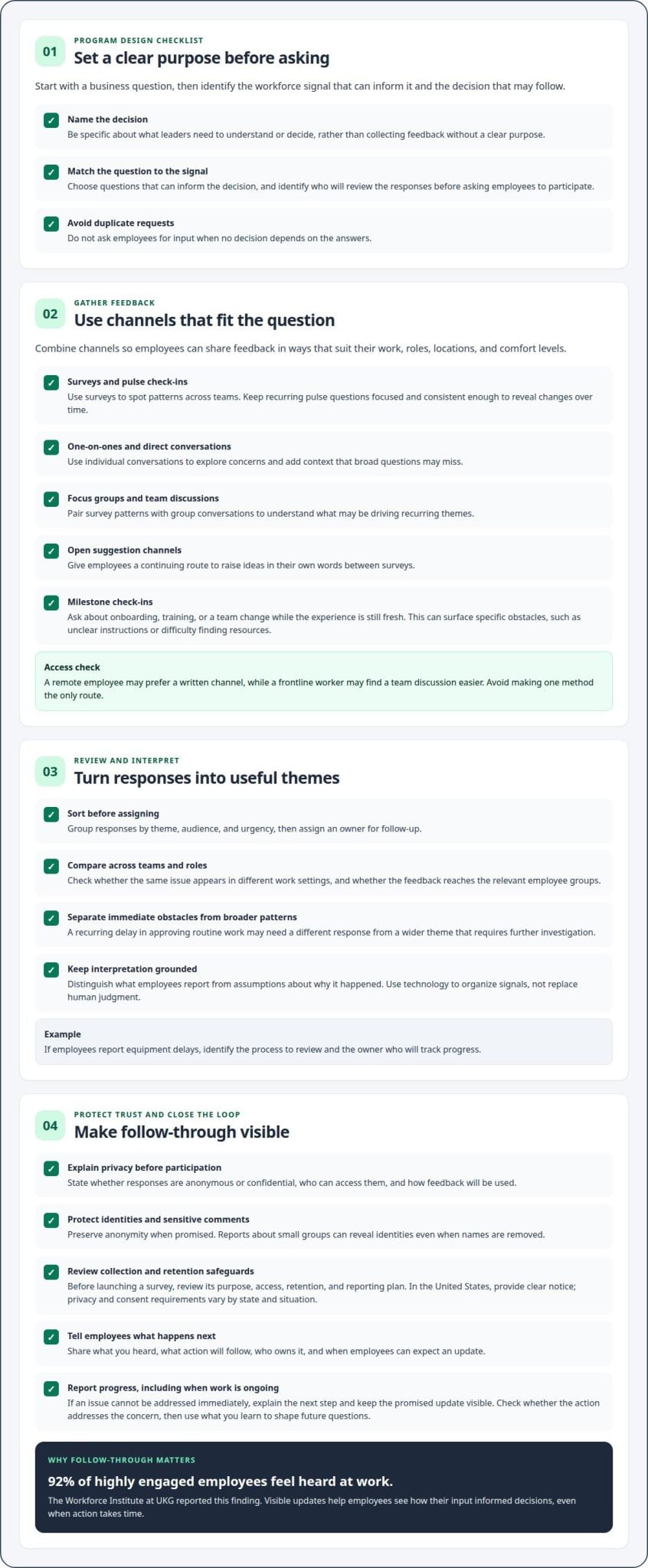
Build the program around decisions leaders need to make, not a calendar of surveys. A clear design links each question to a workforce group, a method, an accountable owner, and a planned response.

  1. Define the decision before writing questions. Identify what leaders need to understand and how answers might shape action. For example, if onboarding feedback will guide process changes, decide which teams own those changes before collecting responses. This keeps the program focused and makes it easier to explain why employees are being asked for feedback.
  2. Map listening moments to the employee journey. Plan opportunities around experiences that can reveal specific friction, such as onboarding, learning, or a team transition. A new-hire plan can use check-ins at days 7, 30, 60, and 90. Choose the moments that align with your decisions, rather than asking the same questions at every stage. Understanding these key milestones also informs external talent attraction, where specialists like GBS Worldwide help organizations translate internal employee insights into an authentic employer brand strategy.
  3. Tailor questions to the audience. Use role-specific or region-specific prompts when a company-wide question might hide local barriers. For example, ask warehouse employees about shift handoffs and office teams about approval workflows. Keep a shared core of questions for organization-wide comparisons, then add targeted prompts to understand distinct workplace experiences.
  4. Set clear ownership before results arrive. Form action-planning teams in advance, with leaders responsible for reviewing findings and deciding next steps. Assign each priority theme to an owner who can coordinate relevant teams. This prevents results from landing in an inbox without a decision-maker and gives employees a clear route from feedback to action.
  5. Tell participants when they will hear back. Explain which audiences will receive results and when they can expect an update. Share survey results with specific groups ideally within 30 days. If one team reports unclear handoffs, communicate the finding to that audience and name the next review step. A defined update date makes follow-through part of the design.
  6. Choose a manageable core question set. Limit the core engagement survey to 10-15 items, then use focused follow-ups when results reveal a specific issue. This supports comparison over time without making every listening moment a full assessment. Review each question for clarity and purpose: remove items that won’t inform a decision or help explain a result.
  7. Build a repeatable action cycle. After each listening round, document the theme, affected audience, owner, next action, and update date. For example, a concern about career growth or leadership readiness could prompt targeted support from Rainmakers Coaching International, followed by a progress update for affected employees. Use this record to distinguish completed actions from issues still being investigated.

Ideawake: Employee Suggestion Platform

Ideawake’s Employee Suggestion Platform gives organizations a structured way to capture, evaluate, and implement employee ideas. It fits when listening reveals opportunities employees can help solve, such as recurring workflow obstacles or ways to improve day-to-day operations.

Use the platform to connect employee input with a defined review process, rather than leaving ideas scattered across meetings, messages, and documents. Leaders can bring suggestions together, assess them, and move suitable ideas toward implementation. This complements surveys and conversations: those methods help identify concerns, while an employee suggestion platform provides a path for actionable ideas.

For organizations building a broader program, Ideawake’s Idea Management Platform and Continuous Improvement offering can help turn employee contributions into practical improvements.

Contact Ideawake to discuss how its Employee Suggestion Platform can fit your listening program.

Make Listening Part of How Work Improves

Make employee listening part of how your organization adapts, not a separate HR exercise. Treat each new priority as a chance to learn: define the decision, invite input from the people closest to the work, and use what you hear to shape the next improvement. Over time, this approach can help leaders spot processes that need attention and ideas employees think could work better.

Ideawake supports this work through its Innovation Management Platform, Idea Management Platform, and Continuous Improvement offering. These options help organizations gather ideas, evaluate them, and move selected improvements forward in a structured way. Connect your listening goals to the decisions and workflows your teams want to improve.

Build a program that makes employee input useful, visible, and connected to better work. Each thoughtful action creates an opportunity for a stronger next conversation.

Frequently Asked Questions

What does a mature listening ecosystem look like at 12-18 months?

At 12-18 months, maturity is better judged by dependable practice than elapsed time alone. A mature program has consistent definitions for key measures, clear data access rules, and a record linking feedback to decisions. For example, leaders can compare how business units describe role clarity while preserving enough context to understand why employees’ experiences differ.

What are the benefits of employee listening programs?

These programs help leaders identify workplace friction, compare experiences across functions, and prioritize changes grounded in employees’ firsthand knowledge. For example, if new hires in several departments describe unclear ownership during role transitions, HR and operations can examine that handoff instead of launching a broad engagement initiative. This gives decision-makers a clearer view of shared concerns and issues that need targeted attention.

How do you build an effective workforce feedback strategy?

Start with a written program charter naming the business question, employee population, method, decision owner, privacy approach, and review date. Pilot the plan with one business unit before expanding it. For example, test whether a question about role clarity means the same thing to frontline and corporate teams, then refine it before comparing results across the organization.

How should employers analyze and act on employee feedback?

Separate employees’ direct observations from interpretations before deciding what feedback means. If workers report missed deadlines, distinguish their stated explanations from assumptions about workload or management. Compare comments with relevant operational context, document the decision and its rationale, and assign an owner to track the result. This gives leaders a practical way to assess whether their employee listening efforts addressed the underlying issue.

Article by

Coby Skonord

Coby Skonord is the co-founder and CEO of Ideawake. Since 2013 he has worked with enterprise innovation, continuous improvement, and HR leaders to turn employee ideas into measurable business impact.

Voice of the Employee: Turn Insights Into Real Action

Employees prioritize anonymous feedback and move a selected idea into a completed action area
Coby Skonord|
November 6, 2026

Employee feedback matters most when it shapes how work gets done. The voice of the employee is the workforce’s collective feedback, opinions, and sentiment, shared through surveys, everyday conversations, and ideas for improvement. Collecting input is only the beginning. Its real value comes when leaders use it to make better decisions and improve the workplace.

Surveys are a familiar way to listen, but a survey alone can’t reveal every obstacle, opportunity, or practical idea employees encounter in their daily work. People need clear ways to speak up and to see that their input leads somewhere.

This article explains what employee voice means, where feedback comes from, and how to interpret survey findings so they don’t become another report left untouched. It also explores how employee ideas can surface improvements, strengthen innovation, and connect listening to action. The key is a deliberate loop: invite input, identify what matters, and show employees what changed.

Key Takeaways

  • Collect feedback at meaningful points across the employee lifecycle to spot needs that a single survey may miss.
  • Combine structured channels, such as surveys and focus groups, with everyday conversations to hear a broader range of perspectives.
  • Recognize that employee voice includes concerns, suggestions, and ideas, shared individually or collectively.
  • Turn survey findings into focused priorities by connecting employee comments to the changes leaders can make.
  • Give employees a clear path to contribute ideas, then make progress visible so listening leads to action.

What is the Voice of the Employee (VoE)?

The voice of the employee is the workforce’s collective feedback, opinions, and sentiment. A strong program helps leaders improve engagement, retention, decision-making, inclusion, and workplace culture by acting on employee input.

Feedback Across the Employee Lifecycle

Collecting feedback across the employee lifecycle means inviting input at key moments, from onboarding through role changes and exit. Unlike an engagement or pulse survey, which measures selected questions at a point in time, VoE combines surveys with interviews, manager conversations, and employee ideas. For an enterprise team, onboarding feedback can reveal unclear training, while exit feedback may surface recurring barriers that routine surveys miss. Listening at each stage gives leaders a clearer view of how needs change over time.

Communication and Closing the Feedback Loop

A communication plan explains why input is being collected, who will review it, and how findings will inform decisions. Before launching a survey, tell employees its purpose and how their responses will be handled. After collecting feedback, share the main themes, identify what leaders will address, and explain any constraints affecting other requests. For example, if staff report confusing handoffs, managers can describe the process change, name its owner, and explain how they’ll assess whether it helped. Updates show employees that speaking up leads to consideration, not silence.

Bias, Trust, and Anonymity

Bias enters feedback when questions steer responses, certain groups are overlooked, or employees fear consequences for speaking honestly. Use neutral wording, offer more than one channel, and compare themes across roles and locations. Anonymity can make it easier to express concerns, but it cannot replace trust; employees may still hesitate if past feedback brought no visible response. CIPD research found a quarter of employees report high levels of silence at work. Leaders can address that barrier by explaining confidentiality clearly and responding consistently to concerns.

Analyzing and Prioritizing Feedback

Analysis turns individual comments into themes leaders can evaluate against business goals. Group related feedback, such as repeated reports of approval delays, then compare its reach, employee impact, effort, budget, and strategic fit. Pairing survey trends with open-ended comments can reveal what lies behind a score. For example, a low rating for work processes may reflect unclear ownership rather than inadequate tools. Prioritize issues with meaningful impact and a practical path forward, assign an owner, and record why other themes are deferred.

A Culture That Welcomes Feedback

A feedback culture makes listening part of everyday work, not an event reserved for an annual survey or a crisis. Leaders and managers shape that culture through specific behaviors: invite dissent in team conversations, thank employees for raising concerns, and explain decisions even when a suggestion isn’t adopted. If staff flag repeated onboarding confusion, managers can discuss the pattern with new hires and review whether guidance is clear. Consistent responses help employees share ideas earlier, when teams have more opportunity to address them.

Formal and informal employee feedback channels

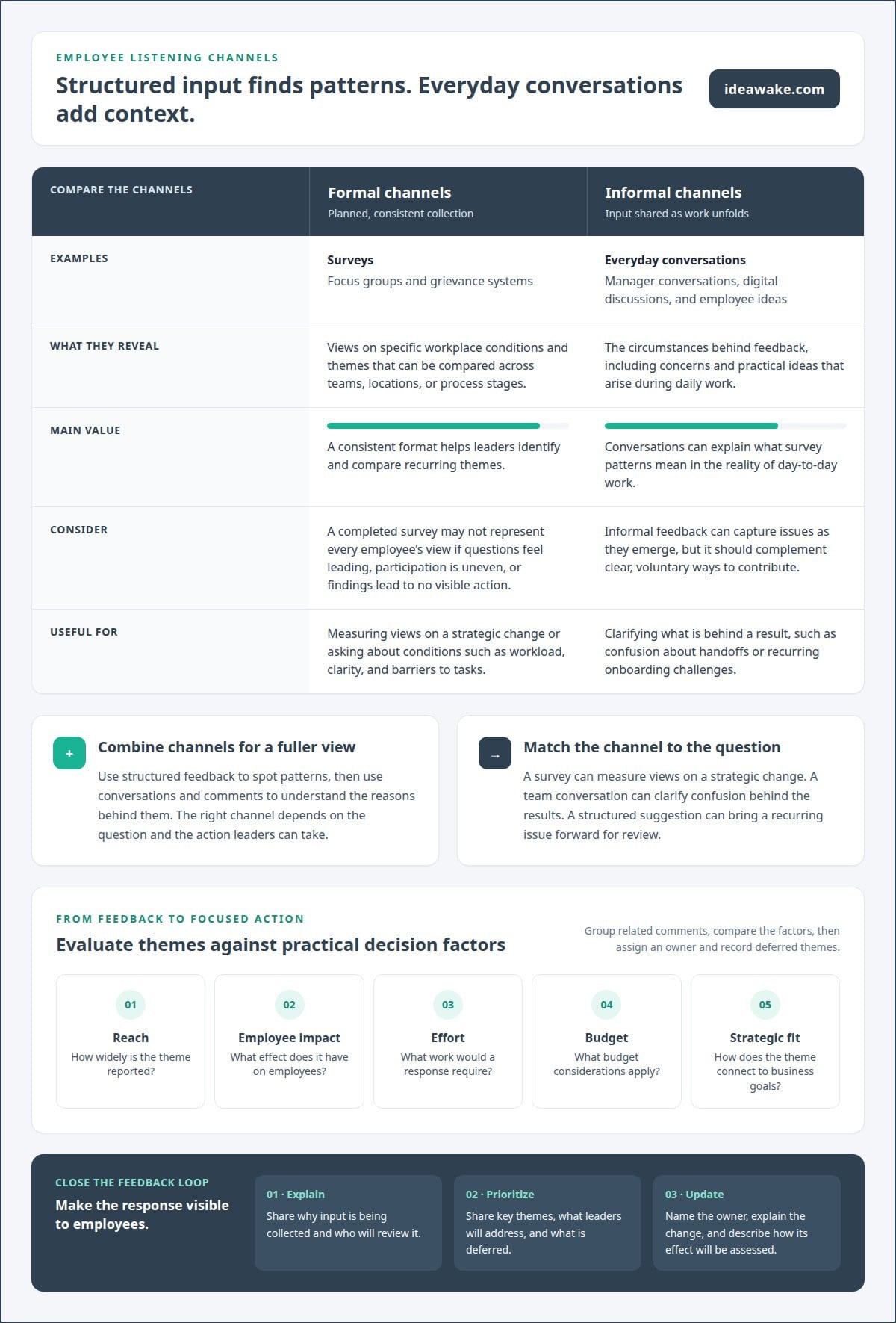
Formal channels create consistent ways to collect input, while informal channels capture concerns and ideas as work unfolds. Organizations need both: structured feedback can reveal patterns, and everyday conversations can explain what those patterns mean.

Structured Feedback Channels

Structured channels are planned methods for gathering employee input, including surveys, focus groups, and grievance systems. Their consistent format helps leaders compare themes across teams, locations, or stages of a process. Survey results can be useful to senior managers yet feel less relevant to employees unless the findings connect to workplace decisions. That gap points to a practical need: make findings useful to employees and managers alike.

Surveys can ask about specific workplace conditions, while focus groups let employees explain the reasons behind their responses. Grievance systems provide a formal route for raising concerns that need review. These channels work best when their purpose is clear and questions connect to decisions leaders can make. For example, an organization assessing a new scheduling process could ask about clarity, workload, and barriers to completing tasks.

A formal process doesn’t guarantee candid input. Employees may doubt that survey responses reflect their experiences if questions feel leading, participation is uneven, or results never lead to visible action. Treat that concern as a reason to examine question design, trust, and follow-through, rather than assuming a completed survey represents every employee’s view.

Tools and Platforms for VoE

Employee listening tools include survey platforms, focus-group tools, grievance systems, collaboration apps, and idea-management platforms. They help organizations gather input across locations and identify themes, but the right channel depends on the question and the action that may follow. A survey can measure views on a strategic change; a team conversation can clarify the confusion behind the results.

Remote and hybrid teams may share feedback through collaboration apps and digital conversations they already use. Passive listening in routine communication channels can supplement formal collection, but it shouldn’t replace clear, voluntary ways to contribute. For example, a distributed operations team could raise recurring handoff issues in a team discussion, then submit a structured suggestion for review. Keeping these routes visible helps employees choose a channel that fits their concern.

Choose channels by matching them to the input needed: surveys for comparable responses, focus groups for discussion, and suggestion systems for proposals. A dedicated employee suggestion program can give ideas a defined route for review. Survey data can have limited value if managers and employees cannot use it to identify a practical next step. A channel earns its place when it helps turn feedback into a clear decision or next step.

Definition and forms of employee voice

Employee voice describes how people share views, raise concerns, and contribute knowledge that can influence workplace decisions. It goes beyond survey answers: an employee who flags a safety risk, questions a process, or proposes a better handoff is also sharing a perspective leaders can use.

The distinction from employee engagement matters. Engagement describes an employee’s relationship with their work and organization; voice describes the act of communicating ideas, concerns, or preferences. The two can influence each other, but they aren’t interchangeable. For example, a team member may feel committed to a project and still stay silent about a flawed approval step if speaking up seems unwelcome.

Employee voice can take several forms, depending on what someone wants to communicate and who needs to hear it:

  • Suggestions: An employee proposes a clearer customer handoff or a way to reduce duplicate data entry.
  • Concerns: A worker flags a recurring safety issue, unclear expectations, or a process that prevents timely service.
  • Constructive challenge: A team member questions an established practice and explains why another approach may work better.
  • Shared or representative input: Employees raise common issues together, such as through a team discussion or employee representatives.
  • Participation in decisions: Employees contribute operational knowledge before leaders choose a workflow or implement a change.

These forms can be direct or collective, formal or conversational. A warehouse employee might submit an equipment-layout idea through a suggestion process, while colleagues discuss the same bottleneck during a shift meeting. Both examples offer useful information, but each needs a suitable route for review. A concern may need prompt attention, while an improvement idea may require evaluation against feasibility and organizational priorities.

For enterprise leaders, the practical test is whether employees can contribute effectively and decision-makers can interpret their input in context. A comment about “slow approvals,” for instance, becomes more actionable when it identifies the affected workflow, the delay’s consequences, and a possible change. Not every employee proposal needs to be adopted. Leaders can explain decisions, recognize contributions, and use relevant knowledge to shape the work environment.

Employee voice reaches beyond employee relations. Frontline knowledge can expose barriers, strengthen decisions, and reveal opportunities central teams may not see. HR, operations, and innovation leaders can put that knowledge to use by giving employees a clear way to raise issues, connecting input to the people who can assess it, and considering it before finalizing decisions. This creates room for informed challenge and practical improvements to working methods.

Voice of the Employee: Turn Insights Into Real Action

Using survey findings to improve employee experience

Surveys become useful when leaders connect responses to a specific workplace decision. A clear process helps identify employee concerns, test possible changes, and measure whether those changes address the issues raised.

Success metrics should track both employee experience and the organization’s response. Useful measures include participation across teams, changes in engagement or satisfaction, recurring concerns resolved, and employee ideas reviewed or implemented. Choose measures that match the survey’s purpose. A survey about onboarding, for example, might track whether new hires understand their roles and can access the support they need.

Start with focused questions about observable workplace conditions. “I can find the information needed to serve customers” is more actionable than “Are you happy here?” Use neutral wording, avoid combining separate issues, and include a comment prompt for context. Scientifically validated survey templates can provide a consistent structure, but leaders still need to check that questions fit their workforce, language, and intended decision.

Surveys show patterns; interviews and focus groups help explain them. If responses point to unclear priorities, a facilitated discussion can reveal whether instructions conflict or change too often. Individual interviews can give employees space to describe sensitive concerns. Combine these methods deliberately, then compare comments with survey results rather than treating any single response as the whole story.

Automated survey deployment can coordinate invitations, reminders, and follow-up across departments or locations. Set the audience and purpose first, then schedule the survey around the decision it will inform. For example, after a policy rollout, a short survey can identify confusing steps while the change is still being implemented. Automation supports consistency, but leaders remain responsible for reviewing findings and communicating next steps.

Use historical results to assess whether actions changed employee experience. External benchmarks may offer context, but they can’t explain whether a particular organization’s own intervention worked. Compare similar questions over time, note which teams were affected, and record relevant changes, such as a revised onboarding process. A survey about employee surveys found 58% of respondents said the data did not or only slightly help managers identify behaviors or practices to change.

Follow-up determines whether measurement leads to action. PeopleMetrics research found employee engagement can drop when organizations survey employees but take no follow-up action. Share the themes, name the change leaders will make, and report progress against the chosen measures. If a concern can’t be addressed immediately, explain why and identify what will happen next. That closes the loop and makes the next survey more meaningful.

Employee ideas and innovation

Employees see operational friction that central teams may miss. A customer service representative handling repeated billing questions, for example, may spot a confusing form that drives avoidable contacts. Capturing that observation as an idea turns frontline knowledge into a potential improvement, not just a complaint. Employee voice can support innovation by connecting daily work with opportunities to change products, processes, and policies.

Ideas need a route from submission to decision. A useful process asks contributors to describe the problem, who experiences it, and what change they propose. Reviewers can then assess strategic fit, likely impact, feasibility, effort, and dependencies. For instance, a proposal to simplify shift handoffs may require coordination between operations, human resources, and information technology before a pilot can begin.

Keep evaluation distinct from popularity. Votes can show which problems resonate, but they don’t establish whether an idea is safe, practical, or aligned with organizational priorities. A review team can combine employee input with operational evidence, then explain its decision. If a proposal is deferred because another project must finish first, a clear reason helps contributors understand the outcome and refine their idea.

Innovation can also strengthen employee engagement when people see their expertise influence decisions. Participation in decision-making is associated with improved job satisfaction. Consider a distribution team that proposes a revised picking sequence: involving employees in testing can reveal workflow effects that a desk-based review might miss. The team can then use what it learns to decide whether to adopt or adjust the change.

For enterprise leaders, employee ideas can support continuous improvement and broader innovation. They may identify a local fix, such as removing a duplicate approval, or point toward a larger opportunity, such as redesigning a customer process. A clear employee ideation approach helps connect those contributions to organizational goals without assuming every suggestion will be implemented.

Track the process as well as the outcome. Useful indicators include where ideas originate, which themes recur, how decisions are communicated, and whether implemented changes address the original problem. Review those signals alongside employee satisfaction and turnover patterns, without assuming that one idea caused a change in either measure. If staff repeatedly flag policies that block routine work, leaders can investigate the policy, explain the decision, and show what happens next.

The takeaway: treat employee ideas as operational knowledge. Give each proposal a fair review, a decision owner, and a response employees can understand. That discipline turns suggestions into evidence for better decisions and gives the workforce a visible role in shaping change.

Ideawake: Innovation Management Platform

Ideawake’s Innovation Management Platform helps organizations capture, evaluate, and implement ideas from employees, customers, and partners. It gives employee suggestions a path beyond collection, helping teams organize contributions and move promising ideas through the innovation lifecycle. For organizations ready to connect employee input with practical improvement work, an Employee Suggestion Platform provides a structured route for ideas to be reviewed and developed.

Ideawake also offers Continuous Improvement and Ideawake AI, alongside idea management capabilities that use voting, leaderboards, and prizes to support participation. These tools help teams bring ideas into view and assess them against organizational priorities. To explore how Ideawake could support your approach, contact Ideawake or visit ideawake.com.

Make employee insight part of how work evolves

Make listening a working practice, not a separate initiative. Choose a business challenge employees experience directly, invite their ideas, and establish how leaders will review and respond. This connects the voice of the employee to decisions and helps teams learn which changes deserve attention.

Ideawake’s Innovation Management Platform and Idea Management Platform support capturing and evaluating ideas, while its Continuous Improvement offering helps organizations focus on practical workplace changes. The right approach starts with a defined challenge, clear ownership, and a visible way for employees to follow progress. Keep the process connected to organizational priorities, and employee insight can become a useful input to ongoing improvement.

Start with one meaningful opportunity, then build on what your workforce teaches you. Better work can begin with an idea someone is ready to share.

Frequently Asked Questions

What does voice of the employee (VoE) mean?

Voice of the employee means the collective views, feedback, and sentiment employees share about their work and organization. It goes beyond survey answers: an employee might flag a confusing customer handoff, raise a concern about a policy, or suggest a change to a routine process. Leaders can use these perspectives to understand workplace conditions and make decisions informed by employees’ day-to-day experience.

What are the main methods for collecting employee feedback?

Common methods include engagement surveys, pulse surveys, focus groups, individual interviews, grievance channels, manager conversations, and employee suggestion processes. Choose a method based on the input needed: a survey can compare views across departments, while interviews can explore why a new scheduling procedure creates problems. Informal team discussions can also surface issues quickly. Combining methods helps leaders hear both recurring patterns and the context behind individual comments.

How do companies design and implement a VoE program?

Start by defining the decision the program should inform, such as improving customer handoffs or clarifying promotion criteria. Select channels that suit the question, then explain who will review responses and how findings will be used. Assign owners to emerging themes, agree on how actions will be tracked, and report outcomes to employees. For example, HR and operations could jointly review recurring concerns about shift scheduling.

What are examples of effective voice of the employee programs?

An effective program might invite frontline employees to identify customer-service obstacles, then let a cross-functional team assess and test selected suggestions. Another could ask new hires to comment on specific onboarding materials, with managers reviewing patterns and updating unclear guidance. A third might give employees a structured way to flag recurring process friction. Each example connects a defined employee input channel to a decision owner and a visible response.

What are the risks and challenges of collecting employee feedback?

Low trust can produce guarded responses, while unclear questions may generate answers leaders can’t act on. Survey fatigue can also grow if organizations repeatedly request input without explaining its purpose or sharing outcomes. Another risk is treating the loudest comments as representative of every team. To reduce these problems, compare input across channels, review participation patterns, and distinguish individual reports from themes that appear across groups.

How can employers protect employee privacy and respond to feedback?

Explain how responses will be collected, who can access them, and whether comments are anonymous or identifiable. Limit access to people responsible for analysis, and avoid sharing details that could identify an employee through their role or circumstances. Respond by acknowledging themes, outlining decisions, and giving employees a way to raise follow-up concerns. If a proposed change isn’t adopted, communicate why and what will be considered next.

Article by

Coby Skonord

Coby Skonord is the co-founder and CEO of Ideawake. Since 2013 he has worked with enterprise innovation, continuous improvement, and HR leaders to turn employee ideas into measurable business impact.

Employee Feedback Software: How to Choose a Platform That Turns Feedback Into Action

Warehouse employees sort anonymous feedback and prioritize a concrete follow-up action
Coby Skonord|
November 4, 2026

Collecting feedback is easy; turning it into action is the real test. Employee feedback software helps organizations gather employee input, identify patterns, and give managers a practical way to follow up. Recurring pulse surveys can capture feedback between broader engagement reviews.

A platform should do more than distribute surveys and display scores. Look for tools that help you understand employee input, connect it to existing systems and workflows, and support useful manager check-ins. This guide explains how to compare analytics, integrations, and follow-up features, so you can assess whether feedback leads to specific, accountable action rather than simply generating more data.

Key Takeaways

  • Prioritize features that turn employee input into clear follow-up, not just another stream of survey results.
  • Compare reporting tools by whether they reveal meaningful patterns across teams while protecting confidentiality.
  • Assess integrations based on how well they fit existing HR systems and everyday workplace workflows.
  • Use manager check-ins to create consistent conversations, clarify next steps, and close the feedback loop.
  • Evaluate platforms with a shared scorecard so your selection reflects your organization’s needs, not a feature-count contest.

What is Employee Feedback Software?

Feedback platforms give organizations a structured way to collect, organize, and act on employee input. They may support surveys, open comments, recognition, and manager conversations. The key question is what happens after an employee responds: useful systems help teams identify issues, assign follow-up, and track actions.

For an enterprise, look beyond survey creation. Check whether a platform supports anonymous and identified responses, recurring surveys, audience segmentation, and automated reminders. For example, an HR team might ask about workload and compare responses across departments while protecting individual comments. Review access controls, mobile usability, accessibility, and options for employees without regular desk access.

Employee feedback software varies in how it combines surveys, integrations, analytics, and check-ins. A survey-focused tool can collect satisfaction data; a broader listening platform may connect results to manager follow-up. Compare the workflows employees and managers will actually use, including how people submit feedback and assign actions.

To implement employee feedback software, start with one clear goal, such as understanding onboarding friction. Choose a focused survey, explain who will see the results, and tell employees how leaders will respond. Then share a concrete update, such as a change to a team process, so participation leads to visible action rather than another unanswered request.

Risks include low participation, survey fatigue, misreading small response groups, and collecting sensitive comments without clear access rules. A department-level score, for example, can conceal different experiences across roles. Set expectations about confidentiality, restrict access to raw comments, and consider survey results alongside manager conversations before deciding what to do.

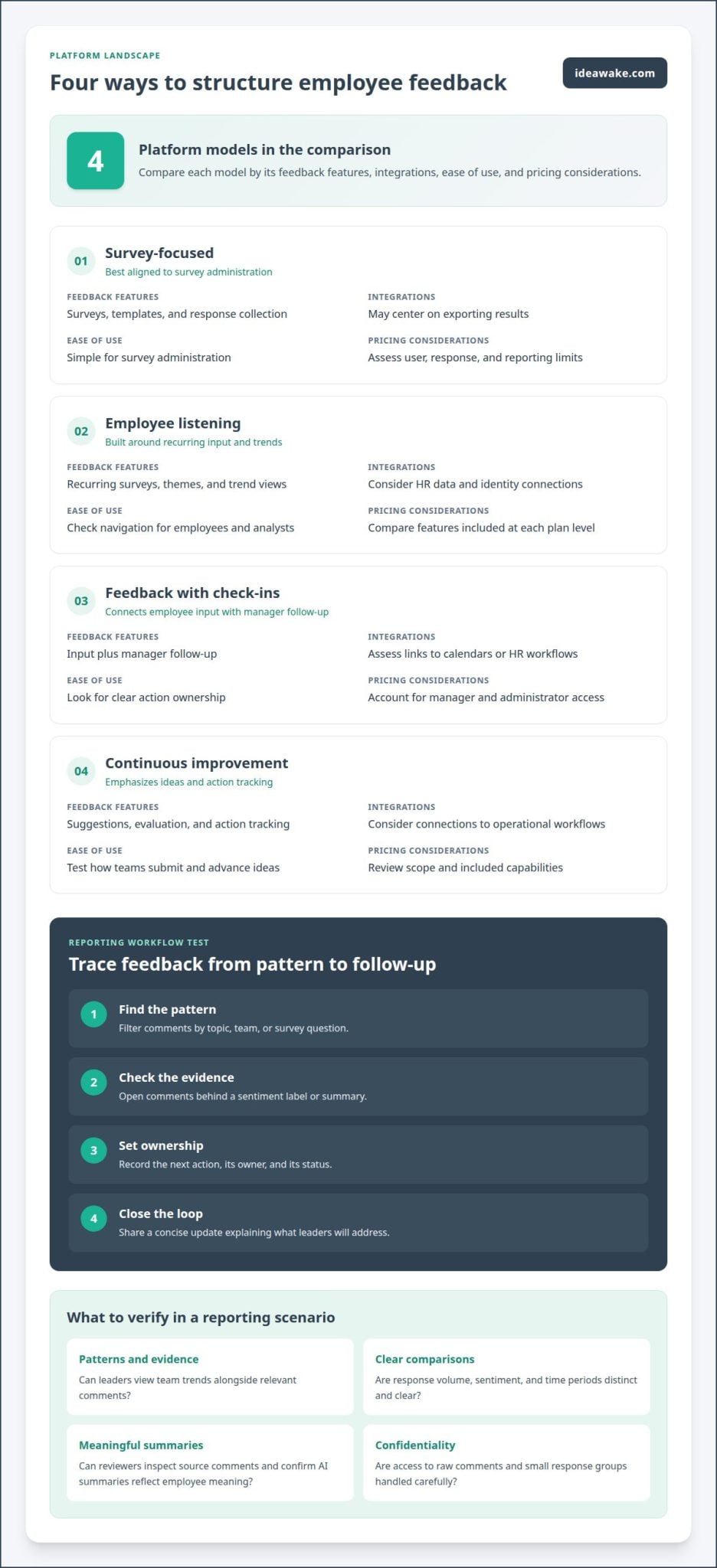
Platform option Feedback features Integrations Ease of use Pricing considerations
Survey-focused Surveys, templates, response collection May center on exporting results Simple for survey administration Assess user, response, and reporting limits
Employee listening Recurring surveys, themes, trend views Consider HR data and identity connections Check navigation for employees and analysts Compare features included at each plan level
Feedback with check-ins Input plus manager follow-up Assess links to calendars or HR workflows Look for clear action ownership Account for manager and administrator access
Continuous improvement Suggestions, evaluation, and action tracking Consider connections to operational workflows Test how teams submit and advance ideas Review scope and included capabilities

Choose the platform type that matches the work employees need to do, then test one example from submission through recorded response. When employee feedback software must also support improvement initiatives, an AI-powered innovation management platform can provide a related path for capturing and advancing ideas.

Feedback analytics and reporting

Useful reporting turns responses into decisions, not just charts. Compare how platforms organize trends, comments, and follow-up for leaders.

Sentiment Analysis and Heatmaps

Sentiment analysis groups written comments by tone, while heatmaps show patterns across teams or topics. A heatmap might reveal stronger concerns about workload in one department than another. These views help locate themes and differences, but they do not explain the cause. Leaders should be able to review a summary alongside its supporting comments and decide whether the pattern warrants action.

AI-Powered Feedback Analysis

AI-powered analysis can sort large volumes of comments into recurring themes, summarize written responses, or flag changes for review. It may help analysts explore new questions without manually tagging every comment. Treat AI output as a starting point, not a verdict: reviewers should inspect example comments, confirm that summaries reflect employees’ meaning, and restrict sensitive information appropriately.

Assess reporting with a specific decision scenario. Suppose engagement scores fall while comments mention unclear priorities. Can the platform show trends by department, connect them to relevant comments, and help leaders assign follow-up? Check whether dashboards distinguish response volume from sentiment, show time periods clearly, and let users compare the same question across survey cycles. Clear reporting makes evidence easier to interpret.

Before selecting a platform, test these reporting steps with sample feedback:

  • Find the pattern: Filter comments by topic, team, or survey question.
  • Check the evidence: Open comments behind a sentiment label or summary.
  • Set ownership: Record the next action, its owner, and its status.
  • Close the loop: Share a concise update explaining what leaders will address.

Templates can make reporting consistent across business units, but leaders should adapt them to the decision at hand. A quarterly engagement review may need a trend view, while a new-process survey may need a focused summary of employee suggestions. Compare how long it takes to find those views and whether reports support clear next steps.

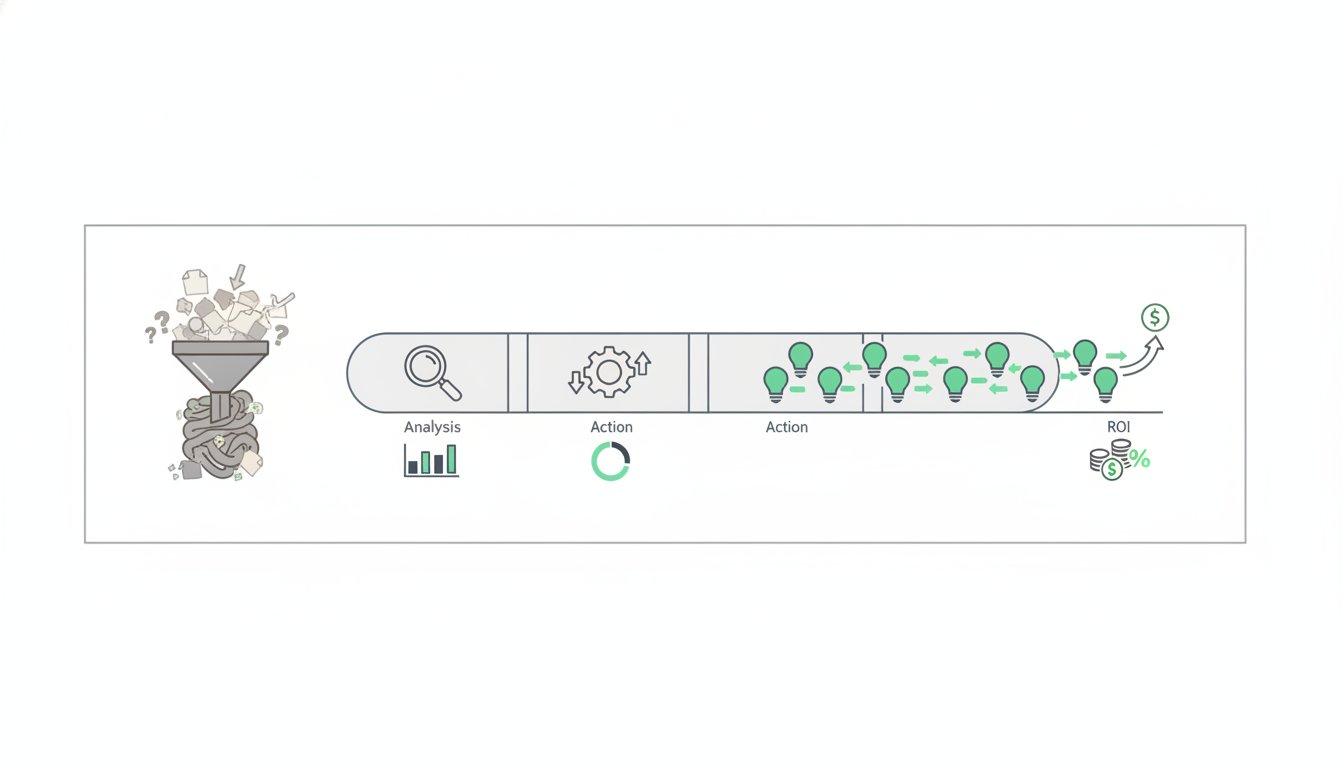
For organizations connecting employee input with improvement work, an analytics-to-action workflow can help illustrate how feedback becomes trackable ideas.

Integration with HR systems and workplace tools

Integrations determine whether feedback fits existing employee workflows or creates another disconnected system. Map how a response moves from a pulse survey through analysis and follow-up to reporting. For example, decide whether HR teams need workforce data for segmentation, managers need reminders in workplace tools, or leaders need summary reports in existing dashboards.

Start with the systems your organization relies on, such as its human resources information system (HRIS), identity management, collaboration tools, and reporting environment. Define what data each connection should use. An HRIS may provide department or location attributes, while a collaboration tool may make survey invitations easier to find. Keep the purpose specific: a feedback tool should not receive employee fields that do not support analysis or follow-up.

Check how integrations handle identity and anonymity. If a survey promises anonymous responses, determine whether identity data is separated from answers and how reports handle small groups. Managers may need team-level sentiment, for example, without access to identifiable comments. Explain intended access to employees before launching surveys, and ensure reporting permissions match those expectations.

Mobile access matters for employees who rarely work at a desk. Test a complete task on a phone: open an invitation, answer a pulse survey, submit a comment, and view the confirmation. Check that text is readable, response controls are easy to use, and the session works in the organization’s usual mobile environment. A polished desktop workflow cannot make up for a difficult frontline experience.

Use this integration review before a pilot:

  • List the systems: Name the HRIS, identity service, collaboration tools, and reporting destination involved.
  • Trace each data field: Record where department, location, and role information originates and where it appears.
  • Test permissions: Sign in as an employee, manager, and administrator to compare access.
  • Try failure scenarios: Check what happens when an employee changes teams or loses access to a connected tool.
  • Measure workflow friction: Ask pilot participants to complete the same survey on desktop and mobile.

Prefer integrations that support a defined workflow over a long list of connections with unclear value. For instance, connecting employee groups to survey reporting can help compare responses consistently, while collaboration alerts can support timely follow-up. A well-planned integration strategy should specify data ownership, access, and the process when a connection changes.

Document the result in a simple matrix: system, data shared, purpose, user access, and fallback process. Review each row with HR, IT, and the employees who will use the platform. This practical test exposes gaps before rollout and keeps integrations accountable to the feedback process.

Employee Feedback Software: How to Choose a Platform That Turns Feedback Into Action

Manager check-ins and constructive feedback

Survey results matter only when managers can respond through useful conversations and clear follow-through. Regular check-ins give employees a consistent opportunity to raise concerns, discuss progress, and ask for support. They also give managers a practical setting to clarify feedback and agree on next steps. Without that conversation, collected input can remain disconnected from daily work.

A strong check-in gives both people room to discuss progress, obstacles, and support. Managers can start with a specific observation, ask an open question, and agree on a next step. If an employee reports unclear priorities, for example, the manager can review competing tasks together and set a shared order. Constructive feedback describes behavior and impact, then invites the employee’s perspective.

Choose a platform that helps managers turn themes into owned actions. It should make it easy to record a commitment, assign responsibility, set a review point, and update status. A team might respond to recurring schedule concerns by testing a new handoff process, then revisiting the issue in a later check-in. Without ownership and follow-up, action planning becomes a list of intentions.

Performance management reporting should support coaching, not reduce employee experience to a score. Keep survey trends separate from individual performance records, and make clear which information managers can access. A team-level concern about workload, for example, can guide a discussion about staffing or priorities without turning one response into a performance judgment. Consistent reporting helps leaders see whether actions are complete and where managers need support.

Assess manager follow-through using observable evidence: completed actions, recurring concerns, and employee updates on whether a change helped. Avoid assigning financial returns to a check-in alone. Instead, connect an intervention to a defined operational outcome, such as fewer repeated handoff issues, and document the baseline and later observations using the same method.

Use this simple check-in sequence to make continuous feedback specific:

  • Listen: Ask what is helping or hindering the employee’s work.
  • Clarify: Reflect the concern and confirm the practical issue.
  • Agree: Choose an action, an owner, and a follow-up point.
  • Recognize: Acknowledge progress or contributions with a concrete example.
  • Review: Return to the commitment and record what changed.

Before rollout, ask managers to practise with a realistic scenario, such as feedback about unclear decision-making. The platform should make the next step visible without turning a conversation into a form-filling exercise. An effective employee engagement approach connects listening, manager coaching, and follow-through while keeping each conversation human.

How employee feedback tools were evaluated

A useful comparison needs more than feature counts. Evaluate each platform against the same employee scenarios, then record the evidence behind each decision. This helps distinguish a polished demonstration from a workflow employees, managers, and administrators can use in practice.

User reviews can surface practical concerns, such as confusing navigation or reporting limitations. Treat them as one consideration, not a substitute for testing. A reviewer’s experience may reflect a different organization size, survey process, or implementation context. Look for recurring details relevant to your requirements, then test those needs in a representative workflow.

Build a scorecard around the decisions your organization needs to make. Compare platforms against the same use cases, such as running engagement surveys, finding recurring themes, and assigning action plans. Record evidence from a product walkthrough or pilot, rather than relying on assumptions based on feature labels.

  • Feedback collection: Test whether employees can complete a survey and submit comments through the channels they use.
  • Analysis: Check whether reports connect scores, written feedback, and relevant employee groups.
  • Integrations: Trace one workflow between the feedback platform and a system your organization already uses.
  • Manager follow-through: Confirm that a manager can assign an action, track progress, and report back.
  • Usability and access: Have employees, managers, and administrators complete relevant tasks using their own roles.

Weight criteria according to operational importance. An organization with distributed teams may prioritize mobile participation and consistent access, while an HR team focused on employee experience may emphasize trend analysis and manager follow-up. Set the weights before reviewing platforms, then document why each tool scored well or poorly against each requirement.

Separate minimum requirements from differentiators. A minimum might be secure, role-based access or an integration needed for an existing workflow. A differentiator might be easier comment analysis or clearer action tracking. This keeps an attractive extra feature from outweighing a gap that could disrupt an essential process.

Finish with a representative pilot. Give a cross-functional group the same scenario, such as identifying a recurring concern and creating a response plan. Record completion issues, interpretation gaps, and handoff delays. The best fit is the platform that makes the required process clear and repeatable, not simply the one with the longest feature list.

Ideawake: Innovation Management Platform

Ideawake’s Innovation Management Platform helps organizations capture, evaluate, and implement ideas from employees, customers, and partners. It is a fit when employee feedback reveals opportunities that need a clear path from suggestion to review and action. Teams can use an Idea Management Platform to organize proposals and assess their potential, rather than treating every comment as a survey response. Ideawake AI and gamification features, including voting, leaderboards, and prizes, support participation in idea programs. The platform also supports Continuous Improvement, helping organizations connect employee suggestions with ongoing improvement work. It’s a practical next step when your feedback process needs to extend beyond listening and manage ideas across their lifecycle. Explore how Ideawake can fit your organization’s needs at ideawake.com.

Make the Next Step Visible

The next decision is not simply which employee feedback software has the broadest feature set. Decide what should happen when employees identify an opportunity, who will assess it, and how the organization will communicate progress. That operating model gives your evaluation a practical test: can the right people move from employee input to an owned initiative?

For organizations ready to manage suggestions beyond survey reporting, Ideawake offers an Innovation Management Platform, an Idea Management Platform, and Continuous Improvement. These offerings help structure the path from idea submission through evaluation and implementation. Start with a real feedback theme, define who should review related ideas, and agree how employees will hear what happens next. Clear ownership turns listening into visible organizational learning.

Bring your intended workflow and priorities to a conversation with Ideawake. Discuss how idea management can fit your employee feedback process and improvement goals.

Keep employee input connected to meaningful work, and give every useful idea a clear next step.

Frequently Asked Questions

Can I customize the surveys to align with my organization’s needs?

Yes, survey design can reflect your organization’s goals, language, and workforce groups. An operations team might ask about handoff issues, for example, while HR explores onboarding experiences. Before launching, define which decision each question should inform, keep wording consistent when comparing responses, and leave room for explanations. Avoid collecting information that does not support a clear action or help leaders understand employee experience.

What are the best feedback tools for enterprises?

The best fit supports your workforce structure, privacy expectations, reporting needs, and follow-up process. An enterprise with frontline and office-based teams, for example, may need accessible participation across different work settings. Compare tools using identical employee scenarios, then assess administrator access, reporting clarity, and how teams communicate actions. A long feature list alone does not establish enterprise suitability; test the workflows your teams will actually rely on.

Which platforms allow real-time feedback and analytics?

Look for tools that show responses and reporting updates as feedback arrives, distinguishing this from alerts or scheduled report refreshes. During a pilot, submit a test response and observe when it appears in the relevant dashboard. Check whether views update by team or topic, and whether managers can act on the signal. “Real time” is useful only when information is timely and easy to interpret.

What is employee feedback software and how does it work?

Employee feedback software collects employee input through digital channels and organizes it for review. An organization can ask about a new scheduling process, group responses by relevant work area, and use the findings to guide a team discussion. The process works best when employees understand why their input is requested and leaders explain what they learned. The platform supports the process, but people still make decisions.

What features should a feedback platform include?

Prioritize survey creation, audience targeting, clear reporting, privacy controls, and a way to track follow-up. A useful system should also make participation practical across the devices and channels employees use. Test whether an employee can complete a questionnaire and whether a manager can review relevant themes without seeing restricted information. Choose features based on workflow requirements, not simply because a tool offers more options.

What are the best platforms for employee feedback in 2026?

There isn’t one best platform for every organization in 2026. Create a shortlist based on workforce needs, existing systems, analytics requirements, and manager workflows, then test each against the same use case. For instance, ask every shortlisted tool to support a feedback cycle about a policy change, from collecting responses to communicating an update. Compare evidence against your criteria, not marketing language or feature counts.

How much does employee feedback software cost in the United States?

Costs depend on workforce size, required capabilities, implementation needs, integrations, and support. To build a useful budget comparison, define user groups, reporting and privacy requirements, and the workflows you expect to support. Then compare options against the same scope, including optional services and usage limits. The lowest initial quote may not reflect the full cost of operating the program or maintaining its processes.

Which employee feedback tools offer free plans or trials?

Free plans and trials vary by platform and commercial terms, so compare the access each option provides. Review trial length, user or response limits, reporting access, integration availability, and export options. A small test should include employee participation and administrator follow-up. This reveals whether the tool supports your actual workflow, rather than merely demonstrating a survey form. Define success criteria before inviting participants.

Article by

Coby Skonord

Coby Skonord is the co-founder and CEO of Ideawake. Since 2013 he has worked with enterprise innovation, continuous improvement, and HR leaders to turn employee ideas into measurable business impact.

How to Encourage Employees to Share Ideas: A Data-Driven Guide to High-Participation Cultures

How to Encourage Employees to Share Ideas: A Data-Driven Guide to High-Participation Cultures
Coby Skonord|
July 13, 2026

If only 21% of your workforce is engaged at work, you aren’t just losing morale; you’re losing the competitive edge hidden within your own ranks. Data from 2026 indicates that employees who are encouraged to innovate are three times more engaged, yet most organizations still rely on “suggestion boxes” that yield nothing but silence. You likely recognize that your frontline staff holds the answers to your most persistent bottlenecks, but without the right systems, those insights remain trapped in silos. This guide details how to encourage employees to share ideas by treating silence as a design flaw in your systems rather than a lack of initiative from your people.

Key Takeaways

  • Identify why the “Futility Factor” is the primary driver of employee silence and how psychological safety acts as a foundation for organizational performance.
  • Discover how to encourage employees to share ideas by launching time-bound Innovation Challenges that focus team energy on specific business problems.
  • Apply the IDEA framework and transparent idea evaluation criteria to ensure high-impact suggestions are prioritized and implemented.
  • Move beyond the “black hole” of physical suggestion boxes by centralizing your innovation pipeline within a digital employee suggestion platform.
  • Build a sustainable culture of participation by closing the feedback loop and measuring the tangible ROI of implemented improvements.

Understanding the Barrier: Why Employees Stop Sharing Ideas

Most managers assume employees stay quiet because they’re afraid of being wrong or facing criticism. The data suggests a more frustrating reality. The “Futility Factor” is often the real killer of innovation. If a team member believes their suggestion will disappear into a void, they simply stop contributing. This isn’t just a loss of morale; it’s a structural failure that creates a “silence climate.” Understanding the root of this behavior is the first step in learning how to encourage employees to share ideas effectively.

The Psychology of the Silent Employee

The Cost of Lost Insights

The traditional suggestion box is a relic of an era that didn’t value transparency. In most offices, it’s a physical or digital graveyard. This lack of a visible feedback loop reinforces the Futility Factor. The financial impact is real. Every unshared idea represents a missed opportunity to eliminate one of the 8 forms of waste, such as waiting times or non-utilized talent.

Designing the Invitation: How to Ask for Ideas Effectively

The Art of the Strategic Question

Open-ended questions outperform yes/no queries because they demand analysis rather than simple compliance. Use these five courageous questions to prompt deep thinking during your next team meeting:

  • If you had to cut our turnaround time by 50% without losing quality, where would you start?
  • What is the most redundant task you perform weekly that adds zero value to the end user?
  • Where are we most vulnerable to a competitor’s strategy right now?
  • What process do we use that feels like a relic of a decade ago?
  • If you were in charge of this department with a blank check, what’s the first thing you’d change?

Active listening must follow these questions. If you ask but don’t document the response, you’re merely performing engagement rather than facilitating it. Employees need to see that their input is recorded and considered in real-time to overcome the “Futility Factor” discussed in the previous section.

Time-Bound Innovation Challenges

Structure matters. A 30-day innovation challenge focused on a single bottleneck provides the necessary constraints to spark creative solutions. Research suggests that limited time and resources often force teams to move past obvious answers toward more radical improvements. For high-energy bursts of participation, many organizations now use hackathons to prototype solutions in real-time. These events transform abstract concepts into tangible results in a matter of hours.

You can inspire your team by highlighting successful innovation examples that started as simple responses to specific challenges. If you find your team is stuck, try reverse brainstorming. Instead of asking how to improve a system, ask how to make it fail. This often reveals hidden roadblocks that standard brainstorming misses. To see how these frameworks look in practice, you can book a free demo of a structured innovation system.

The IDEA Framework and Structured Evaluation

Generating a high volume of suggestions is only half the battle. If your team feels their input is judged arbitrarily, they’ll quickly revert to silence. High-participation cultures are built on the back of transparent, objective systems. To master how to encourage employees to share ideas, you must provide a clear roadmap for what happens after the “submit” button is clicked. The IDEA framework serves as this roadmap, transforming vague suggestions into actionable business cases while protecting managers from the “idea overload” that often leads to administrative paralysis.

The IDEA framework consists of four critical pillars:

  • Interesting: Does the idea solve a documented pain point or align with current strategic goals?
  • Doable: Is the solution technically feasible within our current resource constraints?
  • Engaging: Will the implementation improve the experience for employees or customers?
  • Actions: Are there clear, immediate steps we can take to test or prototype the concept?

Moving beyond simple acronyms requires establishing firm idea evaluation criteria. When these metrics are public, you eliminate the perception of favoritism. Use an “Impact vs. Effort” matrix to visualize these criteria. This helps the organization prioritize “quick wins” that build momentum while identifying the high-resource “moonshots” that require deeper vetting.

Teaching Employees to Self-Vet

Quality improves when employees act as the first line of evaluation. Provide a simple rubric that encourages staff to move from sharing an “opinion” to building a “business case.” A well-structured submission should include the specific problem, the proposed solution, and the anticipated outcome. This shift in mindset encourages incremental vs. radical innovation, showing employees that small, daily improvements are just as valuable as disruptive breakthroughs. When staff understand the “why” behind evaluation, they’re more likely to contribute high-quality data rather than raw complaints.

The Manager’s Role in Evaluation

Building the Infrastructure: Moving Beyond the Suggestion Box

The Digital Advantage

Gamification and Engagement

Healthy competition can be a powerful driver of participation. Using leaderboards and points creates a sense of progress that keeps employees coming back to the platform. While cash rewards can provide a temporary boost, research suggests that social recognition and digital “badges” often lead to higher long-term engagement. A user-friendly interface is non-negotiable. If the system is difficult to navigate, adoption will stall regardless of the incentives offered. To see how a structured system can transform your culture, book a free demo to explore the features that drive high-participation innovation.

Closing the Loop: Recognition, Implementation, and ROI

Effective Feedback Mechanisms

Tracking the Numbers

Transforming Your Workforce into a Scalable Innovation Engine

Dismantling the “Futility Factor” requires more than an open-door policy; it demands a structured approach that combines psychological safety with high-performance digital tools. By replacing stagnant suggestion boxes with a transparent evaluation framework, you transform raw feedback into a measurable corporate asset. This guide has detailed how to encourage employees to share ideas by focusing on strategic questioning, the IDEA framework, and rigorous ROI tracking. It’s about shifting your culture from passive observation to active, high-impact participation.

The path to a high-participation culture is paved with accountability. When managers provide consistent feedback and leadership prioritizes implemented improvements, innovation becomes a sustainable habit rather than a one-time event. Ready to turn your employees into an innovation engine? Ideawake is trusted by organizations to manage thousands of ideas through AI-powered evaluation that saves managers time and built-in ROI tracking that proves your program’s value. See how Ideawake automates the process by booking a free demo.

The potential within your organization is vast. With the right systems in place, you’re ready to unlock it.

Frequently Asked Questions

How do I motivate employees who are afraid to speak up?

You motivate hesitant employees by establishing psychological safety where the risk of sharing is lower than the reward of participation. Silence is rarely a personality trait; it’s a rational response to a “silence climate” where employees feel their input is ignored or punished. Focus on reducing the perceived stakes by asking for small, incremental improvements rather than radical breakthroughs. When staff see that pointing out an inefficiency leads to a better workflow rather than a reprimand, their defensive silence will naturally dissolve.

What is the best way to reward employees for their ideas?

How do I handle “bad” or unfeasible ideas without hurting morale?

Handle unfeasible ideas by providing transparent, data-backed feedback that explains the specific constraints preventing implementation. A “No, because…” response is significantly better than silence because it treats the employee like a professional partner. Use these moments as coaching opportunities to help the staff member refine their next submission. When you explain the “why” behind a rejection, you maintain trust and ensure the employee feels comfortable contributing again in the future.

Should I use a physical suggestion box or digital software?

Digital software is the only scalable choice for modern organizations because it eliminates the administrative “black hole” associated with physical boxes. Physical boxes lack transparency and make it nearly impossible to track ROI or provide timely feedback. A digital platform centralizes all insights into a “Value Vault,” allowing for cross-departmental collaboration and automated sorting. This infrastructure ensures that every idea is documented, evaluated, and archived for future use rather than being lost in a desk drawer.

How often should we run innovation challenges?

Run innovation challenges quarterly or whenever a specific departmental bottleneck requires a fresh perspective. Frequency matters less than the quality of the “ask.” If you run challenges too often without implementing previous winners, you risk “challenge fatigue.” A 30-day window is typically sufficient to generate high-energy participation and rapid prototyping. This time-bound structure creates a sense of urgency that pushes teams to move past obvious solutions toward more impactful improvements.

What role does leadership play in encouraging idea sharing?

How can we ensure that ideas from frontline staff reach upper management?

What are the most common reasons innovation programs fail?

Innovation programs fail primarily due to a lack of feedback and administrative complexity. If employees never hear back about their suggestions, they conclude that their effort is futile and stop participating. Understanding how to encourage employees to share ideas requires a commitment to closing the loop every single time. Additionally, programs often collapse when they rely on manual tracking like spreadsheets, which become unmanageable as the volume of ideas increases. Success demands both a culture of accountability and the right technical infrastructure.

Article by

Coby Skonord

Coby Skonord is the co-founder and CEO of Ideawake. Since 2013 he has worked with enterprise innovation, continuous improvement, and HR leaders to turn employee ideas into measurable business impact.