

Tag Archives: Customer Feedback

Feature Request Software: How to Collect and Prioritize Customer Ideas

Customer advisory team sorting voted feature requests by impact and feasibility
Coby Skonord|
November 9, 2026

Votes can reveal demand, but they cannot set your roadmap. Feature request software gives teams a shared place to collect customer ideas, invite voting, and assess requests by user impact, feasibility, and other criteria. The goal is not to ship the most popular suggestion automatically. It is to understand what people need and make thoughtful, transparent decisions.

When feedback arrives through support conversations, sales calls, and scattered messages, patterns are easy to miss and expectations are harder to manage. A clear process brings requests together, lets customers support ideas that matter to them, and keeps discussion focused on real problems rather than vote counts alone.

This article explains how to collect useful requests, invite participation through voting, and prioritize ideas using practical criteria. You’ll also learn how to decline or defer a request respectfully, so customers understand the reasoning and know their feedback was considered.

Key Takeaways

  • Bring requests from different channels into one place, then capture the problem, context, and intended benefit behind each idea.
  • Use voting to surface shared interest, but weigh customer impact, strategic fit, and feasibility before setting roadmap priorities.
  • Make idea boards easier to use by guiding contributors toward clear, specific submissions and inviting them to support relevant requests.
  • When declining or deferring an idea, explain the decision and keep stakeholders informed as its status changes.
  • Choose a consistent process that helps teams turn customer input into informed decisions, not just a longer list of suggestions.

What is feature request software?

Feature request software gives teams a shared system to collect, review, and prioritize ideas for product changes. Requests might describe a usability problem, an integration need, or new functionality. For example, a customer may request bulk export because downloading records one at a time slows their workflow. The request explains the problem; the proposed feature is one possible solution.

There is no universal “best” request management tool. Compare options by submission methods, voting, status updates, reporting, and connections to existing systems. A support queue can organize incoming issues, while a public board lets customers find and vote on related ideas. A centralized system can bring feedback from these sources together for product review.

For context, Ideawake reports average participation rates of 50%-80%, compared with typical rates of 5%-15% with other tools, according to Ideawake. Its reported average increase in engagement scores is 10%, according to Ideawake. Ideawake reports that the top 5% of ideas drive 95% of new business results, according to Ideawake. These are company-reported figures, not a guarantee of results for every organization.

Use this comparison to narrow your approach before evaluating products:

Option Submission sources Voting and visibility Roadmap support
Shared spreadsheet Manual entry Limited without a review process Manual status tracking
Support-ticket queue Support conversations Organized around individual cases Useful for issue triage
Public idea board Customer submissions Visible ideas and community votes Can communicate request status
Central request system Multiple feedback sources Can group ideas and show demand Supports planning and prioritization

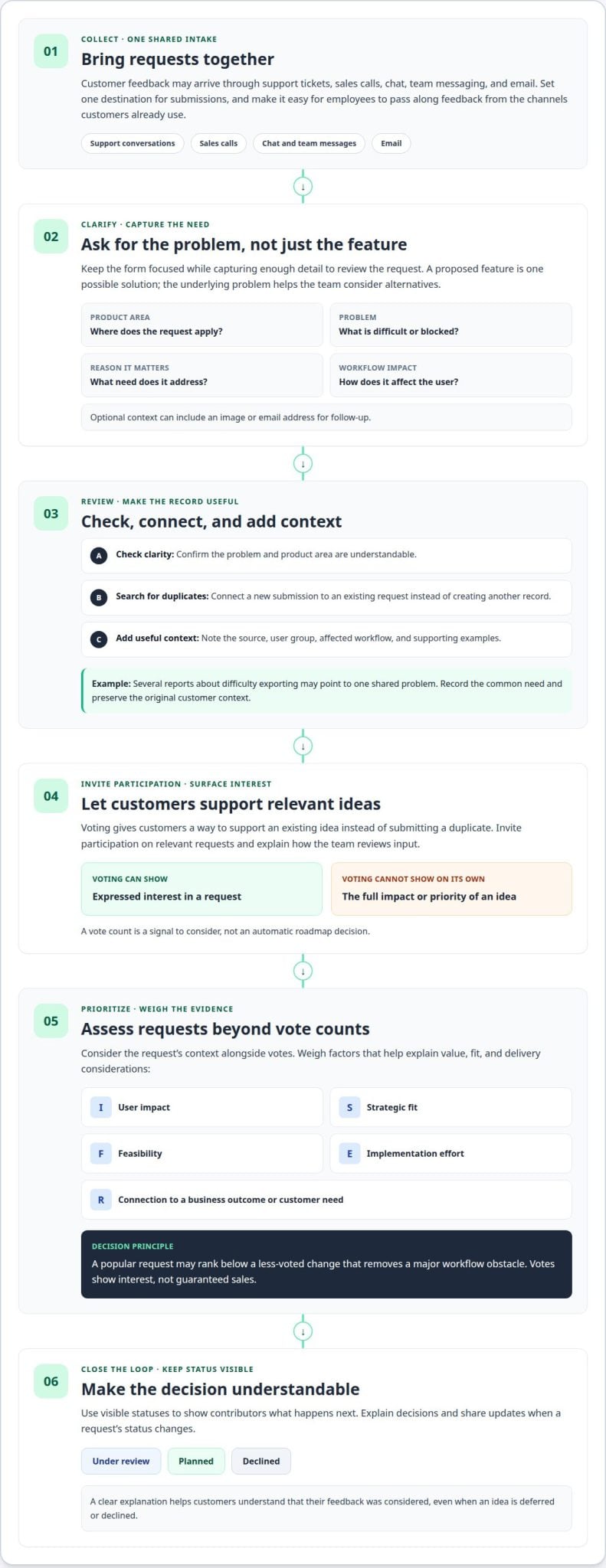
Small businesses can start with a clear submission form, searchable requests, simple status labels, and a reliable way to export data. To prioritize, weigh votes alongside user impact, strategic fit, effort, and feasibility. A popular request may rank below a less-voted change that removes a major workflow obstacle.

Assess revenue impact by connecting a request to a business outcome, such as supporting a customer segment or preserving an important workflow. Votes show interest, not guaranteed sales. Consider implementation effort and the needs of other users before assigning priority.

In the United States, costs depend on factors such as user access, integrations, reporting, and administration needs. Free plans and trials vary, so compare included capabilities and limits. In a security review, examine permissions, customer-data visibility, integrations, and how sensitive information is handled.

To link requests with product planning, track decisions and status changes in a shared workflow. Teams comparing platforms can use this guide to idea management software to assess their needs. For the next step from evaluation to execution, see this guide to implementing innovative ideas.

Feature request collection and voting

Customer requests arrive through support tickets, sales calls, chat, team messaging, and email. Without a clear intake route, the same idea can sit in several inboxes, separated from useful context. Set one destination for submissions, then make it easy for employees to pass along feedback from the channels customers already use.

For example, a support agent hears several customers describe difficulty exporting reports. Rather than treating each conversation as a separate request, the agent records the shared problem and attaches the original context. A consistent intake process helps enterprise teams spot recurring needs across departments, customer segments, and communication channels.

Keep the submission form focused, while collecting enough detail to make review useful. Ask for the product area, the problem, why it matters, and how it affects the user’s workflow. Let people attach an image when a screen or process is difficult to explain. An email address can support follow-up, while optional fields reduce friction for simple submissions.

After collecting requests, organize them so reviewers can understand and act on them:

  • Review the incoming idea: Confirm the problem and product area are clear.
  • Search for duplicates: Connect a new submission to an existing request instead of creating another record.
  • Add useful context: Note the source, user group, workflow affected, and supporting examples.
  • Set a visible status: Tell contributors whether the request is under review, planned, or declined.

This process turns scattered feedback into a searchable record and helps teams distinguish a proposed feature from the underlying need. A request for a dashboard filter, for example, may point to a broader difficulty finding records quickly. That distinction lets product teams evaluate different solutions without losing the customer’s original perspective.

Voting provides a participation signal: customers can support an existing idea instead of submitting a duplicate. But votes represent expressed interest, not a complete measure of impact. Review the request’s context alongside votes, then share updates when its status changes. A brief explanation of what happens next keeps contributors involved and makes the feedback loop visible.

To strengthen participation, tell customers where to submit ideas, invite them to vote on relevant requests, and explain how the team reviews input. Keep the prompt specific: “What task is difficult, and what would make it easier?” is more useful than asking for a feature wish list. Teams refining their wider idea intake can explore idea crowdsourcing methods and consider how a guided platform walkthrough could support their collection process.

Declining feature requests without disappointing customers

Declining a request is part of prioritization, not a judgment of the customer’s needs. Explain the decision clearly, for example, by citing limited capacity, weak strategic fit, or another solution that already addresses the problem. If a requested export duplicates an existing report, point customers to that workflow and record what remains difficult.

Capture the original context before making a decision. A customer conversation may reveal a need that a short request misses: an account manager might learn that teams manually combine reports before sharing them. Record the workflow, impact, and customer segment alongside the proposed feature. This preserves useful feedback even if the requested solution is not selected.

Use categories to distinguish themes such as usability, integrations, reporting, and new functionality. A dashboard filtered by category, status, and customer segment helps reviewers compare similar requests without treating every submission as unique. Define each category briefly so support, sales, and product teams classify requests consistently.

Custom statuses make decisions visible across teams. A practical workflow might include “Under review,” “Planned,” “In progress,” “Declined,” and “Revisit later.” Moderators should merge duplicates, remove spam, and redirect submissions that expose sensitive details. Keep a record of merged requests so contributors’ original context is not lost.

Match customer notifications to the status change. When declining an idea, acknowledge the problem, explain the reason, and describe any next step. For example: “We understand that reconciling these records takes extra work. We’re not planning a separate export because the current report supports this workflow. We’ll revisit the underlying issue as reporting priorities change.” Avoid promising a delivery date unless the roadmap includes one.

Apply a repeatable review sequence to help teams make consistent decisions:

  • Confirm the need: Summarize the customer’s problem in plain language.
  • Check the evidence: Review conversation notes, affected workflows, and related requests.
  • Choose a status: Prioritize, defer, decline, or merge the request.
  • Explain the outcome: Send a specific update and document the rationale.

Review declined and deferred requests during roadmap planning. If several customers describe the same obstacle, reassess the problem even if the original feature proposal remains unsuitable. A team might decline a custom dashboard while investigating whether clearer filters address the broader need. This keeps options open without implying that every request will be built.

When practical, close the loop in the same channel where the conversation began. If a sales call surfaced the idea, give the account team a concise status and response to share. Consistent updates help employees explain decisions accurately and prevent conflicting messages across customer interactions.
Feature Request Software: How to Collect and Prioritize Customer Ideas

Public idea boards and feature voting

A public idea board lets customers submit suggestions, find related requests, and discuss needs in one visible space. This visibility can help product teams identify shared problems and show customers how ideas move through review. A board works best when each entry clearly describes a need and comments add context rather than becoming disconnected conversations.

Public access suits requests that can be discussed openly, such as an improved search filter or a new reporting option. It also lets users vote on existing ideas instead of creating duplicates. Before opening a board, define moderation rules, remove personal or confidential information, and explain what voting means. A vote signals interest, not a promise to build.

Some requests need a private route. Enterprise customers may share account details, internal workflows, or sensitive business context that should not appear publicly. A private board can restrict visibility to selected groups, while product teams review those requests alongside broader feedback. Separate access rules protect context without losing sight of needs that may affect other users too.

Proxy voting can capture feedback from customers who raise ideas during calls or support conversations but do not use the board themselves. An employee can submit the request on their behalf, label it as a proxy, and record its source. Keep proxy votes distinct from direct votes. This makes demand easier to interpret and prevents teams from overstating community participation.

Use a board structure that supports both discovery and review:

  • Choose visibility: Publish general ideas, and route account-specific details to private discussions.
  • Group related requests: Use categories such as reporting, integrations, and usability.
  • Set discussion norms: Ask participants to explain the problem and avoid sharing confidential details.
  • Show request status: Mark ideas as under review, planned, in progress, or declined.

Boards should make participation useful, not merely visible. A customer who finds an existing request can vote and explain their use case. A moderator can merge overlapping entries while preserving why each person supported the idea. This gives reviewers more evidence than a vote count alone and helps product teams distinguish a common need from popular wording.

Choose board access based on the audience and sensitivity of the feedback. A public board supports broad discussion and transparent updates; a private board supports focused review with selected customers or internal teams. A hybrid approach can work well: publish a clear, general problem, then move confidential details into a restricted conversation. Teams comparing board structures can review idea board software approaches as part of their product strategy.

Before launch, test the board with a sample request from each intended audience. Confirm that people can submit, find, discuss, and vote on ideas, and that moderators can update statuses. Then explain how the team uses votes, comments, and customer context in roadmap decisions. Clear expectations make the board a practical input channel, not a public promise of delivery.

Feature request voting and maximizing participation

Voting works best when customers understand how their votes are used. Explain whether votes help teams assess demand, shape research, or inform roadmap discussions. For example, a note beside the voting control can clarify that the product team considers votes alongside customer context, strategic fit, and implementation effort. Clear expectations invite participation without turning popularity into an automatic delivery promise.

Make participation easy to find and complete. After a customer submits an idea, invite them to support related requests. In a customer community, highlight open ideas in relevant discussions rather than sending broad, untargeted reminders. Dedicated platforms like Nomadipity.com, which connects frequent flyers and travel enthusiasts, illustrate how shared interests naturally drive member conversations and organic insights. A focused invitation tied to a workflow gives people a reason to contribute and keeps feedback connected to actual needs.

Use segments to interpret votes. Support from users in one role or customer group may reveal a specific need, while broader support may point to a common friction point. Compare voter segments with the request’s context, including the task affected and the workaround people use. This turns a vote total into evidence product teams can assess.

Set participation rules before opening voting. Decide whether users can support multiple ideas, change their votes, or comment without voting. Then apply the same rules across the board. Moderators can review unusual activity and distinguish direct customer input from ideas submitted by employees on customers’ behalf.

A practical review can combine participation signals with product judgment:

  • Demand: Review votes and comments, then identify which audience contributed.
  • Impact: Assess the problem’s effect on customer workflows or product use.
  • Fit: Compare the request with product strategy and current priorities.
  • Feasibility: Consider available resources and a realistic delivery timeframe.

Use the evidence to inform decisions, not to let a leaderboard dictate them. A highly voted request may serve a narrow use case or require substantial work. A less visible request may address a serious obstacle for an important customer segment. Product teams should document why they prioritize, defer, or decline each idea.

Close the loop with visible updates. If a request moves into review, explain what the team is assessing. If priorities change, update its status and give contributors a concise reason. Do not equate a vote threshold with implementation. A consistent idea evaluation process helps teams weigh participation alongside impact and feasibility.

Ideawake: Innovation Management Platform

Ideawake’s Innovation Management Platform helps organizations capture, evaluate, and implement ideas from customers, employees, and partners. When feedback comes from multiple groups and requires a consistent review process, its Idea Management Platform provides a central place to organize submissions and assess their potential.

Voting and gamification features, including leaderboards and prizes, can encourage participation. Ideawake AI provides AI-assisted evaluation, semantic duplicate detection, and configurable AI agents. Together, these capabilities help teams move from collecting input to evaluating ideas and deciding what to advance, while keeping customer suggestions part of a broader innovation process.

If your team is ready to bring idea collection and evaluation into a shared process, contact Ideawake to discuss your needs.

Turn customer input into a stronger product direction

Make request review a dependable part of product planning. Assign an owner to incoming ideas, agree on how the team weighs evidence, and revisit decisions when customer needs or business priorities shift. Feature request software can support the process, but its value depends on clear criteria and consistent follow-through.

For organizations connecting product feedback with wider innovation work, Ideawake offers an Innovation Management Platform, an Idea Management Platform, and Continuous Improvement. These offerings help teams manage ideas in a shared process and connect evaluation with action.

Start with the workflow your team needs to improve, then build a process that makes customer input easier to assess and act on. Thoughtful decisions help shape a more responsive product direction.

Your next useful product idea may already be in a customer conversation. Give it a clear path forward.

Frequently Asked Questions

How do feedback, the roadmap, and the changelog fit together?

Feedback records user evidence, the roadmap communicates intended direction, and the changelog documents released changes. Keep these connected without treating them as interchangeable. A release note, for example, can reference the request theme it addresses, while the roadmap item describes the planned outcome. This helps customer-facing teams explain what changed and product leaders trace shipped work back to user needs.

How does feature voting work?

Feature voting can follow different rules, so define them before inviting participation. Decide whether people may change a vote, support multiple ideas, or vote only within a particular customer group. If users can revise their choices, use the latest vote for prioritization and preserve the history for analysis. Clear rules make results easier to interpret and reduce confusion when participants compare their input.

What happens to duplicate requests?

Before combining similar submissions, check whether they describe the same underlying need or simply use similar words. A request for faster reporting and one for scheduled reports may sound related but represent different workflows. Keep links to the original submissions and note why they were grouped. This preserves each contributor’s context and helps reviewers distinguish a shared problem from distinct requirements.

What is feature request software and how does it work?

Feature request software manages product suggestions from initial review through a recorded decision. Teams can assign ownership, document evaluation criteria, and maintain a decision history. For example, a reviewer can record why a request was deferred, what evidence might change the decision, and which team owns the next review. These records support consistent decisions when staff or priorities change.

How do you collect and organize customer feature requests?

Choose a small, shared set of categories and define them in plain language for every intake team. A “reporting” category might cover access to, presentation of, or export from reports, with a secondary tag identifying the affected workflow. Preserve the original channel and customer segment as separate fields. Review category use regularly so teams do not label the same request inconsistently.

How do you connect feature request software to product roadmaps and issue trackers?

Start by agreeing on the handoff: which team advances an approved request, what information travels with it, and who keeps its status accurate. Map shared fields such as request identifier, owner, priority, and delivery status. If an integration or API connects systems, define which system is authoritative for each field. This prevents conflicting edits and helps customer-facing teams share accurate progress.

What are the best feature request management tools in 2026?

There is no universal best tool. Compare submission methods, voting, status updates, reporting, and connections to existing systems, then choose a consistent process that fits your needs.

How do popular feature request platforms compare on integrations and features?

Compare tools by submission sources, voting and visibility, status updates, reporting, and connections to existing systems. A support-ticket queue organizes individual cases, a public idea board displays ideas and votes, and a central request system can combine feedback sources and support prioritization.
Article by

Coby Skonord

Coby Skonord is the co-founder and CEO of Ideawake. Since 2013 he has worked with enterprise innovation, continuous improvement, and HR leaders to turn employee ideas into measurable business impact.

Customer Idea Management Platform: The 2026 Guide to Customer-Led Innovation

Customer Idea Management Platform: The 2026 Guide to Customer-Led Innovation
Coby Skonord|
September 6, 2026

By 2026, organizations that prioritize customer-led innovation are projected to see a 25% increase in customer satisfaction. You’ve likely felt the weight of unorganized feature requests and the lack of visibility into which ideas actually move the needle without a dedicated customer idea management platform. It’s a common struggle where the most valuable insights are often buried under a mounting administrative burden. You aren’t alone in feeling that your current feedback process is a cost center rather than a growth engine.

This guide provides the blueprint to transform that raw feedback into a high-ROI innovation pipeline. We’re moving beyond the suggestion box mentality to create a centralized vault for customer intelligence that drives measurable results. You’ll discover how to implement automated workflows that reduce admin time and leverage clear data to connect customer ideas to revenue growth. We are moving past mediocre, manual methods to build a high-performance innovation engine that scales with your ambition. No more guesswork. Just results.

Key Takeaways

  • Understand how a centralized system for capturing insights outperforms manual feedback logs and legacy innovation software by creating a single source of truth.
  • Discover the five core pillars required to transform raw customer requests into prioritized, actionable intelligence for your product roadmap.
  • Evaluate the total cost of ownership and operational advantages of a dedicated customer idea management platform compared to building custom internal tools.
  • Follow a tactical four-step blueprint to successfully launch your innovation portal and establish transparent, high-engagement feedback loops with your community.
  • Learn how to close the innovation loop by connecting specific customer submissions directly to measurable ROI and long-term revenue growth.

Beyond the Suggestion Box: Defining the Modern Customer Idea Management Platform

A customer idea management platform is a centralized system designed to capture, evaluate, and implement external insights with precision. Unlike legacy innovation software that often acted as a graveyard for unvetted suggestions, modern cloud-based platforms serve as active command centers. They replace fragmented manual systems with structured workflows that prioritize high-impact opportunities. In the competitive landscape of 2026, maintaining an edge requires more than just listening. It requires a systematic approach to customer involvement management that bridges the gap between raw feedback and executive decision-making.

A modern customer idea management platform is not a repository for requests; it’s a strategic ROI engine that converts external intelligence into market-dominating product cycles.

The Evolution of Feedback: From Passive to Proactive

Why Generalist Tools Fall Short at Scale

The 5 Pillars of a High-Performance Customer Ideation Strategy

A high-performance strategy requires more than a digital suggestion box. It demands a framework that moves beyond collection into execution. According to innovation management principles, the value lies in the filtration and evaluation process. A modern customer idea management platform must provide end-to-end lifecycle support, ensuring every submission is either validated or archived with transparent feedback. This transition from raw data to actionable intelligence is what separates market leaders from organizations simply “collecting feedback.”

AI-Driven Signal Detection and Deduplication

Administrative overhead is the silent killer of innovation programs. When hundreds of customers submit similar requests, manual sorting becomes impossible. Modern platforms use AI to cluster these submissions, identifying “megatrends” that signal market demand. By implementing Ideawake AI, managers can automate deduplication. This specific capability often reduces administrative hours by up to 80%. It allows teams to focus on evaluating the merit of an idea rather than managing the logistics of an inbox. Signal detection ensures that the loudest voices don’t drown out the most profitable opportunities.

Gamification: Incentivizing the Right Behaviors

Engagement isn’t a one-time event; it’s a habit. High participation rates depend on gamification elements like voting, leaderboards, and status-based prizes. These features tap into the psychology of social proof and organizational status, encouraging customers to submit higher-quality insights. When users see their peers engaging, they’re more likely to contribute meaningful feedback. To ensure this participation yields results, it’s vital to educate your community on what makes an idea great from a business perspective. Quality beats quantity every time.

The synergy between AI and gamification creates a self-sustaining ecosystem. You don’t just want more ideas. You want better ideas that are easier to manage and track toward a final ROI. If your current process feels like a manual struggle, it’s time to see how a structured approach can change your outcomes. You can explore these features in action to see how they fit your specific innovation goals. This modern architecture ensures that your innovation pipeline remains full, focused, and financially viable.

Build vs. Buy: Why Modern Architecture Trumps Custom Solutions

The Financial Reality of Innovation Software TCO

Security and Scalability in the Enterprise

Enterprise deployments demand rigorous data governance, robust access controls, and infrastructure resilience to protect proprietary concepts and customer intelligence from unauthorized exposure. As organizations expand their cloud-based application ecosystem, collaborating with an experienced IT solutions partner like ITS Canada Inc helps maintain comprehensive network protection and enterprise security standards.

Implementation Blueprint: Launching Your Customer Innovation Portal

Transitioning from a software purchase to a high-performance ecosystem requires a disciplined implementation blueprint. A customer idea management platform is only as effective as the strategy driving it. To move from a quiet portal to an active community, you must follow a tactical four-step process: define your success metrics, recruit internal champions, launch targeted challenges, and close the feedback loop with transparent communication. This structured approach prevents the “black hole” effect where customers feel their contributions are ignored. Executive sponsorship isn’t just a support function; it’s the cultural fuel that prevents innovation from becoming a side project.

Phase 1: Defining Success Metrics and Evaluation Criteria

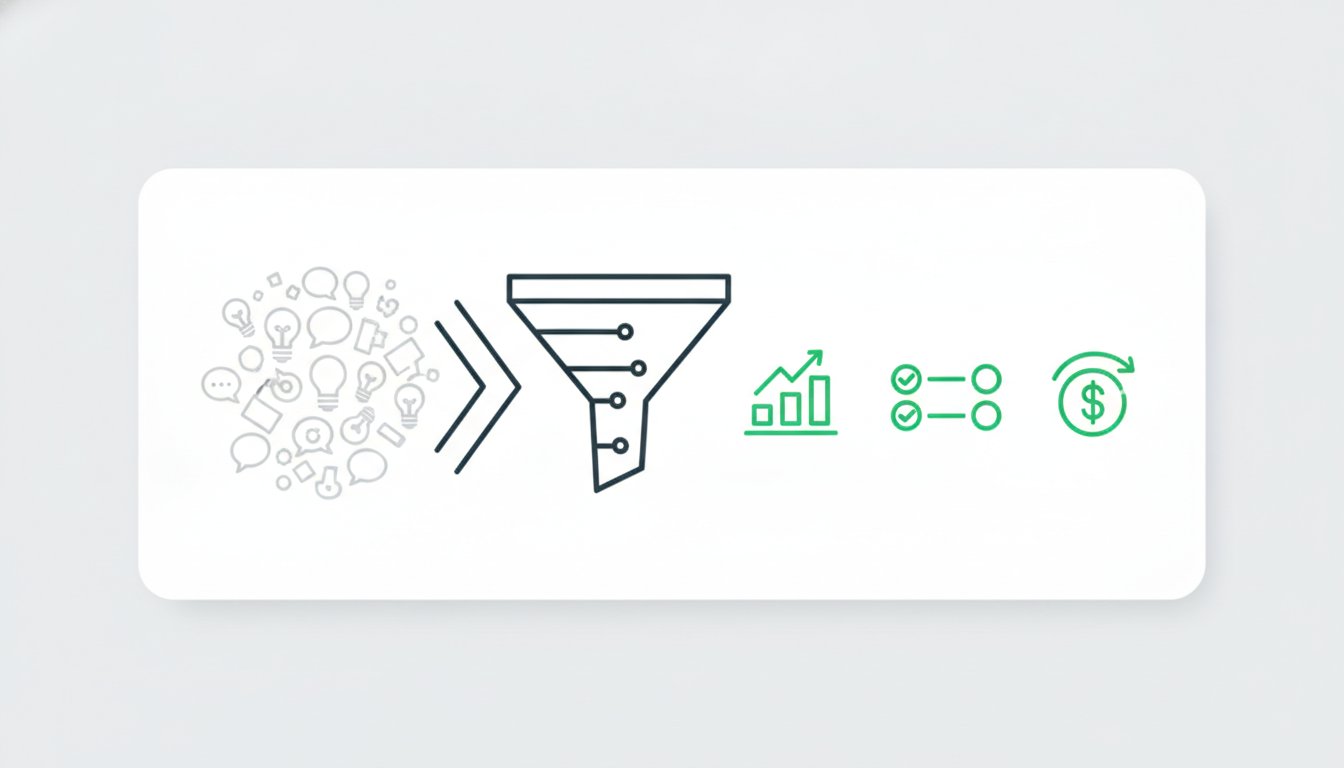
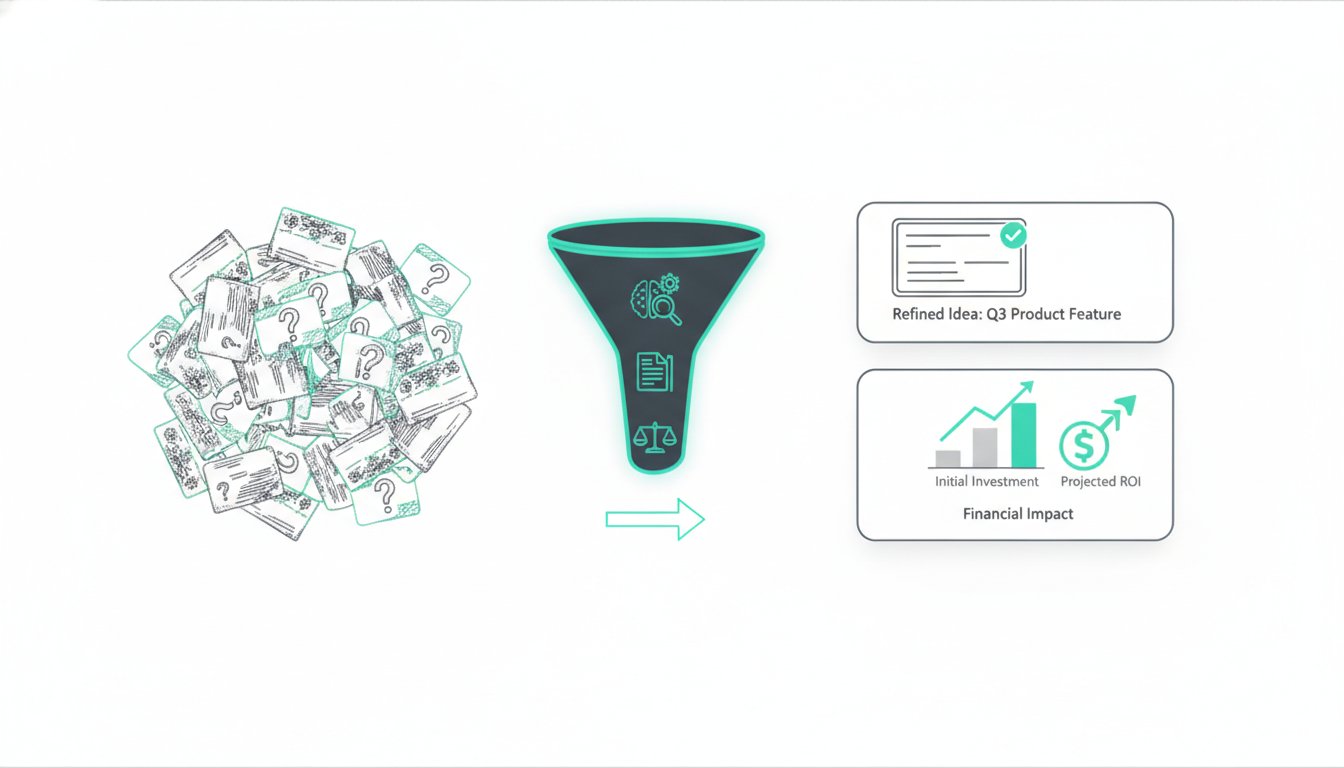
Before inviting a single customer to your portal, you must establish how you will score their contributions. Effective evaluation relies on a three-pronged framework: desirability (do customers actually want this?), feasibility (can we build it?), and viability (does it align with our business goals?). Implementing a standardized idea evaluation process and criteria ensures that your team remains objective and data-driven. This funnel approach allows you to filter thousands of raw data points down to the top 1% of high-impact opportunities without succumbing to internal bias or “loudest voice” syndrome. Quantitative scoring provides the evidence needed to justify R&D investment to stakeholders.

Phase 2: Driving Adoption Through Targeted Challenges

While an “always-on” suggestion box has its place, the most successful programs utilize time-bound innovation challenges. These challenges focus customer energy on specific problem statements, such as “How might we reduce onboarding time by 20%?” rather than vague requests for feedback. This method mirrors the benefits of employee ideation programs, where constraints actually drive higher-quality solutions. By setting realistic expectations and providing clear deadlines, you create a sense of urgency and purpose. Customers are more likely to participate when they understand the specific problem you are trying to solve and how their input will be used.

Success in customer-led innovation depends on closing the loop. Every participant should receive an automated update when their idea moves to a new stage of evaluation. This transparency builds trust and encourages long-term engagement. When customers see that their insights lead to tangible product changes, they transition from passive users to active co-creators. This shift is the ultimate goal of a modern innovation strategy.

Ideawake: The Customer Idea Management Platform for Results-Driven Teams

Ideawake represents the logical evolution for organizations that have moved past the “suggestion box” era and demand measurable outcomes. While legacy systems often struggle with administrative bloat, this customer idea management platform is engineered to reduce complexity while maximizing output. It provides a modern architecture that bridges the gap between raw customer insights and the final delivery of high-value features. By focusing on the full lifecycle of an idea, from initial submission to final ROI measurement, Ideawake ensures that innovation is treated as a core business function rather than a secondary activity.

Turning Raw Ideas Into Pure ROI

The true test of any innovation program is its ability to deliver financial impact. Ideawake provides the “Modern Enterprise Edge” by combining AI-driven deduplication with a robust gamification suite to keep engagement levels high without increasing the workload for managers. Unlike tools that stop at the collection phase, Ideawake tracks the progress of ideas through the implementation phase to ensure nothing falls through the cracks. To see how these efficiencies translate into your specific context, you can use the Idea Management ROI Calculator to quantify potential gains. This data-driven approach removes the guesswork from product roadmapping and allows for more confident resource allocation.

Seamless Integration and Rapid Adoption

A high-performance platform is only valuable if it integrates into the way your team already works. Ideawake offers a variety of integrations that allow it to fit seamlessly into your existing tech stack, whether you rely on project management tools or enterprise communication suites. Our “no-nonsense” approach to user adoption means your community can start contributing within minutes, not weeks. This speed to value is critical for maintaining momentum during innovation challenges. We prioritize a clean, intuitive interface that encourages participation from both technical and non-technical users, ensuring you capture the widest possible range of customer intelligence.

The transformative potential of a dedicated customer idea management platform lies in its ability to turn every customer into a co-creator. By centralizing feedback and automating the evaluation process, you empower your organization to lead the market rather than react to it. Ideawake provides the structure, security, and scalability required for the enterprise of 2026. No more guesswork; just a clear path to customer-led growth.

Accelerating Innovation ROI Through Customer Intelligence

The transition toward customer-led innovation is no longer optional for organizations that intend to lead their markets. You’ve seen how a dedicated customer idea management platform eliminates the noise of unorganized requests and replaces it with a structured, high-performance pipeline. By leveraging modern architecture and AI-driven deduplication, your team can save up to 80% of administrative time while ensuring the most viable ideas reach implementation. This efficiency allows innovation managers to focus on strategic execution rather than manual sorting.

Success requires moving beyond the passive suggestion box to a proactive co-creation model that spans the entire lifecycle of an idea. Trusted by global enterprises, this approach connects every customer insight directly to measurable financial outcomes and long-term revenue growth. It’s time to stop drowning in unorganized feature requests and start driving transformative results. You have the blueprint for a modern innovation engine; now it’s time to execute and secure your competitive edge.

Frequently Asked Questions

What is the difference between a customer idea management platform and a CRM?

While a CRM focuses on managing customer relationships, sales pipelines, and business automation—areas where platforms like Optimo Software Co. specialize—a customer idea management platform is engineered specifically to collect, evaluate, and prioritize product feedback and user innovation.

How do you prevent a customer idea portal from becoming a list of complaints?

Can we integrate a customer idea management platform with our existing project management tools?

Yes, modern platforms are designed to fit seamlessly into your existing tech stack. You can integrate your customer idea management platform with tools like Jira, Trello, or Microsoft Teams to ensure a smooth transition from idea approval to project execution. These integrations eliminate data silos and reduce manual entry. This connectivity allows your product team to manage the development process without leaving their preferred environment.

How much time does it typically take to implement an enterprise-grade idea platform?

Implementation for a modern cloud-based platform typically takes a few weeks, which is significantly faster than the months required for legacy innovation software. Because these systems use a modern architecture, you don’t need extensive custom coding or hardware integration. Most of the time is spent on configuring your innovation challenges and setting up evaluation criteria. This rapid deployment ensures you start seeing a return on your investment quickly.

What are the most important evaluation criteria for customer-led ideas?

The most effective evaluation criteria focus on three core metrics: desirability, feasibility, and viability. You must determine if the customer actually wants the feature, if your engineering team can realistically build it, and if it aligns with your broader business goals. Using a standardized scoring system helps your team remain objective. This data-driven approach ensures that your R&D budget is allocated to the top 1% of high-impact opportunities.

Is AI really necessary for managing customer ideas, or is it just a buzzword?

AI is a critical requirement for managing innovation at scale, especially for deduplication and clustering. Manual sorting of thousands of requests is inefficient and prone to error. AI-driven features can reduce administrative hours by up to 80% by automatically identifying similar ideas and megatrends. Approximately 55% of idea management platforms now incorporate machine learning. It’s a fundamental tool for transforming raw data into actionable intelligence without increasing overhead.

How do you measure the ROI of a customer ideation program?

You measure ROI by tracking an idea from the initial submission through to its final implementation and subsequent impact on revenue or cost savings. Modern platforms provide end-to-end tracking to help you quantify these gains. You can compare the cost of development against the projected customer satisfaction increase or market share growth. Using an ROI calculator helps you provide concrete evidence to stakeholders that customer-led innovation is a profit center.

What is the best way to incentivize customers to share high-quality ideas?

The best way to drive high-quality contributions is through a combination of gamification and radical transparency. Features like voting, leaderboards, and prizes encourage healthy competition and sustain long-term engagement. However, the most powerful incentive is seeing an idea actually get implemented. When you close the feedback loop and show customers that their insights lead to tangible changes, you build a loyal community of active co-creators.

Article by

Coby Skonord

Coby Skonord is the co-founder and CEO of Ideawake. Since 2013 he has worked with enterprise innovation, continuous improvement, and HR leaders to turn employee ideas into measurable business impact.

The Myth of the Passive Feedback Loop: Choosing a Customer Idea Management Platform in 2026

The Myth of the Passive Feedback Loop: Choosing a Customer Idea Management Platform in 2026
Coby Skonord|
June 18, 2026

Collecting feedback is easy, but converting it into enterprise value is where most organizations fail. In 2026, the industry has moved beyond simple voting toward sophisticated systems that integrate directly with financial data from sources like Stripe. If you’re still relying on a passive suggestion box, you’re likely losing ground to competitors who treat feedback as a strategic asset. Selecting the right customer idea management platform is no longer about just listening. It’s about data-driven prioritization and measurable financial outcomes.

You likely recognize the administrative nightmare of manual evaluation and the struggle to link user requests to actual growth. It’s a common burden that leads to organizational stagnation. This article debunks the myth of the passive feedback loop and provides a framework for selecting a platform that converts raw suggestions into tangible ROI. We’ll examine the rise of AI-powered duplicate detection and the critical importance of pricing transparency in a market where seven out of twelve major vendors still hide their costs behind a sales wall. It’s time to stop guessing and start executing with precision.

Key Takeaways

  • Differentiate between simple feedback collection and a comprehensive innovation lifecycle to ensure customer insights lead to actual product development.
  • Utilize AI-driven signal detection to navigate high-volume feedback and eliminate the “noise” that typically causes administrative bottlenecks.
  • Establish a clear ROI blueprint by connecting raw customer suggestions to financial performance metrics and strategic growth goals.
  • Evaluate how a modern customer idea management platform uses automated workflows and gamification to increase participation while reducing manual oversight.
  • Streamline the evaluation process with AI-assisted scoring models that cut administrative burden by as much as 90% compared to legacy tools.

What is a Customer Idea Management Platform (And What It Isn’t)?

A customer idea management platform is far more than a digital suggestion box. It’s a high-performance infrastructure designed to centralize the capture, evaluation, and implementation of external insights. While many organizations mistake a simple survey or a feedback form for an innovation strategy, a true platform acts as a bridge between a raw suggestion and measurable enterprise ROI. It manages the entire innovation lifecycle. This means it doesn’t just store data; it moves it through a structured workflow where ideas are refined, scored, and eventually turned into market-ready solutions.

Without this structured approach, organizations often fall into the trap of “passive listening.” They collect data but lack the mechanism to act on it. A dedicated platform provides the necessary framework to ensure that the most valuable ideas don’t just sit in a database. Instead, they’re routed to the right stakeholders for rapid validation and execution.

The Black Hole Myth: Why Listening Isn’t Enough

CRM vs. Idea Management: The Critical Difference

It’s easy to confuse a Customer Relationship Management (CRM) system with an innovation tool. CRMs excel at tracking interactions and managing the sales funnel. However, they’re fundamentally unequipped to track the evolution of value. Spreadsheets and CRMs inevitably fail to scale for collaborative business innovation because they lack the specialized features required for high-level ideation. While a CRM tells you who your customers are, an idea platform tells you what your company should become next.

A dedicated customer idea management platform provides specific tools that general software lacks:

  • Collaborative Voting: Peer-driven prioritization that highlights the most impactful solutions.
  • Gamification: Incentives that drive sustained engagement rather than a one-time burst of activity.
  • Automated Workflows: Logic-based triggers that move ideas through evaluation stages without manual intervention.

By using a system built for the innovation lifecycle, you eliminate the administrative friction that kills great ideas before they can reach the market.

Debunking the “More is Better” Fallacy in Customer Ideation

Organizations often mistake a high volume of feedback for a successful innovation strategy. It’s a dangerous fallacy. While capturing hundreds of suggestions might look good on a quarterly report, unmanaged volume quickly creates “noise” that paralyzes decision-making. When your team is drowning in unorganized data, the “Cost of Noise” becomes a significant drain on your R&D budget. Every hour an engineer or product manager spends manually reviewing low-quality or duplicate ideas is an hour stolen from high-impact development. A high-performance customer idea management platform doesn’t just collect more data; it acts as a sophisticated filter that finds the needle in the haystack.

To move beyond this paralysis, enterprise leaders must shift their focus from raw quantity to actionable signal. Research in the innovation space shows that without automated filtering, the administrative burden of managing large-scale feedback loops can lead to a 50% drop in implementation rates. By implementing a structured evaluation process, you stop treating every suggestion as equal and start focusing on the insights that drive measurable financial outcomes.

AI-Powered Signal Detection: Filtering for Impact

Modern innovation leaders are turning to ai driven innovation software to solve the volume fatigue problem. These systems automate the deduplication of customer requests by identifying similar concepts even when the phrasing differs. Sentiment analysis and theme clustering allow teams to identify high-demand features and underlying pain points across thousands of submissions instantly. AI-driven idea clustering serves as a primary method for reducing administrative overhead by up to 80%. This automation ensures that your team only reviews the most relevant, unique insights, allowing you to see how automated filtering can reclaim your team's time.

The Quality Filter: Evaluation and Scoring Frameworks

The shift from “gut feeling” to data-driven decision-making requires standardized idea evaluation criteria. Relying on the loudest voice in the room or the most recent request leads to reactive product roadmaps. Instead, sophisticated platforms use multi-weighted scoring to balance three critical pillars:

  • Feasibility: Can we actually build this with our current resources?
  • Desirability: Do our customers actually want this, and how many?
  • Viability: Does this align with our long-term business goals and revenue targets?

By integrating gamification elements like peer voting and leaderboards, you leverage the “wisdom of the crowd” to pre-filter ideas before they ever reach a manager’s desk. This collaborative approach ensures that only the most promising concepts move into the high-stakes stages of the innovation lifecycle.

Legacy Suggestion Boxes vs. Modern Customer Idea Platforms

Legacy suggestion boxes were built on a “set it and forget it” mentality. In contrast, a modern customer idea management platform operates as a dynamic execution engine. The primary difference lies in how data moves through the organization. In legacy systems, tracking is manual and disconnected. This creates silos where valuable insights are lost. Modern platforms centralize this data into idea management databases that provide real-time visibility to all stakeholders. Instead of hunting through email chains or disconnected files, leaders can see the entire innovation pipeline at a glance.

User adoption is another critical differentiator. Legacy interfaces are often clunky and uninspiring, serving as a barrier to participation. They feel like extra work. Modern platforms leverage gamified experiences and intuitive design to drive high engagement rates. They turn the act of submission and voting into a rewarding experience. Implementation has also shifted. While legacy on-premise solutions could take months to deploy and require heavy IT involvement, modern cloud-based architectures allow for rapid setup. Most organizations can move from procurement to launch in just a few weeks.

The “Build vs. Buy” Trap for Enterprises

Many enterprises fall into the trap of thinking an internal portal is the most cost-effective route. This is rarely the case. When you choose to build, you aren’t just paying for the initial development. You’re committing to ongoing security updates, feature requests, and the mounting weight of technical debt. Our build vs buy idea management software guide breaks down these hidden costs in detail. Choosing a specialized customer idea management platform ensures you have access to a dedicated roadmap of features without the internal resource drain. It allows your developers to focus on your core product rather than maintaining a custom feedback tool.

Administrative Complexity: The Hidden Innovation Killer

Administrative friction is the silent killer of corporate innovation. Legacy systems often require full-time staff just to manage basic workflows and manual status updates. This is a waste of human capital. Modern platforms use AI to automate innovation workflows, handling everything from idea routing to progress notifications. This “Modern Enterprise Edge” allows for low-touch management while delivering high-impact results. By automating the mundane tasks, your innovation managers can spend their time on high-value strategy and implementation rather than data entry. It’s the difference between managing a process and driving a result. According to the AI Driven Innovation Software: The 2026 Enterprise Trend Report, 67% of organizations are already increasing their investments in generative AI to eliminate exactly this kind of administrative overhead.

The ROI Blueprint: From Raw Customer Suggestion to Market Value

To move beyond the “listening” phase, organizations must integrate feedback directly into their innovation pipeline. A high-performance customer idea management platform serves as the engine that converts these external insights into measurable financial outcomes. This transition requires a disciplined, four-step blueprint that ensures no valuable suggestion is lost to administrative inertia.

  • Step 1: Capture and Centralize. Every insight must enter a structured idea submission process. This eliminates the fragmentation of email threads and Slack messages, ensuring data is clean and actionable from the start.
  • Step 2: Rapid Evaluation. Using AI-assisted scoring and peer voting, the platform surface-levels the highest-potential ideas. This objective filtering prevents personal bias from dictating the product roadmap.
  • Step 3: Execution Tracking. Visibility is the antidote to “idea stall.” By tracking implementation milestones, stakeholders ensure that selected ideas actually reach the market rather than dying in a backlog.
  • Step 4: ROI Measurement. The final stage involves linking implemented ideas to financial modeling and performance analytics. This closes the loop, proving the platform’s value to the C-suite.

By following this systematic approach, your organization stops guessing and starts executing with mathematical certainty. You can schedule a demo today to see this blueprint in action.

Measuring the Intangible: Beyond Direct Revenue

While direct revenue is the ultimate goal, a sophisticated customer idea management platform also captures “soft” ROI that is often overlooked. Customer retention and churn reduction are critical indicators of success. When users see their suggestions implemented, their lifetime value increases. Furthermore, balancing incremental vs radical innovation allows a company to protect its current market share while simultaneously exploring new revenue streams. Tracking “time-to-implementation” as a key performance indicator helps identify bottlenecks in your R&D process, allowing you to move faster than the competition.

The ROI Calculator: Hard Data for Stakeholders

Securing executive buy-in requires more than just optimism; it requires hard data. The Idea Management ROI Calculator provides a framework for quantifying the impact of your innovation efforts. One of the most significant cost savers is the ability to avoid “bad” product features. By validating ideas with real customer data before development begins, organizations save millions in wasted engineering hours. Industry research indicates that data-backed innovation processes can reduce the failure rate of new product launches by up to 50%. This level of precision transforms innovation from a risky gamble into a predictable driver of enterprise growth.

Ideawake: The High-Performance Customer Idea Management Solution

Ideawake is the modern architecture choice for organizations that prioritize speed and measurable results. While legacy systems often fail due to administrative friction, our customer idea management platform enables a 90% reduction in overhead compared to traditional methods. We achieve this by replacing manual tracking with AI-driven automation. Our system doesn’t just store feedback; it processes it. By automatically deduplicating submissions and clustering themes, Ideawake turns raw customer noise into a prioritized product roadmap. This end-to-end capability ensures that your organization maintains a clear line of sight from the initial suggestion through to final ROI measurement.

Efficiency is the core of our design. We understand that innovation managers shouldn’t spend their days as data entry clerks. A high-performance customer idea management platform acts as an extension of your team, identifying high-impact opportunities in minutes rather than weeks. This shift allows your brightest minds to focus on strategy and implementation, which are the true drivers of market value. It’s a results-driven approach for companies that refuse to settle for average outcomes.

Seamless Integration and Rapid Implementation

Enterprise tools only work if people actually use them. Ideawake integrates with existing stacks including Slack, Microsoft Teams, and Jira to meet your users exactly where they work. This native connectivity removes the barriers to entry that often kill engagement in specialized portals. Beyond software compatibility, our implementation support ensures a rapid transition. We’ve optimized the onboarding process to reduce go-live time from the industry average of several months to just a few weeks. The platform is built for scale, supporting everything from localized departmental pilots to global enterprise-wide deployments without a drop in performance.

Proven Success: Turning Ideas into Impact

The benefits of employee and customer ideation programs are well-documented, but execution remains the primary hurdle. Ideawake provides the structure needed to clear that hurdle every time. By utilizing innovation challenges like a structured enterprise hackathon, you can direct your crowd’s energy toward solving specific, high-priority customer pain points. This prevents the “suggestion box” stagnation and ensures that every submission is aligned with your current business objectives. It’s a proven method for turning collective intelligence into a sustainable competitive advantage.

Stop letting valuable insights slip through the cracks of unorganized spreadsheets. Sign up for a demo to see how Ideawake transforms your customer feedback loop into a powerful engine for growth and innovation.

Drive Measurable Impact with Data-Driven Innovation

Passive feedback loops are a relic of the past. To lead in 2026, organizations must treat customer suggestions as strategic assets that require structured execution. By moving away from manual suggestion boxes and adopting a sophisticated customer idea management platform, you eliminate the administrative bottlenecks that kill progress. Implementing AI-driven deduplication and clustering allows your team to focus on high-impact initiatives rather than drowning in repetitive data. This transition ensures that every insight is evaluated against financial goals rather than gut feelings.

The shift to modern innovation architecture provides a 90% reduction in administrative overhead while offering end-to-end ROI tracking to satisfy the most rigorous executive requirements. You have the blueprint for converting raw suggestions into market value; now it’s time to execute. Ready to turn customer insights into ROI? Book your Ideawake demo today. Embracing a results-driven approach is the fastest way to transform your customer feedback into a sustainable competitive advantage.

Frequently Asked Questions

How does a customer idea management platform differ from a standard suggestion box?

A customer idea management platform provides a structured, end-to-end lifecycle for feedback, whereas a suggestion box is a passive repository that often leads to data silos. The platform uses automated workflows, transparent status tracking, and collaborative scoring to move an idea from submission to market implementation. It replaces manual sorting with high-performance filters, ensuring that every high-impact suggestion is routed to the correct stakeholder for immediate action.

Can I integrate my existing CRM with an idea management platform?

Yes, modern platforms are designed to integrate with CRMs like Salesforce and HubSpot to enrich feedback with real-world financial data. This connection allows you to weigh ideas based on customer lifetime value or specific contract sizes. By turning qualitative feedback into quantitative business cases, your team can prioritize product features that drive the most revenue and prevent churn among high-value accounts.

What is the typical ROI for a customer-led innovation program?

The ROI for customer-led innovation is measured through increased retention rates, reduced development waste, and accelerated time-to-market. By validating features with actual user data before they enter the R&D pipeline, companies can reduce the failure rate of new product launches by up to 50%. This precision saves millions in engineering hours that would otherwise be spent on features that don’t align with market demand.

How does AI help in managing thousands of customer ideas?

AI manages high-volume feedback by automating deduplication and theme clustering across thousands of disparate submissions. Modern systems use natural language processing to identify similar ideas even when users use different terminology or phrasing. This automation reduces the administrative burden on your team by up to 90%, allowing innovation managers to focus on high-level strategy instead of manual data entry.

Is it better to build our own idea management portal or buy a specialized platform?

Buying a specialized customer idea management platform is almost always more cost-effective than building an internal portal due to the hidden costs of maintenance and technical debt. Building from scratch requires dedicated internal resources for security updates, feature requests, and API integrations. A specialized platform provides a ready-made, high-performance infrastructure that allows your developers to focus on your core product instead of internal tools.

How do we encourage customers to participate in our ideation challenges?

Encouraging participation requires a combination of transparency, gamification, and visible results. Customers participate more frequently when they see a clear status for their ideas and know their input has a real impact on the product roadmap. Using leaderboards, voting mechanisms, and public recognition creates a rewarding experience that drives sustained engagement and turns your user base into a collaborative partner.

How do you measure the success of an idea management initiative?

Success is measured through a mix of participation rates, the conversion rate of ideas to implementation, and tangible financial outcomes. Key performance indicators include “time-to-implementation” and the total revenue or cost savings generated from implemented ideas. Tracking these metrics allows you to demonstrate the clear value of the innovation program to executive stakeholders using hard data rather than anecdotal evidence.

What security standards should an enterprise-grade innovation platform meet?

An enterprise-grade platform must meet rigorous security standards like SOC 2 Type II and GDPR compliance to protect sensitive data. It should offer single sign-on (SSO) integration and role-based access controls to ensure data integrity across the organization. These standards protect both customer insights and internal strategic data from unauthorized access while ensuring your organization meets all global regulatory requirements. Organizations looking to extend these same principles internally should also explore how to stop losing employee ideas by applying structured capture and governance frameworks across their workforce.

Article by

Coby Skonord

Coby Skonord is the co-founder and CEO of Ideawake. Since 2013 he has worked with enterprise innovation, continuous improvement, and HR leaders to turn employee ideas into measurable business impact.